1
OBJECTIVES
• To understand concept of sampling distribution
• To understand concept of sampling error
• To determine the mean and std dev for the
  sampling distribution of a sample mean
• To determine the mean and std dev for sampling
  distribution of a sample proportion
• To calculate the probabilities related to the
  sample mean and the sample proportion


                                               2
Sampling distributions
• Can be defined as the distribution of a sample
  statistic.
• Scientific experiments are used to make
  inferences concerning population parameters from
  sample statistics.
• Need to know what is the relationship between the
  sample statistic and its corresponding population
  parameter.

                                                 3
Sampling error
• Can be defined as the difference between the
  calculated sample statistic and population
  parameter.
• Sampling errors occur because only some of the
  observations from the population are contained in
  the sample.
• Sampling error:
      sample statistic – population parameter

                                                  4
Sampling error
• Size of the sampling error depends on the sample
  selected.
• May be positive or negative.
• Should be kept as small as possible.
• For smaller samples the range of possible
  sampling errors becomes larger.
• For larger samples the range of possible sampling
  errors becomes smaller.
                                                  5
CONCEPT QUESTIONS
• P201 QUESTIONS 1-4


                        6
Sampling distribution of the mean
• Sample mean is often used to estimate the
  population mean.
• Sampling distribution of the mean is the
  distribution of sample means obtained if all
  possible samples of the same size are selected
  form the population.


                                                   7
Sampling distribution of the mean
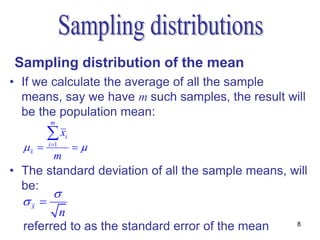
• If we calculate the average of all the sample
  means, say we have m such samples, the result will
  be the population mean:
         m

         x     i
  x    i 1
                    
           m
• The standard deviation of all the sample means, will
  be:
        
  x 
         n
  referred to as the standard error of the mean    8
Central Limit Theorem
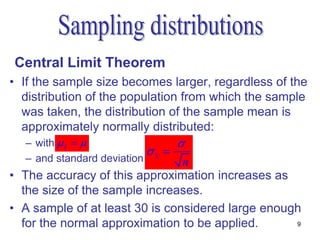
• If the sample size becomes larger, regardless of the
  distribution of the population from which the sample
  was taken, the distribution of the sample mean is
  approximately normally distributed:
  – with  x                    
                           x 
  – and standard deviation      n
• The accuracy of this approximation increases as
  the size of the sample increases.
• A sample of at least 30 is considered large enough
  for the normal approximation to be applied.      9
Properties of the sampling distribution of
the sample mean
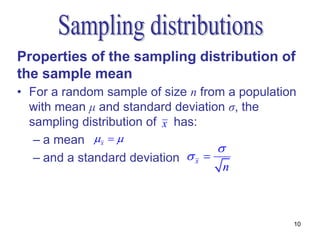
• For a random sample of size n from a population
  with mean μ and standard deviation σ, the
  sampling distribution of x has:
   – a mean  x  
                                    
   – and a standard deviation  x 
                                     n


                                                10
Properties of the sampling distribution of
the sample mean
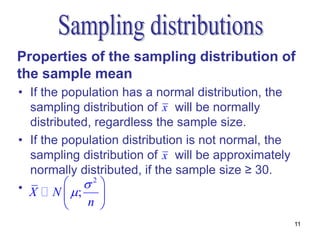
• If the population has a normal distribution, the
  sampling distribution of x will be normally
  distributed, regardless the sample size.
• If the population distribution is not normal, the
  sampling distribution of x will be approximately
  normally distributed, if the sample size ≥ 30.
• X N ;  2 
               
            n 
                                                      11
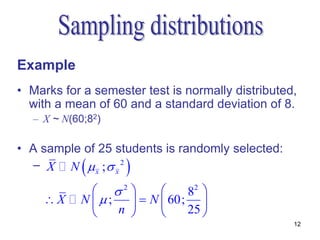
Example
• Marks for a semester test is normally distributed,
  with a mean of 60 and a standard deviation of 8.
  – X ~ N(60;82)

• A sample of 25 students is randomly selected:
            
  – X N  x ; x 2  
              2           82 
    X     N ;     N  60; 
                n          25 
                                                   12
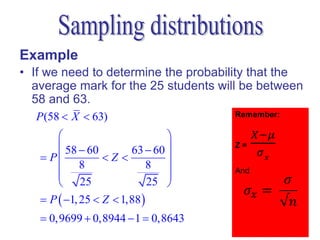
Example
• If we need to determine the probability that the
  average mark for the 25 students will be between
  58 and 63.
  P (58  X  63)
                           
       58  60     63  60 
    P         Z         
       8              8 
                           
       25             25 
    P  1, 25  Z  1,88 
    0,9699  0,8944  1  0,8643
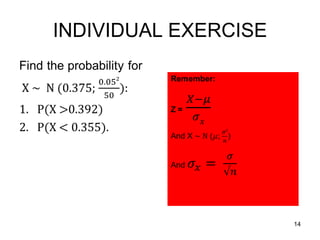
INDIVIDUAL EXERCISE


                      14
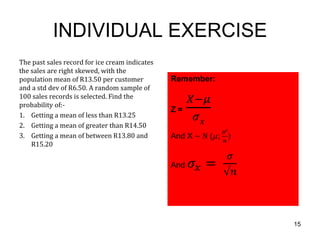
INDIVIDUAL EXERCISE
The past sales record for ice cream indicates
the sales are right skewed, with the
population mean of R13.50 per customer
and a std dev of R6.50. A random sample of
100 sales records is selected. Find the
probability of:-
1. Getting a mean of less than R13.25
2. Getting a mean of greater than R14.50
3. Getting a mean of between R13.80 and
    R15.20


                                                15
Solution
P205 - 207 of textbook


                           16
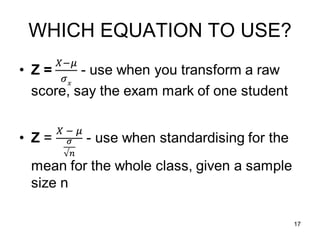
WHICH EQUATION TO USE?


                         17
Sampling distribution of
           proportion
• Categorical values such as number of
  drivers that wear safety belts in Gauteng
  or number of drivers who do not wear
  safety belts


                                              18
Sampling distribution of the proportion
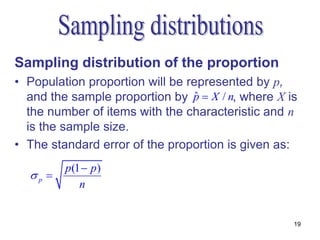
• Population proportion will be represented by p,
  and the sample proportion by p  X / n, where X is
                                  ˆ
  the number of items with the characteristic and n
  is the sample size.
• The standard error of the proportion is given as:
         p(1  p)
  p 
            n


                                                   19
Example
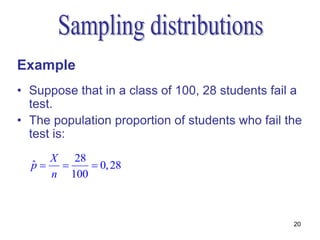
• Suppose that in a class of 100, 28 students fail a
  test.
• The population proportion of students who fail the
  test is:
    X  28
  p 
  ˆ        0, 28
    n 100


                                                  20
Example
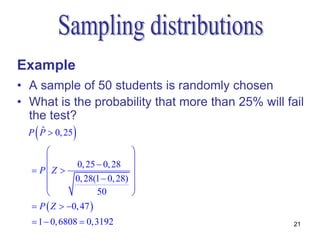
• A sample of 50 students is randomly chosen
• What is the probability that more than 25% will fail
  the test?
   ˆ
  P P  0, 25   
                                
             0, 25  0, 28      
   PZ                         
             0, 28(1  0, 28)   
                                
                    50          
   P  Z  0, 47 
   1  0, 6808  0,3192                            21
Individual exercise/homework
•   Read pages 195 – 211
•   Self review test p 209
•   Supplementary exercises p209
•   Go to www.jillmitchell.net and view the following:-
•   Video on sampling distributions
•   Video on example of sampling distribution
•   Video on central limit theorem
•   Completely re-do the NUBE test using your textbook to
    assist you.


                                                            22

Statistics lecture 7 (ch6)

  • 1.
  • 2.
    OBJECTIVES • To understandconcept of sampling distribution • To understand concept of sampling error • To determine the mean and std dev for the sampling distribution of a sample mean • To determine the mean and std dev for sampling distribution of a sample proportion • To calculate the probabilities related to the sample mean and the sample proportion 2
  • 3.
    Sampling distributions • Canbe defined as the distribution of a sample statistic. • Scientific experiments are used to make inferences concerning population parameters from sample statistics. • Need to know what is the relationship between the sample statistic and its corresponding population parameter. 3
  • 4.
    Sampling error • Canbe defined as the difference between the calculated sample statistic and population parameter. • Sampling errors occur because only some of the observations from the population are contained in the sample. • Sampling error: sample statistic – population parameter 4
  • 5.
    Sampling error • Sizeof the sampling error depends on the sample selected. • May be positive or negative. • Should be kept as small as possible. • For smaller samples the range of possible sampling errors becomes larger. • For larger samples the range of possible sampling errors becomes smaller. 5
  • 6.
  • 7.
    Sampling distribution ofthe mean • Sample mean is often used to estimate the population mean. • Sampling distribution of the mean is the distribution of sample means obtained if all possible samples of the same size are selected form the population. 7
  • 8.
    Sampling distribution ofthe mean • If we calculate the average of all the sample means, say we have m such samples, the result will be the population mean: m x i x  i 1  m • The standard deviation of all the sample means, will be:  x  n referred to as the standard error of the mean 8
  • 9.
    Central Limit Theorem •If the sample size becomes larger, regardless of the distribution of the population from which the sample was taken, the distribution of the sample mean is approximately normally distributed: – with  x    x  – and standard deviation n • The accuracy of this approximation increases as the size of the sample increases. • A sample of at least 30 is considered large enough for the normal approximation to be applied. 9
  • 10.
    Properties of thesampling distribution of the sample mean • For a random sample of size n from a population with mean μ and standard deviation σ, the sampling distribution of x has: – a mean  x    – and a standard deviation  x  n 10
  • 11.
    Properties of thesampling distribution of the sample mean • If the population has a normal distribution, the sampling distribution of x will be normally distributed, regardless the sample size. • If the population distribution is not normal, the sampling distribution of x will be approximately normally distributed, if the sample size ≥ 30. • X N ;  2     n  11
  • 12.
    Example • Marks fora semester test is normally distributed, with a mean of 60 and a standard deviation of 8. – X ~ N(60;82) • A sample of 25 students is randomly selected:  – X N  x ; x 2   2   82  X N ;   N  60;   n   25  12
  • 13.
    Example • If weneed to determine the probability that the average mark for the 25 students will be between 58 and 63. P (58  X  63)    58  60 63  60   P Z   8 8     25 25   P  1, 25  Z  1,88   0,9699  0,8944  1  0,8643
  • 14.
  • 15.
    INDIVIDUAL EXERCISE The pastsales record for ice cream indicates the sales are right skewed, with the population mean of R13.50 per customer and a std dev of R6.50. A random sample of 100 sales records is selected. Find the probability of:- 1. Getting a mean of less than R13.25 2. Getting a mean of greater than R14.50 3. Getting a mean of between R13.80 and R15.20 15
  • 16.
    Solution P205 - 207of textbook 16
  • 17.
  • 18.
    Sampling distribution of proportion • Categorical values such as number of drivers that wear safety belts in Gauteng or number of drivers who do not wear safety belts 18
  • 19.
    Sampling distribution ofthe proportion • Population proportion will be represented by p, and the sample proportion by p  X / n, where X is ˆ the number of items with the characteristic and n is the sample size. • The standard error of the proportion is given as: p(1  p) p  n 19
  • 20.
    Example • Suppose thatin a class of 100, 28 students fail a test. • The population proportion of students who fail the test is: X 28 p  ˆ  0, 28 n 100 20
  • 21.
    Example • A sampleof 50 students is randomly chosen • What is the probability that more than 25% will fail the test? ˆ P P  0, 25     0, 25  0, 28   PZ    0, 28(1  0, 28)     50   P  Z  0, 47   1  0, 6808  0,3192 21
  • 22.
    Individual exercise/homework • Read pages 195 – 211 • Self review test p 209 • Supplementary exercises p209 • Go to www.jillmitchell.net and view the following:- • Video on sampling distributions • Video on example of sampling distribution • Video on central limit theorem • Completely re-do the NUBE test using your textbook to assist you. 22