Probability distributions
  • Discrete
    – Binomial distribution
    – Poisson distribution
  • Continuous
    – Normal distribution
• Discrete random variable
  – Variable is the characteristic of interest that
    assumes different values for different elements of
    the sample/population.
  – If the value of the variable depends on the outcome
    of an experiment it is called a random variable.
  – Discrete random variable takes on a countable
    number of values.
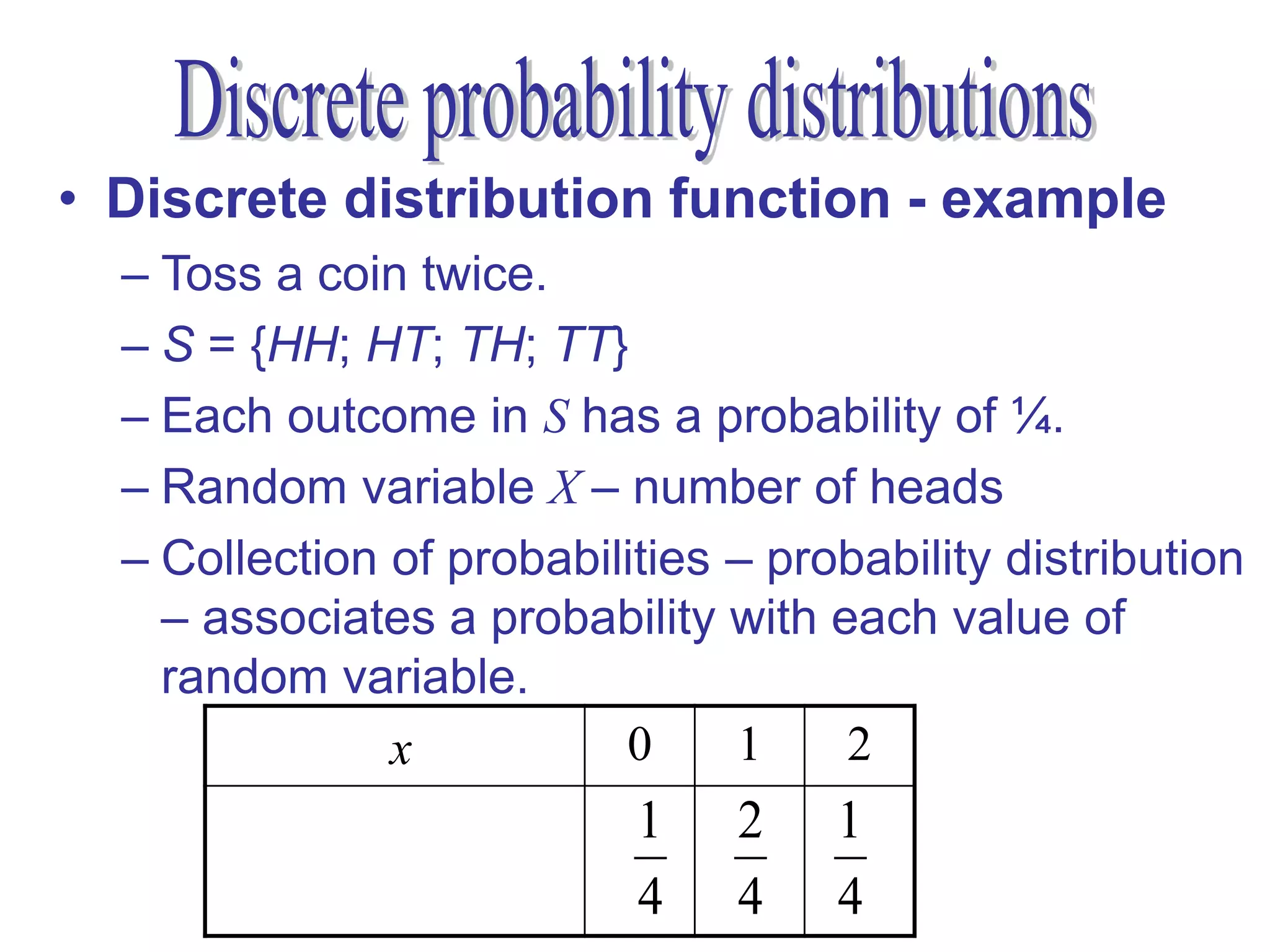
• Discrete distribution function - example
  – Toss a coin twice.
  – S = {HH; HT; TH; TT}
  – Each outcome in S has a probability of ¼.
  – Random variable X – number of heads
  – Collection of probabilities – probability distribution
    – associates a probability with each value of
    random variable.
               x          0     1    2
                           1    2    1
       P(X = x) = P(x)
                           4    4    4
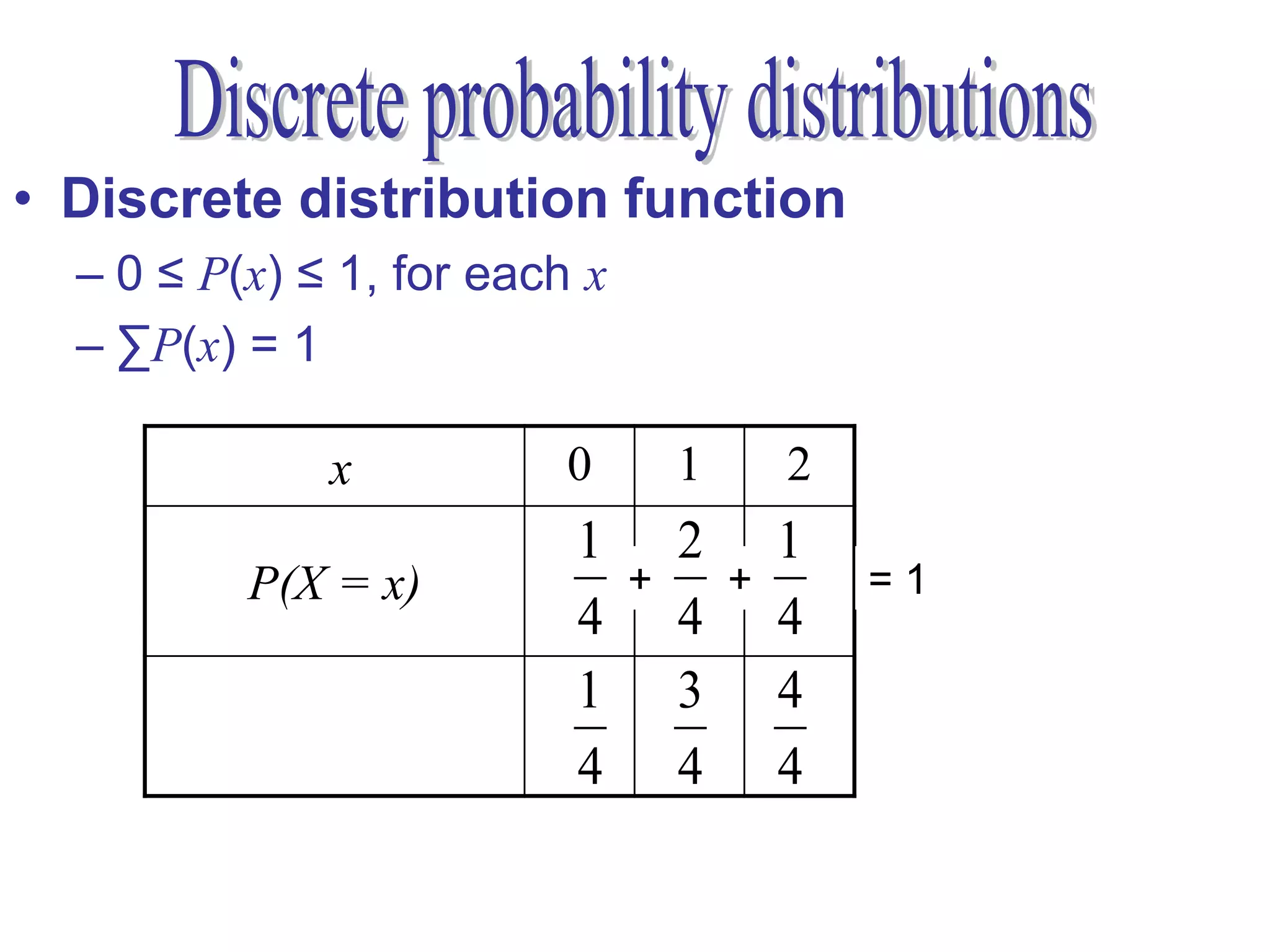
• Discrete distribution function
  – 0 ≤ P(x) ≤ 1, for each x
  – ∑P(x) = 1

              x           0        1       2
                          1        2       1
          P(X = x)             +       +       =1
                          4        4       4
                          1        3       4
          P(X ≤ x)
                          4        4       4
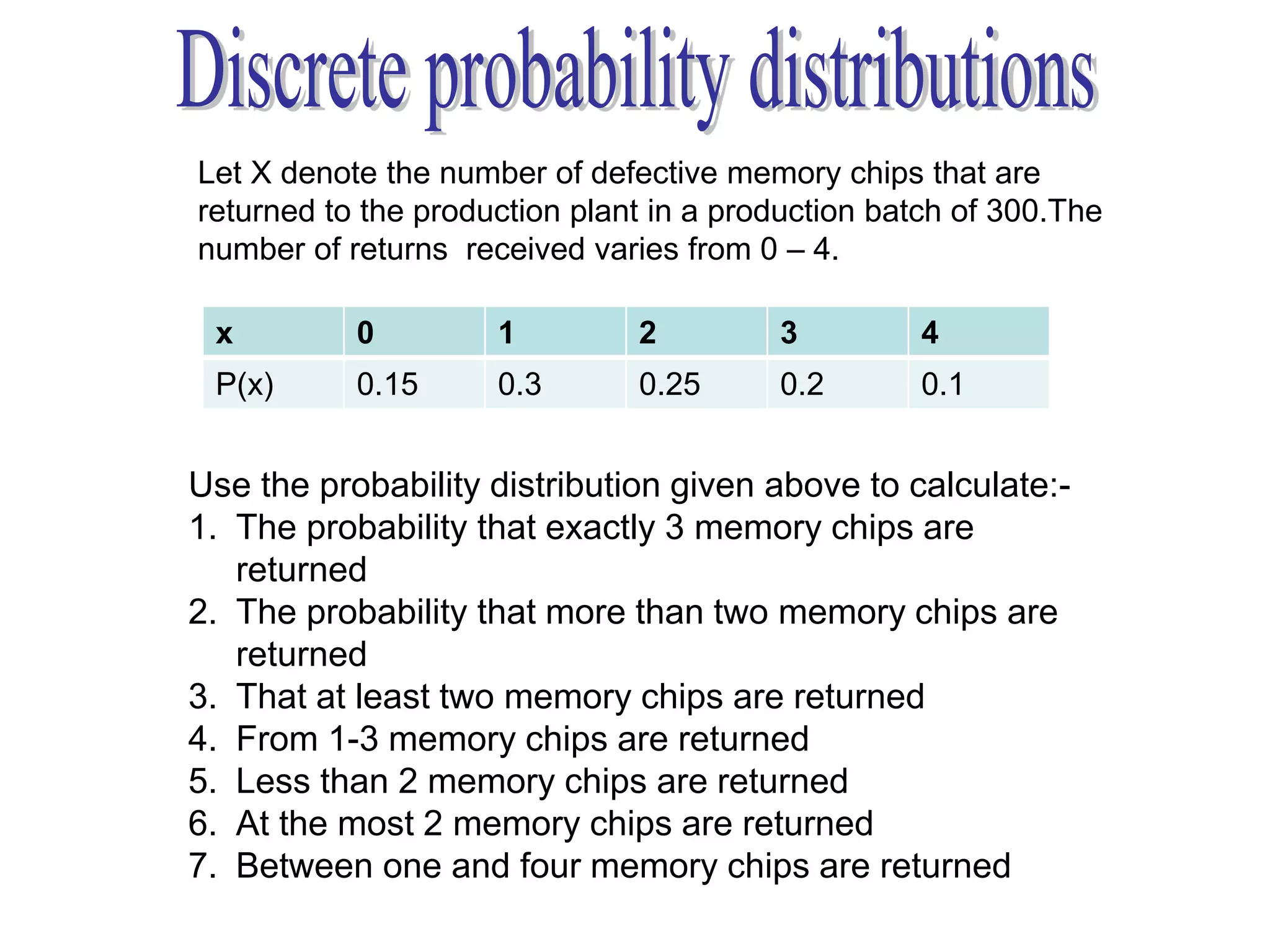
Let X denote the number of defective memory chips that are
returned to the production plant in a production batch of 300.The
number of returns received varies from 0 – 4.

 x         0         1         2         3         4
 P(x)      0.15      0.3       0.25      0.2       0.1


Use the probability distribution given above to calculate:-
1. The probability that exactly 3 memory chips are
   returned
2. The probability that more than two memory chips are
   returned
3. That at least two memory chips are returned
4. From 1-3 memory chips are returned
5. Less than 2 memory chips are returned
6. At the most 2 memory chips are returned
7. Between one and four memory chips are returned
Answers
 • Example 5.3, p154 Elementary
   Statistics
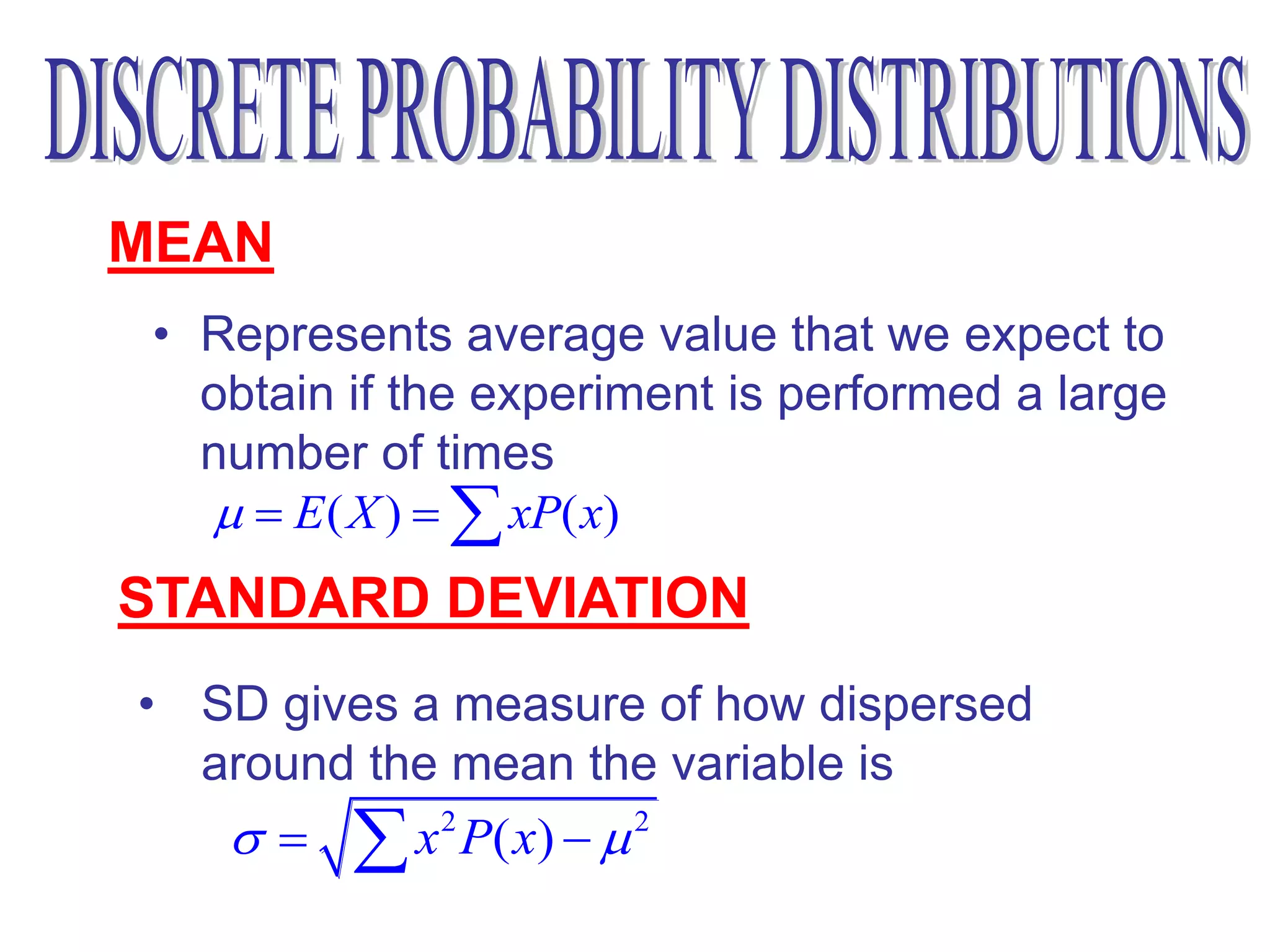
MEAN
 • Represents average value that we expect to
   obtain if the experiment is performed a large
   number of times
     E ( X )   xP( x)
STANDARD DEVIATION
• SD gives a measure of how dispersed
  around the mean the variable is
      x P( x)  
            2        2
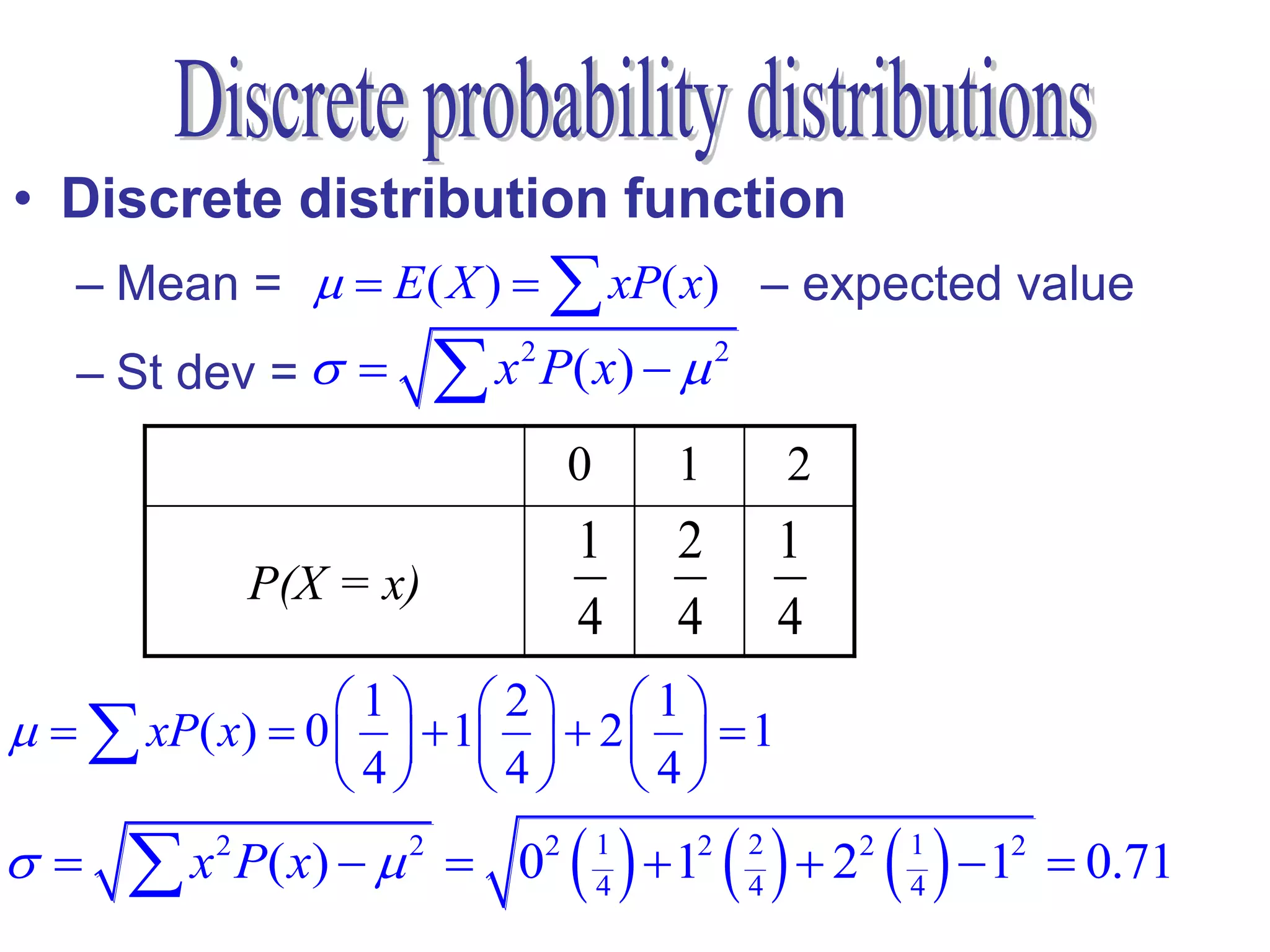
• Discrete distribution function
   – Mean =   E ( X )   xP( x) – expected value
   – St dev =         x 2 P( x)   2
                               0        1         2
                               1        2         1
            P(X = x)
                               4        4         4
                 1 2 1
   xP( x)  0    1   2    1
                 4 4 4
     x 2 P( x)   2  02     1
                                   4
                                        12   
                                              2
                                              4
                                                    22   
                                                          1
                                                          4
                                                                12  0.71
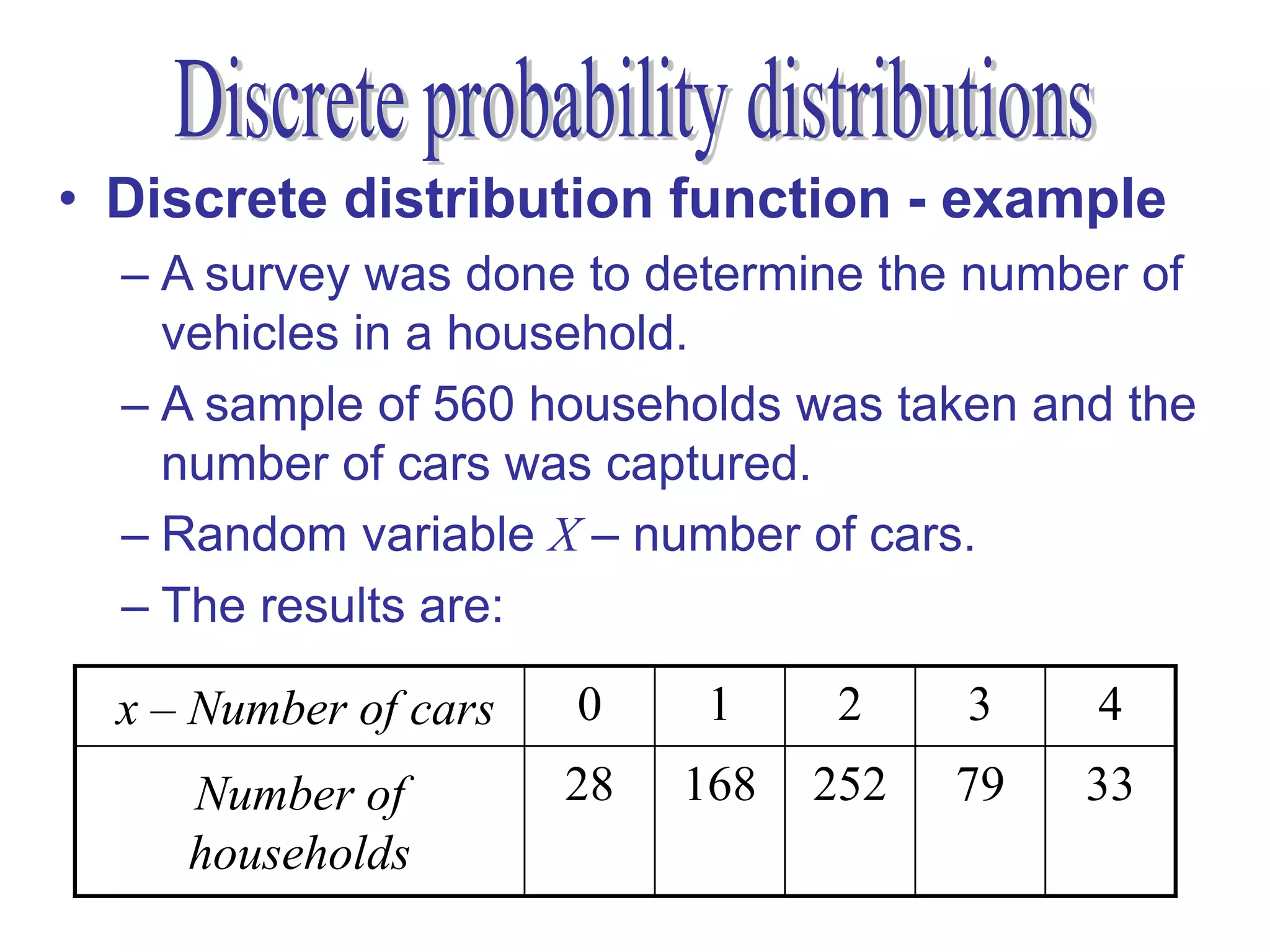
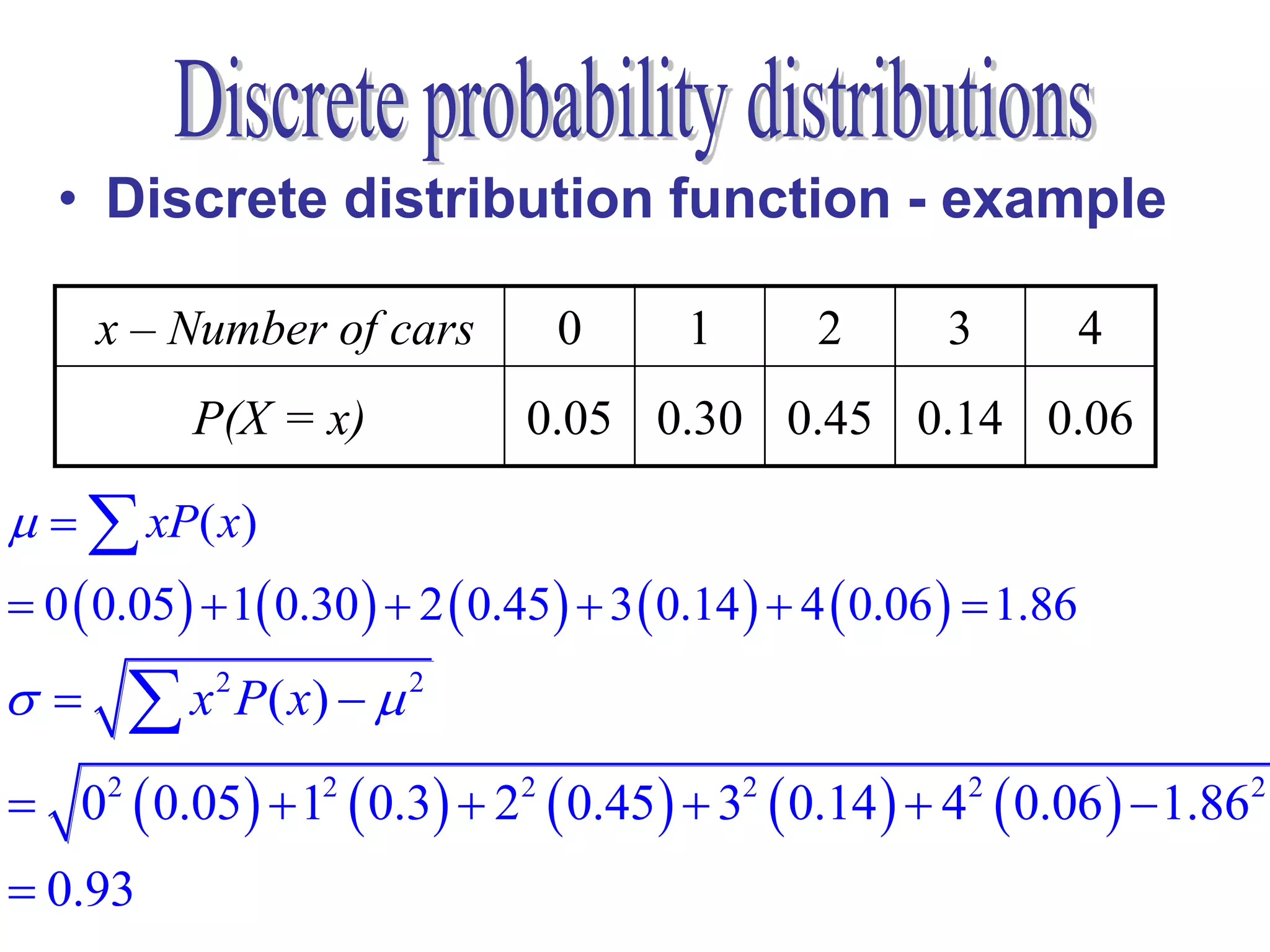
• Discrete distribution function - example
  – A survey was done to determine the number of
    vehicles in a household.
  – A sample of 560 households was taken and the
    number of cars was captured.
  – Random variable X – number of cars.
  – The results are:

  x – Number of cars   0     1     2    3    4
     Number of         28   168   252   79   33
     households
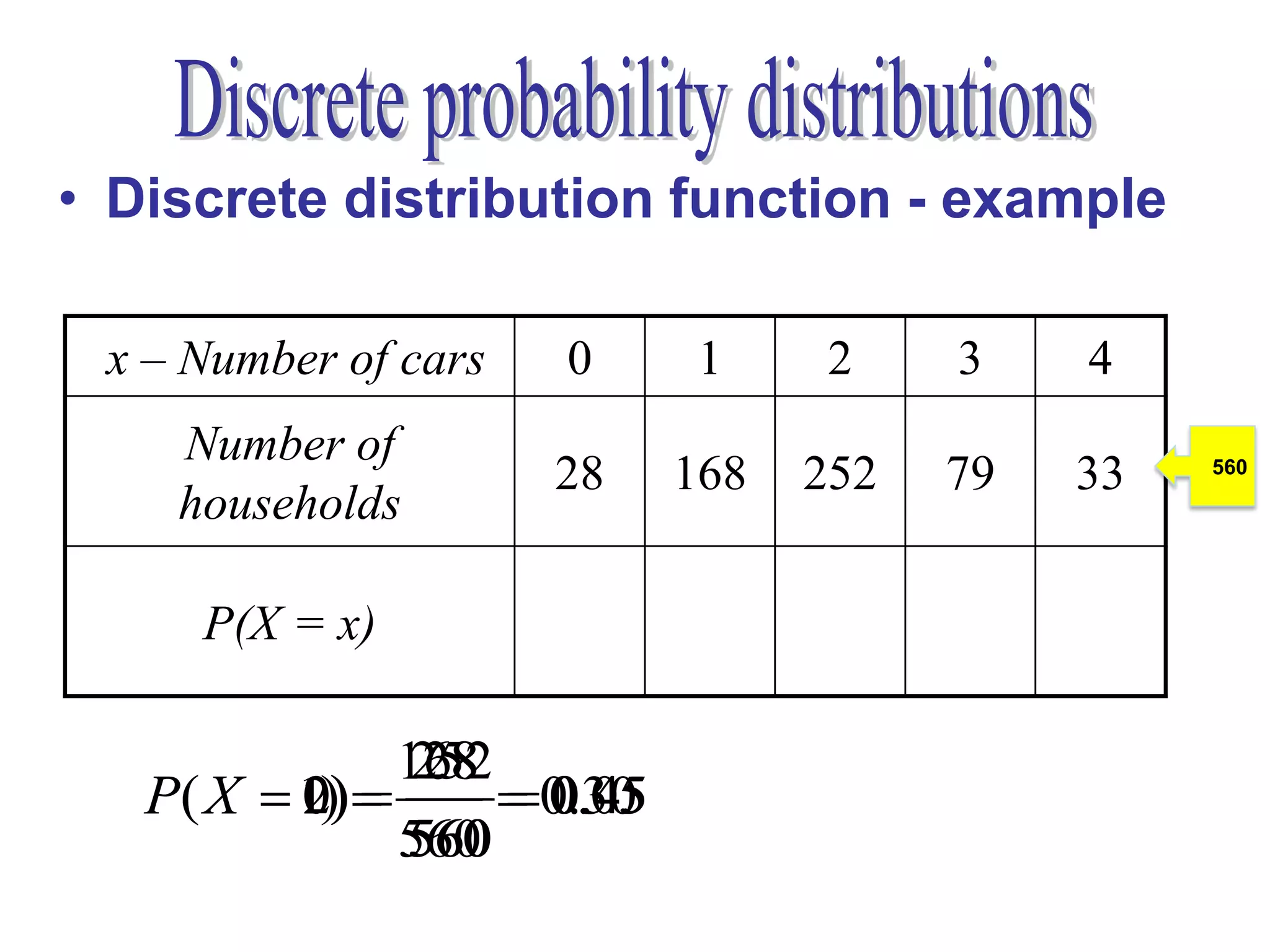
• Discrete distribution function - example

 x – Number of cars    0     1     2    3    4
    Number of
                      28    168   252   79   33   560

    households

     P(X = x)         0.05 0.30 0.45 0.14 0.06

               252
                28
               168
   P( X  1) 
          0) 
          2)        0.05
                    0.30
                     0.45
               560
               560
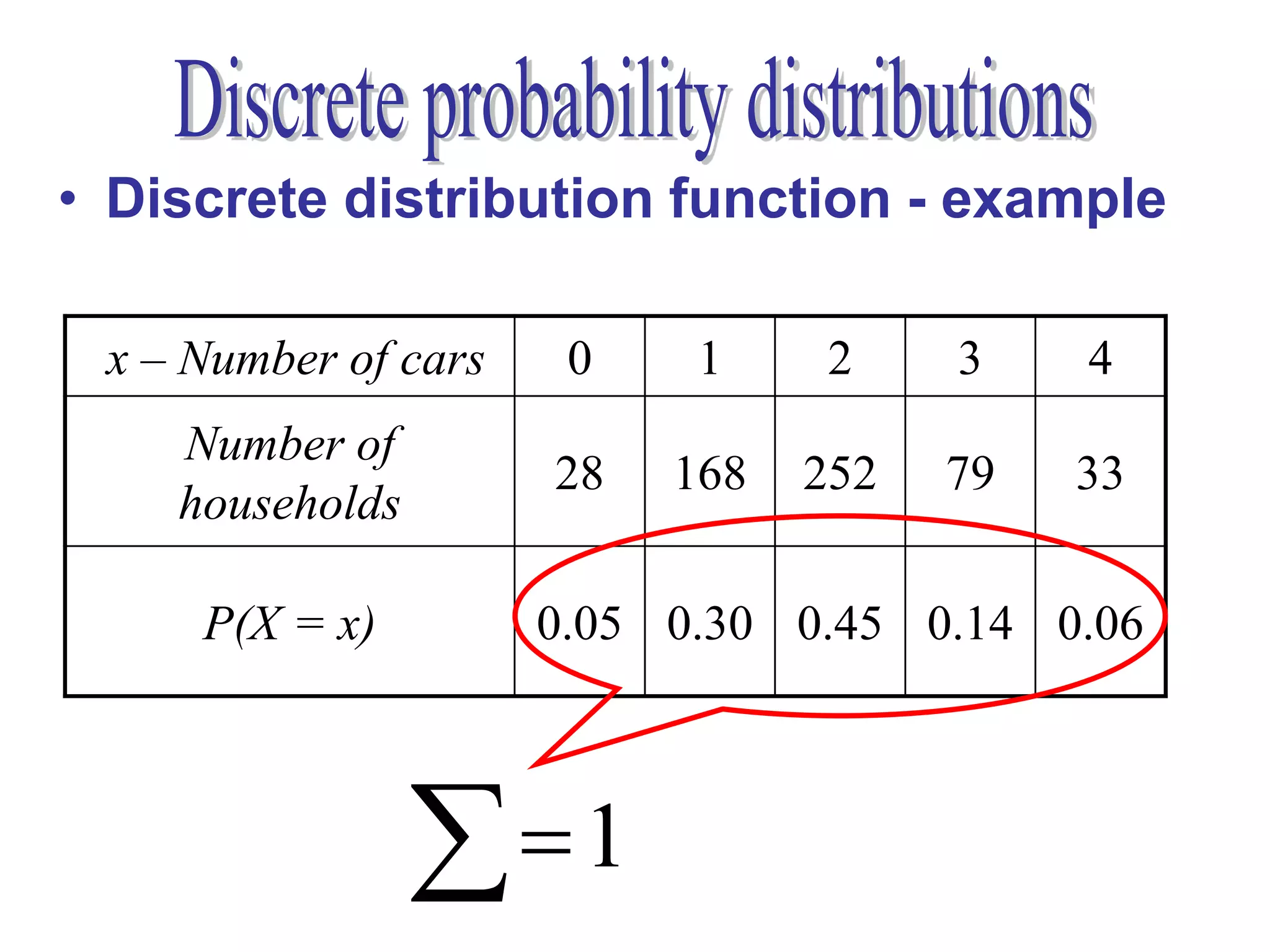
• Discrete distribution function - example

 x – Number of cars    0    1     2    3    4
    Number of
                      28   168   252   79   33
    households

     P(X = x)         0.05 0.30 0.45 0.14 0.06


                 1
• Discrete distribution function - example

     x – Number of cars              0     1        2       3           4
             P(X = x)            0.05 0.30 0.45 0.14 0.06

   xP( x)
 0  0.05  1 0.30   2  0.45   3  0.14   4  0.06   1.86
         x 2 P( x)   2

 0  0.05   1  0.3  2  0.45   3  0.14   4  0.06   1.86
      2              2           2             2             2              2


 0.93
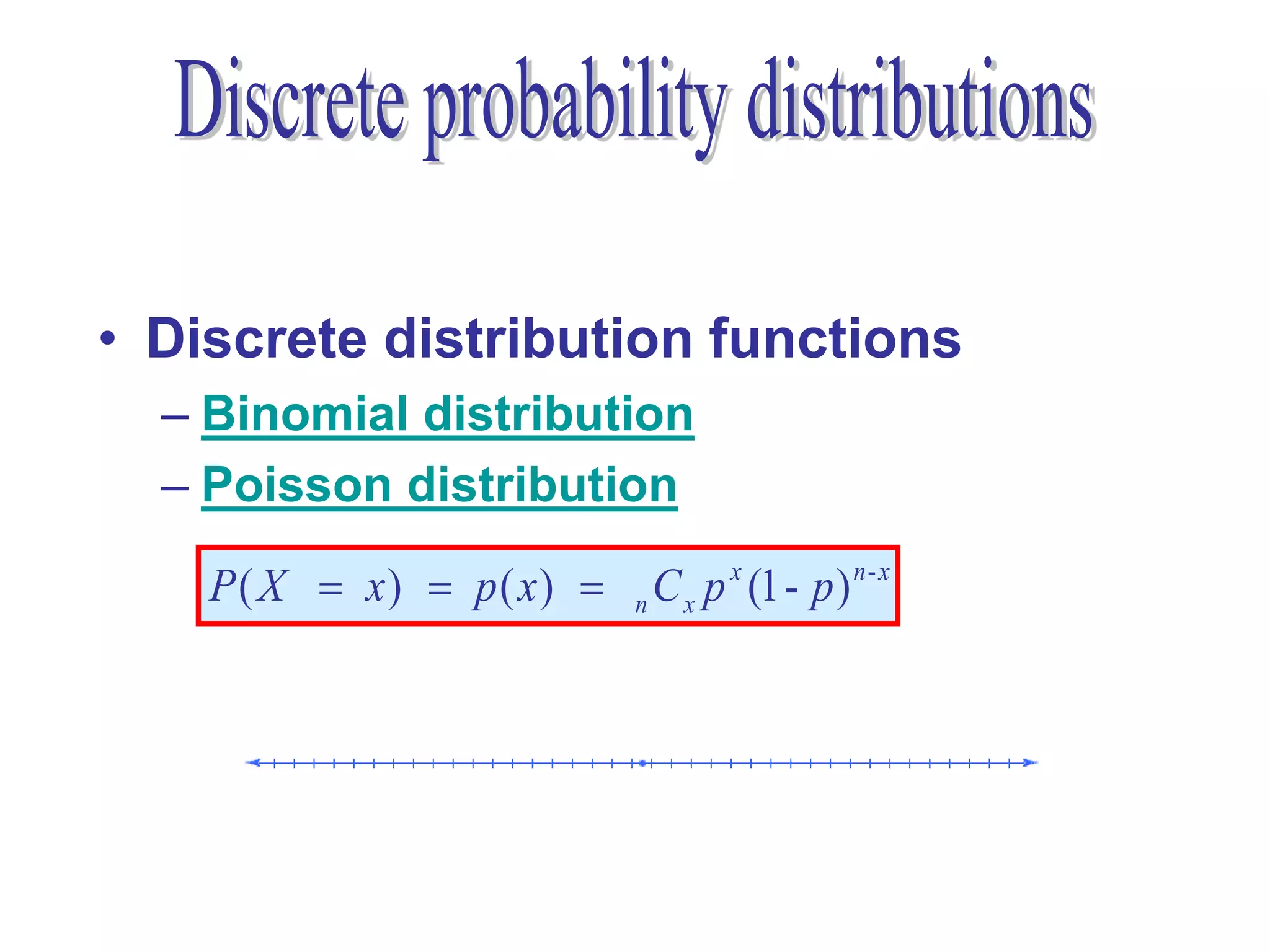
• Discrete distribution functions
  – Binomial distribution
  – Poisson distribution

    P( X  x)  p( x)    n C x p x (1- p ) n - x
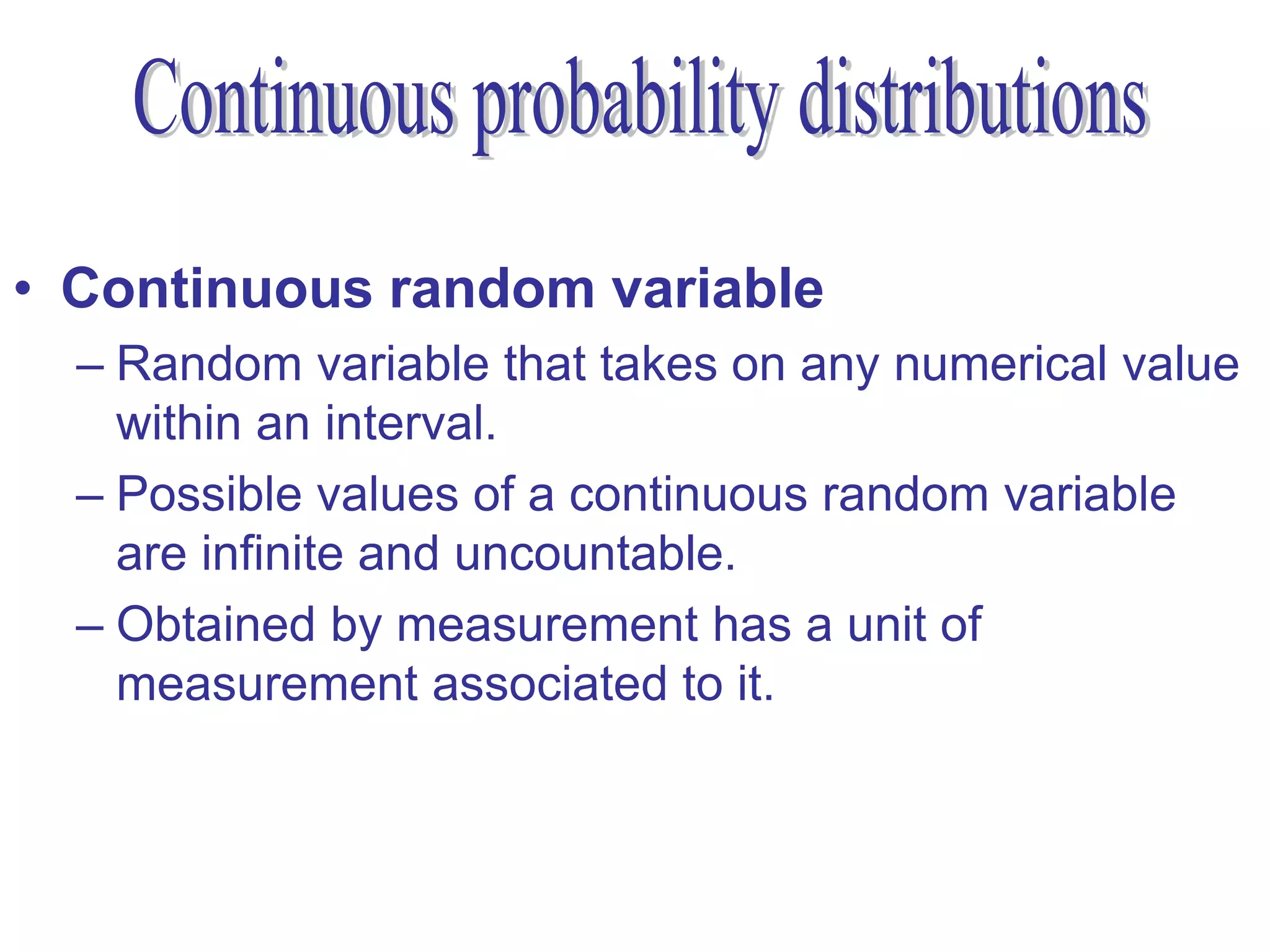
• Continuous random variable
  – Random variable that takes on any numerical value
    within an interval.
  – Possible values of a continuous random variable
    are infinite and uncountable.
  – Obtained by measurement has a unit of
    measurement associated to it.
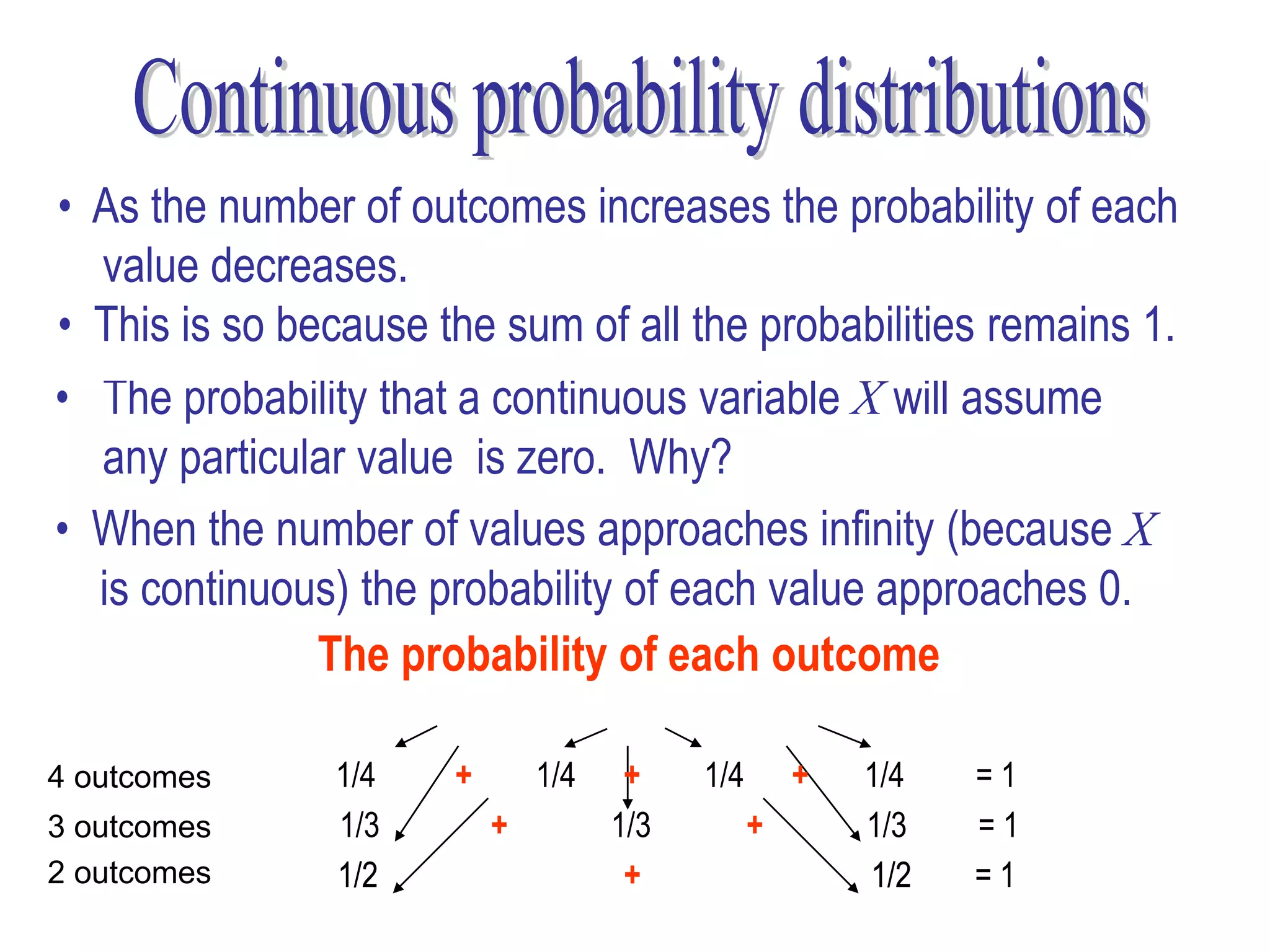
•• Ascontinuous random variable has probability of each
   A the number of outcomes increases the an uncountable
    value decreases.
   infinite number of values in the interval (a,b)
 • This is so because the sum of all the probabilities remains 1.
 • The probability that a continuous variable X will assume
    any particular value is zero. Why?
 • When the number of values approaches infinity (because X
   is continuous) the probability of each value approaches 0.
                The probability of each outcome

4 outcomes      1/4    +       1/4    +    1/4       +   1/4   =1
3 outcomes      1/3        +         1/3         +       1/3   =1
2 outcomes      1/2                   +                  1/2   =1
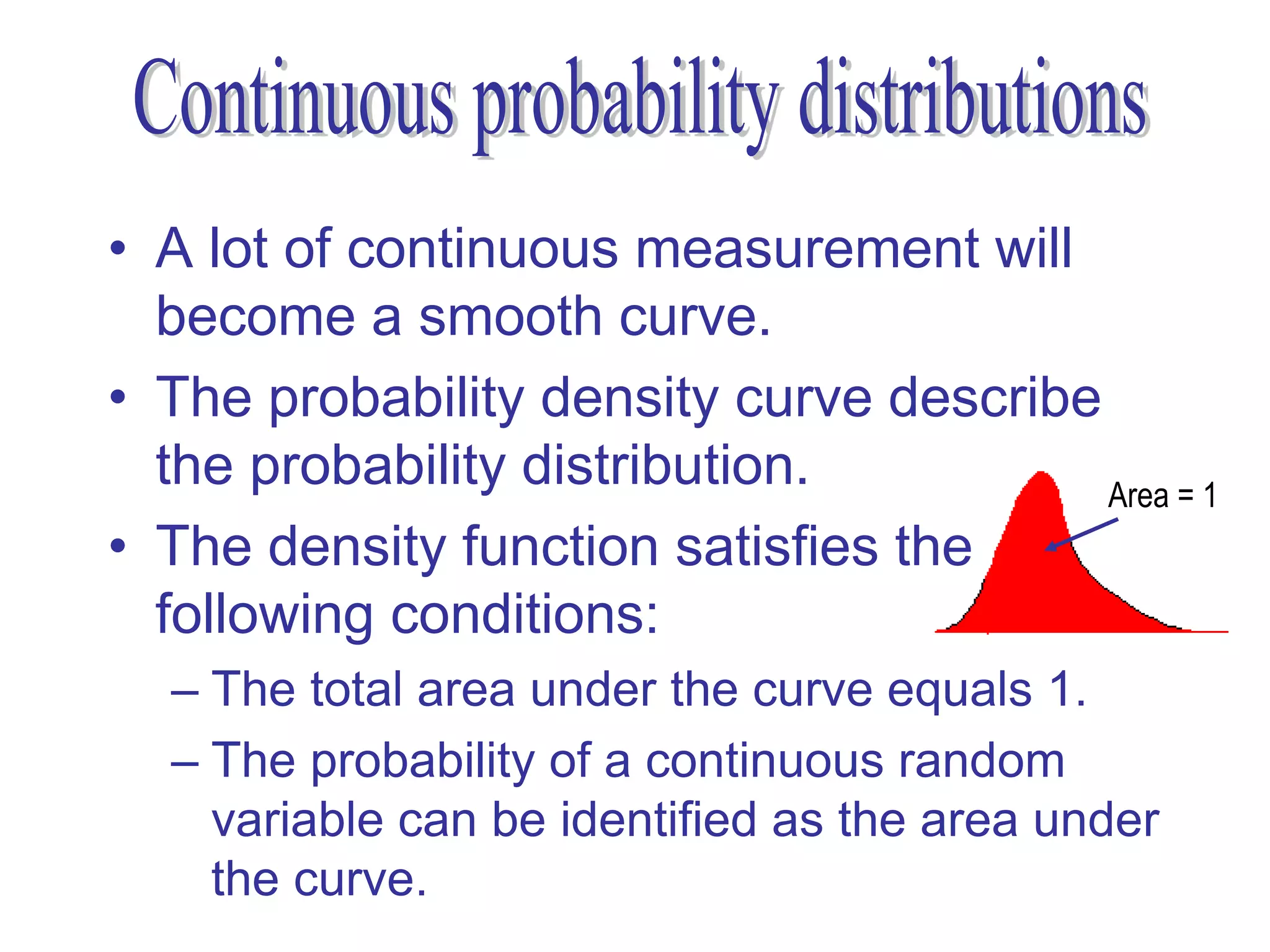
• A lot of continuous measurement will
  become a smooth curve.
• The probability density curve describe
  the probability distribution.          Area = 1
• The density function satisfies the
  following conditions:
  – The total area under the curve equals 1.
  – The probability of a continuous random
    variable can be identified as the area under
    the curve.
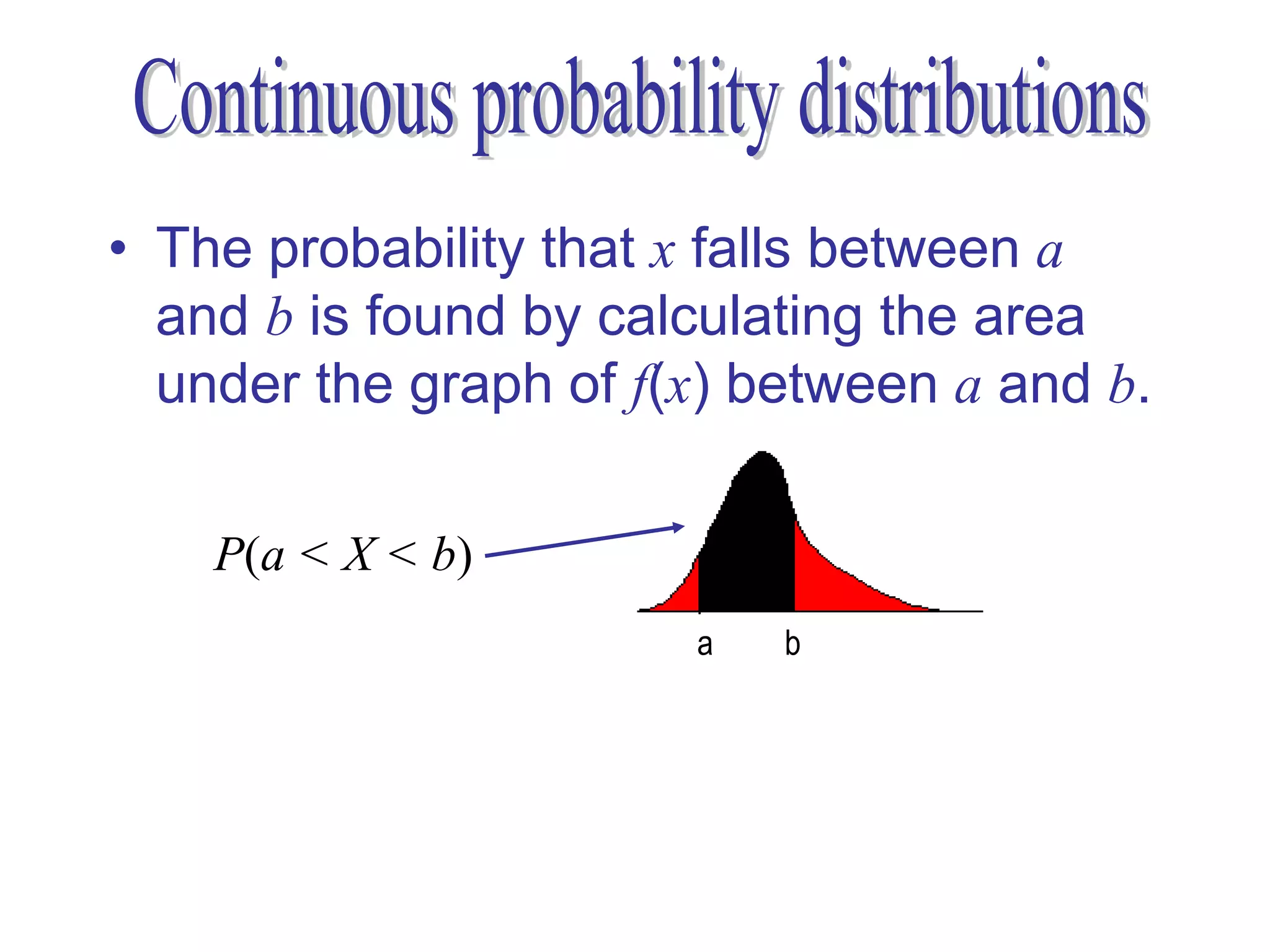
• The probability that x falls between a
  and b is found by calculating the area
  under the graph of f(x) between a and b.

    P(a < X < b)
                       a   b
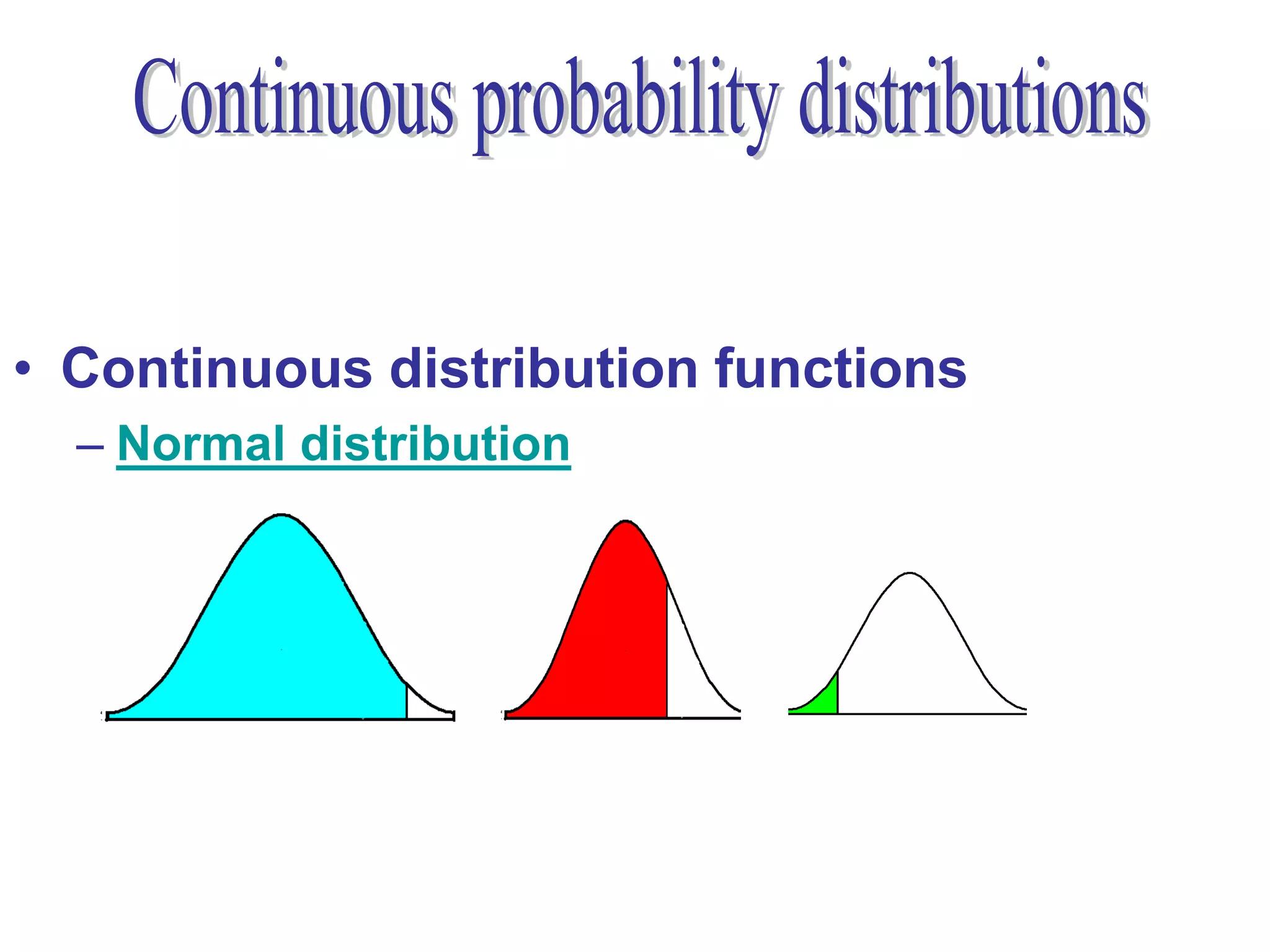
• Continuous distribution functions
  – Normal distribution

Statistics lecture 6 (ch5)

  • 2.
    Probability distributions • Discrete – Binomial distribution – Poisson distribution • Continuous – Normal distribution
  • 3.
    • Discrete randomvariable – Variable is the characteristic of interest that assumes different values for different elements of the sample/population. – If the value of the variable depends on the outcome of an experiment it is called a random variable. – Discrete random variable takes on a countable number of values.
  • 4.
    • Discrete distributionfunction - example – Toss a coin twice. – S = {HH; HT; TH; TT} – Each outcome in S has a probability of ¼. – Random variable X – number of heads – Collection of probabilities – probability distribution – associates a probability with each value of random variable. x 0 1 2 1 2 1 P(X = x) = P(x) 4 4 4
  • 5.
    • Discrete distributionfunction – 0 ≤ P(x) ≤ 1, for each x – ∑P(x) = 1 x 0 1 2 1 2 1 P(X = x) + + =1 4 4 4 1 3 4 P(X ≤ x) 4 4 4
  • 6.
    Let X denotethe number of defective memory chips that are returned to the production plant in a production batch of 300.The number of returns received varies from 0 – 4. x 0 1 2 3 4 P(x) 0.15 0.3 0.25 0.2 0.1 Use the probability distribution given above to calculate:- 1. The probability that exactly 3 memory chips are returned 2. The probability that more than two memory chips are returned 3. That at least two memory chips are returned 4. From 1-3 memory chips are returned 5. Less than 2 memory chips are returned 6. At the most 2 memory chips are returned 7. Between one and four memory chips are returned
  • 7.
    Answers • Example5.3, p154 Elementary Statistics
  • 8.
    MEAN • Representsaverage value that we expect to obtain if the experiment is performed a large number of times   E ( X )   xP( x) STANDARD DEVIATION • SD gives a measure of how dispersed around the mean the variable is    x P( x)   2 2
  • 9.
    • Discrete distributionfunction – Mean =   E ( X )   xP( x) – expected value – St dev =    x 2 P( x)   2 0 1 2 1 2 1 P(X = x) 4 4 4 1 2 1    xP( x)  0    1   2    1 4 4 4   x 2 P( x)   2  02  1 4  12  2 4  22  1 4  12  0.71
  • 10.
    • Discrete distributionfunction - example – A survey was done to determine the number of vehicles in a household. – A sample of 560 households was taken and the number of cars was captured. – Random variable X – number of cars. – The results are: x – Number of cars 0 1 2 3 4 Number of 28 168 252 79 33 households
  • 11.
    • Discrete distributionfunction - example x – Number of cars 0 1 2 3 4 Number of 28 168 252 79 33 560 households P(X = x) 0.05 0.30 0.45 0.14 0.06 252 28 168 P( X  1)  0)  2)  0.05  0.30 0.45 560 560
  • 12.
    • Discrete distributionfunction - example x – Number of cars 0 1 2 3 4 Number of 28 168 252 79 33 households P(X = x) 0.05 0.30 0.45 0.14 0.06 1
  • 13.
    • Discrete distributionfunction - example x – Number of cars 0 1 2 3 4 P(X = x) 0.05 0.30 0.45 0.14 0.06    xP( x)  0  0.05  1 0.30   2  0.45   3  0.14   4  0.06   1.86   x 2 P( x)   2  0  0.05   1  0.3  2  0.45   3  0.14   4  0.06   1.86 2 2 2 2 2 2  0.93
  • 14.
    • Discrete distributionfunctions – Binomial distribution – Poisson distribution P( X  x)  p( x)  n C x p x (1- p ) n - x
  • 15.
    • Continuous randomvariable – Random variable that takes on any numerical value within an interval. – Possible values of a continuous random variable are infinite and uncountable. – Obtained by measurement has a unit of measurement associated to it.
  • 16.
    •• Ascontinuous randomvariable has probability of each A the number of outcomes increases the an uncountable value decreases. infinite number of values in the interval (a,b) • This is so because the sum of all the probabilities remains 1. • The probability that a continuous variable X will assume any particular value is zero. Why? • When the number of values approaches infinity (because X is continuous) the probability of each value approaches 0. The probability of each outcome 4 outcomes 1/4 + 1/4 + 1/4 + 1/4 =1 3 outcomes 1/3 + 1/3 + 1/3 =1 2 outcomes 1/2 + 1/2 =1
  • 17.
    • A lotof continuous measurement will become a smooth curve. • The probability density curve describe the probability distribution. Area = 1 • The density function satisfies the following conditions: – The total area under the curve equals 1. – The probability of a continuous random variable can be identified as the area under the curve.
  • 18.
    • The probabilitythat x falls between a and b is found by calculating the area under the graph of f(x) between a and b. P(a < X < b) a b
  • 19.
    • Continuous distributionfunctions – Normal distribution