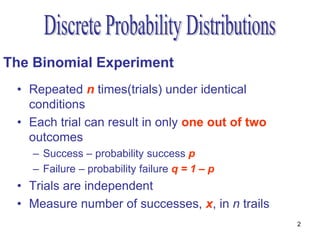
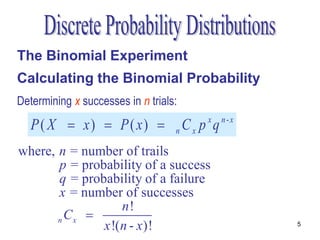
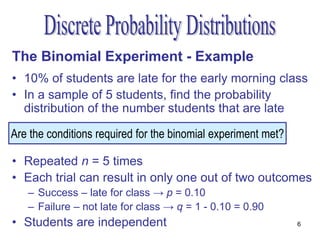
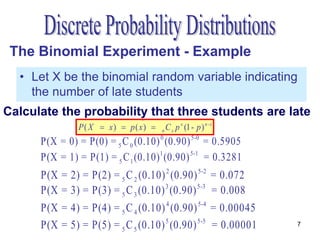
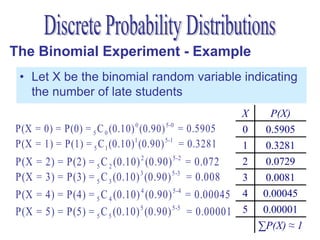
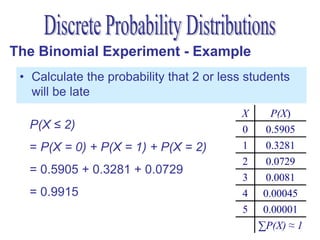
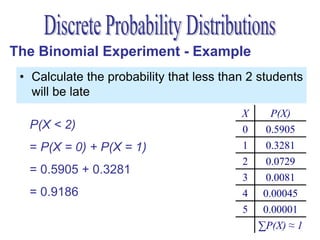
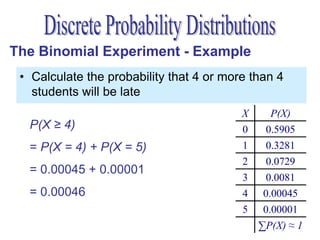
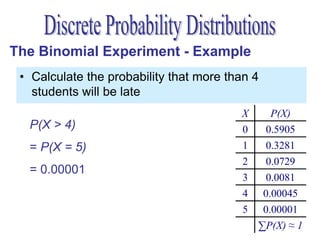
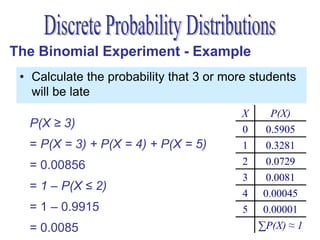
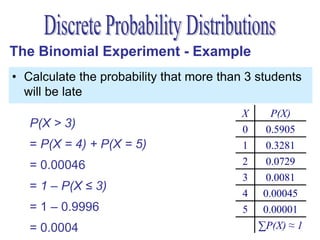
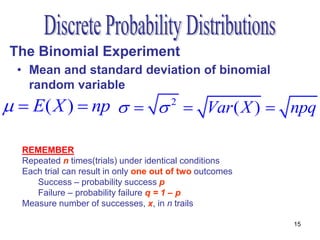
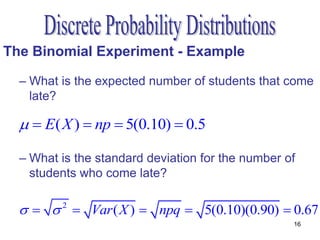
The document describes the binomial experiment, which involves repeating a trial with two possible outcomes (success or failure) a fixed number of times. Each trial has a known probability of success (p) or failure (q=1-p) and trials are independent. The number of successes is then modeled by the binomial distribution. An example calculates the probabilities of different numbers of students being late to class when sampling 5 students, where the probability of an individual student being late is 10%. Key aspects of the binomial experiment and calculating binomial probabilities are summarized.