 What is probability?
   Probability is a numerical value used to
    express the chance that a specific event
    will occur.
   Probability is always in the interval 0 to 1
    and can be expressed as percentages.
   The greater the chance that an event will
    occur, the closer the probability is to 1.
   The smaller the chance that an event will
    occur, the closer the probability is to 0.
   Probabilities is needed to make
    generalisations about the population based
                                                 2
    on a sample drawn from the population.
 Experiment
   Process that results in obtaining observations
    from an experimental unit.
   Experimental unit is the object on which the
    observations are made.
   Results of experiment are called outcomes.
   Stochastic experiment
     The results are a definite set of two or more
      possible outcomes.
     The outcome can not be determined in advance.
     Can be repeated under stable conditions.
                                                      3
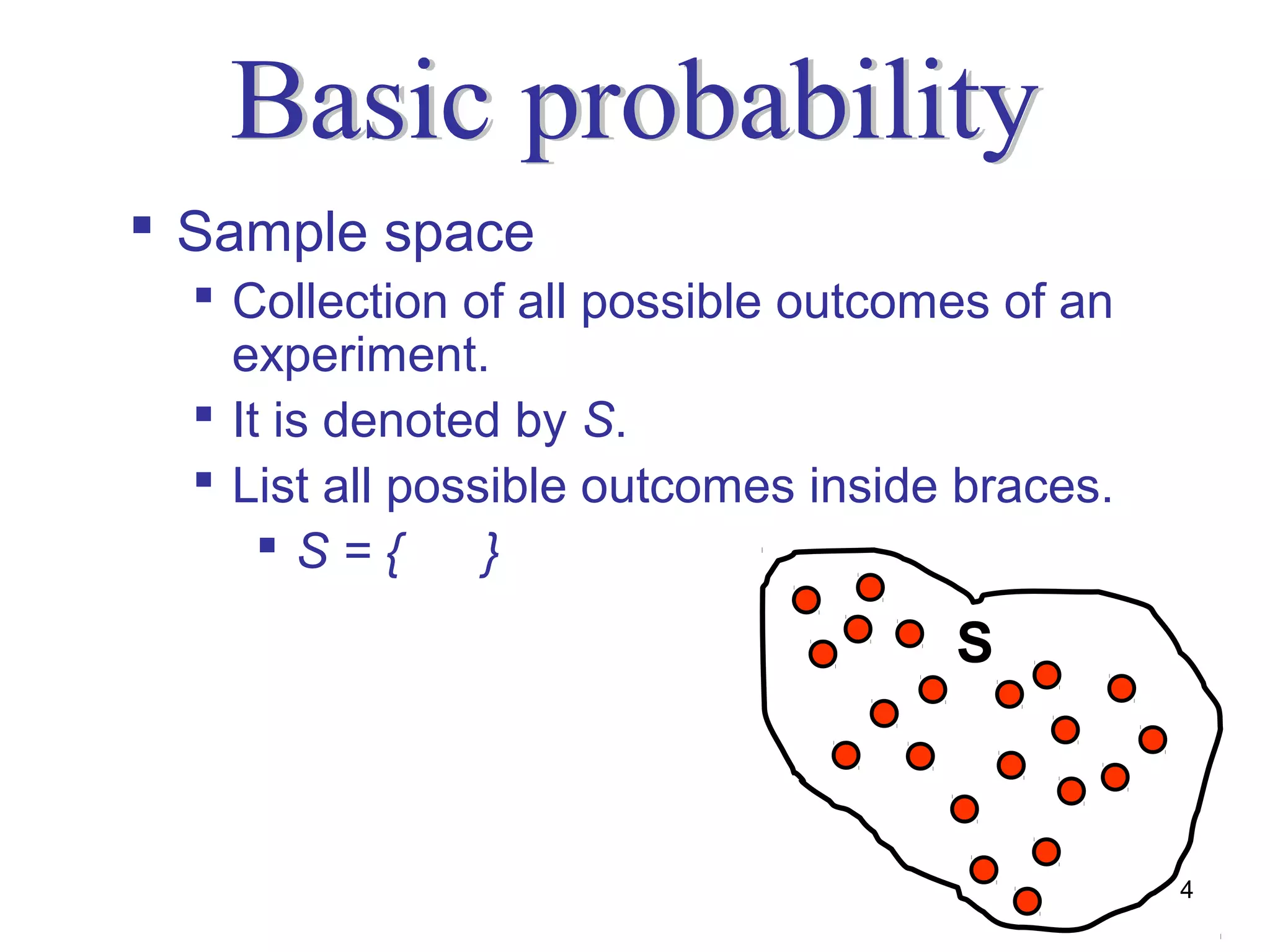
 Sample space
   Collection of all possible outcomes of an
    experiment.
   It is denoted by S.
   List all possible outcomes inside braces.
      S={       }
                                     S


                                                4
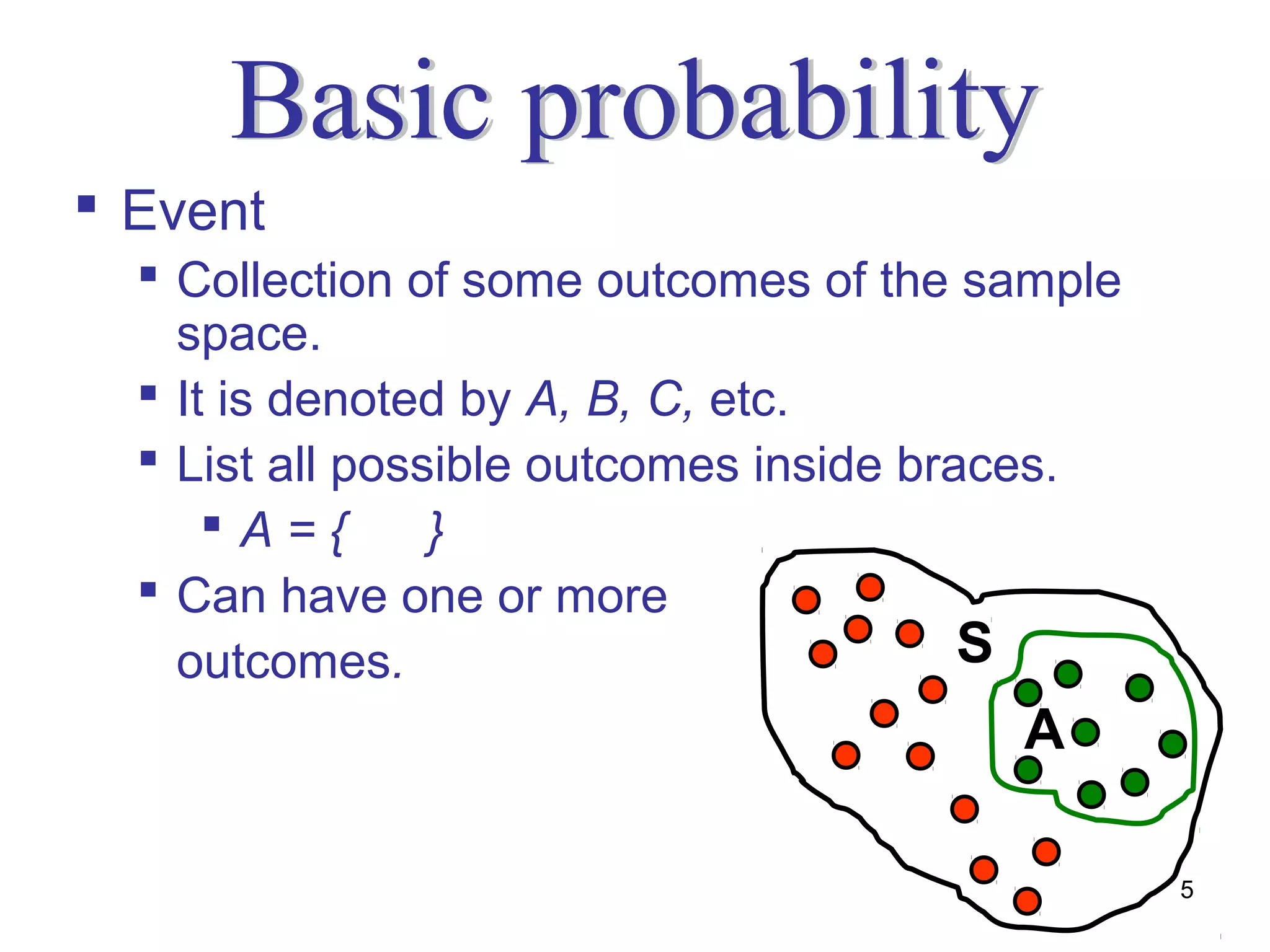
 Event
   Collection of some outcomes of the sample
    space.
   It is denoted by A, B, C, etc.
   List all possible outcomes inside braces.
      A={       }
   Can have one or more
    outcomes.                            S
                                        A

                                                5
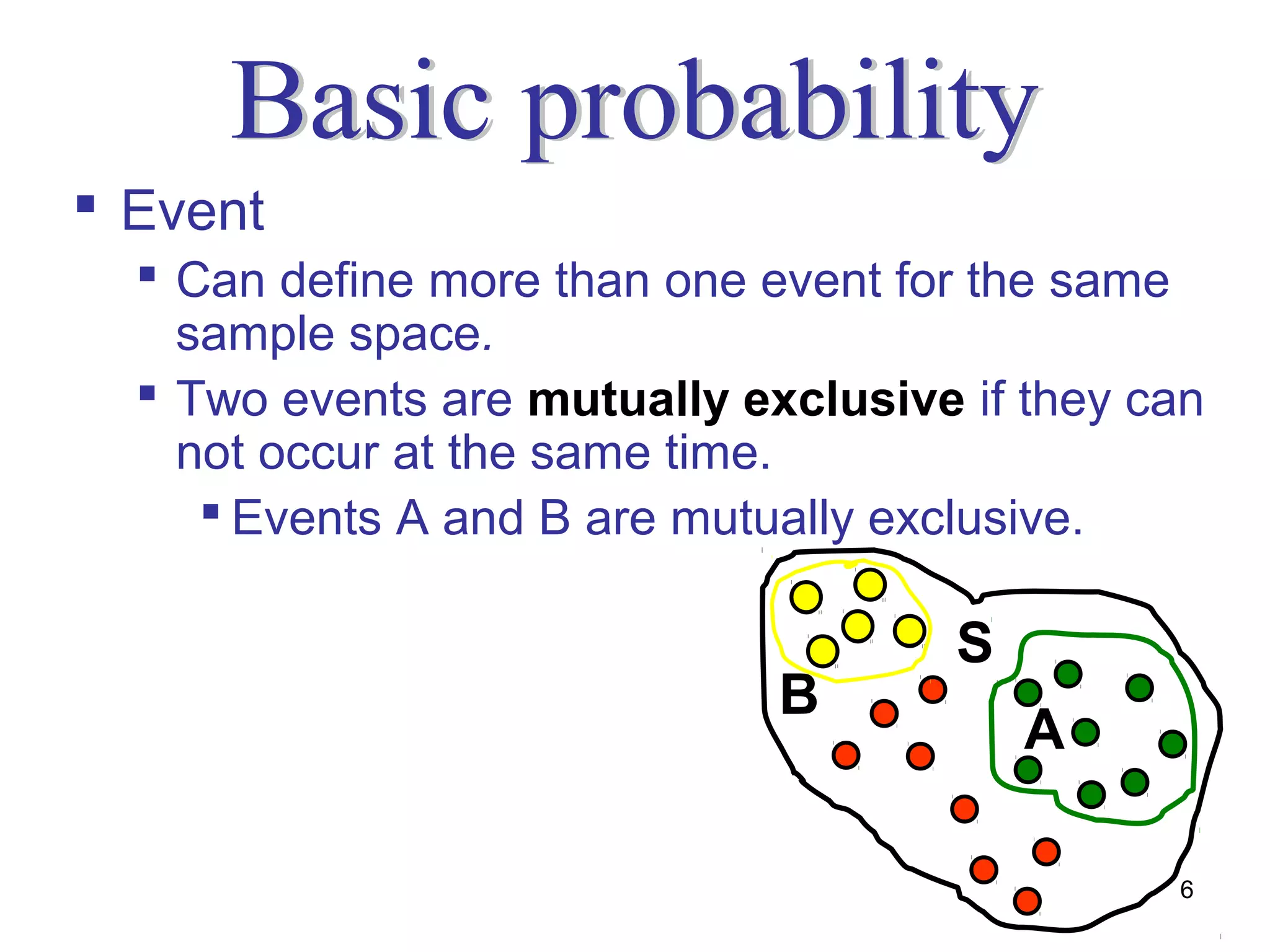
 Event
   Can define more than one event for the same
    sample space.
   Two events are mutually exclusive if they can
    not occur at the same time.
      Events A and B are mutually exclusive.

                                      S
                              B
                                          A

                                               6
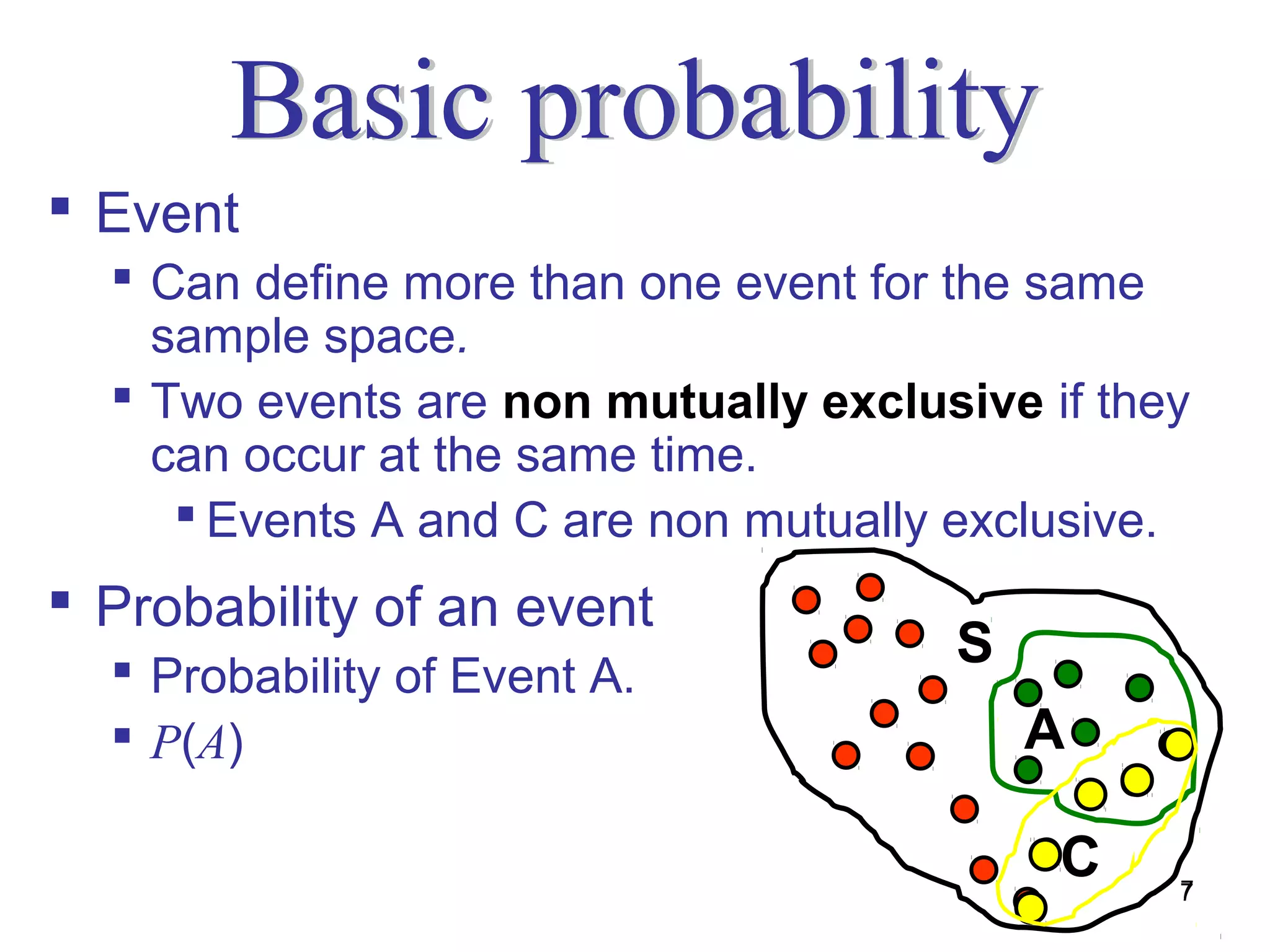
 Event
   Can define more than one event for the same
    sample space.
   Two events are non mutually exclusive if they
    can occur at the same time.
      Events A and C are non mutually exclusive.
 Probability of an event
   Probability of Event A.
                                      S
   P(A)                                  A

                                           C    7
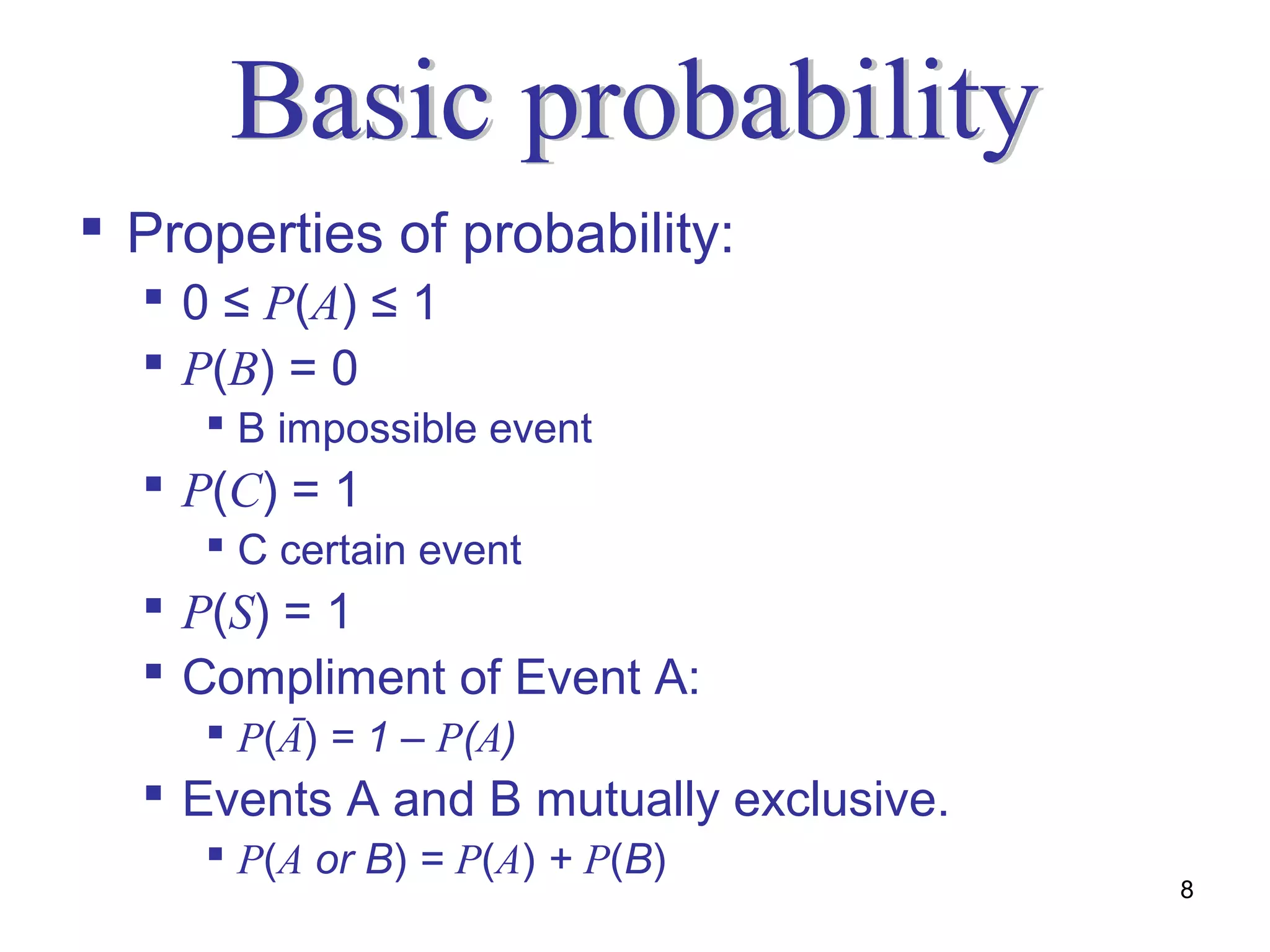
 Properties of probability:
   0 ≤ P(A) ≤ 1
   P(B) = 0
      B impossible event
   P(C) = 1
      C certain event
   P(S) = 1
   Compliment of Event A:
      P(Ā) = 1 – P(A)
   Events A and B mutually exclusive.
      P(A or B) = P(A) + P(B)
                                         8
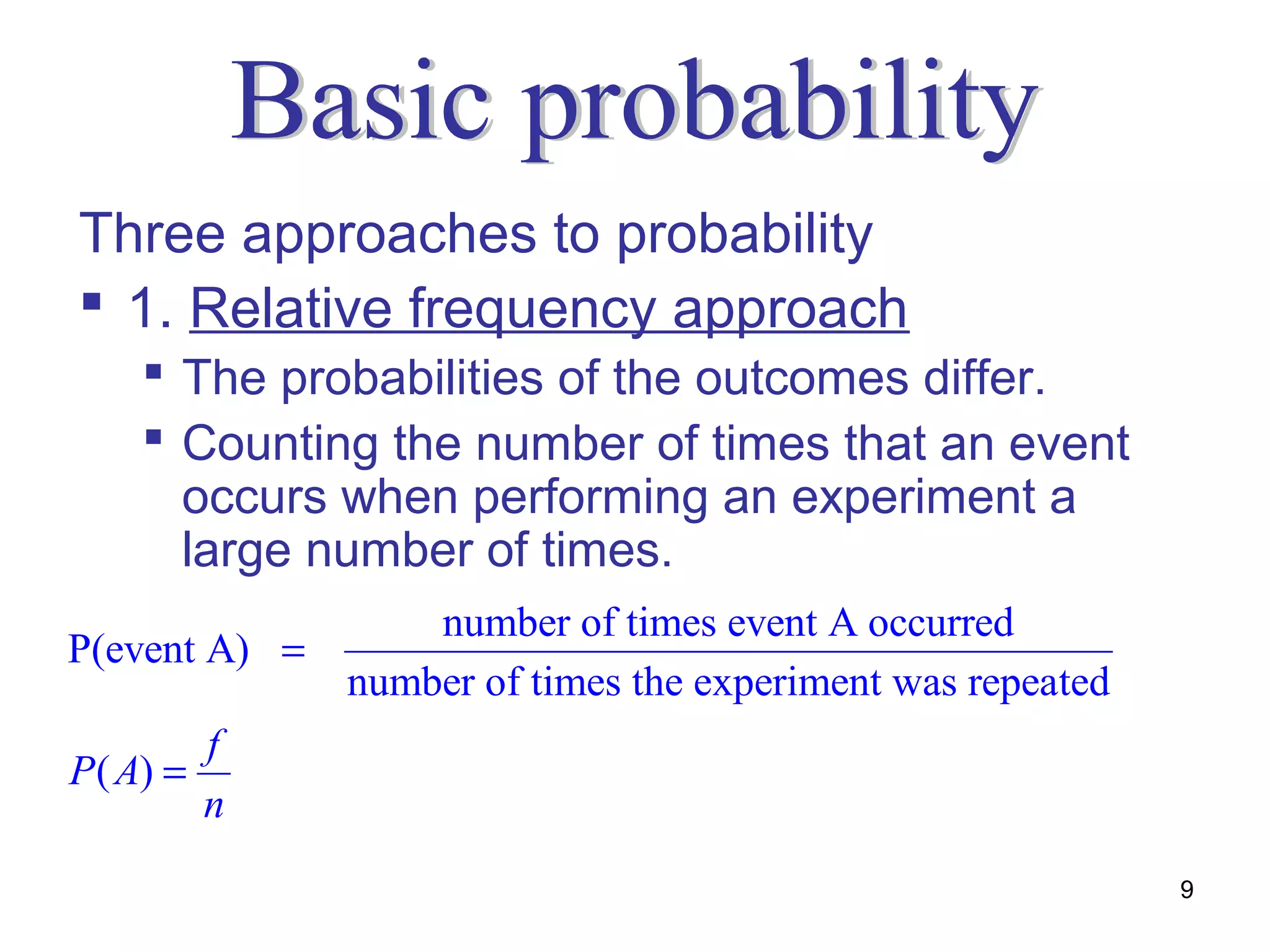
Three approaches to probability
 1. Relative frequency approach
     The probabilities of the outcomes differ.
     Counting the number of times that an event
      occurs when performing an experiment a
      large number of times.
                   number of times event A occurred
P(event A) =
               number of times the experiment was repeated
         f
P ( A) =
         n
                                                             9
Three approaches to probability
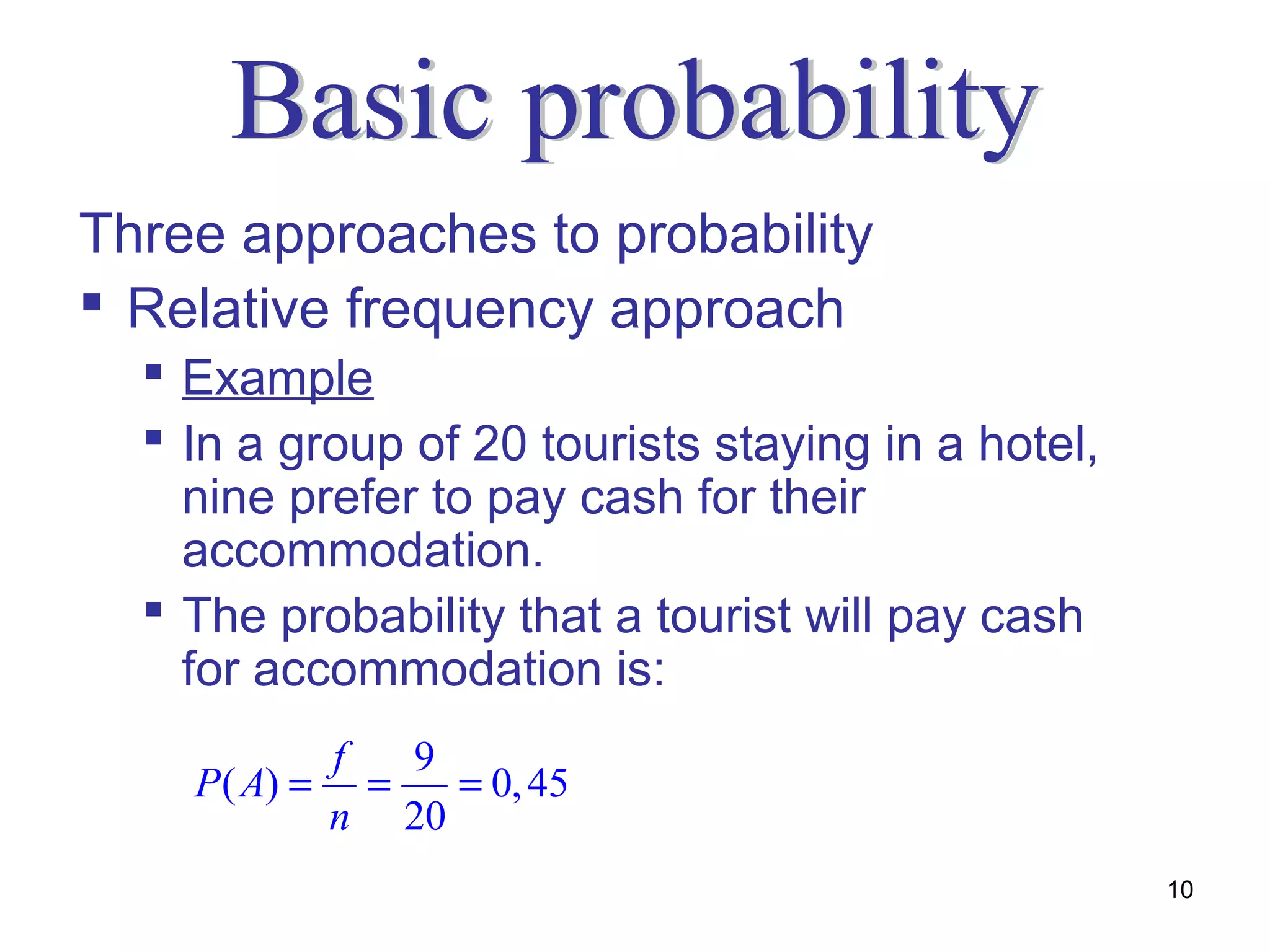
 Relative frequency approach
   Example
   In a group of 20 tourists staying in a hotel,
    nine prefer to pay cash for their
    accommodation.
   The probability that a tourist will pay cash
    for accommodation is:
               f   9
    P ( A) =     =   = 0, 45
               n 20
                                                    10
Three approaches to probability
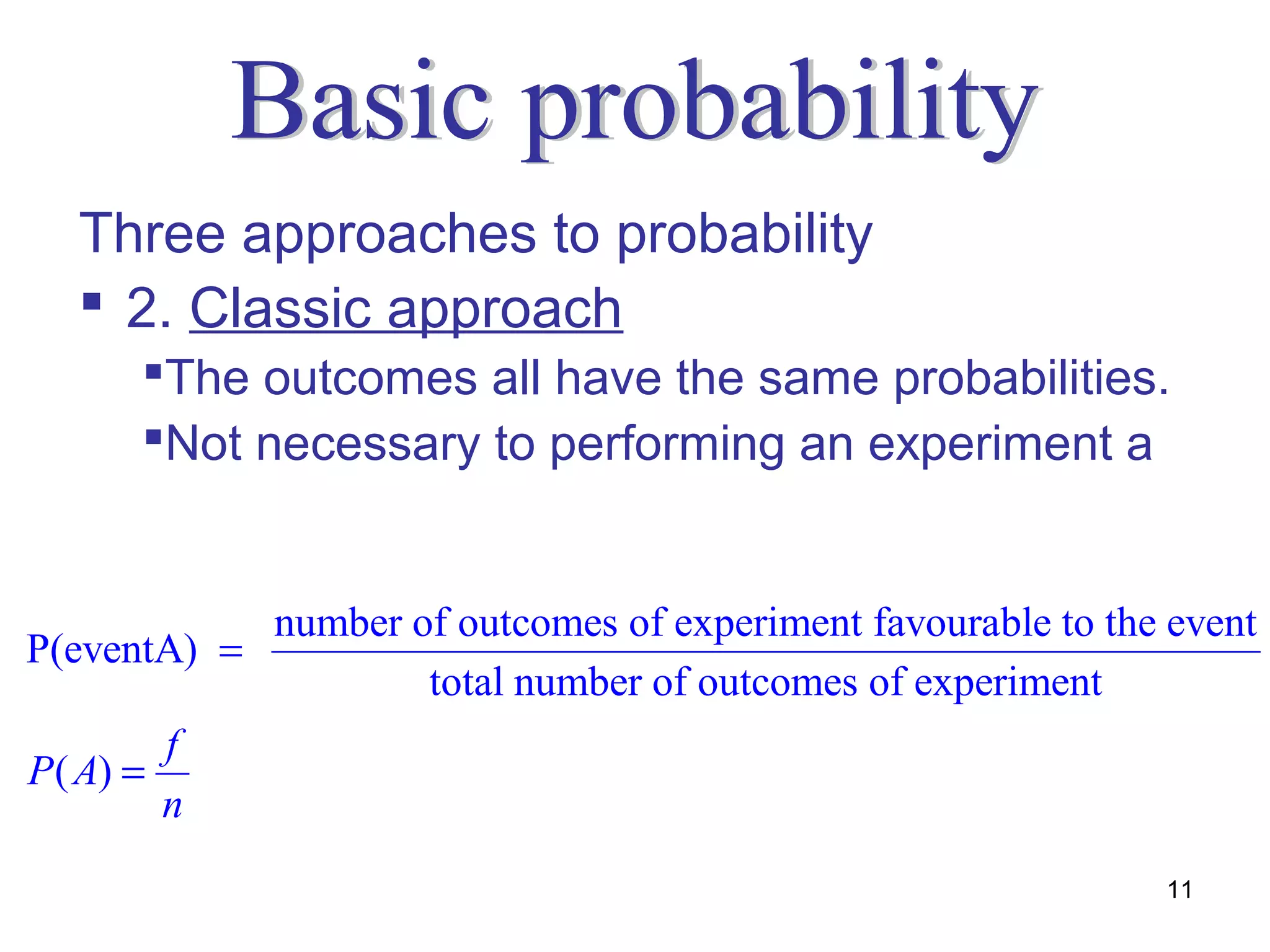
    2. Classic approach
       The outcomes all have the same probabilities.
       Not necessary to performing an experiment a


              number of outcomes of experiment favourable to the event
P(eventA) =
                      total number of outcomes of experiment
         f
P ( A) =
         n
                                                                11
Three approaches to probability
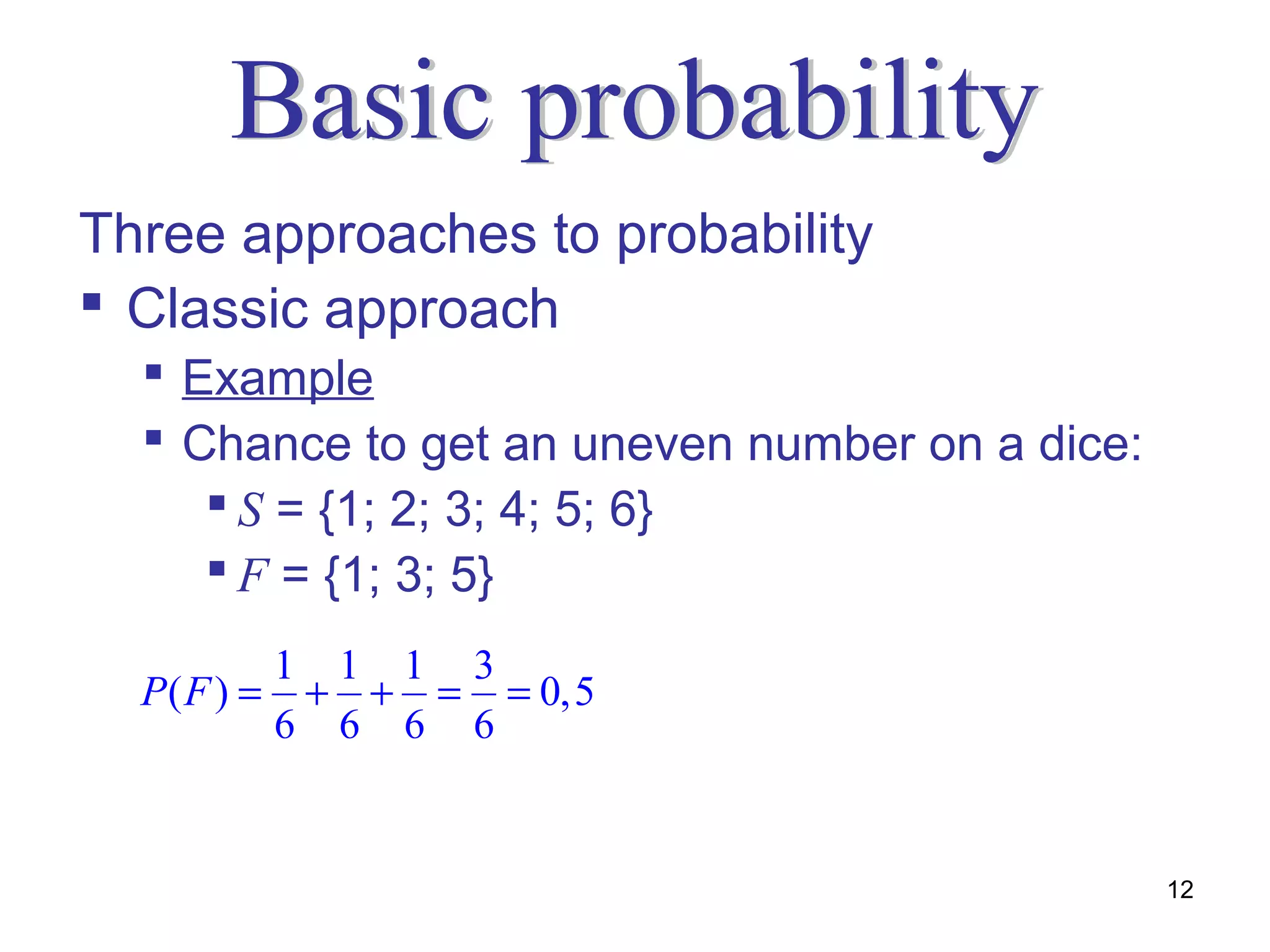
 Classic approach
   Example
   Chance to get an uneven number on a dice:
      S = {1; 2; 3; 4; 5; 6}
      F = {1; 3; 5}
             1 1 1 3
  P( F ) =    + + = = 0,5
             6 6 6 6


                                                12
Three approaches to probability
 3. Subjective approach
   The probabilities assigned to the outcomes of
    the experiment is subjective to the person who
    performs the experiment.


                                                13
 The word “or” in probability is an indication of
  addition
    P(A or B)

 The word “and” in probability is an indication of
  multiplication
    P(A and B)


                                                      14
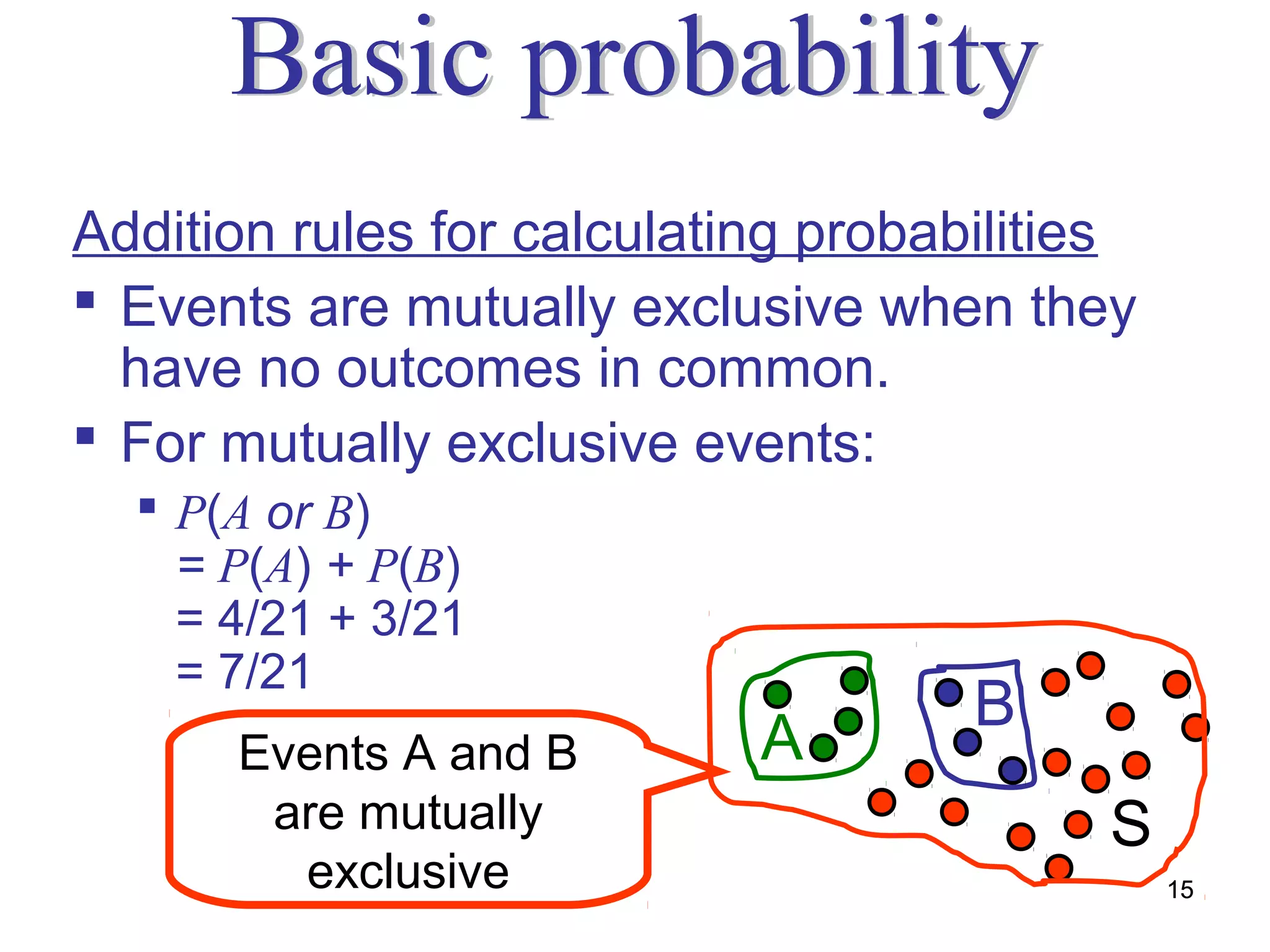
Addition rules for calculating probabilities
 Events are mutually exclusive when they
  have no outcomes in common.
 For mutually exclusive events:
   P(A or B)
    = P(A) + P(B)
    = 4/21 + 3/21
    = 7/21
                                     B
      Events A and B        A
       are mutually                       S
        exclusive                              15
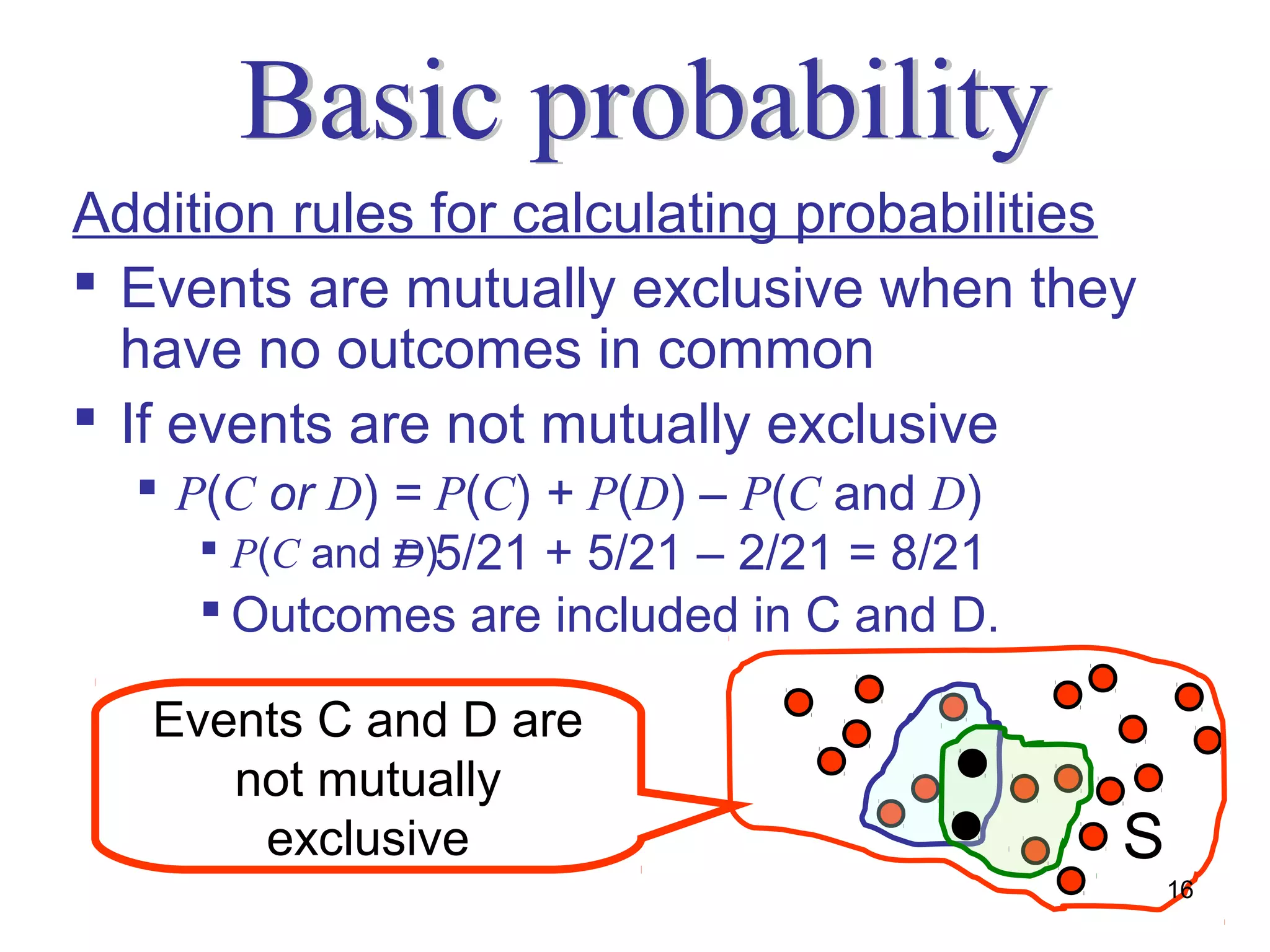
Addition rules for calculating probabilities
 Events are mutually exclusive when they
  have no outcomes in common
 If events are not mutually exclusive
   P(C or D) = P(C) + P(D) – P(C and D)
      P(C and = 5/21 + 5/21 – 2/21 = 8/21
               D)
      Outcomes are included in C and D.

   Events C and D are
      not mutually
       exclusive                             S
                                                 16
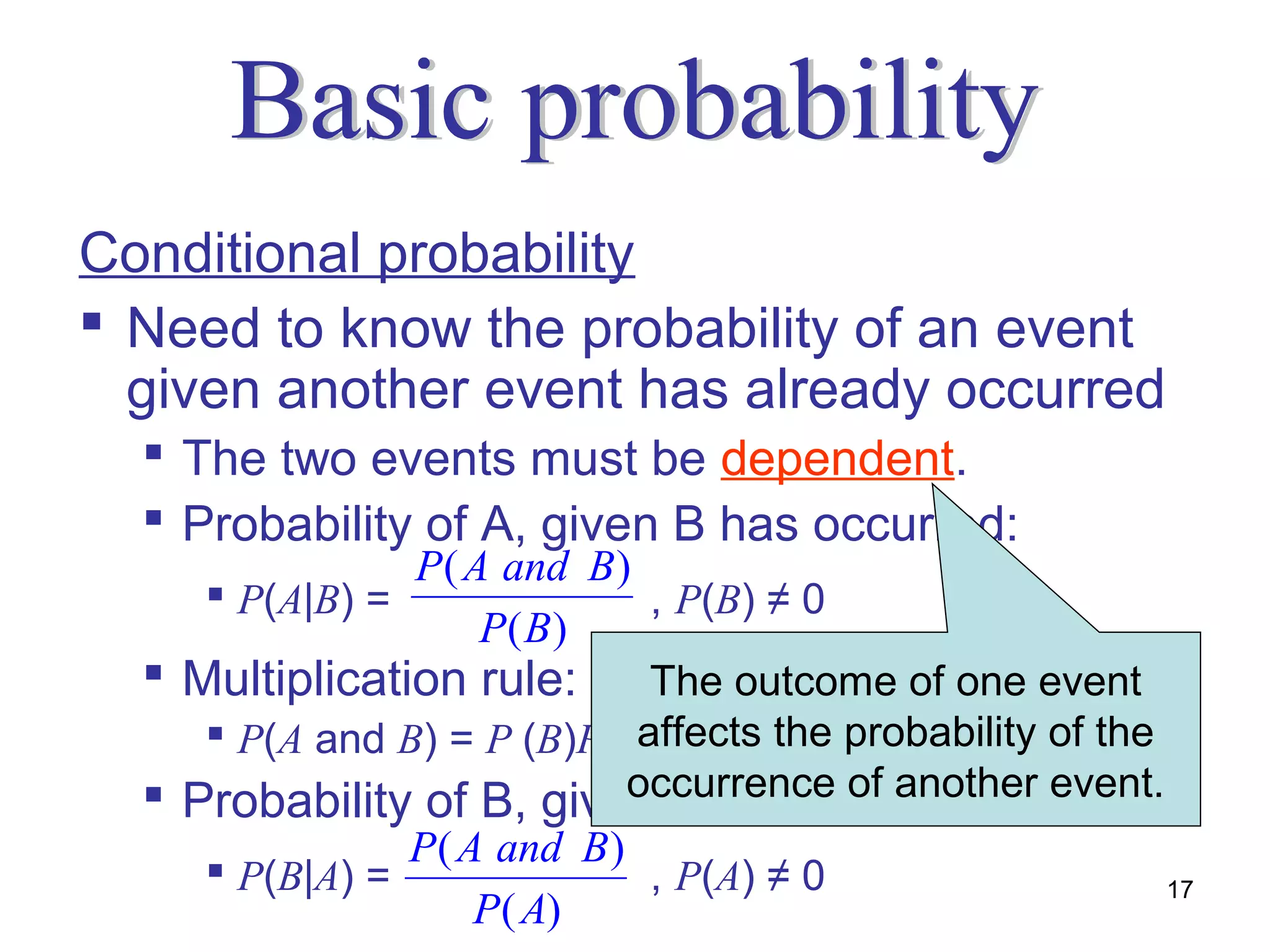
Conditional probability
 Need to know the probability of an event
  given another event has already occurred
   The two events must be dependent.
   Probability of A, given B has occurred:
                P ( A and B )
      P(A|B) =                , P(B) ≠ 0
                     P( B)
   Multiplication rule: The outcome of one event
                              affects the probability of the
      P(A and B) = P (B)P(A|B)
   Probability of B, given A has occurred: event.
                              occurrence of another
                P ( A and B )
      P(B|A) =                , P(A) ≠ 0                    17
                     P( A)
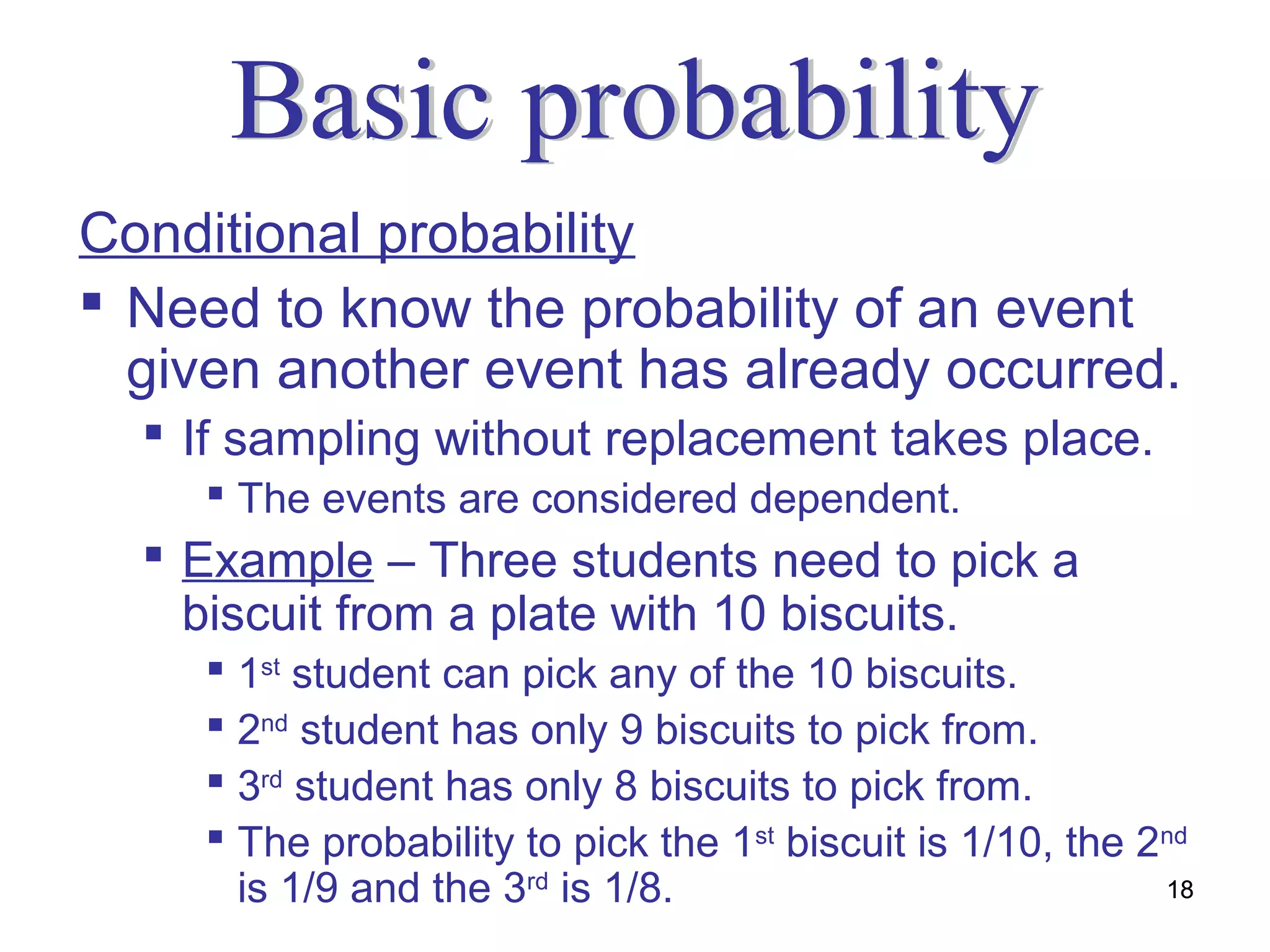
Conditional probability
 Need to know the probability of an event
  given another event has already occurred.
   If sampling without replacement takes place.
     The events are considered dependent.
   Example – Three students need to pick a
    biscuit from a plate with 10 biscuits.
     1st student can pick any of the 10 biscuits.
     2nd student has only 9 biscuits to pick from.
     3rd student has only 8 biscuits to pick from.
     The probability to pick the 1st biscuit is 1/10, the 2nd
      is 1/9 and the 3rd is 1/8.                            18
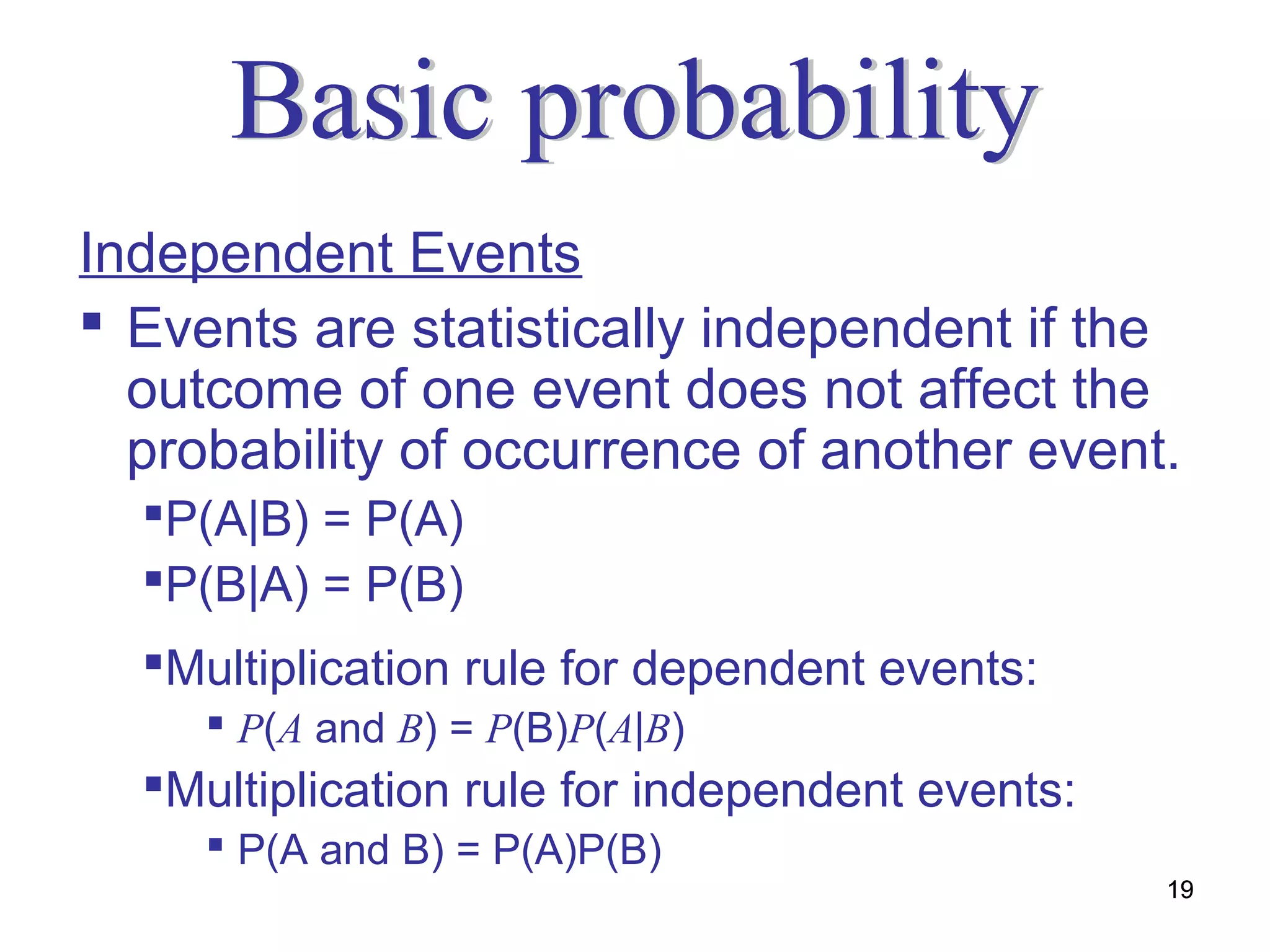
Independent Events
 Events are statistically independent if the
  outcome of one event does not affect the
  probability of occurrence of another event.
  P(A|B) = P(A)
  P(B|A) = P(B)
  Multiplication rule for dependent events:
      P(A and B) = P(B)P(A|B)
  Multiplication rule for independent events:
      P(A and B) = P(A)P(B)
                                                 19
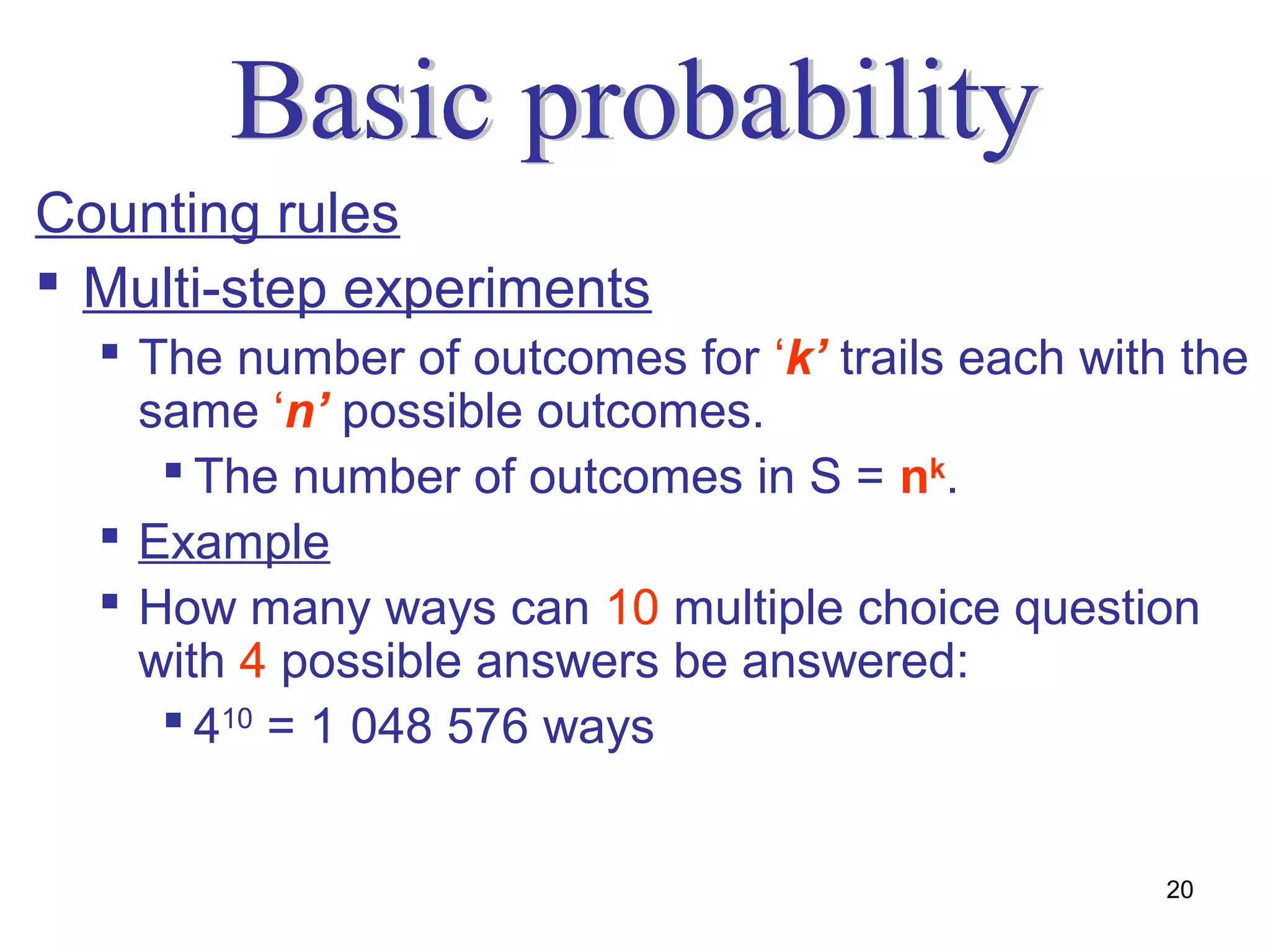
Counting rules
 Multi-step experiments
   The number of outcomes for ‘k’ trails each with the
    same ‘n’ possible outcomes.
      The number of outcomes in S = nk.
   Example
   How many ways can 10 multiple choice question
    with 4 possible answers be answered:
      410 = 1 048 576 ways


                                                   20
Counting rules
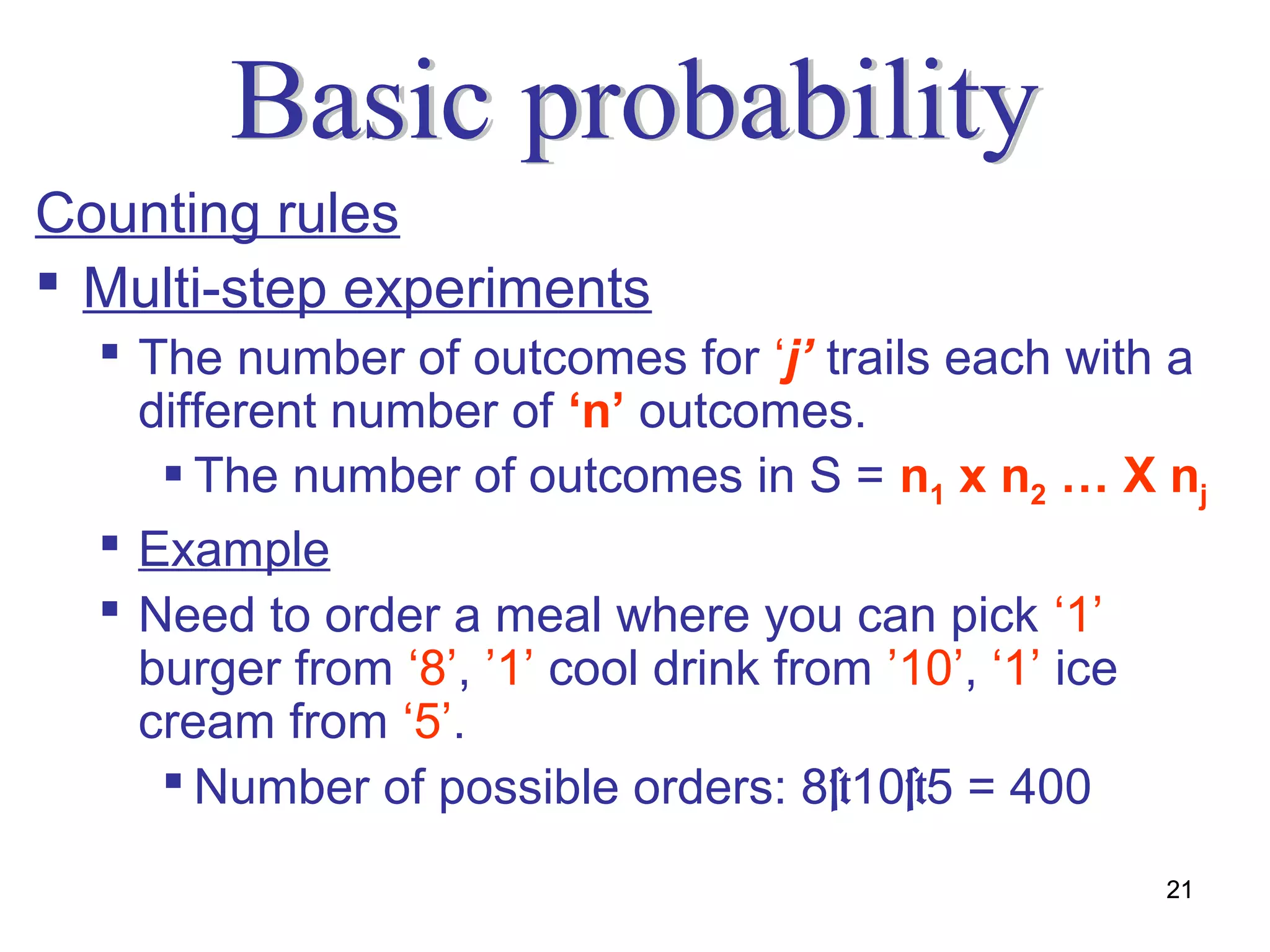
 Multi-step experiments
   The number of outcomes for ‘j’ trails each with a
    different number of ‘n’ outcomes.
      The number of outcomes in S = n1 x n2 … X nj
   Example
   Need to order a meal where you can pick ‘1’
    burger from ‘8’, ’1’ cool drink from ’10’, ‘1’ ice
    cream from ‘5’.
      Number of possible orders: 8×10×5 = 400

                                                    21
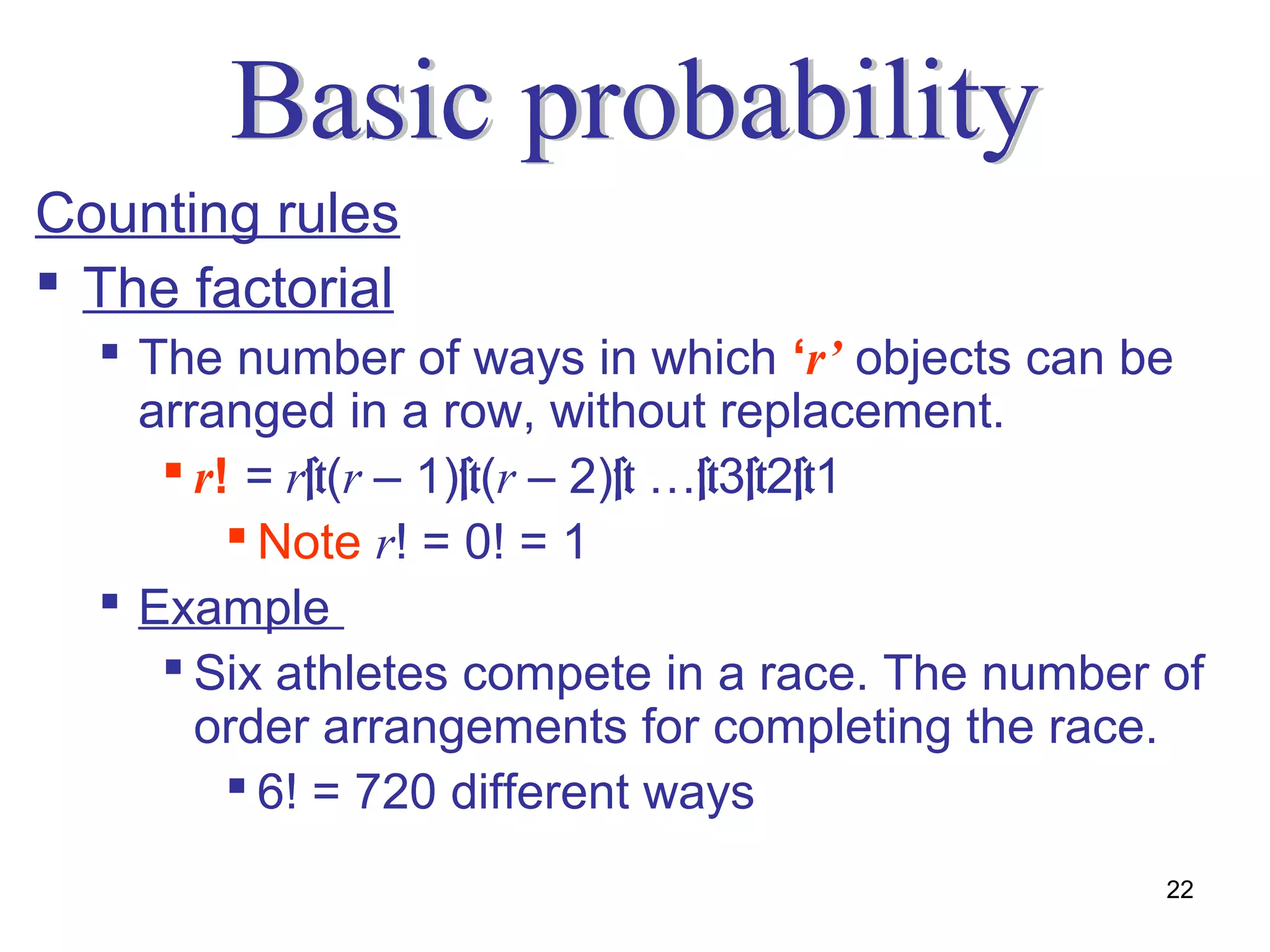
Counting rules
 The factorial
   The number of ways in which ‘r’ objects can be
    arranged in a row, without replacement.
      r! = r×(r – 1)×(r – 2)× …×3×2×1
          Note r! = 0! = 1
   Example
      Six athletes compete in a race. The number of
       order arrangements for completing the race.
          6! = 720 different ways
                                                  22
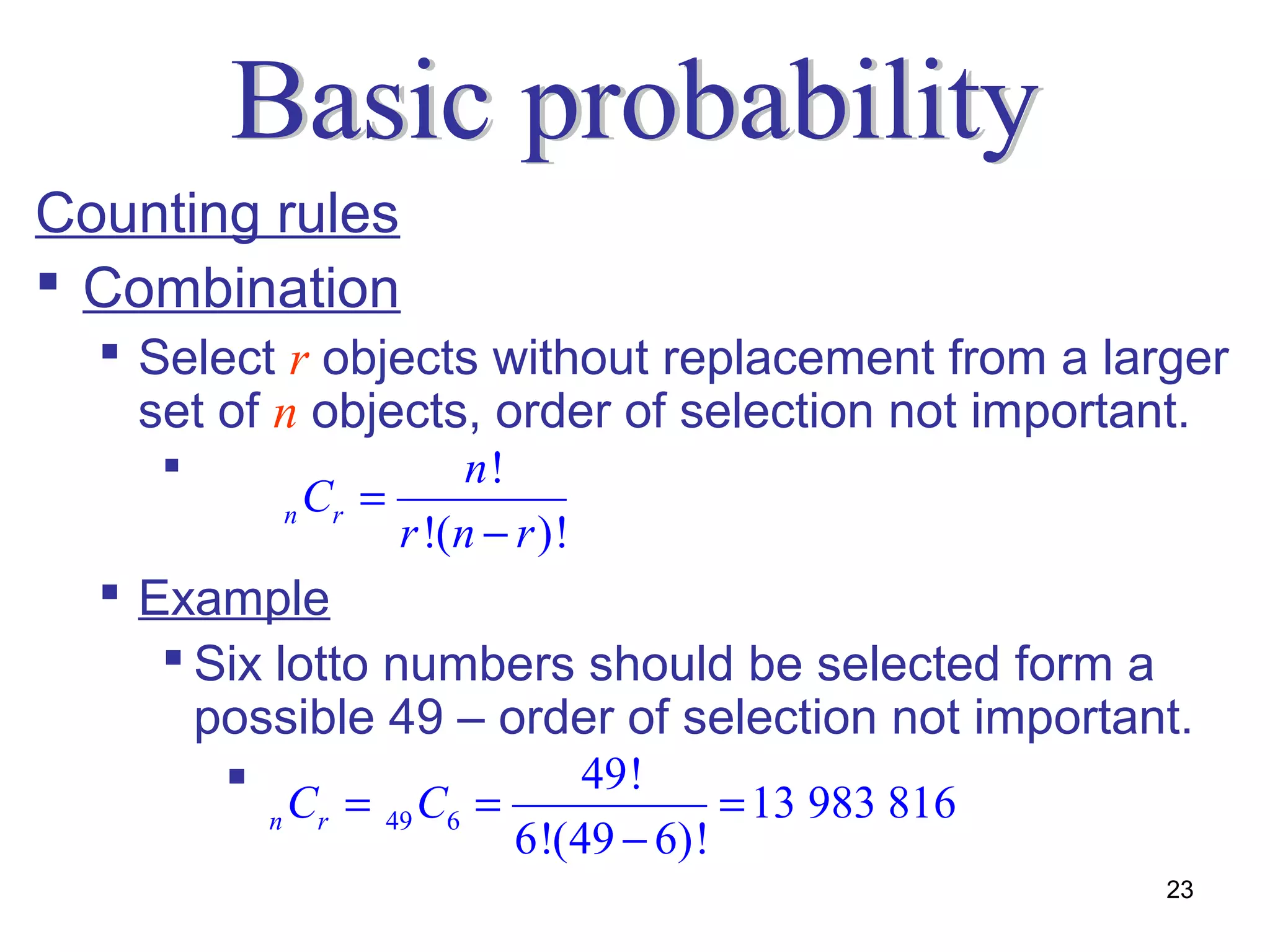
Counting rules
 Combination
   Select r objects without replacement from a larger
    set of n objects, order of selection not important.
                         n!
              n Cr =
                     r !(n − r )!
   Example
      Six lotto numbers should be selected form a
       possible 49 – order of selection not important.
         C = C =       49!
          n     r   49   6     = 13 983 816
                             6!(49 − 6)!
                                                    23
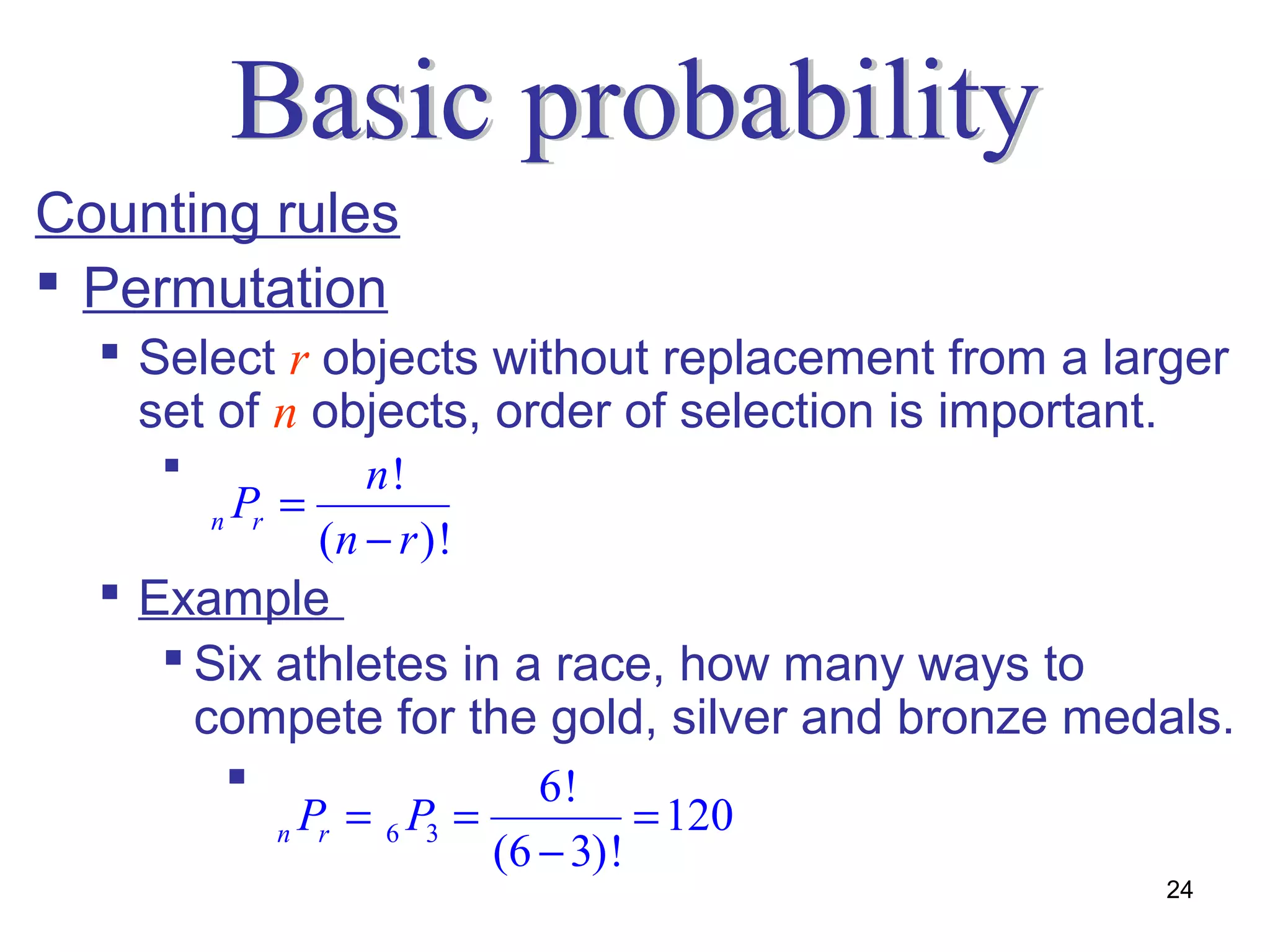
Counting rules
 Permutation
   Select r objects without replacement from a larger
    set of n objects, order of selection is important.
               n!
        nP =
          r
             (n − r )!
   Example
      Six athletes in a race, how many ways to
       compete for the gold, silver and bronze medals.
                       6!
           n   Pr = 6 P3 =              = 120
                             (6 − 3)!
                                                   24
Additional examples


                      25
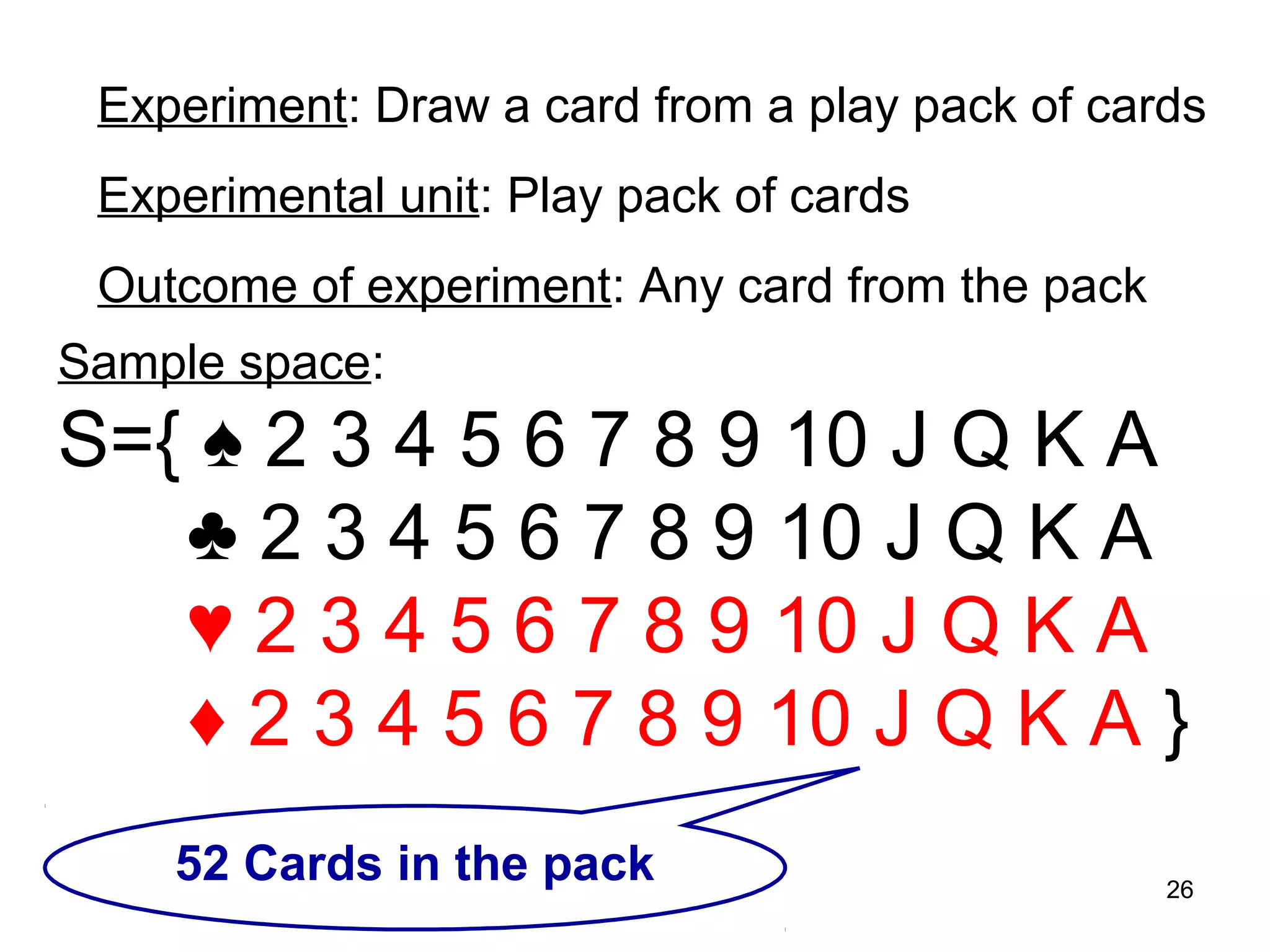
Experiment: Draw a card from a play pack of cards
 Experimental unit: Play pack of cards
 Outcome of experiment: Any card from the pack
Sample space:
S={ ♠ 2 3 4 5 6 7 8 9 10 J Q K A
   ♣ 2 3 4 5 6 7 8 9 10 J Q K A
   ♥ 2 3 4 5 6 7 8 9 10 J Q K A
   ♦ 2 3 4 5 6 7 8 9 10 J Q K A }
    52 Cards in the pack                         26
A
S={ ♠ 2 3 4 5 6 7 8 9 10 J Q K A
   ♣ 2 3 4 5 6 7 8 9 10 J Q K A
   ♥ 2 3 4 5 6 7 8 9 10 J Q K A
   ♦ 2 3 4 5 6 7 8 9 10 J Q K A }
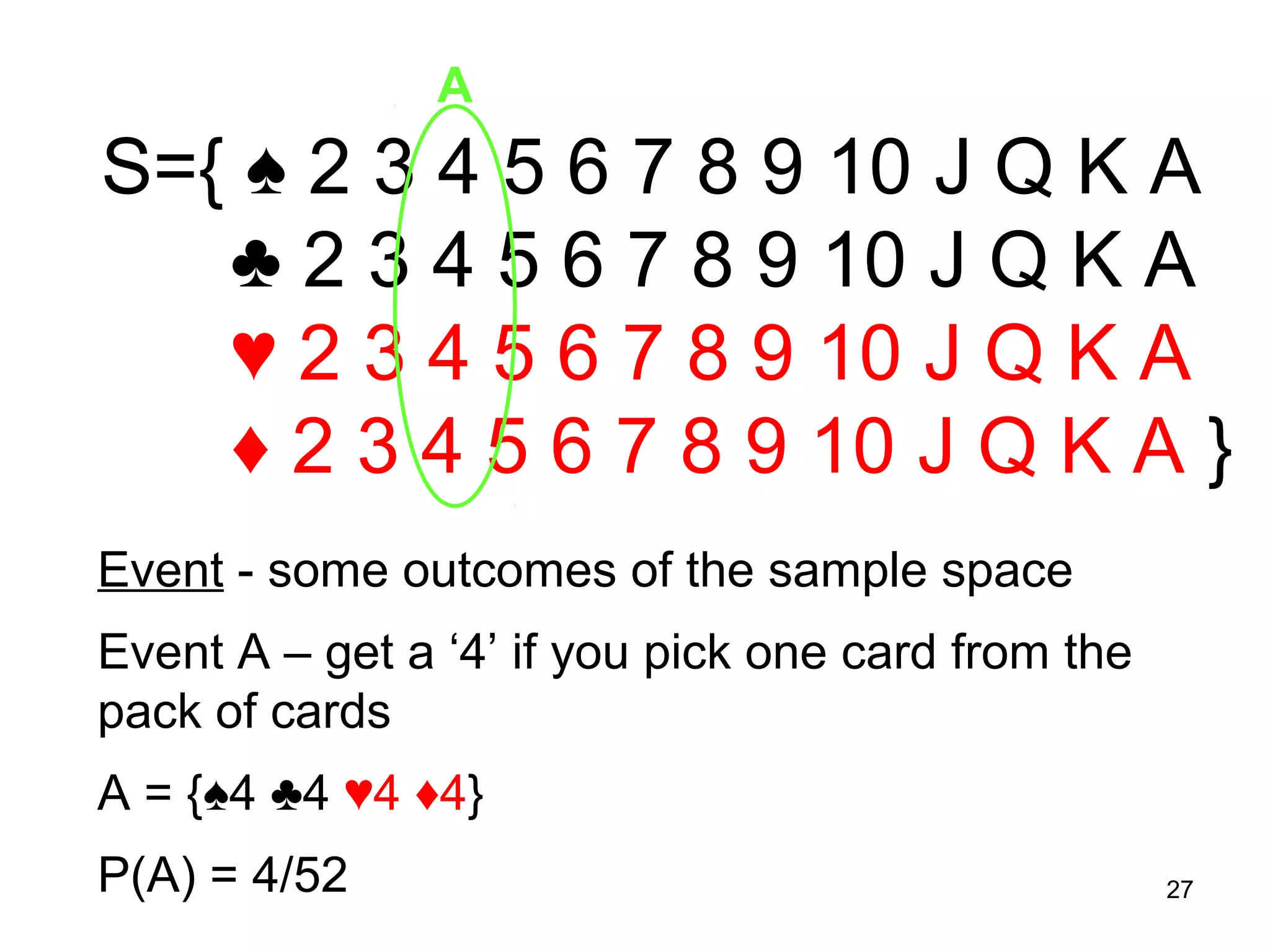
Event - some outcomes of the sample space
Event A – get a ‘4’ if you pick one card from the
pack of cards
A = {♠4 ♣4 ♥4 ♦4}
P(A) = 4/52                                         27
B

S={ ♠ 2 3 4 5 6 7 8 9 10 J Q K A
   ♣ 2 3 4 5 6 7 8 9 10 J Q K A
   ♥ 2 3 4 5 6 7 8 9 10 J Q K A
   ♦ 2 3 4 5 6 7 8 9 10 J Q K A }
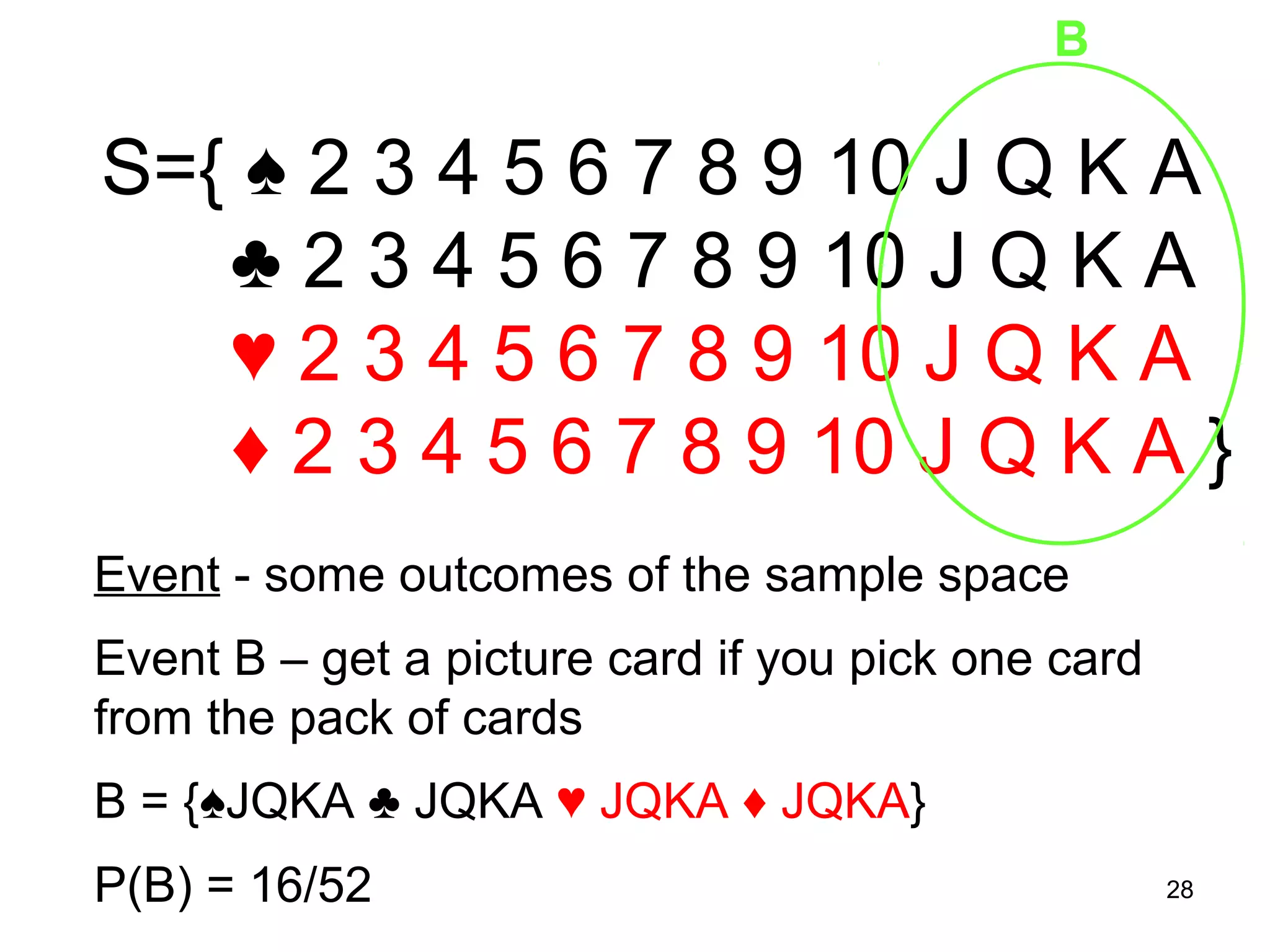
Event - some outcomes of the sample space
Event B – get a picture card if you pick one card
from the pack of cards
B = {♠JQKA ♣ JQKA ♥ JQKA ♦ JQKA}
P(B) = 16/52                                        28
B

S={ ♠ 2 3 4 5 6 7 8 9 10 J Q K A
   ♣ 2 3 4 5 6 7 8 9 10 J Q K A
   ♥ 2 3 4 5 6 7 8 9 10 J Q K A
   ♦ 2 3 4 5 6 7 8 9 10 J Q K A }
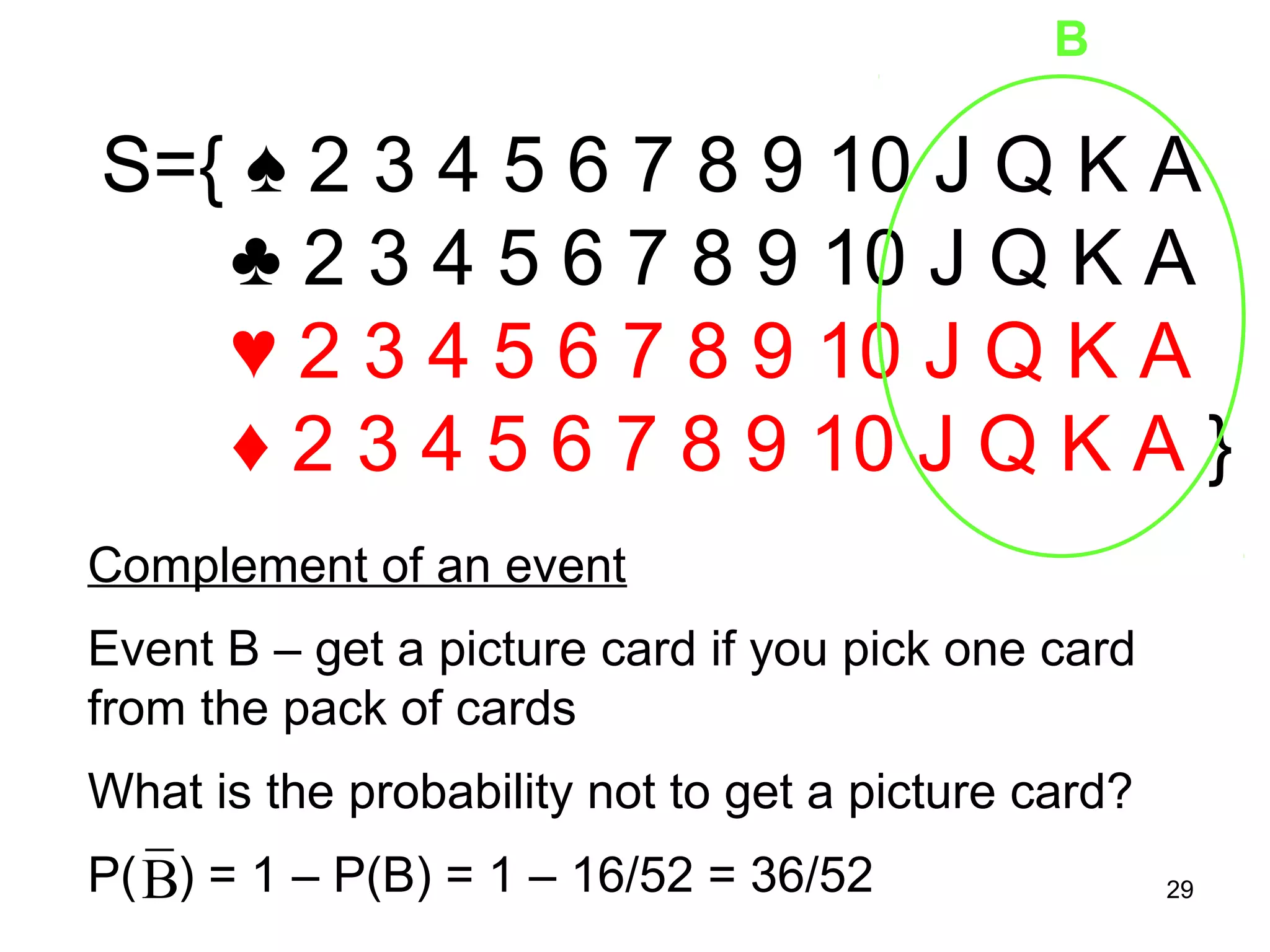
Complement of an event
Event B – get a picture card if you pick one card
from the pack of cards
What is the probability not to get a picture card?
P( B) = 1 – P(B) = 1 – 16/52 = 36/52                 29
B
                  A
S={ ♠ 2 3 4 5 6 7 8 9 10 J Q K A
   ♣ 2 3 4 5 6 7 8 9 10 J Q K A
   ♥ 2 3 4 5 6 7 8 9 10 J Q K A
   ♦ 2 3 4 5 6 7 8 9 10 J Q K A }
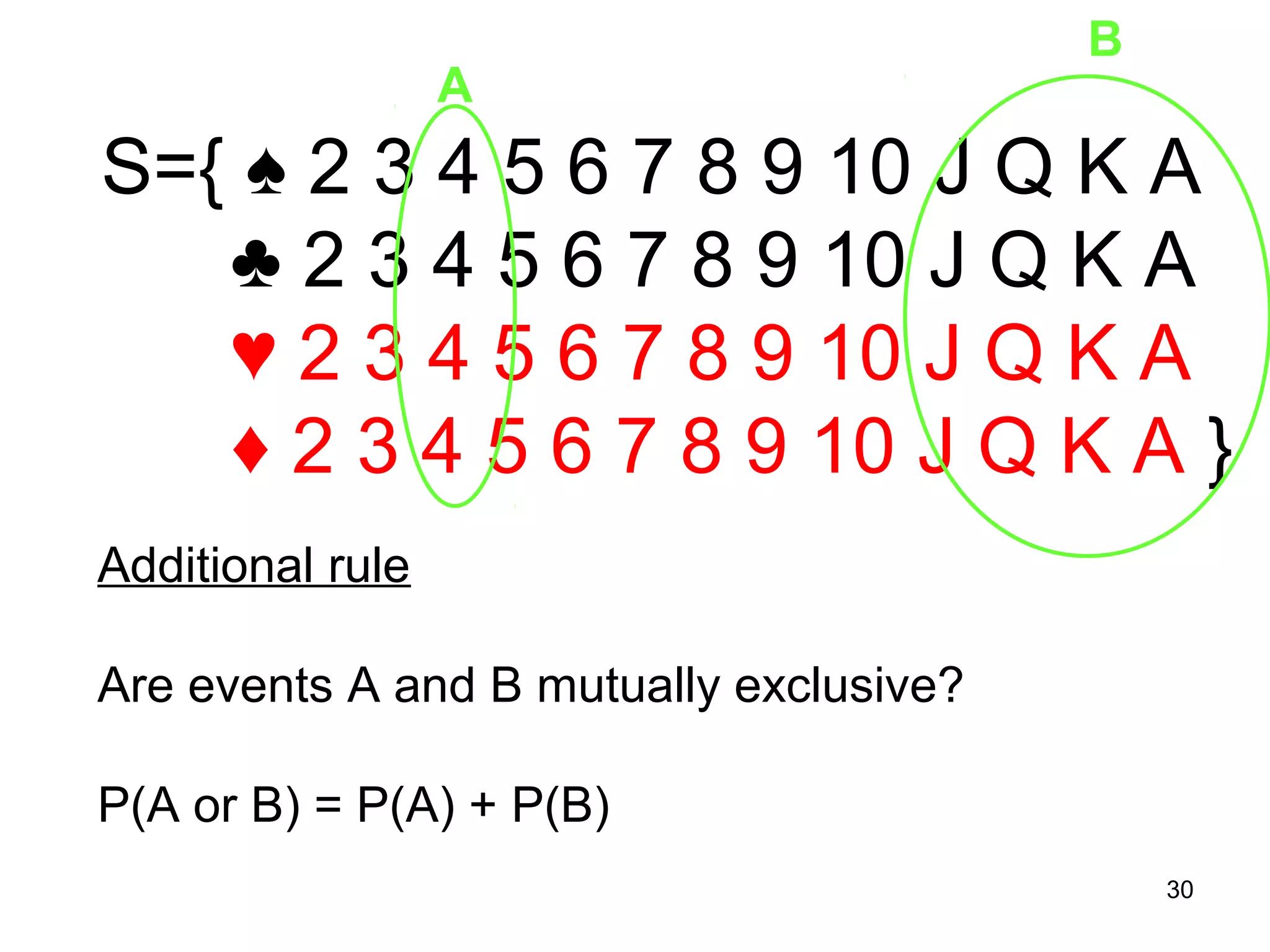
Additional rule

Are events A and B mutually exclusive?

P(A or B) = P(A) + P(B) = 4/52 + 16/52 = 20/52
                                                 30
S={ ♠ 2 3 4 5 6 7 8 9 10 J Q K A
   ♣ 2 3 4 5 6 7 8 9 10 J Q K A
   ♥ 2 3 4 5 6 7 8 9 10 J Q K A
 C
   ♦ 2 3 4 5 6 7 8 9 10 J Q K A }
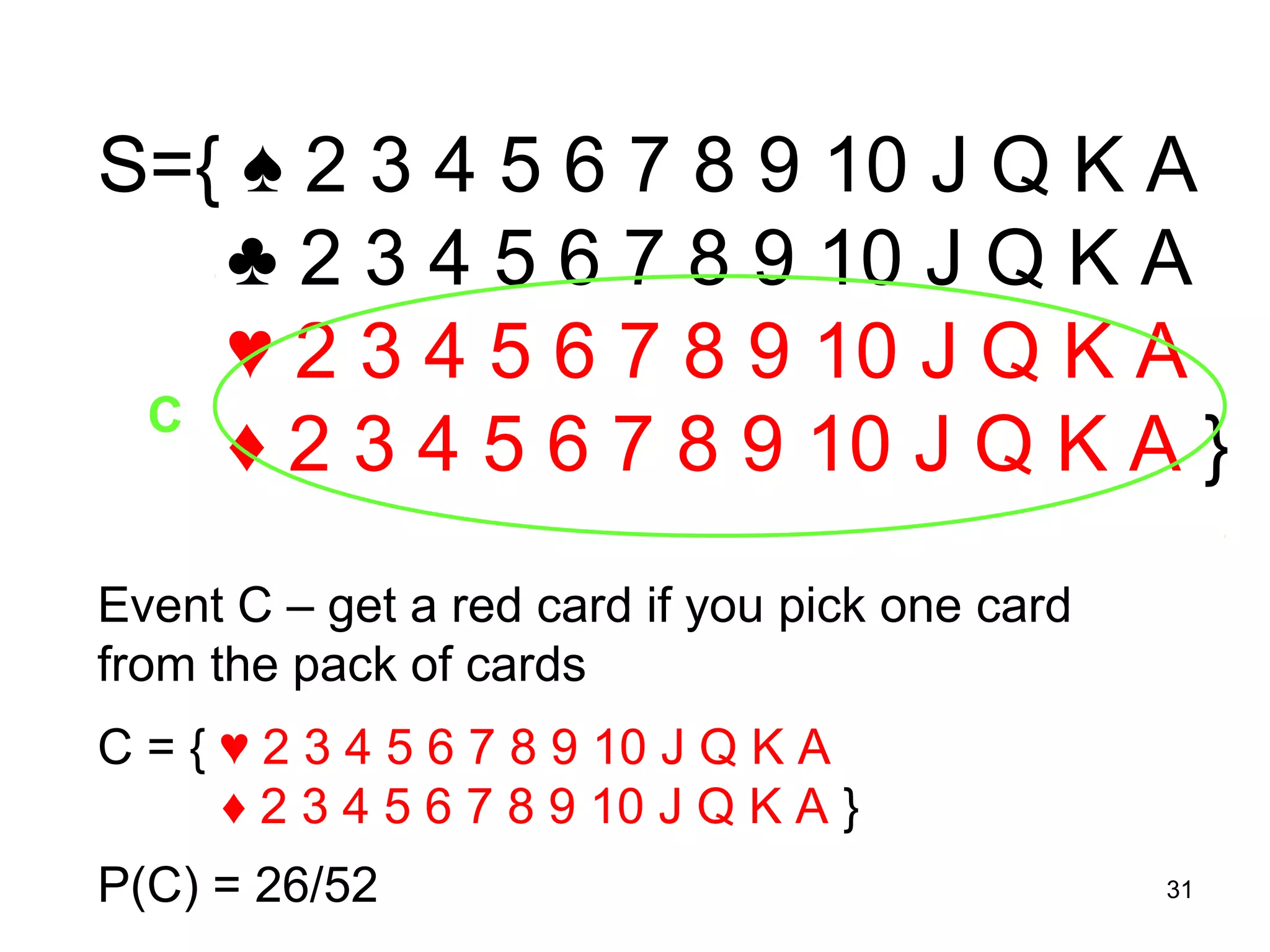
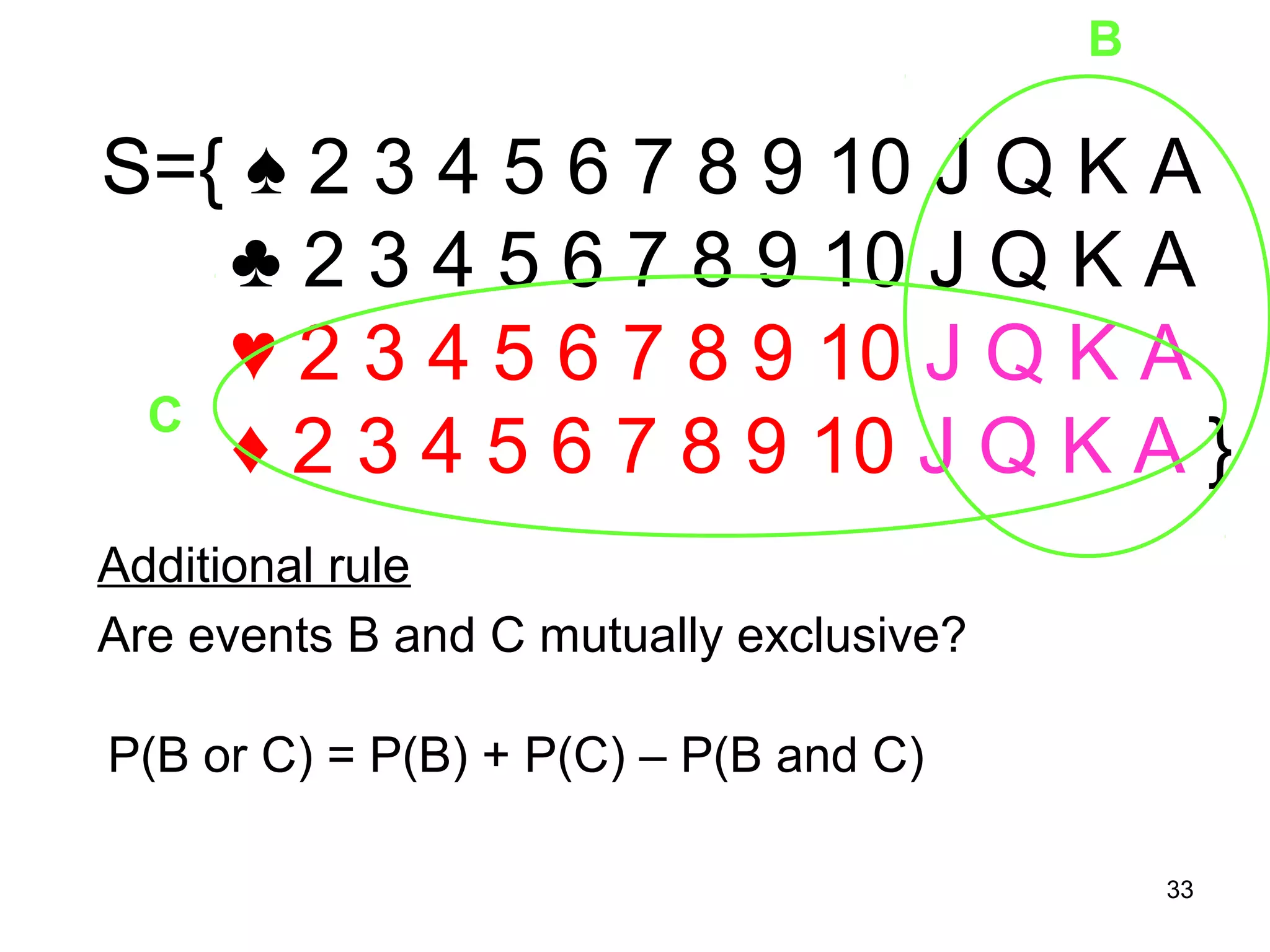
Event C – get a red card if you pick one card
from the pack of cards
C = { ♥ 2 3 4 5 6 7 8 9 10 J Q K A
      ♦ 2 3 4 5 6 7 8 9 10 J Q K A }
P(C) = 26/52                                    31
B

S={ ♠ 2 3 4 5 6 7 8 9 10 J Q K A
   ♣ 2 3 4 5 6 7 8 9 10 J Q K A
   ♥ 2 3 4 5 6 7 8 9 10 J Q K A
 C
   ♦ 2 3 4 5 6 7 8 9 10 J Q K A }
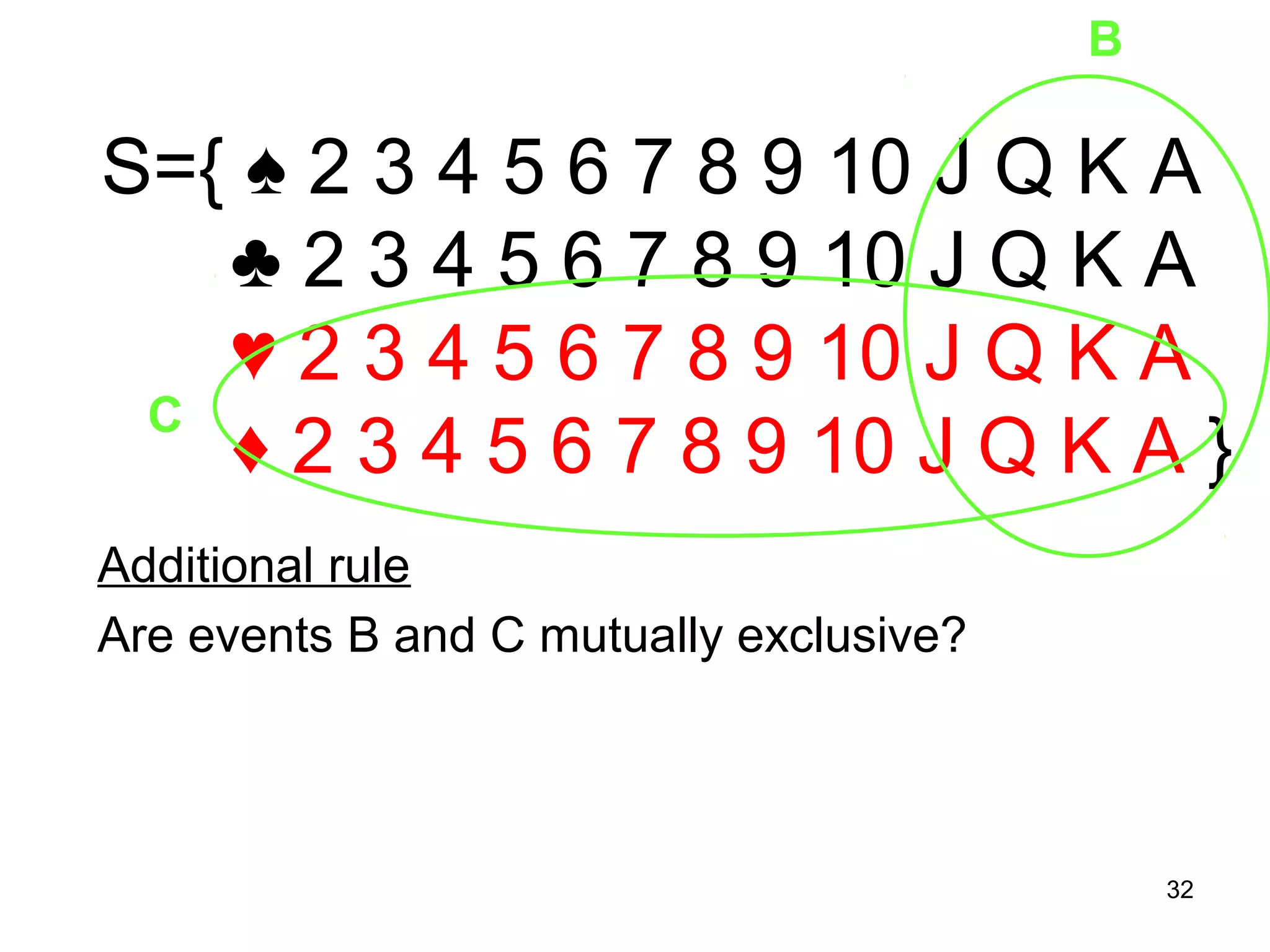
Additional rule
Are events B and C mutually exclusive?


                                             32
B

S={ ♠ 2 3 4 5 6 7 8 9 10 J Q K A
   ♣ 2 3 4 5 6 7 8 9 10 J Q K A
   ♥ 2 3 4 5 6 7 8 9 10 J Q K A
 C
   ♦ 2 3 4 5 6 7 8 9 10 J Q K A }
Additional rule
Are events B and C mutually exclusive?

P(B or C) = P(B) + P(C) – P(B and C)
= 16/52 + 26/52 – 8/52 = 34/52
                                             33
B

S={ ♠ 2 3 4 5 6 7 8 9 10 J Q K A
   ♣ 2 3 4 5 6 7 8 9 10 J Q K A
   ♥ 2 3 4 5 6 7 8 9 10 J Q K A
 C
   ♦ 2 3 4 5 6 7 8 9 10 J Q K A }
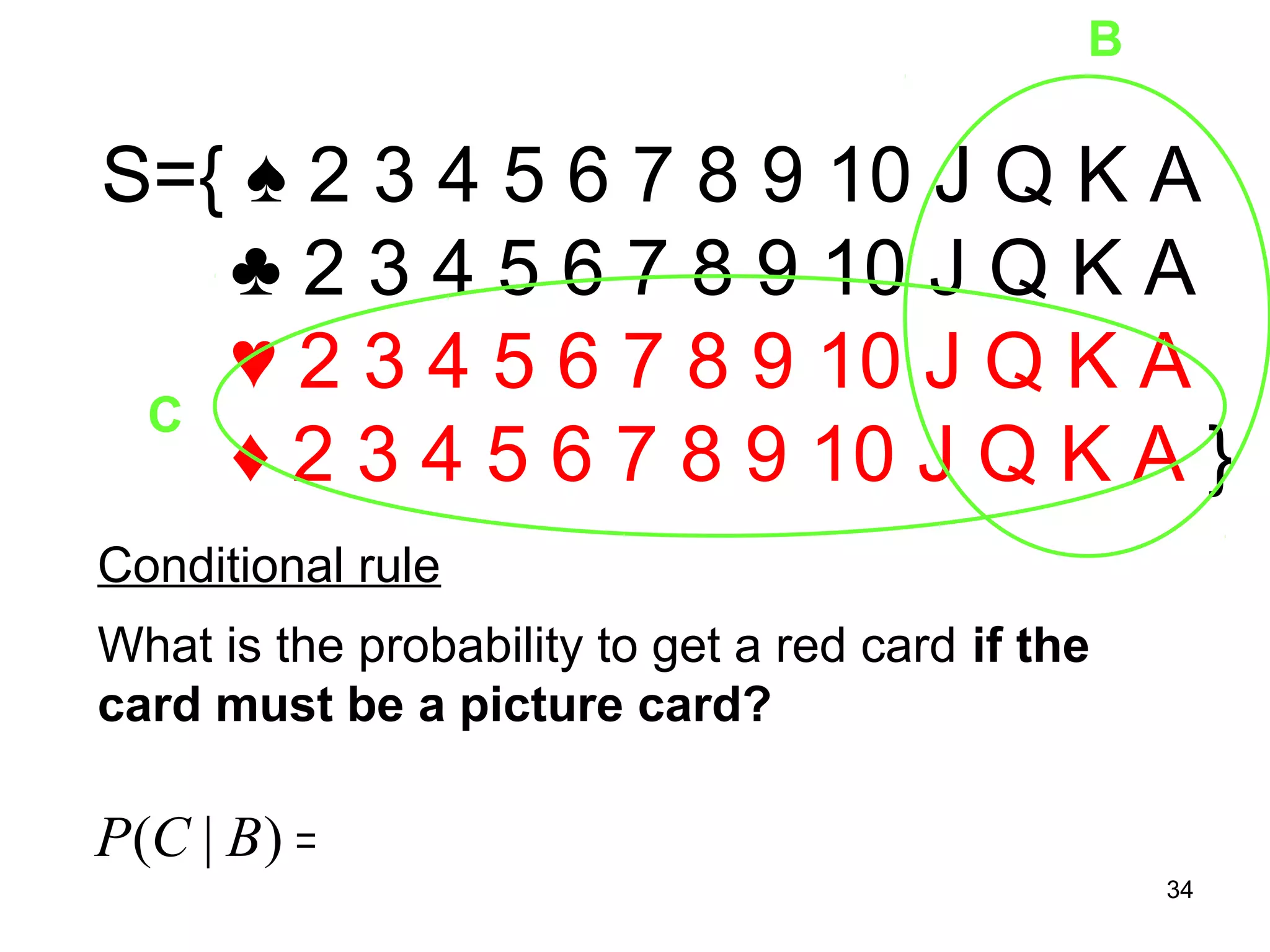
Conditional rule
What is the probability to get a red card if the
card must be a picture card?
                             8
            P (C and B )     52 = 8
P(C | B ) =              =
                P( B)      16    16                34
                              52
A

S={ ♠ 2 3 4 5 6 7 8 9 10 J Q K A
   ♣ 2 3 4 5 6 7 8 9 10 J Q K A
   ♥ 2 3 4 5 6 7 8 9 10 J Q K A
 C
   ♦ 2 3 4 5 6 7 8 9 10 J Q K A }
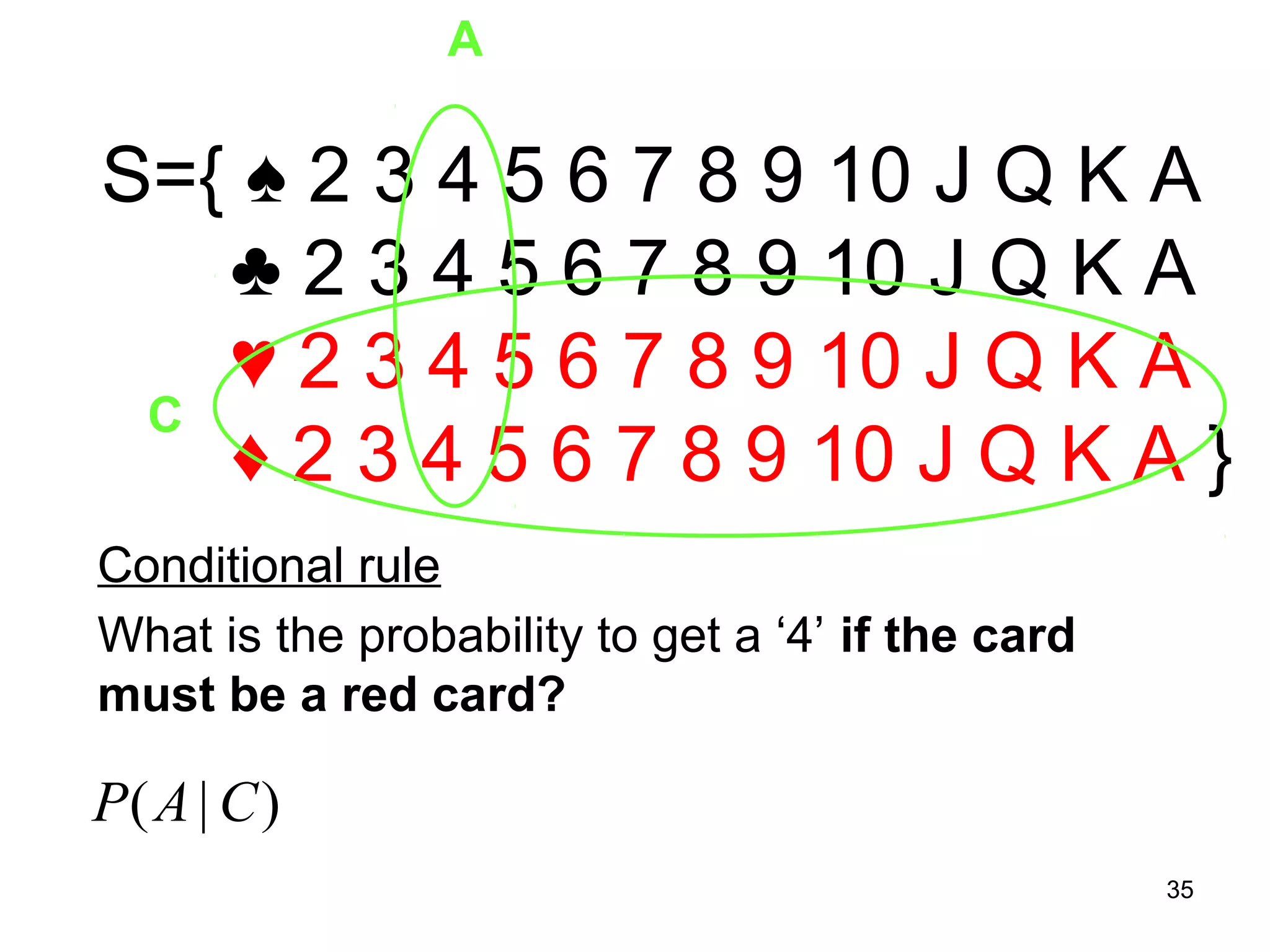
Conditional rule
What is the probability to get a ‘4’ if the card
must be a red card?
                              2
             P( A and C )     52 = 2
P( A | C ) =              =
                 P(C )      26     26
                               52                  35
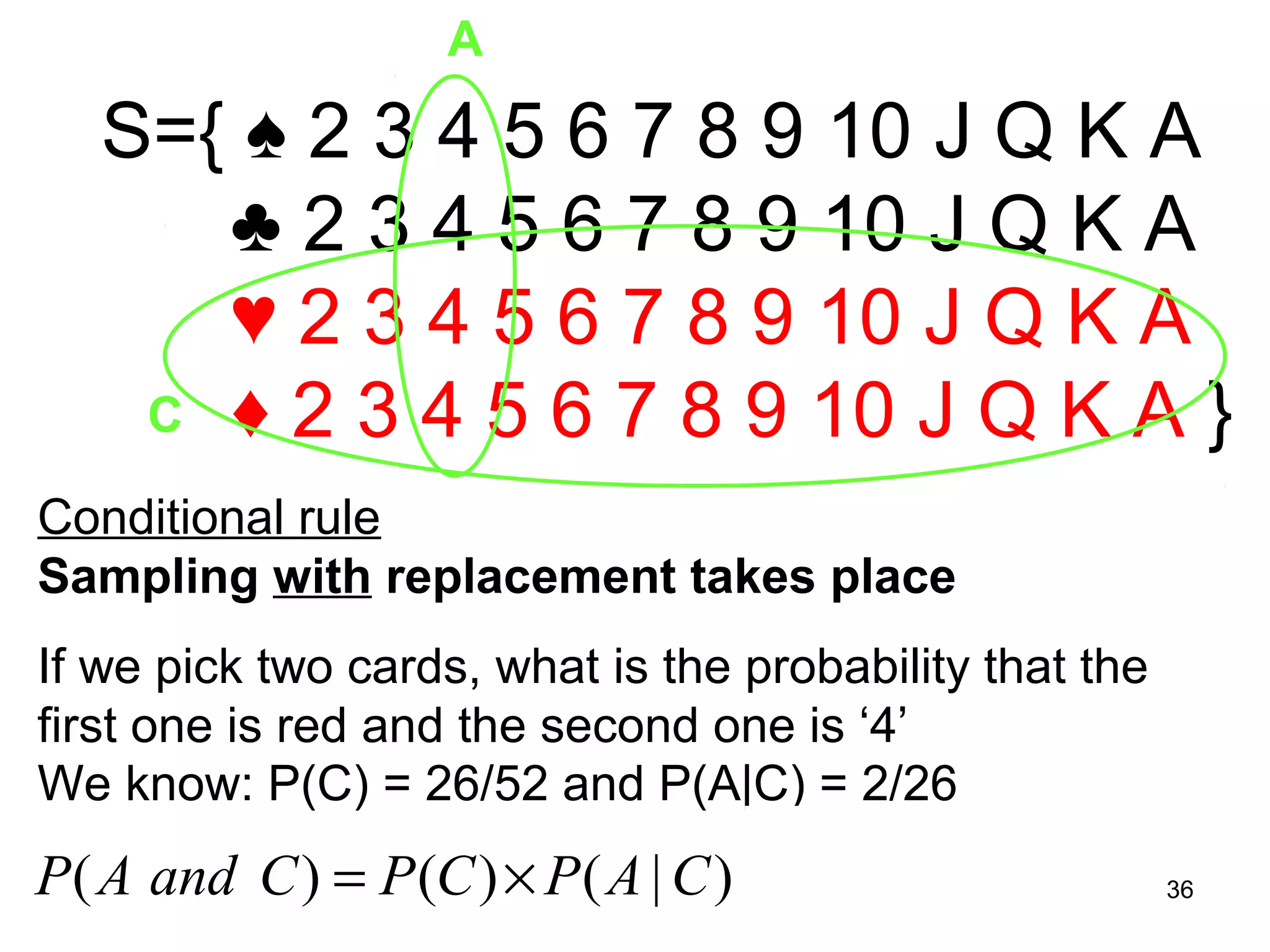
A

   S={ ♠ 2 3 4 5 6 7 8 9 10 J Q K A
      ♣ 2 3 4 5 6 7 8 9 10 J Q K A
      ♥ 2 3 4 5 6 7 8 9 10 J Q K A
    C ♦ 2 3 4 5 6 7 8 9 10 J Q K A }

Conditional rule
Sampling with replacement takes place
If we pick two cards, what is the probability that the
first one is red and the second one is ‘4’
We know: P(C) = 26/52 and P(A|C) = 2/26
                                                         2
P( A and C ) = P (C ) × P ( A | C ) = 26        ×2     = 36
                                           52        26 52
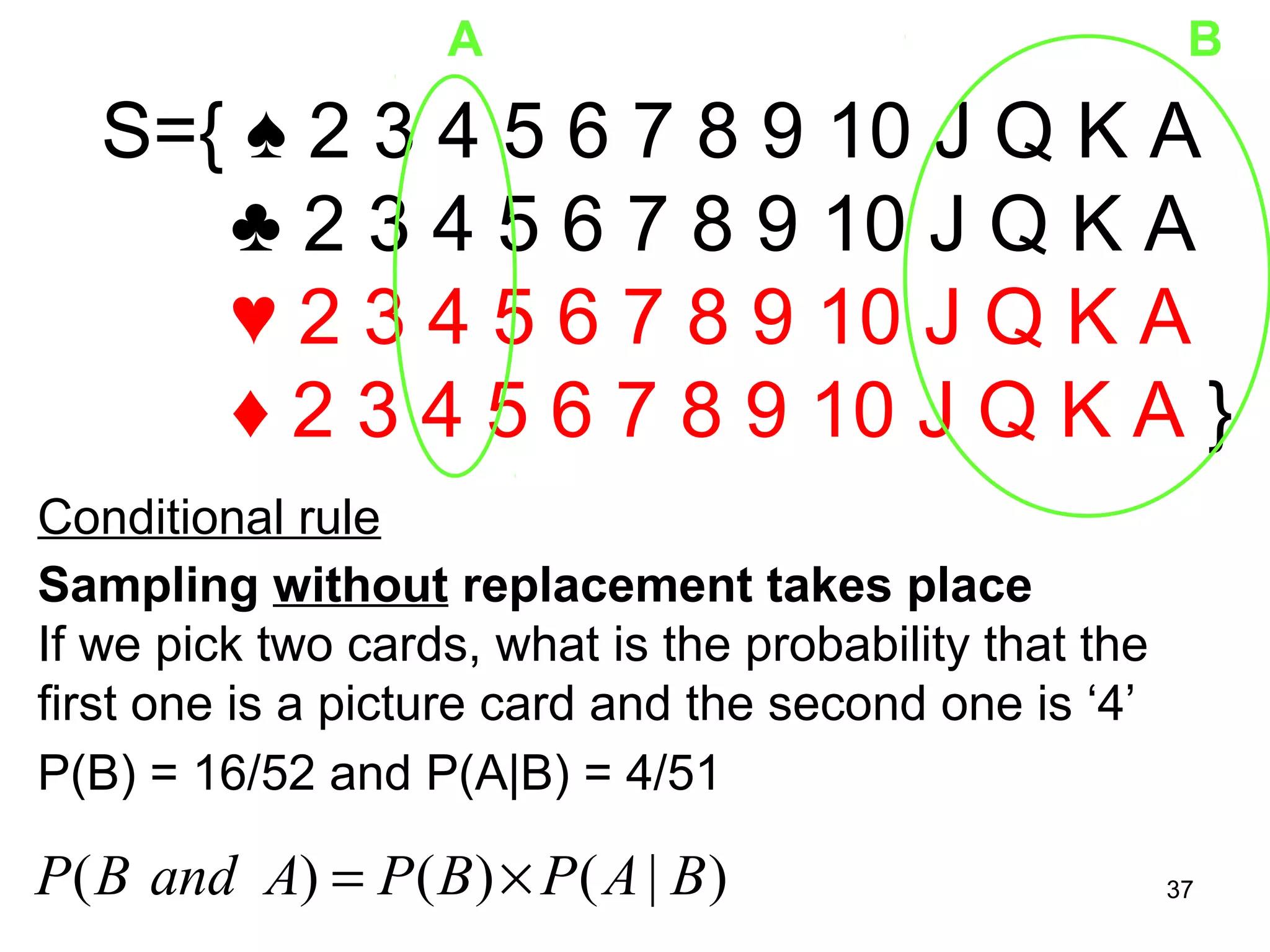
A                                      B

   S={ ♠ 2 3 4 5 6 7 8 9 10 J Q K A
      ♣ 2 3 4 5 6 7 8 9 10 J Q K A
      ♥ 2 3 4 5 6 7 8 9 10 J Q K A
      ♦ 2 3 4 5 6 7 8 9 10 J Q K A }
Conditional rule
Sampling without replacement takes place
If we pick two cards, what is the probability that the
first one is a picture card and the second one is ‘4’
P(B) = 16/52 and P(A|B) = 4/51
                                                         64
P( B and A) = P ( B ) × P ( A | B ) = 16        ×4     = 37
                                           52        51 2652
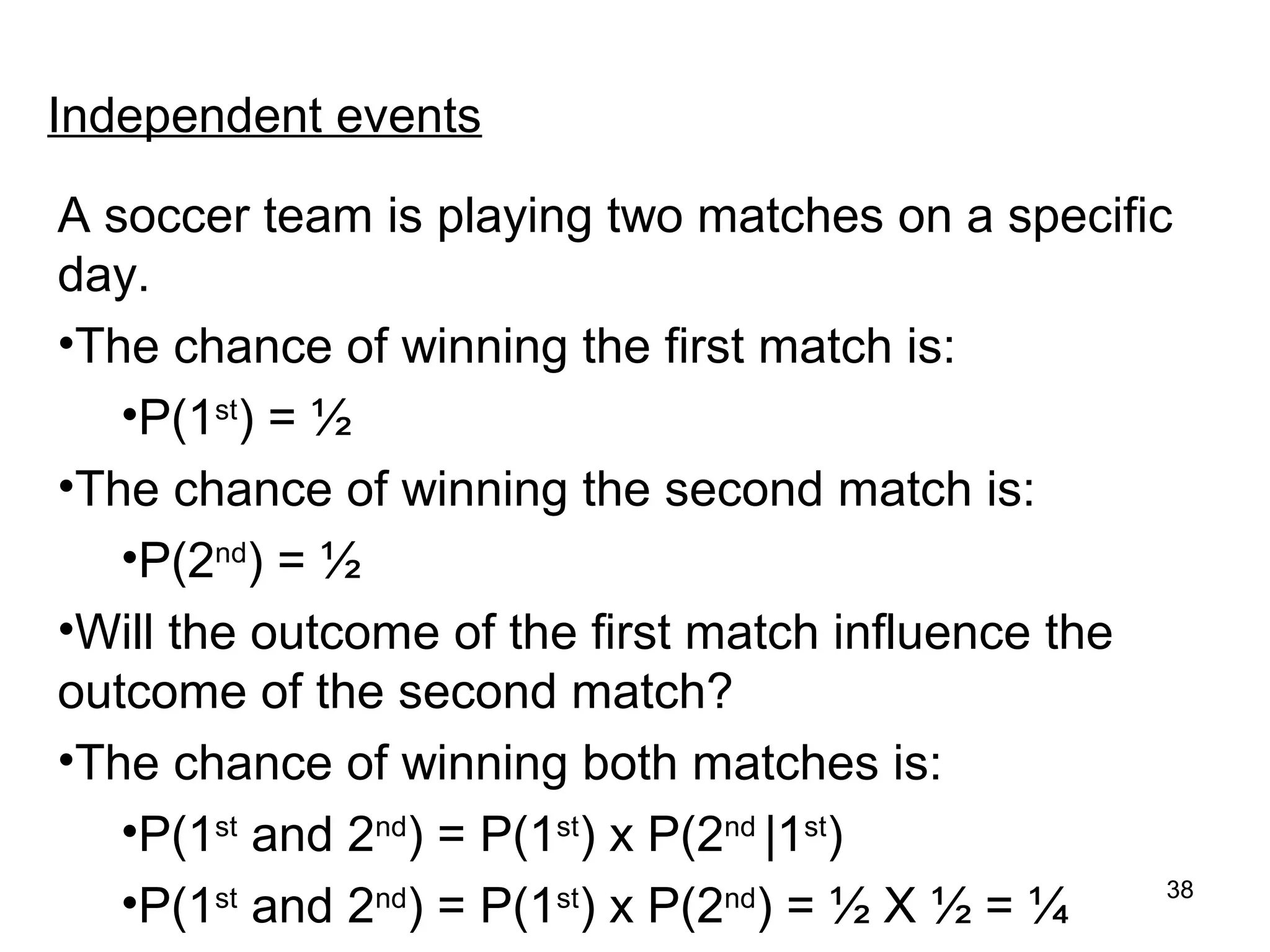
Independent events

A soccer team is playing two matches on a specific
day.
•The chance of winning the first match is:
   •P(1st) = ½
•The chance of winning the second match is:
   •P(2nd) = ½
•Will the outcome of the first match influence the
outcome of the second match?
•The chance of winning both matches is:
   •P(1st and 2nd) = P(1st) x P(2nd |1st)
   •P(1st and 2nd) = P(1st) x P(2nd) = ½ X ½ = ¼   38
In chapter 2 we looked at an example to organise
qualitative data into a frequency distribution table.


                                                        39
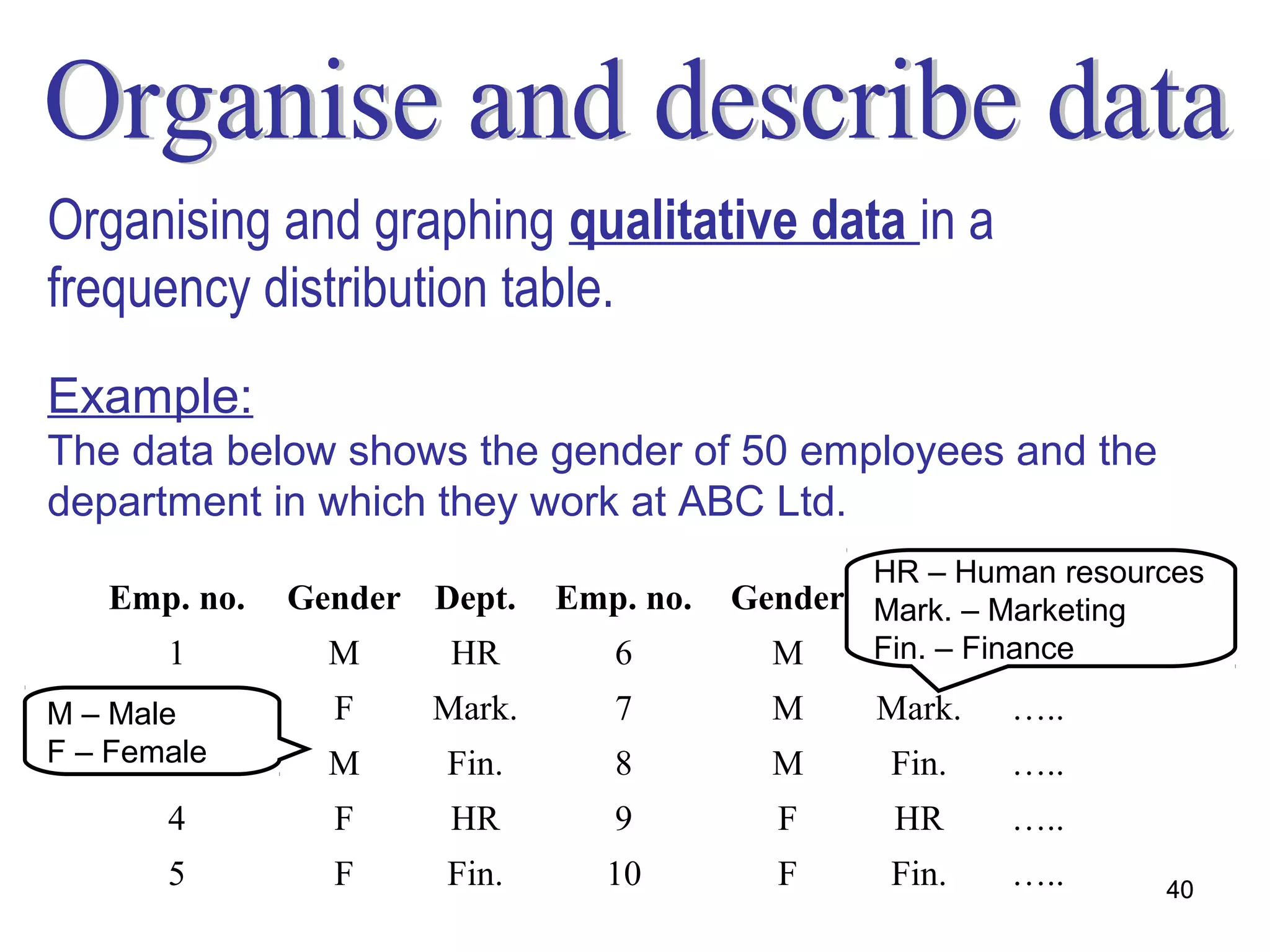
Organising and graphing qualitative data in a
frequency distribution table.
Example:
The data below shows the gender of 50 employees and the
department in which they work at ABC Ltd.
                                               HR – Human resources
   Emp. no.   Gender Dept.   Emp. no.   Gender Mark. – Marketing
                                               Dept      …..
       1        M     HR        6         M    Fin. – Finance
                                                Fin.     …..
M – Male2       F    Mark.      7         M     Mark.   …..
F – Female
        3       M     Fin.      8         M      Fin.   …..
       4        F     HR        9         F      HR     …..
       5        F     Fin.     10         F      Fin.   …..     40
Organising and graphing qualitative data in a frequency
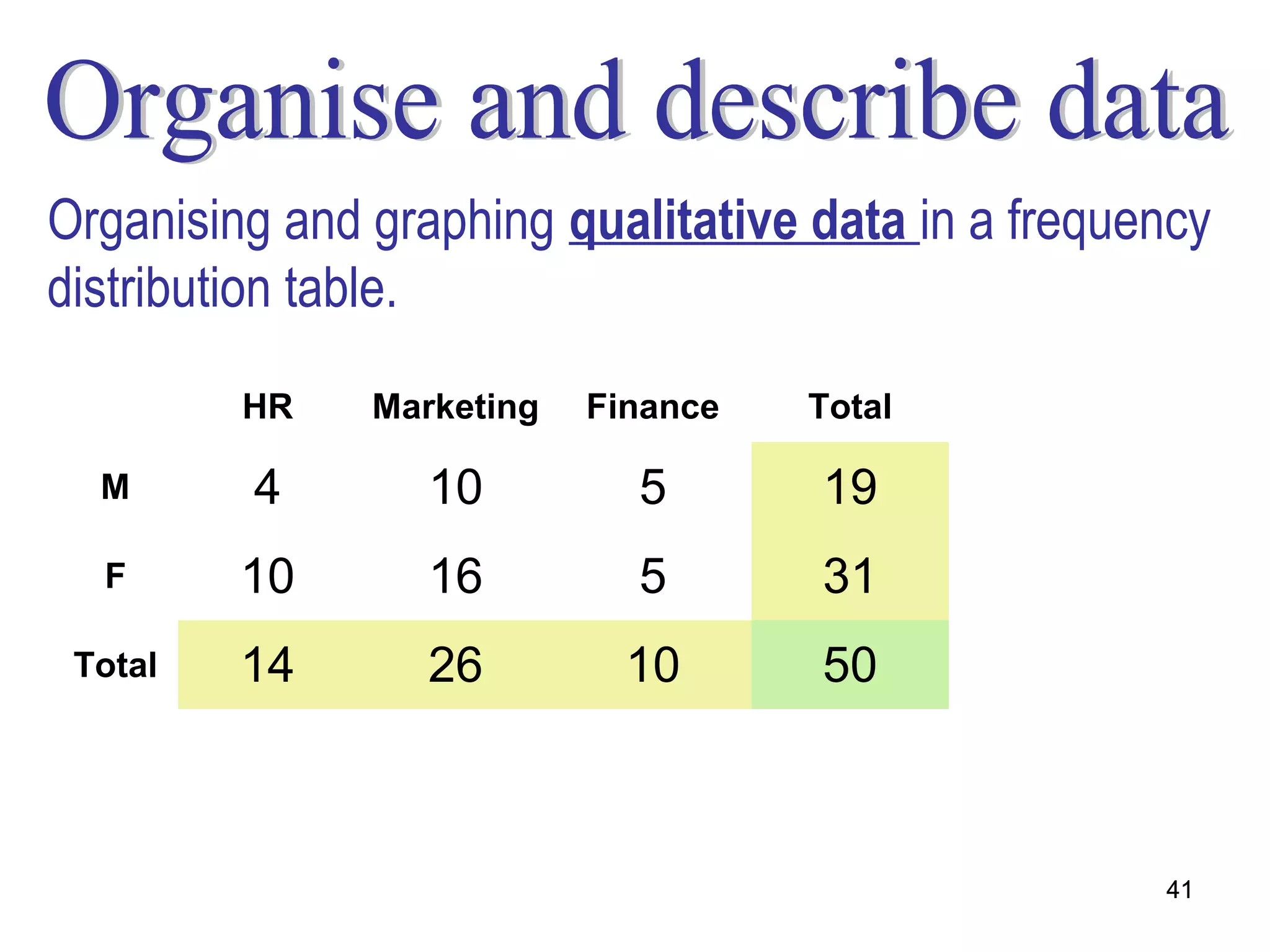
distribution table.
         HR    Marketing   Finance   Total

  M      4        10         5       19
  F      10       16         5       31
 Total   14       26         10      50


                                                    41
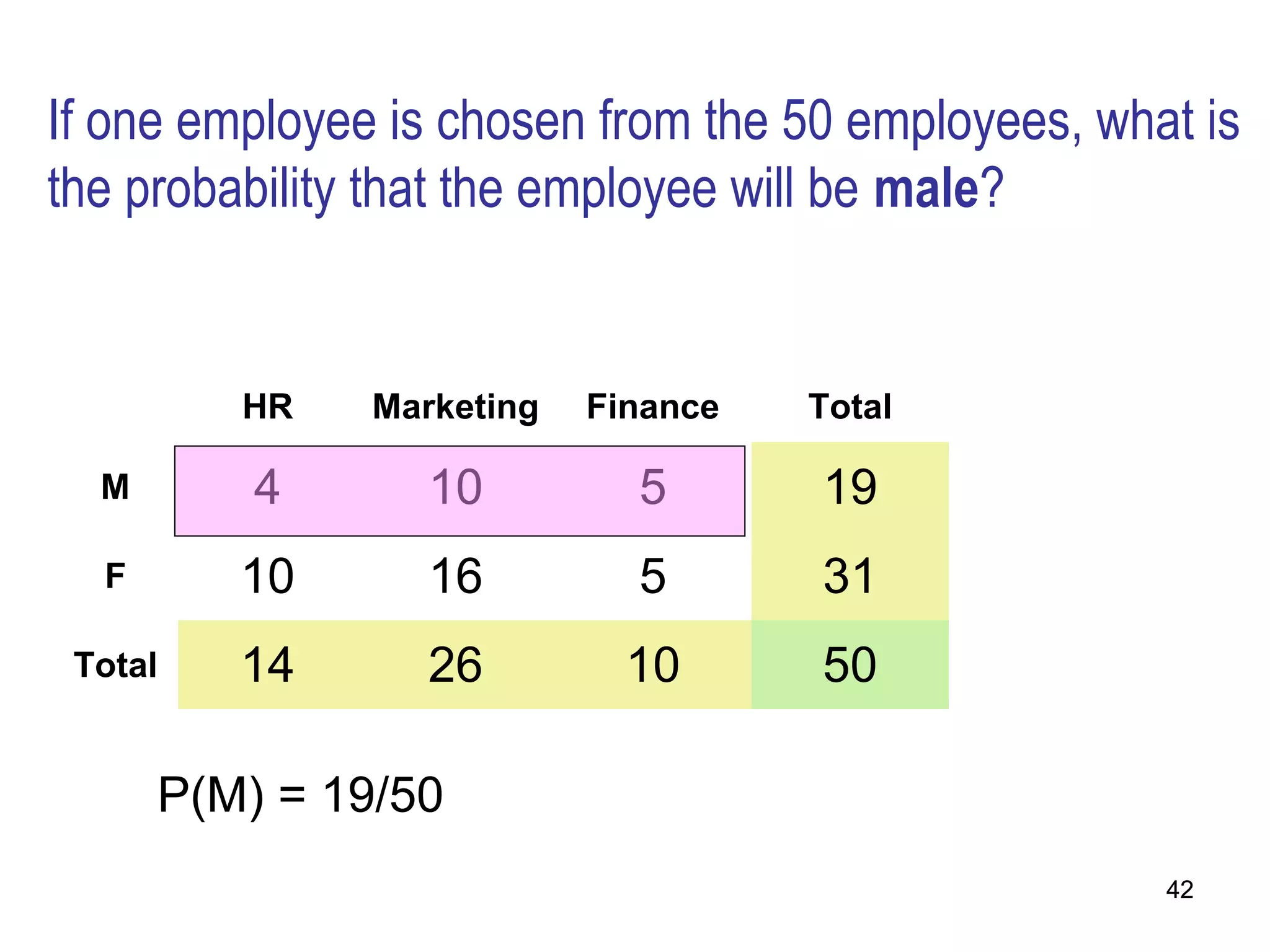
If one employee is chosen from the 50 employees, what is
the probability that the employee will be male?


         HR    Marketing   Finance   Total

  M       4       10         5       19
  F      10       16         5       31
 Total   14       26         10      50

      P(M) = 19/50
                                                    42
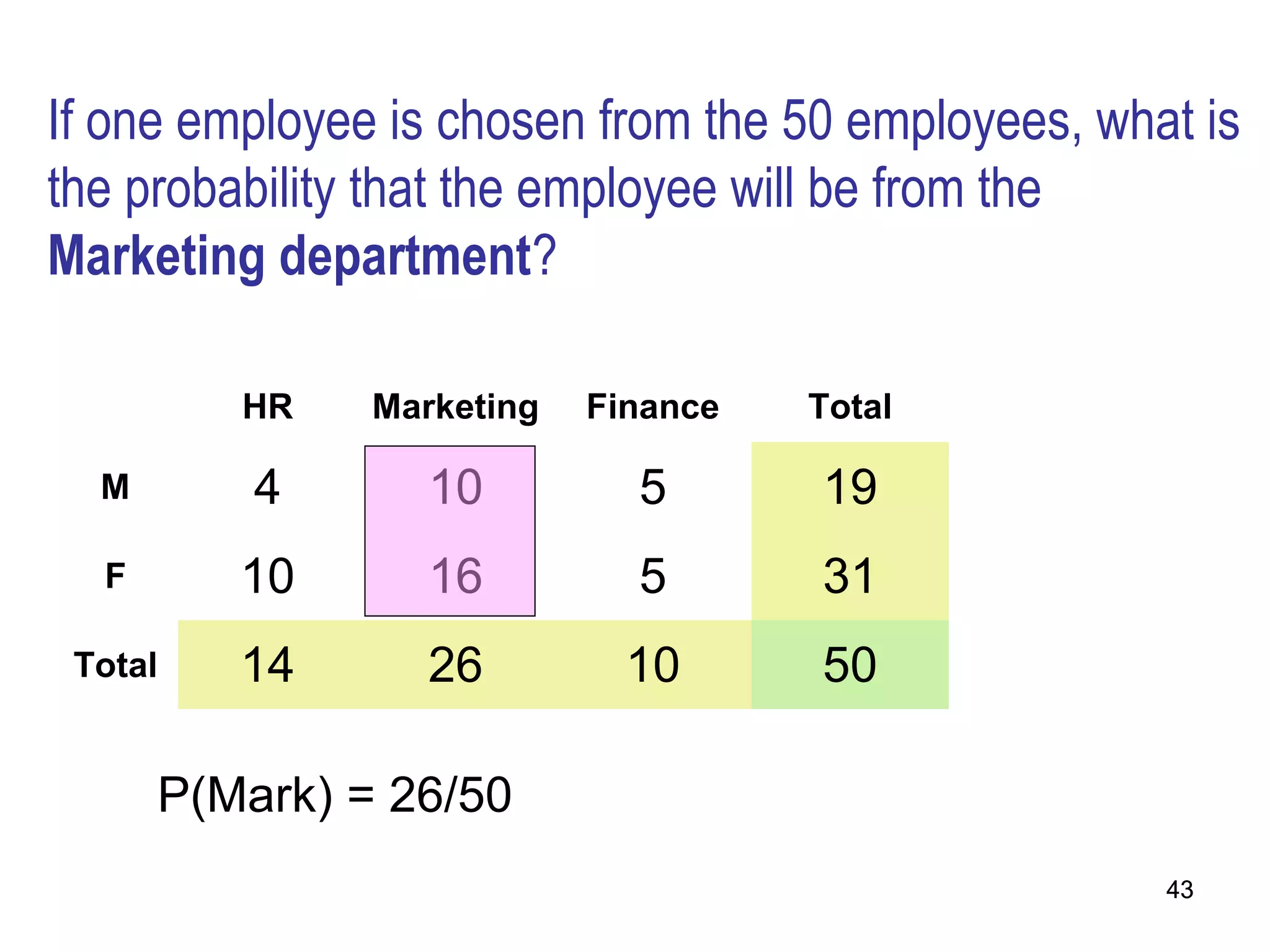
If one employee is chosen from the 50 employees, what is
the probability that the employee will be from the
Marketing department?

         HR    Marketing   Finance   Total

  M       4       10         5       19
  F      10       16         5       31
 Total   14       26         10      50

      P(Mark) = 26/50
                                                    43
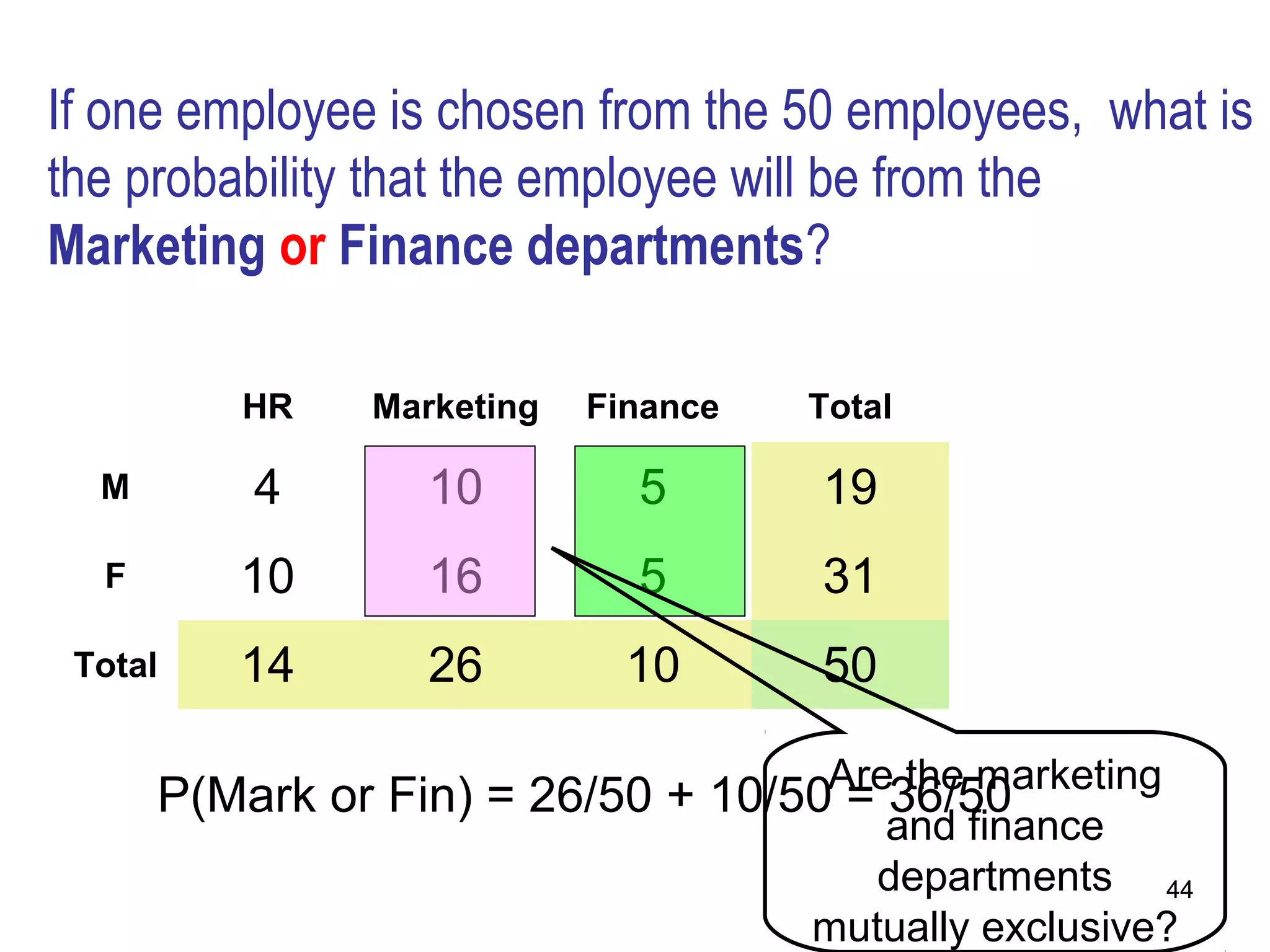
If one employee is chosen from the 50 employees, what is
the probability that the employee will be from the
Marketing or Finance departments?

         HR    Marketing   Finance   Total

  M       4       10         5       19
  F      10       16         5       31
 Total   14       26         10      50

                                    Are the marketing
      P(Mark or Fin) = 26/50 + 10/50 = 36/50
                                       and finance
                                      departments 44
                                   mutually exclusive?
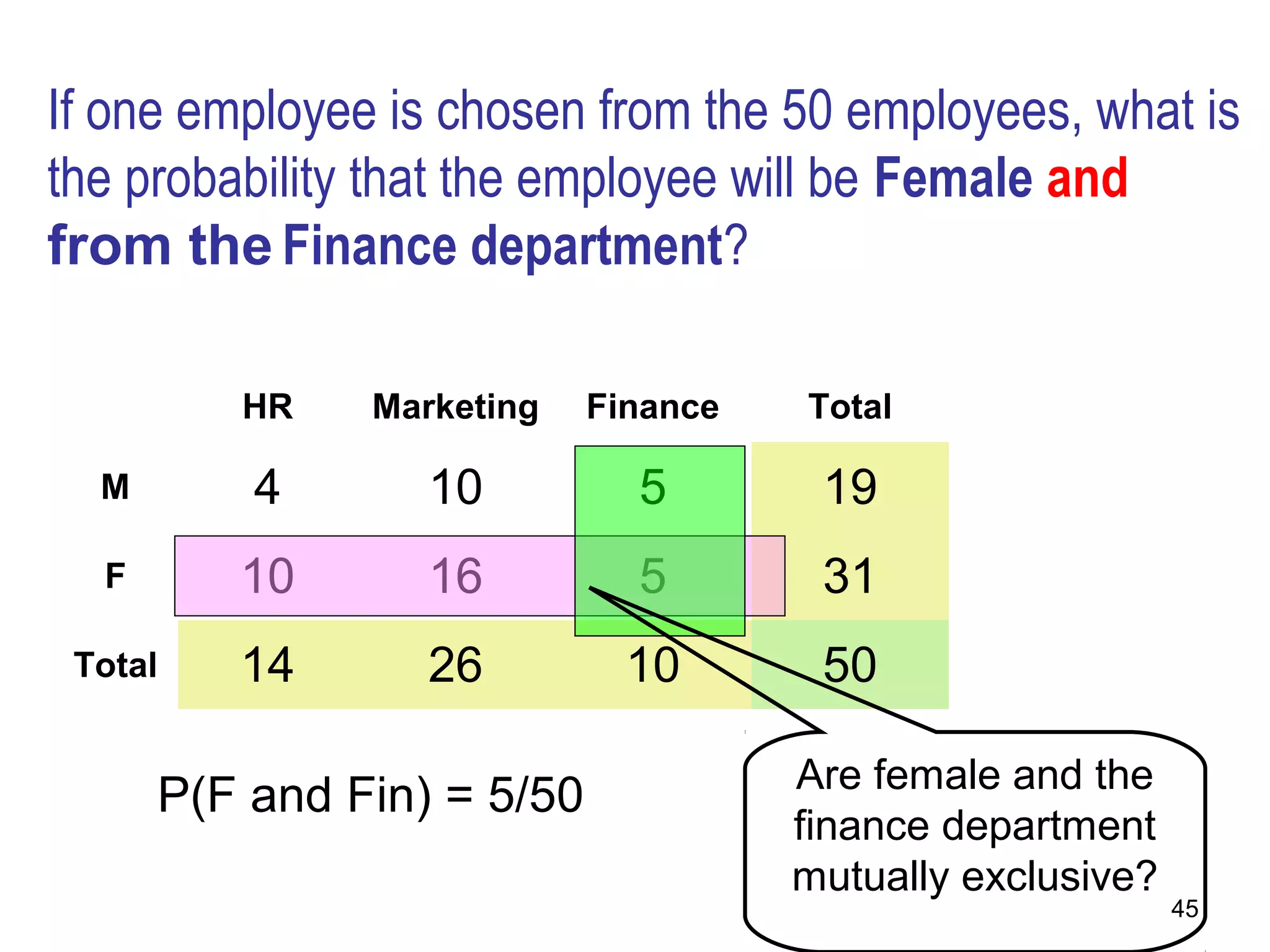
If one employee is chosen from the 50 employees, what is
the probability that the employee will be Female and
from the Finance department?

         HR    Marketing    Finance   Total

  M       4       10          5        19
  F      10       16          5        31
 Total   14       26          10       50

                                      Are female and the
      P(F and Fin) = 5/50
                                      finance department
                                      mutually exclusive?
                                                            45
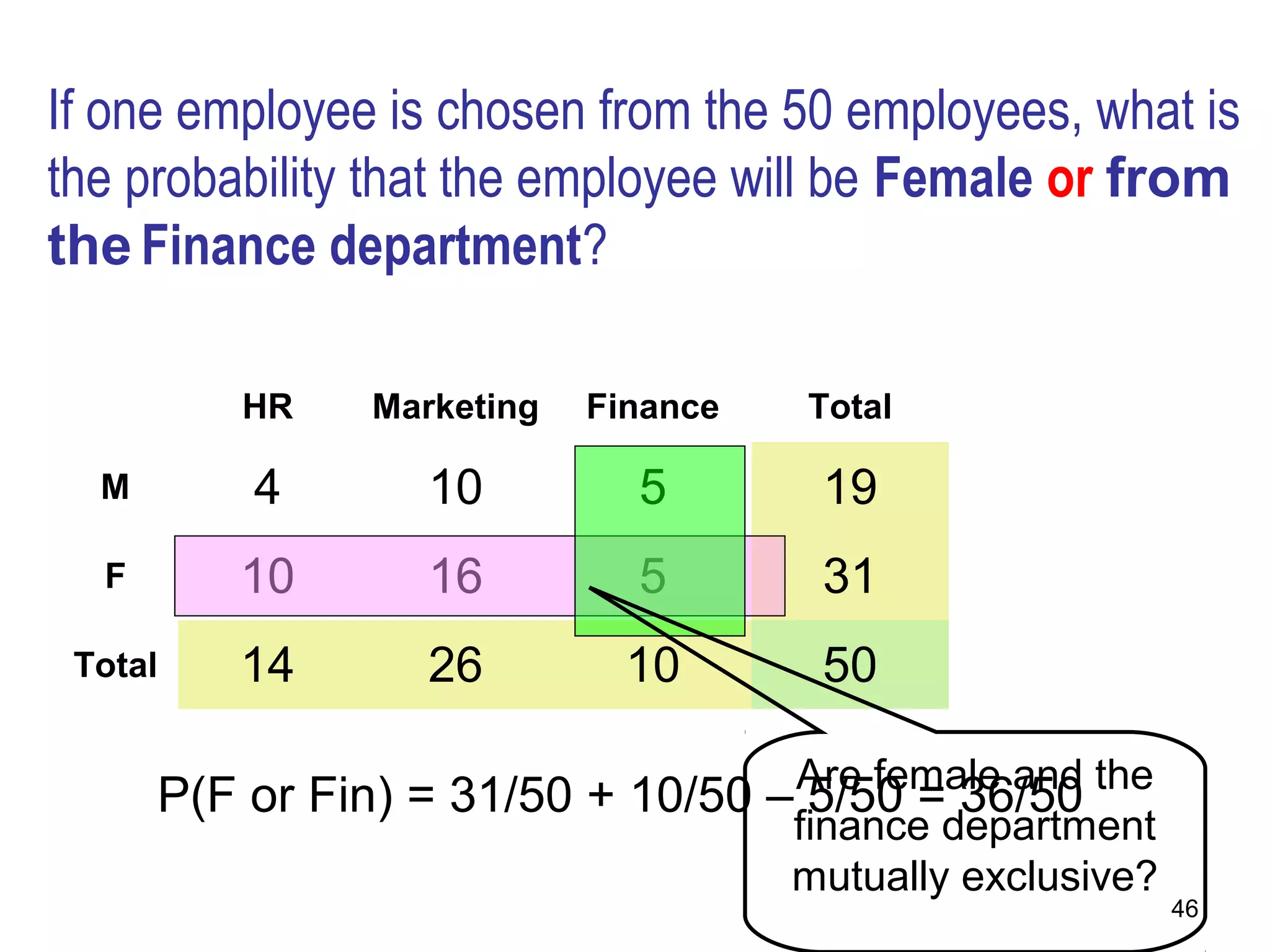
If one employee is chosen from the 50 employees, what is
the probability that the employee will be Female or from
the Finance department?

          HR    Marketing   Finance   Total

  M       4        10         5       19
  F      10        16         5       31
 Total   14        26         10      50

                                   Are female and the
      P(F or Fin) = 31/50 + 10/50 – 5/50 = 36/50
                                   finance department
                                   mutually exclusive?
                                                         46
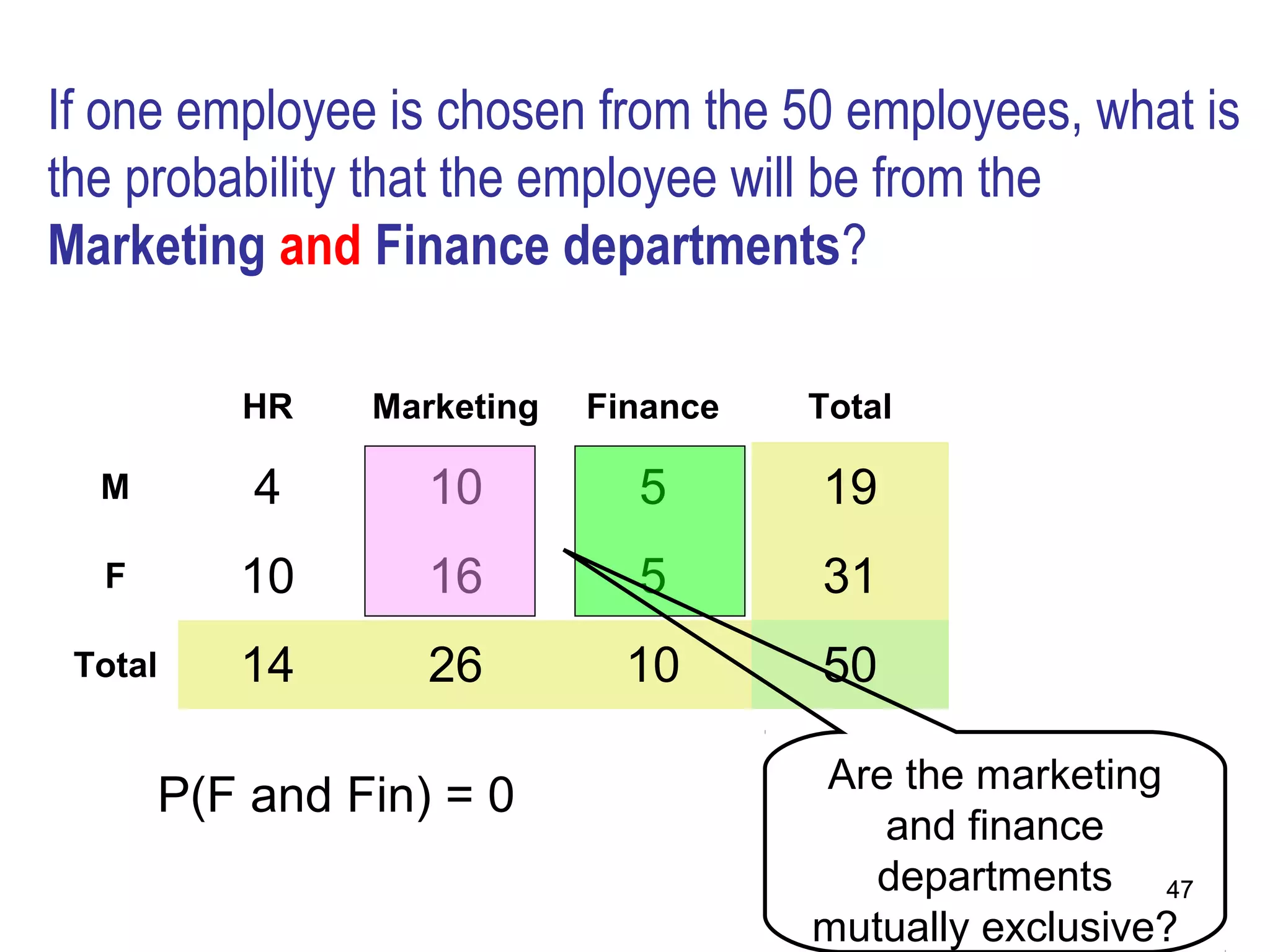
If one employee is chosen from the 50 employees, what is
the probability that the employee will be from the
Marketing and Finance departments?

         HR    Marketing   Finance   Total

  M       4       10         5       19
  F      10       16         5       31
 Total   14       26         10      50

                                     Are the marketing
      P(F and Fin) = 0
                                        and finance
                                        departments 47
                                     mutually exclusive?
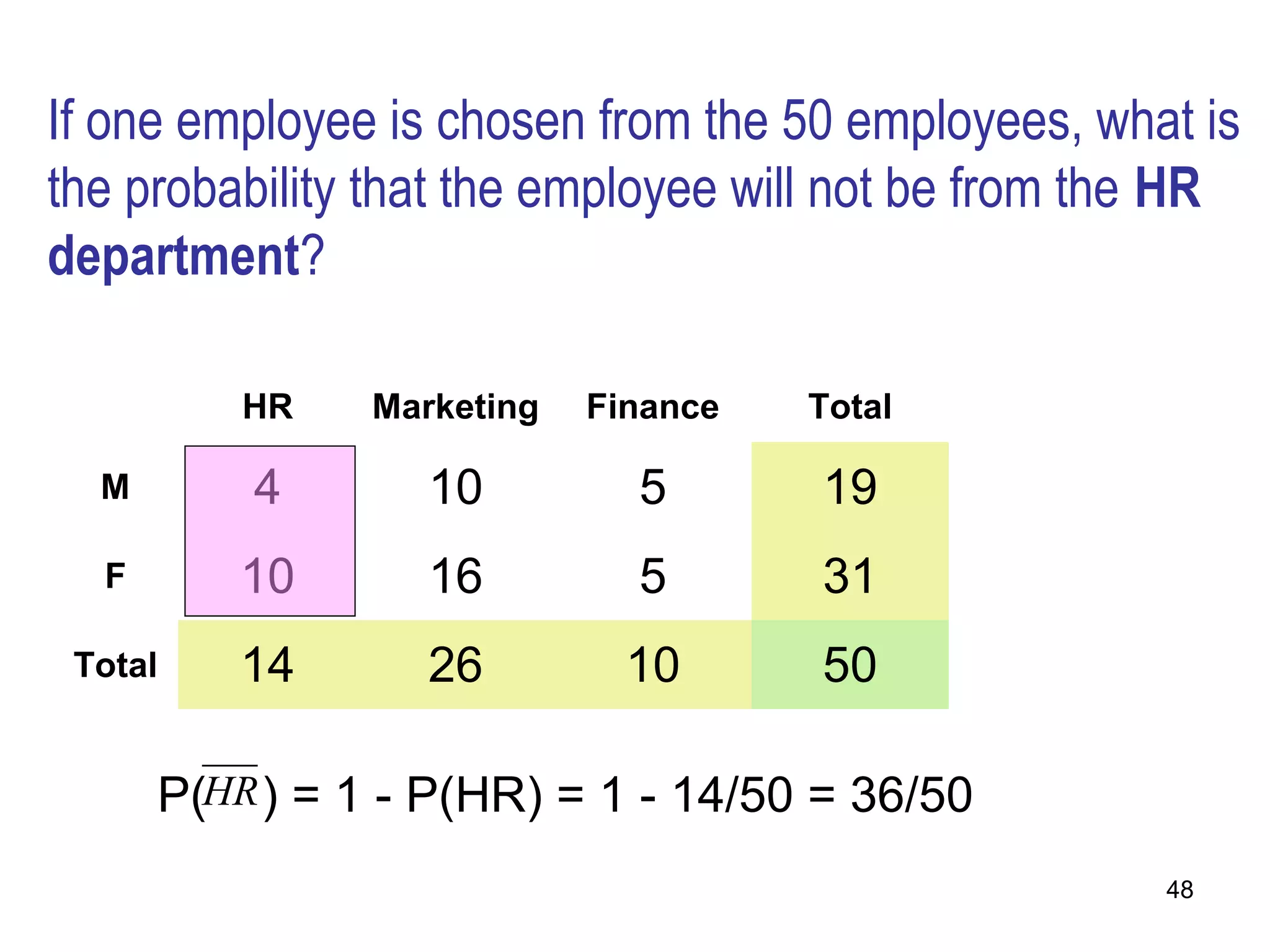
If one employee is chosen from the 50 employees, what is
the probability that the employee will not be from the HR
department?

         HR    Marketing   Finance   Total

  M       4       10         5       19
  F      10       16         5       31
 Total   14       26         10      50

      P(HR ) = 1 - P(HR) = 1 - 14/50 = 36/50
                                                     48
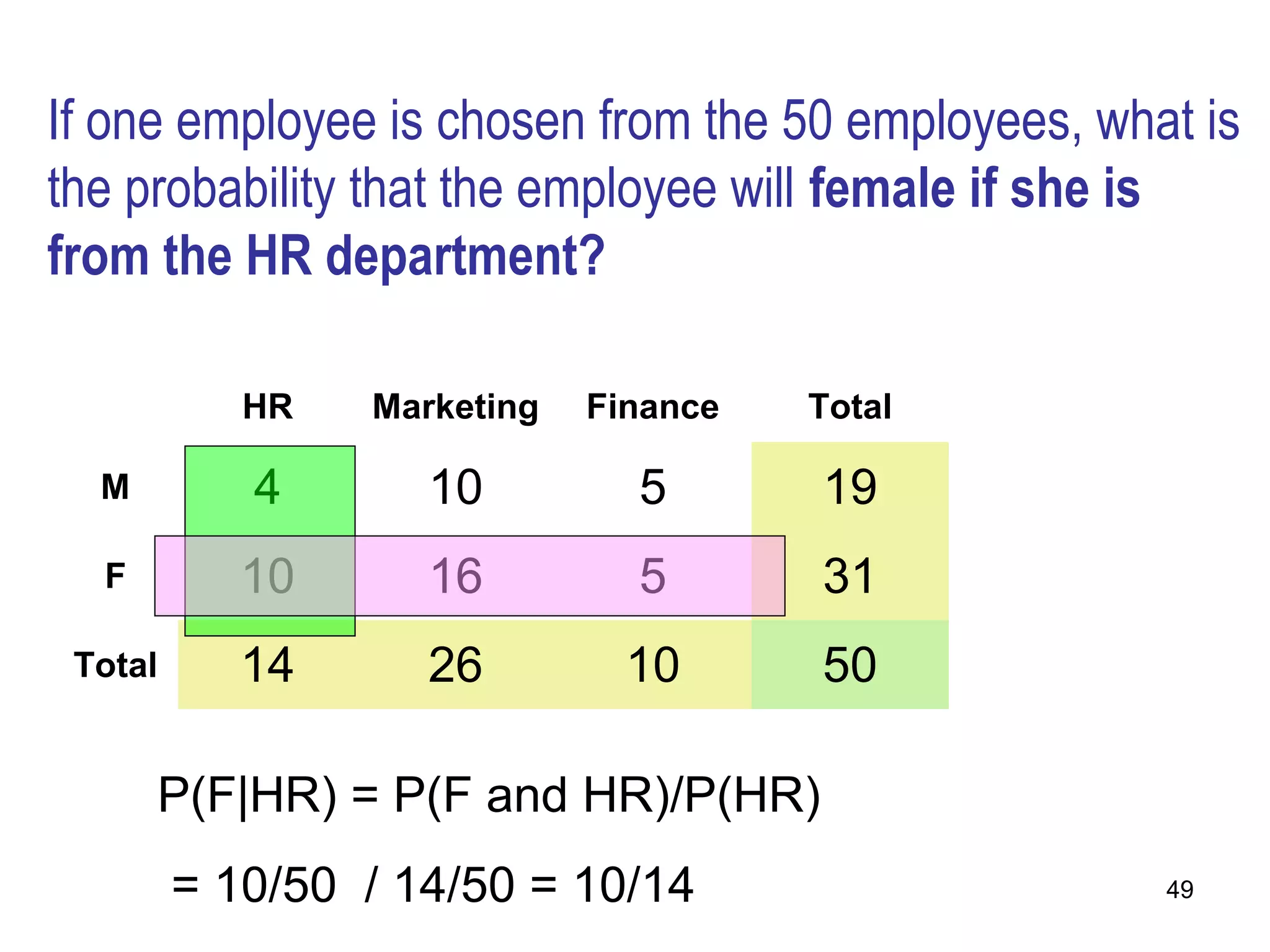
If one employee is chosen from the 50 employees, what is
the probability that the employee will female if she is
from the HR department?

            HR   Marketing   Finance   Total

  M         4       10         5       19
  F         10      16         5       31
 Total      14      26         10      50

      P(F|HR) = P(F and HR)/P(HR)
         = 10/50 / 14/50 = 10/14                    49

Statistics lecture 5 (ch4)

  • 2.
     What isprobability?  Probability is a numerical value used to express the chance that a specific event will occur.  Probability is always in the interval 0 to 1 and can be expressed as percentages.  The greater the chance that an event will occur, the closer the probability is to 1.  The smaller the chance that an event will occur, the closer the probability is to 0.  Probabilities is needed to make generalisations about the population based 2 on a sample drawn from the population.
  • 3.
     Experiment  Process that results in obtaining observations from an experimental unit.  Experimental unit is the object on which the observations are made.  Results of experiment are called outcomes.  Stochastic experiment  The results are a definite set of two or more possible outcomes.  The outcome can not be determined in advance.  Can be repeated under stable conditions. 3
  • 4.
     Sample space  Collection of all possible outcomes of an experiment.  It is denoted by S.  List all possible outcomes inside braces. S={ } S 4
  • 5.
     Event  Collection of some outcomes of the sample space.  It is denoted by A, B, C, etc.  List all possible outcomes inside braces. A={ }  Can have one or more outcomes. S A 5
  • 6.
     Event  Can define more than one event for the same sample space.  Two events are mutually exclusive if they can not occur at the same time.  Events A and B are mutually exclusive. S B A 6
  • 7.
     Event  Can define more than one event for the same sample space.  Two events are non mutually exclusive if they can occur at the same time.  Events A and C are non mutually exclusive.  Probability of an event  Probability of Event A. S  P(A) A C 7
  • 8.
     Properties ofprobability:  0 ≤ P(A) ≤ 1  P(B) = 0  B impossible event  P(C) = 1  C certain event  P(S) = 1  Compliment of Event A:  P(Ā) = 1 – P(A)  Events A and B mutually exclusive.  P(A or B) = P(A) + P(B) 8
  • 9.
    Three approaches toprobability  1. Relative frequency approach  The probabilities of the outcomes differ.  Counting the number of times that an event occurs when performing an experiment a large number of times. number of times event A occurred P(event A) = number of times the experiment was repeated f P ( A) = n 9
  • 10.
    Three approaches toprobability  Relative frequency approach  Example  In a group of 20 tourists staying in a hotel, nine prefer to pay cash for their accommodation.  The probability that a tourist will pay cash for accommodation is: f 9 P ( A) = = = 0, 45 n 20 10
  • 11.
    Three approaches toprobability  2. Classic approach The outcomes all have the same probabilities. Not necessary to performing an experiment a number of outcomes of experiment favourable to the event P(eventA) = total number of outcomes of experiment f P ( A) = n 11
  • 12.
    Three approaches toprobability  Classic approach  Example  Chance to get an uneven number on a dice:  S = {1; 2; 3; 4; 5; 6}  F = {1; 3; 5} 1 1 1 3 P( F ) = + + = = 0,5 6 6 6 6 12
  • 13.
    Three approaches toprobability  3. Subjective approach  The probabilities assigned to the outcomes of the experiment is subjective to the person who performs the experiment. 13
  • 14.
     The word“or” in probability is an indication of addition  P(A or B)  The word “and” in probability is an indication of multiplication  P(A and B) 14
  • 15.
    Addition rules forcalculating probabilities  Events are mutually exclusive when they have no outcomes in common.  For mutually exclusive events:  P(A or B) = P(A) + P(B) = 4/21 + 3/21 = 7/21 B Events A and B A are mutually S exclusive 15
  • 16.
    Addition rules forcalculating probabilities  Events are mutually exclusive when they have no outcomes in common  If events are not mutually exclusive  P(C or D) = P(C) + P(D) – P(C and D)  P(C and = 5/21 + 5/21 – 2/21 = 8/21 D)  Outcomes are included in C and D. Events C and D are not mutually exclusive S 16
  • 17.
    Conditional probability  Needto know the probability of an event given another event has already occurred  The two events must be dependent.  Probability of A, given B has occurred: P ( A and B )  P(A|B) = , P(B) ≠ 0 P( B)  Multiplication rule: The outcome of one event affects the probability of the  P(A and B) = P (B)P(A|B)  Probability of B, given A has occurred: event. occurrence of another P ( A and B )  P(B|A) = , P(A) ≠ 0 17 P( A)
  • 18.
    Conditional probability  Needto know the probability of an event given another event has already occurred.  If sampling without replacement takes place.  The events are considered dependent.  Example – Three students need to pick a biscuit from a plate with 10 biscuits.  1st student can pick any of the 10 biscuits.  2nd student has only 9 biscuits to pick from.  3rd student has only 8 biscuits to pick from.  The probability to pick the 1st biscuit is 1/10, the 2nd is 1/9 and the 3rd is 1/8. 18
  • 19.
    Independent Events  Eventsare statistically independent if the outcome of one event does not affect the probability of occurrence of another event. P(A|B) = P(A) P(B|A) = P(B) Multiplication rule for dependent events:  P(A and B) = P(B)P(A|B) Multiplication rule for independent events:  P(A and B) = P(A)P(B) 19
  • 20.
    Counting rules  Multi-stepexperiments  The number of outcomes for ‘k’ trails each with the same ‘n’ possible outcomes.  The number of outcomes in S = nk.  Example  How many ways can 10 multiple choice question with 4 possible answers be answered:  410 = 1 048 576 ways 20
  • 21.
    Counting rules  Multi-stepexperiments  The number of outcomes for ‘j’ trails each with a different number of ‘n’ outcomes.  The number of outcomes in S = n1 x n2 … X nj  Example  Need to order a meal where you can pick ‘1’ burger from ‘8’, ’1’ cool drink from ’10’, ‘1’ ice cream from ‘5’.  Number of possible orders: 8×10×5 = 400 21
  • 22.
    Counting rules  Thefactorial  The number of ways in which ‘r’ objects can be arranged in a row, without replacement.  r! = r×(r – 1)×(r – 2)× …×3×2×1  Note r! = 0! = 1  Example  Six athletes compete in a race. The number of order arrangements for completing the race.  6! = 720 different ways 22
  • 23.
    Counting rules  Combination  Select r objects without replacement from a larger set of n objects, order of selection not important.  n! n Cr = r !(n − r )!  Example  Six lotto numbers should be selected form a possible 49 – order of selection not important.  C = C = 49! n r 49 6 = 13 983 816 6!(49 − 6)! 23
  • 24.
    Counting rules  Permutation  Select r objects without replacement from a larger set of n objects, order of selection is important.  n! nP = r (n − r )!  Example  Six athletes in a race, how many ways to compete for the gold, silver and bronze medals.  6! n Pr = 6 P3 = = 120 (6 − 3)! 24
  • 25.
  • 26.
    Experiment: Draw acard from a play pack of cards Experimental unit: Play pack of cards Outcome of experiment: Any card from the pack Sample space: S={ ♠ 2 3 4 5 6 7 8 9 10 J Q K A ♣ 2 3 4 5 6 7 8 9 10 J Q K A ♥ 2 3 4 5 6 7 8 9 10 J Q K A ♦ 2 3 4 5 6 7 8 9 10 J Q K A } 52 Cards in the pack 26
  • 27.
    A S={ ♠ 23 4 5 6 7 8 9 10 J Q K A ♣ 2 3 4 5 6 7 8 9 10 J Q K A ♥ 2 3 4 5 6 7 8 9 10 J Q K A ♦ 2 3 4 5 6 7 8 9 10 J Q K A } Event - some outcomes of the sample space Event A – get a ‘4’ if you pick one card from the pack of cards A = {♠4 ♣4 ♥4 ♦4} P(A) = 4/52 27
  • 28.
    B S={ ♠ 23 4 5 6 7 8 9 10 J Q K A ♣ 2 3 4 5 6 7 8 9 10 J Q K A ♥ 2 3 4 5 6 7 8 9 10 J Q K A ♦ 2 3 4 5 6 7 8 9 10 J Q K A } Event - some outcomes of the sample space Event B – get a picture card if you pick one card from the pack of cards B = {♠JQKA ♣ JQKA ♥ JQKA ♦ JQKA} P(B) = 16/52 28
  • 29.
    B S={ ♠ 23 4 5 6 7 8 9 10 J Q K A ♣ 2 3 4 5 6 7 8 9 10 J Q K A ♥ 2 3 4 5 6 7 8 9 10 J Q K A ♦ 2 3 4 5 6 7 8 9 10 J Q K A } Complement of an event Event B – get a picture card if you pick one card from the pack of cards What is the probability not to get a picture card? P( B) = 1 – P(B) = 1 – 16/52 = 36/52 29
  • 30.
    B A S={ ♠ 2 3 4 5 6 7 8 9 10 J Q K A ♣ 2 3 4 5 6 7 8 9 10 J Q K A ♥ 2 3 4 5 6 7 8 9 10 J Q K A ♦ 2 3 4 5 6 7 8 9 10 J Q K A } Additional rule Are events A and B mutually exclusive? P(A or B) = P(A) + P(B) = 4/52 + 16/52 = 20/52 30
  • 31.
    S={ ♠ 23 4 5 6 7 8 9 10 J Q K A ♣ 2 3 4 5 6 7 8 9 10 J Q K A ♥ 2 3 4 5 6 7 8 9 10 J Q K A C ♦ 2 3 4 5 6 7 8 9 10 J Q K A } Event C – get a red card if you pick one card from the pack of cards C = { ♥ 2 3 4 5 6 7 8 9 10 J Q K A ♦ 2 3 4 5 6 7 8 9 10 J Q K A } P(C) = 26/52 31
  • 32.
    B S={ ♠ 23 4 5 6 7 8 9 10 J Q K A ♣ 2 3 4 5 6 7 8 9 10 J Q K A ♥ 2 3 4 5 6 7 8 9 10 J Q K A C ♦ 2 3 4 5 6 7 8 9 10 J Q K A } Additional rule Are events B and C mutually exclusive? 32
  • 33.
    B S={ ♠ 23 4 5 6 7 8 9 10 J Q K A ♣ 2 3 4 5 6 7 8 9 10 J Q K A ♥ 2 3 4 5 6 7 8 9 10 J Q K A C ♦ 2 3 4 5 6 7 8 9 10 J Q K A } Additional rule Are events B and C mutually exclusive? P(B or C) = P(B) + P(C) – P(B and C) = 16/52 + 26/52 – 8/52 = 34/52 33
  • 34.
    B S={ ♠ 23 4 5 6 7 8 9 10 J Q K A ♣ 2 3 4 5 6 7 8 9 10 J Q K A ♥ 2 3 4 5 6 7 8 9 10 J Q K A C ♦ 2 3 4 5 6 7 8 9 10 J Q K A } Conditional rule What is the probability to get a red card if the card must be a picture card? 8 P (C and B ) 52 = 8 P(C | B ) = = P( B) 16 16 34 52
  • 35.
    A S={ ♠ 23 4 5 6 7 8 9 10 J Q K A ♣ 2 3 4 5 6 7 8 9 10 J Q K A ♥ 2 3 4 5 6 7 8 9 10 J Q K A C ♦ 2 3 4 5 6 7 8 9 10 J Q K A } Conditional rule What is the probability to get a ‘4’ if the card must be a red card? 2 P( A and C ) 52 = 2 P( A | C ) = = P(C ) 26 26 52 35
  • 36.
    A S={ ♠ 2 3 4 5 6 7 8 9 10 J Q K A ♣ 2 3 4 5 6 7 8 9 10 J Q K A ♥ 2 3 4 5 6 7 8 9 10 J Q K A C ♦ 2 3 4 5 6 7 8 9 10 J Q K A } Conditional rule Sampling with replacement takes place If we pick two cards, what is the probability that the first one is red and the second one is ‘4’ We know: P(C) = 26/52 and P(A|C) = 2/26 2 P( A and C ) = P (C ) × P ( A | C ) = 26 ×2 = 36 52 26 52
  • 37.
    A B S={ ♠ 2 3 4 5 6 7 8 9 10 J Q K A ♣ 2 3 4 5 6 7 8 9 10 J Q K A ♥ 2 3 4 5 6 7 8 9 10 J Q K A ♦ 2 3 4 5 6 7 8 9 10 J Q K A } Conditional rule Sampling without replacement takes place If we pick two cards, what is the probability that the first one is a picture card and the second one is ‘4’ P(B) = 16/52 and P(A|B) = 4/51 64 P( B and A) = P ( B ) × P ( A | B ) = 16 ×4 = 37 52 51 2652
  • 38.
    Independent events A soccerteam is playing two matches on a specific day. •The chance of winning the first match is: •P(1st) = ½ •The chance of winning the second match is: •P(2nd) = ½ •Will the outcome of the first match influence the outcome of the second match? •The chance of winning both matches is: •P(1st and 2nd) = P(1st) x P(2nd |1st) •P(1st and 2nd) = P(1st) x P(2nd) = ½ X ½ = ¼ 38
  • 39.
    In chapter 2we looked at an example to organise qualitative data into a frequency distribution table. 39
  • 40.
    Organising and graphingqualitative data in a frequency distribution table. Example: The data below shows the gender of 50 employees and the department in which they work at ABC Ltd. HR – Human resources Emp. no. Gender Dept. Emp. no. Gender Mark. – Marketing Dept ….. 1 M HR 6 M Fin. – Finance Fin. ….. M – Male2 F Mark. 7 M Mark. ….. F – Female 3 M Fin. 8 M Fin. ….. 4 F HR 9 F HR ….. 5 F Fin. 10 F Fin. ….. 40
  • 41.
    Organising and graphingqualitative data in a frequency distribution table. HR Marketing Finance Total M 4 10 5 19 F 10 16 5 31 Total 14 26 10 50 41
  • 42.
    If one employeeis chosen from the 50 employees, what is the probability that the employee will be male? HR Marketing Finance Total M 4 10 5 19 F 10 16 5 31 Total 14 26 10 50 P(M) = 19/50 42
  • 43.
    If one employeeis chosen from the 50 employees, what is the probability that the employee will be from the Marketing department? HR Marketing Finance Total M 4 10 5 19 F 10 16 5 31 Total 14 26 10 50 P(Mark) = 26/50 43
  • 44.
    If one employeeis chosen from the 50 employees, what is the probability that the employee will be from the Marketing or Finance departments? HR Marketing Finance Total M 4 10 5 19 F 10 16 5 31 Total 14 26 10 50 Are the marketing P(Mark or Fin) = 26/50 + 10/50 = 36/50 and finance departments 44 mutually exclusive?
  • 45.
    If one employeeis chosen from the 50 employees, what is the probability that the employee will be Female and from the Finance department? HR Marketing Finance Total M 4 10 5 19 F 10 16 5 31 Total 14 26 10 50 Are female and the P(F and Fin) = 5/50 finance department mutually exclusive? 45
  • 46.
    If one employeeis chosen from the 50 employees, what is the probability that the employee will be Female or from the Finance department? HR Marketing Finance Total M 4 10 5 19 F 10 16 5 31 Total 14 26 10 50 Are female and the P(F or Fin) = 31/50 + 10/50 – 5/50 = 36/50 finance department mutually exclusive? 46
  • 47.
    If one employeeis chosen from the 50 employees, what is the probability that the employee will be from the Marketing and Finance departments? HR Marketing Finance Total M 4 10 5 19 F 10 16 5 31 Total 14 26 10 50 Are the marketing P(F and Fin) = 0 and finance departments 47 mutually exclusive?
  • 48.
    If one employeeis chosen from the 50 employees, what is the probability that the employee will not be from the HR department? HR Marketing Finance Total M 4 10 5 19 F 10 16 5 31 Total 14 26 10 50 P(HR ) = 1 - P(HR) = 1 - 14/50 = 36/50 48
  • 49.
    If one employeeis chosen from the 50 employees, what is the probability that the employee will female if she is from the HR department? HR Marketing Finance Total M 4 10 5 19 F 10 16 5 31 Total 14 26 10 50 P(F|HR) = P(F and HR)/P(HR) = 10/50 / 14/50 = 10/14 49