Normal Distribution
Definition
•It is defined as a continuous
frequency distribution of
infinite range.
•The normal distribution is a
descriptive model that
describes real world situations.
Importance
• Many dependent variables are
commonly assumed to be normally
distributed in the population
• If a variable is approximately normally
distributed we can make inferences
about values of that variable
Characteristics
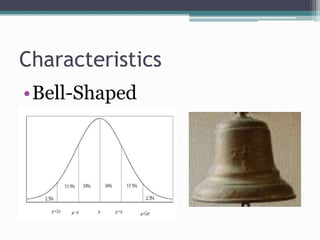
•Bell-Shaped
•Mean=Median=Mode
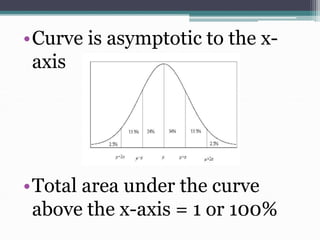
•Curve is asymptotic to the x-
axis
•Total area under the curve
above the x-axis = 1 or 100%
Empirical Rule:
68% of
the data
95% of the data
99.7% of the data
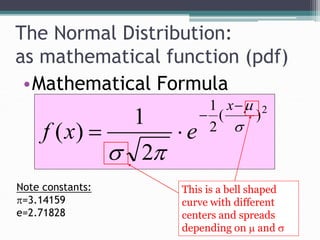
•Mathematical Formula
Note constants:
=3.14159
e=2.71828
The Normal Distribution:
as mathematical function (pdf)
2
)(
2
1
2
1
)( 





x
exf
This is a bell shaped
curve with different
centers and spreads
depending on  and 
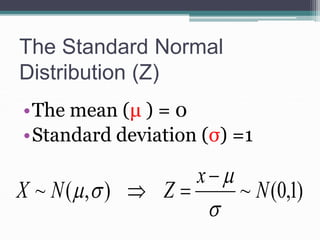
The Standard Normal
Distribution (Z)
•The mean (μ ) = 0
•Standard deviation (σ) =1
)1,0(~),(~ N
x
ZNX





11 33
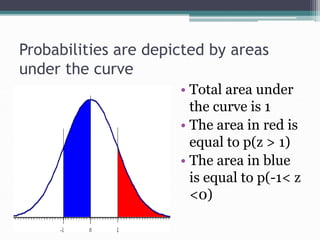
Probabilities are depicted by areas
under the curve
• Total area under
the curve is 1
• The area in red is
equal to p(z > 1)
• The area in blue
is equal to p(-1< z
<0)
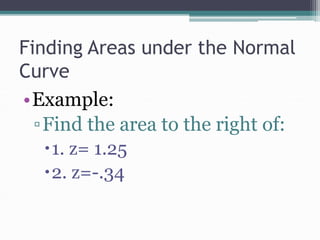
Finding Areas under the Normal
Curve
•Example:
▫Find the area to the right of:
1. z= 1.25
2. z=-.34
•Example:
▫Find the area to the left of:
1. z=0.33
2. z=-0.21
•Example:
▫Find the area between:
1. z = -0.24 and z = 1.23
2. z = 0.15 and z = 2.04
3. z = -0.15 and z = -2.02
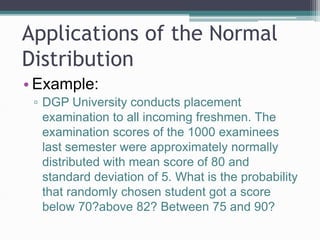
Applications of the Normal
Distribution
• Example:
▫ DGP University conducts placement
examination to all incoming freshmen. The
examination scores of the 1000 examinees
last semester were approximately normally
distributed with mean score of 80 and
standard deviation of 5. What is the probability
that randomly chosen student got a score
below 70?above 82? Between 75 and 90?
Solution: a.below 70
•Given:
▫μ= 80
▫σ =5
▫x<70



x
Z
5
8070 
Z
Z= -2
• P [x<70] = P[z<-2] = 0.5 – P[0<z<2]
=0.5 – 0.4772
=0.0228 or 2.28%
-2
Solution: above 82
5
8082 
Z = 0.4
• P [x>82] = P[z>0.4] = 0.5 – P[0>z>0.4]
=0.5 – 0.1554
=0.3446 or 34.46%
0.4
Exercise: (Using the same
problem) Sketch of the curve and
find:
•Between 75 and 90 (Ronald and Jyx,)
•How many got scores below
87? (Nikki,Dioniel ) above 77?
(Frea,Gretchel) between 75 and 90
(Vhea and Sheryl)
Evaluation: (1/2)
• X is a normally normally distributed
variable with mean μ = 30 and standard
deviation σ = 4. Find
a) P(x < 40)
b) P(x > 21)
c) P(30 < x < 35)
• Molly earned a score of 940 on a national
achievement test. The mean test score was 850
with a standard deviation of 100. What
proportion of students had a higher score than
Molly? (Assume that test scores are normally
distributed.)
Agreement:
•A firms marketing manager
believes that total sales for the
firm next year can be modeled
using a normal distribution, with a
mean of P 2.5 million and a
standard deviation of P300,000
a. What is the probability that the
firm’s sales will exceed the P3
million?
b. In order to cover fixed cost, the
firm’s sales must exceed the
break-even level of P 1.8 million.
What is the probability that sales
will exceed the break-even level?

Normal distribution

  • 1.
  • 2.
    Definition •It is definedas a continuous frequency distribution of infinite range. •The normal distribution is a descriptive model that describes real world situations.
  • 3.
    Importance • Many dependentvariables are commonly assumed to be normally distributed in the population • If a variable is approximately normally distributed we can make inferences about values of that variable
  • 4.
  • 5.
  • 6.
    •Curve is asymptoticto the x- axis •Total area under the curve above the x-axis = 1 or 100%
  • 7.
    Empirical Rule: 68% of thedata 95% of the data 99.7% of the data
  • 8.
    •Mathematical Formula Note constants: =3.14159 e=2.71828 TheNormal Distribution: as mathematical function (pdf) 2 )( 2 1 2 1 )(       x exf This is a bell shaped curve with different centers and spreads depending on  and 
  • 9.
    The Standard Normal Distribution(Z) •The mean (μ ) = 0 •Standard deviation (σ) =1 )1,0(~),(~ N x ZNX     
  • 10.
  • 11.
    Probabilities are depictedby areas under the curve • Total area under the curve is 1 • The area in red is equal to p(z > 1) • The area in blue is equal to p(-1< z <0)
  • 12.
    Finding Areas underthe Normal Curve •Example: ▫Find the area to the right of: 1. z= 1.25 2. z=-.34
  • 13.
    •Example: ▫Find the areato the left of: 1. z=0.33 2. z=-0.21
  • 14.
    •Example: ▫Find the areabetween: 1. z = -0.24 and z = 1.23 2. z = 0.15 and z = 2.04 3. z = -0.15 and z = -2.02
  • 15.
    Applications of theNormal Distribution • Example: ▫ DGP University conducts placement examination to all incoming freshmen. The examination scores of the 1000 examinees last semester were approximately normally distributed with mean score of 80 and standard deviation of 5. What is the probability that randomly chosen student got a score below 70?above 82? Between 75 and 90?
  • 16.
    Solution: a.below 70 •Given: ▫μ=80 ▫σ =5 ▫x<70    x Z 5 8070  Z Z= -2
  • 17.
    • P [x<70]= P[z<-2] = 0.5 – P[0<z<2] =0.5 – 0.4772 =0.0228 or 2.28% -2
  • 18.
  • 19.
    • P [x>82]= P[z>0.4] = 0.5 – P[0>z>0.4] =0.5 – 0.1554 =0.3446 or 34.46% 0.4
  • 20.
    Exercise: (Using thesame problem) Sketch of the curve and find: •Between 75 and 90 (Ronald and Jyx,) •How many got scores below 87? (Nikki,Dioniel ) above 77? (Frea,Gretchel) between 75 and 90 (Vhea and Sheryl)
  • 21.
    Evaluation: (1/2) • Xis a normally normally distributed variable with mean μ = 30 and standard deviation σ = 4. Find a) P(x < 40) b) P(x > 21) c) P(30 < x < 35)
  • 22.
    • Molly earneda score of 940 on a national achievement test. The mean test score was 850 with a standard deviation of 100. What proportion of students had a higher score than Molly? (Assume that test scores are normally distributed.)
  • 23.
    Agreement: •A firms marketingmanager believes that total sales for the firm next year can be modeled using a normal distribution, with a mean of P 2.5 million and a standard deviation of P300,000
  • 24.
    a. What isthe probability that the firm’s sales will exceed the P3 million? b. In order to cover fixed cost, the firm’s sales must exceed the break-even level of P 1.8 million. What is the probability that sales will exceed the break-even level?

Editor's Notes

  • #10 If we know the population mean and population standard deviation, for any value of X we can compute a z-score by subtracting the population mean and dividing the result by the population standard deviation
  • #11 For normal distributions + 1 SD ~ 68% + 2 SD ~ 95% + 3 SD ~ 99.9%