Chapter 10Estimating with Confidence
10.1 	Confidence Intervals:		The Basics
DefinitionsStatistical InferenceThe method of drawing conclusions about a population based on a sampleThe last Major Topic for this last statistics courseThe mindset: we are looking at data that comes from a random sample (or an experiment) and inferring characteristics of the population
The Basic Plan	In the absence of other data, the sample estimate is the estimate of the parameterWe would like an interval estimationState the parameter that is being estimatedCheck to see if the data can be NormalizedCompute the interval using area under the Normal curveWrite  a nice conclusion
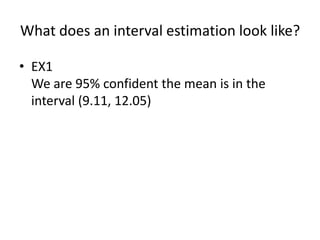
What does an interval estimation look like?EX1We are 95% confident the mean is in the interval (9.11, 12.05)
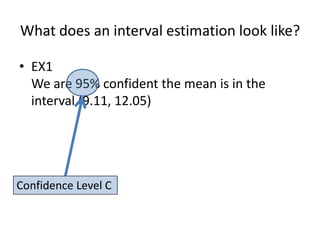
What does an interval estimation look like?EX1We are 95% confident the mean is in the interval (9.11, 12.05)Confidence Level C
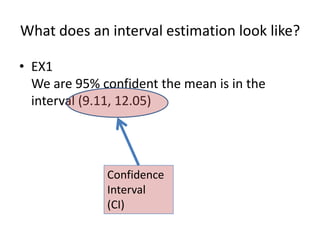
What does an interval estimation look like?EX1We are 95% confident the mean is in the interval (9.11, 12.05)Confidence Interval(CI)
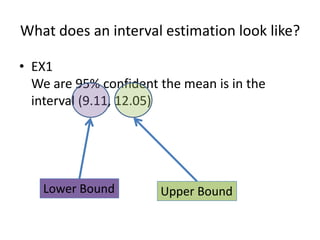
What does an interval estimation look like?EX1We are 95% confident the mean is in the interval (9.11, 12.05)Lower BoundUpper Bound
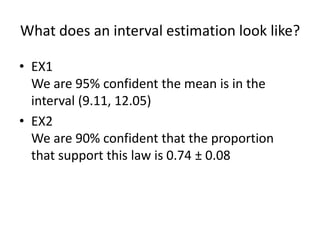
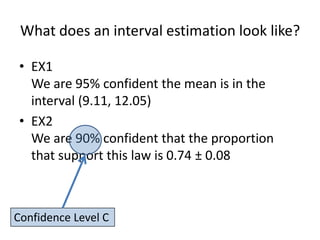
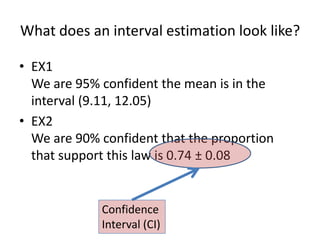
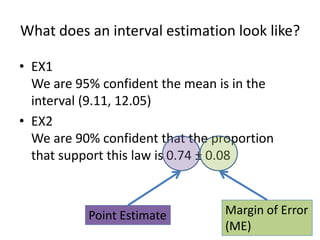
What does an interval estimation look like?EX1We are 95% confident the mean is in the interval (9.11, 12.05)EX2We are 90% confident that the proportion that support this law is 0.74 ± 0.08
What does an interval estimation look like?EX1We are 95% confident the mean is in the interval (9.11, 12.05)EX2We are 90% confident that the proportion that support this law is 0.74 ± 0.08Confidence Level C
What does an interval estimation look like?EX1We are 95% confident the mean is in the interval (9.11, 12.05)EX2We are 90% confident that the proportion that support this law is 0.74 ± 0.08Confidence Interval (CI)
What does an interval estimation look like?EX1We are 95% confident the mean is in the interval (9.11, 12.05)EX2We are 90% confident that the proportion that support this law is 0.74 ± 0.08Margin of Error(ME)Point Estimate
Confidence LevelThe value of the parameter is fixed before we start our samplingEither the parameter is ‘in’ our interval or it’s not.There is no probability involved here“There is a 95% probability the parameter is in the interval”
Confidence LevelThe value of the parameter is fixed before we start our samplingEither the parameter is ‘in’ our interval or it’s not.There is no probability involved here“There is a 95% probability the parameter is in the interval”F   A   I   L
Confidence LevelRemember that our sample is just one of many samples that could have been takenIf good sampling technique is used, 95% (for example) of the samples would contain the parameterWe just don’t know if our sample is part of the 95% or the 5%
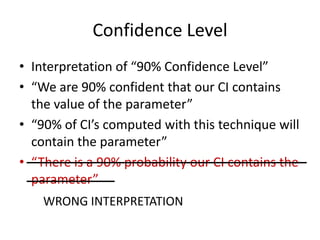
Confidence LevelInterpretation of “90% Confidence Level”“We are 90% confident that our CI contains the value of the parameter”“90% of CI’s computed with this technique will contain the parameter”“There is a 90% probability our CI contains the parameter”WRONG INTERPRETATION
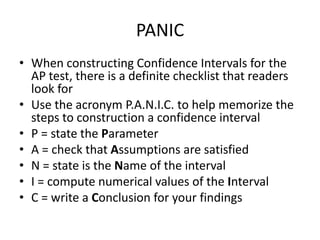
PANICWhen constructing Confidence Intervals for the AP test, there is a definite checklist that readers look forUse the acronym P.A.N.I.C. to help memorize the steps to construction a confidence intervalP = state the ParameterA = check that Assumptions are satisfiedN = state is the Name of the intervalI = compute numerical values of the IntervalC = write a Conclusion for your findings
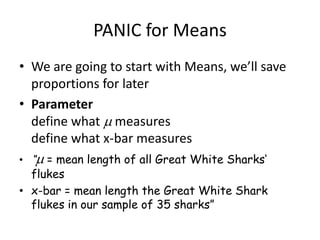
PANIC for MeansWe are going to start with Means, we’ll save proportions for laterParameterdefine what  measuresdefine what x-bar measures“ = mean length of all Great White Sharks‘ flukesx-bar = mean length the Great White Shark flukes in our sample of 35 sharks”
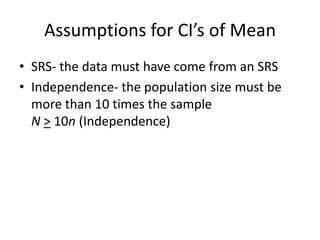
Assumptions for CI’s of MeanSRS- the data must have come from an SRSIndependence- the population size must be more than 10 times the sampleN> 10n (Independence)
Assumptions for CI’s of MeanSRS- the data must have come from an SRSIndependence- the population size must be more than 10 times the sampleN> 10n (Independence)This is a condition that must be met since we are sampling without replacement and our formula forstd dev needs to hold true
Assumptions for CI’s of MeanSRS- the data must have come from an SRSIndependence- the population size must be more than 10 times the sampleN> 10n (Independence)The sampling Distribution is approximately Normal (Normality)
More on NormalityWe are looking for justification that the sampling distribution is NormalIf the population is Normal, then the samp dist is also NormalIf n> 30 and the sample data is not given, state “The Central Limit Theorem guarantees that the sampling distribution is Normal”For smaller samples, check the following:(1) the Histogram is single peak, symmetric with 	no outliers(2) the Normal Probability Plot is approx Linear
Name of the IntervalCurrently, the only Interval we will worry about is “z-interval for sample means”This will always be the name of the distribution used
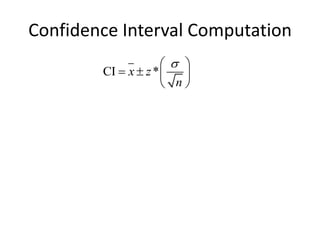
Confidence Interval Computation
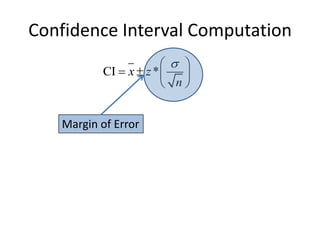
Confidence Interval ComputationMargin of Error
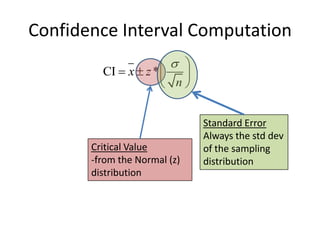
Confidence Interval ComputationStandard ErrorAlways the std devof the sampling distributionCritical Value-from the Normal (z) distribution
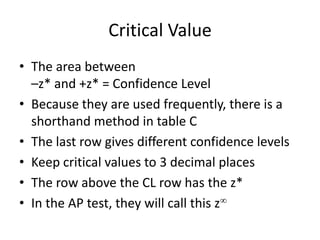
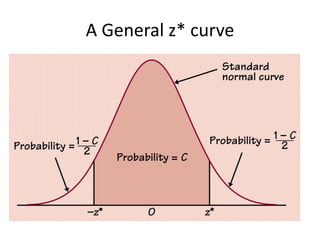
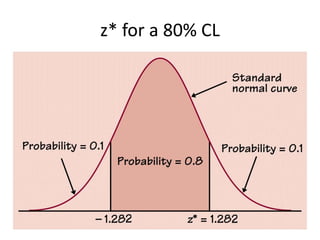
Critical ValueThe area between –z* and +z* = Confidence LevelBecause they are used frequently, there is a shorthand method in table CThe last row gives different confidence levelsKeep critical values to 3 decimal places The row above the CL row has the z*In the AP test, they will call this z
A General z* curve
z* for a 80% CL
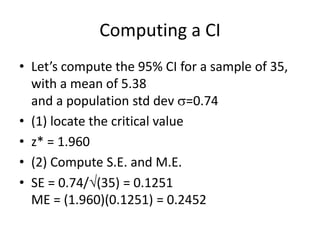
Computing a CILet’s compute the 95% CI for a sample of 35, with a mean of 5.38 and a population std dev =0.74(1) locate the critical valuez* = 1.960(2) Compute S.E. and M.E.SE = 0.74/(35) = 0.1251ME = (1.960)(0.1251) = 0.2452
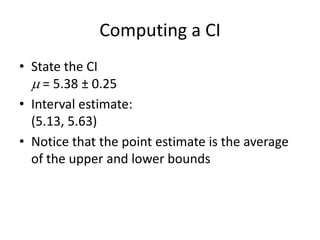
Computing a CIState the CI = 5.38 ± 0.25Interval estimate:(5.13, 5.63)Notice that the point estimate is the average of the upper and lower bounds
ConclusionsWe are 95% confident that the mean length of a great white shark fluke is 5.38 ± 0.25 ft.	ORWe are 95% confident that the mean length of all great white shark flukes is in the interval  (5.13 ft, 5.63 ft).
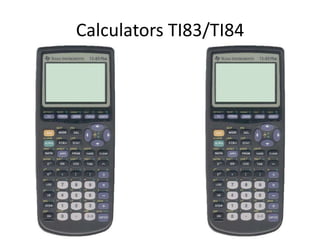
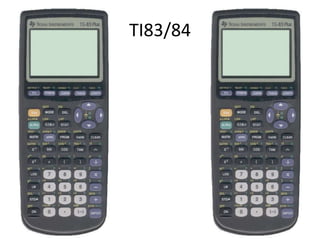
Calculators TI83/TI84
Calculators TI83/TI84Your TI is very efficient for finding these intervals!  This doesn’t excuse you from the mathematics, of course.[stat] ->  “TESTS” -> “Zinterval”Inpt: “Stats” (if your data is in L1, you can use “Data”Enter values for , x-bar, n, and C-Level.Viola!
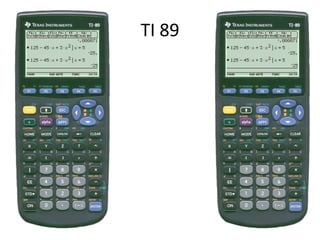
Calculators TI89Run the “Stats/List Editor” APP[2nd] -> [F2] (F7) -> “Zinterval”Input Method = “Stats”Choose Data if all the observations are in a ListEnter values for , x-bar, n, and C-Level.Viola!
Behavior of Margin of ErrorME = z* (/n)In practice, we would like to minimize ME.(1) decrease z* This also means decrease our CL!(2) increase nthis is usually a trade off, since obtaining large samples could be more expensive/time consuming(3) decrease Not really an option.  is a known quantity.
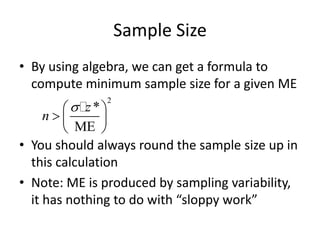
Sample SizeBy using algebra, we can get a formula to compute minimum sample size for a given MEYou should always round the sample size up in this calculationNote: ME is produced by sampling variability, it has nothing to do with “sloppy work”
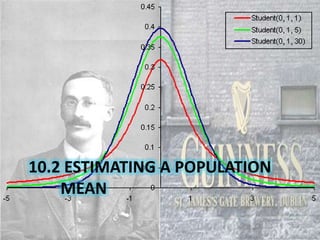
10.2 Estimating a Population 	Mean
Student’s t-distributionThe confidence intervals computed in the previous section assumed that we knew .It doesn’t seem likely that we would know  and not know the value of When  is unknown, we can no longer use the Normal distribution
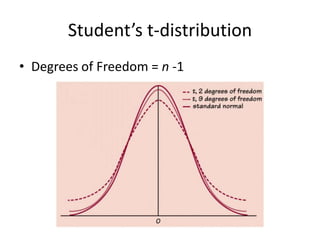
Student’s t-distributionThe t-distribution is to be used when  is unknown.The t-distribution is very similar to the Normal distribution with a key differenceThe shape of the distribution changes based upon the sample size/degrees of freedom (df)Large samples have a tall peak and thinner tailsSmall samples have a small peak and thicker tails.
Student’s t-distributionDegrees of Freedom = n -1
Using the t-distributionThe CI is found using PANICThe Assumptions are the same as a z-intervalSince sample sizes tend to be small, you will most likely need to check the histogram (symmetric, no outliers) and Normal prob plot (approx linear)We cannot use the t-distribution when there are outliers!The Name of the interval is “1-sample t-interval for mean”
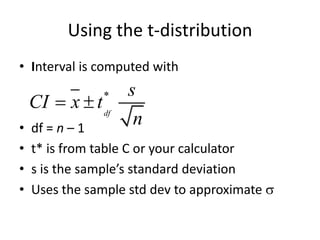
Using the t-distributionInterval is computed withdf = n – 1t* is from table C or your calculators is the sample’s standard deviationUses the sample std dev to approximate 
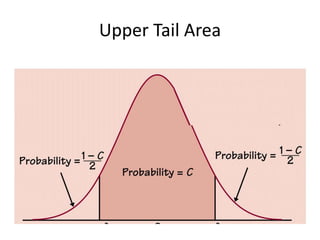
Upper Tail Area
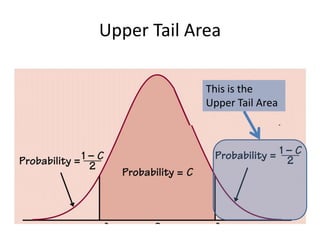
Upper Tail AreaThis is the Upper Tail Area
Using the t-distribution
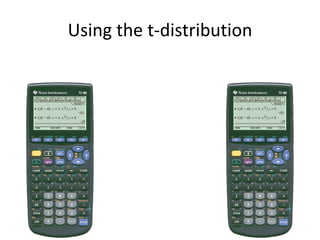
Using the t-distributionUsing TI84	[2nd] -> [vars](DIST) -> “invT”“invT(1-Upper Tail Area, df)”Where “Upper Tail Area” = (1-CL)/2This is the area to the left of the right crit. Value.ALTERNATIVELY, you may use“−invT(Upper Tail Area, df)”
Using the t-distributionUsing TI84	[2nd] -> [vars](DIST) -> “invT”“invT(1-Upper Tail Area, df)”Where “Upper Tail Area” = (1-CL)/2This is the area to the left of the right crit. Value.ALTERNATIVELY, you may use“−invT(Upper Tail Area, df)”Don’t forget the negative!
Using the t-distribution
Using the t-distributionUsing TI89From home screen:[catalog] -> [F3](FlashApps) -> inv_t…TIStat“tistat.invT(1-Upper Tail Area, df)”Where “Upper Tail Area” = (1-CL)/2This is the area to the left of the right crit. Value.ALTERNATIVELY, you may use“-tistat.invT(Upper Tail Area, df)”
Using the t-distributionUsing TI89From home screen:[catalog] -> [F3](FlashApps) -> inv_t…TIStat“tistat.invT(1-Upper Tail Area, df)”Where “Upper Tail Area” = (1-CL)/2This is the area to the left of the right crit. Value.ALTERNATIVELY, you may use“-tistat.invT(Upper Tail Area, df)”Don’t forget the negative!
Using the t-distributionALTERNATIVE TI89 titanium[APPS] -> “Stat/List Editor” -> [F5] (distrib) -> “Inverse” -> “Inverse  t…” “Area: 1- Upper Tail”Upper Tail = (1 – CL)/2“degrees of freedom, df: df”This takes longer to get to, but the menu “guides” you through
Table COccasionally, you will need to fine the t* for a df that does not appear in the chart.When this happens, you are to use the nearest greatest  df in the same columnThis usually means “use the t* that is in the line above where the desired t* should be”
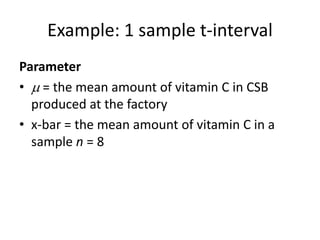
Example: 1 sample t-interval	Problem 10.30	The amount of Vitamin C (mg/100g) in CSB for a random sample of 8 are given as:	26, 31, 23, 22, 11, 22, 14, 31	Construct a 95% Confidence interval for the amount of vitamin C in CSB.
Example: 1 sample t-intervalParameter = the mean amount of vitamin C in CSB produced at the factoryx-bar = the mean amount of vitamin C in a sample n = 8
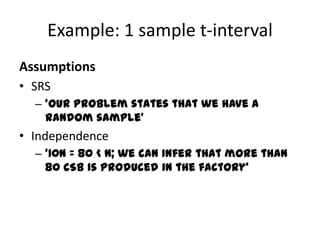
Example: 1 sample t-intervalAssumptionsSRS‘Our problem states that we have a random sample’Independence‘10n = 80 < N; we can infer that more than 80 CSB is produced in the factory’
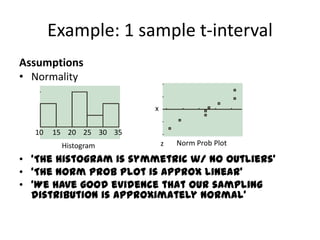
Example: 1 sample t-intervalAssumptionsNormality‘The histogram is symmetric w/ no outliers’‘The Norm Prob Plot is approx linear’‘We have good evidence that our sampling distribution is approximately Normal’x10     15    20    25    30    35Norm Prob PlotHistogramz
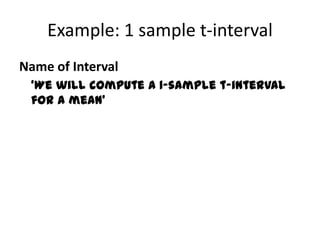
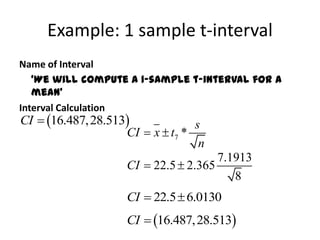
Example: 1 sample t-intervalName of Interval	‘We will compute a 1-sample t-interval for a mean’
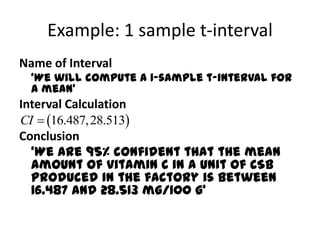
Example: 1 sample t-intervalName of Interval	‘We will compute a 1-sample t-interval for a mean’Interval Calculation
Example: 1 sample t-intervalName of Interval	‘We will compute a 1-sample t-interval for a mean’Interval CalculationConclusion	‘We are 95% confident that the mean amount of vitamin C in a unit of CSB produced in the factory is between 16.487 and 28.513 mg/100 g’
10.3 Estimating a population Proportion
Estimating a ProportionLike with means, we are going to estimate the population proportion based on the proportion in a samplex = # of positive responsesn = total number of responsesWe will again use the PANIC proceduresNote: nothing is averaged.  We are not looking at the average proportion from many samples
ParameterSome typical parameters:‘p = prop of people in CA who support the proposition	p-hat = proportion of people in a sample n = 35 who support the proposition’‘p = prop of students at THS who ride the bus	p-hat = propotion of students in  a sample (n = 14) from THS who ride the bus
AssumptionsSimple Random Sample SRS must be either stated or inferredIndependencebecause you are usually sampling without replacement:N> 10nNormalityn·p-hat > 10n·q-hat > 10
Name of the Interval“1-proportion z interval”Unlike for means, you will always use the Normal curve when dealing with proportions!
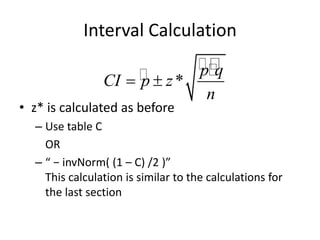
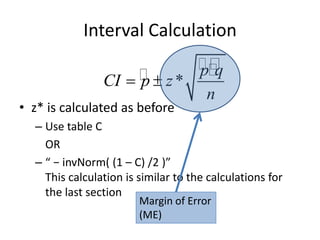
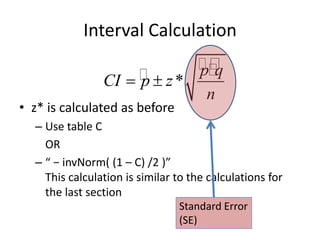
Interval Calculationz* is calculated as beforeUse table C	OR“ − invNorm( (1 – C) /2 )”This calculation is similar to the calculations for the last section
Interval Calculationz* is calculated as beforeUse table C	OR“ − invNorm( (1 – C) /2 )”This calculation is similar to the calculations for the last sectionMargin of Error (ME)
Interval Calculationz* is calculated as beforeUse table C	OR“ − invNorm( (1 – C) /2 )”This calculation is similar to the calculations for the last sectionStandard Error(SE)
ConclusionSome Examples:We are 90% confident that the proportion of voters in CA who support the proposition is 0.34 ± 0.03We are 95% confident that the proportion of students at THS who ride this bus is in the interval (0.39, 0.44)
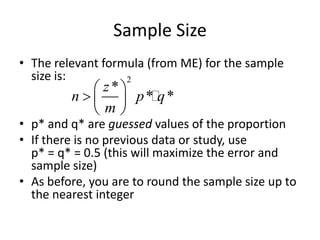
Sample SizeThe relevant formula (from ME) for the sample size is:p* and q* are guessed values of the proportionIf there is no previous data or study, use p* = q* = 0.5 (this will maximize the error and sample size)As before, you are to round the sample size up to the nearest integer
TI83/84
TI83/84[stat] -> “TEST” -> “1-PropZInt”“x: number of successes” this can be computed with “p-hat x n”“n: number of people in sample”“C-Level : confidence level”“Calculate” and you are doneYou still need to fully write up “PANIC” procedures
TI 89
TI 89[APPS] -> “Stat/List Editor”[2nd] -> [F2](F7) -> “1-PropZInt”“Successes x: # of successes”“n: number of people in sample”“C-Level : confidence level”“Calculate” and you are doneYou still need to fully write up “PANIC” procedures
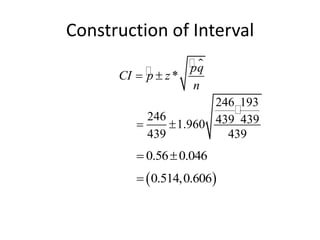
Example 1-PropZInt	The 2004 Gallup Youth Survey asked a random sample of 439 US teens aged 13 to 17 whether they though young people should wait to have sex until marriage.  246 sad “yes.”  Let’s construct a 95% confidence interval for the proportion of all teens who would say “Yes”
Parameterp = the proportion of all teens in the US aged 13-17 who would answer “Yes” to the surveyp-hat = the proportion of teens in the survey of 439 who answered “Yes” to the survey
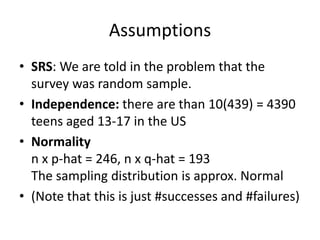
AssumptionsSRS: We are told in the problem that the survey was random sample.Independence: there are than 10(439) = 4390 teens aged 13-17 in the USNormalityn x p-hat = 246, n x q-hat = 193The sampling distribution is approx. Normal(Note that this is just #successes and #failures)
Name of IntervalWe are constructing a “1 proportion Z interval”
Construction of Interval
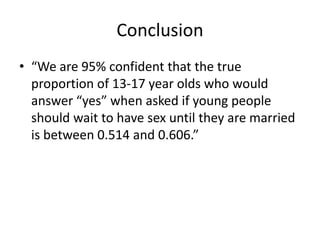
Conclusion“We are 95% confident that the true proportion of 13-17 year olds who would answer “yes” when asked if young people should wait to have sex until they are married is between 0.514 and 0.606.”
Stats chapter 10

Stats chapter 10

  • 1.
  • 2.
  • 3.
    DefinitionsStatistical InferenceThe methodof drawing conclusions about a population based on a sampleThe last Major Topic for this last statistics courseThe mindset: we are looking at data that comes from a random sample (or an experiment) and inferring characteristics of the population
  • 4.
    The Basic Plan Inthe absence of other data, the sample estimate is the estimate of the parameterWe would like an interval estimationState the parameter that is being estimatedCheck to see if the data can be NormalizedCompute the interval using area under the Normal curveWrite a nice conclusion
  • 5.
    What does aninterval estimation look like?EX1We are 95% confident the mean is in the interval (9.11, 12.05)
  • 6.
    What does aninterval estimation look like?EX1We are 95% confident the mean is in the interval (9.11, 12.05)Confidence Level C
  • 7.
    What does aninterval estimation look like?EX1We are 95% confident the mean is in the interval (9.11, 12.05)Confidence Interval(CI)
  • 8.
    What does aninterval estimation look like?EX1We are 95% confident the mean is in the interval (9.11, 12.05)Lower BoundUpper Bound
  • 9.
    What does aninterval estimation look like?EX1We are 95% confident the mean is in the interval (9.11, 12.05)EX2We are 90% confident that the proportion that support this law is 0.74 ± 0.08
  • 10.
    What does aninterval estimation look like?EX1We are 95% confident the mean is in the interval (9.11, 12.05)EX2We are 90% confident that the proportion that support this law is 0.74 ± 0.08Confidence Level C
  • 11.
    What does aninterval estimation look like?EX1We are 95% confident the mean is in the interval (9.11, 12.05)EX2We are 90% confident that the proportion that support this law is 0.74 ± 0.08Confidence Interval (CI)
  • 12.
    What does aninterval estimation look like?EX1We are 95% confident the mean is in the interval (9.11, 12.05)EX2We are 90% confident that the proportion that support this law is 0.74 ± 0.08Margin of Error(ME)Point Estimate
  • 13.
    Confidence LevelThe valueof the parameter is fixed before we start our samplingEither the parameter is ‘in’ our interval or it’s not.There is no probability involved here“There is a 95% probability the parameter is in the interval”
  • 14.
    Confidence LevelThe valueof the parameter is fixed before we start our samplingEither the parameter is ‘in’ our interval or it’s not.There is no probability involved here“There is a 95% probability the parameter is in the interval”F A I L
  • 15.
    Confidence LevelRemember thatour sample is just one of many samples that could have been takenIf good sampling technique is used, 95% (for example) of the samples would contain the parameterWe just don’t know if our sample is part of the 95% or the 5%
  • 16.
    Confidence LevelInterpretation of“90% Confidence Level”“We are 90% confident that our CI contains the value of the parameter”“90% of CI’s computed with this technique will contain the parameter”“There is a 90% probability our CI contains the parameter”WRONG INTERPRETATION
  • 17.
    Confidence LevelInterpretation of“90% Confidence Level”“We are 90% confident that our CI contains the value of the parameter”“90% of CI’s computed with this technique will contain the parameter”“There is a 90% probability our CI contains the parameter”WRONG INTERPRETATION
  • 18.
    PANICWhen constructing ConfidenceIntervals for the AP test, there is a definite checklist that readers look forUse the acronym P.A.N.I.C. to help memorize the steps to construction a confidence intervalP = state the ParameterA = check that Assumptions are satisfiedN = state is the Name of the intervalI = compute numerical values of the IntervalC = write a Conclusion for your findings
  • 19.
    PANIC for MeansWeare going to start with Means, we’ll save proportions for laterParameterdefine what  measuresdefine what x-bar measures“ = mean length of all Great White Sharks‘ flukesx-bar = mean length the Great White Shark flukes in our sample of 35 sharks”
  • 20.
    Assumptions for CI’sof MeanSRS- the data must have come from an SRSIndependence- the population size must be more than 10 times the sampleN> 10n (Independence)
  • 21.
    Assumptions for CI’sof MeanSRS- the data must have come from an SRSIndependence- the population size must be more than 10 times the sampleN> 10n (Independence)This is a condition that must be met since we are sampling without replacement and our formula forstd dev needs to hold true
  • 22.
    Assumptions for CI’sof MeanSRS- the data must have come from an SRSIndependence- the population size must be more than 10 times the sampleN> 10n (Independence)The sampling Distribution is approximately Normal (Normality)
  • 23.
    More on NormalityWeare looking for justification that the sampling distribution is NormalIf the population is Normal, then the samp dist is also NormalIf n> 30 and the sample data is not given, state “The Central Limit Theorem guarantees that the sampling distribution is Normal”For smaller samples, check the following:(1) the Histogram is single peak, symmetric with no outliers(2) the Normal Probability Plot is approx Linear
  • 24.
    Name of theIntervalCurrently, the only Interval we will worry about is “z-interval for sample means”This will always be the name of the distribution used
  • 25.
  • 26.
  • 27.
    Confidence Interval ComputationStandardErrorAlways the std devof the sampling distributionCritical Value-from the Normal (z) distribution
  • 28.
    Critical ValueThe areabetween –z* and +z* = Confidence LevelBecause they are used frequently, there is a shorthand method in table CThe last row gives different confidence levelsKeep critical values to 3 decimal places The row above the CL row has the z*In the AP test, they will call this z
  • 29.
  • 30.
    z* for a80% CL
  • 31.
    Computing a CILet’scompute the 95% CI for a sample of 35, with a mean of 5.38 and a population std dev =0.74(1) locate the critical valuez* = 1.960(2) Compute S.E. and M.E.SE = 0.74/(35) = 0.1251ME = (1.960)(0.1251) = 0.2452
  • 32.
    Computing a CIStatethe CI = 5.38 ± 0.25Interval estimate:(5.13, 5.63)Notice that the point estimate is the average of the upper and lower bounds
  • 33.
    ConclusionsWe are 95%confident that the mean length of a great white shark fluke is 5.38 ± 0.25 ft. ORWe are 95% confident that the mean length of all great white shark flukes is in the interval (5.13 ft, 5.63 ft).
  • 34.
  • 35.
    Calculators TI83/TI84Your TIis very efficient for finding these intervals! This doesn’t excuse you from the mathematics, of course.[stat] -> “TESTS” -> “Zinterval”Inpt: “Stats” (if your data is in L1, you can use “Data”Enter values for , x-bar, n, and C-Level.Viola!
  • 36.
    Calculators TI89Run the“Stats/List Editor” APP[2nd] -> [F2] (F7) -> “Zinterval”Input Method = “Stats”Choose Data if all the observations are in a ListEnter values for , x-bar, n, and C-Level.Viola!
  • 37.
    Behavior of Marginof ErrorME = z* (/n)In practice, we would like to minimize ME.(1) decrease z* This also means decrease our CL!(2) increase nthis is usually a trade off, since obtaining large samples could be more expensive/time consuming(3) decrease Not really an option.  is a known quantity.
  • 38.
    Sample SizeBy usingalgebra, we can get a formula to compute minimum sample size for a given MEYou should always round the sample size up in this calculationNote: ME is produced by sampling variability, it has nothing to do with “sloppy work”
  • 39.
    10.2 Estimating aPopulation Mean
  • 40.
    Student’s t-distributionThe confidenceintervals computed in the previous section assumed that we knew .It doesn’t seem likely that we would know  and not know the value of When  is unknown, we can no longer use the Normal distribution
  • 41.
    Student’s t-distributionThe t-distributionis to be used when  is unknown.The t-distribution is very similar to the Normal distribution with a key differenceThe shape of the distribution changes based upon the sample size/degrees of freedom (df)Large samples have a tall peak and thinner tailsSmall samples have a small peak and thicker tails.
  • 42.
  • 43.
    Using the t-distributionTheCI is found using PANICThe Assumptions are the same as a z-intervalSince sample sizes tend to be small, you will most likely need to check the histogram (symmetric, no outliers) and Normal prob plot (approx linear)We cannot use the t-distribution when there are outliers!The Name of the interval is “1-sample t-interval for mean”
  • 44.
    Using the t-distributionIntervalis computed withdf = n – 1t* is from table C or your calculators is the sample’s standard deviationUses the sample std dev to approximate 
  • 45.
  • 46.
    Upper Tail AreaThisis the Upper Tail Area
  • 47.
  • 48.
    Using the t-distributionUsingTI84 [2nd] -> [vars](DIST) -> “invT”“invT(1-Upper Tail Area, df)”Where “Upper Tail Area” = (1-CL)/2This is the area to the left of the right crit. Value.ALTERNATIVELY, you may use“−invT(Upper Tail Area, df)”
  • 49.
    Using the t-distributionUsingTI84 [2nd] -> [vars](DIST) -> “invT”“invT(1-Upper Tail Area, df)”Where “Upper Tail Area” = (1-CL)/2This is the area to the left of the right crit. Value.ALTERNATIVELY, you may use“−invT(Upper Tail Area, df)”
  • 50.
    Using the t-distributionUsingTI84 [2nd] -> [vars](DIST) -> “invT”“invT(1-Upper Tail Area, df)”Where “Upper Tail Area” = (1-CL)/2This is the area to the left of the right crit. Value.ALTERNATIVELY, you may use“−invT(Upper Tail Area, df)”Don’t forget the negative!
  • 51.
  • 52.
    Using the t-distributionUsingTI89From home screen:[catalog] -> [F3](FlashApps) -> inv_t…TIStat“tistat.invT(1-Upper Tail Area, df)”Where “Upper Tail Area” = (1-CL)/2This is the area to the left of the right crit. Value.ALTERNATIVELY, you may use“-tistat.invT(Upper Tail Area, df)”
  • 53.
    Using the t-distributionUsingTI89From home screen:[catalog] -> [F3](FlashApps) -> inv_t…TIStat“tistat.invT(1-Upper Tail Area, df)”Where “Upper Tail Area” = (1-CL)/2This is the area to the left of the right crit. Value.ALTERNATIVELY, you may use“-tistat.invT(Upper Tail Area, df)”
  • 54.
    Using the t-distributionUsingTI89From home screen:[catalog] -> [F3](FlashApps) -> inv_t…TIStat“tistat.invT(1-Upper Tail Area, df)”Where “Upper Tail Area” = (1-CL)/2This is the area to the left of the right crit. Value.ALTERNATIVELY, you may use“-tistat.invT(Upper Tail Area, df)”Don’t forget the negative!
  • 55.
    Using the t-distributionALTERNATIVETI89 titanium[APPS] -> “Stat/List Editor” -> [F5] (distrib) -> “Inverse” -> “Inverse t…” “Area: 1- Upper Tail”Upper Tail = (1 – CL)/2“degrees of freedom, df: df”This takes longer to get to, but the menu “guides” you through
  • 56.
    Table COccasionally, youwill need to fine the t* for a df that does not appear in the chart.When this happens, you are to use the nearest greatest df in the same columnThis usually means “use the t* that is in the line above where the desired t* should be”
  • 57.
    Example: 1 samplet-interval Problem 10.30 The amount of Vitamin C (mg/100g) in CSB for a random sample of 8 are given as: 26, 31, 23, 22, 11, 22, 14, 31 Construct a 95% Confidence interval for the amount of vitamin C in CSB.
  • 58.
    Example: 1 samplet-intervalParameter = the mean amount of vitamin C in CSB produced at the factoryx-bar = the mean amount of vitamin C in a sample n = 8
  • 59.
    Example: 1 samplet-intervalAssumptionsSRS‘Our problem states that we have a random sample’Independence‘10n = 80 < N; we can infer that more than 80 CSB is produced in the factory’
  • 60.
    Example: 1 samplet-intervalAssumptionsNormality‘The histogram is symmetric w/ no outliers’‘The Norm Prob Plot is approx linear’‘We have good evidence that our sampling distribution is approximately Normal’x10 15 20 25 30 35Norm Prob PlotHistogramz
  • 61.
    Example: 1 samplet-intervalName of Interval ‘We will compute a 1-sample t-interval for a mean’
  • 62.
    Example: 1 samplet-intervalName of Interval ‘We will compute a 1-sample t-interval for a mean’Interval Calculation
  • 63.
    Example: 1 samplet-intervalName of Interval ‘We will compute a 1-sample t-interval for a mean’Interval CalculationConclusion ‘We are 95% confident that the mean amount of vitamin C in a unit of CSB produced in the factory is between 16.487 and 28.513 mg/100 g’
  • 64.
    10.3 Estimating apopulation Proportion
  • 65.
    Estimating a ProportionLikewith means, we are going to estimate the population proportion based on the proportion in a samplex = # of positive responsesn = total number of responsesWe will again use the PANIC proceduresNote: nothing is averaged. We are not looking at the average proportion from many samples
  • 66.
    ParameterSome typical parameters:‘p= prop of people in CA who support the proposition p-hat = proportion of people in a sample n = 35 who support the proposition’‘p = prop of students at THS who ride the bus p-hat = propotion of students in a sample (n = 14) from THS who ride the bus
  • 67.
    AssumptionsSimple Random SampleSRS must be either stated or inferredIndependencebecause you are usually sampling without replacement:N> 10nNormalityn·p-hat > 10n·q-hat > 10
  • 68.
    Name of theInterval“1-proportion z interval”Unlike for means, you will always use the Normal curve when dealing with proportions!
  • 69.
    Interval Calculationz* iscalculated as beforeUse table C OR“ − invNorm( (1 – C) /2 )”This calculation is similar to the calculations for the last section
  • 70.
    Interval Calculationz* iscalculated as beforeUse table C OR“ − invNorm( (1 – C) /2 )”This calculation is similar to the calculations for the last sectionMargin of Error (ME)
  • 71.
    Interval Calculationz* iscalculated as beforeUse table C OR“ − invNorm( (1 – C) /2 )”This calculation is similar to the calculations for the last sectionStandard Error(SE)
  • 72.
    ConclusionSome Examples:We are90% confident that the proportion of voters in CA who support the proposition is 0.34 ± 0.03We are 95% confident that the proportion of students at THS who ride this bus is in the interval (0.39, 0.44)
  • 73.
    Sample SizeThe relevantformula (from ME) for the sample size is:p* and q* are guessed values of the proportionIf there is no previous data or study, use p* = q* = 0.5 (this will maximize the error and sample size)As before, you are to round the sample size up to the nearest integer
  • 74.
  • 75.
    TI83/84[stat] -> “TEST”-> “1-PropZInt”“x: number of successes” this can be computed with “p-hat x n”“n: number of people in sample”“C-Level : confidence level”“Calculate” and you are doneYou still need to fully write up “PANIC” procedures
  • 76.
  • 77.
    TI 89[APPS] ->“Stat/List Editor”[2nd] -> [F2](F7) -> “1-PropZInt”“Successes x: # of successes”“n: number of people in sample”“C-Level : confidence level”“Calculate” and you are doneYou still need to fully write up “PANIC” procedures
  • 78.
    Example 1-PropZInt The 2004Gallup Youth Survey asked a random sample of 439 US teens aged 13 to 17 whether they though young people should wait to have sex until marriage. 246 sad “yes.” Let’s construct a 95% confidence interval for the proportion of all teens who would say “Yes”
  • 79.
    Parameterp = theproportion of all teens in the US aged 13-17 who would answer “Yes” to the surveyp-hat = the proportion of teens in the survey of 439 who answered “Yes” to the survey
  • 80.
    AssumptionsSRS: We aretold in the problem that the survey was random sample.Independence: there are than 10(439) = 4390 teens aged 13-17 in the USNormalityn x p-hat = 246, n x q-hat = 193The sampling distribution is approx. Normal(Note that this is just #successes and #failures)
  • 81.
    Name of IntervalWeare constructing a “1 proportion Z interval”
  • 82.
  • 83.
    Conclusion“We are 95%confident that the true proportion of 13-17 year olds who would answer “yes” when asked if young people should wait to have sex until they are married is between 0.514 and 0.606.”