1Slide
Online Tutoring |Homework Help
Exam Preparations
2Slide
A term too broad to define, Statistics is an
important subject studied by almost all commerce
graduates and undergraduates across the globe.
We at Homework Guru offer best Statistics
Homework Help available online.
3Slide
Students needing Statistics Homework Help can
connect to us for :-
1.Instant On Demand Statistics Online Tutoring
2.Scheduled Statistics Online Tutoring
3.Email Based Statistics Homework Help
4.Preparation for Statistics & Accounts
competitive exams like CFA & CPA
4Slide
Estimation & Confidence Interval
 Interval Estimation for Population Mean: s Known
 Interval Estimation for Population Mean: s Unknown
 Determining the Sample Size
5Slide
Why Homework Guru ?
All experts registered with us are handpicked and have to clear more than 5 exams
before being inducted for Statistics Homework Help
We are available 24 X 7 so you can connect to us anytime and from anywhere
All the solutions we provide are properly proof read, 100% genuine and plagiarism
free.
Our Statistics tutoring sessions take place in our specially customized online
classroom. You and your tutor can review financial statements and cash flows using
the interactive white board.
We not just solve your problem but also explain you the concepts so that you dont
need to come back again for Statistics help.
6Slide
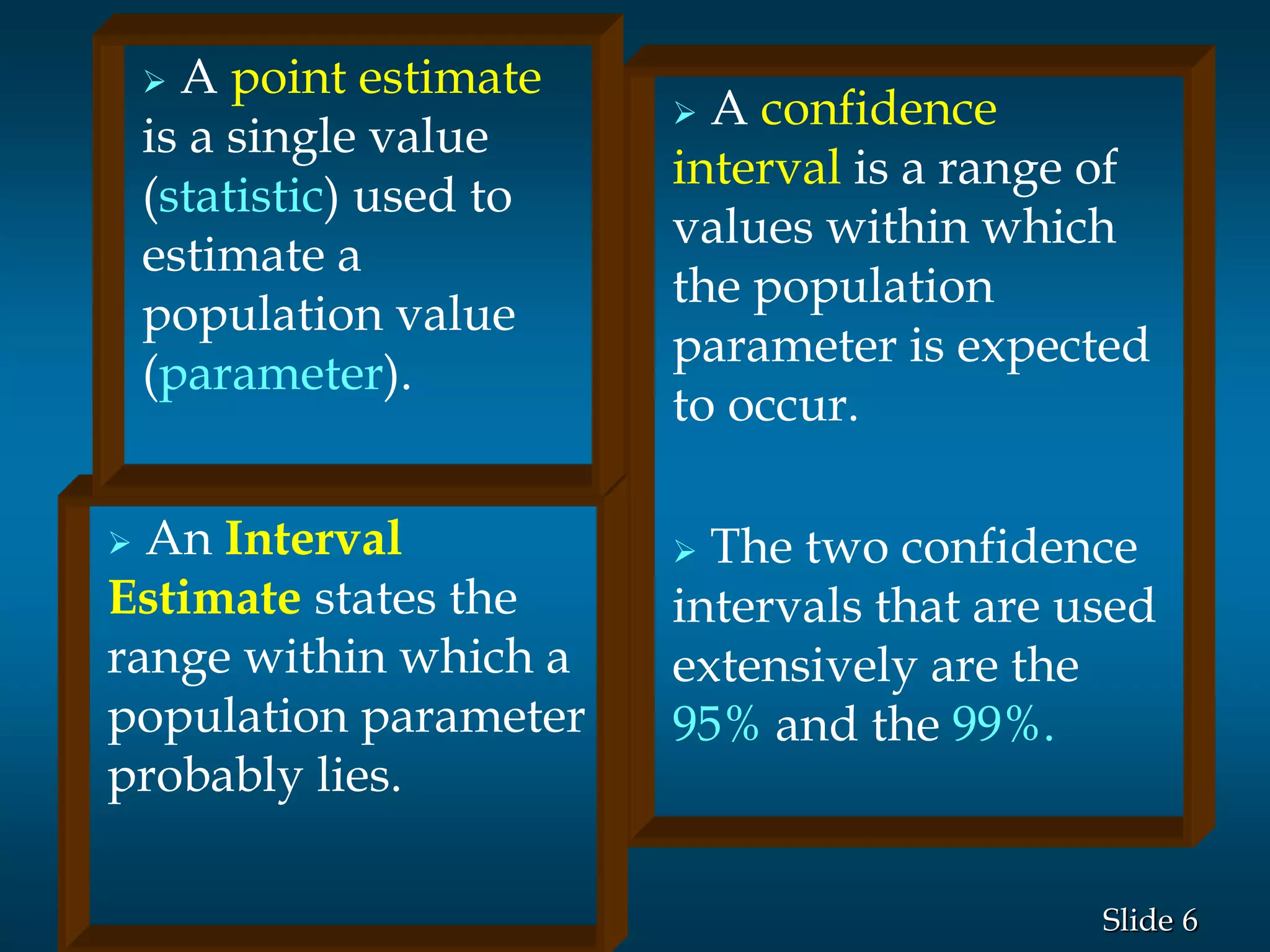
 A confidence
interval is a range of
values within which
the population
parameter is expected
to occur.
 The two confidence
intervals that are used
extensively are the
95% and the 99%.
 An Interval
Estimate states the
range within which a
population parameter
probably lies.
 A point estimate
is a single value
(statistic) used to
estimate a
population value
(parameter).
7Slide
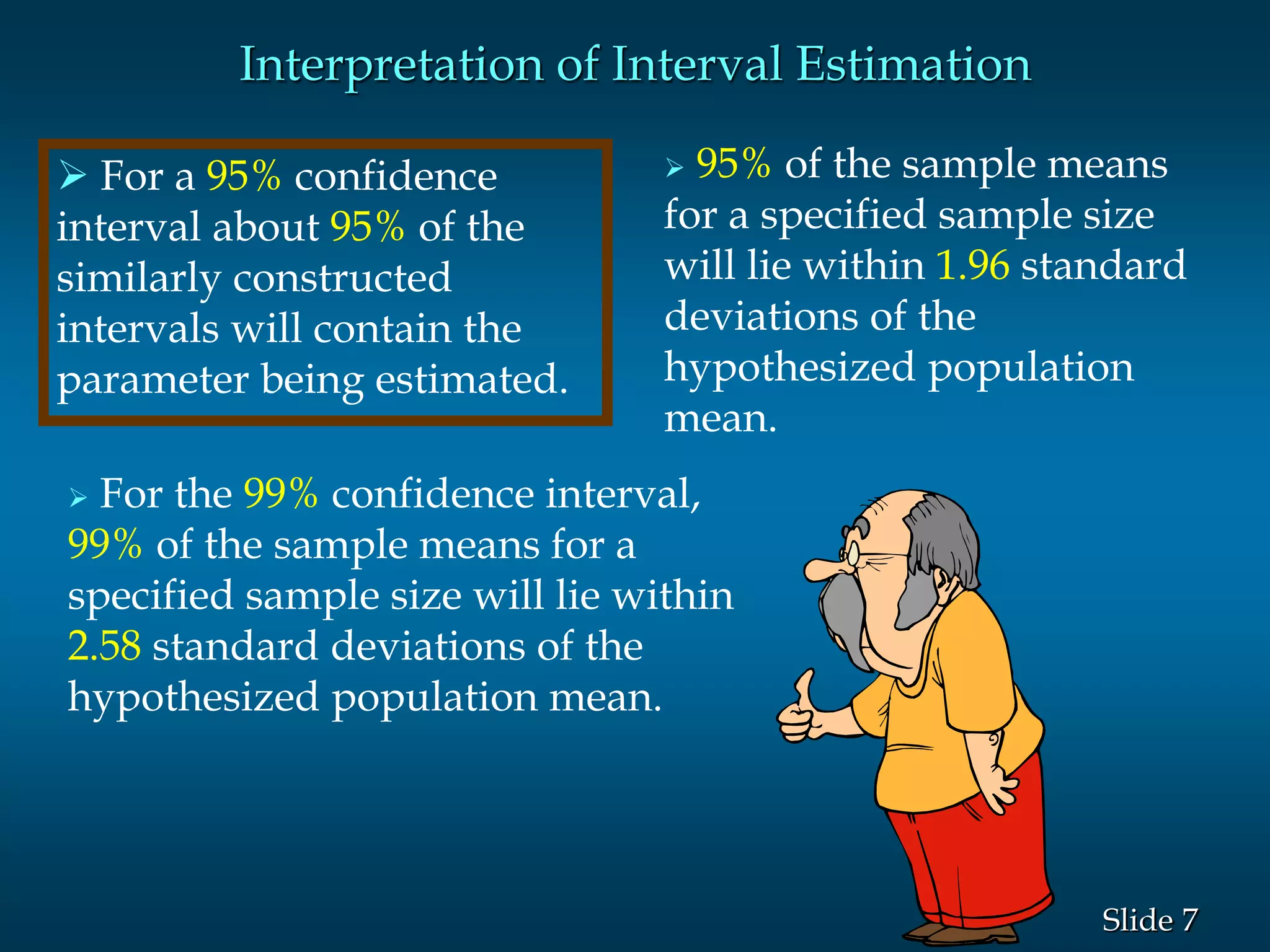
 For the 99% confidence interval,
99% of the sample means for a
specified sample size will lie within
2.58 standard deviations of the
hypothesized population mean.
 95% of the sample means
for a specified sample size
will lie within 1.96 standard
deviations of the
hypothesized population
mean.
 For a 95% confidence
interval about 95% of the
similarly constructed
intervals will contain the
parameter being estimated.
Interpretation of Interval Estimation
8Slide
A point estimator cannot be expected to provide the
exact value of the population parameter.
An interval estimate can be computed by adding and
subtracting a margin of error to the point estimate.
Point Estimate +/- Margin of Error
The purpose of an interval estimate is to provide
information about how close the point estimate is to
the value of the parameter.
Margin of Error and the Interval Estimate
9Slide
The general form of an interval estimate of a
population mean is
Margin of Errorx 
Margin of Error and the Interval Estimate
(Continued)
Point Estimate
10Slide
Interval Estimation of a Population Mean:
s Known (Continued)
 In order to develop an interval estimate of a
population mean, the margin of error must be
computed using either:
•the population standard deviation s , or
•the sample standard deviation s
 s is rarely known exactly, but often a good estimate
can be obtained based on historical data or other
information.
 We refer to such cases as the s known case.
11Slide
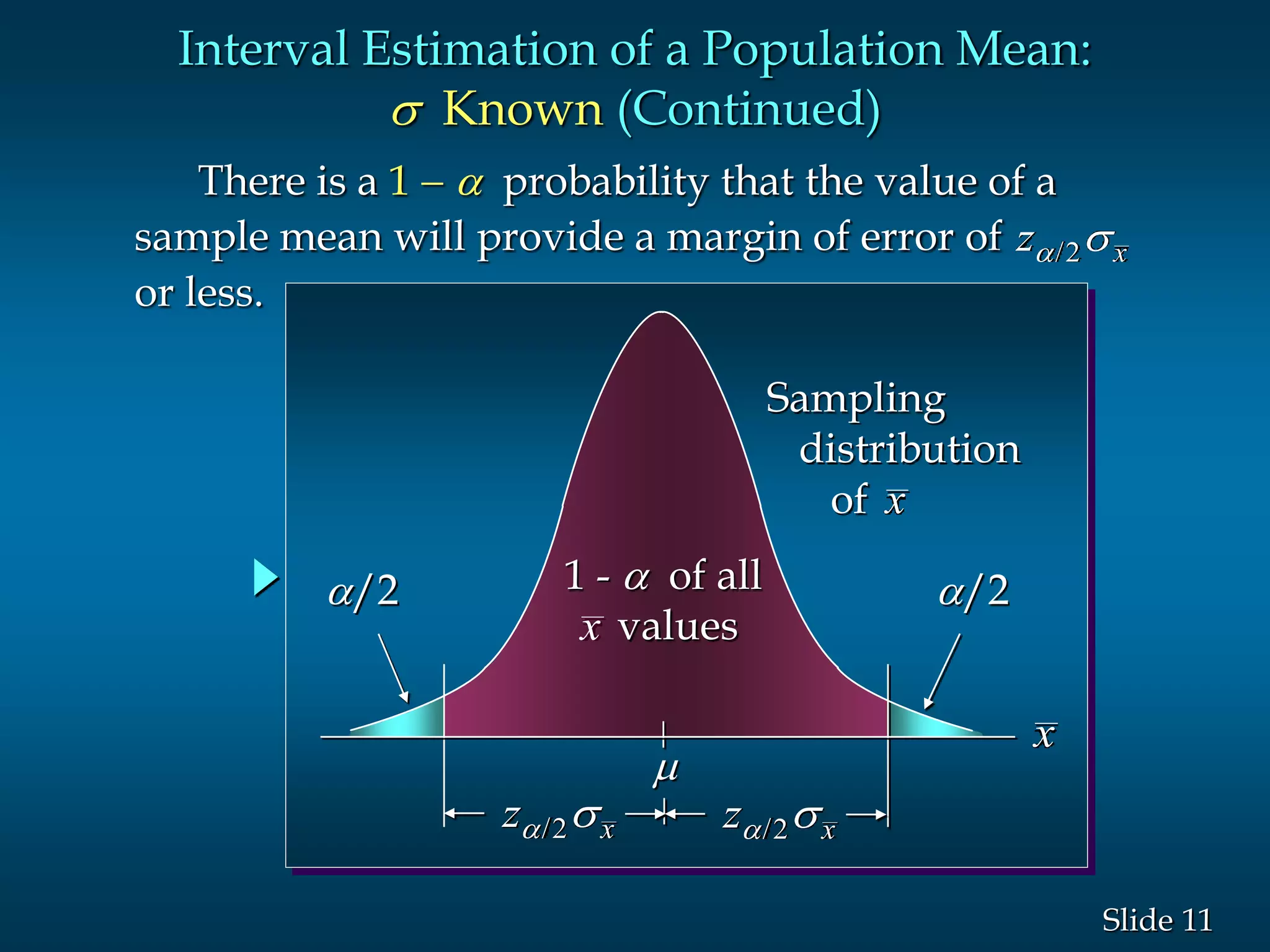
There is a 1 -  probability that the value of a
sample mean will provide a margin of error of
or less.
z x s/2

/2 /21 -  of all
valuesx
Sampling
distribution
of x
x
z x s/2z x s/2
Interval Estimation of a Population Mean:
s Known (Continued)
12Slide

/2 /2
1 -  of all
valuesx
Sampling
distribution
of x
x
z x s/2z x s/2
[------------------------- -------------------------]
[------------------------- -------------------------]
[------------------------- -------------------------]
x
x
x
interval
does not
include  interval
includes 
interval
includes 
Interval Estimate of a Population Mean:
s Known (Continued)
13Slide
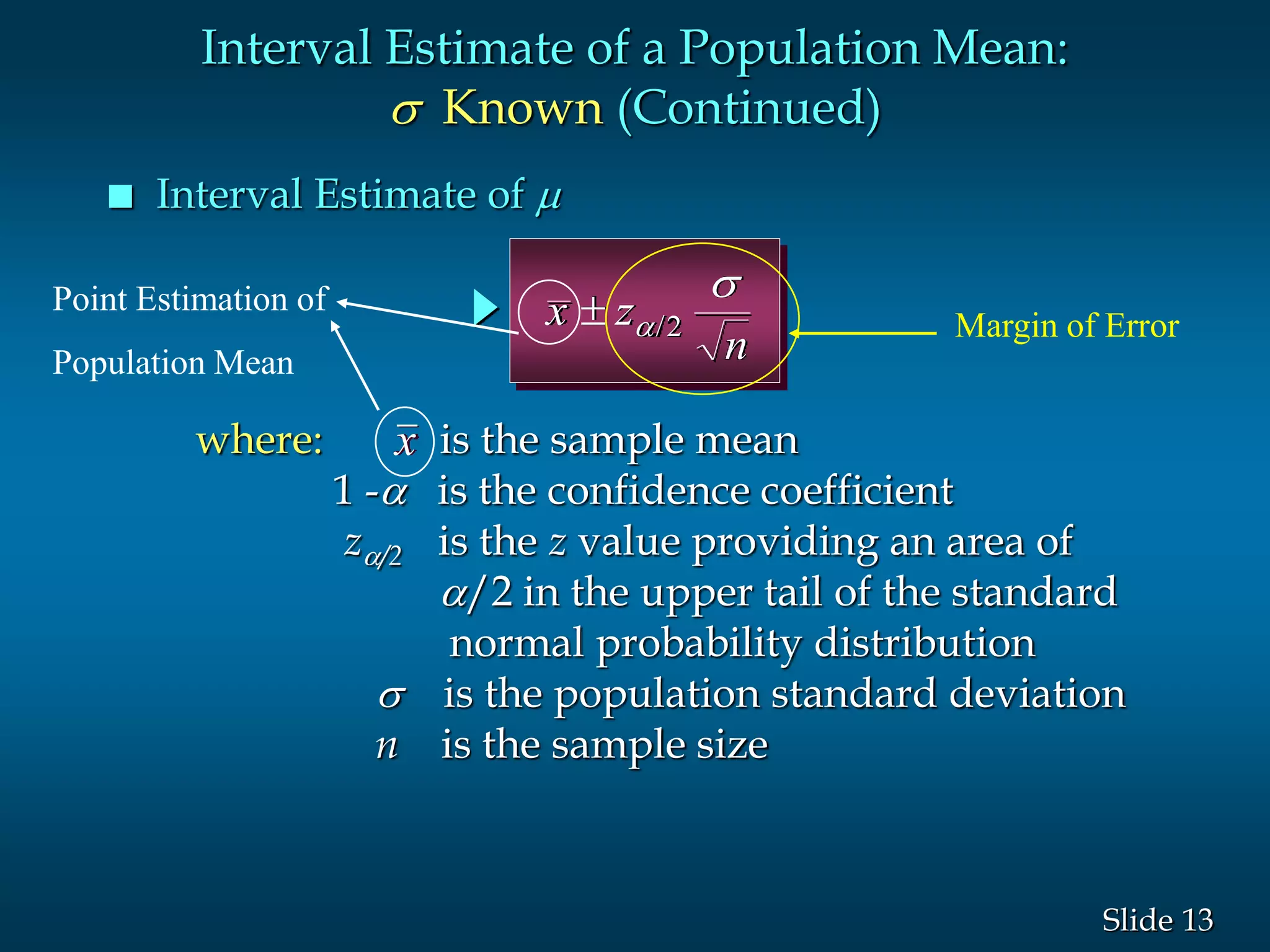
 Interval Estimate of 
Interval Estimate of a Population Mean:
s Known (Continued)
where: is the sample mean
1 - is the confidence coefficient
z/2 is the z value providing an area of
/2 in the upper tail of the standard
normal probability distribution
s is the population standard deviation
n is the sample size
x
x z
n
 
s
/2 Margin of Error
Point Estimation of
Population Mean
14Slide
D
Interval Estimate of Population Mean:
s Known
 Example: Discount Sounds
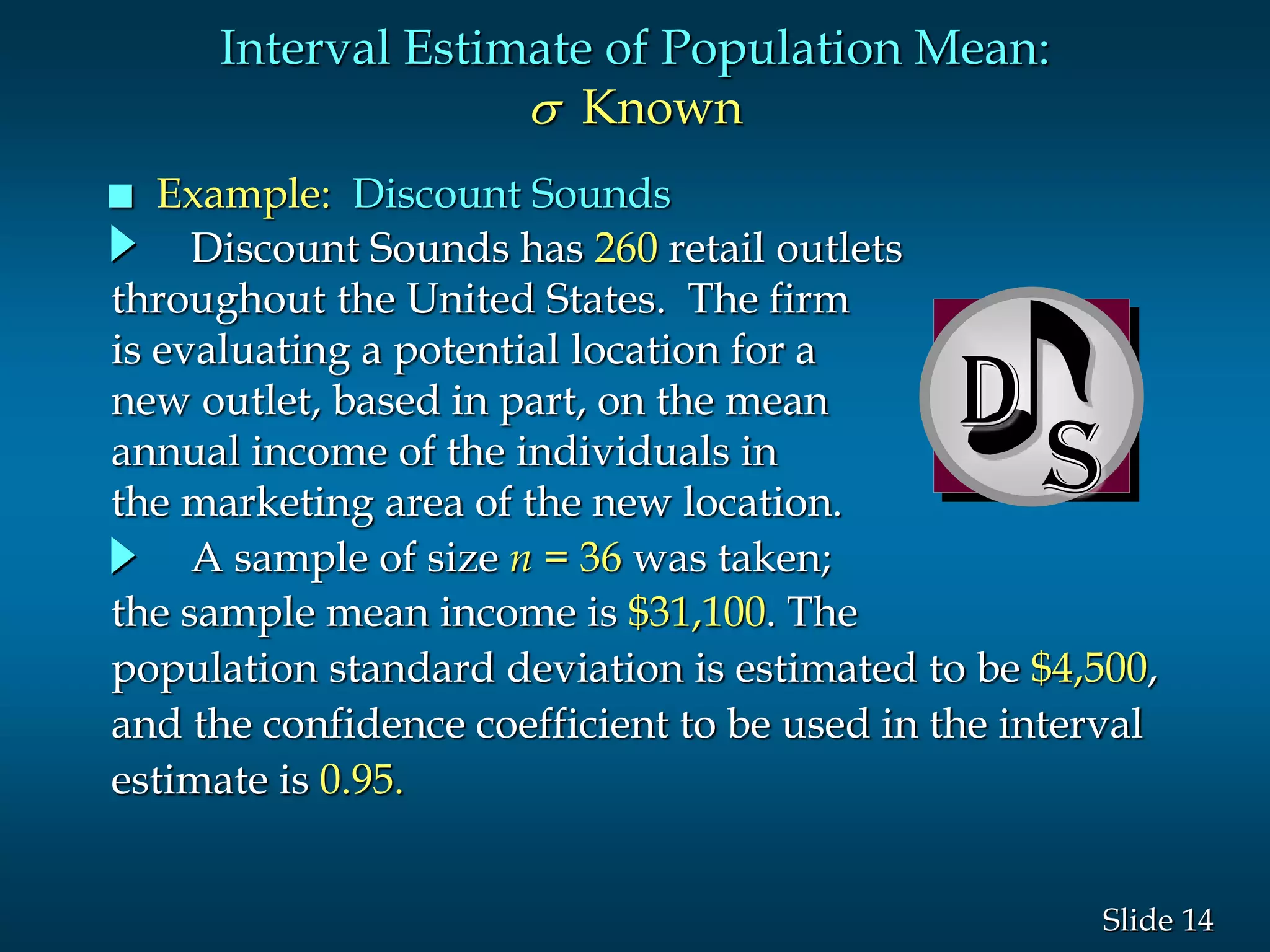
Discount Sounds has 260 retail outlets
throughout the United States. The firm
is evaluating a potential location for a
new outlet, based in part, on the mean
annual income of the individuals in
the marketing area of the new location.
A sample of size n = 36 was taken;
the sample mean income is $31,100. The
population standard deviation is estimated to be $4,500,
and the confidence coefficient to be used in the interval
estimate is 0.95.
15Slide
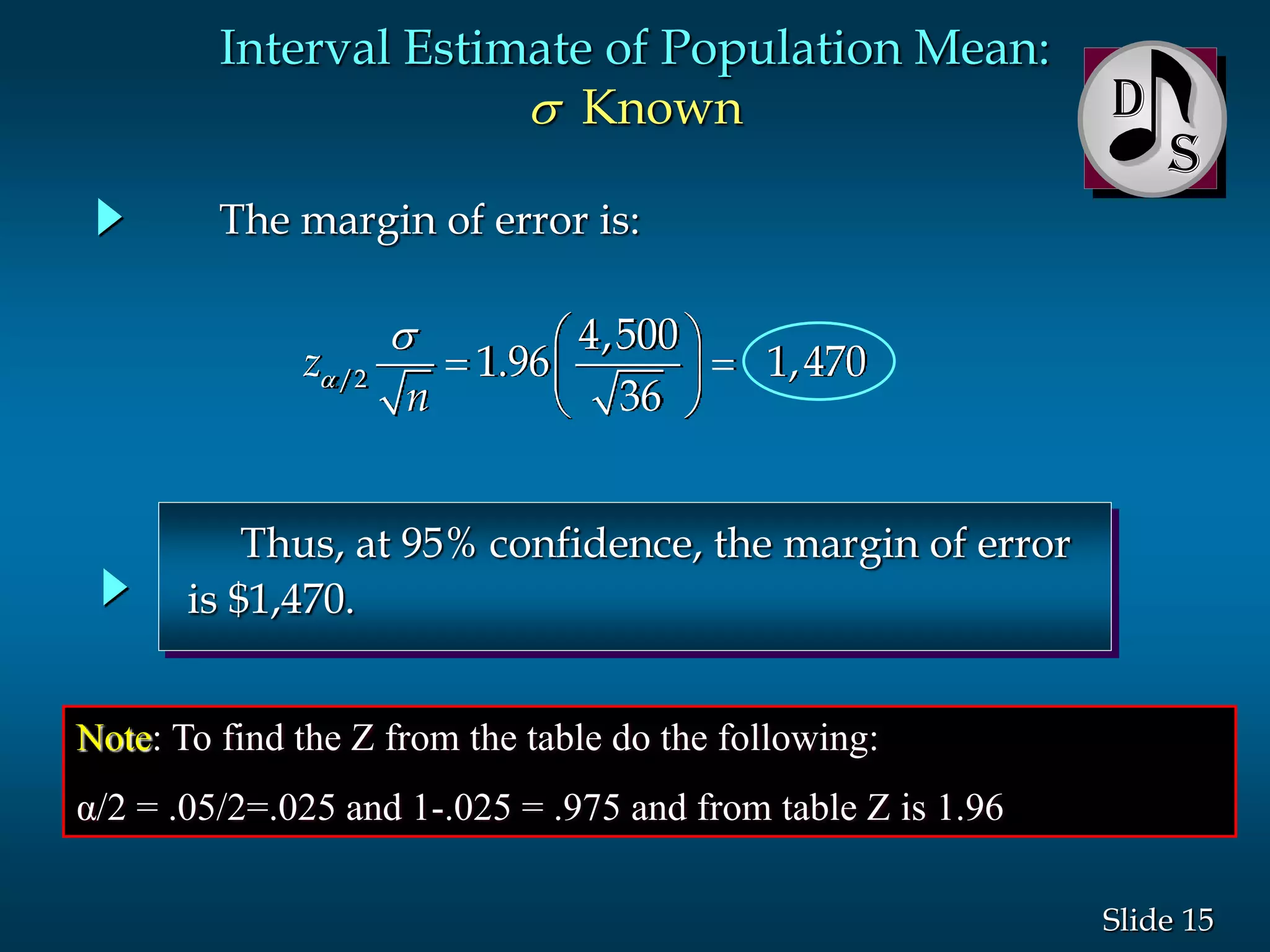
The margin of error is:

s  
  
 
/2
4,500
1.96 1,470
36
z
n
Thus, at 95% confidence, the margin of error
is $1,470.
D
Interval Estimate of Population Mean:
s Known
Note: To find the Z from the table do the following:
α/2 = .05/2=.025 and 1-.025 = .975 and from table Z is 1.96
16Slide
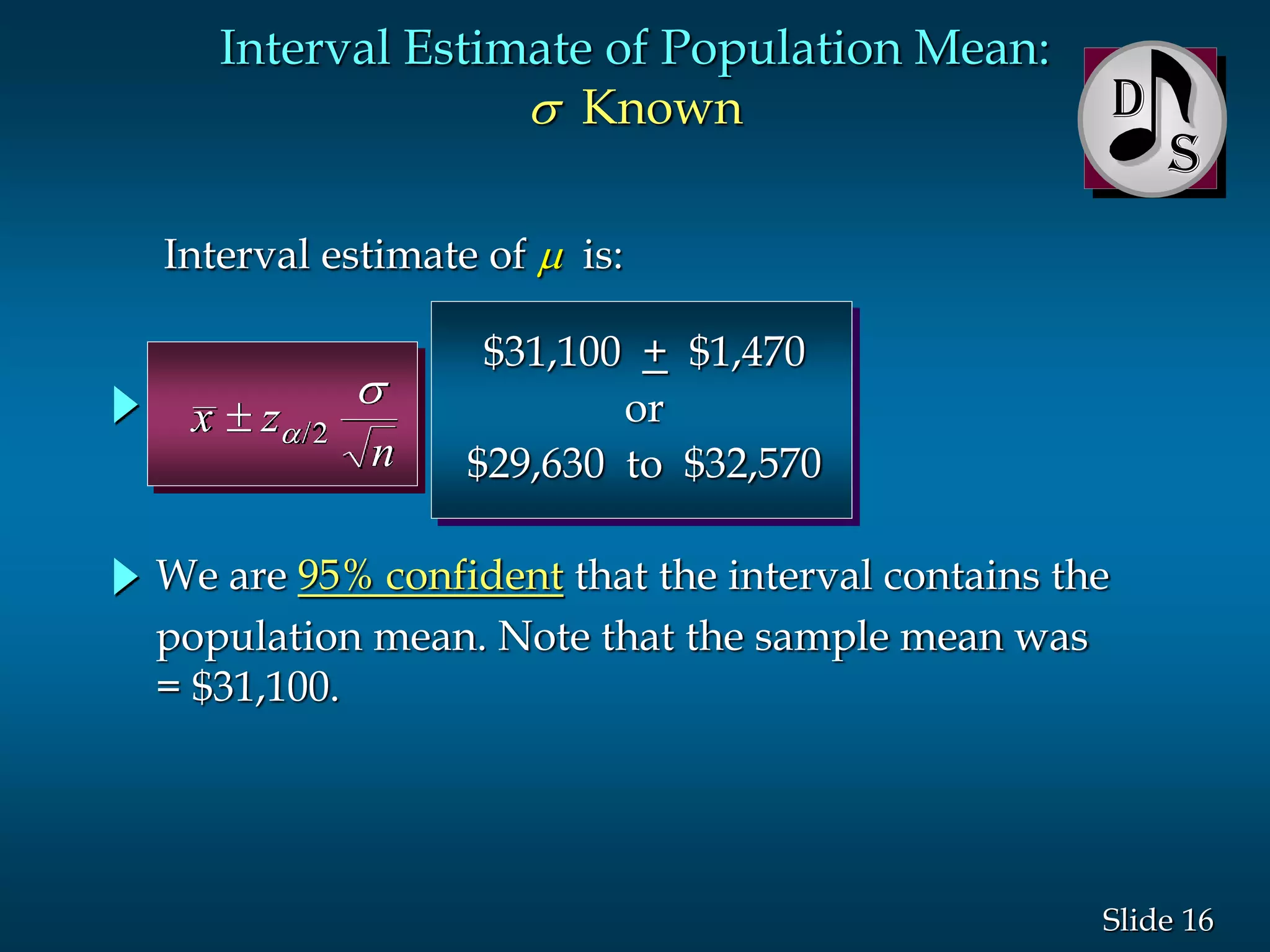
Interval estimate of  is:
Interval Estimate of Population Mean:
s Known D
We are 95% confident that the interval contains the
population mean. Note that the sample mean was
= $31,100.
$31,100 + $1,470
or
$29,630 to $32,570
x z
n
 
s
/2
17Slide
Interval Estimation of a Population Mean:
s Unknown
 If an estimate of the population standard deviation s
cannot be developed prior to sampling, we use the
sample standard deviation s to estimate s .
 This is the s unknown case.
 In this case, the interval estimate for  is based on the
t distribution.
18Slide
The t distribution is a family of similar probability
distributions.
t Distribution
A specific t distribution depends on a parameter
known as the degrees of freedom.
Degrees of freedom refer to the number of
independent pieces of information that go into the
computation of s.
19Slide
t Distribution (Continued)
A t distribution with more degrees of freedom has
less dispersion.
As the number of degrees of freedom increases, the
difference between the t distribution and the
standard normal probability distribution becomes
smaller and smaller.
20Slide
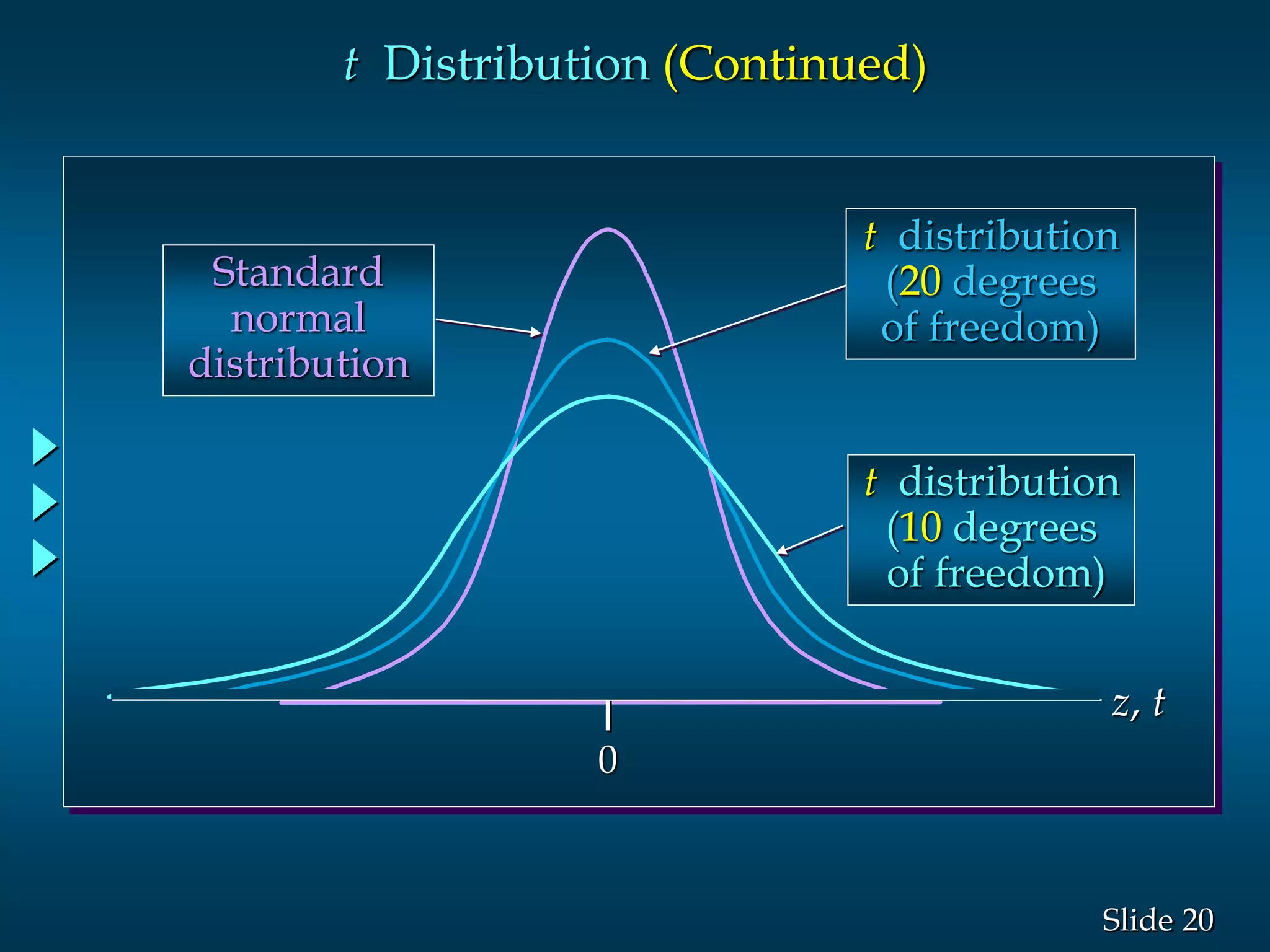
t Distribution (Continued)
Standard
normal
distribution
t distribution
(20 degrees
of freedom)
t distribution
(10 degrees
of freedom)
0
z, t
21Slide
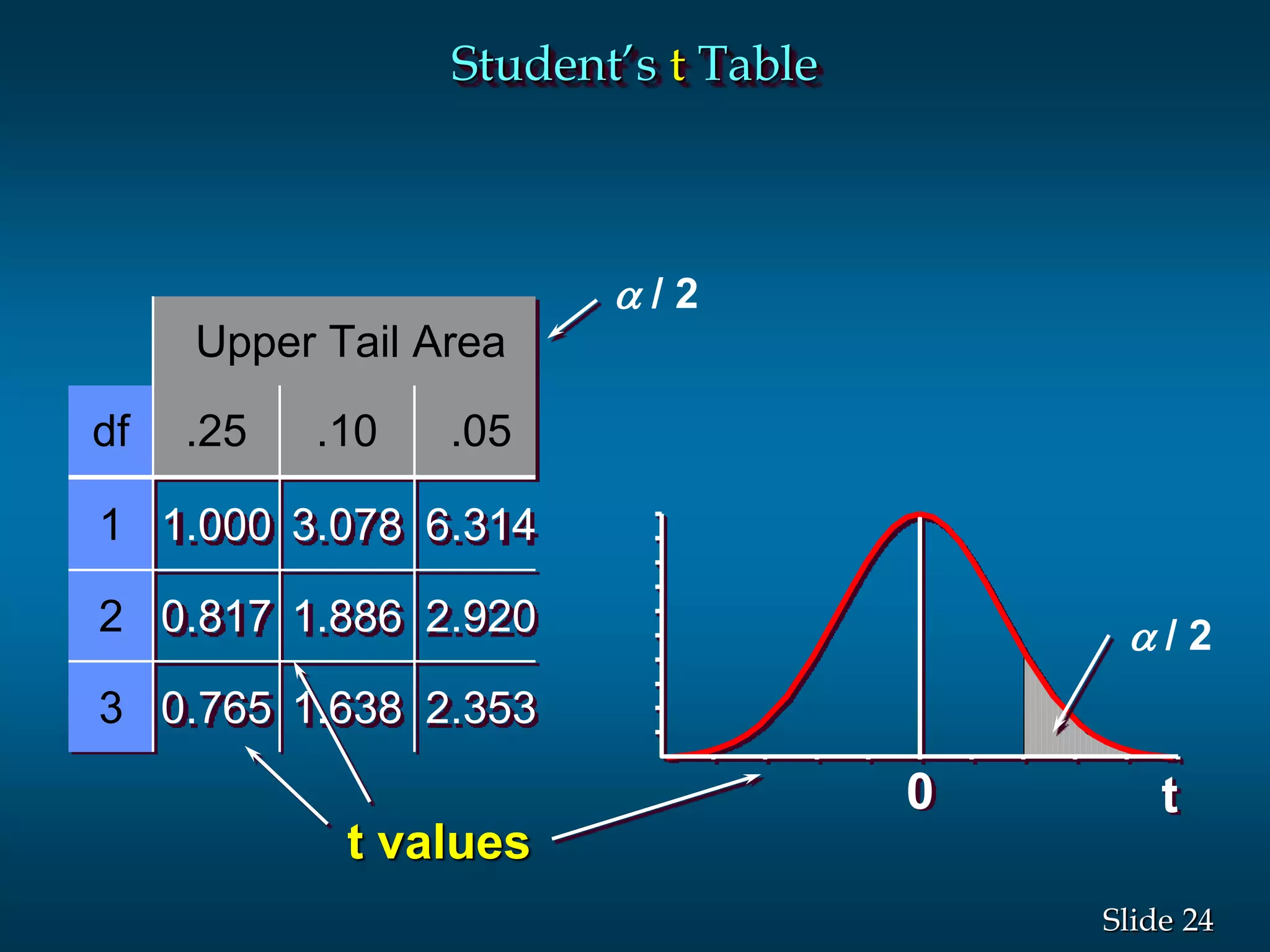
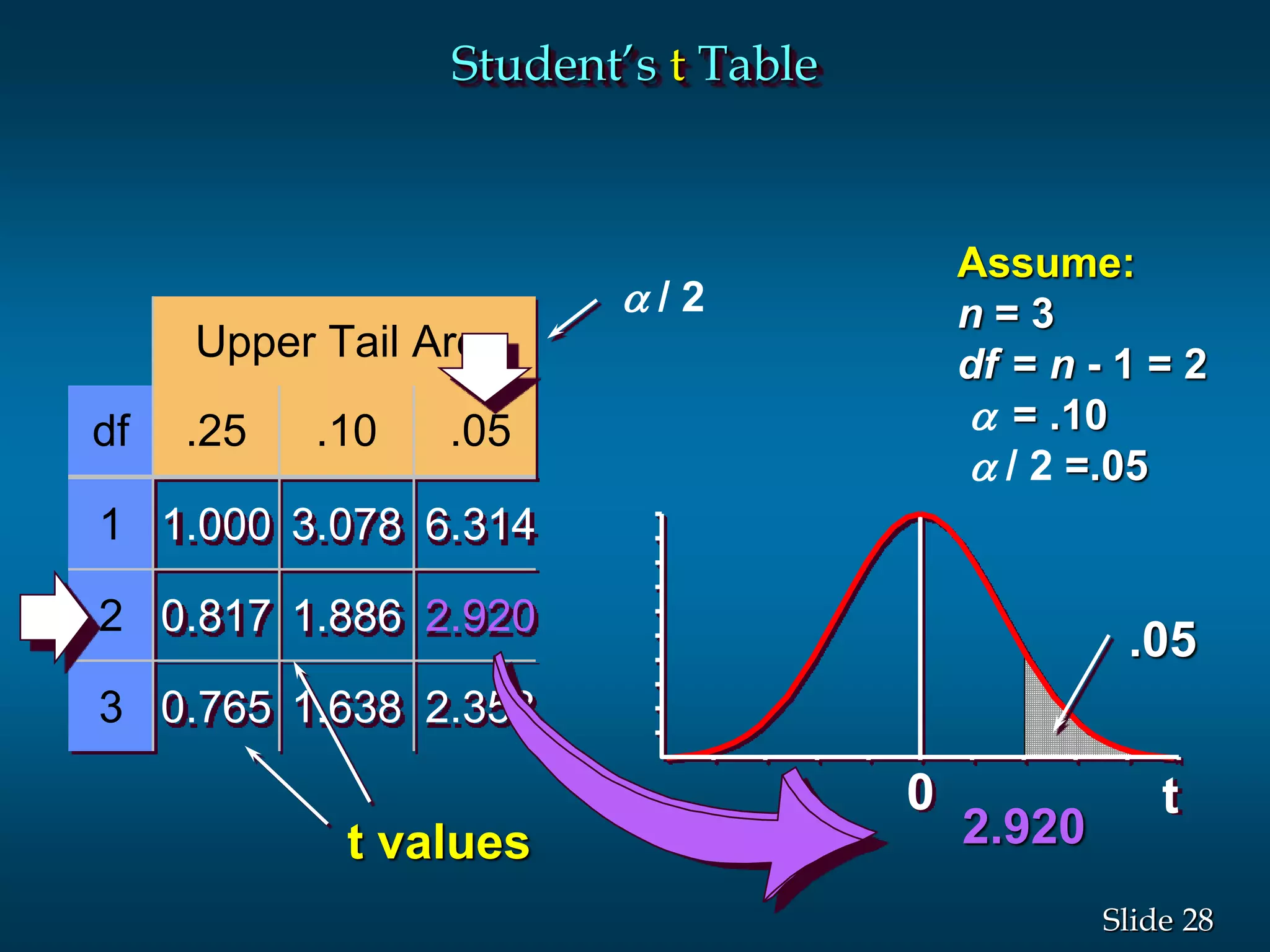
Student’s t Table
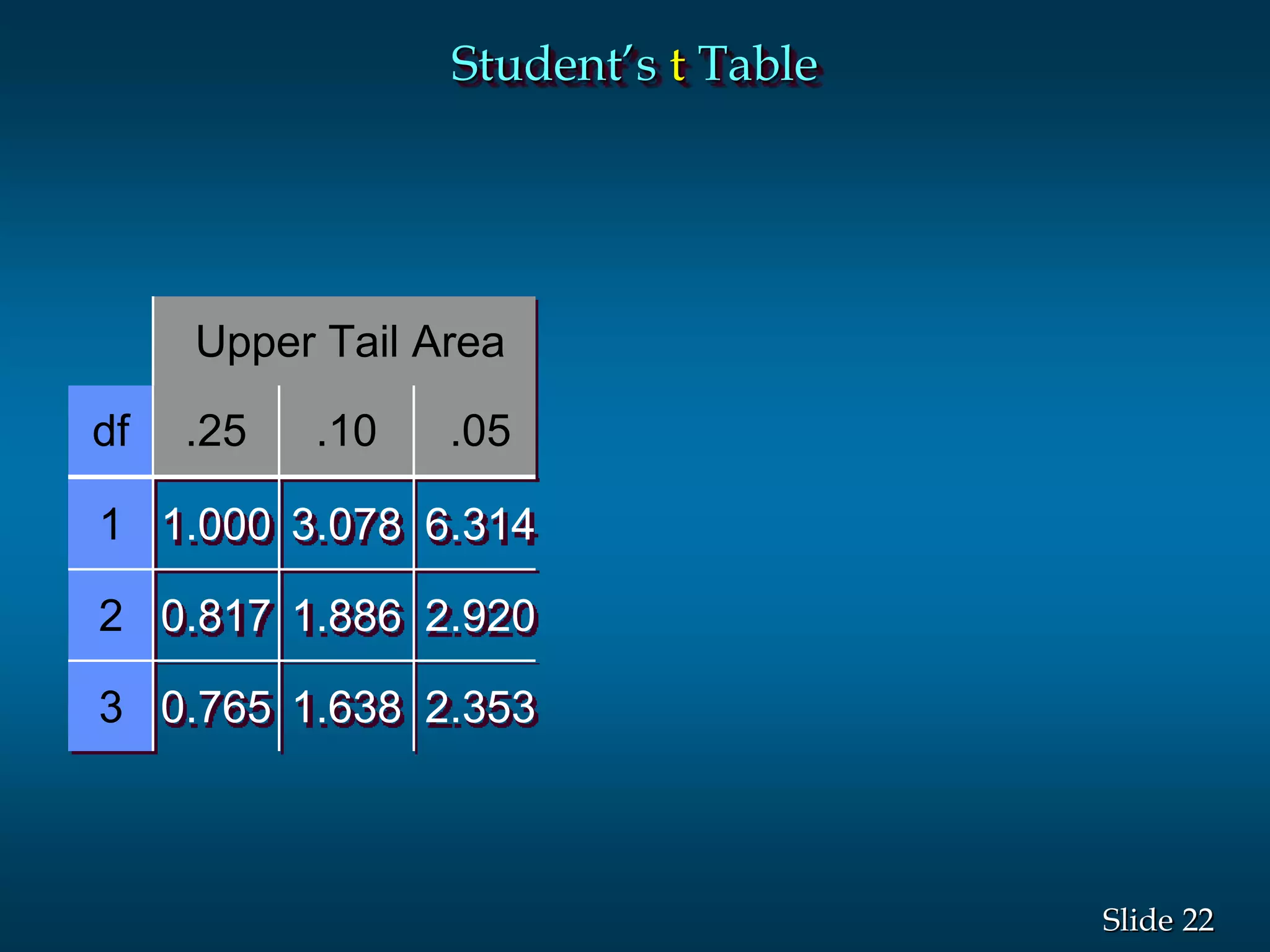
22Slide
Upper Tail Area
df .25 .10 .05
1 1.000 3.078 6.314
2 0.817 1.886 2.920
3 0.765 1.638 2.353
Student’s t Table
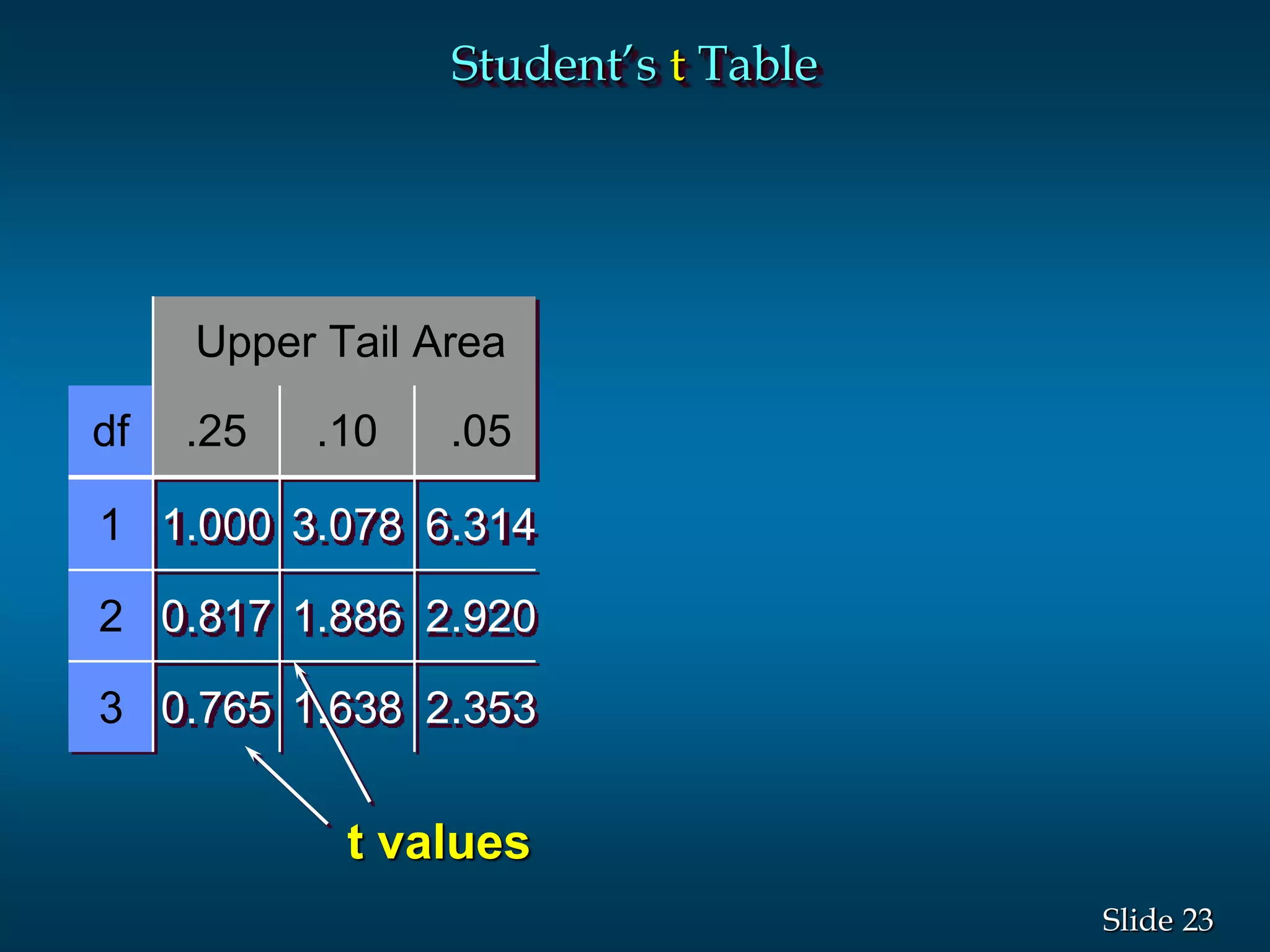
23Slide
Upper Tail Area
df .25 .10 .05
1 1.000 3.078 6.314
2 0.817 1.886 2.920
3 0.765 1.638 2.353
t values
Student’s t Table
24Slide
Upper Tail Area
df .25 .10 .05
1 1.000 3.078 6.314
2 0.817 1.886 2.920
3 0.765 1.638 2.353
t values
t0
 / 2
 / 2
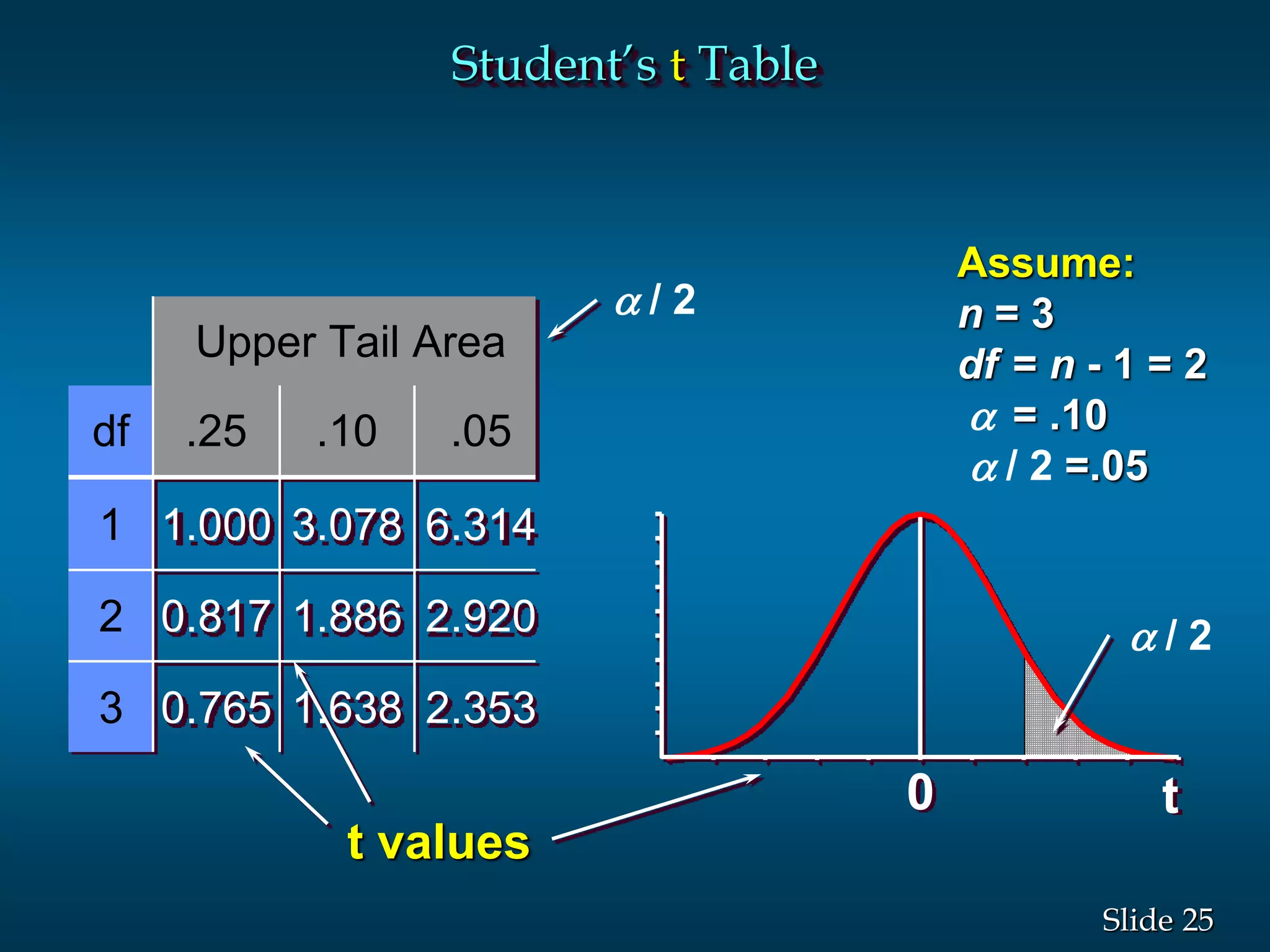
Student’s t Table
25Slide
Upper Tail Area
df .25 .10 .05
1 1.000 3.078 6.314
2 0.817 1.886 2.920
3 0.765 1.638 2.353
t values
t0
Assume:
n = 3
df = n - 1 = 2
 = .10
 / 2 =.05
Student’s t Table
 / 2
 / 2
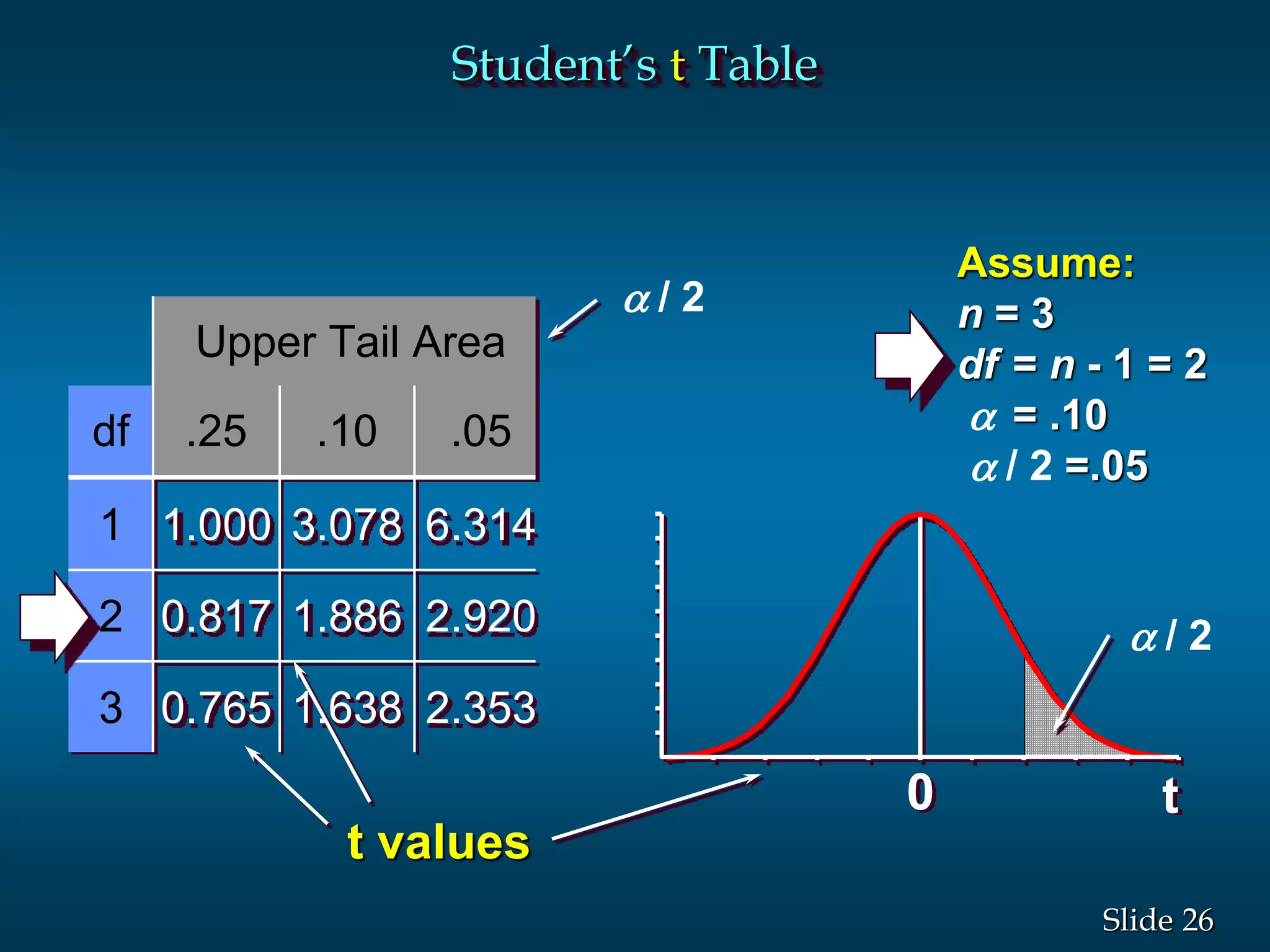
26Slide
Upper Tail Area
df .25 .10 .05
1 1.000 3.078 6.314
2 0.817 1.886 2.920
3 0.765 1.638 2.353
t values
t0
Assume:
n = 3
df = n - 1 = 2
 = .10
 / 2 =.05
Student’s t Table
 / 2
 / 2
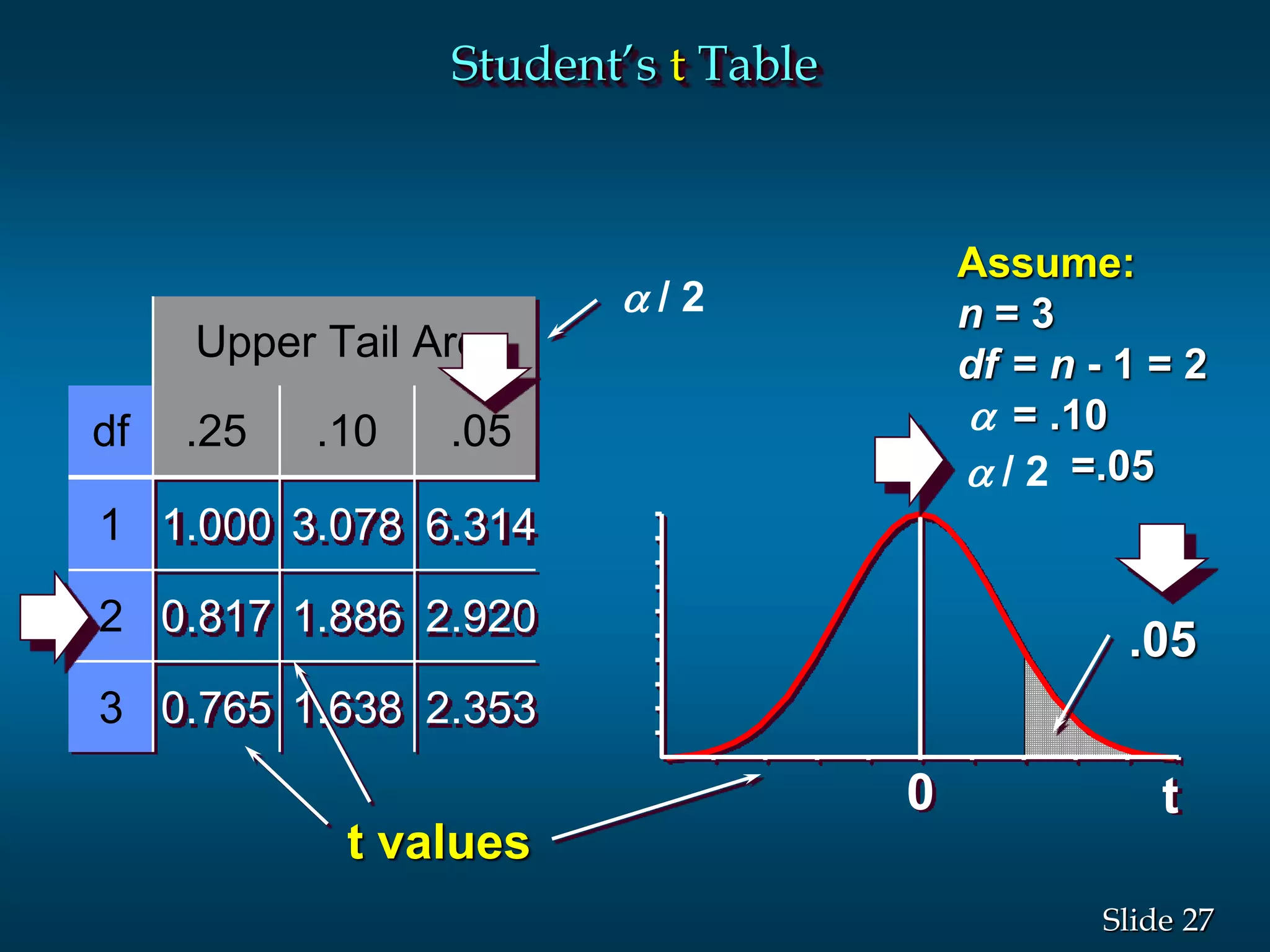
27Slide
Upper Tail Area
df .25 .10 .05
1 1.000 3.078 6.314
2 0.817 1.886 2.920
3 0.765 1.638 2.353
t values
t0
Assume:
n = 3
df = n - 1 = 2
 = .10
=.05
.05
Student’s t Table
 / 2
 / 2
28Slide
Upper Tail Area
df .25 .10 .05
1 1.000 3.078 6.314
2 0.817 1.886 2.920
3 0.765 1.638 2.353
t0
Assume:
n = 3
df = n - 1 = 2
 = .10
 / 2 =.05
2.920t values
.05
Student’s t Table
 / 2
29Slide
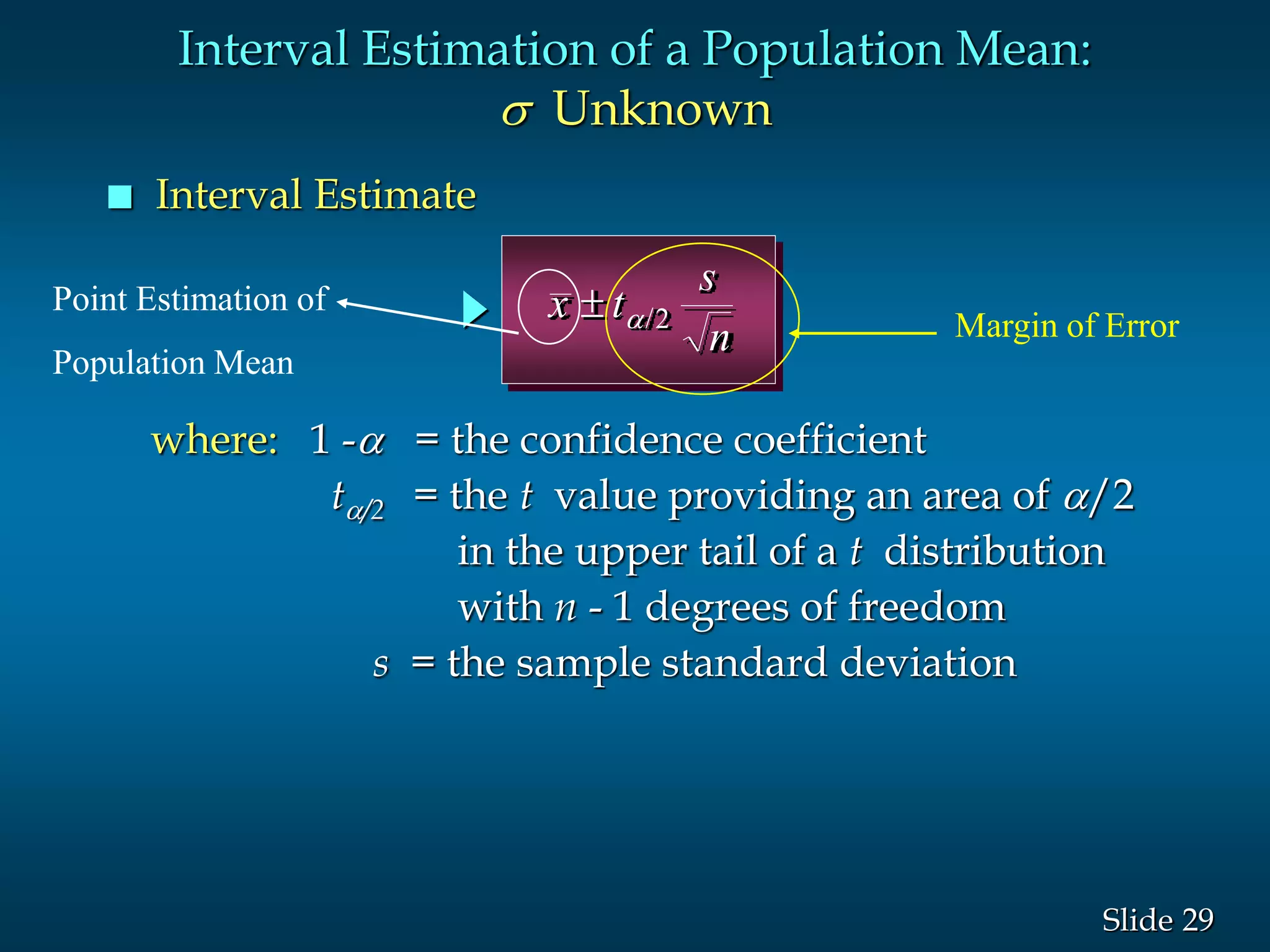
 Interval Estimate
x t
s
n
 /2
where: 1 - = the confidence coefficient
t/2 = the t value providing an area of /2
in the upper tail of a t distribution
with n - 1 degrees of freedom
s = the sample standard deviation
Interval Estimation of a Population Mean:
s Unknown
Margin of Error
Point Estimation of
Population Mean
30Slide
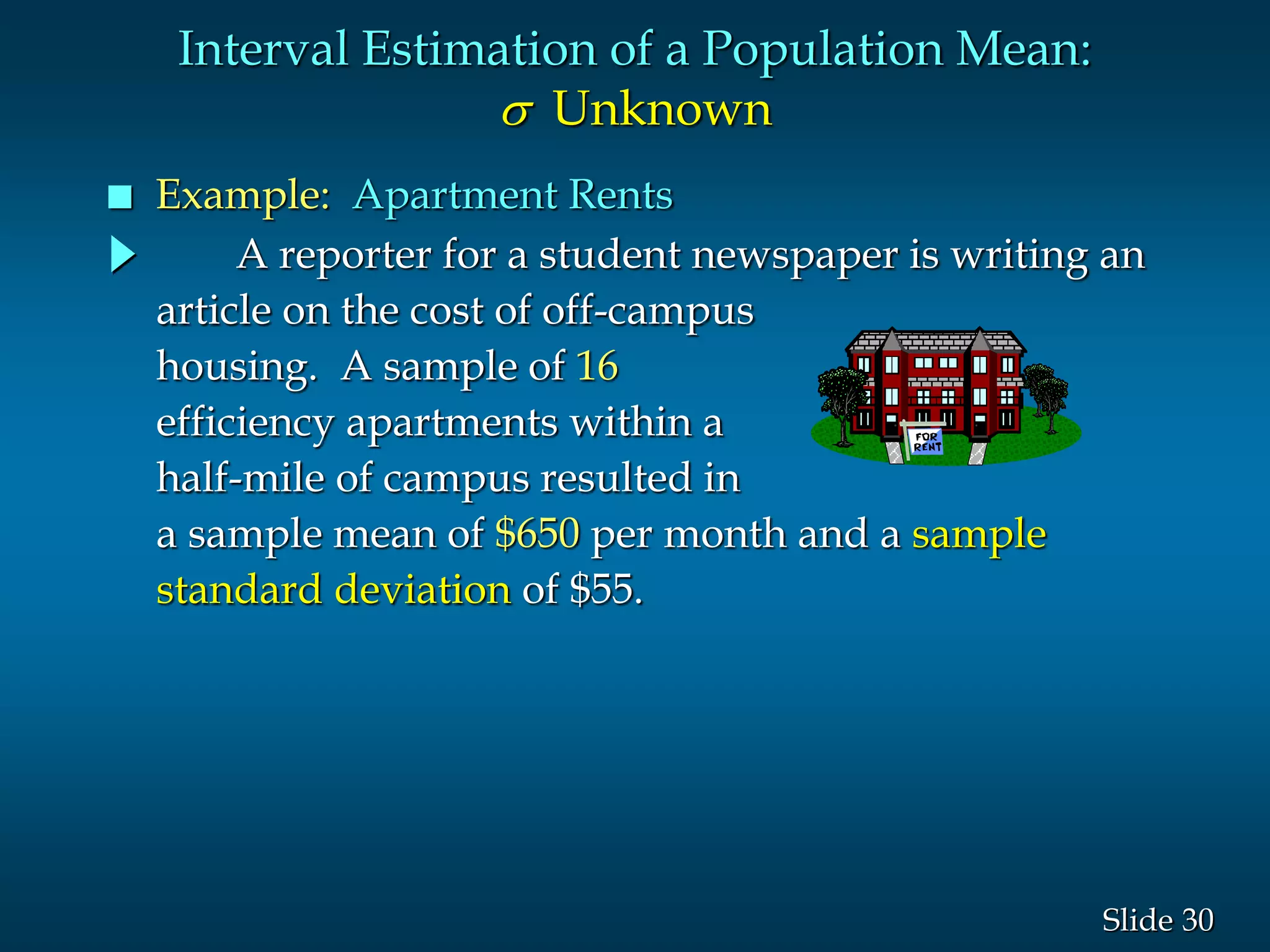
A reporter for a student newspaper is writing an
article on the cost of off-campus
housing. A sample of 16
efficiency apartments within a
half-mile of campus resulted in
a sample mean of $650 per month and a sample
standard deviation of $55.
Interval Estimation of a Population Mean:
s Unknown
 Example: Apartment Rents
31Slide
Let us provide a 95% confidence interval
estimate of the mean rent per
month for the population of
efficiency apartments within a
half-mile of campus.
Interval Estimation of a Population Mean:
s Unknown (Example Continued)
 Example: Apartment Rents
32Slide
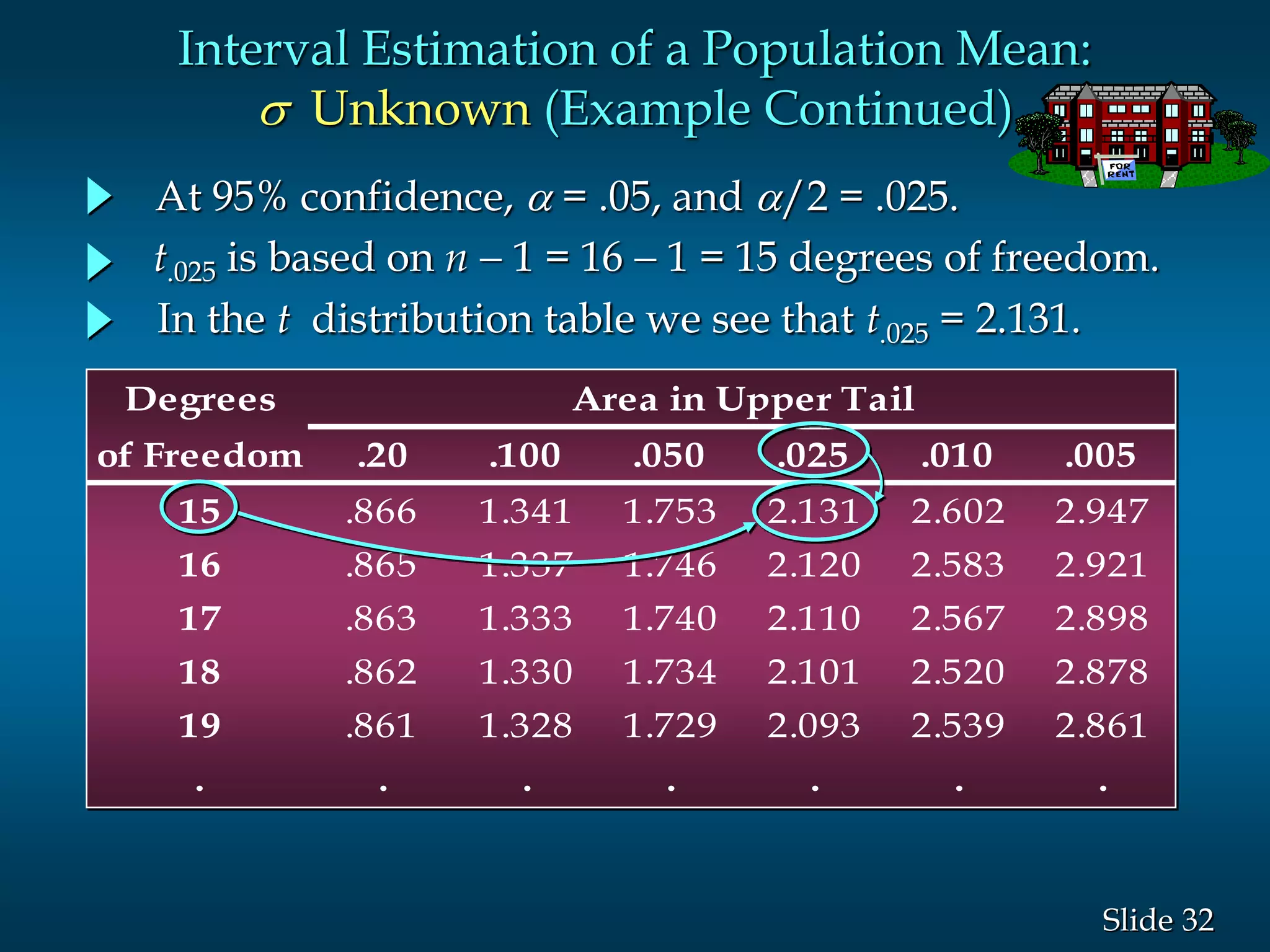
At 95% confidence,  = .05, and /2 = .025.
Degrees Area in Upper Tail
of Freedom .20 .100 .050 .025 .010 .005
15 .866 1.341 1.753 2.131 2.602 2.947
16 .865 1.337 1.746 2.120 2.583 2.921
17 .863 1.333 1.740 2.110 2.567 2.898
18 .862 1.330 1.734 2.101 2.520 2.878
19 .861 1.328 1.729 2.093 2.539 2.861
. . . . . . .
In the t distribution table we see that t.025 = 2.131.
t.025 is based on n - 1 = 16 - 1 = 15 degrees of freedom.
Interval Estimation of a Population Mean:
s Unknown (Example Continued)
33Slide
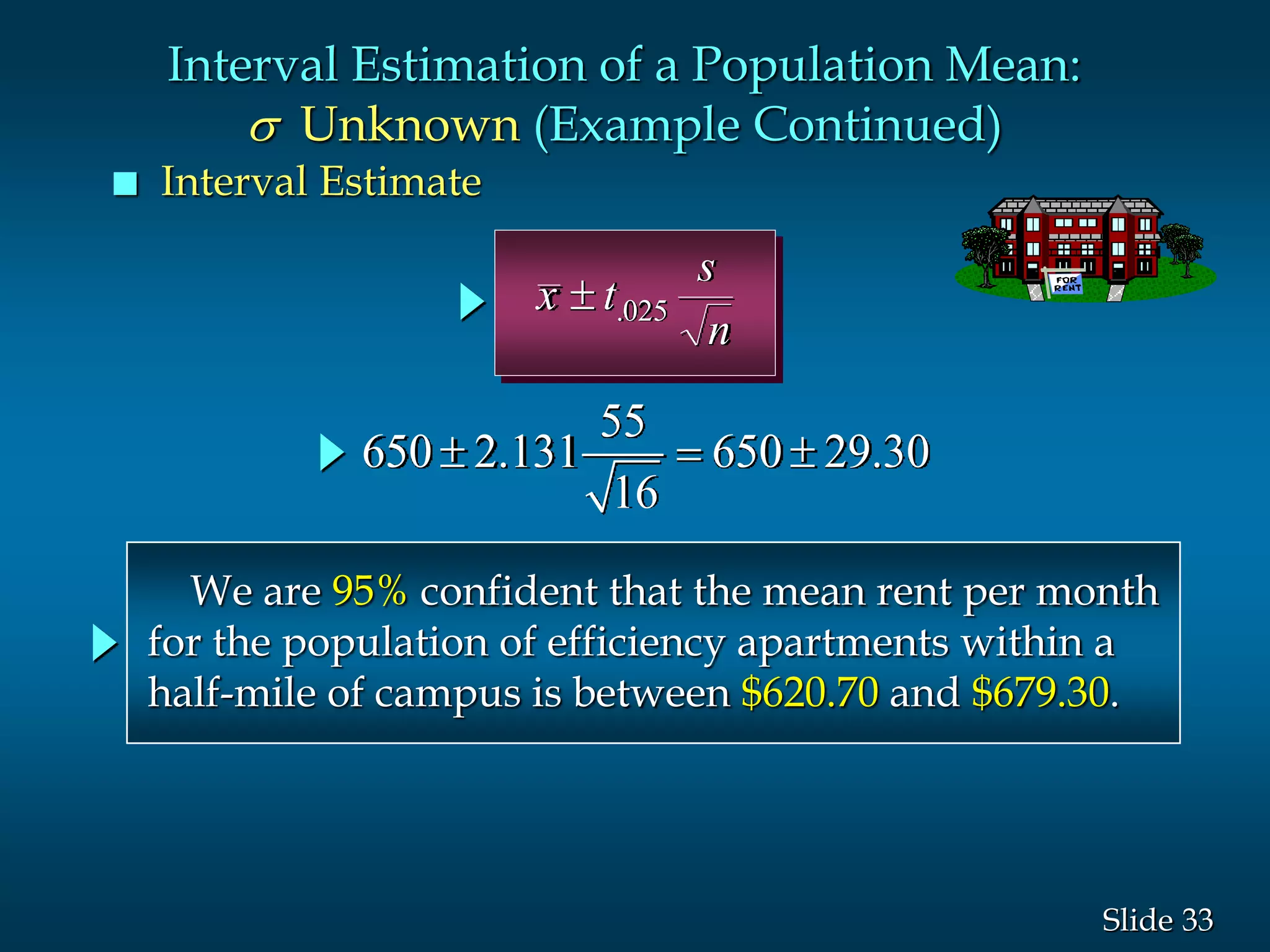
x t
s
n
 .025
We are 95% confident that the mean rent per month
for the population of efficiency apartments within a
half-mile of campus is between $620.70 and $679.30.
 Interval Estimate
Interval Estimation of a Population Mean:
s Unknown (Example Continued)
55
650 2.131 650 29.30
16
  
34Slide
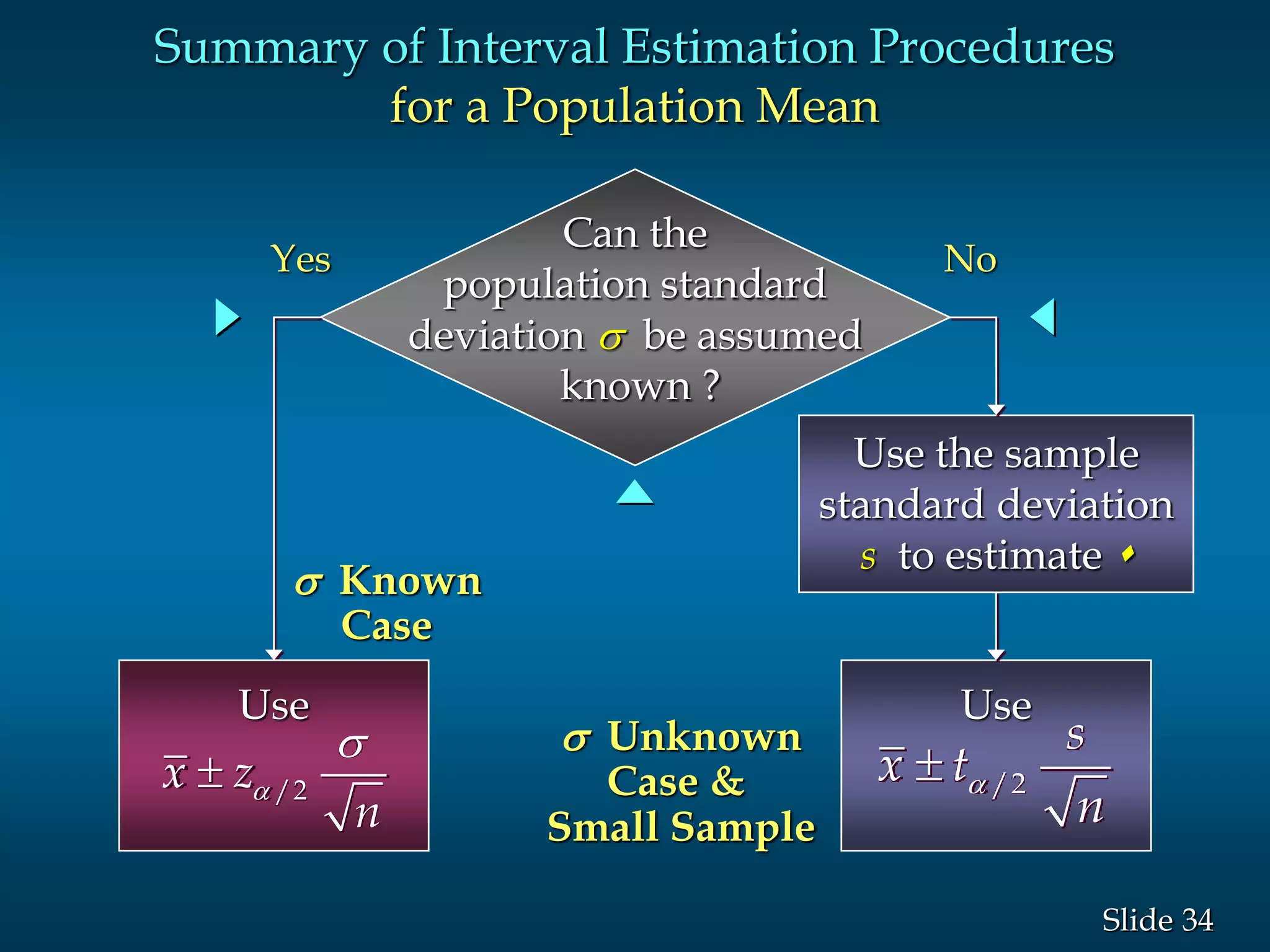
Summary of Interval Estimation Procedures
for a Population Mean
Can the
population standard
deviation s be assumed
known ?
Use the sample
standard deviation
s to estimate s
Use
Yes No
/2
s
x t
n

Use
/2x z
n

s

s Known
Case
s Unknown
Case &
Small Sample
35Slide
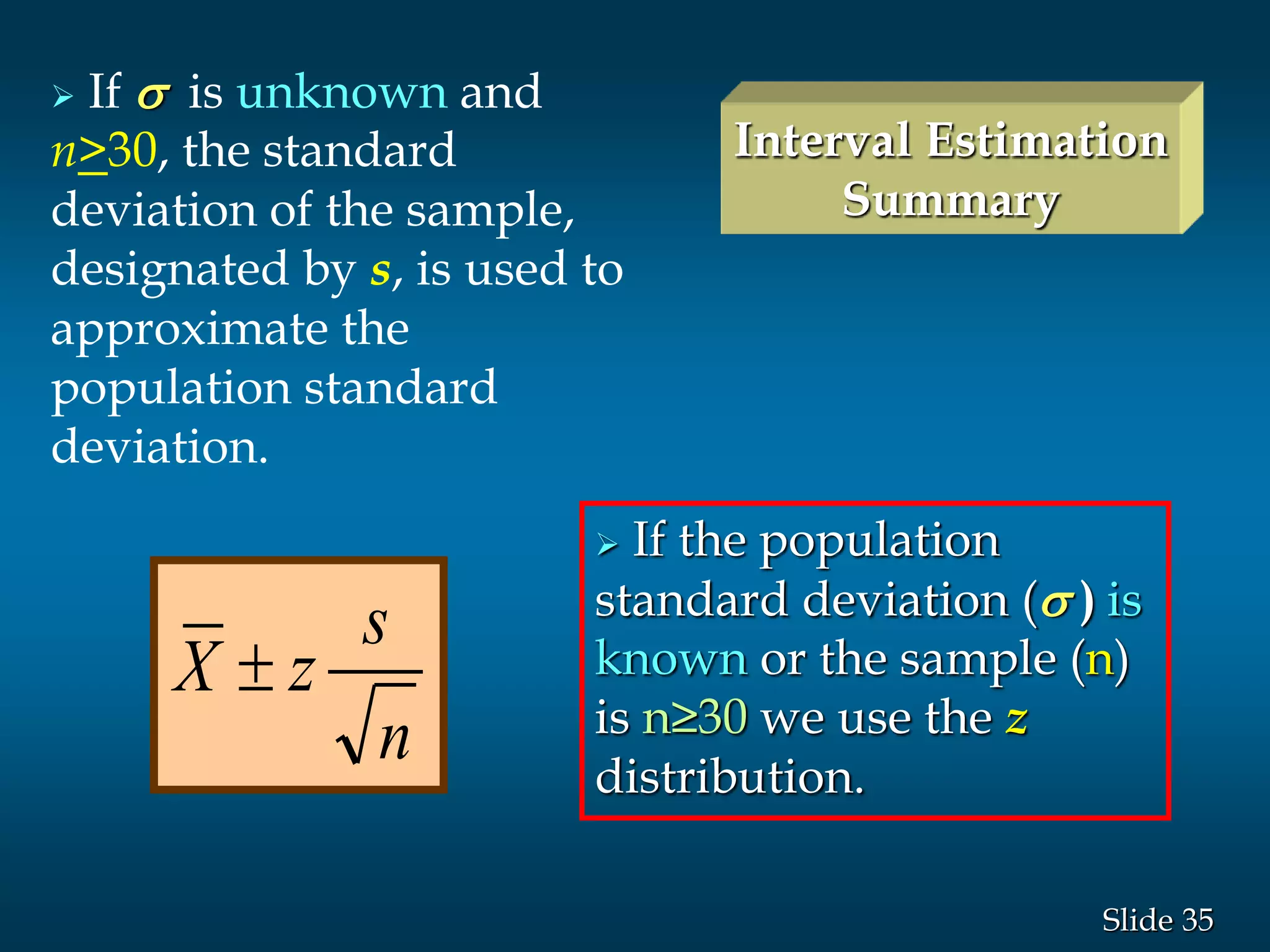
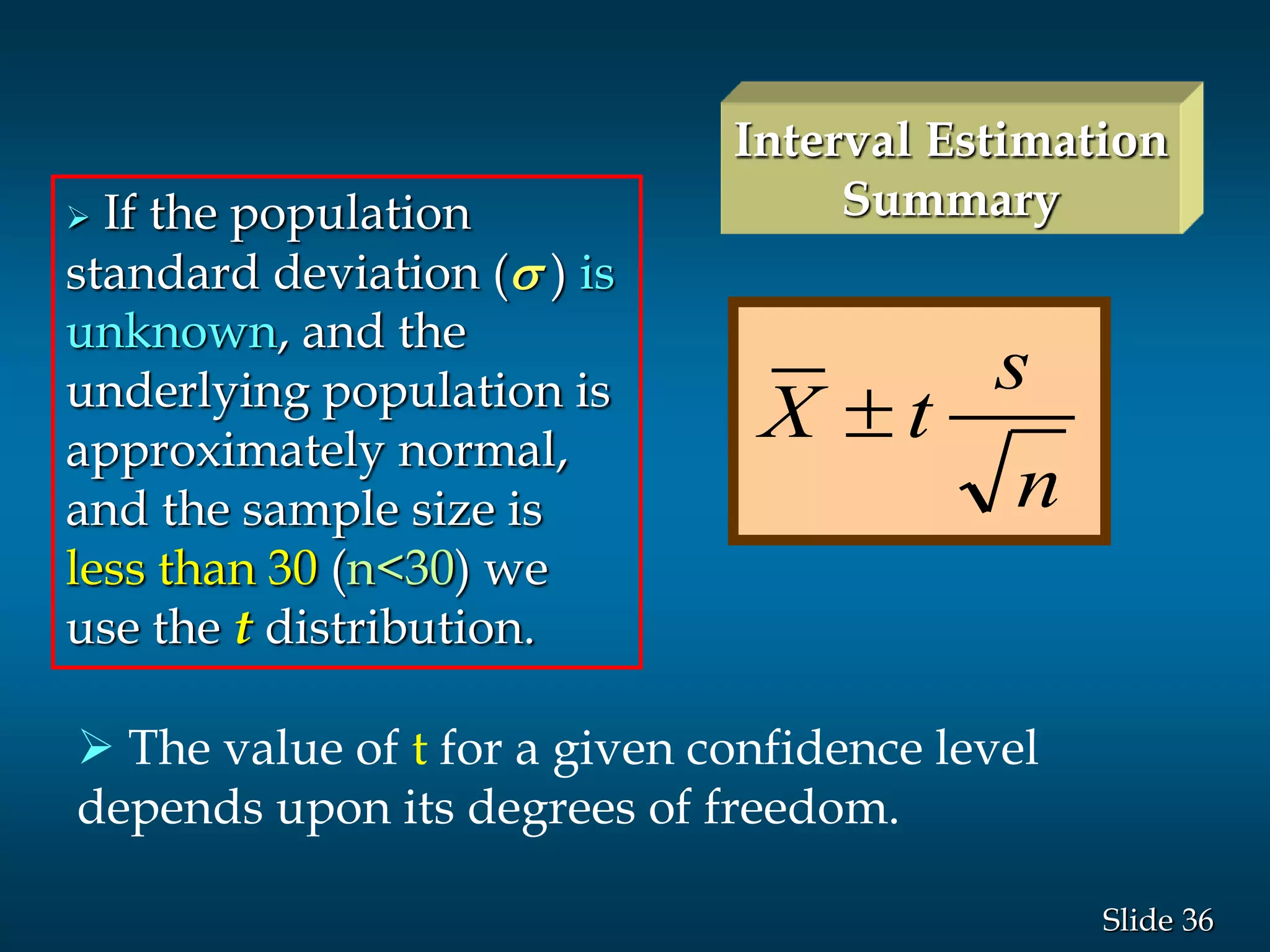
 If s is unknown and
n>30, the standard
deviation of the sample,
designated by s, is used to
approximate the
population standard
deviation.
Interval Estimation
Summary
 If the population
standard deviation (s ) is
known or the sample (n)
is n≥30 we use the z
distribution.
n
s
zX 
36Slide
n
s
tX 
 The value of t for a given confidence level
depends upon its degrees of freedom.
 If the population
standard deviation (s ) is
unknown, and the
underlying population is
approximately normal,
and the sample size is
less than 30 (n<30) we
use the t distribution.
Interval Estimation
Summary
Confidence Interval
Estimate for Mean
(s Known)
More Examples
38Slide
Thinking Challenge Example
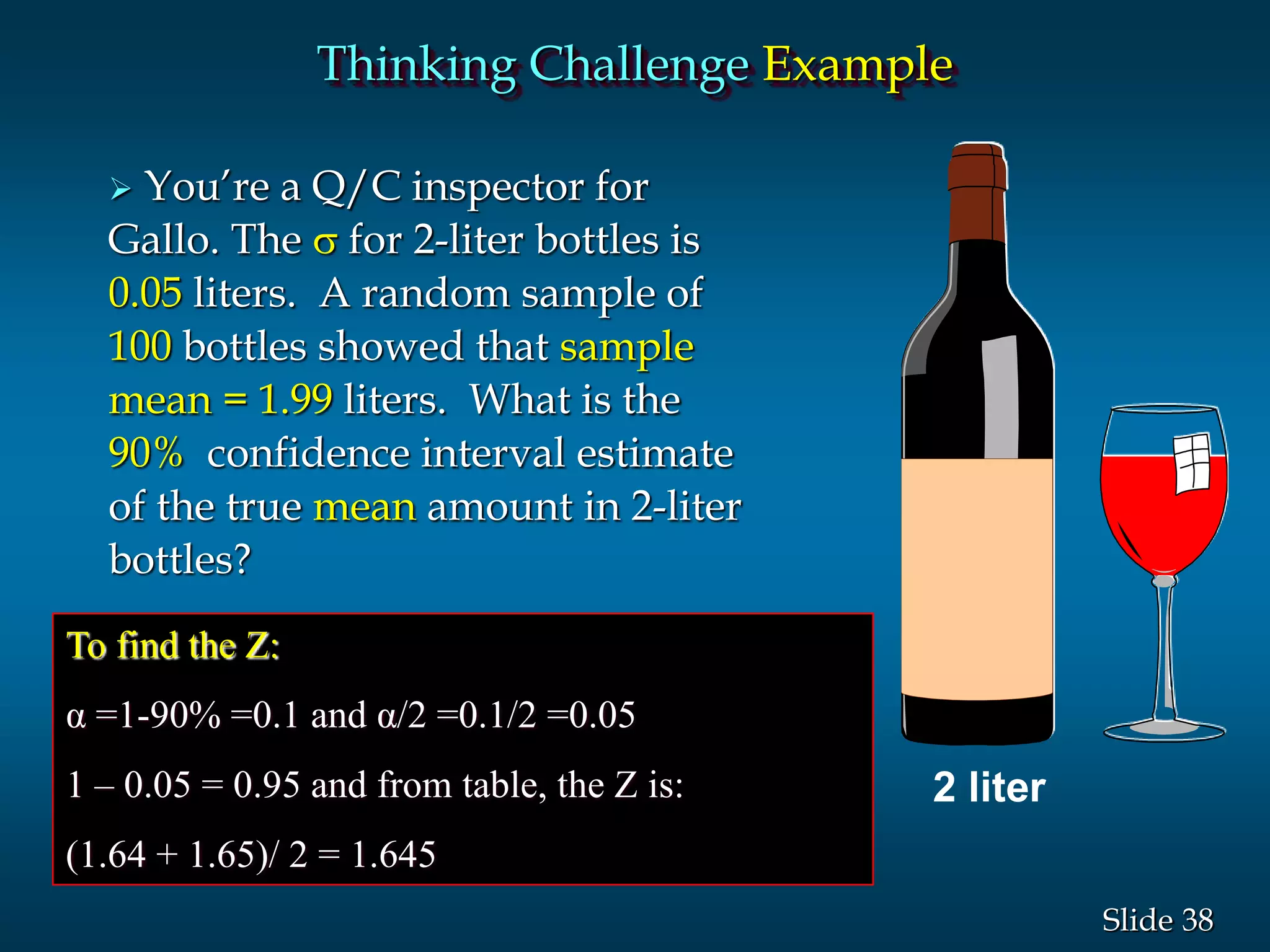
 You’re a Q/C inspector for
Gallo. The s for 2-liter bottles is
0.05 liters. A random sample of
100 bottles showed that sample
mean = 1.99 liters. What is the
90% confidence interval estimate
of the true mean amount in 2-liter
bottles?
2 liter
To find the Z:
α =1-90% =0.1 and α/2 =0.1/2 =0.05
1 – 0.05 = 0.95 and from table, the Z is:
(1.64 + 1.65)/ 2 = 1.645
39Slide
Confidence Interval
Solution
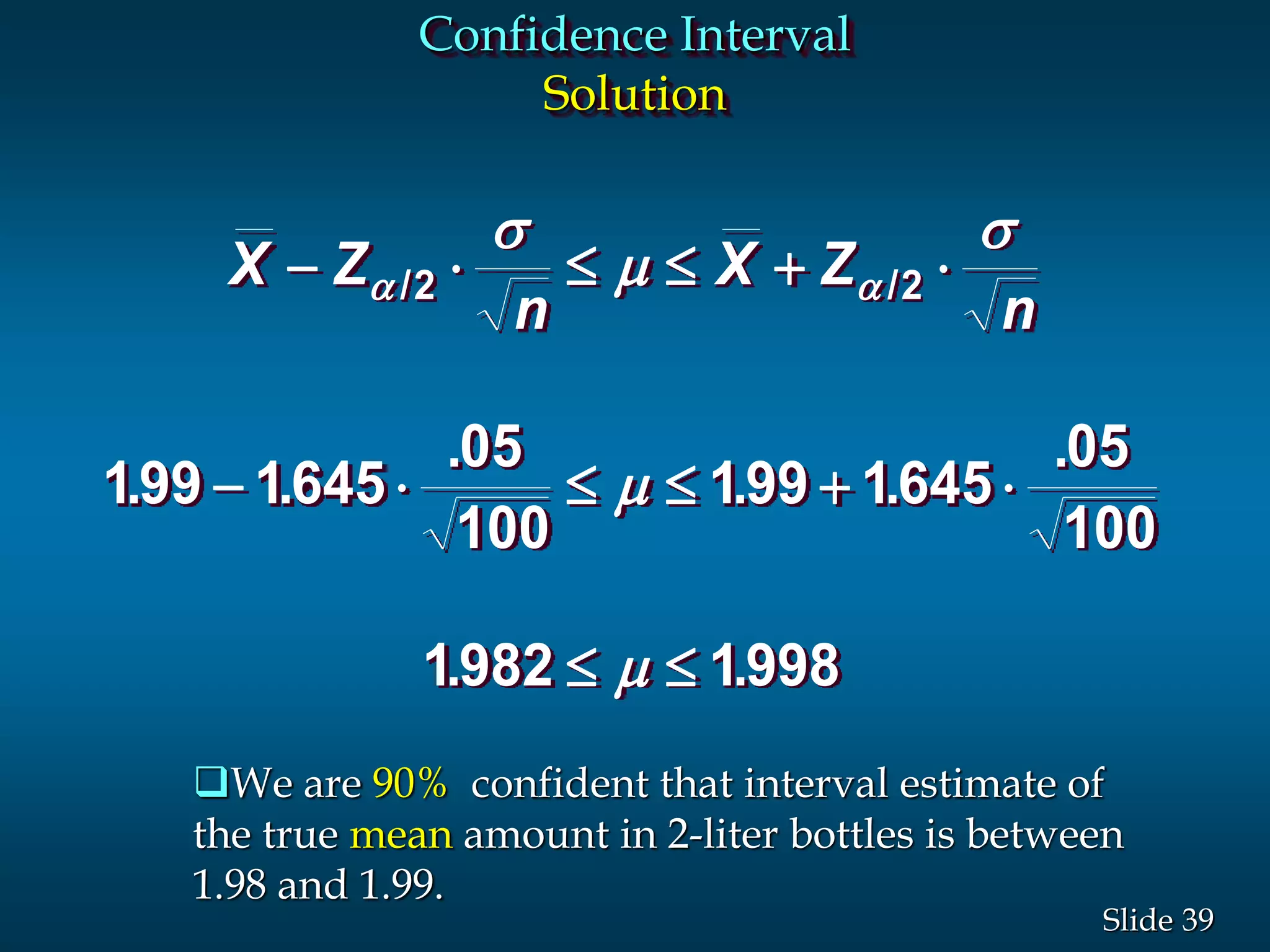
X Z
n
X Z
n
-     
-     
 
 
s

s


/ /
. .
.
. .
.
. .
2 2
199 1645
05
100
199 1645
05
100
1982 1998
We are 90% confident that interval estimate of
the true mean amount in 2-liter bottles is between
1.98 and 1.99.
40Slide
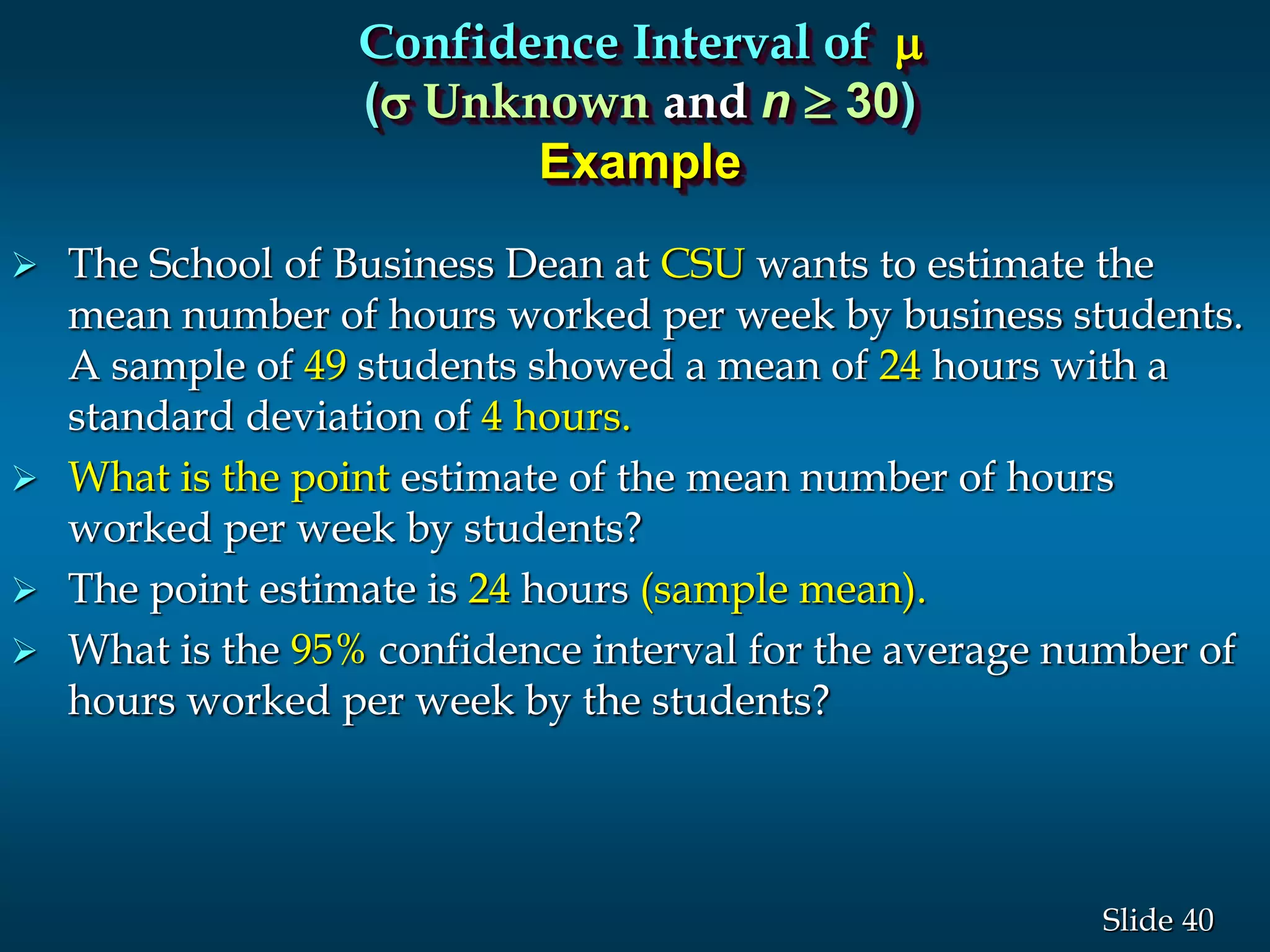
 The School of Business Dean at CSU wants to estimate the
mean number of hours worked per week by business students.
A sample of 49 students showed a mean of 24 hours with a
standard deviation of 4 hours.
 What is the point estimate of the mean number of hours
worked per week by students?
 The point estimate is 24 hours (sample mean).
 What is the 95% confidence interval for the average number of
hours worked per week by the students?
Confidence Interval of 
(s Unknown and n  30)
Example
41Slide
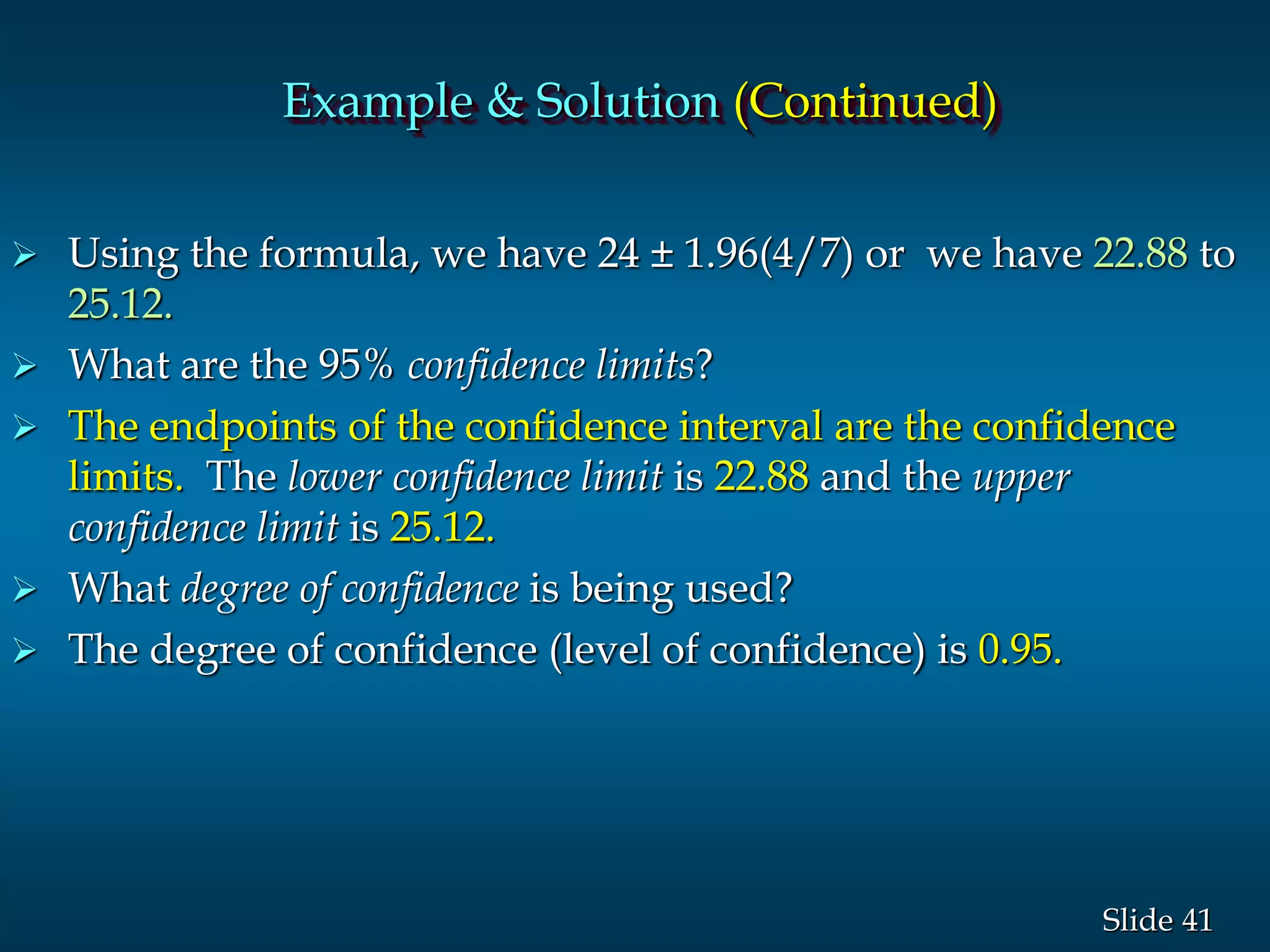
 Using the formula, we have 24 ± 1.96(4/7) or we have 22.88 to
25.12.
 What are the 95% confidence limits?
 The endpoints of the confidence interval are the confidence
limits. The lower confidence limit is 22.88 and the upper
confidence limit is 25.12.
 What degree of confidence is being used?
 The degree of confidence (level of confidence) is 0.95.
Example & Solution (Continued)
42Slide
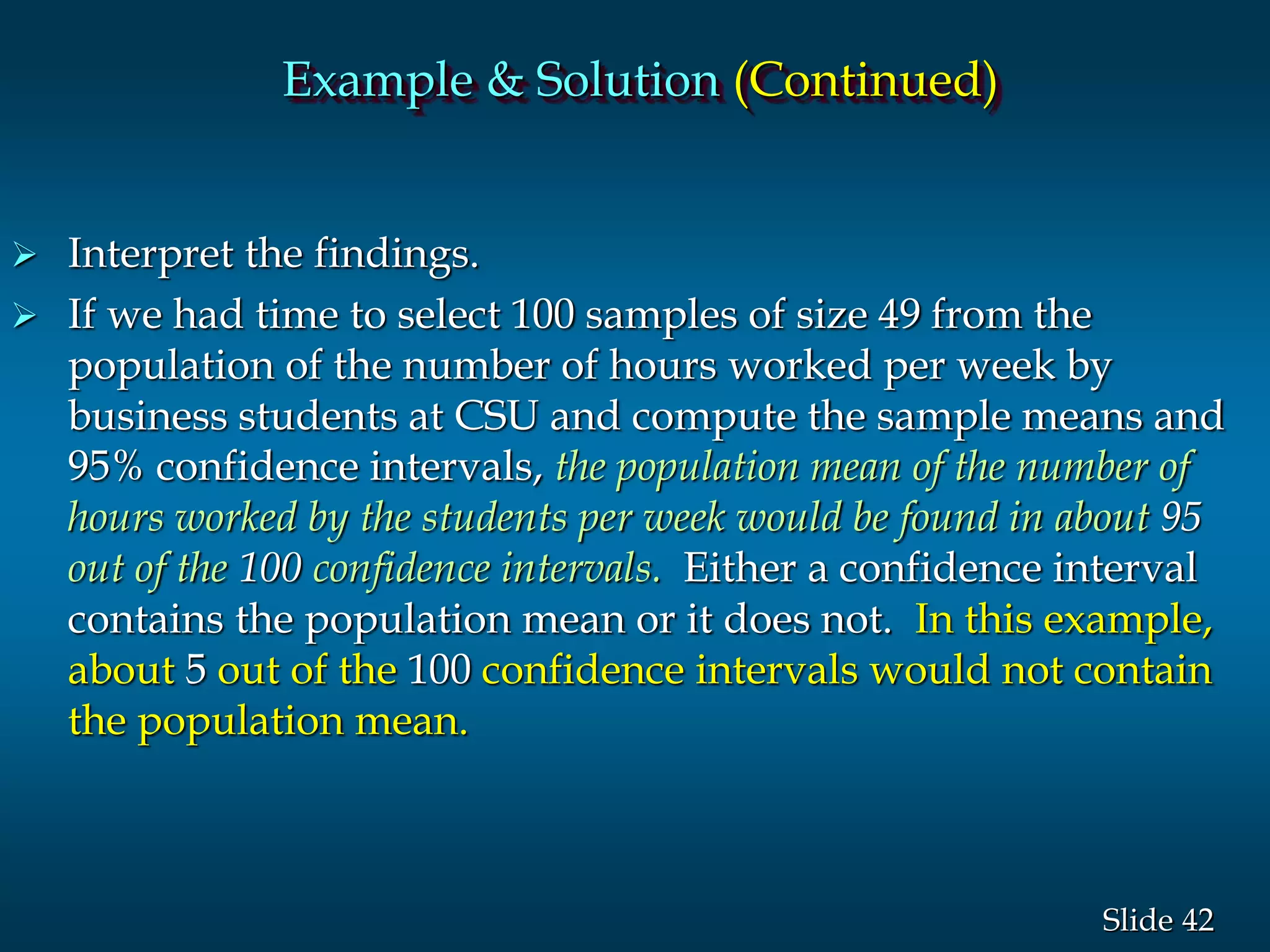
 Interpret the findings.
 If we had time to select 100 samples of size 49 from the
population of the number of hours worked per week by
business students at CSU and compute the sample means and
95% confidence intervals, the population mean of the number of
hours worked by the students per week would be found in about 95
out of the 100 confidence intervals. Either a confidence interval
contains the population mean or it does not. In this example,
about 5 out of the 100 confidence intervals would not contain
the population mean.
Example & Solution (Continued)
Confidence Interval Estimate
for Mean
(s Unknown, and n<30)
More Examples
44Slide
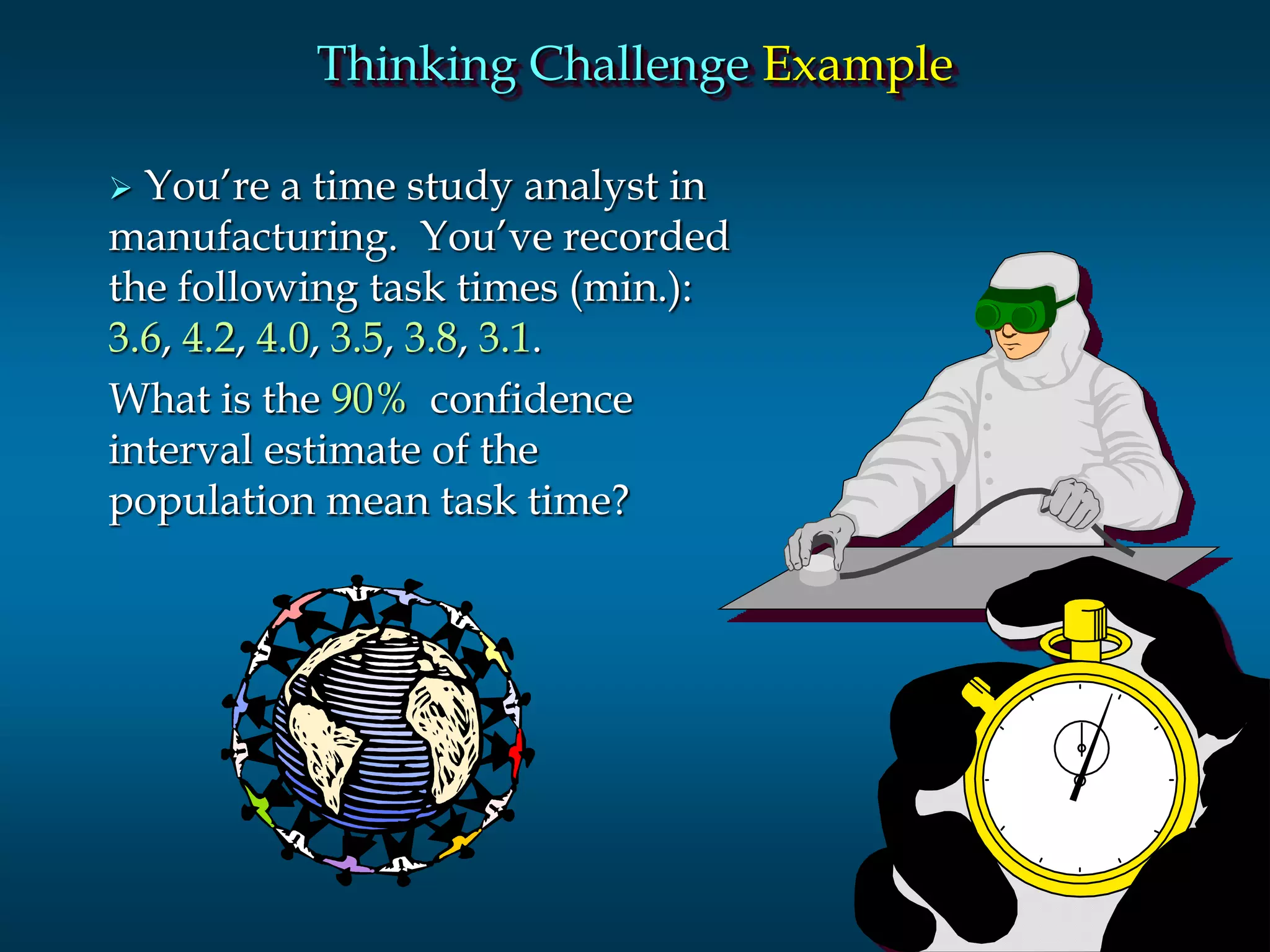
Thinking Challenge Example
 You’re a time study analyst in
manufacturing. You’ve recorded
the following task times (min.):
3.6, 4.2, 4.0, 3.5, 3.8, 3.1.
What is the 90% confidence
interval estimate of the
population mean task time?
45Slide
Solution
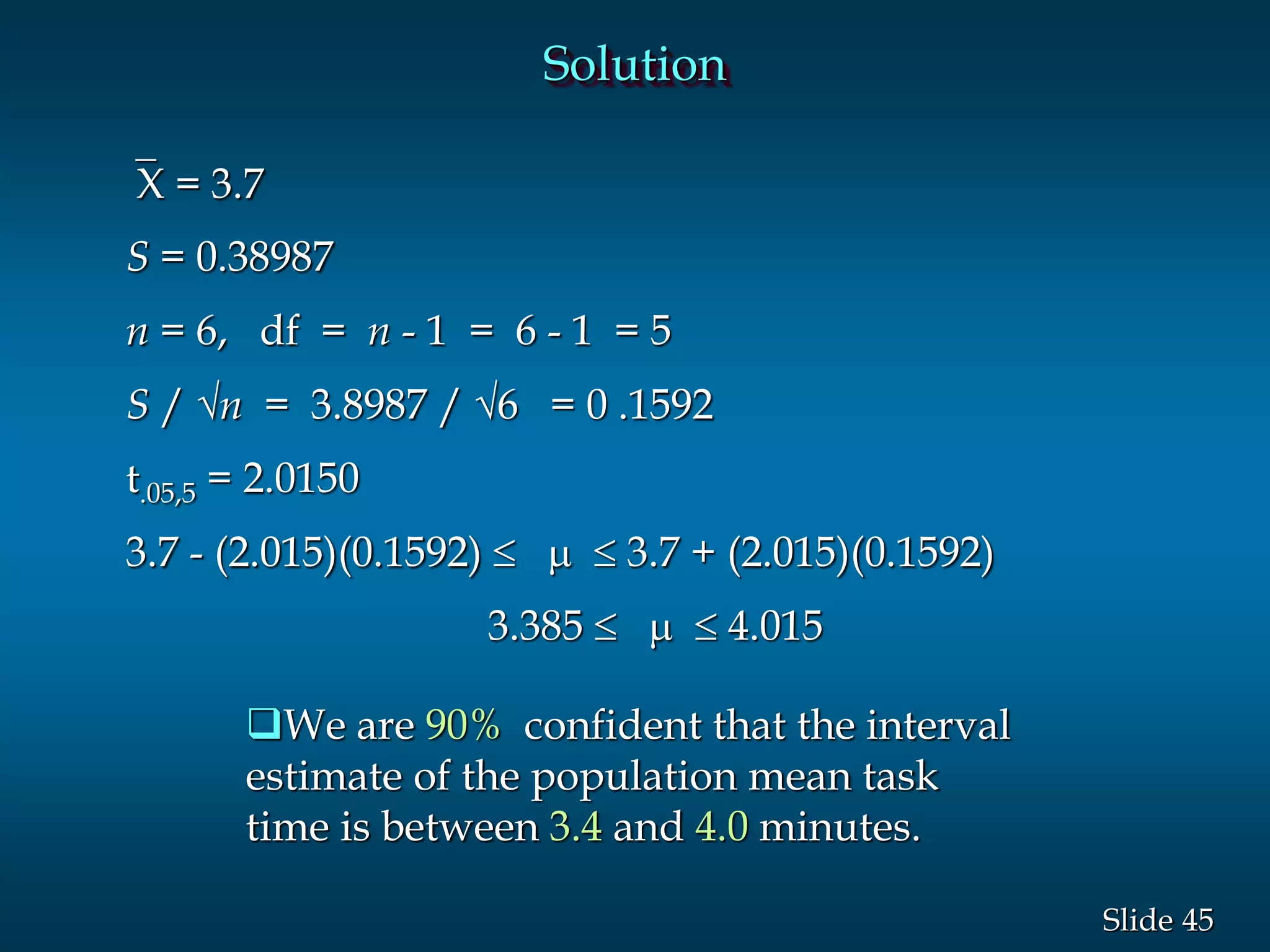
`X = 3.7
S = 0.38987
n = 6, df = n - 1 = 6 - 1 = 5
S / n = 3.8987 / 6 = 0 .1592
t.05,5 = 2.0150
3.7 - (2.015)(0.1592) 3.7 + (2.015)(0.1592)
3.385  4.015
We are 90% confident that the interval
estimate of the population mean task
time is between 3.4 and 4.0 minutes.
46Slide
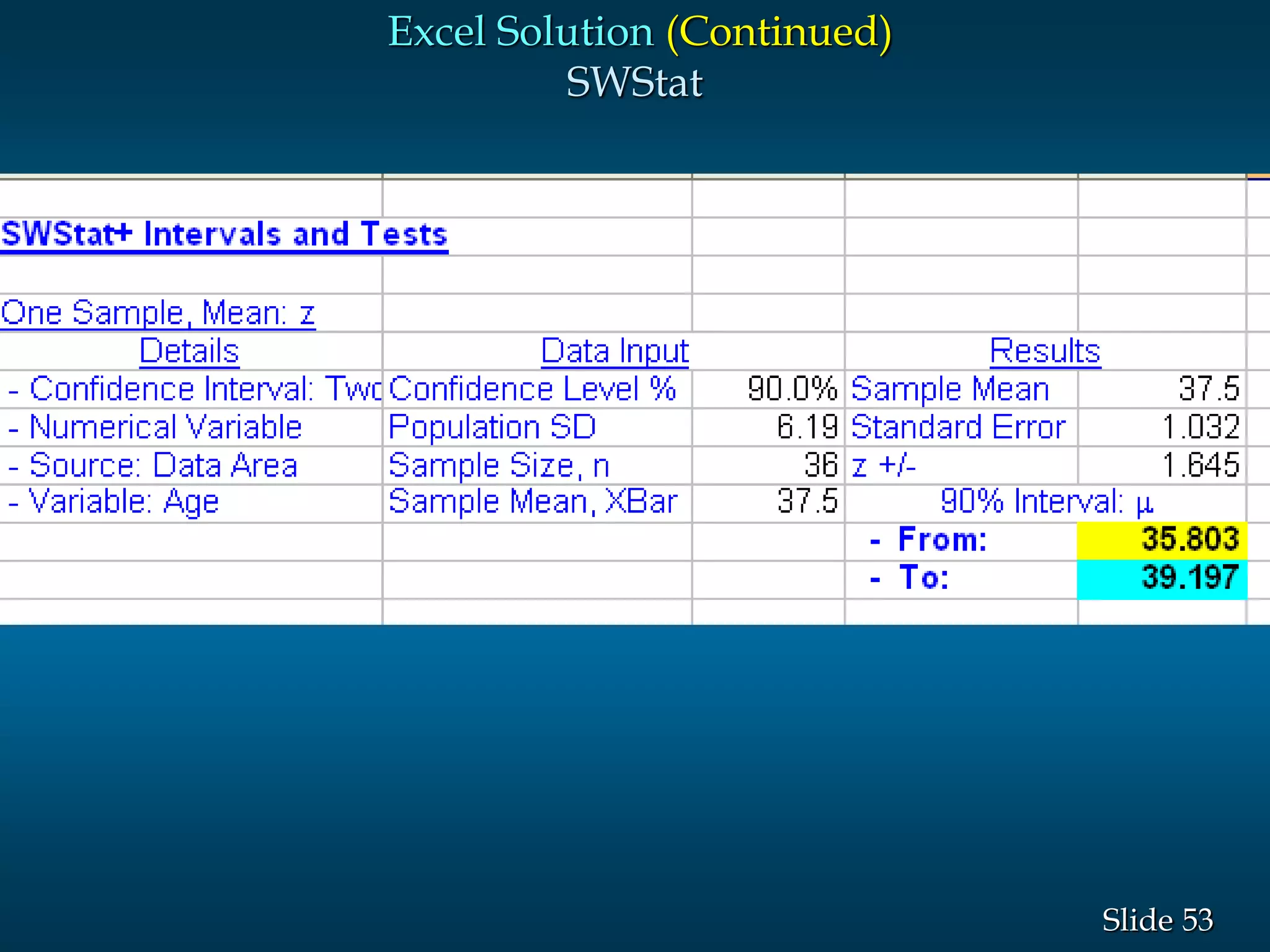
Confidence Interval Excel Application
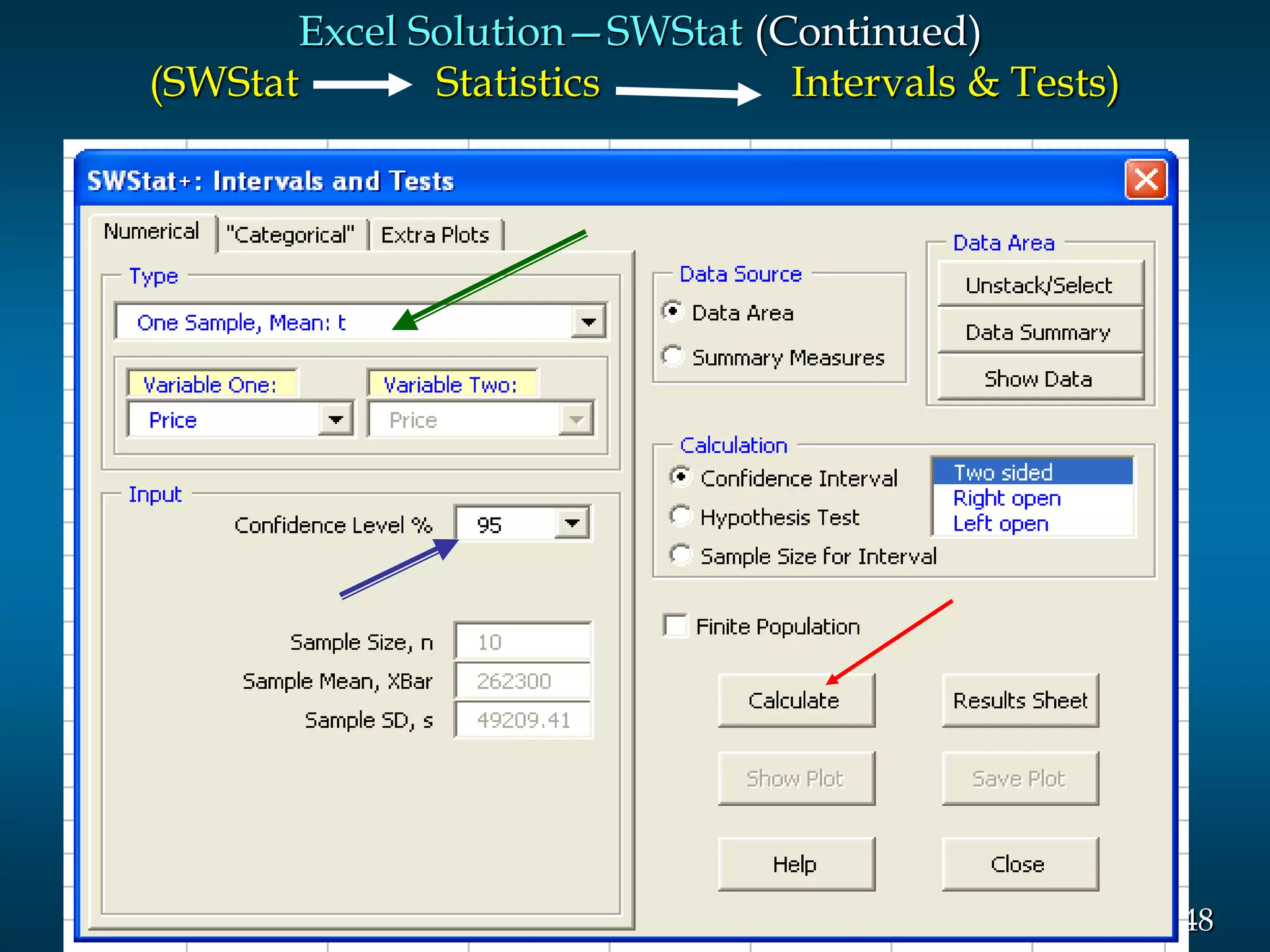
 Given the price of ten (10) houses in one of the
subdivisions located in Henry County, use Excel to
construct a 95% confidence interval for the
population mean.
 Data: $230,000, $240,000, $310,000, $198,000,
$257,000, $345,000, $315,000, $260,000, $198,000,
$270,000.
47Slide
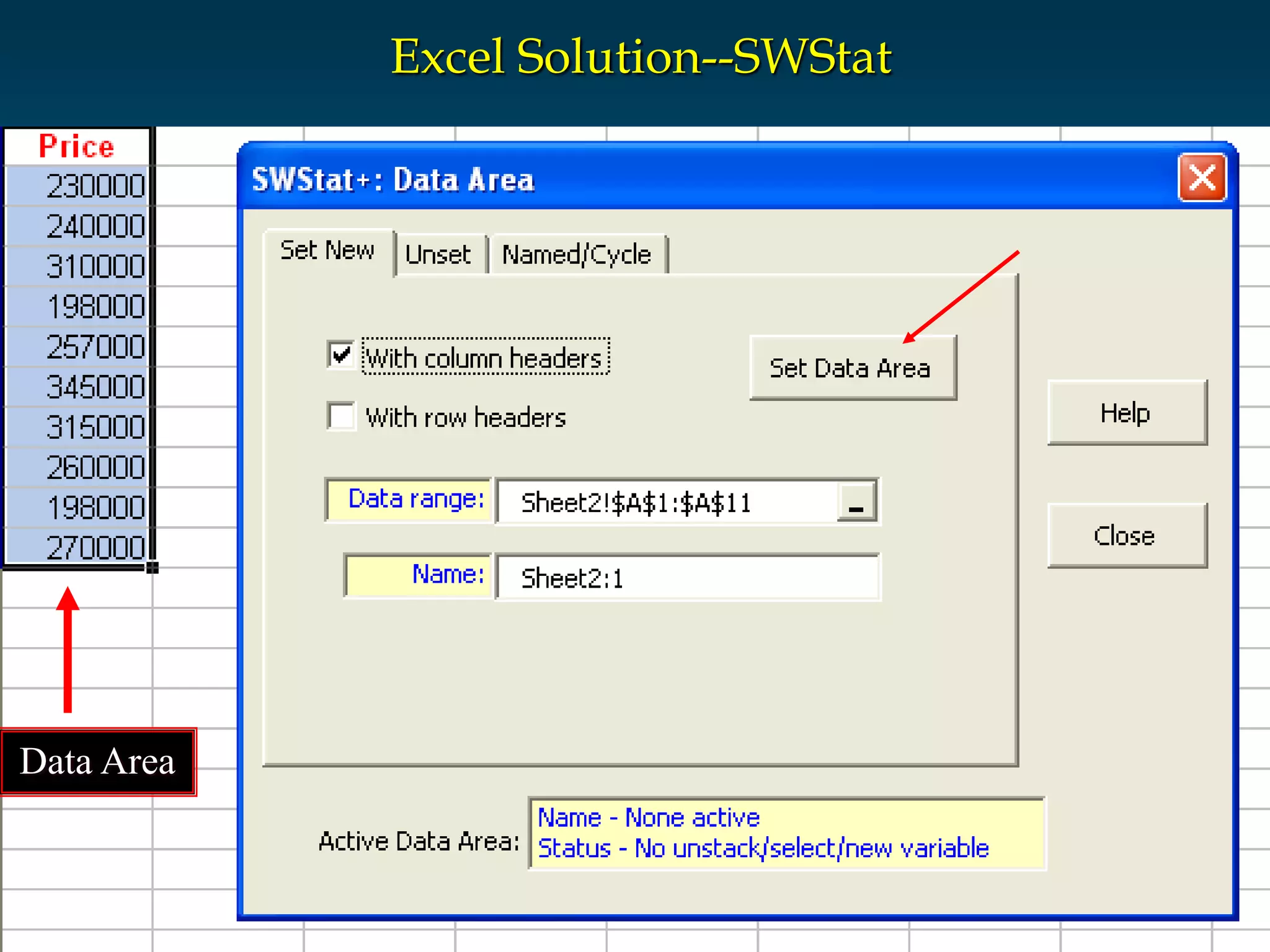
Excel Solution--SWStat
Data Area
48Slide
Excel Solution—SWStat (Continued)
(SWStat Statistics Intervals & Tests)
49Slide
Excel Solution—SWStat (Continued)
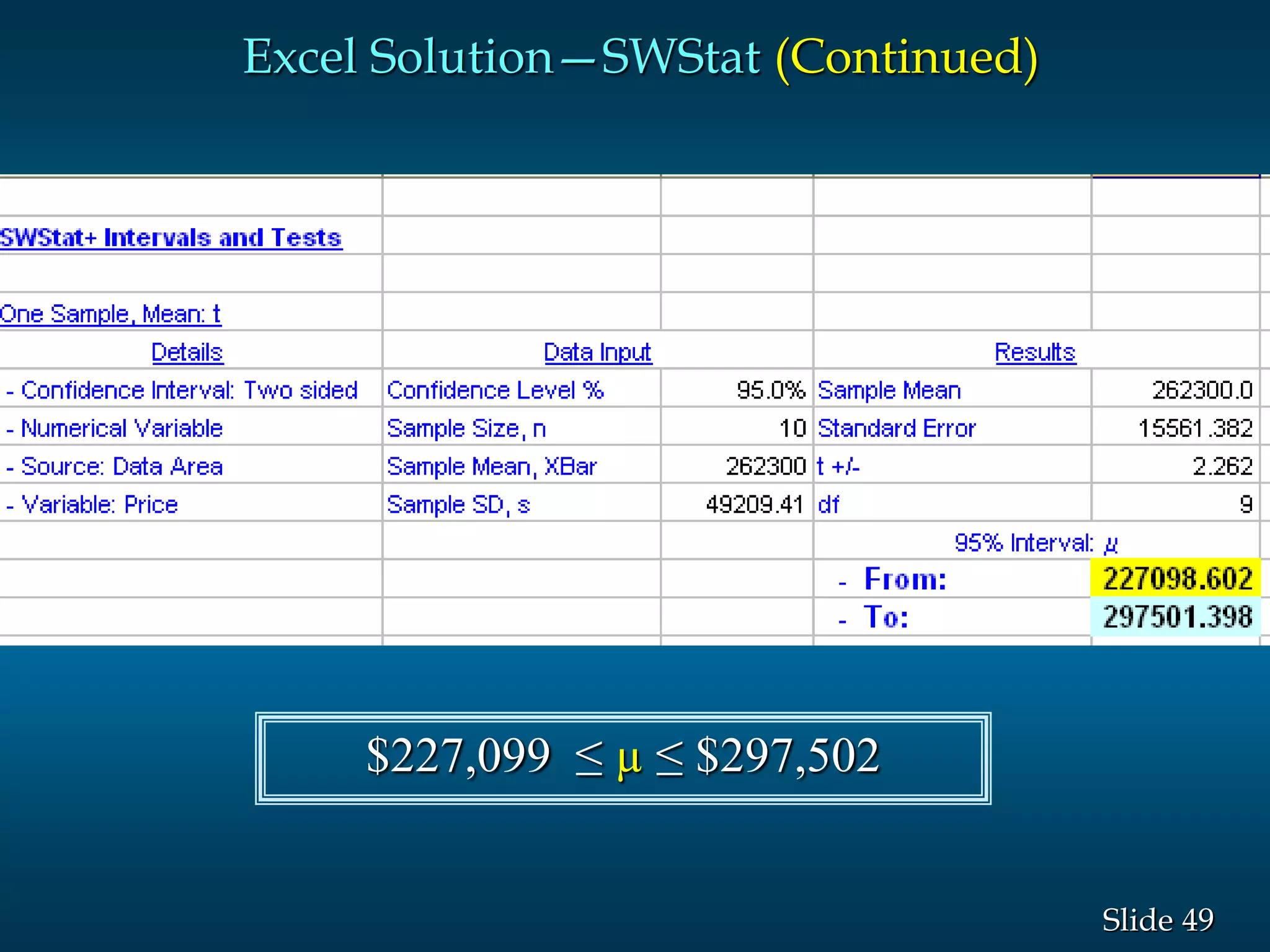
$227,099 ≤ µ ≤ $297,502
50Slide
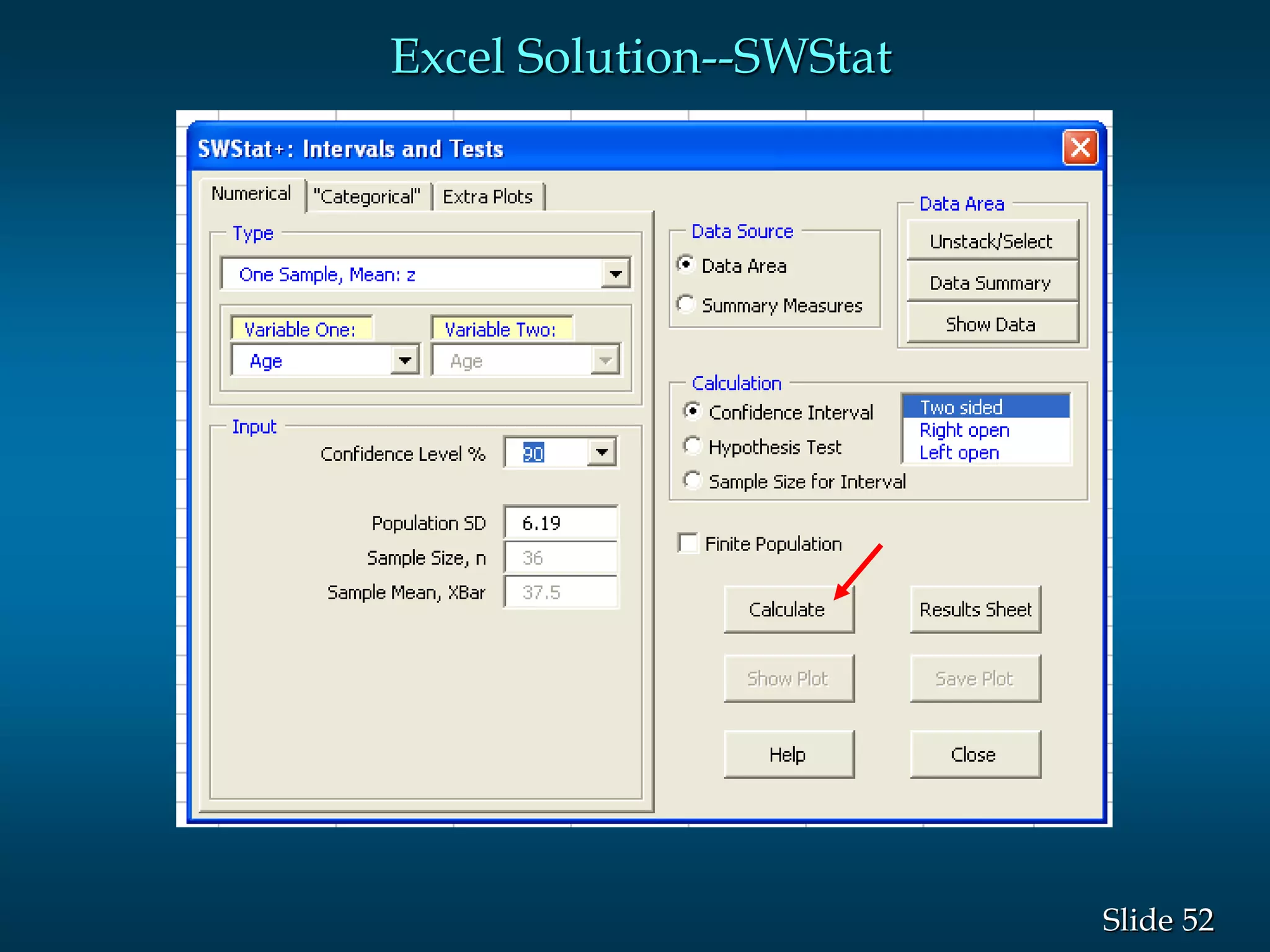
 A random sample of 36 magazine subscribers is
taken to estimate the mean age of all subscribers.
Use Excel to construct a 90% confidence interval
estimate of the mean age of all of this magazine’s
subscribers.
 See next slide for the data.
Confidence Interval Excel Application
(Another Problem)
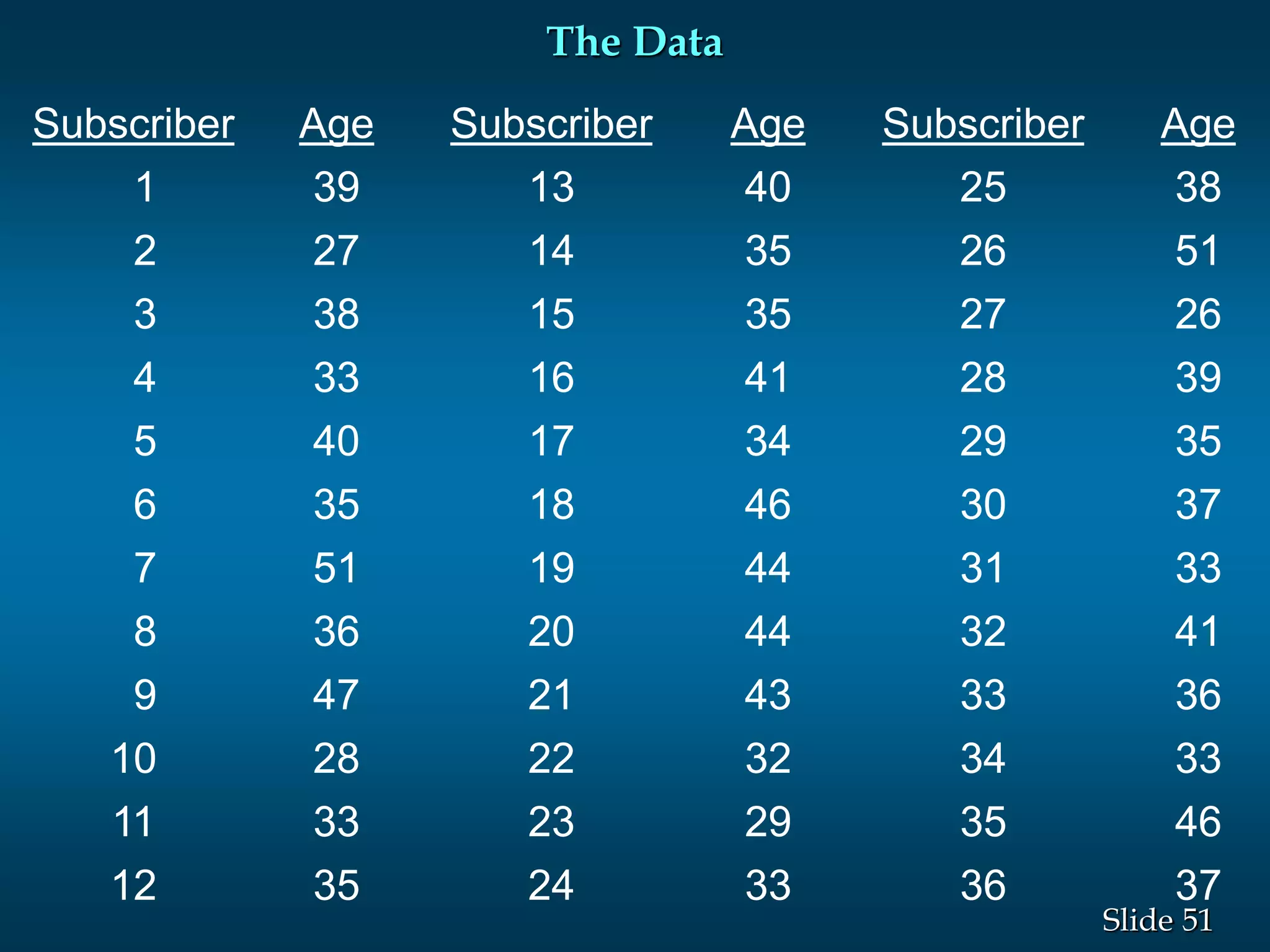
51Slide
The Data
Subscriber Age Subscriber Age Subscriber Age
1 39 13 40 25 38
2 27 14 35 26 51
3 38 15 35 27 26
4 33 16 41 28 39
5 40 17 34 29 35
6 35 18 46 30 37
7 51 19 44 31 33
8 36 20 44 32 41
9 47 21 43 33 36
10 28 22 32 34 33
11 33 23 29 35 46
12 35 24 33 36 37
52Slide
Excel Solution--SWStat
53Slide
Excel Solution (Continued)
SWStat
54Slide
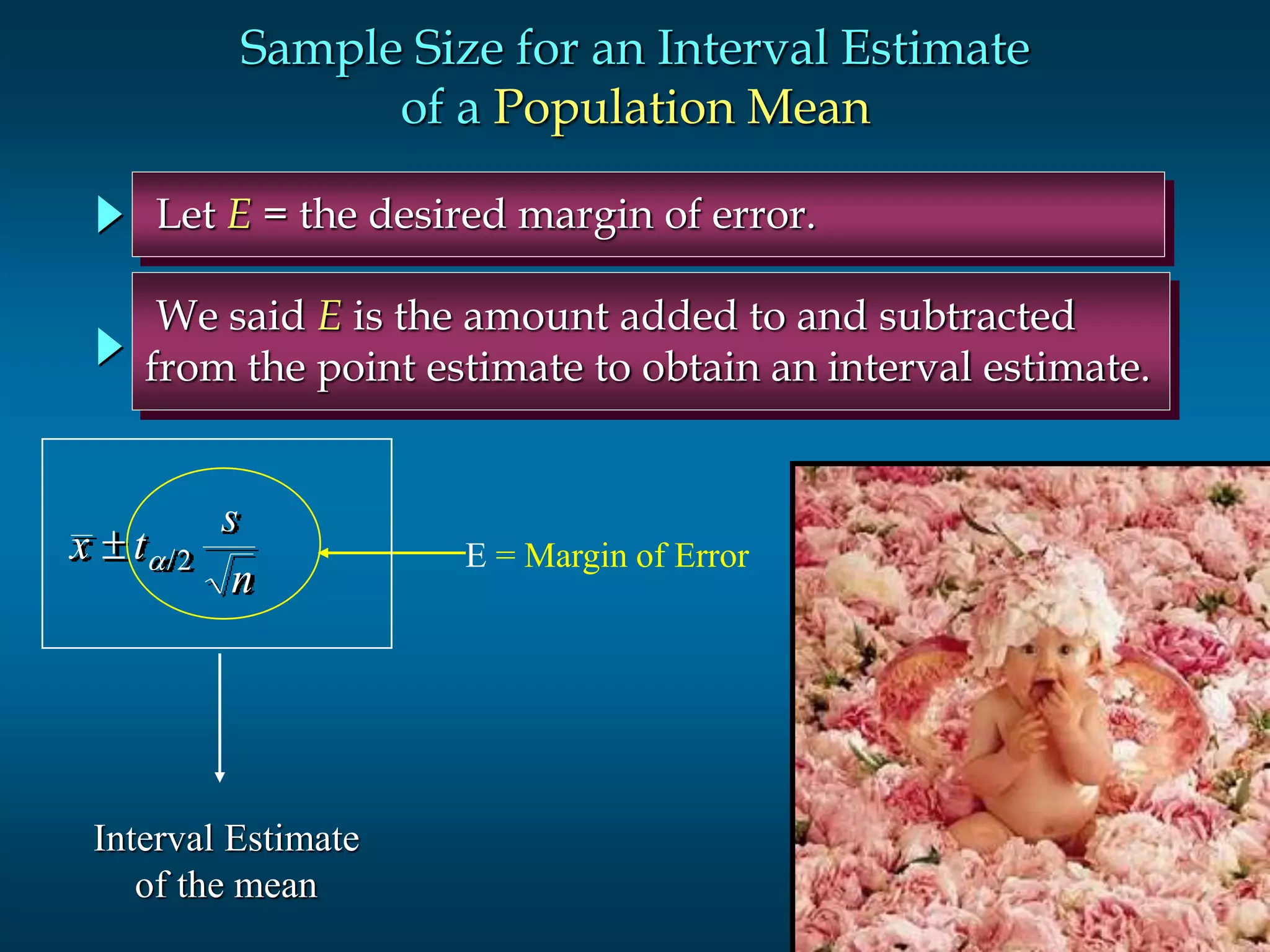
Let E = the desired margin of error.
We said E is the amount added to and subtracted
from the point estimate to obtain an interval estimate.
Sample Size for an Interval Estimate
of a Population Mean
x t
s
n
 /2 E = Margin of Error
Interval Estimate
of the mean
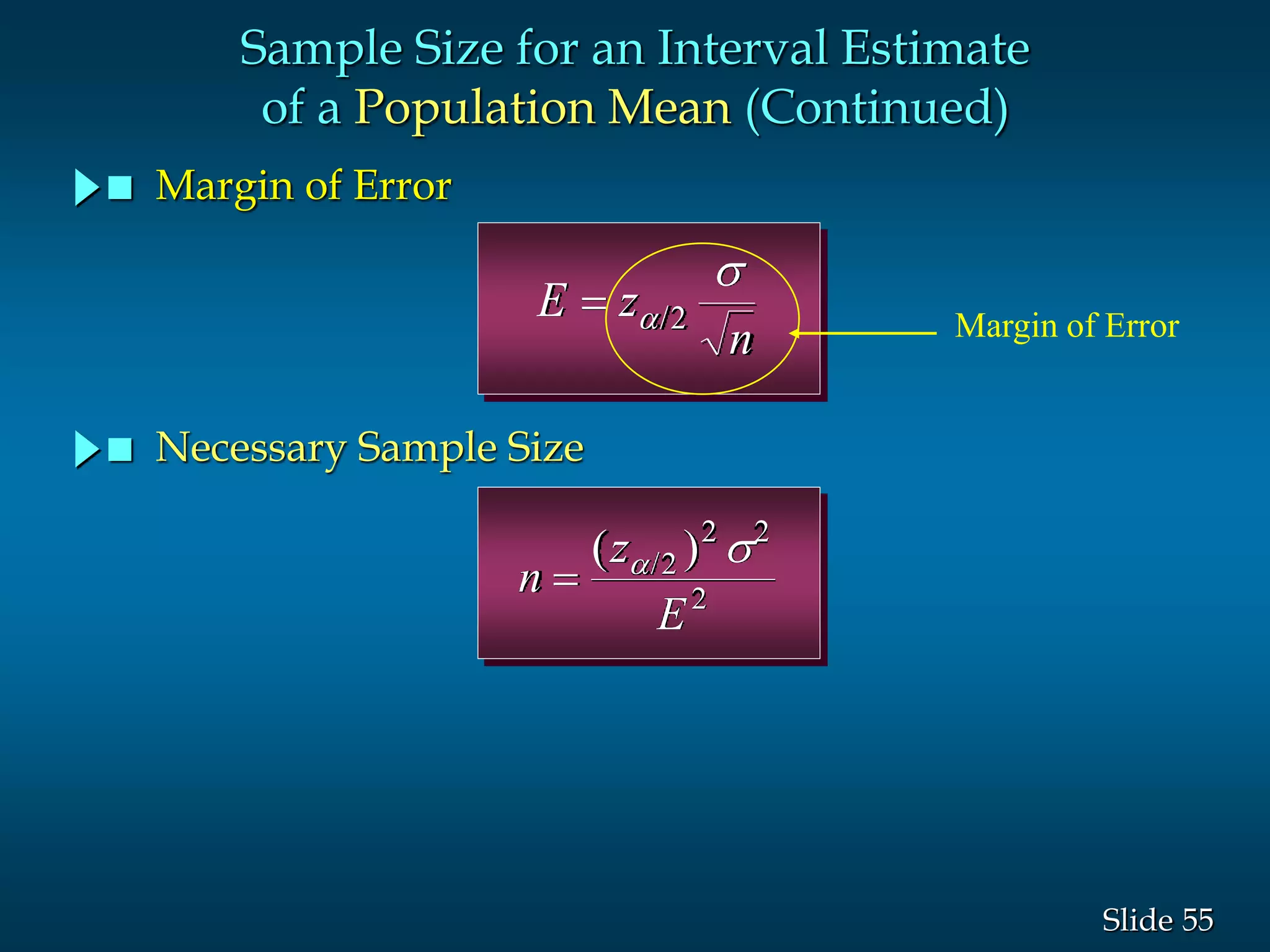
55Slide
Sample Size for an Interval Estimate
of a Population Mean (Continued)
E z
n
 
s
/2
n
z
E

( )/ s2
2 2
2
 Margin of Error
 Necessary Sample Size
Margin of Error
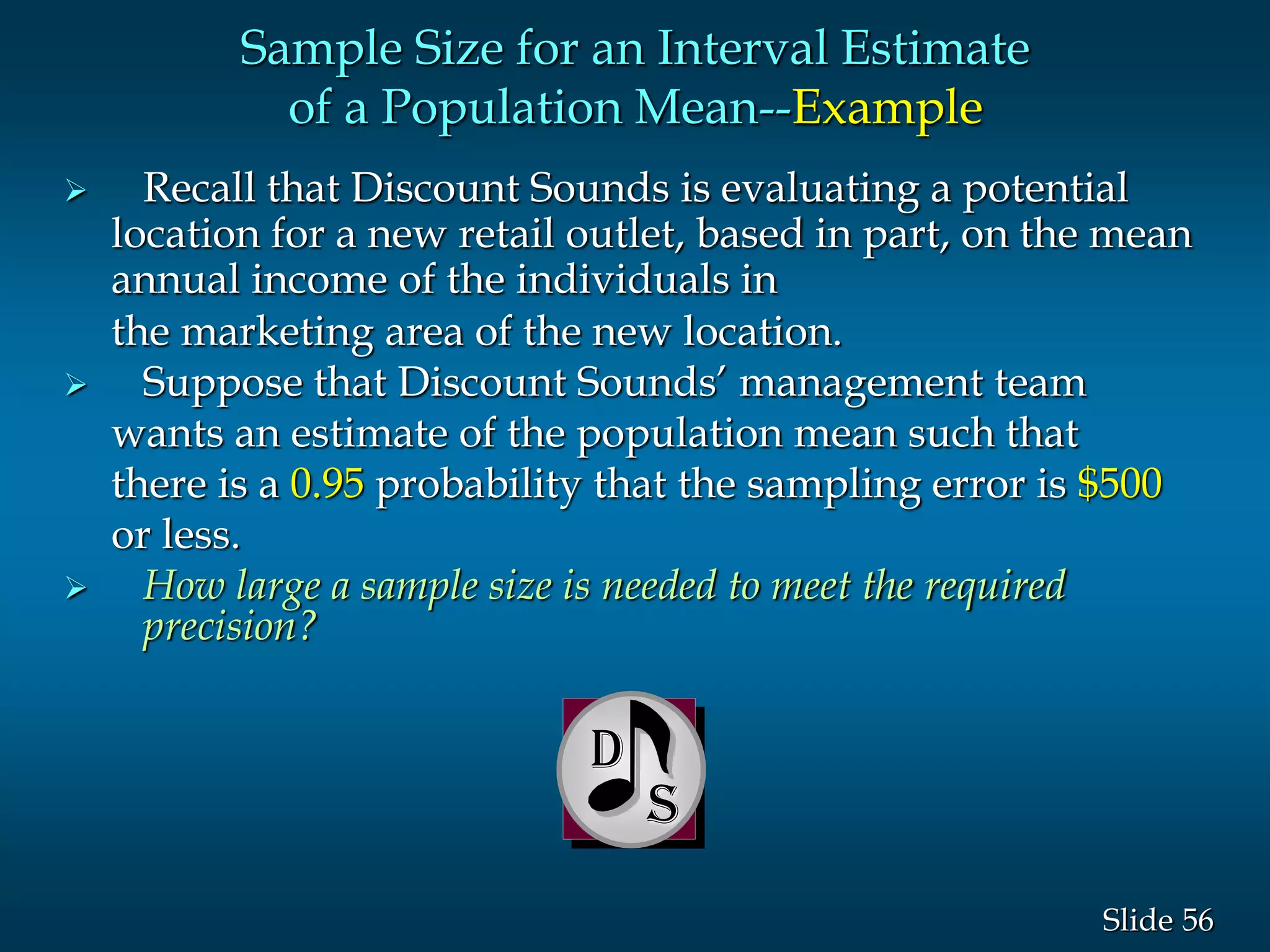
56Slide
 Recall that Discount Sounds is evaluating a potential
location for a new retail outlet, based in part, on the mean
annual income of the individuals in
the marketing area of the new location.
 Suppose that Discount Sounds’ management team
wants an estimate of the population mean such that
there is a 0.95 probability that the sampling error is $500
or less.
 How large a sample size is needed to meet the required
precision?
D
Sample Size for an Interval Estimate
of a Population Mean--Example
57Slide
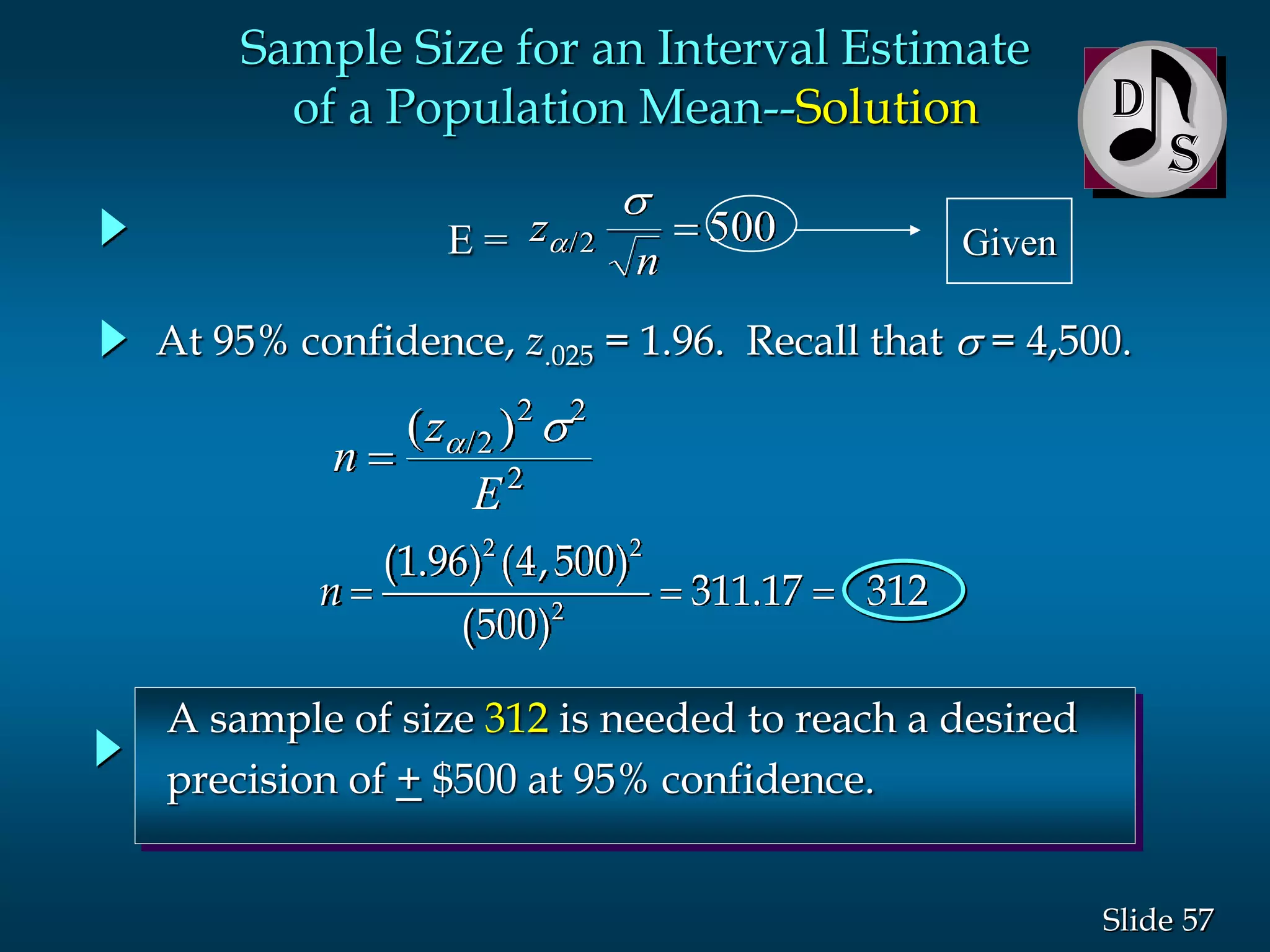
At 95% confidence, z.025 = 1.96. Recall that s= 4,500.
z
n

s
/2 500
2 2
2
(1.96) (4,500)
311.17 312
(500)
n   
Sample Size for an Interval Estimate
of a Population Mean--Solution D
A sample of size 312 is needed to reach a desired
precision of + $500 at 95% confidence.
n
z
E

( )/ s2
2 2
2
E = Given
58Slide
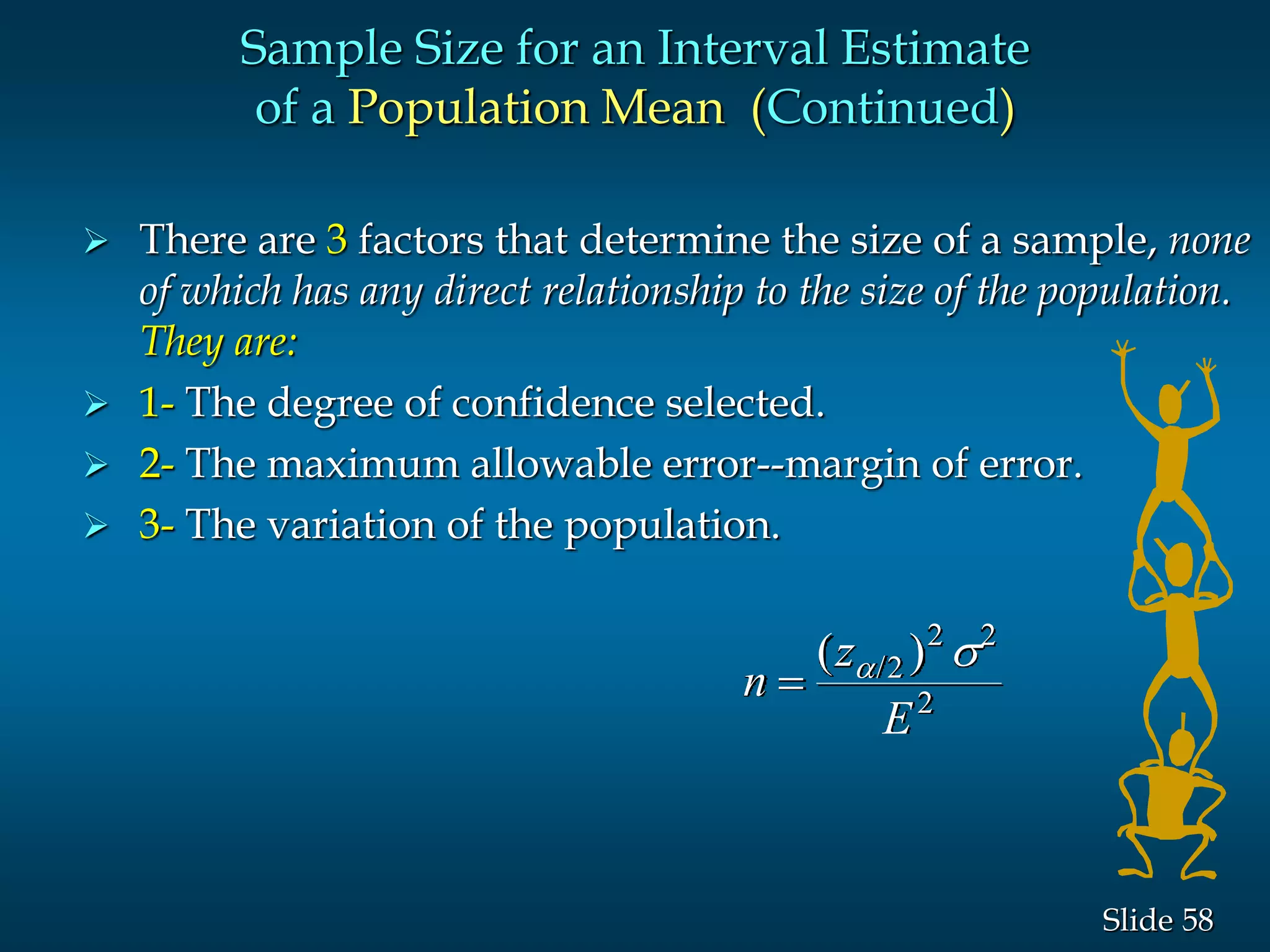
 There are 3 factors that determine the size of a sample, none
of which has any direct relationship to the size of the population.
They are:
 1- The degree of confidence selected.
 2- The maximum allowable error--margin of error.
 3- The variation of the population.
Sample Size for an Interval Estimate
of a Population Mean (Continued)
n
z
E

( )/ s2
2 2
2
59Slide
 A consumer group would like to estimate the mean monthly
electric bill for a single family house in July. Based on similar
studies the standard deviation is estimated to be $20.00. A
99% level of confidence is desired, with an accuracy of  $5.00.
How large a sample is required?
 n = [(2.58)(20)/5]2 = 106.5024  107
n
z
E

( )/ s2
2 2
2
Thinking Challenge Sample Size Example 1
60Slide
 What sample size is needed to be 90% confident of
being correct within  5? A pilot study suggested that
the standard deviation is 45.
Thinking Challenge Sample Size Example 1
(Continued)
61Slide
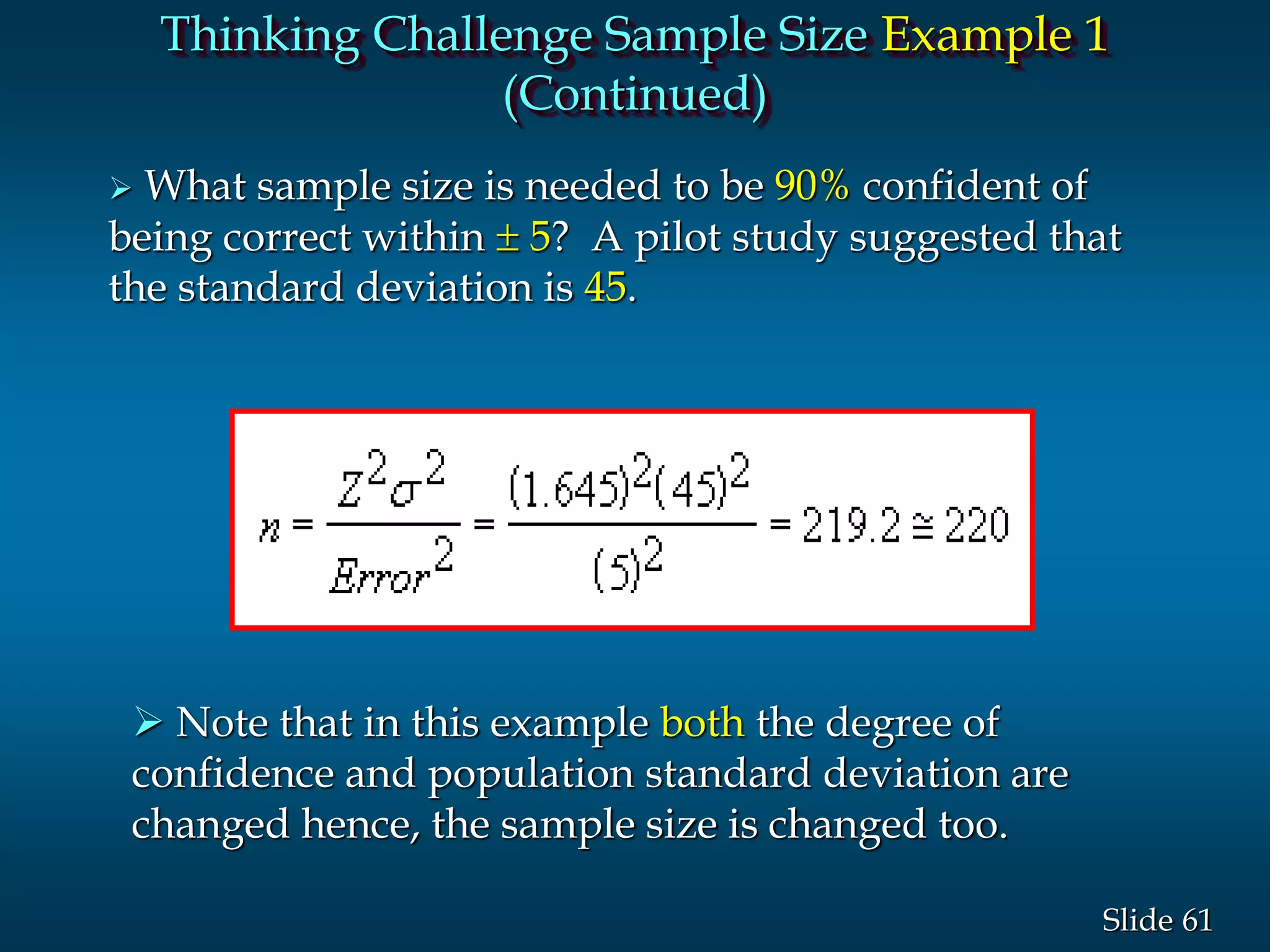
 What sample size is needed to be 90% confident of
being correct within  5? A pilot study suggested that
the standard deviation is 45.
 Note that in this example both the degree of
confidence and population standard deviation are
changed hence, the sample size is changed too.
Thinking Challenge Sample Size Example 1
(Continued)
62Slide
Thinking Challenge Sample Size Example 2
 You work in Human Resources at
Merrill Lynch. You plan to survey
employees to find their average
medical expenses. You want to be
95% confident that the sample mean
is within ± $50. A pilot study showed
that sample standard deviation was
about $400. What sample size do you
use?
63Slide
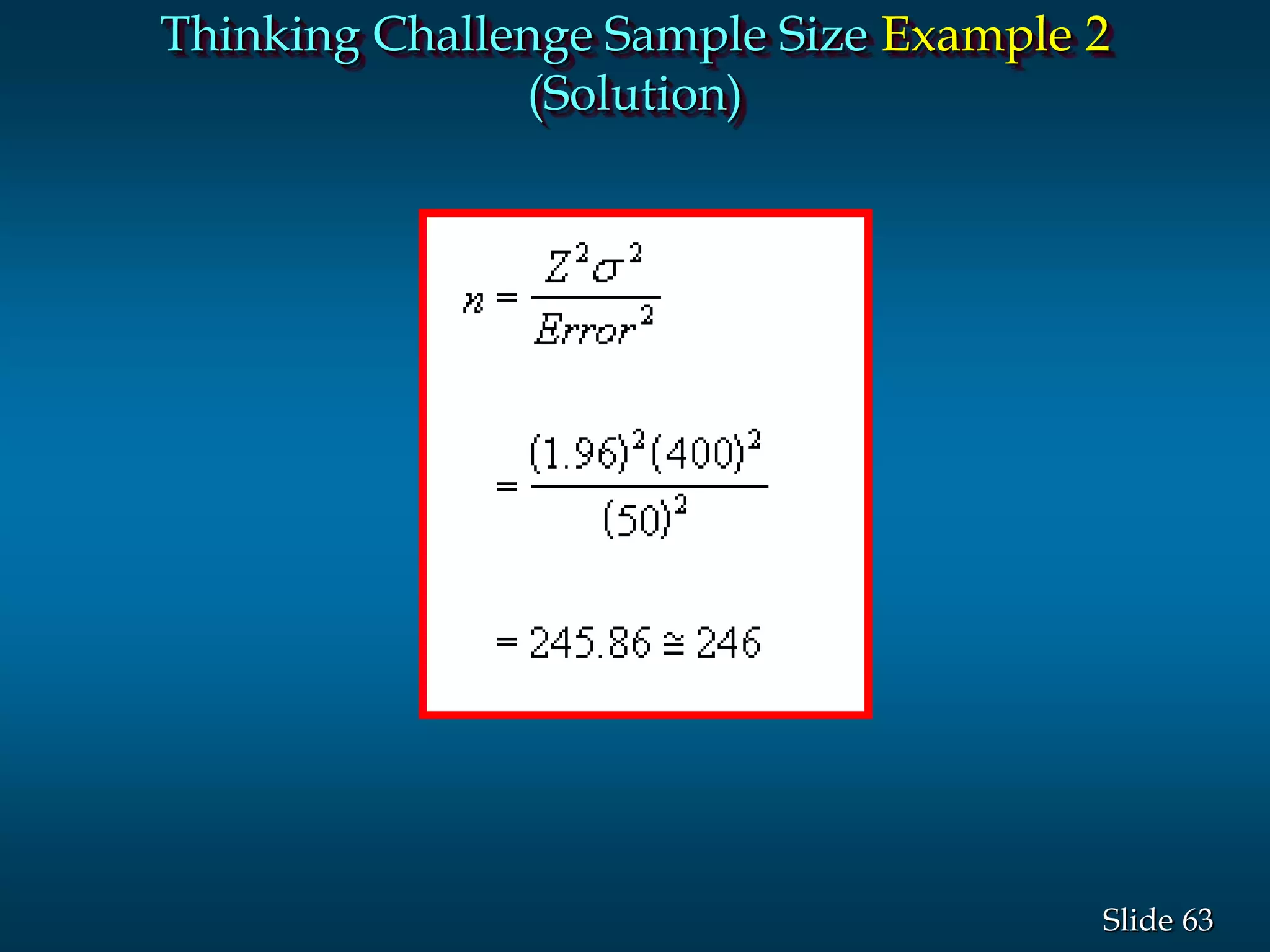
Thinking Challenge Sample Size Example 2
(Solution)
64Slide
Interval Estimation
of a Population Proportion
OPTIONAL
READINGS
65Slide
Statistics Homework Help at
Homework Guru
For any questions and queries, please
contact us at :-
support@homeworkguru.com