

Recap of Normal Distribution 
Sampling Distribution 
Estimation 
Steps of Hypothesis Testing
 Normal curve: brief review 
 “Standardized scores” brief review 
 Z-scores 
 Transformed scores (e.g., T-score, IQ, SAT) 
 Sampling Distributions 
 Estimation: Confidence Intervals 
 Hypothesis Testing
Areas 
Z-scores 
Transformed scores (e.g., T-scores)
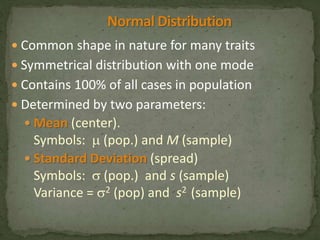
 Common shape in nature for many traits 
 Symmetrical distribution with one mode 
 Contains 100% of all cases in population 
 Determined by two parameters: 
 Mean (center). 
Symbols:  (pop.) and M (sample) 
 Standard Deviation (spread) 
Symbols:  (pop.) and s (sample) 
Variance = 2 (pop) and s2 (sample)
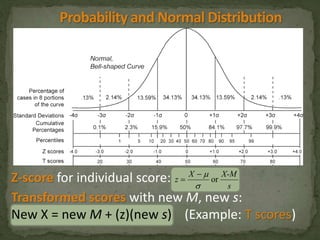
X  
X-M 
Z-score for individual score: 
z  
or 
 
s 
Transformed scores with new M, new s: 
New X = new M + (z)(new s) (Example: T scores)
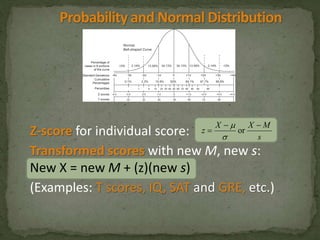
X X M 
Z-score for individual score: 
z 
s 
Transformed scores with new M, new s: 
New X = new M + (z)(new s) 
(Examples: T scores, IQ, SAT and GRE, etc.) 
  
 or 
 

Shape of the distribution 
Standard Error
 No longer dealing with individual scores 
 Instead, considering the behavior of a statistic 
(computed on samples) relative to parameter 
in the population. 
 Sampling Distribution = distribution of that 
statistic if a very large (infinite) number of 
samples are drawn. 
 Can be distribution of mean, variance, median. 
 Sampling Distribution of the Mean is common.
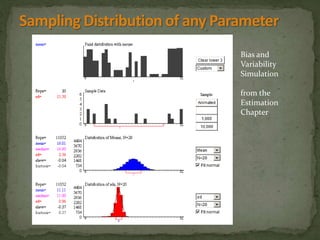
Bias and 
Variability 
Simulation 
from the 
Estimation 
Chapter
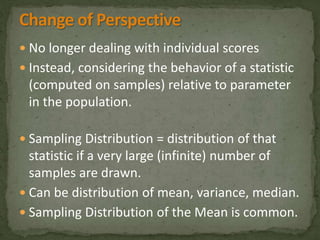
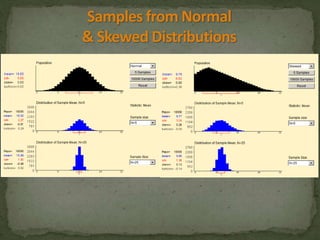
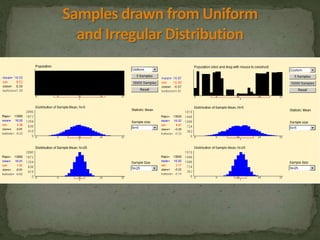
 When many samples are drawn, the 
distribution of their means is normal. 
 This is true regardless of the shape of the 
population’s distribution. 
 The Mean of the sampling distribution is equal 
to the Population Mean  
2 2 
  
 
2 so or 
   
 
N N N M M
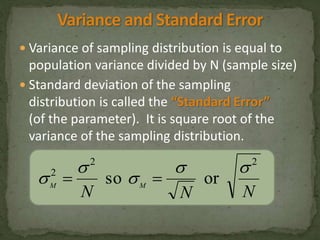
 Variance of sampling distribution is equal to 
population variance divided by N (sample size) 
 Standard deviation of the sampling 
distribution is called the “Standard Error” 
(of the parameter). It is square root of the 
variance of the sampling distribution. 
2 2 
  
 
2 so or 
   
 
N N N M M
Point Estimates 
Interval Estimates
 Use our knowledge of sampling distribution to 
make a guess about the population when we 
only have information from a sample. 
 First examples are artificially simple: they give 
us the population standard deviation while we 
don’t know the population mean.
 The mean of the distribution of sample means 
is equal to the population mean . 
 The mean of the sampling distribution is called 
the expected value of the statistic 
 The sample mean is an unbiased estimator of 
the population mean .
 The mean of a single sample is an unbiased 
estimator of the population mean  
 The Standard Error of the Mean (when we 
know the population standard deviation ) 
gives us information about the expected 
deviation score of our sample mean M from 
the population parameter  
We use this information, and the areas of the 
normal curve, to compute an interval estimate.
M = 30,  = 9, N =25, 90% confidence interval 
We find z.90 from the Inverse Normal 
Calculator (here) for the Unit Normal Curve 
(z = 1.6449 for a 90% confidence interval) 
 According to the Central Limit theorem, the 
middle 90% of sample means will be within 
1.6449 M of the population mean  
 Therefore, the probability that the population 
mean will be within 1.6449 M is also 90%
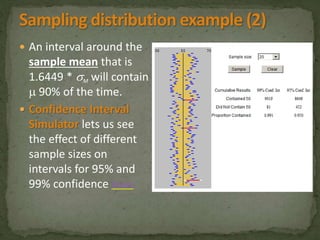
 An interval around the 
sample mean that is 
1.6449 * M will contain 
 90% of the time. 
 Confidence Interval 
Simulator lets us see 
the effect of different 
sample sizes on 
intervals for 95% and 
99% confidence (here)
 Calculate the Standard Error of the Mean: 
M = /N = 9/ 25 = 9/5 = 1.80 
 Calculate Confidence Interval by hand: 
 Lower limit = M – (1.6449*1.80) = 35-2.96082 
 Upper limit = M + (1.6449*1.80) = 35+2.96082 
 90% Confidence Interval 
= [32.03918, 37.96082 ]
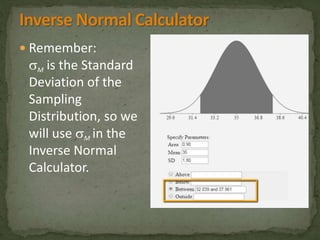
 Remember: 
M is the Standard 
Deviation of the 
Sampling 
Distribution, so we 
will use M in the 
Inverse Normal 
Calculator.
Null hypothesis and Alternate Hypotheses 
Reject a Null hypothesis when it is very unlikely
1. State a null hypothesis about a population 
2. Predict the characteristics of the sample 
based on the hypothesis 
3. Obtain a random sample from the population 
4. Compare the obtained sample data with the 
prediction made from the hypothesis 
 If consistent, hypothesis is reasonable 
 If discrepant, hypothesis is rejected
• Trial begins with null hypothesis 
(innocent until proven guilty). 
• Police and prosecutor gather evidence (data) 
about probable innocence. 
• If there is sufficient evidence, jury rejects 
innocence claim and concludes guilt. 
• If there is not enough evidence, jury fails to 
convict (but does not conclude defendant 
is innocent).
 State the hypotheses 
 Null hypothesis or H0 
 Alternate hypothesis or HA or H1 
 Set the criteria for a decision 
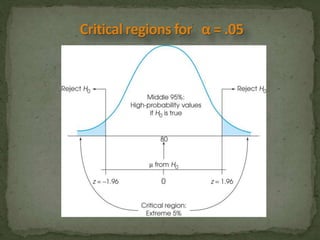
 Pick an alpha level (.05 is common) 
 Collect data and compute sample statistics 
 Need mean and standard deviation 
 Make a decision
 Null hypothesis (H0) states that, in the 
general population, there is no change, no 
difference, or no relationship 
 Alternative hypothesis (H1) states that 
there is a change, a difference, or a 
relationship in the general population
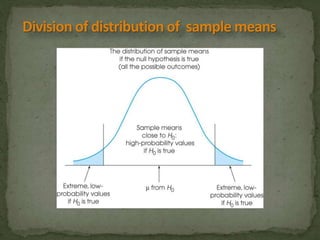
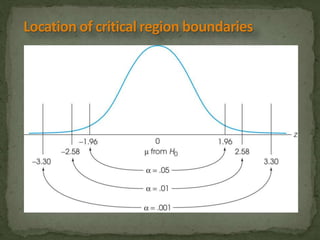
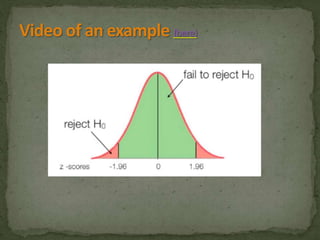
 Distribution of sample means is divided 
 Those likely if H0 is true 
 Those very unlikely if H0 is true 
 Alpha level, or level of significance, is a 
probability value used to define “very unlikely” 
 Critical region is composed of the extreme 
sample values that are very unlikely 
 Boundaries of critical region are determined 
by alpha level.
 Data collected after hypotheses stated 
 Data collected after criteria for decision set 
 This sequence assures objectivity 
 Compute a sample statistic (z-score) to 
show the exact position of the sample.
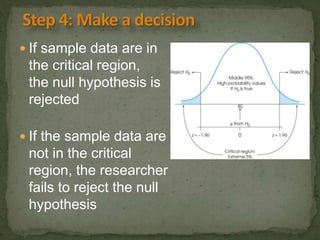
 If sample data are in 
the critical region, 
the null hypothesis is 
rejected 
 If the sample data are 
not in the critical 
region, the researcher 
fails to reject the null 
hypothesis
 Hypothesis testing is an inferential process 
 Uses limited information to reach a general 
conclusion, often leading to action 
 Sample data used to draw conclusion 
about a population that cannot be 
observed. 
 Errors are possible and probable
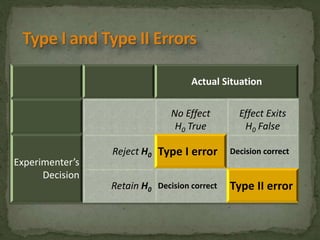
Actual Situation 
No Effect 
H0 True 
Effect Exits 
H0 False 
Experimenter’s 
Decision 
Reject H0 Type I error Decision correct 
Retain H0 Decision correct Type II error
 Size of difference between sample mean 
and original population mean 
 Appears in numerator of the z-score 
 Variability of the scores 
 Influences size of the standard error 
 Sample Size 
 Influences size of the standard error
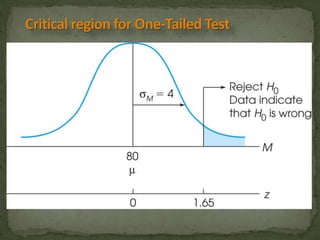
 In a two-tailed test, the critical region is 
divided on both tails of the distribution. 
 Researchers usually have a specific 
prediction about the direction of a 
treatment effect before they begin. 
 In a directional hypothesis or one-tailed 
test, the hypotheses specify an increase or 
decrease in the population mean
It all makes sense when a teacher walks through it. 
The ideas become yours when you work with them.
Recap of Normal Distribution 
Sampling Distribution 
Estimation 
Steps of Hypothesis Testing

Review & Hypothesis Testing

  • 1.
    Recap of NormalDistribution Sampling Distribution Estimation Steps of Hypothesis Testing
  • 2.
     Normal curve:brief review  “Standardized scores” brief review  Z-scores  Transformed scores (e.g., T-score, IQ, SAT)  Sampling Distributions  Estimation: Confidence Intervals  Hypothesis Testing
  • 3.
    Areas Z-scores Transformedscores (e.g., T-scores)
  • 4.
     Common shapein nature for many traits  Symmetrical distribution with one mode  Contains 100% of all cases in population  Determined by two parameters:  Mean (center). Symbols:  (pop.) and M (sample)  Standard Deviation (spread) Symbols:  (pop.) and s (sample) Variance = 2 (pop) and s2 (sample)
  • 5.
    X  X-M Z-score for individual score: z  or  s Transformed scores with new M, new s: New X = new M + (z)(new s) (Example: T scores)
  • 6.
    X X M Z-score for individual score: z s Transformed scores with new M, new s: New X = new M + (z)(new s) (Examples: T scores, IQ, SAT and GRE, etc.)    or  
  • 7.
    Shape of thedistribution Standard Error
  • 8.
     No longerdealing with individual scores  Instead, considering the behavior of a statistic (computed on samples) relative to parameter in the population.  Sampling Distribution = distribution of that statistic if a very large (infinite) number of samples are drawn.  Can be distribution of mean, variance, median.  Sampling Distribution of the Mean is common.
  • 11.
    Bias and Variability Simulation from the Estimation Chapter
  • 12.
     When manysamples are drawn, the distribution of their means is normal.  This is true regardless of the shape of the population’s distribution.  The Mean of the sampling distribution is equal to the Population Mean  2 2    2 so or     N N N M M
  • 13.
     Variance ofsampling distribution is equal to population variance divided by N (sample size)  Standard deviation of the sampling distribution is called the “Standard Error” (of the parameter). It is square root of the variance of the sampling distribution. 2 2    2 so or     N N N M M
  • 14.
  • 15.
     Use ourknowledge of sampling distribution to make a guess about the population when we only have information from a sample.  First examples are artificially simple: they give us the population standard deviation while we don’t know the population mean.
  • 16.
     The meanof the distribution of sample means is equal to the population mean .  The mean of the sampling distribution is called the expected value of the statistic  The sample mean is an unbiased estimator of the population mean .
  • 17.
     The meanof a single sample is an unbiased estimator of the population mean   The Standard Error of the Mean (when we know the population standard deviation ) gives us information about the expected deviation score of our sample mean M from the population parameter  We use this information, and the areas of the normal curve, to compute an interval estimate.
  • 18.
    M = 30, = 9, N =25, 90% confidence interval We find z.90 from the Inverse Normal Calculator (here) for the Unit Normal Curve (z = 1.6449 for a 90% confidence interval)  According to the Central Limit theorem, the middle 90% of sample means will be within 1.6449 M of the population mean   Therefore, the probability that the population mean will be within 1.6449 M is also 90%
  • 19.
     An intervalaround the sample mean that is 1.6449 * M will contain  90% of the time.  Confidence Interval Simulator lets us see the effect of different sample sizes on intervals for 95% and 99% confidence (here)
  • 20.
     Calculate theStandard Error of the Mean: M = /N = 9/ 25 = 9/5 = 1.80  Calculate Confidence Interval by hand:  Lower limit = M – (1.6449*1.80) = 35-2.96082  Upper limit = M + (1.6449*1.80) = 35+2.96082  90% Confidence Interval = [32.03918, 37.96082 ]
  • 21.
     Remember: Mis the Standard Deviation of the Sampling Distribution, so we will use M in the Inverse Normal Calculator.
  • 22.
    Null hypothesis andAlternate Hypotheses Reject a Null hypothesis when it is very unlikely
  • 23.
    1. State anull hypothesis about a population 2. Predict the characteristics of the sample based on the hypothesis 3. Obtain a random sample from the population 4. Compare the obtained sample data with the prediction made from the hypothesis  If consistent, hypothesis is reasonable  If discrepant, hypothesis is rejected
  • 24.
    • Trial beginswith null hypothesis (innocent until proven guilty). • Police and prosecutor gather evidence (data) about probable innocence. • If there is sufficient evidence, jury rejects innocence claim and concludes guilt. • If there is not enough evidence, jury fails to convict (but does not conclude defendant is innocent).
  • 25.
     State thehypotheses  Null hypothesis or H0  Alternate hypothesis or HA or H1  Set the criteria for a decision  Pick an alpha level (.05 is common)  Collect data and compute sample statistics  Need mean and standard deviation  Make a decision
  • 26.
     Null hypothesis(H0) states that, in the general population, there is no change, no difference, or no relationship  Alternative hypothesis (H1) states that there is a change, a difference, or a relationship in the general population
  • 27.
     Distribution ofsample means is divided  Those likely if H0 is true  Those very unlikely if H0 is true  Alpha level, or level of significance, is a probability value used to define “very unlikely”  Critical region is composed of the extreme sample values that are very unlikely  Boundaries of critical region are determined by alpha level.
  • 30.
     Data collectedafter hypotheses stated  Data collected after criteria for decision set  This sequence assures objectivity  Compute a sample statistic (z-score) to show the exact position of the sample.
  • 31.
     If sampledata are in the critical region, the null hypothesis is rejected  If the sample data are not in the critical region, the researcher fails to reject the null hypothesis
  • 32.
     Hypothesis testingis an inferential process  Uses limited information to reach a general conclusion, often leading to action  Sample data used to draw conclusion about a population that cannot be observed.  Errors are possible and probable
  • 33.
    Actual Situation NoEffect H0 True Effect Exits H0 False Experimenter’s Decision Reject H0 Type I error Decision correct Retain H0 Decision correct Type II error
  • 35.
     Size ofdifference between sample mean and original population mean  Appears in numerator of the z-score  Variability of the scores  Influences size of the standard error  Sample Size  Influences size of the standard error
  • 36.
     In atwo-tailed test, the critical region is divided on both tails of the distribution.  Researchers usually have a specific prediction about the direction of a treatment effect before they begin.  In a directional hypothesis or one-tailed test, the hypotheses specify an increase or decrease in the population mean
  • 39.
    It all makessense when a teacher walks through it. The ideas become yours when you work with them.
  • 40.
    Recap of NormalDistribution Sampling Distribution Estimation Steps of Hypothesis Testing