Statistics  for Management Confidence Interval Estimation
Lesson Topics Confidence Interval Estimation for the Mean (  Known) Confidence Interval Estimation for the Mean   (  Unknown) Confidence Interval Estimation for the  Proportion  The Situation of   Finite Populations Sample Size Estimation
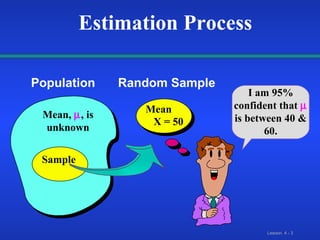
Mean,   , is unknown Population Random Sample I am 95% confident that     is between 40 & 60. Mean  X = 50 Estimation Process Sample
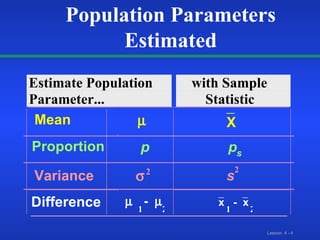
Estimate Population Parameter... with Sample Statistic Mean  Proportion p p s Variance s 2 Population Parameters Estimated  2 Difference    -   1 2 x  -  x  1 2 X _ _ _
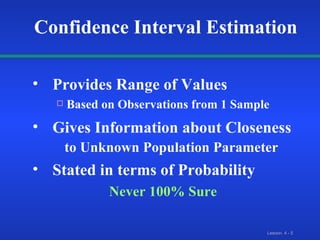
Provides Range of Values  Based on Observations from 1 Sample Gives Information about Closeness  to Unknown Population Parameter Stated in terms of Probability Never 100% Sure  Confidence Interval Estimation
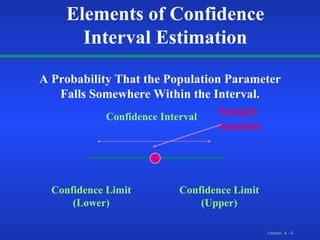
Confidence Interval Sample Statistic Confidence Limit (Lower) Confidence Limit (Upper) A Probability That the Population Parameter Falls Somewhere Within the Interval. Elements of Confidence Interval Estimation
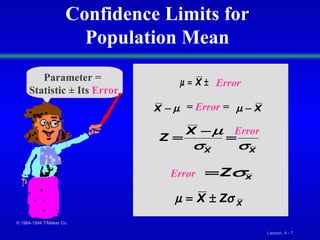
Parameter =  Statistic ± Its  Error © 1984-1994 T/Maker Co. Confidence Limits for Population Mean Error =   Error  = Error Error
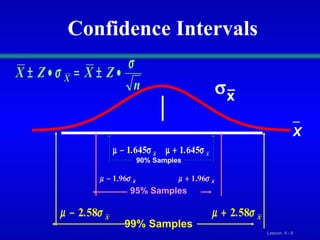
90% Samples 95% Samples Confidence Intervals 99% Samples X _  x _
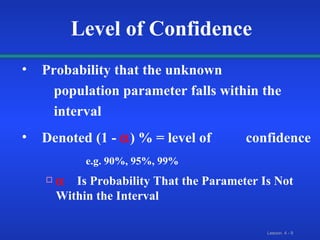
Probability that the unknown  population parameter falls within the   interval Denoted (1 -   ) % = level of  confidence  e.g. 90%, 95%, 99%  Is Probability That the Parameter Is Not Within the Interval Level of Confidence
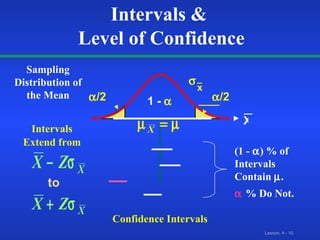
Confidence Intervals  Intervals Extend from (1 -   ) % of Intervals Contain   .    % Do Not. 1 -   /2  /2 X _  x _ Intervals &  Level of Confidence Sampling Distribution of the Mean to
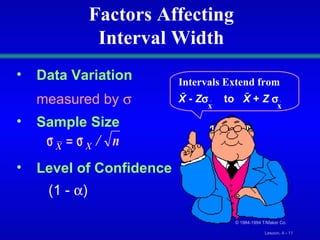
Data Variation   measured by   Sample Size Level of Confidence   (1 -   ) Intervals Extend from © 1984-1994 T/Maker Co. Factors Affecting Interval Width X  -  Z    to  X  +  Z      x x
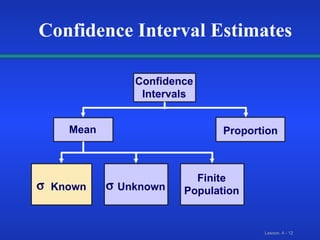
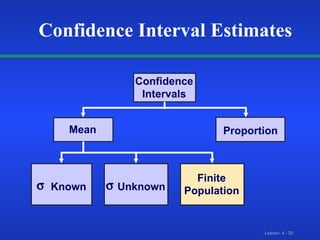
Mean  Unknown Confidence Intervals Proportion Finite Population  Known Confidence Interval Estimates
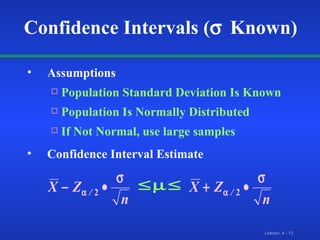
Assumptions Population Standard Deviation Is Known Population Is Normally Distributed If Not Normal, use large samples Confidence Interval Estimate Confidence Intervals (  Known)
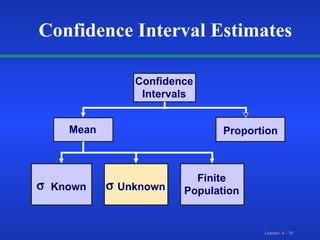
Mean  Unknown Confidence Intervals Proportion Finite Population  Known Confidence Interval Estimates
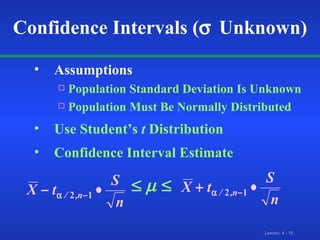
Assumptions Population Standard Deviation Is Unknown Population Must Be Normally Distributed Use Student’s  t  Distribution Confidence Interval Estimate Confidence Intervals (  Unknown)
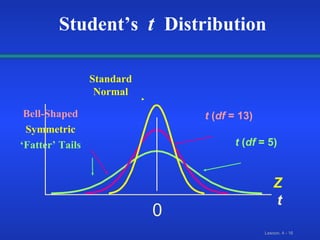
Z t 0 t  ( df  = 5) Standard Normal t  ( df  = 13) Bell-Shaped Symmetric ‘ Fatter’ Tails Student’s  t   Distribution
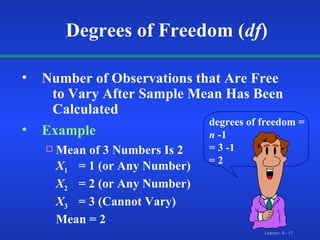
Number of Observations that Are Free   to Vary After Sample Mean Has Been    Calculated Example Mean of 3 Numbers Is 2 X 1  = 1 (or Any Number) X 2  = 2 (or Any Number) X 3  = 3 (Cannot Vary) Mean = 2 degrees of freedom =  n  -1  = 3 -1 = 2 Degrees of Freedom ( df )
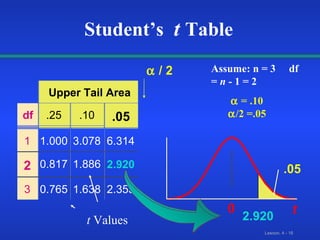
Upper Tail Area df .25 .10 .05 1 1.000 3.078 6.314 2 0.817 1.886 2.920 3 0.765 1.638 2.353 t 0 Assume: n = 3  df =  n  - 1 = 2     = .10    /2 =.05 2.920 t  Values    / 2 .05 Student’s   t  Table
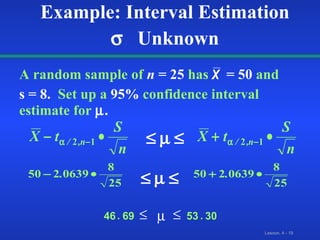
A random sample of   n  = 25   has   = 50   and   s = 8.   Set up a   95%   confidence interval estimate for    .    . . 46 69 53 30 Example: Interval Estimation  Unknown
Mean  Unknown Confidence Intervals Proportion Finite Population  Known Confidence Interval Estimates
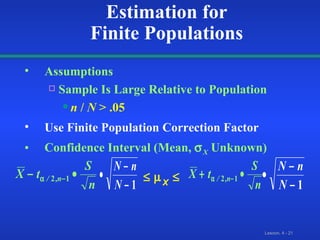
Assumptions Sample Is Large Relative to Population n  /  N  > .05 Use Finite Population Correction Factor Confidence Interval (Mean,   X  Unknown) X    Estimation for Finite Populations
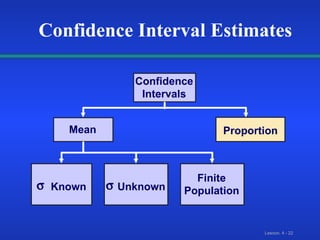
Mean  Unknown Confidence Intervals Proportion Finite Population  Known Confidence Interval Estimates
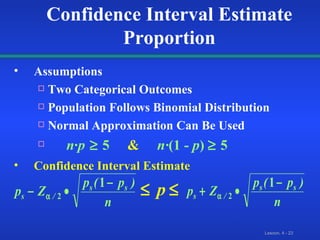
Assumptions Two Categorical Outcomes Population Follows Binomial Distribution Normal Approximation Can Be Used n · p   5   &  n· (1 -  p )    5 Confidence Interval Estimate Confidence Interval Estimate Proportion
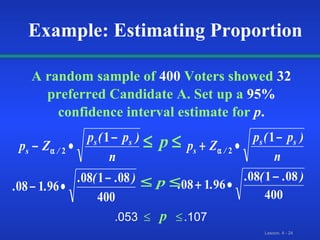
A random sample of  400   Voters showed   32   preferred Candidate A. Set up   a   95%   confidence interval estimate for   p . p   .053 .107 Example: Estimating Proportion
Sample Size Too Big: Requires too much resources Too Small: Won’t do  the job
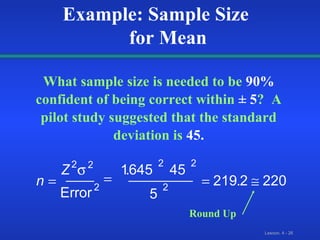
What sample size is needed to be   90%   confident of being correct within   ± 5 ?  A pilot study suggested that the standard deviation is   45. n Z Error     2 2 2 2 2 2 1 645 45 5 219 2 220  . . Example: Sample Size  for Mean Round Up
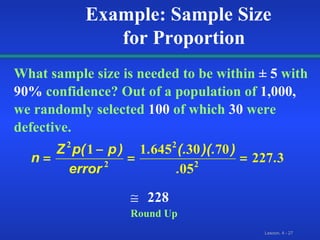
What sample size is needed to be within   ± 5   with  90%   confidence? Out of a population of   1,000,   we randomly selected   100   of which   30   were defective. Example: Sample Size  for Proportion Round Up 228 
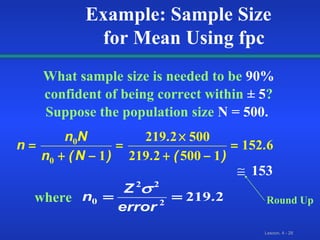
What sample size is needed to be   90%   confident of being correct within   ± 5 ? Suppose the population size   N = 500.   Example: Sample Size  for Mean Using fpc Round Up where 153 
Lesson Summary Discussed Confidence Interval Estimation for   the Mean (  Known) Discussed Confidence Interval Estimation for   the Mean (  Unknown) Addressed Confidence Interval Estimation for   the Proportion   Addressed the Situation of   Finite Populations Determined  Sample Size

Lesson04_Static11

  • 1.
    Statistics forManagement Confidence Interval Estimation
  • 2.
    Lesson Topics ConfidenceInterval Estimation for the Mean (  Known) Confidence Interval Estimation for the Mean (  Unknown) Confidence Interval Estimation for the Proportion The Situation of Finite Populations Sample Size Estimation
  • 3.
    Mean, , is unknown Population Random Sample I am 95% confident that  is between 40 & 60. Mean X = 50 Estimation Process Sample
  • 4.
    Estimate Population Parameter...with Sample Statistic Mean  Proportion p p s Variance s 2 Population Parameters Estimated  2 Difference  -  1 2 x - x 1 2 X _ _ _
  • 5.
    Provides Range ofValues Based on Observations from 1 Sample Gives Information about Closeness to Unknown Population Parameter Stated in terms of Probability Never 100% Sure Confidence Interval Estimation
  • 6.
    Confidence Interval SampleStatistic Confidence Limit (Lower) Confidence Limit (Upper) A Probability That the Population Parameter Falls Somewhere Within the Interval. Elements of Confidence Interval Estimation
  • 7.
    Parameter = Statistic ± Its Error © 1984-1994 T/Maker Co. Confidence Limits for Population Mean Error = Error = Error Error
  • 8.
    90% Samples 95%Samples Confidence Intervals 99% Samples X _  x _
  • 9.
    Probability that theunknown population parameter falls within the interval Denoted (1 -  ) % = level of confidence e.g. 90%, 95%, 99%  Is Probability That the Parameter Is Not Within the Interval Level of Confidence
  • 10.
    Confidence Intervals Intervals Extend from (1 -  ) % of Intervals Contain  .   % Do Not. 1 -   /2  /2 X _  x _ Intervals & Level of Confidence Sampling Distribution of the Mean to
  • 11.
    Data Variation measured by  Sample Size Level of Confidence (1 -  ) Intervals Extend from © 1984-1994 T/Maker Co. Factors Affecting Interval Width X - Z  to X + Z  x x
  • 12.
    Mean  UnknownConfidence Intervals Proportion Finite Population  Known Confidence Interval Estimates
  • 13.
    Assumptions Population StandardDeviation Is Known Population Is Normally Distributed If Not Normal, use large samples Confidence Interval Estimate Confidence Intervals (  Known)
  • 14.
    Mean  UnknownConfidence Intervals Proportion Finite Population  Known Confidence Interval Estimates
  • 15.
    Assumptions Population StandardDeviation Is Unknown Population Must Be Normally Distributed Use Student’s t Distribution Confidence Interval Estimate Confidence Intervals (  Unknown)
  • 16.
    Z t 0t ( df = 5) Standard Normal t ( df = 13) Bell-Shaped Symmetric ‘ Fatter’ Tails Student’s t Distribution
  • 17.
    Number of Observationsthat Are Free to Vary After Sample Mean Has Been Calculated Example Mean of 3 Numbers Is 2 X 1 = 1 (or Any Number) X 2 = 2 (or Any Number) X 3 = 3 (Cannot Vary) Mean = 2 degrees of freedom = n -1 = 3 -1 = 2 Degrees of Freedom ( df )
  • 18.
    Upper Tail Areadf .25 .10 .05 1 1.000 3.078 6.314 2 0.817 1.886 2.920 3 0.765 1.638 2.353 t 0 Assume: n = 3 df = n - 1 = 2   = .10  /2 =.05 2.920 t Values  / 2 .05 Student’s t Table
  • 19.
    A random sampleof n = 25 has = 50 and s = 8. Set up a 95% confidence interval estimate for  .    . . 46 69 53 30 Example: Interval Estimation  Unknown
  • 20.
    Mean  UnknownConfidence Intervals Proportion Finite Population  Known Confidence Interval Estimates
  • 21.
    Assumptions Sample IsLarge Relative to Population n / N > .05 Use Finite Population Correction Factor Confidence Interval (Mean,  X Unknown) X    Estimation for Finite Populations
  • 22.
    Mean  UnknownConfidence Intervals Proportion Finite Population  Known Confidence Interval Estimates
  • 23.
    Assumptions Two CategoricalOutcomes Population Follows Binomial Distribution Normal Approximation Can Be Used n · p  5 & n· (1 - p )  5 Confidence Interval Estimate Confidence Interval Estimate Proportion
  • 24.
    A random sampleof 400 Voters showed 32 preferred Candidate A. Set up a 95% confidence interval estimate for p . p   .053 .107 Example: Estimating Proportion
  • 25.
    Sample Size TooBig: Requires too much resources Too Small: Won’t do the job
  • 26.
    What sample sizeis needed to be 90% confident of being correct within ± 5 ? A pilot study suggested that the standard deviation is 45. n Z Error     2 2 2 2 2 2 1 645 45 5 219 2 220  . . Example: Sample Size for Mean Round Up
  • 27.
    What sample sizeis needed to be within ± 5 with 90% confidence? Out of a population of 1,000, we randomly selected 100 of which 30 were defective. Example: Sample Size for Proportion Round Up 228 
  • 28.
    What sample sizeis needed to be 90% confident of being correct within ± 5 ? Suppose the population size N = 500. Example: Sample Size for Mean Using fpc Round Up where 153 
  • 29.
    Lesson Summary DiscussedConfidence Interval Estimation for the Mean (  Known) Discussed Confidence Interval Estimation for the Mean (  Unknown) Addressed Confidence Interval Estimation for the Proportion Addressed the Situation of Finite Populations Determined Sample Size