1
• Analyze the relationship among two
  quantitative variables
• Correlation determines the strength and
  direction between the variables
• Regression determines a mathematical
  equation to explain the relation
• Equation can be used for prediction

                                            2
• Regression Analysis
  – X → independent variable
  – Y → dependent variable
  – Independent variable influence depended variable
  – Sample consists of n pairs of observations
  – Ascertain if a relation exists
  – Examine the nature of the relation
  – Obtain an equation that relates Y to X
  – The magnitude in change of one variable due to
    change in another variable can be evaluated
  – Predict value of Y on different values of X
                                                 3
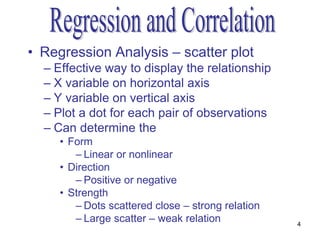
• Regression Analysis – scatter plot
  – Effective way to display the relationship
  – X variable on horizontal axis
  – Y variable on vertical axis
  – Plot a dot for each pair of observations
  – Can determine the
     • Form
        – Linear or nonlinear
     • Direction
        – Positive or negative
     • Strength
        – Dots scattered close – strong relation
        – Large scatter – weak relation            4
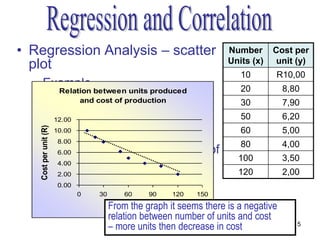
• Regression Analysis – scatter                                       Number      Cost per
                                                                      Units (x)    unit (y)
  plot
                                                                         10       R10,00
  – Example                                                              20           8,80
      Relation between units produced
  – Two variables production
           and cost of                                                   30           7,90
                   • 12.00 of producing units
                      Cost                                               50           6,20
   Cost per unit (R)


                   • 10.00
                      Number of units produced                           60           5,00
                       8.00
                                                                         80           4,00
  – Cost is depending on number of
      6.00
                                                                        100           3,50
    units
      4.00
                       2.00                                             120           2,00
                       0.00
                              0   30       60    90    120    150

                                       From theof unitsit seems there is a negative
                                        Number graph
                                       relation between number of units and cost
                                       – more units then decrease in cost                5
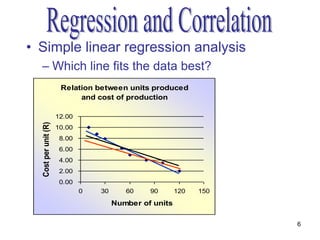
• Simple linear regression analysis
  – Which line fits the data best?
                       Relation between units produced
                            and cost of production

                      12.00
  Cost per unit (R)


                      10.00
                       8.00
                       6.00
                       4.00
                       2.00
                       0.00
                              0   30      60    90       120   150

                                       Number of units

                                                                     6
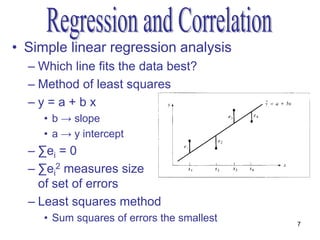
• Simple linear regression analysis
  – Which line fits the data best?
  – Method of least squares
  –y=a+bx
     • b → slope
     • a → y intercept
  – ∑ei = 0
  – ∑ei2 measures size
    of set of errors
  – Least squares method
     • Sum squares of errors the smallest   7
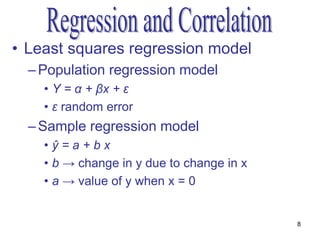
• Least squares regression model
  – Population regression model
    • Y = α + βx + ε
    • ε random error
  – Sample regression model
    •ŷ=a+bx
    • b → change in y due to change in x
    • a → value of y when x = 0


                                           8
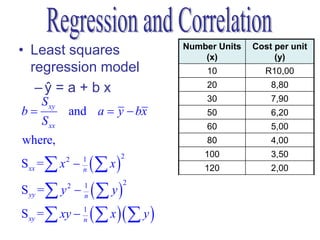
• Least squares                      Number Units
                                         (x)
                                                     Cost per unit
                                                          (y)
  regression model                       10             R10,00

   –ŷ = a + b x                          20                 8,80
     S xy                                30                 7,90
b          and a  y  bx               50                 6,20
     S xx                                60                 5,00
where,                                   80                 4,00

                     x
                                         100                3,50
Sxx =  x  2   1         2
                n                        120                2,00

                     y
                                       ∑x = 470        ∑y = 47,4
S yy =  y 2   1          2
                n                    ∑x2 = 38300     ∑y2 = 335,54

Sxy =  xy  1
             n        x   y      x  58,75       y  5,925
                                               ∑xy = 2033          9
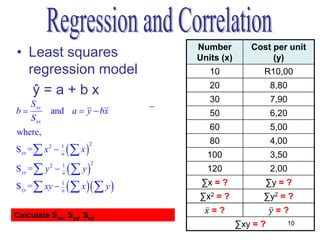
Number         Cost per unit
• Least squares                      Units (x)           (y)
  regression model                      10             R10,00

   ŷ=a+bx                               20                 8,80
                                        30                 7,90
     S xy
b          and a  y  bx              50                 6,20
     S xx
                                        60                 5,00
where,
                                        80                 4,00
Sxx =  x           x
            2   1         2
                n                      100                 3,50
S yy =  y          y
            2   1          2
                n
                                       120                 2,00
Sxy =  xy  1
             n        x   y     ∑x = ?           ∑y = ?
                                     ∑x2 = ?           ∑y2 = ?

Calculate Sxx, Syy, Sxy
                                                 ∑xy = ?          10
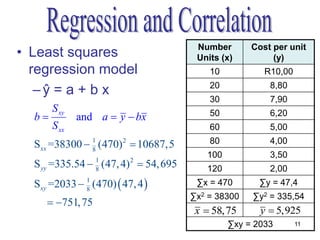
Number       Cost per unit
• Least squares                       Units (x)         (y)
  regression model                       10           R10,00

   –ŷ = a + b x                          20            8,80
                                         30            7,90
       S xy
  b          and a  y  bx             50            6,20
       S xx                              60            5,00
  Sxx =38300  1 (470) 2  10687,5
               8
                                         80            4,00
                                        100            3,50
  S yy =335.54  (47, 4)  54, 695
                  1
                  8
                          2
                                        120            2,00
  Sxy =2033  1 (470)  47, 4 
              8
                                      ∑x = 470       ∑y = 47,4
                                     ∑x2 = 38300   ∑y2 = 335,54
      751, 75
                                      x  58,75      y  5,925
                                              ∑xy = 2033       11
Note Syy not used
• Least squares                          here but we will
  regression model                       use later!!

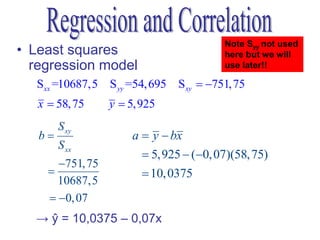
  Sxx =10687,5 S yy =54, 695 Sxy  751, 75
   x  58, 75     y  5,925
        S xy
   b                 a  y  bx
        S xx
                         5,925  (0, 07)(58, 75)
       751, 75
                        10, 0375
       10687,5
      0, 07
  → ŷ = 10,0375 – 0,07x
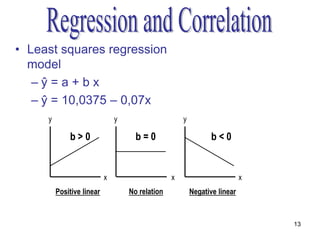
• Least squares regression
  model
   –ŷ=a+bx
   – ŷ = 10,0375 – 0,07x
     y                         y                     y

             b>0                     b=0                        b<0


                           x                     x                         x
         Positive linear           No relation           Negative linear


                                                                               13
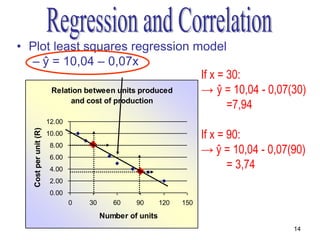
• Plot least squares regression model
  – ŷ = 10,04 – 0,07x
                                      If x = 30:
      Relation between units produced → ŷ = 10,04 - 0,07(30)
           and cost of production
                                             =7,94
                       12.00

                                                                      If x = 90:
   Cost per unit (R)


                       10.00
                        8.00
                        6.00
                                                                      → ŷ = 10,04 - 0,07(90)
                        4.00                                                 = 3,74
                        2.00
                        0.00
                               0   30      60    90       120   150

                                        Number of units
                                                                                         14
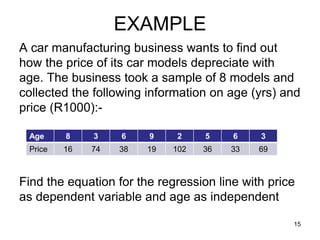
EXAMPLE
A car manufacturing business wants to find out
how the price of its car models depreciate with
age. The business took a sample of 8 models and
collected the following information on age (yrs) and
price (R1000):-

 Age     8    3    6    9    2     5    6    3
 Price   16   74   38   19   102   36   33   69


Find the equation for the regression line with price
as dependent variable and age as independent

                                                   15
Example answer
Example 11.4, textbook, part 2, page 383


                                           16
PREDICTIONS IN REGRESSION ANALYSIS

• A sample regression line usually obtained
  for the purpose of prediction
• That is to estimate the value of Y
  corresponding to as selected value of x
• Two ways to estimate y:-
  – Point estimate
  – Confidence interval


                                              17
• Prediction with regression model
  – Point estimate using ŷ = 10,04 – 0,07x
  – What will be the estimated cost if 60 units
    will be produced?
  – ŷ = 10,04 – 0,07(60)=R5,84
  – What will be the estimated cost if 25 units
    will be produced?
  – ŷ = 10,075 – 0,07(25)=R8,29


                                                  18
ERRORS
• When regression line estimates every
  observed value has a predicted value
• Predicted values will all fall exactly on
  regression line
• All observed values will not fall on
  regression line
• Difference between the two values is
  known as an ERROR and is denoted by
  ei
                                          19
ERRORS
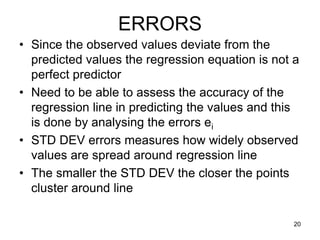
• Since the observed values deviate from the
  predicted values the regression equation is not a
  perfect predictor
• Need to be able to assess the accuracy of the
  regression line in predicting the values and this
  is done by analysing the errors ei
• STD DEV errors measures how widely observed
  values are spread around regression line
• The smaller the STD DEV the closer the points
  cluster around line

                                                  20
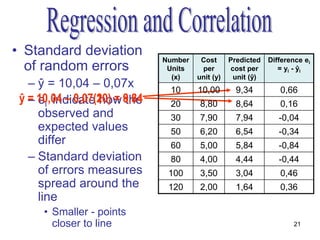
• Standard deviation
                               Number    Cost      Predicted   Difference ei
  of random errors              Units    per       cost per       = yi - ŷi
                                 (x)    unit (y)    unit (ŷ)
   – ŷ = 10,04 – 0,07x          10      10,00        9,34         0,66
 ŷ = 10,04 – 0,07(10) = 9,34
   – ei indicate how 8,64
             0,07(20) the       20       8,80        8,64         0,16
     observed and               30       7,90        7,94         -0,04
     expected values            50       6,20        6,54         -0,34
     differ                     60       5,00        5,84         -0,84
   – Standard deviation         80       4,00        4,44         -0,44
     of errors measures         100      3,50        3,04         0,46
     spread around the          120      2,00        1,64         0,36
     line
      • Smaller - points
        closer to line                                                21
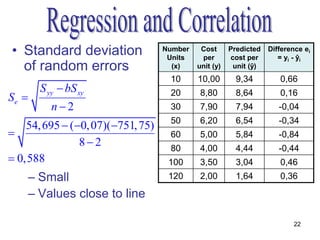
• Standard deviation               Number
                                    Units
                                             Cost
                                             per
                                                       Predicted
                                                       cost per
                                                                   Difference ei
                                                                      = yi - ŷi
  of random errors                   (x)    unit (y)    unit (ŷ)
                                    10      10,00        9,34         0,66
       S yy  bS xy
Se                                 20       8,80        8,64         0,16
          n2                       30       7,90        7,94         -0,04

    54, 695  (0, 07)(751, 75)    50       6,20        6,54         -0,34
                                   60       5,00        5,84         -0,84
                82                 80       4,00        4,44         -0,44
 0,588                             100      3,50        3,04         0,46
    – Small                         120      2,00        1,64         0,36

    – Values close to line

                                                                          22
CONFIDENCE INTERVAL FOR PREDICTION

• Different samples from the same population will
  give different point estimates
• Likely that different samples from same
  population will give different estimated
  regression lines
• Therefore need to construct a confidence
  interval for Y based on one sample that will give
  a more reliable estimate of Y
• Generally called a PREDICTION INTERVAL

                                                  23
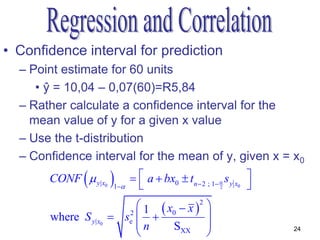
• Confidence interval for prediction
  – Point estimate for 60 units
     • ŷ = 10,04 – 0,07(60)=R5,84
  – Rather calculate a confidence interval for the
    mean value of y for a given x value
  – Use the t-distribution
  – Confidence interval for the mean of y, given x = x0
               
       CONF  y| x0    1
                                a  bx0  tn  2 ; 1  s y x0 
                                                       2        
                              1  x0  x 2 
       where S y| x0    se2               
                             n     SXX 
                                                                   24
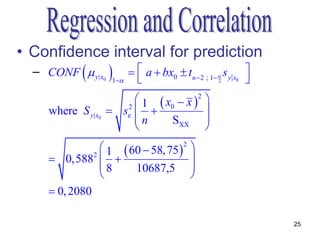
• Confidence interval for prediction
  – CONF   y| x               a  bx0  tn  2 ; 1  s y x0 
                     0   1                            2        
                            1  x0  x 2 
     where S y| x0    se2               
                           n     SXX 
                                          
                1  60  58, 75 2 
      0,5882                     
               8     10687,5 
                                   
      0, 2080

                                                                      25
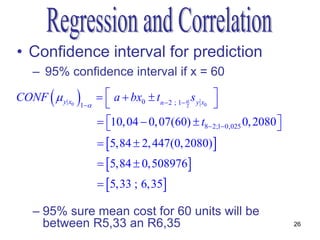
• Confidence interval for prediction
   – 95% confidence interval if x = 60

       
CONF  y| x0   
               1
                       a  bx0  tn  2 ; 1  s y x0 
                                              2        
                      10, 04  0, 07(60)  t8 2;10,025 0, 2080 
                                                                  
                      5,84  2, 447(0, 2080) 
                      5,84  0,508976
                      5,33 ; 6,35

   – 95% sure mean cost for 60 units will be
     between R5,33 an R6,35                                            26
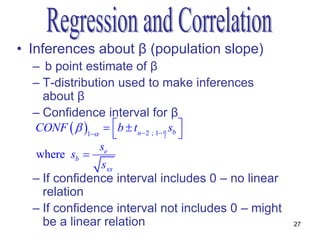
• Inferences about β (population slope)
  – b point estimate of β
  – T-distribution used to make inferences
    about β
  – Confidence interval for β
  CONF   1  b  tn  2 ; 1  sb 
                         2             
                se
  where sb 
                sxx
  – If confidence interval includes 0 – no linear
    relation
  – If confidence interval not includes 0 – might
    be a linear relation                            27
• Inferences about β (population
  slope)
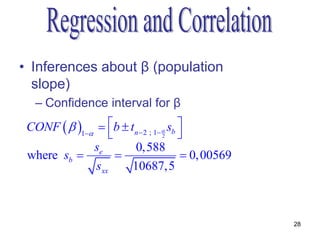
   – Confidence interval for β
 CONF   1  b  tn  2 ; 1  sb 
                                 2    
              se        0,588
 where sb                             0, 00569
               sxx     10687,5


                                                    28
• Inferences about β (population
  slope)
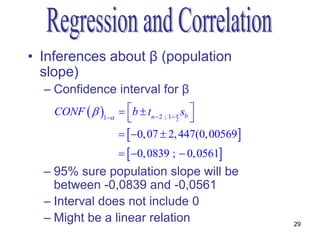
  – Confidence interval for β
    CONF   1  b  tn  2 ; 1  sb 
                                    2    
                    0, 07  2, 447(0, 00569
                    0, 0839 ;  0, 0561
  – 95% sure population slope will be
    between -0,0839 and -0,0561
  – Interval does not include 0
  – Might be a linear relation                    29
• Inferences about β (population slope)
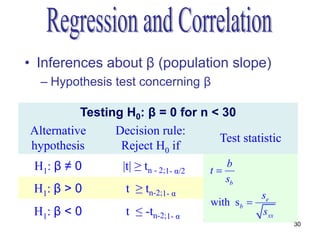
  – Hypothesis test concerning β

          Testing H0: β = 0 for n < 30
Alternative     Decision rule:
                                   Test statistic
hypothesis       Reject H0 if
 H1: β ≠ 0        |t| ≥ tn - 2;1- α/2   t
                                           b
                                           sb
 H1: β > 0        t ≥ tn-2;1- α
                                                  se
                                        with sb 
 H1: β < 0        t ≤ -tn-2;1- α                  sxx
                                                        30
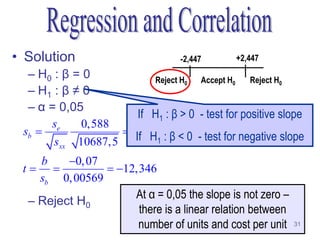
• Solution                        -2,447      +2,447
  – H0 : β = 0            Reject H0 Accept H0    Reject H0
  – H1 : β ≠ 0
  – α = 0,05
                      If H1 : β > 0 - test for positive slope
      se     0,588
 sb                0, 00569β < 0 - test for negative slope
       sxx 10687,5 If H1 :
    b    0, 07
   
 t–              12,346
    sb 0, 00569
                     At α = 0,05 the slope is not zero –
  – Reject H0
                      there is a linear relation between
                      number of units and cost per unit    31
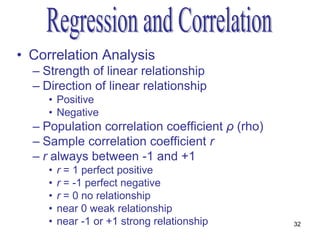
• Correlation Analysis
  – Strength of linear relationship
  – Direction of linear relationship
     • Positive
     • Negative
  – Population correlation coefficient ρ (rho)
  – Sample correlation coefficient r
  – r always between -1 and +1
     •   r = 1 perfect positive
     •   r = -1 perfect negative
     •   r = 0 no relationship
     •   near 0 weak relationship
     •   near -1 or +1 strong relationship       32
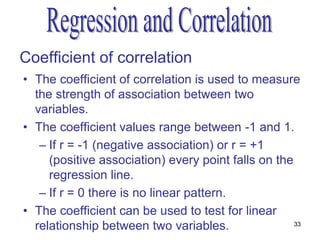
Coefficient of correlation
• The coefficient of correlation is used to measure
  the strength of association between two
  variables.
• The coefficient values range between -1 and 1.
   – If r = -1 (negative association) or r = +1
     (positive association) every point falls on the
     regression line.
   – If r = 0 there is no linear pattern.
• The coefficient can be used to test for linear
  relationship between two variables.                33
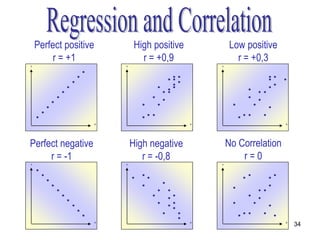
Perfect positive            High positive            Low positive
         r = +1                   r = +0,9                 r = +0,3
Y                          Y                        Y


                       X                        X                        X


Perfect negative               High negative            No Correlation
     r = -1                       r = -0,8                  r=0
Y                          Y                        Y


                       X                        X                        X
                                                                             34
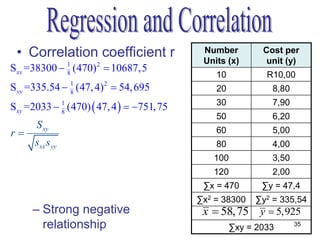
• Correlation coefficient r                Number
                                            Units (x)
                                                           Cost per
                                                            unit (y)
Sxx =38300  1 (470) 2  10687,5
             8                                 10           R10,00
S yy =335.54  1 (47, 4) 2  54, 695
               8                               20            8,80

Sxy =2033  1 (470)  47, 4   751, 75
            8
                                               30            7,90
                                               50            6,20
      S xy
r                                             60            5,00
      sxx s yy                                 80            4,00
      751, 75                                100            3,50
                                             120            2,00
   10687,5(54, 695)
                                            ∑x = 470       ∑y = 47,4
  0,98                                   ∑x2 = 38300   ∑y2 = 335,54
     – Strong negative                      x  58,75 y  5,925
       relationship                                 ∑xy = 2033      35
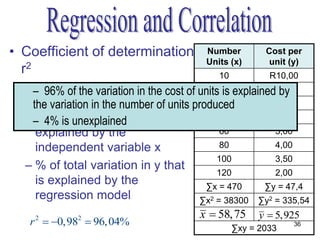
• Coefficient of determination            Number         Cost per
                                          Units (x)       unit (y)
  r2                                         10           R10,00
  – – 96% of the proportionthe cost of units20 explained8,80
     Measures variation in of                   is         by
    the variation inthe number of units produced
     changes in the dependent                  30         7,90

    – 4% is unexplained be
     variable y that can                       50         6,20
     explained by the                          60         5,00
     independent variable x                    80         4,00
                                              100         3,50
  – % of total variation in y that
                                              120         2,00
     is explained by the                   ∑x = 470    ∑y = 47,4
     regression model                     ∑x2 = 38300 ∑y2 = 335,54
                                         x  58,75      y  5,925
   r  0,98  96,04%
    2        2
                                                               36
                                                  ∑xy = 2033
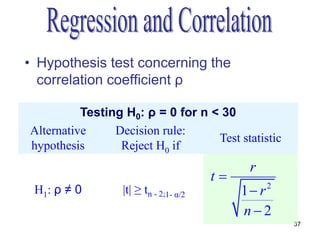
• Hypothesis test concerning the
  correlation coefficient ρ

          Testing H0: ρ = 0 for n < 30
Alternative     Decision rule:
                                   Test statistic
hypothesis       Reject H0 if
                                              r
                                        t
 H1: ρ ≠ 0        |t| ≥ tn - 2;1- α/2        1 r2
                                             n2
                                                     37
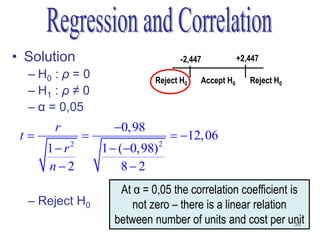
• Solution                          -2,447           +2,447
  – H0 : ρ = 0               Reject H0   Accept H0      Reject H0
  – H1 : ρ ≠ 0
  – α = 0,05
       r            0,98
 t                               12, 06
      1 r2       1  (0,98) 2
  –   n2              82
                     At α = 0,05 the correlation coefficient is
  – Reject H0           not zero – there is a linear relation
                    between number of units and cost per unit 38

Statistics lecture 11 (chapter 11)

  • 1.
  • 2.
    • Analyze therelationship among two quantitative variables • Correlation determines the strength and direction between the variables • Regression determines a mathematical equation to explain the relation • Equation can be used for prediction 2
  • 3.
    • Regression Analysis – X → independent variable – Y → dependent variable – Independent variable influence depended variable – Sample consists of n pairs of observations – Ascertain if a relation exists – Examine the nature of the relation – Obtain an equation that relates Y to X – The magnitude in change of one variable due to change in another variable can be evaluated – Predict value of Y on different values of X 3
  • 4.
    • Regression Analysis– scatter plot – Effective way to display the relationship – X variable on horizontal axis – Y variable on vertical axis – Plot a dot for each pair of observations – Can determine the • Form – Linear or nonlinear • Direction – Positive or negative • Strength – Dots scattered close – strong relation – Large scatter – weak relation 4
  • 5.
    • Regression Analysis– scatter Number Cost per Units (x) unit (y) plot 10 R10,00 – Example 20 8,80 Relation between units produced – Two variables production and cost of 30 7,90 • 12.00 of producing units Cost 50 6,20 Cost per unit (R) • 10.00 Number of units produced 60 5,00 8.00 80 4,00 – Cost is depending on number of 6.00 100 3,50 units 4.00 2.00 120 2,00 0.00 0 30 60 90 120 150 From theof unitsit seems there is a negative Number graph relation between number of units and cost – more units then decrease in cost 5
  • 6.
    • Simple linearregression analysis – Which line fits the data best? Relation between units produced and cost of production 12.00 Cost per unit (R) 10.00 8.00 6.00 4.00 2.00 0.00 0 30 60 90 120 150 Number of units 6
  • 7.
    • Simple linearregression analysis – Which line fits the data best? – Method of least squares –y=a+bx • b → slope • a → y intercept – ∑ei = 0 – ∑ei2 measures size of set of errors – Least squares method • Sum squares of errors the smallest 7
  • 8.
    • Least squaresregression model – Population regression model • Y = α + βx + ε • ε random error – Sample regression model •ŷ=a+bx • b → change in y due to change in x • a → value of y when x = 0 8
  • 9.
    • Least squares Number Units (x) Cost per unit (y) regression model 10 R10,00 –ŷ = a + b x 20 8,80 S xy 30 7,90 b and a  y  bx 50 6,20 S xx 60 5,00 where, 80 4,00  x 100 3,50 Sxx =  x  2 1 2 n 120 2,00  y ∑x = 470 ∑y = 47,4 S yy =  y 2 1 2 n ∑x2 = 38300 ∑y2 = 335,54 Sxy =  xy  1 n   x   y  x  58,75 y  5,925 ∑xy = 2033 9
  • 10.
    Number Cost per unit • Least squares Units (x) (y) regression model 10 R10,00 ŷ=a+bx 20 8,80 30 7,90 S xy b and a  y  bx 50 6,20 S xx 60 5,00 where, 80 4,00 Sxx =  x   x 2 1 2 n 100 3,50 S yy =  y   y 2 1 2 n 120 2,00 Sxy =  xy  1 n   x   y  ∑x = ? ∑y = ? ∑x2 = ? ∑y2 = ? Calculate Sxx, Syy, Sxy ∑xy = ? 10
  • 11.
    Number Cost per unit • Least squares Units (x) (y) regression model 10 R10,00 –ŷ = a + b x 20 8,80 30 7,90 S xy b and a  y  bx 50 6,20 S xx 60 5,00 Sxx =38300  1 (470) 2  10687,5 8 80 4,00 100 3,50 S yy =335.54  (47, 4)  54, 695 1 8 2 120 2,00 Sxy =2033  1 (470)  47, 4  8 ∑x = 470 ∑y = 47,4 ∑x2 = 38300 ∑y2 = 335,54  751, 75 x  58,75 y  5,925 ∑xy = 2033 11
  • 12.
    Note Syy notused • Least squares here but we will regression model use later!! Sxx =10687,5 S yy =54, 695 Sxy  751, 75 x  58, 75 y  5,925 S xy b a  y  bx S xx  5,925  (0, 07)(58, 75) 751, 75   10, 0375 10687,5  0, 07 → ŷ = 10,0375 – 0,07x
  • 13.
    • Least squaresregression model –ŷ=a+bx – ŷ = 10,0375 – 0,07x y y y b>0 b=0 b<0 x x x Positive linear No relation Negative linear 13
  • 14.
    • Plot leastsquares regression model – ŷ = 10,04 – 0,07x If x = 30: Relation between units produced → ŷ = 10,04 - 0,07(30) and cost of production =7,94 12.00 If x = 90: Cost per unit (R) 10.00 8.00 6.00 → ŷ = 10,04 - 0,07(90) 4.00 = 3,74 2.00 0.00 0 30 60 90 120 150 Number of units 14
  • 15.
    EXAMPLE A car manufacturingbusiness wants to find out how the price of its car models depreciate with age. The business took a sample of 8 models and collected the following information on age (yrs) and price (R1000):- Age 8 3 6 9 2 5 6 3 Price 16 74 38 19 102 36 33 69 Find the equation for the regression line with price as dependent variable and age as independent 15
  • 16.
    Example answer Example 11.4,textbook, part 2, page 383 16
  • 17.
    PREDICTIONS IN REGRESSIONANALYSIS • A sample regression line usually obtained for the purpose of prediction • That is to estimate the value of Y corresponding to as selected value of x • Two ways to estimate y:- – Point estimate – Confidence interval 17
  • 18.
    • Prediction withregression model – Point estimate using ŷ = 10,04 – 0,07x – What will be the estimated cost if 60 units will be produced? – ŷ = 10,04 – 0,07(60)=R5,84 – What will be the estimated cost if 25 units will be produced? – ŷ = 10,075 – 0,07(25)=R8,29 18
  • 19.
    ERRORS • When regressionline estimates every observed value has a predicted value • Predicted values will all fall exactly on regression line • All observed values will not fall on regression line • Difference between the two values is known as an ERROR and is denoted by ei 19
  • 20.
    ERRORS • Since theobserved values deviate from the predicted values the regression equation is not a perfect predictor • Need to be able to assess the accuracy of the regression line in predicting the values and this is done by analysing the errors ei • STD DEV errors measures how widely observed values are spread around regression line • The smaller the STD DEV the closer the points cluster around line 20
  • 21.
    • Standard deviation Number Cost Predicted Difference ei of random errors Units per cost per = yi - ŷi (x) unit (y) unit (ŷ) – ŷ = 10,04 – 0,07x 10 10,00 9,34 0,66 ŷ = 10,04 – 0,07(10) = 9,34 – ei indicate how 8,64 0,07(20) the 20 8,80 8,64 0,16 observed and 30 7,90 7,94 -0,04 expected values 50 6,20 6,54 -0,34 differ 60 5,00 5,84 -0,84 – Standard deviation 80 4,00 4,44 -0,44 of errors measures 100 3,50 3,04 0,46 spread around the 120 2,00 1,64 0,36 line • Smaller - points closer to line 21
  • 22.
    • Standard deviation Number Units Cost per Predicted cost per Difference ei = yi - ŷi of random errors (x) unit (y) unit (ŷ) 10 10,00 9,34 0,66 S yy  bS xy Se  20 8,80 8,64 0,16 n2 30 7,90 7,94 -0,04 54, 695  (0, 07)(751, 75) 50 6,20 6,54 -0,34  60 5,00 5,84 -0,84 82 80 4,00 4,44 -0,44  0,588 100 3,50 3,04 0,46 – Small 120 2,00 1,64 0,36 – Values close to line 22
  • 23.
    CONFIDENCE INTERVAL FORPREDICTION • Different samples from the same population will give different point estimates • Likely that different samples from same population will give different estimated regression lines • Therefore need to construct a confidence interval for Y based on one sample that will give a more reliable estimate of Y • Generally called a PREDICTION INTERVAL 23
  • 24.
    • Confidence intervalfor prediction – Point estimate for 60 units • ŷ = 10,04 – 0,07(60)=R5,84 – Rather calculate a confidence interval for the mean value of y for a given x value – Use the t-distribution – Confidence interval for the mean of y, given x = x0  CONF  y| x0 1   a  bx0  tn  2 ; 1  s y x0   2   1  x0  x 2  where S y| x0  se2    n SXX    24
  • 25.
    • Confidence intervalfor prediction – CONF   y| x    a  bx0  tn  2 ; 1  s y x0  0 1  2   1  x0  x 2  where S y| x0  se2    n SXX     1  60  58, 75 2   0,5882    8 10687,5     0, 2080 25
  • 26.
    • Confidence intervalfor prediction – 95% confidence interval if x = 60  CONF  y| x0  1   a  bx0  tn  2 ; 1  s y x0   2   10, 04  0, 07(60)  t8 2;10,025 0, 2080     5,84  2, 447(0, 2080)   5,84  0,508976  5,33 ; 6,35 – 95% sure mean cost for 60 units will be between R5,33 an R6,35 26
  • 27.
    • Inferences aboutβ (population slope) – b point estimate of β – T-distribution used to make inferences about β – Confidence interval for β CONF   1  b  tn  2 ; 1  sb   2  se where sb  sxx – If confidence interval includes 0 – no linear relation – If confidence interval not includes 0 – might be a linear relation 27
  • 28.
    • Inferences aboutβ (population slope) – Confidence interval for β CONF   1  b  tn  2 ; 1  sb   2  se 0,588 where sb    0, 00569 sxx 10687,5 28
  • 29.
    • Inferences aboutβ (population slope) – Confidence interval for β CONF   1  b  tn  2 ; 1  sb   2    0, 07  2, 447(0, 00569   0, 0839 ;  0, 0561 – 95% sure population slope will be between -0,0839 and -0,0561 – Interval does not include 0 – Might be a linear relation 29
  • 30.
    • Inferences aboutβ (population slope) – Hypothesis test concerning β Testing H0: β = 0 for n < 30 Alternative Decision rule: Test statistic hypothesis Reject H0 if H1: β ≠ 0 |t| ≥ tn - 2;1- α/2 t b sb H1: β > 0 t ≥ tn-2;1- α se with sb  H1: β < 0 t ≤ -tn-2;1- α sxx 30
  • 31.
    • Solution -2,447 +2,447 – H0 : β = 0 Reject H0 Accept H0 Reject H0 – H1 : β ≠ 0 – α = 0,05 If H1 : β > 0 - test for positive slope se 0,588 sb   0, 00569β < 0 - test for negative slope sxx 10687,5 If H1 : b 0, 07   t–  12,346 sb 0, 00569 At α = 0,05 the slope is not zero – – Reject H0 there is a linear relation between number of units and cost per unit 31
  • 32.
    • Correlation Analysis – Strength of linear relationship – Direction of linear relationship • Positive • Negative – Population correlation coefficient ρ (rho) – Sample correlation coefficient r – r always between -1 and +1 • r = 1 perfect positive • r = -1 perfect negative • r = 0 no relationship • near 0 weak relationship • near -1 or +1 strong relationship 32
  • 33.
    Coefficient of correlation •The coefficient of correlation is used to measure the strength of association between two variables. • The coefficient values range between -1 and 1. – If r = -1 (negative association) or r = +1 (positive association) every point falls on the regression line. – If r = 0 there is no linear pattern. • The coefficient can be used to test for linear relationship between two variables. 33
  • 34.
    Perfect positive High positive Low positive r = +1 r = +0,9 r = +0,3 Y Y Y X X X Perfect negative High negative No Correlation r = -1 r = -0,8 r=0 Y Y Y X X X 34
  • 35.
    • Correlation coefficientr Number Units (x) Cost per unit (y) Sxx =38300  1 (470) 2  10687,5 8 10 R10,00 S yy =335.54  1 (47, 4) 2  54, 695 8 20 8,80 Sxy =2033  1 (470)  47, 4   751, 75 8 30 7,90 50 6,20 S xy r 60 5,00 sxx s yy 80 4,00 751, 75 100 3,50  120 2,00 10687,5(54, 695) ∑x = 470 ∑y = 47,4  0,98 ∑x2 = 38300 ∑y2 = 335,54 – Strong negative x  58,75 y  5,925 relationship ∑xy = 2033 35
  • 36.
    • Coefficient ofdetermination Number Cost per Units (x) unit (y) r2 10 R10,00 – – 96% of the proportionthe cost of units20 explained8,80 Measures variation in of is by the variation inthe number of units produced changes in the dependent 30 7,90 – 4% is unexplained be variable y that can 50 6,20 explained by the 60 5,00 independent variable x 80 4,00 100 3,50 – % of total variation in y that 120 2,00 is explained by the ∑x = 470 ∑y = 47,4 regression model ∑x2 = 38300 ∑y2 = 335,54 x  58,75 y  5,925 r  0,98  96,04% 2 2 36 ∑xy = 2033
  • 37.
    • Hypothesis testconcerning the correlation coefficient ρ Testing H0: ρ = 0 for n < 30 Alternative Decision rule: Test statistic hypothesis Reject H0 if r t H1: ρ ≠ 0 |t| ≥ tn - 2;1- α/2 1 r2 n2 37
  • 38.
    • Solution -2,447 +2,447 – H0 : ρ = 0 Reject H0 Accept H0 Reject H0 – H1 : ρ ≠ 0 – α = 0,05 r 0,98 t   12, 06 1 r2 1  (0,98) 2 – n2 82 At α = 0,05 the correlation coefficient is – Reject H0 not zero – there is a linear relation between number of units and cost per unit 38