Confidence Interval
&
Probability
Dr Zahid Khan
SENIOR LECTURER KING FAISAL UNIVERSITY
2

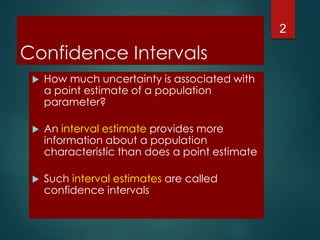
Confidence Intervals


How much uncertainty is associated with
a point estimate of a population
parameter?



An interval estimate provides more
information about a population
characteristic than does a point estimate



Such interval estimates are called
confidence intervals
Point and Interval
Estimates



3

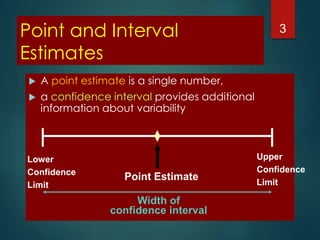
A point estimate is a single number,
a confidence interval provides additional
information about variability

Lower
Confidence
Limit

Point Estimate
Width of
confidence interval

Upper
Confidence
Limit
4

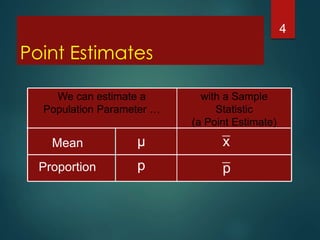
Point Estimates
We can estimate a
Population Parameter …

with a Sample
Statistic
(a Point Estimate)

Mean

μ

x

Proportion

p

p
Confidence Interval
Estimate


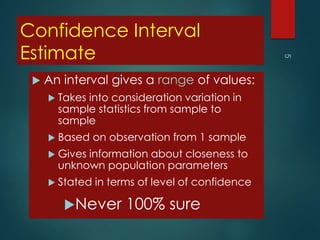
An interval gives a range of values:
 Takes

into consideration variation in
sample statistics from sample to
sample

 Based

on observation from 1 sample

 Gives

information about closeness to
unknown population parameters

 Stated

in terms of level of confidence

Never

100% sure
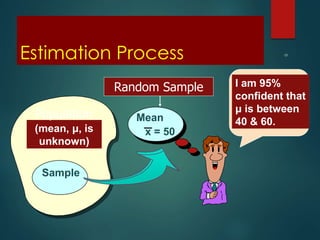
Estimation Process
Random Sample
Population
(mean, μ, is
unknown)
Sample

Mean
x = 50

I am 95%
confident that
μ is between
40 & 60.
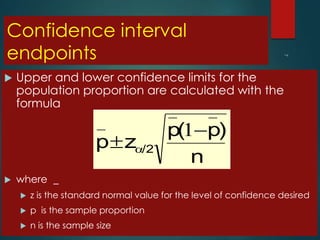
Confidence interval
endpoints


Upper and lower confidence limits for the
population proportion are calculated with the
formula

p  z/2


p(1p)
n

where


z is the standard normal value for the level of confidence desired



p is the sample proportion



n is the sample size
Example


A random sample of 100 people shows that 25 are left-handed.



Form a 95% confidence interval for the true proportion of left-handers
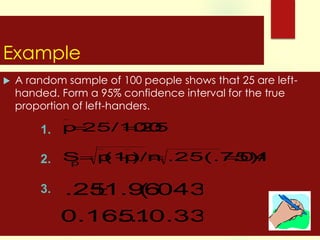
Example


A random sample of 100 people shows that 25 are lefthanded. Form a 95% confidence interval for the true
proportion of left-handers.



.25
1. p 25/100
(1
p 

.0433
2. S p  )/n .25(.75)/n
p

3.

.251.96

(.0433)
0.16510.3349
.....
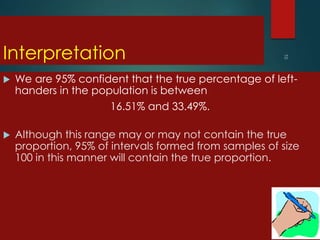
Interpretation


We are 95% confident that the true percentage of lefthanders in the population is between
16.51% and 33.49%.



Although this range may or may not contain the true
proportion, 95% of intervals formed from samples of size
100 in this manner will contain the true proportion.
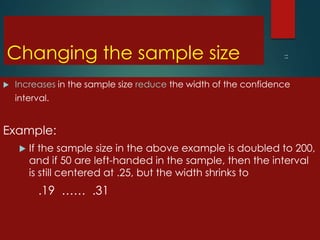
Changing the sample size


Increases in the sample size reduce the width of the confidence
interval.

Example:


If the sample size in the above example is doubled to 200,
and if 50 are left-handed in the sample, then the interval
is still centered at .25, but the width shrinks to

.19 …… .31
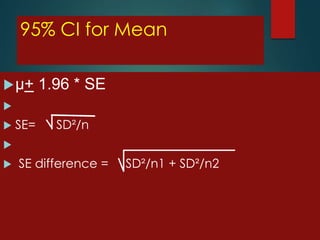
95% CI for Mean
 μ+

1.96 * SE




SE=

SD²/n





SE difference =

SD²/n1 + SD²/n2
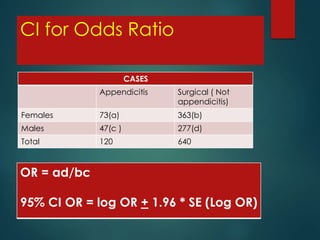
CI for Odds Ratio
CASES
Appendicitis

Surgical ( Not
appendicitis)

Females

73(a)

363(b)

Males

47(c )

277(d)

Total

120

640

OR = ad/bc
95% CI OR = log OR + 1.96 * SE (Log OR)
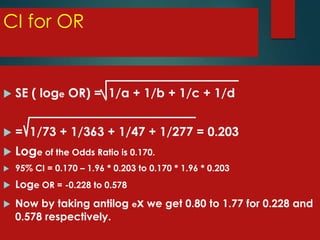
CI for OR



SE ( loge OR) = 1/a + 1/b + 1/c + 1/d



= 1/73 + 1/363 + 1/47 + 1/277 = 0.203



Loge of the Odds Ratio is 0.170.



95% CI = 0.170 – 1.96 * 0.203 to 0.170 * 1.96 * 0.203



Loge OR = -0.228 to 0.578



Now by taking antilog ex we get 0.80 to 1.77 for 0.228 and
0.578 respectively.
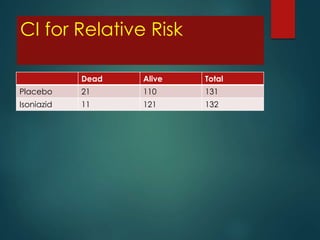
CI for Relative Risk
Dead

Alive

Total

Placebo

21

110

131

Isoniazid

11

121

132
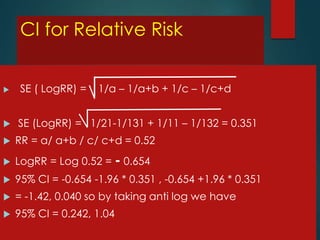
CI for Relative Risk


SE ( LogRR) =

1/a – 1/a+b + 1/c – 1/c+d



SE (LogRR) = 1/21-1/131 + 1/11 – 1/132 = 0.351



RR = a/ a+b / c/ c+d = 0.52



LogRR = Log 0.52 = - 0.654



95% CI = -0.654 -1.96 * 0.351 , -0.654 +1.96 * 0.351



= -1.42, 0.040 so by taking anti log we have



95% CI = 0.242, 1.04

Confidence interval & probability statements

  • 1.
    Confidence Interval & Probability Dr ZahidKhan SENIOR LECTURER KING FAISAL UNIVERSITY
  • 2.
    2 Confidence Intervals  How muchuncertainty is associated with a point estimate of a population parameter?  An interval estimate provides more information about a population characteristic than does a point estimate  Such interval estimates are called confidence intervals
  • 3.
    Point and Interval Estimates   3 Apoint estimate is a single number, a confidence interval provides additional information about variability Lower Confidence Limit Point Estimate Width of confidence interval Upper Confidence Limit
  • 4.
    4 Point Estimates We canestimate a Population Parameter … with a Sample Statistic (a Point Estimate) Mean μ x Proportion p p
  • 5.
    Confidence Interval Estimate  An intervalgives a range of values:  Takes into consideration variation in sample statistics from sample to sample  Based on observation from 1 sample  Gives information about closeness to unknown population parameters  Stated in terms of level of confidence Never 100% sure
  • 6.
    Estimation Process Random Sample Population (mean,μ, is unknown) Sample Mean x = 50 I am 95% confident that μ is between 40 & 60.
  • 7.
    Confidence interval endpoints  Upper andlower confidence limits for the population proportion are calculated with the formula p  z/2  p(1p) n where  z is the standard normal value for the level of confidence desired  p is the sample proportion  n is the sample size
  • 8.
    Example  A random sampleof 100 people shows that 25 are left-handed.  Form a 95% confidence interval for the true proportion of left-handers
  • 9.
    Example  A random sampleof 100 people shows that 25 are lefthanded. Form a 95% confidence interval for the true proportion of left-handers.   .25 1. p 25/100 (1 p   .0433 2. S p  )/n .25(.75)/n p 3. .251.96  (.0433) 0.16510.3349 .....
  • 10.
    Interpretation  We are 95%confident that the true percentage of lefthanders in the population is between 16.51% and 33.49%.  Although this range may or may not contain the true proportion, 95% of intervals formed from samples of size 100 in this manner will contain the true proportion.
  • 11.
    Changing the samplesize  Increases in the sample size reduce the width of the confidence interval. Example:  If the sample size in the above example is doubled to 200, and if 50 are left-handed in the sample, then the interval is still centered at .25, but the width shrinks to .19 …… .31
  • 12.
    95% CI forMean  μ+ 1.96 * SE   SE= SD²/n   SE difference = SD²/n1 + SD²/n2
  • 13.
    CI for OddsRatio CASES Appendicitis Surgical ( Not appendicitis) Females 73(a) 363(b) Males 47(c ) 277(d) Total 120 640 OR = ad/bc 95% CI OR = log OR + 1.96 * SE (Log OR)
  • 14.
    CI for OR  SE( loge OR) = 1/a + 1/b + 1/c + 1/d  = 1/73 + 1/363 + 1/47 + 1/277 = 0.203  Loge of the Odds Ratio is 0.170.  95% CI = 0.170 – 1.96 * 0.203 to 0.170 * 1.96 * 0.203  Loge OR = -0.228 to 0.578  Now by taking antilog ex we get 0.80 to 1.77 for 0.228 and 0.578 respectively.
  • 15.
    CI for RelativeRisk Dead Alive Total Placebo 21 110 131 Isoniazid 11 121 132
  • 16.
    CI for RelativeRisk  SE ( LogRR) = 1/a – 1/a+b + 1/c – 1/c+d  SE (LogRR) = 1/21-1/131 + 1/11 – 1/132 = 0.351  RR = a/ a+b / c/ c+d = 0.52  LogRR = Log 0.52 = - 0.654  95% CI = -0.654 -1.96 * 0.351 , -0.654 +1.96 * 0.351  = -1.42, 0.040 so by taking anti log we have  95% CI = 0.242, 1.04