UNIT – VI
NUMERICAL SOLUTION OF
ORDINARY DIFFERENTIAL
     EQUATIONS
MATHEMATICAL METHODS
CONTENTS
•   Matrices and Linear systems of equations
•   Eigen values and eigen vectors
•   Real and complex matrices and Quadratic forms
•   Algebraic equations transcendental equations and
    Interpolation
•   Curve Fitting, numerical differentiation & integration
•   Numerical differentiation of O.D.E
•   Fourier series and Fourier transforms
•   Partial differential equation and Z-transforms
TEXT BOOKS
• 1.Mathematical Methods, T.K.V.Iyengar, B.Krishna
  Gandhi and others, S.Chand and company
• Mathematical Methods, C.Sankaraiah, V.G.S.Book
  links.
• A text book of Mathametical Methods,
  V.Ravindranath, A.Vijayalakshmi, Himalaya
  Publishers.
• A text book of Mathametical Methods, Shahnaz
  Bathul, Right Publishers.
REFERENCES
• 1. A text book of Engineering Mathematics,
  B.V.Ramana, Tata Mc Graw Hill.
• 2.Advanced Engineering Mathematics, Irvin Kreyszig
  Wiley India Pvt Ltd.
• 3. Numerical Methods for scientific and Engineering
  computation, M.K.Jain, S.R.K.Iyengar and R.K.Jain,
  New Age International Publishers
• Elementary Numerical Analysis, Aitkison and Han,
  Wiley India, 3rd Edition, 2006.
UNIT HEADER
  Name of the Course:B.Tech
      Code No:07A1BS02
      Year/Branch:I Year
CSE,IT,ECE,EEE,ME,CIVIL,AERO
         Unit No: VI
        No.of slides:32
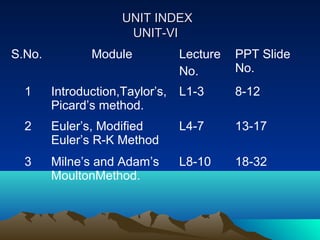
UNIT INDEX
                      UNIT-VI
S.No.          Module            Lecture   PPT Slide
                                 No.       No.
  1     Introduction,Taylor’s,   L1-3      8-12
        Picard’s method.
  2     Euler’s, Modified        L4-7      13-17
        Euler’s R-K Method
  3     Milne’s and Adam’s       L8-10     18-32
        MoultonMethod.
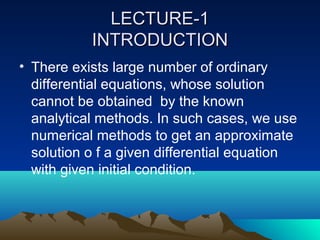
LECTURE-1
           INTRODUCTION
• There exists large number of ordinary
  differential equations, whose solution
  cannot be obtained by the known
  analytical methods. In such cases, we use
  numerical methods to get an approximate
  solution o f a given differential equation
  with given initial condition.
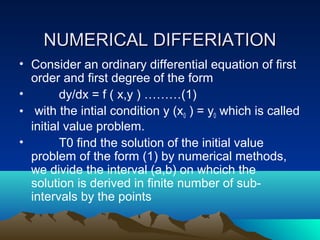
NUMERICAL DIFFERIATION
• Consider an ordinary differential equation of first
  order and first degree of the form
•        dy/dx = f ( x,y ) ………(1)
• with the intial condition y (x0 ) = y0 which is called
  initial value problem.
•        T0 find the solution of the initial value
  problem of the form (1) by numerical methods,
  we divide the interval (a,b) on whcich the
  solution is derived in finite number of sub-
  intervals by the points
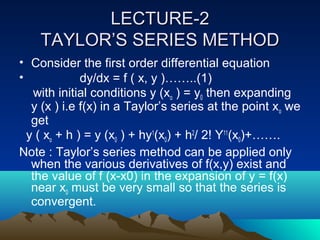
LECTURE-2
    TAYLOR’S SERIES METHOD
• Consider the first order differential equation
•             dy/dx = f ( x, y )……..(1)
    with initial conditions y (xo ) = y0 then expanding
   y (x ) i.e f(x) in a Taylor’s series at the point xo we
   get
  y ( xo + h ) = y (x0 ) + hy1(x0) + h2/ 2! Y11(x0)+…….
Note : Taylor’s series method can be applied only
   when the various derivatives of f(x,y) exist and
   the value of f (x-x0) in the expansion of y = f(x)
   near x0 must be very small so that the series is
   convergent.
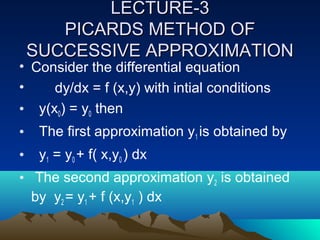
LECTURE-3
       PICARDS METHOD OF
    SUCCESSIVE APPROXIMATION
• Consider the differential equation
•    dy/dx = f (x,y) with intial conditions
• y(x0) = y0 then
•    The first approximation y1 is obtained by
•    y1 = y0 + f( x,y0 ) dx
• The second approximation y2 is obtained
  by y2 = y1 + f (x,y1 ) dx
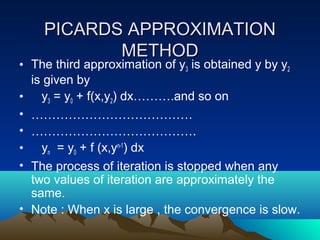
PICARDS APPROXIMATION
           METHOD
• The third approximation of y3 is obtained y by y2
  is given by
• y3 = y0 + f(x,y2) dx……….and so on
• …………………………………
• ………………………………….
• yn = y0 + f (x,yn-1) dx
• The process of iteration is stopped when any
  two values of iteration are approximately the
  same.
• Note : When x is large , the convergence is slow.
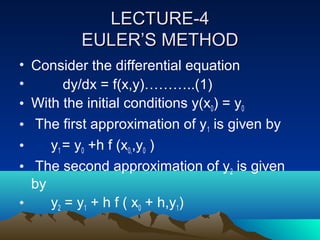
LECTURE-4
          EULER’S METHOD
• Consider the differential equation
•       dy/dx = f(x,y)………..(1)
• With the initial conditions y(x0) = y0
• The first approximation of y1 is given by
•    y1 = y0 +h f (x0,,y0 )
• The second approximation of y2 is given
  by
•    y2 = y1 + h f ( x0 + h,y1)
EULER’S METHOD
• The third approximation of y3 is given by
•    y3 = y2 + h f ( x0 + 2h,y2 )
•    ………………………………
•     ……………………………..
•     ……………………………...
•    yn = yn-1 + h f [ x0 + (n-1)h,yn-1 ]
• This is Eulers method to find an appproximate
  solution of the given differential equation.
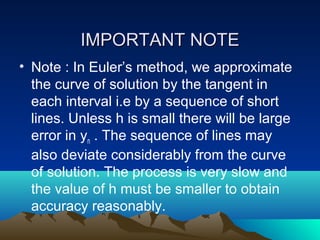
IMPORTANT NOTE
• Note : In Euler’s method, we approximate
  the curve of solution by the tangent in
  each interval i.e by a sequence of short
  lines. Unless h is small there will be large
  error in yn . The sequence of lines may
  also deviate considerably from the curve
  of solution. The process is very slow and
  the value of h must be smaller to obtain
  accuracy reasonably.
LECTURE-5
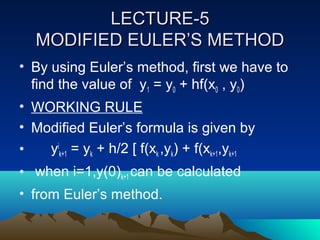
   MODIFIED EULER’S METHOD
• By using Euler’s method, first we have to
  find the value of y1 = y0 + hf(x0 , y0)
• WORKING RULE
• Modified Euler’s formula is given by
•   yik+1 = yk + h/2 [ f(xk ,yk) + f(xk+1,yk+1
• when i=1,y(0)k+1 can be calculated
• from Euler’s method.
MODIFIED EULER’S METHOD
• When k=o,1,2,3,……..gives number of
  iterations
• i = 1,2,3,…….gives number of times a
  particular iteration k is repeated when
• i=1
• Y1k+1= yk + h/2 [ f(xk,yk) + f(xk+1,y k+1)],,,,,,
LECTURE-6
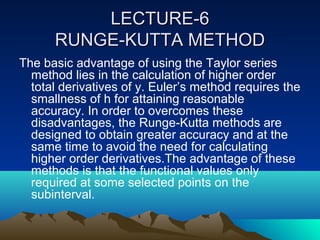
      RUNGE-KUTTA METHOD
The basic advantage of using the Taylor series
  method lies in the calculation of higher order
  total derivatives of y. Euler’s method requires the
  smallness of h for attaining reasonable
  accuracy. In order to overcomes these
  disadvantages, the Runge-Kutta methods are
  designed to obtain greater accuracy and at the
  same time to avoid the need for calculating
  higher order derivatives.The advantage of these
  methods is that the functional values only
  required at some selected points on the
  subinterval.
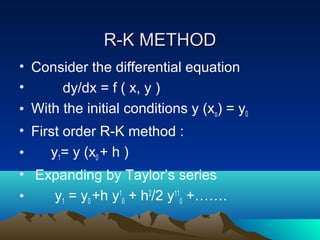
R-K METHOD
• Consider the differential equation
•      dy/dx = f ( x, y )
• With the initial conditions y (xo) = y0
• First order R-K method :
•    y1= y (x0 + h )
• Expanding by Taylor’s series
•   y1 = y0 +h y10 + h2/2 y110 +…….
LECTURE-7
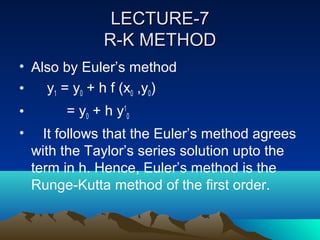
                R-K METHOD
• Also by Euler’s method
•   y1 = y0 + h f (x0 ,y0)
•        = y0 + h y10
•     It follows that the Euler’s method agrees
    with the Taylor’s series solution upto the
    term in h. Hence, Euler’s method is the
    Runge-Kutta method of the first order.
•
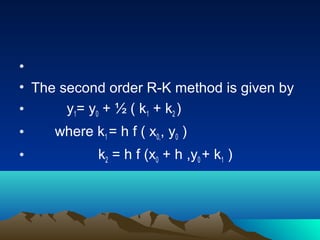
• The second order R-K method is given by
•      y1= y0 + ½ ( k1 + k2 )
•    where k1 = h f ( x0,, y0 )
•            k2 = h f (x0 + h ,y0 + k1 )
•
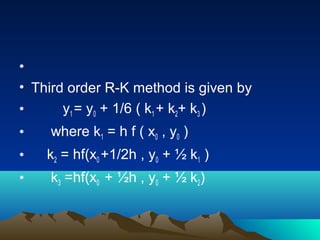
• Third order R-K method is given by
•      y1 = y0 + 1/6 ( k1 + k2+ k3 )
•   where k1 = h f ( x0 , y0 )
•   k2 = hf(x0 +1/2h , y0 + ½ k1 )
•   k3 =hf(x0 + ½h , y0 + ½ k2)
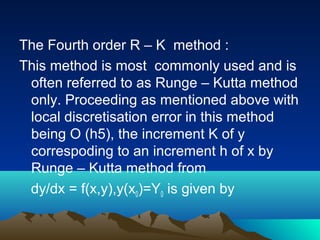
The Fourth order R – K method :
This method is most commonly used and is
 often referred to as Runge – Kutta method
 only. Proceeding as mentioned above with
 local discretisation error in this method
 being O (h5), the increment K of y
 correspoding to an increment h of x by
 Runge – Kutta method from
 dy/dx = f(x,y),y(x0)=Y0 is given by
•
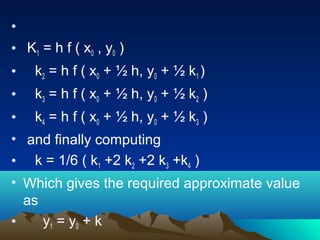
• K1 = h f ( x 0 , y0 )
•   k2 = h f ( x0 + ½ h, y0 + ½ k1 )
•   k3 = h f ( x0 + ½ h, y0 + ½ k2 )
•   k4 = h f ( x0 + ½ h, y0 + ½ k3 )
• and finally computing
• k = 1/6 ( k1 +2 k2 +2 k3 +k4 )
• Which gives the required approximate value
  as
•    y1 = y0 + k
R-K METHOD
Note 1 : k is known as weighted mean of
 k1, k2, k3 and k4.


Note 2 : The advantage of these methods is
 that the operation is identical whether the
 differential equation is linear or non-linear.
LECTURE-8
     PREDICTOR-CORRECTOR
           METHODS
• We have discussed so far the methods in which
  a differential equation over an interval can be
  solved if the value of y only is known at the
  beginning of the interval. But, in the Predictor-
  Corrector method, four prior values are needed
  for finding the value of y at xk.
• The advantage of these methods is to estimate
  error from successive approximations to yk
PREDICTOR-CORRECTOR
           METHOD
• If xk and xk+1 be two consecutive points,
  such that xk+1=xk+h, then
• Euler’s method is
• Yk+1 = yk + hf(x0 +kh,yk) ,k= 0,1,2,3…….
• First we estimate yk+1 and then this value
  of yk+1 is substituted to get a better
  approximation of y k+1.
LECTURE-9
           MILNE’S METHOD
• This procedure is repeated till two consecutive
  iterated values of yk+1 are approximately equal.
  This technique of refining an initially crude
  estimate of yk+1 by means of a more accurate
  formula is known as Predictor- Corrector
  method.
• Therefore, the equation is called the Predictor
  while the equation serves as a corrector of
  yk+1.Two such methods, namely, Adams-
  Moulton and Milne’s method are discussed.
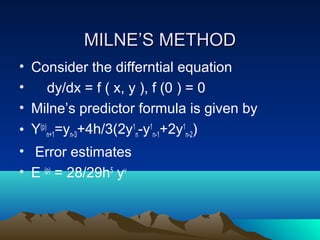
MILNE’S METHOD
• Consider the differntial equation
•     dy/dx = f ( x, y ), f (0 ) = 0
• Milne’s predictor formula is given by
• Y(p)n+1=yn-3+4h/3(2y1n-y1n-1+2y1n-2)
• Error estimates
• E (p) = 28/29h5 yv
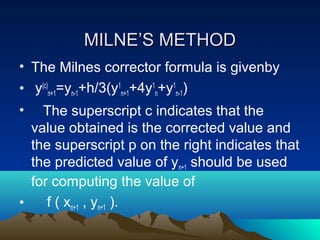
MILNE’S METHOD
• The Milnes corrector formula is givenby
• y(c)n+1=yn-1+h/3(y1n+1+4y1n+y1n-1)
•   The superscript c indicates that the
  value obtained is the corrected value and
  the superscript p on the right indicates that
  the predicted value of yn+1 should be used
  for computing the value of
•    f ( xn+1 , yn+1 ).
LECTURE-10
  ADAMS – MOULTON METHOD
• Consider the differential equation
•   dy/dx = f ( x,y ), y(x0) = y0
• The Adams Moulton predictor formula is
  given by
• y(p)n+1 = yn + h/24 [55y1n-59y1n-1+37y1n-2- 9y1n-3]
ADAM’S MOULTON METHOD

• Adams – Moulton corrector formula is
  given by
• Yn+1=yn+h/24[9y1pn+1 +19y1n-5-y1n-1+y1n-2]
 Error estimates
 EAB = 251/720 h5

Unit vi

  • 1.
    UNIT – VI NUMERICALSOLUTION OF ORDINARY DIFFERENTIAL EQUATIONS
  • 2.
  • 3.
    CONTENTS • Matrices and Linear systems of equations • Eigen values and eigen vectors • Real and complex matrices and Quadratic forms • Algebraic equations transcendental equations and Interpolation • Curve Fitting, numerical differentiation & integration • Numerical differentiation of O.D.E • Fourier series and Fourier transforms • Partial differential equation and Z-transforms
  • 4.
    TEXT BOOKS • 1.MathematicalMethods, T.K.V.Iyengar, B.Krishna Gandhi and others, S.Chand and company • Mathematical Methods, C.Sankaraiah, V.G.S.Book links. • A text book of Mathametical Methods, V.Ravindranath, A.Vijayalakshmi, Himalaya Publishers. • A text book of Mathametical Methods, Shahnaz Bathul, Right Publishers.
  • 5.
    REFERENCES • 1. Atext book of Engineering Mathematics, B.V.Ramana, Tata Mc Graw Hill. • 2.Advanced Engineering Mathematics, Irvin Kreyszig Wiley India Pvt Ltd. • 3. Numerical Methods for scientific and Engineering computation, M.K.Jain, S.R.K.Iyengar and R.K.Jain, New Age International Publishers • Elementary Numerical Analysis, Aitkison and Han, Wiley India, 3rd Edition, 2006.
  • 6.
    UNIT HEADER Name of the Course:B.Tech Code No:07A1BS02 Year/Branch:I Year CSE,IT,ECE,EEE,ME,CIVIL,AERO Unit No: VI No.of slides:32
  • 7.
    UNIT INDEX UNIT-VI S.No. Module Lecture PPT Slide No. No. 1 Introduction,Taylor’s, L1-3 8-12 Picard’s method. 2 Euler’s, Modified L4-7 13-17 Euler’s R-K Method 3 Milne’s and Adam’s L8-10 18-32 MoultonMethod.
  • 8.
    LECTURE-1 INTRODUCTION • There exists large number of ordinary differential equations, whose solution cannot be obtained by the known analytical methods. In such cases, we use numerical methods to get an approximate solution o f a given differential equation with given initial condition.
  • 9.
    NUMERICAL DIFFERIATION • Consideran ordinary differential equation of first order and first degree of the form • dy/dx = f ( x,y ) ………(1) • with the intial condition y (x0 ) = y0 which is called initial value problem. • T0 find the solution of the initial value problem of the form (1) by numerical methods, we divide the interval (a,b) on whcich the solution is derived in finite number of sub- intervals by the points
  • 10.
    LECTURE-2 TAYLOR’S SERIES METHOD • Consider the first order differential equation • dy/dx = f ( x, y )……..(1) with initial conditions y (xo ) = y0 then expanding y (x ) i.e f(x) in a Taylor’s series at the point xo we get y ( xo + h ) = y (x0 ) + hy1(x0) + h2/ 2! Y11(x0)+……. Note : Taylor’s series method can be applied only when the various derivatives of f(x,y) exist and the value of f (x-x0) in the expansion of y = f(x) near x0 must be very small so that the series is convergent.
  • 11.
    LECTURE-3 PICARDS METHOD OF SUCCESSIVE APPROXIMATION • Consider the differential equation • dy/dx = f (x,y) with intial conditions • y(x0) = y0 then • The first approximation y1 is obtained by • y1 = y0 + f( x,y0 ) dx • The second approximation y2 is obtained by y2 = y1 + f (x,y1 ) dx
  • 12.
    PICARDS APPROXIMATION METHOD • The third approximation of y3 is obtained y by y2 is given by • y3 = y0 + f(x,y2) dx……….and so on • ………………………………… • …………………………………. • yn = y0 + f (x,yn-1) dx • The process of iteration is stopped when any two values of iteration are approximately the same. • Note : When x is large , the convergence is slow.
  • 13.
    LECTURE-4 EULER’S METHOD • Consider the differential equation • dy/dx = f(x,y)………..(1) • With the initial conditions y(x0) = y0 • The first approximation of y1 is given by • y1 = y0 +h f (x0,,y0 ) • The second approximation of y2 is given by • y2 = y1 + h f ( x0 + h,y1)
  • 14.
    EULER’S METHOD • Thethird approximation of y3 is given by • y3 = y2 + h f ( x0 + 2h,y2 ) • ……………………………… • …………………………….. • ……………………………... • yn = yn-1 + h f [ x0 + (n-1)h,yn-1 ] • This is Eulers method to find an appproximate solution of the given differential equation.
  • 15.
    IMPORTANT NOTE • Note: In Euler’s method, we approximate the curve of solution by the tangent in each interval i.e by a sequence of short lines. Unless h is small there will be large error in yn . The sequence of lines may also deviate considerably from the curve of solution. The process is very slow and the value of h must be smaller to obtain accuracy reasonably.
  • 16.
    LECTURE-5 MODIFIED EULER’S METHOD • By using Euler’s method, first we have to find the value of y1 = y0 + hf(x0 , y0) • WORKING RULE • Modified Euler’s formula is given by • yik+1 = yk + h/2 [ f(xk ,yk) + f(xk+1,yk+1 • when i=1,y(0)k+1 can be calculated • from Euler’s method.
  • 17.
    MODIFIED EULER’S METHOD •When k=o,1,2,3,……..gives number of iterations • i = 1,2,3,…….gives number of times a particular iteration k is repeated when • i=1 • Y1k+1= yk + h/2 [ f(xk,yk) + f(xk+1,y k+1)],,,,,,
  • 18.
    LECTURE-6 RUNGE-KUTTA METHOD The basic advantage of using the Taylor series method lies in the calculation of higher order total derivatives of y. Euler’s method requires the smallness of h for attaining reasonable accuracy. In order to overcomes these disadvantages, the Runge-Kutta methods are designed to obtain greater accuracy and at the same time to avoid the need for calculating higher order derivatives.The advantage of these methods is that the functional values only required at some selected points on the subinterval.
  • 19.
    R-K METHOD • Considerthe differential equation • dy/dx = f ( x, y ) • With the initial conditions y (xo) = y0 • First order R-K method : • y1= y (x0 + h ) • Expanding by Taylor’s series • y1 = y0 +h y10 + h2/2 y110 +…….
  • 20.
    LECTURE-7 R-K METHOD • Also by Euler’s method • y1 = y0 + h f (x0 ,y0) • = y0 + h y10 • It follows that the Euler’s method agrees with the Taylor’s series solution upto the term in h. Hence, Euler’s method is the Runge-Kutta method of the first order.
  • 21.
    • • The secondorder R-K method is given by • y1= y0 + ½ ( k1 + k2 ) • where k1 = h f ( x0,, y0 ) • k2 = h f (x0 + h ,y0 + k1 )
  • 22.
    • • Third orderR-K method is given by • y1 = y0 + 1/6 ( k1 + k2+ k3 ) • where k1 = h f ( x0 , y0 ) • k2 = hf(x0 +1/2h , y0 + ½ k1 ) • k3 =hf(x0 + ½h , y0 + ½ k2)
  • 23.
    The Fourth orderR – K method : This method is most commonly used and is often referred to as Runge – Kutta method only. Proceeding as mentioned above with local discretisation error in this method being O (h5), the increment K of y correspoding to an increment h of x by Runge – Kutta method from dy/dx = f(x,y),y(x0)=Y0 is given by
  • 24.
    • • K1 =h f ( x 0 , y0 ) • k2 = h f ( x0 + ½ h, y0 + ½ k1 ) • k3 = h f ( x0 + ½ h, y0 + ½ k2 ) • k4 = h f ( x0 + ½ h, y0 + ½ k3 ) • and finally computing • k = 1/6 ( k1 +2 k2 +2 k3 +k4 ) • Which gives the required approximate value as • y1 = y0 + k
  • 25.
    R-K METHOD Note 1: k is known as weighted mean of k1, k2, k3 and k4. Note 2 : The advantage of these methods is that the operation is identical whether the differential equation is linear or non-linear.
  • 26.
    LECTURE-8 PREDICTOR-CORRECTOR METHODS • We have discussed so far the methods in which a differential equation over an interval can be solved if the value of y only is known at the beginning of the interval. But, in the Predictor- Corrector method, four prior values are needed for finding the value of y at xk. • The advantage of these methods is to estimate error from successive approximations to yk
  • 27.
    PREDICTOR-CORRECTOR METHOD • If xk and xk+1 be two consecutive points, such that xk+1=xk+h, then • Euler’s method is • Yk+1 = yk + hf(x0 +kh,yk) ,k= 0,1,2,3……. • First we estimate yk+1 and then this value of yk+1 is substituted to get a better approximation of y k+1.
  • 28.
    LECTURE-9 MILNE’S METHOD • This procedure is repeated till two consecutive iterated values of yk+1 are approximately equal. This technique of refining an initially crude estimate of yk+1 by means of a more accurate formula is known as Predictor- Corrector method. • Therefore, the equation is called the Predictor while the equation serves as a corrector of yk+1.Two such methods, namely, Adams- Moulton and Milne’s method are discussed.
  • 29.
    MILNE’S METHOD • Considerthe differntial equation • dy/dx = f ( x, y ), f (0 ) = 0 • Milne’s predictor formula is given by • Y(p)n+1=yn-3+4h/3(2y1n-y1n-1+2y1n-2) • Error estimates • E (p) = 28/29h5 yv
  • 30.
    MILNE’S METHOD • TheMilnes corrector formula is givenby • y(c)n+1=yn-1+h/3(y1n+1+4y1n+y1n-1) • The superscript c indicates that the value obtained is the corrected value and the superscript p on the right indicates that the predicted value of yn+1 should be used for computing the value of • f ( xn+1 , yn+1 ).
  • 31.
    LECTURE-10 ADAMS– MOULTON METHOD • Consider the differential equation • dy/dx = f ( x,y ), y(x0) = y0 • The Adams Moulton predictor formula is given by • y(p)n+1 = yn + h/24 [55y1n-59y1n-1+37y1n-2- 9y1n-3]
  • 32.
    ADAM’S MOULTON METHOD •Adams – Moulton corrector formula is given by • Yn+1=yn+h/24[9y1pn+1 +19y1n-5-y1n-1+y1n-2] Error estimates EAB = 251/720 h5