MOHAN LAL SUKHADIA
UNIVERSITY
TOPIC :RUNGE-KUTTA METHOD
SUBMITTED BY :
SHUBHAM TOMAR
SUBMITTED TO:
Mrs. DIPTI MA’AM
1
CONTENTS :
• Introduction
• Example of Second-order Runge-kutta method
• Fourth order Runge-kutta method
• Example of fourth order Runge-kutta method
• Illustration of Heun’s Method
• Illustration of Runge-Kutta second order
• Illustration of Runge Kutta fourth order
2
• Runge-kutta method are popular because of efficiency.
• It is single step method as Euler’s method.
• Developed by two German mathematicians Runge
and kutta .
• Also called R-K method.
• Runge-kutta method distinguished by their order
3
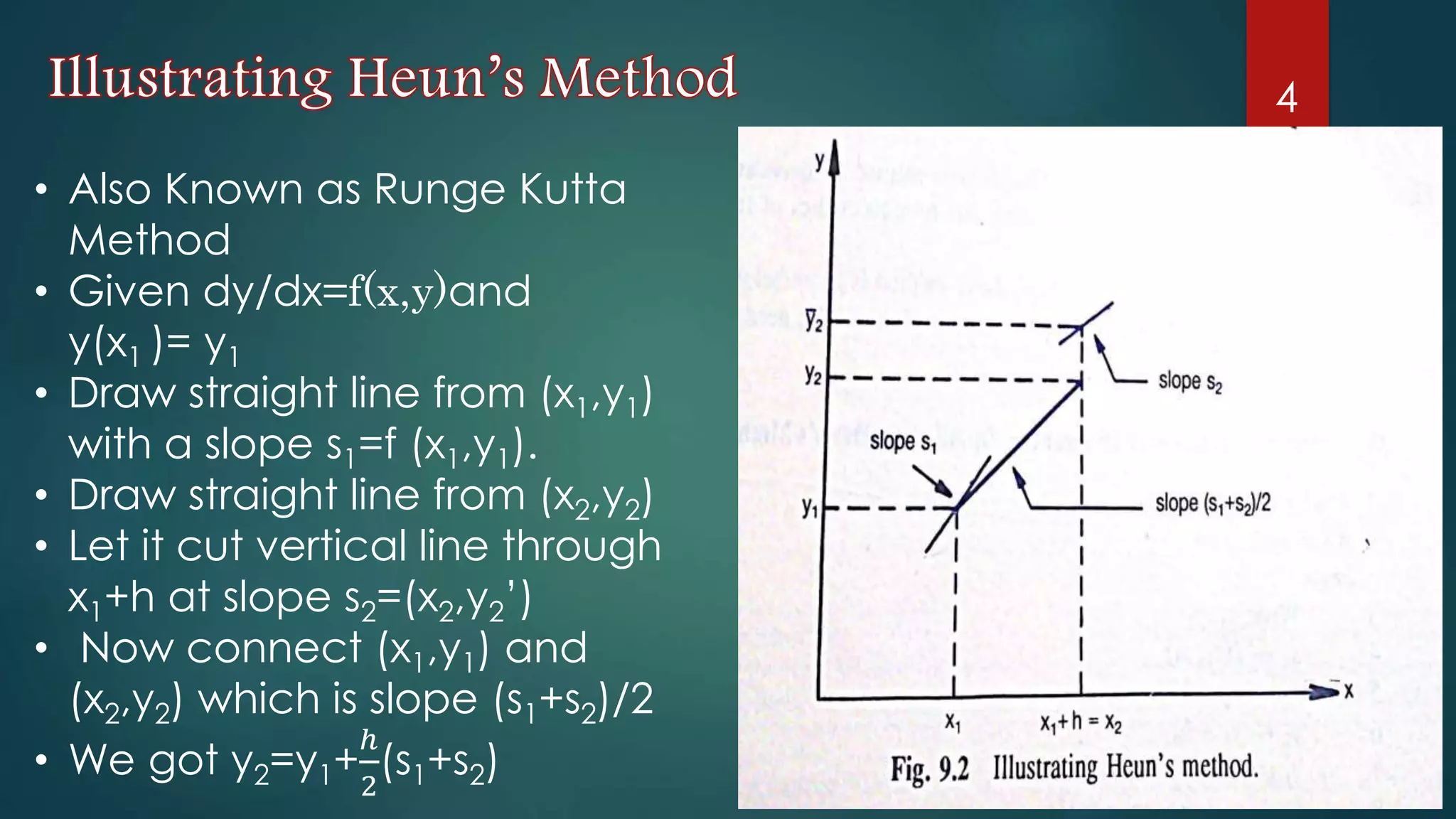
• Also Known as Runge Kutta
Method
• Given dy/dx=f(x,y)and
y(x1 )= y1
• Draw straight line from (x1,y1)
with a slope s1=f (x1,y1).
• Draw straight line from (x2,y2)
• Let it cut vertical line through
x1+h at slope s2=(x2,y2’)
• Now connect (x1,y1) and
(x2,y2) which is slope (s1+s2)/2
• We got y2=y1+
ℎ
2
(s1+s2)
4
• Also Known as Polygon Method
• Draw straight line from (x1,y1)
find the value of y where this
line cuts vertical line erected at
x1+h/2 call it yh
• Calculate f(x1+h/2, yh) which is
slope of solution curve at this
point
• Go back to (x1,y1) and draw a
straight line with slope s2
• We have
yi+1=yi+hf(xi+h/2,yi+sih/2 )
5
• Give the point A=(xi,yi) on the
solution curve.
• Draw straight line cut the vertical
line erected at xi+h/2 at B this
slope s2= f(x1+h/2, yi+sih/2.
• Draw another straight line starting
at A with slope s3
• Go back to (x1,y1) and draw a
straight line with slope s2
• Let this straight line cut the
vertical line erected at xi+h at D
• Find the slope s4 of the solution
curve at D
• We haveyi+1=yi+h/6(s1+2s2,2s3+s4)
6
f(x,y)=y+x/y-x h=0.2 x0=0 and y0=1
We have to calculate first : y1=y0+
ℎ
2
(k1+k2)
K1 =f(x0,y0)
=(1+0)/(1-0)
=1
K2 =f(x0+h,y0+hk1)
=f(0+.2,1+0.2*1)
=1.24
7
Y1 =1+0.2(1+1.4)=24
X1 =0+0.2=0.2 h=0.2
now calculate y2 =y1+
ℎ
2
(k1+k2)
k1=f(x1,y1) k2=f(x1+h,y1+hk1)
=(y+x)/(y-x) =f(0.2+0.2, 1.24+0.2*1.3846)
=(1.24+0.2)/1.24-0.2 =1.7162
=1.3846
y2=1.24+
.2
2
(1.3846+1.7162)
=1.5500
8
yn+1=yn+
ℎ
6
(k1+2k2+2k3+k4)
k1=f(xn, yn)
k2=f(xn+h/2, yn+h
𝑘1
2
)
k3=f(xn+h/2, yn+h
𝑘2
2
)
k4=f(xn+h, yn+hk3)
9
k1= f(x0,y0)
=(1+0)/(1-0)
=1
k2=k2=f(xn+h/2, yn+h
𝑘1
2
)
=f(0+.2/2, 1+
0.2
2
*1)
= (0.1, 1+0.1)
= 1.2
k3= f(x0+h/2, y0+h
𝑘2
2
)
=f(0+0.2/2,1+0.2*
1.2
2
)
=(0.1, 1.12)
=1.1960
f(x,y)=y+x/y-x h=0.2 x0=0 and y0=1
10
k4= f(x0+h, y0+hk3)
= f(0+0.2,1+0.2*1.196)
= (0.2,1.2392)
= 1.3848
y1=y0+
ℎ
6
(k1+2k2+2k3+k4)
=1+
0.2
6
(1+2*1.2+2*1.960+1.3848)
= 1+
.2
6
(7.1768)
=1.2392
11
x1=0.2, y1=1.2392, calculate y2=y1+h/6(k1+2k2+2k3+k4)
k1=f(x1,y1)
=f(0.2,1.2392)
=(1.4392/1.0392)
=1.3849
k2=f(x1+h/2, y1+h
𝑘1
2
)
=(0.2+0.1,1.2392+.1384)
=(.3,1.3776)
=1.5567
k3= f(x1+h/2, y1+h
𝑘2
2
)
=f(.2+.2/2,1.2392+.2*
1.5567
2
)
=(0.3, 1.1556)
=1.7012
k4= f(x1+h, y1+hk3)
= f(.2+.2,1.2392+.3402)
= (0.4,1.5794)
= 1.6783
Y2= (1.2392+.2/6(1.3849+2*1.5546+2*1.7012+1.6783))
= 1.55836
y2 =y1+
ℎ
6
(k1+2k2+2k3+k4)
12
x2=0.4, y2=1.55836, calculate y3=y2+h/6(k1+2k2+2k3+k4)
k1=f(x2,y2)
=f(0.4,1.5583)
=(1.9583/1.1583)
=1.6906
k2=f(x2+h/2, y2+h
𝑘1
2
)
=(0.4+0.1,1.5583+.16906)
=(.5,1.7273)
=1.8147
k3= f(x2+h/2, y2+h
𝑘2
2
)
=f(.4+.2/2,1.5583+.2*
1.8147
2
)
=(0.5, 1.7397)
=1.8066
k4= f(x2+h, y2+hk3)
= f(.4+.2,1.5583+.18066)
= (0.6,1.7389)
= 2.0536
Y3= (1.5583+.2/6(1.6906+2*1.8147+2*1.8066+2.0536))
= 1.9245
y3 =y2+
ℎ
6
(k1+2k2+2k3+k4)
13
x3=0.6, y3=1.92452, calculate y4=y3+h/6(k1+2k2+2k3+k4)
k1=f(x3,y3)
=f(0.6,1.9245)
=(2.5245/1.3245)
=1.9060
k2=f(x3+h/2, y3+h
𝑘1
2
)
=(0.6+0.1,1.9245+.1906)
=(.7,2.1151)
=1.9893
k3= f(x3+h/2, y3+h
𝑘2
2
)
=f(.6+.2/2,1.9245+.2*
1.9893
2
)
=(0.7, 2.1234)
=1.9835
k4= f(x3+h, y3+hk3)
= f(.6+.2,1.9245+.1983)
= (0.8,2.1228)
= 2.2095
Y4= (1.9245+.2/6(1.9060+2*1.9893+2*1.9835+2.2095))
= 2.3265
y4 =y3+
ℎ
6
(k1+2k2+2k3+k4)
14
15

Runge kutta

  • 1.
    MOHAN LAL SUKHADIA UNIVERSITY TOPIC:RUNGE-KUTTA METHOD SUBMITTED BY : SHUBHAM TOMAR SUBMITTED TO: Mrs. DIPTI MA’AM 1
  • 2.
    CONTENTS : • Introduction •Example of Second-order Runge-kutta method • Fourth order Runge-kutta method • Example of fourth order Runge-kutta method • Illustration of Heun’s Method • Illustration of Runge-Kutta second order • Illustration of Runge Kutta fourth order 2
  • 3.
    • Runge-kutta methodare popular because of efficiency. • It is single step method as Euler’s method. • Developed by two German mathematicians Runge and kutta . • Also called R-K method. • Runge-kutta method distinguished by their order 3
  • 4.
    • Also Knownas Runge Kutta Method • Given dy/dx=f(x,y)and y(x1 )= y1 • Draw straight line from (x1,y1) with a slope s1=f (x1,y1). • Draw straight line from (x2,y2) • Let it cut vertical line through x1+h at slope s2=(x2,y2’) • Now connect (x1,y1) and (x2,y2) which is slope (s1+s2)/2 • We got y2=y1+ ℎ 2 (s1+s2) 4
  • 5.
    • Also Knownas Polygon Method • Draw straight line from (x1,y1) find the value of y where this line cuts vertical line erected at x1+h/2 call it yh • Calculate f(x1+h/2, yh) which is slope of solution curve at this point • Go back to (x1,y1) and draw a straight line with slope s2 • We have yi+1=yi+hf(xi+h/2,yi+sih/2 ) 5
  • 6.
    • Give thepoint A=(xi,yi) on the solution curve. • Draw straight line cut the vertical line erected at xi+h/2 at B this slope s2= f(x1+h/2, yi+sih/2. • Draw another straight line starting at A with slope s3 • Go back to (x1,y1) and draw a straight line with slope s2 • Let this straight line cut the vertical line erected at xi+h at D • Find the slope s4 of the solution curve at D • We haveyi+1=yi+h/6(s1+2s2,2s3+s4) 6
  • 7.
    f(x,y)=y+x/y-x h=0.2 x0=0and y0=1 We have to calculate first : y1=y0+ ℎ 2 (k1+k2) K1 =f(x0,y0) =(1+0)/(1-0) =1 K2 =f(x0+h,y0+hk1) =f(0+.2,1+0.2*1) =1.24 7
  • 8.
    Y1 =1+0.2(1+1.4)=24 X1 =0+0.2=0.2h=0.2 now calculate y2 =y1+ ℎ 2 (k1+k2) k1=f(x1,y1) k2=f(x1+h,y1+hk1) =(y+x)/(y-x) =f(0.2+0.2, 1.24+0.2*1.3846) =(1.24+0.2)/1.24-0.2 =1.7162 =1.3846 y2=1.24+ .2 2 (1.3846+1.7162) =1.5500 8
  • 9.
  • 10.
    k1= f(x0,y0) =(1+0)/(1-0) =1 k2=k2=f(xn+h/2, yn+h 𝑘1 2 ) =f(0+.2/2,1+ 0.2 2 *1) = (0.1, 1+0.1) = 1.2 k3= f(x0+h/2, y0+h 𝑘2 2 ) =f(0+0.2/2,1+0.2* 1.2 2 ) =(0.1, 1.12) =1.1960 f(x,y)=y+x/y-x h=0.2 x0=0 and y0=1 10
  • 11.
    k4= f(x0+h, y0+hk3) =f(0+0.2,1+0.2*1.196) = (0.2,1.2392) = 1.3848 y1=y0+ ℎ 6 (k1+2k2+2k3+k4) =1+ 0.2 6 (1+2*1.2+2*1.960+1.3848) = 1+ .2 6 (7.1768) =1.2392 11
  • 12.
    x1=0.2, y1=1.2392, calculatey2=y1+h/6(k1+2k2+2k3+k4) k1=f(x1,y1) =f(0.2,1.2392) =(1.4392/1.0392) =1.3849 k2=f(x1+h/2, y1+h 𝑘1 2 ) =(0.2+0.1,1.2392+.1384) =(.3,1.3776) =1.5567 k3= f(x1+h/2, y1+h 𝑘2 2 ) =f(.2+.2/2,1.2392+.2* 1.5567 2 ) =(0.3, 1.1556) =1.7012 k4= f(x1+h, y1+hk3) = f(.2+.2,1.2392+.3402) = (0.4,1.5794) = 1.6783 Y2= (1.2392+.2/6(1.3849+2*1.5546+2*1.7012+1.6783)) = 1.55836 y2 =y1+ ℎ 6 (k1+2k2+2k3+k4) 12
  • 13.
    x2=0.4, y2=1.55836, calculatey3=y2+h/6(k1+2k2+2k3+k4) k1=f(x2,y2) =f(0.4,1.5583) =(1.9583/1.1583) =1.6906 k2=f(x2+h/2, y2+h 𝑘1 2 ) =(0.4+0.1,1.5583+.16906) =(.5,1.7273) =1.8147 k3= f(x2+h/2, y2+h 𝑘2 2 ) =f(.4+.2/2,1.5583+.2* 1.8147 2 ) =(0.5, 1.7397) =1.8066 k4= f(x2+h, y2+hk3) = f(.4+.2,1.5583+.18066) = (0.6,1.7389) = 2.0536 Y3= (1.5583+.2/6(1.6906+2*1.8147+2*1.8066+2.0536)) = 1.9245 y3 =y2+ ℎ 6 (k1+2k2+2k3+k4) 13
  • 14.
    x3=0.6, y3=1.92452, calculatey4=y3+h/6(k1+2k2+2k3+k4) k1=f(x3,y3) =f(0.6,1.9245) =(2.5245/1.3245) =1.9060 k2=f(x3+h/2, y3+h 𝑘1 2 ) =(0.6+0.1,1.9245+.1906) =(.7,2.1151) =1.9893 k3= f(x3+h/2, y3+h 𝑘2 2 ) =f(.6+.2/2,1.9245+.2* 1.9893 2 ) =(0.7, 2.1234) =1.9835 k4= f(x3+h, y3+hk3) = f(.6+.2,1.9245+.1983) = (0.8,2.1228) = 2.2095 Y4= (1.9245+.2/6(1.9060+2*1.9893+2*1.9835+2.2095)) = 2.3265 y4 =y3+ ℎ 6 (k1+2k2+2k3+k4) 14
  • 15.