VIVEKANANDA COLLEGE, TIRUVEDAKAM WEST
(Residential & Autonomous – A Gurukula Institute of Life-Training)
(Affiliated to Madurai Kamaraj University)
PART III: PHYSICS MAJOR – FOURTH SEMESTER-CORE SUBJECT PAPER-II
NUMERICAL METHODS – 06CT42
(For those who joined in June 2018 and after)
Reference Text Book: Numerical Methods – P.Kandasamy, K.Thilagavathy & K.Gunavathi,
S.Chand & Company Ltd., New Delhi, 2014.
UNIT – V NUMERICAL SOLUTION OF ORDINARY DIFFERENTIAL EQUATIONS
Introduction:
In solving a differential equation for approximate solution. We find numerical values of
𝑦1, 𝑦2, 𝑦3 …. corresponding to given numerical values of independent variable values 𝑥1, 𝑥2, 𝑥3 … so
that the orderd pairs (𝑥𝑖, 𝑦𝑖), (𝑥2, 𝑦2) … … satisfy a particular solution, though approximately. A
solution of this type is called a point wise solution. Suppose we require to sole
𝑑𝑦
𝑑𝑥
= 𝑓(𝑥, 𝑦) with the
initial condition 𝑦(𝑥0) = 𝑦0. By numerical solution of the differential equation, let 𝑦(𝑥0) =
𝑦0, 𝑦(𝑥1), 𝑦(𝑥2), … be the solution of y at 𝑥 = 𝑥0, 𝑥1, 𝑥2, … Let 𝑦 = 𝑦(𝑥)be the exact solution.
Truncation errors are the errors that result from using an approximation in place of an exact
mathematical procedure. at 𝑥 = 𝑥𝑖
Power Series approximations
Let us suppose that we require to find the solution of
𝑦′
=
𝑑𝑦
𝑑𝑥
= 𝑓(𝑥, 𝑦)
subject to the initial condition 𝑦(𝑥0) = 𝑦0
By Taylor series, we have
𝑦(𝑥) = 𝑦(𝑥0) +
𝑥 − 𝑥0
1!
𝑦′(𝑥0) +
(𝑥 − 𝑥0)2
2!
𝑦′′(𝑥0) + ⋯
If 𝑥 = 𝑥0 = 0 (origin) we get the Maclaurin series expansion,
𝑦(𝑥) = 𝑦(0) +
𝑥
1!
𝑦′(0) +
𝑥2
2!
𝑦′′(0) + ⋯
Solution by Taylor series (Type 1)
If 𝑦′
= 𝑓(𝑡, 𝑦)𝑥0 ≤ 𝑥 ≤ 𝑏 𝑤𝑖𝑡ℎ 𝑦(𝑡0) = 𝑦0 gives the solution 𝑦0 at initial point 𝑥 = 𝑥0 for given step
size ℎ, the solution at 𝑥 = 𝑥0 + ℎ 𝑜𝑟 ℎ = 𝑥1 − 𝑥0 can be computed from Taylor series as
𝑦(𝑥) = 𝑦(𝑥0 + ℎ) = 𝑦(𝑥0) + ℎ𝑦′(𝑥0) +
ℎ2
2!
𝑦′′(𝑥0) +
ℎ3
3!
𝑦′′′(𝑥0) + ⋯ … (1)
from the differential equation, if is observed that 𝑦′(𝑥0) = 𝑓(𝑥0, 𝑦0)
Repeated differentiation gives 𝑦′′(𝑥0), 𝑦′′′(𝑥0) …as
𝑦′′(𝑥0) = [
𝛿𝑓
𝛿𝑡
+
𝛿𝑓
𝛿𝑦
𝑦′
]
𝑥=𝑥0
𝑦′′′(𝑥0) = [
𝛿2
𝑓
𝑑𝑡2
+
2𝛿2
𝑓
𝛿𝑡𝛿𝑦
𝑦′
+ (
𝛿𝑓
𝛿𝑦
𝑦′
)
2
]
𝑥=𝑥0
and so on
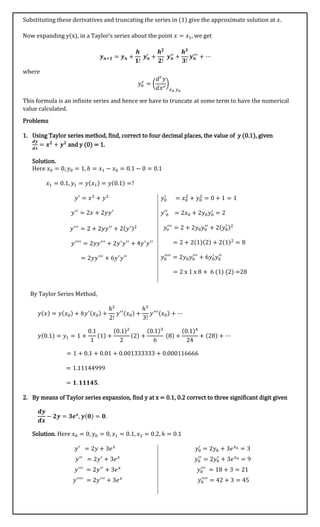
Substituting these derivatives and truncating the series in (1) give the approximate solution at 𝑥.
Now expanding y(x), in a Taylor’s series about the point 𝑥 = 𝑥1, we get
𝒚 𝒏+𝟏 = 𝒚 𝒏 +
𝒉
𝟏!
𝒚 𝒏
′
+
𝒉 𝟐
𝟐!
𝒚 𝒏
′′
+
𝒉 𝟑
𝟑!
𝒚 𝒏
′′′
+ ⋯
where
𝑦𝑛
𝑟
= (
𝑑 𝑟
𝑦
𝑑𝑥 𝑟
)
𝑥 𝑛 𝑦 𝑛
This formula is an infinite series and hence we have to truncate at some term to have the numerical
value calculated.
Problems
1. Using Taylor series method, find, correct to four decimal places, the value of y (0.1), given
𝒅𝒚
𝒅𝒙
= 𝒙 𝟐
+ 𝒚 𝟐
and y (0) = 1.
Solution.
Here 𝑥0 = 0, 𝑦0 = 1, ℎ = 𝑥1 − 𝑥0 = 0.1 − 0 = 0.1
𝑥1 = 0.1, 𝑦1 = 𝑦(𝑥1) = 𝑦(0.1) =?
𝑦′
= 𝑥2
+ 𝑦2
𝑦′′
= 2𝑥 + 2𝑦𝑦′
𝑦′′′
= 2 + 2𝑦𝑦′′
+ 2(𝑦′)2
𝑦′′′′
= 2𝑦𝑦′′′
+ 2𝑦′
𝑦′′
+ 4𝑦′
𝑦′′
= 2𝑦𝑦′′′
+ 6𝑦′
𝑦′′
𝑦0
′
= 𝑥0
2
+ 𝑦0
2
= 0 + 1 = 1
𝑦′0
′
= 2𝑥0 + 2𝑦0 𝑦0
′
= 2
𝑦𝑜
′′′
= 2 + 2𝑦0 𝑦0
′′
+ 2(𝑦0
′ )2
= 2 + 2(1)(2) + 2(1)2
= 8
𝑦0
′′′′
= 2𝑦0 𝑦0
′′′
+ 6𝑦0
′
𝑦0
′′
= 2 x 1 x 8 + 6 (1) (2) =28
By Taylor Series Method,
𝑦(𝑥) = 𝑦(𝑥0) + ℎ𝑦′(𝑥0) +
ℎ2
2!
𝑦′′(𝑥0) +
ℎ3
3!
𝑦′′′(𝑥0) + ⋯
𝑦(0.1) = 𝑦1 = 1 +
0.1
1
(1) +
(0.1)2
2
(2) +
(0.1)3
6
(8) +
(0.1)4
24
+ (28) + ⋯
= 1 + 0.1 + 0.01 + 0.001333333 + 0.000116666
= 1.11144999
= 𝟏. 𝟏𝟏𝟏𝟒𝟓.
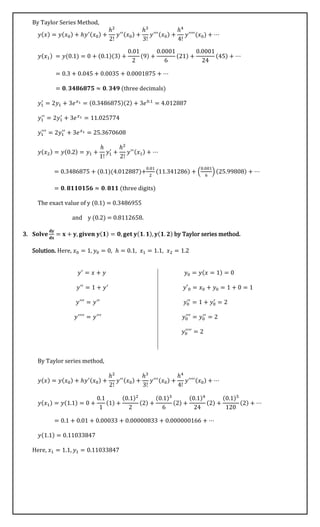
2. By means of Taylor series expansion, find y at x = 0.1, 0.2 correct to three significant digit given
𝒅𝒚
𝒅𝒙
− 𝟐𝒚 = 𝟑𝒆 𝒙
, 𝒚(𝟎) = 𝟎.
Solution. Here 𝑥0 = 0, 𝑦0 = 0, 𝑥1 = 0.1, 𝑥2 = 0.2, ℎ = 0.1
𝑦′
= 2𝑦 + 3𝑒 𝑥
𝑦′′
= 2𝑦′
+ 3𝑒 𝑥
𝑦′′′
= 2𝑦′′
+ 3𝑒 𝑥
𝑦′′′′
= 2𝑦′′′
+ 3𝑒 𝑥
𝑦0
′
= 2𝑦0 + 3𝑒 𝑥0 = 3
𝑦0
′′
= 2𝑦0
′
+ 3𝑒 𝑥0 = 9
𝑦0
′′′
= 18 + 3 = 21
𝑦0
′′′′
= 42 + 3 = 45
By Taylor Series Method,
𝑦(𝑥) = 𝑦(𝑥0) + ℎ𝑦′(𝑥0) +
ℎ2
2!
𝑦′′(𝑥0) +
ℎ3
3!
𝑦′′′(𝑥0) +
ℎ4
4!
𝑦′′′′
(𝑥0) + ⋯
𝑦(𝑥1) = 𝑦(0.1) = 0 + (0.1)(3) +
0.01
2
(9) +
0.0001
6
(21) +
0.0001
24
(45) + ⋯
= 0.3 + 0.045 + 0.0035 + 0.0001875 + ⋯
= 𝟎. 𝟑𝟒𝟖𝟔𝟖𝟕𝟓 ≈ 𝟎. 𝟑𝟒𝟗 (three decimals)
𝑦1
′
= 2𝑦1 + 3𝑒 𝑥1 = (0.3486875)(2) + 3𝑒0.1
= 4.012887
𝑦1
′′
= 2𝑦1
′
+ 3𝑒 𝑥1 = 11.025774
𝑦1
′′′
= 2𝑦1
′′
+ 3𝑒 𝑥1 = 25.3670608
𝑦(𝑥2) = 𝑦(0.2) = 𝑦1 +
ℎ
1!
𝑦1
′
+
ℎ2
2!
𝑦′′(𝑥1) + ⋯
= 0.3486875 + (0.1)(4.012887)+
0.01
2
(11.341286) + (
0.001
6
) (25.99808) + ⋯
= 𝟎. 𝟖𝟏𝟏𝟎𝟏𝟓𝟔 ≈ 𝟎. 𝟖𝟏𝟏 (three digits)
The exact value of y (0.1) = 0.3486955
and y (0.2) = 0.8112658.
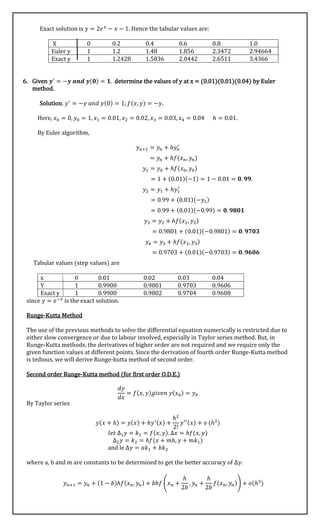
3. 𝐒𝐨𝐥𝐯𝐞
𝐝𝐲
𝐝𝐱
= 𝐱 + 𝐲, 𝐠𝐢𝐯𝐞𝐧 𝐲(𝟏) = 𝟎, 𝐠𝐞𝐭 𝐲(𝟏. 𝟏), 𝐲(𝟏. 𝟐) by Taylor series method.
Solution. Here, 𝑥0 = 1, 𝑦0 = 0, ℎ = 0.1, 𝑥1 = 1.1, 𝑥2 = 1.2
𝑦′
= 𝑥 + 𝑦
𝑦′′
= 1 + 𝑦′
𝑦′′′
= 𝑦′′
𝑦′′′′
= 𝑦′′′
𝑦0 = 𝑦(𝑥 = 1) = 0
𝑦′0 = 𝑥0 + 𝑦0 = 1 + 0 = 1
𝑦0
′′
= 1 + 𝑦0
′
= 2
𝑦0
′′′
= 𝑦0
′′
= 2
𝑦0
′′′′
= 2
By Taylor series method,
𝑦(𝑥) = 𝑦(𝑥0) + ℎ𝑦′(𝑥0) +
ℎ2
2!
𝑦′′(𝑥0) +
ℎ3
3!
𝑦′′′(𝑥0) +
ℎ4
4!
𝑦′′′′(𝑥0) + ⋯
𝑦(𝑥1) = 𝑦(1.1) = 0 +
0.1
1
(1) +
(0.1)2
2
(2) +
(0.1)3
6
(2) +
(0.1)4
24
(2) +
(0.1)5
120
(2) + ⋯
= 0.1 + 0.01 + 0.00033 + 0.00000833 + 0.000000166 + ⋯
𝑦(1.1) = 0.11033847
Here, 𝑥1 = 1.1, 𝑦1 = 0.11033847
Now, take 𝑥2 = 1.2, ℎ = 0.1
By Taylor series
𝑦(𝑥2) = 𝑦(𝑥1) + ℎ𝑦′(𝑥1) +
ℎ2
2!
𝑦′′(𝑥1) +
ℎ3
3!
𝑦′′′(𝑥1) +
ℎ4
4!
𝑦′′′′(𝑥1) + ⋯
𝑦(𝑥2) = 𝑦(1.2)
= 0.11033847 +
0.1
1
(1.21033847) +
(0.1)2
2
(2.21033847) +
(0.1)3
6
(2.21033847)
+
(0.1)4
24
(2.21033847) + ⋯
= 0.11033847 + 0.121033847 + 2.21033847(0.005 + 0.0016666 + ⋯ )
= 𝟎. 𝟐𝟒𝟐𝟖𝟎𝟏𝟔𝟎.
4. Using Taylor method, compute y(0.2) and y(0.4) correct to 4 decimal places given
𝑑𝑦
𝑑𝑥
= 1 − 2𝑥𝑦
and y(0)=0.
Solution. Here 𝑥0 = 0, 𝑦0 = 0, 𝑥1 = 0.2, 𝑥2 = 0.4, ℎ = 0.2
𝑦′
= 1 − 2𝑥𝑦
𝑦′′
= −2(𝑥𝑦′
+ 𝑦)
𝑦′′
′ = −2(𝑥𝑦′′
+ 2𝑦′)
𝑦′′′′
= −2(𝑥𝑦′′′
+ 3𝑦′′)
𝑦′′′′′
= −2(2𝑥𝑦′′′′
+ 4𝑦′′′
)
𝑦0
′
= 1 − 2𝑥0 𝑦0 = 1
𝑦0
′′
= 0
𝑦0
′′′
= −4
𝑦0
′′′′
= 0
𝑦0
′′′′′
= 32
By Taylor series.
𝑦(𝑥) = 𝑦(𝑥0) + ℎ𝑦′(𝑥0) +
ℎ2
2!
𝑦′′(𝑥0) +
ℎ3
3!
𝑦′′′(𝑥0) +
ℎ4
4!
𝑦′′′′(𝑥0) + ⋯
𝑦(𝑥1) = 𝑦(0.2) = 0 +
0.2
1
(1) +
(0.2)2
2
(0) +
(0.2)3
6
(−4) +
(0.2)4
24
(0) +
(0.2)5
120
(32) + ⋯
= 0.2 − 0.00533333 + 0.000085333
= 𝟎. 𝟏𝟗𝟒𝟕𝟓𝟐𝟎𝟎𝟑
Here, 𝑥1 = 0.2 𝑦1 = 0.194752003, ℎ = 0.2
𝑦′1 = 𝑥1 + 𝑦1
𝑦1
′′
= 1 + 𝑦1
;
𝑦1
′′′
= 𝑦1
′′
𝑦1
′′′′
= 𝑦1′′′
𝑦1
′
= 𝑥1 + 𝑦1 = 1.1 + 0.11033847 = 1.21033847
𝑦1
′′
= 1 + 1.21033847 = 2.21033847
𝑦1
′′′
= 𝑦1
′′
= 𝑦1
′′′′
= 𝑦1
′′′′′
= ⋯ = 2.21033847
𝑦1
′
= 1 − 2𝑥1 𝑦1
𝑦1
′′
= −2(𝑥1 𝑦1
′
+ 𝑦1)
𝑦1
′′′
= −2(𝑥1 𝑦1
′′
+ 2𝑦1
′)
𝑦1
′′′′
= −2(𝑥1 𝑦1
′′′
+ 3𝑦1
′′)
𝑦1
′′′′′
= −2(2𝑥1 𝑦1
′′′
+ 4𝑦1
′′′
)
𝑦1
′
= 1 − 2(0.2)(0.194752003) = 0.9220992
𝑦1
′′
= −2[(0.2)(0.9220992) + 0.194752003]
= −0.758343686
𝑦1
′′′
= −2[(0.2)(−0.758343686)
+ 2(0.9220992)]
= −3.38505933
𝑦1
′′′′
= −2[(0.2)(-3.38505933)+3(-
0.75834686)]
= 5.90408585
Here, 𝑥2 = 0.4 ℎ = 0.2
By Taylor Series
𝑦(𝑥2) = 𝑦(𝑥1) + ℎ𝑦′(𝑥1) +
ℎ2
2!
𝑦′′(𝑥1) +
ℎ3
3!
𝑦′′′(𝑥1) +
ℎ4
4!
𝑦′′′′(𝑥1) + ⋯
𝑦(𝑥2) = 𝑦(0.4)
= 0.194752003 +
0.2
1
(0.9220992) +
(0.2)2
2
(−0.758343686) +
(0.2)3
6
(−3.38505933)
+
(0.2)4
24
(5.90403585)
= 0.194752003 + 0.18441984 − 0.0151668737 − 0.00451341243 + 0.00039360239
= 0.35988515
Euler’s Method
In solving a first order differential equation by numerical methods, we come across two types of
solutions:
• A series solution of y in terms of x, which will yield the value of y at a particular value of x
by direct substitution in the series solution.
• Values of y at specified values of x.
Let us take the point 𝑥 = 𝑥0, 𝑥1, 𝑥2, … 𝑤ℎ𝑒𝑟𝑒 𝑥1 − 𝑥𝑖−1 = ℎ 𝑖. 𝑒. , 𝑥𝑖 = 𝑥0 + 𝑖ℎ, 𝑖 = 0,1,2, ….
The equation of tangent at (𝑥0, 𝑦0) to curve is
𝑦 − 𝑦0 = 𝑦(𝑥0,𝑦0)
′
(𝑥 − 𝑥0)
= 𝑓(𝑥0, 𝑦0). (𝑥 − 𝑥0)
𝑦 = 𝑦0 + 𝑓(𝑥0, 𝑦0). (𝑥 − 𝑥0)
∴ 𝑦1 = 𝑦0 + ℎ𝑦0
′
𝑤ℎ𝑒𝑟𝑒 ℎ = 𝑥1 − 𝑥0.
Thus
𝒚 𝒏+𝟏 = 𝒚 𝒏 + 𝒉𝒇(𝒙 𝒏, 𝒚 𝒏); 𝒏 = 𝟎, 𝟏, 𝟐, …
This formula is called Euler’s algorithm
5. Using Euler’s method, solve numerically the equation, 𝒚′
= 𝒙 + 𝒚, 𝒚(𝟎) = 𝟏, 𝒇𝒐𝒓 𝒙 =
𝟎. 𝟎 (𝟎. 𝟐)(𝟏. 𝟎) Check your answer with the exact solution.
Solution. Here, h=0.2, 𝑓(𝑥, 𝑦) = 𝑥 + 𝑦, 𝑥0 = 0, 𝑦0 = 1 𝑥1 = 0.2, 𝑥2 = 0.4, 𝑥3 = 0.6, 𝑥4 =
0.8, 𝑥5 = 1.0
By Euler algorithm
𝑦1 = 𝑦0 + ℎ𝑓(𝑥0, 𝑦0)
𝑦1 = 𝑦0 + ℎ[𝑥0 + 𝑦0]
= 1 + (0.2)(0 + 1) = 𝟏. 𝟐
𝑦2 = 𝑦1 + ℎ[𝑥1 + 𝑦1]
= 1.2 + (0.2)(0.2 + 1.2) = 𝟏. 𝟒𝟖
𝑦3 = 𝑦2 + ℎ[𝑥2 + 𝑦2]
= 1.48 + (0.2)(0.4 + 1.48) = 𝟏. 𝟖𝟓𝟔
𝑦4 = 1.856 + (0.2)(0.6 + 1.856) = 𝟐. 𝟑𝟒𝟕𝟐
𝑦5 = 2.3472 + (0.2)(0.8 + 2.3472) = 𝟐. 𝟗𝟒𝟔𝟔𝟒
Exact solution is 𝑦 = 2𝑒 𝑥
− 𝑥 − 1. Hence the tabular values are:
X 0 0.2 0.4 0.6 0.8 1.0
Euler y 1 1.2 1.48 1.856 2.3472 2.94664
Exact y 1 1.2428 1.5836 2.0442 2.6511 3.4366
6. Given 𝒚′
= −𝒚 𝒂𝒏𝒅 𝒚(𝟎) = 𝟏. determine the values of y at x = (0.01)(0.01)(0.04) by Euler
method.
Solution. 𝑦′
= −𝑦 𝑎𝑛𝑑 𝑦(0) = 1; 𝑓(𝑥, 𝑦) = −𝑦.
Here, 𝑥0 = 0, 𝑦0 = 1, 𝑥1 = 0.01, 𝑥2 = 0.02, 𝑥3 = 0.03, 𝑥4 = 0.04 ℎ = 0.01.
By Euler algorithm,
𝑦 𝑛+1 = 𝑦𝑛 + ℎ𝑦𝑛
′
= 𝑦𝑛 + ℎ𝑓(𝑥 𝑛, 𝑦𝑛)
𝑦1 = 𝑦0 + ℎ𝑓(𝑥0, 𝑦0)
= 1 + (0.01)(−1) = 1 − 0.01 = 𝟎. 𝟗𝟗.
𝑦2 = 𝑦1 + ℎ𝑦1
′
= 0.99 + (0.01)(−𝑦1)
= 0.99 + (0.01)(−0.99) = 𝟎. 𝟗𝟖𝟎𝟏
𝑦3 = 𝑦2 + ℎ𝑓(𝑥2, 𝑦2)
= 0.9801 + (0.01)(−0.9801) = 𝟎. 𝟗𝟕𝟎𝟑
𝑦4 = 𝑦3 + ℎ𝑓(𝑥3, 𝑦3)
= 0.9703 + (0.01)(−0.9703) = 𝟎. 𝟗𝟔𝟎𝟔
Tabular values (step values) are
x 0 0.01 0.02 0.03 0.04
Y 1 0.9900 0.9801 0.9703 0.9606
Exact y 1 0.9900 0.9802 0.9704 0.9608
since 𝑦 = 𝑒−𝑥
is the exact solution.
Runge-Kutta Method
The use of the previous methods to solve the differential equation numerically is restricted due to
either slow convergence or due to labour involved, especially in Taylor series method. But, in
Runge-Kutta methods, the derivatives of higher order are not required and we require only the
given function values at different points. Since the derivation of fourth order Runge-Kutta method
is tedious, we will derive Runge-kutta method of second order.
Second order Runge-Kutta method (for first order O.D.E.)
𝑑𝑦
𝑑𝑥
= 𝑓(𝑥, 𝑦)𝑔𝑖𝑣𝑒𝑛 𝑦(𝑥0) = 𝑦0
By Taylor series
𝑦(𝑥 + ℎ) = 𝑦(𝑥) + ℎ𝑦′(𝑥) +
ℎ2
2!
𝑦′′(𝑥) + 𝑜 (ℎ3
)
𝑙𝑒𝑡 ∆1 𝑦 = 𝑘1 = 𝑓(𝑥, 𝑦). ∆𝑥 = ℎ𝑓(𝑥, 𝑦)
∆2 𝑦 = 𝑘2 = ℎ𝑓(𝑥 + 𝑚ℎ, 𝑦 + 𝑚𝑘1)
and le ∆𝑦 = 𝑎𝑘1 + 𝑏𝑘2
where a, b and m are constants to be determined to get the better accuracy of ∆𝑦.
𝑦 𝑛+1 = 𝑦𝑛 + (1 − 𝑏)ℎ𝑓(𝑥 𝑛, 𝑦𝑛) + 𝑏ℎ𝑓 (𝑥 𝑛 +
ℎ
2𝑏
, 𝑦𝑛 +
ℎ
2𝑏
𝑓(𝑥 𝑛, 𝑦𝑛)) + 𝑜(ℎ3
)
From this general second order Runge-Kutta formula, setting 𝑎 = 0, 𝑏 = 1, 𝑚 =
1
2
, we get the
second order Runge-Kutta algorithm as
𝑘1 = ℎ𝑓(𝑥, 𝑦)
𝑘2 = ℎ𝑓 (𝑥 +
1
2
ℎ, 𝑦 +
1
2
𝑘1)
and ∆𝑦 = 𝐾2 where ℎ = ∆𝑥.
Since the derivation of third and fourth order Runge-Kutta algorithms are tedious, we state them
below for use.
The third order Runge-Kutta method algorithm is given below:
The fourth order Runge-Kutta method algorithm is mostly used in problem unless other
mentioned. It is
7. Using Runge-Kutta method of fourth order, solve
𝒅𝒚
𝒅𝒙
=
𝒚 𝟐−𝒙 𝟐
𝒚 𝟐+𝒙 𝟐
given
y(0)=1 at x=0.2,0.4.
Solution. 𝑦′
= 𝑓(𝑥, 𝑦) =
𝑦2−𝑥2
𝑦2+𝑥2
Here 𝑥0 = 0, ℎ = 0.2, 𝑥1 = 0.2, 𝑥2 = 0.4, 𝑦0 = 1
𝑓(𝑥0, 𝑦0) = 𝑓(0,1) =
1 − 0
1 + 0
= 1
𝑘1 = ℎ𝑓(𝑥0, 𝑦0) = (0.2)(1) = 0.2
𝑘2 = ℎ𝑓 (𝑥0 +
1
2
ℎ, 𝑦0 +
1
2
𝑘1) = (0.2)𝑓(0.1,1.1)
= (0.2) [
(1.1)2
− (0.1)2
(1.1)2 + (0.1)2
] = (0.2) [
1.21 − 0.01
1.21 + 0.01
]
= 0.1967213
𝑘3 = ℎ𝑓 (𝑥0 +
1
2
ℎ, 𝑦0 +
1
2
𝑘2)
= (0.2)𝑓 (0.1, 1 +
1
2
(0.1967213))
= (0.2)𝑓(0.1,1.0983606)
= (0.2) [
(1.0983606)2
− (0.01)
(1.0983606)2 + (0.01)
] = 0.1967
Second order R.K. algorithm
𝑘1 = ℎ𝑓(𝑥, 𝑦)
𝑘2 = ℎ𝑓 (𝑥 +
1
2
ℎ, 𝑦 +
1
2
𝑘1)
𝑘3 = ℎ𝑓(𝑥 + ℎ, 𝑦 + 2𝑘2 − 𝑘1)
and ∆𝑦 =
1
6
(𝑘1 + 4𝑘2 + 𝑘3)
Third order
R.K. algorithm
𝑘1 = ℎ𝑓(𝑥, 𝑦)
𝑘2 = ℎ𝑓 (𝑥 +
1
2
ℎ, 𝑦 +
1
2
𝑘1)
𝑘3 = ℎ𝑓(𝑥 + ℎ, 𝑦 + 2𝑘2 − 𝑘1)
𝑘4 = ℎ𝑓(𝑥 + ℎ, 𝑦 + 𝑘3)
and ∆𝑦 =
1
6
(𝑘1 + 4𝑘2 + 2𝑘3) + 𝑘4)
𝑦(𝑥 + ℎ) = 𝑦(𝑥) + ∆𝑦
Fourth order
R.K. algorithm
𝑘4 = ℎ𝑓(𝑥0 + ℎ, 𝑦0 + 𝑘3)
= (0.2)𝑓(0.2,1.1967)
= (0.2) [
(1.1967)2
− (0.2)2
(1.1967)2 + (0.2)2
] = 0.1891
∴ ∆𝑦 =
1
6
[𝑘1 + 2𝑘2 + 𝑘4]
=
1
6
[0.2 + 2(0.19672) + 2(1.1967) + 0.1891]
= 0.19598
𝒚(𝟎. 𝟐) = 𝒚 𝟏 = 𝒚 𝟎 + ∆𝒚 = 𝟏. 𝟏𝟗𝟓𝟗𝟖
Again to find y(0.4) start form (𝑥1, 𝑦1) = (0.2, 1.19598)
Now,
∴ 𝑘1 = ℎ𝑓(𝑥1, 𝑦1) = (0.2) [
(1.19598)2
− (0.2)2
(1.19598)2 + (0.2)2
] = 0.1891
𝑘2 = ℎ𝑓 (𝑥1 +
1
2
ℎ, 𝑦1 +
1
2
𝑘1) = (0.2)𝑓(0.3,1.29055)
= (0.2) [
(1.29055)2
− (0.3)2
(1.29055)2 + (0.3)2
] = 0.17949
𝑘3 = (0.2)𝑓(0.3,1.28572) = 0.1793
𝑘4 = (0.2)𝑓(0.4, 𝑦1 + 𝑘3) = (0.2)𝑓(0.4,1.37528)
= 0.1687
∆𝑦 =
1
6
(𝑘1 + 2𝑘2 + 2𝑘3 + 𝑘4)
=
1
6
[0.1891 + 2(0.1795) + 2(0.1793) + 0.1687] = 0.1792
∴ 𝒚 𝟐 = 𝒚(𝟎. 𝟒) = 𝒚 𝟏 + ∆𝒚 = 𝟏. 𝟑𝟕𝟓𝟏.
8. Compute y(0.3) given
𝒅𝒚
𝒅𝒙
+ 𝒚 + 𝒙𝒚 𝟐
= 𝟎, y (0) =1 by taking h=0.1 using R.K method of fourth
order (correct to 4 decimals)
Solution. 𝑦′
= −(𝑥𝑦2
+ 𝑦) = 𝑓(𝑥, 𝑦); 𝑥0 = 0, 𝑦0 = 1, ℎ = 0.1, 𝑥1 = 0.1, 𝑥2 = 0.2, 𝑥3 = 0.3,
𝑦3 =?
𝑘1 = ℎ𝑓(𝑥0, 𝑦0) = (0.1)[−(𝑥0 𝑦0
2
+ 𝑦0)] = −0.1
𝑘2 = ℎ𝑓 (𝑥0 +
1
2
ℎ, 𝑦0 +
1
2
𝑘1) = (0.1)𝑓(0.05,0.95)
= −0.1[(0.05)(0.95)2
+ 0.95]
= −0.0995
𝑘3 = ℎ𝑓 (𝑥0 +
1
2
ℎ, 𝑦0 +
1
2
𝑘2)
= (0.1)𝑓(0.05,0.95025)
= (0.1)[−(0.05 𝑥 0.95025 + 1)(0.95025)]
= −0.09953987 ≈ −0.0995.
𝑘4 = ℎ𝑓(𝑥0 + ℎ, 𝑦0 + 𝑘3)
= (0.1)𝑓(0.1,0.9005) = −0.0982.
𝑦1 = 𝑦(0.1) = 1 +
1
6
[−0.1 + 2(−0.0995) + 2(−0.0995) − 0.0982]
𝑦(0.1) = 𝟎. 𝟗𝟎𝟎𝟔.
Again taking (𝑥1, 𝑦1)in place of 𝑥0, 𝑦0) repeat the process
𝑘1 = ℎ𝑓(𝑥1, 𝑦1) = (0.1)𝑓(0.1,0.9006) = −0.0982
𝑘2 = ℎ𝑓 (𝑥1 +
1
2
ℎ, 𝑦1 +
1
2
𝑘1) = (0.1)𝑓(0.15,0.8515) = −0.0960
𝑘3 = ℎ𝑓 (𝑥1 +
ℎ
2
, 𝑦1 +
1
2
𝑘2) = (0.1)𝑓(0.15, 0.8526) = −0.0962
𝑘4 = ℎ𝑓(𝑥1 + ℎ, , 𝑦1 + 𝑘3) = (0.1)𝑓(0.2,0.8044) = −0.0934
𝑦2 = 𝑦1 +
1
6
(𝑘1 + 2𝑘2 + 2𝑘3 + 𝑘4)
𝑦2 = 𝑦(0.2) = 0.9006 +
1
6
[−0.0982 + 2(−0.0960) + 2(−0.0962) + (−0.0934)]
𝑦(0.2) = 𝟎. 𝟖𝟎𝟒𝟔
Again, starting form (𝑥2, 𝑦2) in place of (𝑥0, 𝑦0)
𝑘1 = −0.0934, 𝑘2 = −0.0902, 𝑘3 = −0.0904, 𝑘4 = −0.0867
∴ 𝑦3 = 𝑦(0.3) = 𝑦2 +
1
6
∆𝑦 = 𝑦2 +
1
6
(𝑘1 + 2𝑘2 + 2𝑘3 + 𝑘4)
𝒚(𝟎. 𝟑) = 𝟎. 𝟕𝟏𝟒𝟒.
9. Apply the fourth order Runge-Kutta method to find 𝒚(𝟎. 𝟐)𝒈𝒊𝒗𝒆𝒏 𝒕𝒉𝒂𝒕 𝒚′
= 𝒙 + 𝒚, 𝒚(𝟎) = 𝟏.
Solution. Since h is not mentioned in the question, we take h=0.1
𝑦′
= 𝑥 + 𝑦; 𝑦(0) = 1
𝑥1 = 0.1, 𝑥2 = 0.2
∴ 𝑓(𝑥, 𝑦) = 𝑥 + 𝑦, 𝑥0 = 0, 𝑦0 = 1
By fourth order Runge-Kutta method,
𝑘1 = ℎ𝑓(𝑥0, 𝑦0) = (0.1)(𝑥0 + 𝑦0) = (0.1)(0 + 1) = 0.1
𝑘2 = ℎ𝑓 (𝑥0 +
1
2
ℎ, 𝑦0 +
1
2
𝑘1) = (0.1)𝑓(0.05,1.05)
= (0.1)(0.05 + 1.05) = 0.11
𝑘3 = ℎ𝑓 (𝑥0 +
1
2
ℎ, 𝑦0 +
1
2
𝑘2)
= (0.1)𝑓(0.05, 1.055)
= (0.1)(0.05 + 1.055) = 0.1105
𝑘4 = ℎ𝑓(𝑥0 + ℎ, 𝑦0 + 𝑘3)
= (0.1)𝑓(0.1, 1.1105) = 0.12105
∆𝑦 =
1
6
(𝑘1 + 2𝑘2 + 2𝑘3 + 𝑘4) =
1
6
(0.1 + 0.22 + 0.2210 + 0.12105)
= 0.110341667
𝑦(0.1) = 𝑦1 = 𝑦0 + ∆𝑦 = 1.110341667 ≈ 𝟏. 𝟏𝟏𝟎𝟑𝟒𝟐.
Now starting from (𝑥1, 𝑦1) we get 𝑥2, 𝑦2). Again apply Runge-Kutta algorithm replacing
(𝑥0, 𝑦0) 𝑏𝑦(𝑥1, 𝑦1)
𝑘1 = ℎ𝑓(𝑥1, 𝑦1) = (0.1)𝑓(0.1,0.9006)
= (0.1)(0.1 + 1.110342) = 0.1210342
𝑘2 = ℎ𝑓 (𝑥1 +
1
2
ℎ, 𝑦1 +
1
2
𝑘1)
= (0.1)𝑓(0.15, 1.170859) = (0.1)(0.15 + 1.170859)
= 0.1320859
𝑘3 = ℎ𝑓 (𝑥1 +
ℎ
2
, 𝑦1 +
1
2
𝑘2) = (0.1)𝑓(0.15, 1.1763848)
= (0.1)(0.15 + 1.1763848)
= 0.13263848
𝑘4 = ℎ𝑓(𝑥1 + ℎ, , 𝑦1 + 𝑘3) = (0.1)𝑓(0.2, 1.24298048)
= 0.144298048
𝑦(0.2) = 𝑦(0.1) +
1
6
(𝑘1 + 2𝑘2 + 2𝑘3 + 𝑘4)
= 1.110342 +
1
6
(0.794781008) = 1.2428055
𝑦(0.2) = 𝟏. 𝟐𝟒𝟐𝟖𝟎𝟓𝟓
Correct to four decimal places, y (0.2) =1.2428.
10. Using Runge -Kutta method of fourth order, find y (0.8) correct to four decimal places if
𝑦′
= 𝑦 − 𝑥2
, 𝑦(0.6) = 1.7379.
Solution. Here, 𝑥0 = 0.6, 𝑦0 = 1.7379, ℎ = 0.1, 𝑥1 = 0.7, 𝑥2 = 0.8
𝑓(𝑥, 𝑦) = 𝑦 − 𝑥2
𝑘1 = ℎ𝑓(𝑥0, 𝑦0) = (0.1)𝑓(0.6, 1.7379)
= (0.1)[1.7379 − (0.6)2] = 0.1378
𝑘2 = ℎ𝑓 (𝑥0 +
1
2
ℎ, 𝑦0 +
1
2
𝑘1) = (0.1)𝑓(0.65, 1.8068)
= (0.1)[1.8068 − (0.65)2] = 0.1384
𝑘3 = ℎ𝑓 (𝑥0 +
1
2
ℎ, 𝑦0 +
1
2
𝑘2)
= (0.1)𝑓(0.65, 1.8071)
= (0.1)[1.8071 − (0.65)2
] = 0.1385
𝑘4 = ℎ𝑓(𝑥0 + ℎ, 𝑦0 + 𝑘3)
= (0.1)𝑓(0.7, 1.8764)
= (0.1)[(1.8764) − (0.7)2] = 0.1386
By Runge-Kutta method of fourth order,
𝑦1 = 𝑦0 +
1
6
(𝑘1 + 2𝑘2 + 2𝑘3 + 𝑘4)
𝑦1 = 𝑦(0.7) = 1.7379 +
1
6
[0.1378 + 2(0.1384) + 2(0.1385) + 0.1386]
𝒚(𝟎. 𝟕) = 𝟏. 𝟖𝟕𝟔𝟑
To find 𝑦2 = 𝑦(0.8), we again start from (𝑥1, 𝑦1)= (0.7, 1.8763)
Now,
𝑘1 = ℎ𝑓(𝑥1, 𝑦1) = (0.1)[1.8763 − (0.7)2] = 0.1386
𝑘2 = ℎ𝑓 (𝑥1 +
1
2
ℎ, 𝑦1 +
1
2
𝑘1) = (0.1)𝑓(0.75, 1.9456)
= (0.1)[1.9456 − (0.75)2] = 0.1383
𝑘3 = ℎ𝑓 (𝑥1 +
1
2
ℎ, 𝑦1 +
1
2
𝑘2)
= (0.1)𝑓(0.75, 1.9455)
= (0.1)[1.9455 − (0.75)2
] = 0.1383
= (0.1)𝑓(0.8, 2.0146)
= (0.1)[(2.0146) − (0.8)2] = 0.1375
𝑦2 = 𝑦1 +
1
6
(𝑘1 + 2𝑘2 + 2𝑘3 + 𝑘4)
𝑦2 = 𝑦(0.8) = 1.8763 +
1
6
[0.1386 + 2(1.1383) + 2(1.1383) + 0.1375]
= 2.0145
𝒚 𝟐 = 𝒚(𝟎. 𝟖) = 𝟐. 𝟎𝟏𝟒𝟓
Short Answer
1. What do you mean by point-wise solution?
In solving a differential equation for approximate solution, we find numerical values of 𝑦1, 𝑦2, 𝑦3 …
corresponding to given numerical values of independent variable values 𝑥1, 𝑥2, 𝑥3 … so that the
ordered pairs (𝑥1, 𝑦1), (𝑥2, 𝑦2), … satisfy a particular solution, though approximately. A solution of this
type is called a pointwise solution.
2. What is Truncation error?
Truncation errors are the errors that result from using an approximation in place of an exact
mathematical procedure.
𝑒 𝑥
= 1 + 𝑥 +
𝑥2
2!
+
𝑥3
3!
+
𝑥 𝑛
𝑛!
+
𝑥 𝑛+1
(𝑛 + 1)!
+ ⋯
Approximation
Truncation errors
Exact mathematical formulation
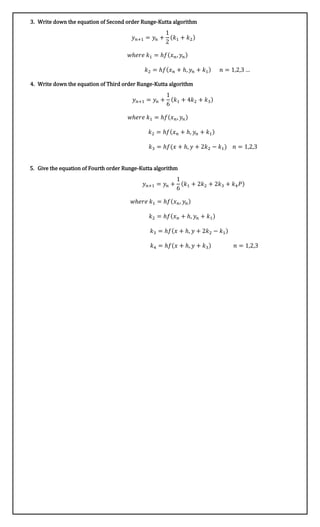
3. Write down the equation of Second order Runge-Kutta algorithm
𝑦 𝑛+1 = 𝑦𝑛 +
1
2
(𝑘1 + 𝑘2)
𝑤ℎ𝑒𝑟𝑒 𝑘1 = ℎ𝑓(𝑥 𝑛, 𝑦𝑛)
𝑘2 = ℎ𝑓(𝑥 𝑛 + ℎ, 𝑦𝑛 + 𝑘1) 𝑛 = 1,2,3 …
4. Write down the equation of Third order Runge-Kutta algorithm
𝑦 𝑛+1 = 𝑦𝑛 +
1
6
(𝑘1 + 4𝑘2 + 𝑘3)
𝑤ℎ𝑒𝑟𝑒 𝑘1 = ℎ𝑓(𝑥 𝑛, 𝑦𝑛)
𝑘2 = ℎ𝑓(𝑥 𝑛 + ℎ, 𝑦𝑛 + 𝑘1)
𝑘3 = ℎ𝑓(𝑥 + ℎ, 𝑦 + 2𝑘2 − 𝑘1) 𝑛 = 1,2,3
5. Give the equation of Fourth order Runge-Kutta algorithm
𝑦 𝑛+1 = 𝑦𝑛 +
1
6
(𝑘1 + 2𝑘2 + 2𝑘3 + 𝑘4 𝑃)
𝑤ℎ𝑒𝑟𝑒 𝑘1 = ℎ𝑓(𝑥 𝑛, 𝑦𝑛)
𝑘2 = ℎ𝑓(𝑥 𝑛 + ℎ, 𝑦𝑛 + 𝑘1)
𝑘3 = ℎ𝑓(𝑥 + ℎ, 𝑦 + 2𝑘2 − 𝑘1)
𝑘4 = ℎ𝑓(𝑥 + ℎ, 𝑦 + 𝑘3) 𝑛 = 1,2,3

Study Material Numerical Solution of Odinary Differential Equations

  • 1.
    VIVEKANANDA COLLEGE, TIRUVEDAKAMWEST (Residential & Autonomous – A Gurukula Institute of Life-Training) (Affiliated to Madurai Kamaraj University) PART III: PHYSICS MAJOR – FOURTH SEMESTER-CORE SUBJECT PAPER-II NUMERICAL METHODS – 06CT42 (For those who joined in June 2018 and after) Reference Text Book: Numerical Methods – P.Kandasamy, K.Thilagavathy & K.Gunavathi, S.Chand & Company Ltd., New Delhi, 2014. UNIT – V NUMERICAL SOLUTION OF ORDINARY DIFFERENTIAL EQUATIONS Introduction: In solving a differential equation for approximate solution. We find numerical values of 𝑦1, 𝑦2, 𝑦3 …. corresponding to given numerical values of independent variable values 𝑥1, 𝑥2, 𝑥3 … so that the orderd pairs (𝑥𝑖, 𝑦𝑖), (𝑥2, 𝑦2) … … satisfy a particular solution, though approximately. A solution of this type is called a point wise solution. Suppose we require to sole 𝑑𝑦 𝑑𝑥 = 𝑓(𝑥, 𝑦) with the initial condition 𝑦(𝑥0) = 𝑦0. By numerical solution of the differential equation, let 𝑦(𝑥0) = 𝑦0, 𝑦(𝑥1), 𝑦(𝑥2), … be the solution of y at 𝑥 = 𝑥0, 𝑥1, 𝑥2, … Let 𝑦 = 𝑦(𝑥)be the exact solution. Truncation errors are the errors that result from using an approximation in place of an exact mathematical procedure. at 𝑥 = 𝑥𝑖 Power Series approximations Let us suppose that we require to find the solution of 𝑦′ = 𝑑𝑦 𝑑𝑥 = 𝑓(𝑥, 𝑦) subject to the initial condition 𝑦(𝑥0) = 𝑦0 By Taylor series, we have 𝑦(𝑥) = 𝑦(𝑥0) + 𝑥 − 𝑥0 1! 𝑦′(𝑥0) + (𝑥 − 𝑥0)2 2! 𝑦′′(𝑥0) + ⋯ If 𝑥 = 𝑥0 = 0 (origin) we get the Maclaurin series expansion, 𝑦(𝑥) = 𝑦(0) + 𝑥 1! 𝑦′(0) + 𝑥2 2! 𝑦′′(0) + ⋯ Solution by Taylor series (Type 1) If 𝑦′ = 𝑓(𝑡, 𝑦)𝑥0 ≤ 𝑥 ≤ 𝑏 𝑤𝑖𝑡ℎ 𝑦(𝑡0) = 𝑦0 gives the solution 𝑦0 at initial point 𝑥 = 𝑥0 for given step size ℎ, the solution at 𝑥 = 𝑥0 + ℎ 𝑜𝑟 ℎ = 𝑥1 − 𝑥0 can be computed from Taylor series as 𝑦(𝑥) = 𝑦(𝑥0 + ℎ) = 𝑦(𝑥0) + ℎ𝑦′(𝑥0) + ℎ2 2! 𝑦′′(𝑥0) + ℎ3 3! 𝑦′′′(𝑥0) + ⋯ … (1) from the differential equation, if is observed that 𝑦′(𝑥0) = 𝑓(𝑥0, 𝑦0) Repeated differentiation gives 𝑦′′(𝑥0), 𝑦′′′(𝑥0) …as 𝑦′′(𝑥0) = [ 𝛿𝑓 𝛿𝑡 + 𝛿𝑓 𝛿𝑦 𝑦′ ] 𝑥=𝑥0 𝑦′′′(𝑥0) = [ 𝛿2 𝑓 𝑑𝑡2 + 2𝛿2 𝑓 𝛿𝑡𝛿𝑦 𝑦′ + ( 𝛿𝑓 𝛿𝑦 𝑦′ ) 2 ] 𝑥=𝑥0 and so on
  • 2.
    Substituting these derivativesand truncating the series in (1) give the approximate solution at 𝑥. Now expanding y(x), in a Taylor’s series about the point 𝑥 = 𝑥1, we get 𝒚 𝒏+𝟏 = 𝒚 𝒏 + 𝒉 𝟏! 𝒚 𝒏 ′ + 𝒉 𝟐 𝟐! 𝒚 𝒏 ′′ + 𝒉 𝟑 𝟑! 𝒚 𝒏 ′′′ + ⋯ where 𝑦𝑛 𝑟 = ( 𝑑 𝑟 𝑦 𝑑𝑥 𝑟 ) 𝑥 𝑛 𝑦 𝑛 This formula is an infinite series and hence we have to truncate at some term to have the numerical value calculated. Problems 1. Using Taylor series method, find, correct to four decimal places, the value of y (0.1), given 𝒅𝒚 𝒅𝒙 = 𝒙 𝟐 + 𝒚 𝟐 and y (0) = 1. Solution. Here 𝑥0 = 0, 𝑦0 = 1, ℎ = 𝑥1 − 𝑥0 = 0.1 − 0 = 0.1 𝑥1 = 0.1, 𝑦1 = 𝑦(𝑥1) = 𝑦(0.1) =? 𝑦′ = 𝑥2 + 𝑦2 𝑦′′ = 2𝑥 + 2𝑦𝑦′ 𝑦′′′ = 2 + 2𝑦𝑦′′ + 2(𝑦′)2 𝑦′′′′ = 2𝑦𝑦′′′ + 2𝑦′ 𝑦′′ + 4𝑦′ 𝑦′′ = 2𝑦𝑦′′′ + 6𝑦′ 𝑦′′ 𝑦0 ′ = 𝑥0 2 + 𝑦0 2 = 0 + 1 = 1 𝑦′0 ′ = 2𝑥0 + 2𝑦0 𝑦0 ′ = 2 𝑦𝑜 ′′′ = 2 + 2𝑦0 𝑦0 ′′ + 2(𝑦0 ′ )2 = 2 + 2(1)(2) + 2(1)2 = 8 𝑦0 ′′′′ = 2𝑦0 𝑦0 ′′′ + 6𝑦0 ′ 𝑦0 ′′ = 2 x 1 x 8 + 6 (1) (2) =28 By Taylor Series Method, 𝑦(𝑥) = 𝑦(𝑥0) + ℎ𝑦′(𝑥0) + ℎ2 2! 𝑦′′(𝑥0) + ℎ3 3! 𝑦′′′(𝑥0) + ⋯ 𝑦(0.1) = 𝑦1 = 1 + 0.1 1 (1) + (0.1)2 2 (2) + (0.1)3 6 (8) + (0.1)4 24 + (28) + ⋯ = 1 + 0.1 + 0.01 + 0.001333333 + 0.000116666 = 1.11144999 = 𝟏. 𝟏𝟏𝟏𝟒𝟓. 2. By means of Taylor series expansion, find y at x = 0.1, 0.2 correct to three significant digit given 𝒅𝒚 𝒅𝒙 − 𝟐𝒚 = 𝟑𝒆 𝒙 , 𝒚(𝟎) = 𝟎. Solution. Here 𝑥0 = 0, 𝑦0 = 0, 𝑥1 = 0.1, 𝑥2 = 0.2, ℎ = 0.1 𝑦′ = 2𝑦 + 3𝑒 𝑥 𝑦′′ = 2𝑦′ + 3𝑒 𝑥 𝑦′′′ = 2𝑦′′ + 3𝑒 𝑥 𝑦′′′′ = 2𝑦′′′ + 3𝑒 𝑥 𝑦0 ′ = 2𝑦0 + 3𝑒 𝑥0 = 3 𝑦0 ′′ = 2𝑦0 ′ + 3𝑒 𝑥0 = 9 𝑦0 ′′′ = 18 + 3 = 21 𝑦0 ′′′′ = 42 + 3 = 45
  • 3.
    By Taylor SeriesMethod, 𝑦(𝑥) = 𝑦(𝑥0) + ℎ𝑦′(𝑥0) + ℎ2 2! 𝑦′′(𝑥0) + ℎ3 3! 𝑦′′′(𝑥0) + ℎ4 4! 𝑦′′′′ (𝑥0) + ⋯ 𝑦(𝑥1) = 𝑦(0.1) = 0 + (0.1)(3) + 0.01 2 (9) + 0.0001 6 (21) + 0.0001 24 (45) + ⋯ = 0.3 + 0.045 + 0.0035 + 0.0001875 + ⋯ = 𝟎. 𝟑𝟒𝟖𝟔𝟖𝟕𝟓 ≈ 𝟎. 𝟑𝟒𝟗 (three decimals) 𝑦1 ′ = 2𝑦1 + 3𝑒 𝑥1 = (0.3486875)(2) + 3𝑒0.1 = 4.012887 𝑦1 ′′ = 2𝑦1 ′ + 3𝑒 𝑥1 = 11.025774 𝑦1 ′′′ = 2𝑦1 ′′ + 3𝑒 𝑥1 = 25.3670608 𝑦(𝑥2) = 𝑦(0.2) = 𝑦1 + ℎ 1! 𝑦1 ′ + ℎ2 2! 𝑦′′(𝑥1) + ⋯ = 0.3486875 + (0.1)(4.012887)+ 0.01 2 (11.341286) + ( 0.001 6 ) (25.99808) + ⋯ = 𝟎. 𝟖𝟏𝟏𝟎𝟏𝟓𝟔 ≈ 𝟎. 𝟖𝟏𝟏 (three digits) The exact value of y (0.1) = 0.3486955 and y (0.2) = 0.8112658. 3. 𝐒𝐨𝐥𝐯𝐞 𝐝𝐲 𝐝𝐱 = 𝐱 + 𝐲, 𝐠𝐢𝐯𝐞𝐧 𝐲(𝟏) = 𝟎, 𝐠𝐞𝐭 𝐲(𝟏. 𝟏), 𝐲(𝟏. 𝟐) by Taylor series method. Solution. Here, 𝑥0 = 1, 𝑦0 = 0, ℎ = 0.1, 𝑥1 = 1.1, 𝑥2 = 1.2 𝑦′ = 𝑥 + 𝑦 𝑦′′ = 1 + 𝑦′ 𝑦′′′ = 𝑦′′ 𝑦′′′′ = 𝑦′′′ 𝑦0 = 𝑦(𝑥 = 1) = 0 𝑦′0 = 𝑥0 + 𝑦0 = 1 + 0 = 1 𝑦0 ′′ = 1 + 𝑦0 ′ = 2 𝑦0 ′′′ = 𝑦0 ′′ = 2 𝑦0 ′′′′ = 2 By Taylor series method, 𝑦(𝑥) = 𝑦(𝑥0) + ℎ𝑦′(𝑥0) + ℎ2 2! 𝑦′′(𝑥0) + ℎ3 3! 𝑦′′′(𝑥0) + ℎ4 4! 𝑦′′′′(𝑥0) + ⋯ 𝑦(𝑥1) = 𝑦(1.1) = 0 + 0.1 1 (1) + (0.1)2 2 (2) + (0.1)3 6 (2) + (0.1)4 24 (2) + (0.1)5 120 (2) + ⋯ = 0.1 + 0.01 + 0.00033 + 0.00000833 + 0.000000166 + ⋯ 𝑦(1.1) = 0.11033847 Here, 𝑥1 = 1.1, 𝑦1 = 0.11033847
  • 4.
    Now, take 𝑥2= 1.2, ℎ = 0.1 By Taylor series 𝑦(𝑥2) = 𝑦(𝑥1) + ℎ𝑦′(𝑥1) + ℎ2 2! 𝑦′′(𝑥1) + ℎ3 3! 𝑦′′′(𝑥1) + ℎ4 4! 𝑦′′′′(𝑥1) + ⋯ 𝑦(𝑥2) = 𝑦(1.2) = 0.11033847 + 0.1 1 (1.21033847) + (0.1)2 2 (2.21033847) + (0.1)3 6 (2.21033847) + (0.1)4 24 (2.21033847) + ⋯ = 0.11033847 + 0.121033847 + 2.21033847(0.005 + 0.0016666 + ⋯ ) = 𝟎. 𝟐𝟒𝟐𝟖𝟎𝟏𝟔𝟎. 4. Using Taylor method, compute y(0.2) and y(0.4) correct to 4 decimal places given 𝑑𝑦 𝑑𝑥 = 1 − 2𝑥𝑦 and y(0)=0. Solution. Here 𝑥0 = 0, 𝑦0 = 0, 𝑥1 = 0.2, 𝑥2 = 0.4, ℎ = 0.2 𝑦′ = 1 − 2𝑥𝑦 𝑦′′ = −2(𝑥𝑦′ + 𝑦) 𝑦′′ ′ = −2(𝑥𝑦′′ + 2𝑦′) 𝑦′′′′ = −2(𝑥𝑦′′′ + 3𝑦′′) 𝑦′′′′′ = −2(2𝑥𝑦′′′′ + 4𝑦′′′ ) 𝑦0 ′ = 1 − 2𝑥0 𝑦0 = 1 𝑦0 ′′ = 0 𝑦0 ′′′ = −4 𝑦0 ′′′′ = 0 𝑦0 ′′′′′ = 32 By Taylor series. 𝑦(𝑥) = 𝑦(𝑥0) + ℎ𝑦′(𝑥0) + ℎ2 2! 𝑦′′(𝑥0) + ℎ3 3! 𝑦′′′(𝑥0) + ℎ4 4! 𝑦′′′′(𝑥0) + ⋯ 𝑦(𝑥1) = 𝑦(0.2) = 0 + 0.2 1 (1) + (0.2)2 2 (0) + (0.2)3 6 (−4) + (0.2)4 24 (0) + (0.2)5 120 (32) + ⋯ = 0.2 − 0.00533333 + 0.000085333 = 𝟎. 𝟏𝟗𝟒𝟕𝟓𝟐𝟎𝟎𝟑 Here, 𝑥1 = 0.2 𝑦1 = 0.194752003, ℎ = 0.2 𝑦′1 = 𝑥1 + 𝑦1 𝑦1 ′′ = 1 + 𝑦1 ; 𝑦1 ′′′ = 𝑦1 ′′ 𝑦1 ′′′′ = 𝑦1′′′ 𝑦1 ′ = 𝑥1 + 𝑦1 = 1.1 + 0.11033847 = 1.21033847 𝑦1 ′′ = 1 + 1.21033847 = 2.21033847 𝑦1 ′′′ = 𝑦1 ′′ = 𝑦1 ′′′′ = 𝑦1 ′′′′′ = ⋯ = 2.21033847 𝑦1 ′ = 1 − 2𝑥1 𝑦1 𝑦1 ′′ = −2(𝑥1 𝑦1 ′ + 𝑦1) 𝑦1 ′′′ = −2(𝑥1 𝑦1 ′′ + 2𝑦1 ′) 𝑦1 ′′′′ = −2(𝑥1 𝑦1 ′′′ + 3𝑦1 ′′) 𝑦1 ′′′′′ = −2(2𝑥1 𝑦1 ′′′ + 4𝑦1 ′′′ ) 𝑦1 ′ = 1 − 2(0.2)(0.194752003) = 0.9220992 𝑦1 ′′ = −2[(0.2)(0.9220992) + 0.194752003] = −0.758343686 𝑦1 ′′′ = −2[(0.2)(−0.758343686) + 2(0.9220992)] = −3.38505933 𝑦1 ′′′′ = −2[(0.2)(-3.38505933)+3(- 0.75834686)] = 5.90408585
  • 5.
    Here, 𝑥2 =0.4 ℎ = 0.2 By Taylor Series 𝑦(𝑥2) = 𝑦(𝑥1) + ℎ𝑦′(𝑥1) + ℎ2 2! 𝑦′′(𝑥1) + ℎ3 3! 𝑦′′′(𝑥1) + ℎ4 4! 𝑦′′′′(𝑥1) + ⋯ 𝑦(𝑥2) = 𝑦(0.4) = 0.194752003 + 0.2 1 (0.9220992) + (0.2)2 2 (−0.758343686) + (0.2)3 6 (−3.38505933) + (0.2)4 24 (5.90403585) = 0.194752003 + 0.18441984 − 0.0151668737 − 0.00451341243 + 0.00039360239 = 0.35988515 Euler’s Method In solving a first order differential equation by numerical methods, we come across two types of solutions: • A series solution of y in terms of x, which will yield the value of y at a particular value of x by direct substitution in the series solution. • Values of y at specified values of x. Let us take the point 𝑥 = 𝑥0, 𝑥1, 𝑥2, … 𝑤ℎ𝑒𝑟𝑒 𝑥1 − 𝑥𝑖−1 = ℎ 𝑖. 𝑒. , 𝑥𝑖 = 𝑥0 + 𝑖ℎ, 𝑖 = 0,1,2, …. The equation of tangent at (𝑥0, 𝑦0) to curve is 𝑦 − 𝑦0 = 𝑦(𝑥0,𝑦0) ′ (𝑥 − 𝑥0) = 𝑓(𝑥0, 𝑦0). (𝑥 − 𝑥0) 𝑦 = 𝑦0 + 𝑓(𝑥0, 𝑦0). (𝑥 − 𝑥0) ∴ 𝑦1 = 𝑦0 + ℎ𝑦0 ′ 𝑤ℎ𝑒𝑟𝑒 ℎ = 𝑥1 − 𝑥0. Thus 𝒚 𝒏+𝟏 = 𝒚 𝒏 + 𝒉𝒇(𝒙 𝒏, 𝒚 𝒏); 𝒏 = 𝟎, 𝟏, 𝟐, … This formula is called Euler’s algorithm 5. Using Euler’s method, solve numerically the equation, 𝒚′ = 𝒙 + 𝒚, 𝒚(𝟎) = 𝟏, 𝒇𝒐𝒓 𝒙 = 𝟎. 𝟎 (𝟎. 𝟐)(𝟏. 𝟎) Check your answer with the exact solution. Solution. Here, h=0.2, 𝑓(𝑥, 𝑦) = 𝑥 + 𝑦, 𝑥0 = 0, 𝑦0 = 1 𝑥1 = 0.2, 𝑥2 = 0.4, 𝑥3 = 0.6, 𝑥4 = 0.8, 𝑥5 = 1.0 By Euler algorithm 𝑦1 = 𝑦0 + ℎ𝑓(𝑥0, 𝑦0) 𝑦1 = 𝑦0 + ℎ[𝑥0 + 𝑦0] = 1 + (0.2)(0 + 1) = 𝟏. 𝟐 𝑦2 = 𝑦1 + ℎ[𝑥1 + 𝑦1] = 1.2 + (0.2)(0.2 + 1.2) = 𝟏. 𝟒𝟖 𝑦3 = 𝑦2 + ℎ[𝑥2 + 𝑦2] = 1.48 + (0.2)(0.4 + 1.48) = 𝟏. 𝟖𝟓𝟔 𝑦4 = 1.856 + (0.2)(0.6 + 1.856) = 𝟐. 𝟑𝟒𝟕𝟐 𝑦5 = 2.3472 + (0.2)(0.8 + 2.3472) = 𝟐. 𝟗𝟒𝟔𝟔𝟒
  • 6.
    Exact solution is𝑦 = 2𝑒 𝑥 − 𝑥 − 1. Hence the tabular values are: X 0 0.2 0.4 0.6 0.8 1.0 Euler y 1 1.2 1.48 1.856 2.3472 2.94664 Exact y 1 1.2428 1.5836 2.0442 2.6511 3.4366 6. Given 𝒚′ = −𝒚 𝒂𝒏𝒅 𝒚(𝟎) = 𝟏. determine the values of y at x = (0.01)(0.01)(0.04) by Euler method. Solution. 𝑦′ = −𝑦 𝑎𝑛𝑑 𝑦(0) = 1; 𝑓(𝑥, 𝑦) = −𝑦. Here, 𝑥0 = 0, 𝑦0 = 1, 𝑥1 = 0.01, 𝑥2 = 0.02, 𝑥3 = 0.03, 𝑥4 = 0.04 ℎ = 0.01. By Euler algorithm, 𝑦 𝑛+1 = 𝑦𝑛 + ℎ𝑦𝑛 ′ = 𝑦𝑛 + ℎ𝑓(𝑥 𝑛, 𝑦𝑛) 𝑦1 = 𝑦0 + ℎ𝑓(𝑥0, 𝑦0) = 1 + (0.01)(−1) = 1 − 0.01 = 𝟎. 𝟗𝟗. 𝑦2 = 𝑦1 + ℎ𝑦1 ′ = 0.99 + (0.01)(−𝑦1) = 0.99 + (0.01)(−0.99) = 𝟎. 𝟗𝟖𝟎𝟏 𝑦3 = 𝑦2 + ℎ𝑓(𝑥2, 𝑦2) = 0.9801 + (0.01)(−0.9801) = 𝟎. 𝟗𝟕𝟎𝟑 𝑦4 = 𝑦3 + ℎ𝑓(𝑥3, 𝑦3) = 0.9703 + (0.01)(−0.9703) = 𝟎. 𝟗𝟔𝟎𝟔 Tabular values (step values) are x 0 0.01 0.02 0.03 0.04 Y 1 0.9900 0.9801 0.9703 0.9606 Exact y 1 0.9900 0.9802 0.9704 0.9608 since 𝑦 = 𝑒−𝑥 is the exact solution. Runge-Kutta Method The use of the previous methods to solve the differential equation numerically is restricted due to either slow convergence or due to labour involved, especially in Taylor series method. But, in Runge-Kutta methods, the derivatives of higher order are not required and we require only the given function values at different points. Since the derivation of fourth order Runge-Kutta method is tedious, we will derive Runge-kutta method of second order. Second order Runge-Kutta method (for first order O.D.E.) 𝑑𝑦 𝑑𝑥 = 𝑓(𝑥, 𝑦)𝑔𝑖𝑣𝑒𝑛 𝑦(𝑥0) = 𝑦0 By Taylor series 𝑦(𝑥 + ℎ) = 𝑦(𝑥) + ℎ𝑦′(𝑥) + ℎ2 2! 𝑦′′(𝑥) + 𝑜 (ℎ3 ) 𝑙𝑒𝑡 ∆1 𝑦 = 𝑘1 = 𝑓(𝑥, 𝑦). ∆𝑥 = ℎ𝑓(𝑥, 𝑦) ∆2 𝑦 = 𝑘2 = ℎ𝑓(𝑥 + 𝑚ℎ, 𝑦 + 𝑚𝑘1) and le ∆𝑦 = 𝑎𝑘1 + 𝑏𝑘2 where a, b and m are constants to be determined to get the better accuracy of ∆𝑦. 𝑦 𝑛+1 = 𝑦𝑛 + (1 − 𝑏)ℎ𝑓(𝑥 𝑛, 𝑦𝑛) + 𝑏ℎ𝑓 (𝑥 𝑛 + ℎ 2𝑏 , 𝑦𝑛 + ℎ 2𝑏 𝑓(𝑥 𝑛, 𝑦𝑛)) + 𝑜(ℎ3 )
  • 7.
    From this generalsecond order Runge-Kutta formula, setting 𝑎 = 0, 𝑏 = 1, 𝑚 = 1 2 , we get the second order Runge-Kutta algorithm as 𝑘1 = ℎ𝑓(𝑥, 𝑦) 𝑘2 = ℎ𝑓 (𝑥 + 1 2 ℎ, 𝑦 + 1 2 𝑘1) and ∆𝑦 = 𝐾2 where ℎ = ∆𝑥. Since the derivation of third and fourth order Runge-Kutta algorithms are tedious, we state them below for use. The third order Runge-Kutta method algorithm is given below: The fourth order Runge-Kutta method algorithm is mostly used in problem unless other mentioned. It is 7. Using Runge-Kutta method of fourth order, solve 𝒅𝒚 𝒅𝒙 = 𝒚 𝟐−𝒙 𝟐 𝒚 𝟐+𝒙 𝟐 given y(0)=1 at x=0.2,0.4. Solution. 𝑦′ = 𝑓(𝑥, 𝑦) = 𝑦2−𝑥2 𝑦2+𝑥2 Here 𝑥0 = 0, ℎ = 0.2, 𝑥1 = 0.2, 𝑥2 = 0.4, 𝑦0 = 1 𝑓(𝑥0, 𝑦0) = 𝑓(0,1) = 1 − 0 1 + 0 = 1 𝑘1 = ℎ𝑓(𝑥0, 𝑦0) = (0.2)(1) = 0.2 𝑘2 = ℎ𝑓 (𝑥0 + 1 2 ℎ, 𝑦0 + 1 2 𝑘1) = (0.2)𝑓(0.1,1.1) = (0.2) [ (1.1)2 − (0.1)2 (1.1)2 + (0.1)2 ] = (0.2) [ 1.21 − 0.01 1.21 + 0.01 ] = 0.1967213 𝑘3 = ℎ𝑓 (𝑥0 + 1 2 ℎ, 𝑦0 + 1 2 𝑘2) = (0.2)𝑓 (0.1, 1 + 1 2 (0.1967213)) = (0.2)𝑓(0.1,1.0983606) = (0.2) [ (1.0983606)2 − (0.01) (1.0983606)2 + (0.01) ] = 0.1967 Second order R.K. algorithm 𝑘1 = ℎ𝑓(𝑥, 𝑦) 𝑘2 = ℎ𝑓 (𝑥 + 1 2 ℎ, 𝑦 + 1 2 𝑘1) 𝑘3 = ℎ𝑓(𝑥 + ℎ, 𝑦 + 2𝑘2 − 𝑘1) and ∆𝑦 = 1 6 (𝑘1 + 4𝑘2 + 𝑘3) Third order R.K. algorithm 𝑘1 = ℎ𝑓(𝑥, 𝑦) 𝑘2 = ℎ𝑓 (𝑥 + 1 2 ℎ, 𝑦 + 1 2 𝑘1) 𝑘3 = ℎ𝑓(𝑥 + ℎ, 𝑦 + 2𝑘2 − 𝑘1) 𝑘4 = ℎ𝑓(𝑥 + ℎ, 𝑦 + 𝑘3) and ∆𝑦 = 1 6 (𝑘1 + 4𝑘2 + 2𝑘3) + 𝑘4) 𝑦(𝑥 + ℎ) = 𝑦(𝑥) + ∆𝑦 Fourth order R.K. algorithm
  • 8.
    𝑘4 = ℎ𝑓(𝑥0+ ℎ, 𝑦0 + 𝑘3) = (0.2)𝑓(0.2,1.1967) = (0.2) [ (1.1967)2 − (0.2)2 (1.1967)2 + (0.2)2 ] = 0.1891 ∴ ∆𝑦 = 1 6 [𝑘1 + 2𝑘2 + 𝑘4] = 1 6 [0.2 + 2(0.19672) + 2(1.1967) + 0.1891] = 0.19598 𝒚(𝟎. 𝟐) = 𝒚 𝟏 = 𝒚 𝟎 + ∆𝒚 = 𝟏. 𝟏𝟗𝟓𝟗𝟖 Again to find y(0.4) start form (𝑥1, 𝑦1) = (0.2, 1.19598) Now, ∴ 𝑘1 = ℎ𝑓(𝑥1, 𝑦1) = (0.2) [ (1.19598)2 − (0.2)2 (1.19598)2 + (0.2)2 ] = 0.1891 𝑘2 = ℎ𝑓 (𝑥1 + 1 2 ℎ, 𝑦1 + 1 2 𝑘1) = (0.2)𝑓(0.3,1.29055) = (0.2) [ (1.29055)2 − (0.3)2 (1.29055)2 + (0.3)2 ] = 0.17949 𝑘3 = (0.2)𝑓(0.3,1.28572) = 0.1793 𝑘4 = (0.2)𝑓(0.4, 𝑦1 + 𝑘3) = (0.2)𝑓(0.4,1.37528) = 0.1687 ∆𝑦 = 1 6 (𝑘1 + 2𝑘2 + 2𝑘3 + 𝑘4) = 1 6 [0.1891 + 2(0.1795) + 2(0.1793) + 0.1687] = 0.1792 ∴ 𝒚 𝟐 = 𝒚(𝟎. 𝟒) = 𝒚 𝟏 + ∆𝒚 = 𝟏. 𝟑𝟕𝟓𝟏. 8. Compute y(0.3) given 𝒅𝒚 𝒅𝒙 + 𝒚 + 𝒙𝒚 𝟐 = 𝟎, y (0) =1 by taking h=0.1 using R.K method of fourth order (correct to 4 decimals) Solution. 𝑦′ = −(𝑥𝑦2 + 𝑦) = 𝑓(𝑥, 𝑦); 𝑥0 = 0, 𝑦0 = 1, ℎ = 0.1, 𝑥1 = 0.1, 𝑥2 = 0.2, 𝑥3 = 0.3, 𝑦3 =? 𝑘1 = ℎ𝑓(𝑥0, 𝑦0) = (0.1)[−(𝑥0 𝑦0 2 + 𝑦0)] = −0.1 𝑘2 = ℎ𝑓 (𝑥0 + 1 2 ℎ, 𝑦0 + 1 2 𝑘1) = (0.1)𝑓(0.05,0.95) = −0.1[(0.05)(0.95)2 + 0.95] = −0.0995 𝑘3 = ℎ𝑓 (𝑥0 + 1 2 ℎ, 𝑦0 + 1 2 𝑘2) = (0.1)𝑓(0.05,0.95025) = (0.1)[−(0.05 𝑥 0.95025 + 1)(0.95025)] = −0.09953987 ≈ −0.0995.
  • 9.
    𝑘4 = ℎ𝑓(𝑥0+ ℎ, 𝑦0 + 𝑘3) = (0.1)𝑓(0.1,0.9005) = −0.0982. 𝑦1 = 𝑦(0.1) = 1 + 1 6 [−0.1 + 2(−0.0995) + 2(−0.0995) − 0.0982] 𝑦(0.1) = 𝟎. 𝟗𝟎𝟎𝟔. Again taking (𝑥1, 𝑦1)in place of 𝑥0, 𝑦0) repeat the process 𝑘1 = ℎ𝑓(𝑥1, 𝑦1) = (0.1)𝑓(0.1,0.9006) = −0.0982 𝑘2 = ℎ𝑓 (𝑥1 + 1 2 ℎ, 𝑦1 + 1 2 𝑘1) = (0.1)𝑓(0.15,0.8515) = −0.0960 𝑘3 = ℎ𝑓 (𝑥1 + ℎ 2 , 𝑦1 + 1 2 𝑘2) = (0.1)𝑓(0.15, 0.8526) = −0.0962 𝑘4 = ℎ𝑓(𝑥1 + ℎ, , 𝑦1 + 𝑘3) = (0.1)𝑓(0.2,0.8044) = −0.0934 𝑦2 = 𝑦1 + 1 6 (𝑘1 + 2𝑘2 + 2𝑘3 + 𝑘4) 𝑦2 = 𝑦(0.2) = 0.9006 + 1 6 [−0.0982 + 2(−0.0960) + 2(−0.0962) + (−0.0934)] 𝑦(0.2) = 𝟎. 𝟖𝟎𝟒𝟔 Again, starting form (𝑥2, 𝑦2) in place of (𝑥0, 𝑦0) 𝑘1 = −0.0934, 𝑘2 = −0.0902, 𝑘3 = −0.0904, 𝑘4 = −0.0867 ∴ 𝑦3 = 𝑦(0.3) = 𝑦2 + 1 6 ∆𝑦 = 𝑦2 + 1 6 (𝑘1 + 2𝑘2 + 2𝑘3 + 𝑘4) 𝒚(𝟎. 𝟑) = 𝟎. 𝟕𝟏𝟒𝟒. 9. Apply the fourth order Runge-Kutta method to find 𝒚(𝟎. 𝟐)𝒈𝒊𝒗𝒆𝒏 𝒕𝒉𝒂𝒕 𝒚′ = 𝒙 + 𝒚, 𝒚(𝟎) = 𝟏. Solution. Since h is not mentioned in the question, we take h=0.1 𝑦′ = 𝑥 + 𝑦; 𝑦(0) = 1 𝑥1 = 0.1, 𝑥2 = 0.2 ∴ 𝑓(𝑥, 𝑦) = 𝑥 + 𝑦, 𝑥0 = 0, 𝑦0 = 1 By fourth order Runge-Kutta method, 𝑘1 = ℎ𝑓(𝑥0, 𝑦0) = (0.1)(𝑥0 + 𝑦0) = (0.1)(0 + 1) = 0.1 𝑘2 = ℎ𝑓 (𝑥0 + 1 2 ℎ, 𝑦0 + 1 2 𝑘1) = (0.1)𝑓(0.05,1.05) = (0.1)(0.05 + 1.05) = 0.11 𝑘3 = ℎ𝑓 (𝑥0 + 1 2 ℎ, 𝑦0 + 1 2 𝑘2) = (0.1)𝑓(0.05, 1.055) = (0.1)(0.05 + 1.055) = 0.1105 𝑘4 = ℎ𝑓(𝑥0 + ℎ, 𝑦0 + 𝑘3) = (0.1)𝑓(0.1, 1.1105) = 0.12105
  • 10.
    ∆𝑦 = 1 6 (𝑘1 +2𝑘2 + 2𝑘3 + 𝑘4) = 1 6 (0.1 + 0.22 + 0.2210 + 0.12105) = 0.110341667 𝑦(0.1) = 𝑦1 = 𝑦0 + ∆𝑦 = 1.110341667 ≈ 𝟏. 𝟏𝟏𝟎𝟑𝟒𝟐. Now starting from (𝑥1, 𝑦1) we get 𝑥2, 𝑦2). Again apply Runge-Kutta algorithm replacing (𝑥0, 𝑦0) 𝑏𝑦(𝑥1, 𝑦1) 𝑘1 = ℎ𝑓(𝑥1, 𝑦1) = (0.1)𝑓(0.1,0.9006) = (0.1)(0.1 + 1.110342) = 0.1210342 𝑘2 = ℎ𝑓 (𝑥1 + 1 2 ℎ, 𝑦1 + 1 2 𝑘1) = (0.1)𝑓(0.15, 1.170859) = (0.1)(0.15 + 1.170859) = 0.1320859 𝑘3 = ℎ𝑓 (𝑥1 + ℎ 2 , 𝑦1 + 1 2 𝑘2) = (0.1)𝑓(0.15, 1.1763848) = (0.1)(0.15 + 1.1763848) = 0.13263848 𝑘4 = ℎ𝑓(𝑥1 + ℎ, , 𝑦1 + 𝑘3) = (0.1)𝑓(0.2, 1.24298048) = 0.144298048 𝑦(0.2) = 𝑦(0.1) + 1 6 (𝑘1 + 2𝑘2 + 2𝑘3 + 𝑘4) = 1.110342 + 1 6 (0.794781008) = 1.2428055 𝑦(0.2) = 𝟏. 𝟐𝟒𝟐𝟖𝟎𝟓𝟓 Correct to four decimal places, y (0.2) =1.2428. 10. Using Runge -Kutta method of fourth order, find y (0.8) correct to four decimal places if 𝑦′ = 𝑦 − 𝑥2 , 𝑦(0.6) = 1.7379. Solution. Here, 𝑥0 = 0.6, 𝑦0 = 1.7379, ℎ = 0.1, 𝑥1 = 0.7, 𝑥2 = 0.8 𝑓(𝑥, 𝑦) = 𝑦 − 𝑥2 𝑘1 = ℎ𝑓(𝑥0, 𝑦0) = (0.1)𝑓(0.6, 1.7379) = (0.1)[1.7379 − (0.6)2] = 0.1378 𝑘2 = ℎ𝑓 (𝑥0 + 1 2 ℎ, 𝑦0 + 1 2 𝑘1) = (0.1)𝑓(0.65, 1.8068) = (0.1)[1.8068 − (0.65)2] = 0.1384 𝑘3 = ℎ𝑓 (𝑥0 + 1 2 ℎ, 𝑦0 + 1 2 𝑘2) = (0.1)𝑓(0.65, 1.8071) = (0.1)[1.8071 − (0.65)2 ] = 0.1385
  • 11.
    𝑘4 = ℎ𝑓(𝑥0+ ℎ, 𝑦0 + 𝑘3) = (0.1)𝑓(0.7, 1.8764) = (0.1)[(1.8764) − (0.7)2] = 0.1386 By Runge-Kutta method of fourth order, 𝑦1 = 𝑦0 + 1 6 (𝑘1 + 2𝑘2 + 2𝑘3 + 𝑘4) 𝑦1 = 𝑦(0.7) = 1.7379 + 1 6 [0.1378 + 2(0.1384) + 2(0.1385) + 0.1386] 𝒚(𝟎. 𝟕) = 𝟏. 𝟖𝟕𝟔𝟑 To find 𝑦2 = 𝑦(0.8), we again start from (𝑥1, 𝑦1)= (0.7, 1.8763) Now, 𝑘1 = ℎ𝑓(𝑥1, 𝑦1) = (0.1)[1.8763 − (0.7)2] = 0.1386 𝑘2 = ℎ𝑓 (𝑥1 + 1 2 ℎ, 𝑦1 + 1 2 𝑘1) = (0.1)𝑓(0.75, 1.9456) = (0.1)[1.9456 − (0.75)2] = 0.1383 𝑘3 = ℎ𝑓 (𝑥1 + 1 2 ℎ, 𝑦1 + 1 2 𝑘2) = (0.1)𝑓(0.75, 1.9455) = (0.1)[1.9455 − (0.75)2 ] = 0.1383 = (0.1)𝑓(0.8, 2.0146) = (0.1)[(2.0146) − (0.8)2] = 0.1375 𝑦2 = 𝑦1 + 1 6 (𝑘1 + 2𝑘2 + 2𝑘3 + 𝑘4) 𝑦2 = 𝑦(0.8) = 1.8763 + 1 6 [0.1386 + 2(1.1383) + 2(1.1383) + 0.1375] = 2.0145 𝒚 𝟐 = 𝒚(𝟎. 𝟖) = 𝟐. 𝟎𝟏𝟒𝟓 Short Answer 1. What do you mean by point-wise solution? In solving a differential equation for approximate solution, we find numerical values of 𝑦1, 𝑦2, 𝑦3 … corresponding to given numerical values of independent variable values 𝑥1, 𝑥2, 𝑥3 … so that the ordered pairs (𝑥1, 𝑦1), (𝑥2, 𝑦2), … satisfy a particular solution, though approximately. A solution of this type is called a pointwise solution. 2. What is Truncation error? Truncation errors are the errors that result from using an approximation in place of an exact mathematical procedure. 𝑒 𝑥 = 1 + 𝑥 + 𝑥2 2! + 𝑥3 3! + 𝑥 𝑛 𝑛! + 𝑥 𝑛+1 (𝑛 + 1)! + ⋯ Approximation Truncation errors Exact mathematical formulation
  • 12.
    3. Write downthe equation of Second order Runge-Kutta algorithm 𝑦 𝑛+1 = 𝑦𝑛 + 1 2 (𝑘1 + 𝑘2) 𝑤ℎ𝑒𝑟𝑒 𝑘1 = ℎ𝑓(𝑥 𝑛, 𝑦𝑛) 𝑘2 = ℎ𝑓(𝑥 𝑛 + ℎ, 𝑦𝑛 + 𝑘1) 𝑛 = 1,2,3 … 4. Write down the equation of Third order Runge-Kutta algorithm 𝑦 𝑛+1 = 𝑦𝑛 + 1 6 (𝑘1 + 4𝑘2 + 𝑘3) 𝑤ℎ𝑒𝑟𝑒 𝑘1 = ℎ𝑓(𝑥 𝑛, 𝑦𝑛) 𝑘2 = ℎ𝑓(𝑥 𝑛 + ℎ, 𝑦𝑛 + 𝑘1) 𝑘3 = ℎ𝑓(𝑥 + ℎ, 𝑦 + 2𝑘2 − 𝑘1) 𝑛 = 1,2,3 5. Give the equation of Fourth order Runge-Kutta algorithm 𝑦 𝑛+1 = 𝑦𝑛 + 1 6 (𝑘1 + 2𝑘2 + 2𝑘3 + 𝑘4 𝑃) 𝑤ℎ𝑒𝑟𝑒 𝑘1 = ℎ𝑓(𝑥 𝑛, 𝑦𝑛) 𝑘2 = ℎ𝑓(𝑥 𝑛 + ℎ, 𝑦𝑛 + 𝑘1) 𝑘3 = ℎ𝑓(𝑥 + ℎ, 𝑦 + 2𝑘2 − 𝑘1) 𝑘4 = ℎ𝑓(𝑥 + ℎ, 𝑦 + 𝑘3) 𝑛 = 1,2,3