1. The document describes predictor-corrector methods for numerically solving ordinary and partial differential equations.
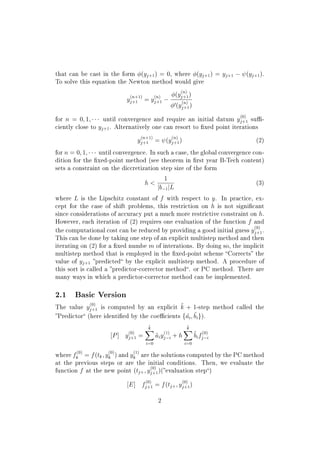
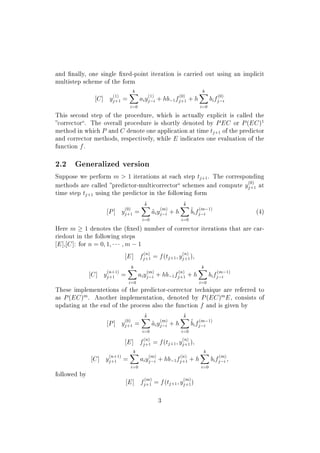
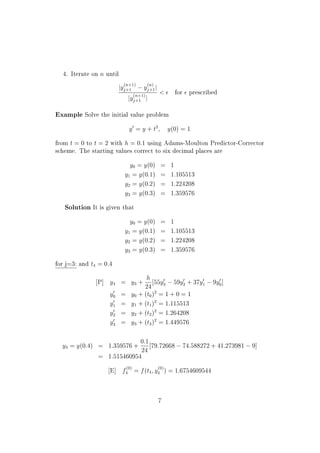
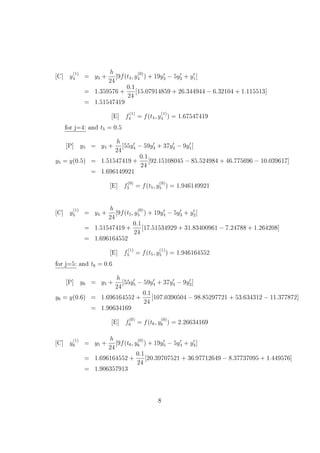
2. Predictor-corrector methods use an explicit method to predict the next value, then apply an implicit correction method in an iterative process to improve the accuracy of the predicted value.
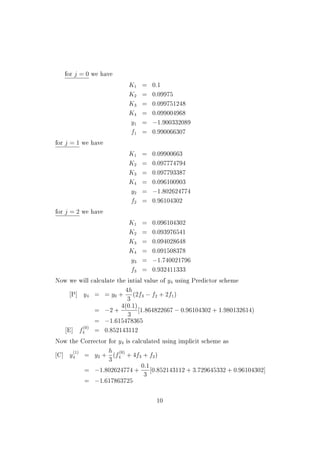
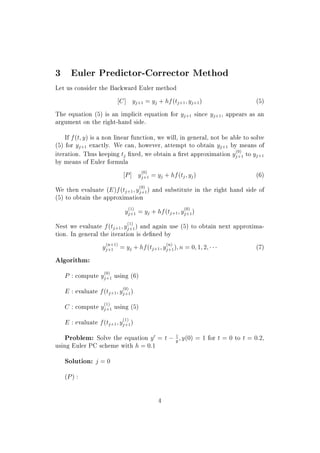
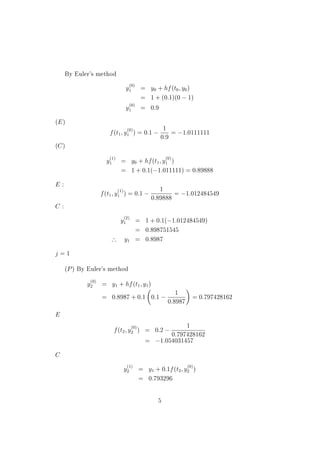
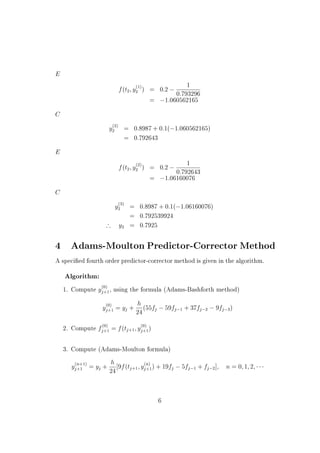
3. The Euler predictor-corrector method is presented as a basic example, using Euler's explicit method for the predictor and the backward Euler implicit method for the corrector.
![Numerical solution of ordinary and
partial dierential Equations
Module 16: Predictor-Corrector methods
Dr.rer.nat. Narni Nageswara Rao
£
August 2011
1 General Multistep Methods
Consider the linear multistep methods
yj+1 =
kX
i=0
aiyj i + h
kX
i=0
bifj i + hb 1fj+1j = k; k + 1; ¡¡¡ (1)
Which are k+1 step methods, k ! 0. For k = 0, we recover one-step methods.
The coecients ai, bi are real and fully identify the scheme, thus are such
that ak T= 0, or bk T= 0. If b 1 T= 0 the scheme is implicit, otherwise it is
explicit.
2 Predictor-Corrector Methods
When solving nonlinear IVP of the form
y
H = f(t; y); y(t0) = y0
at each time step implicit schemes require solving nonlinear algebraic equa-
tions. For instance, if the Crack-Nicolson method is used, we get the nonlin-
ear equation
yj+1 = yj +
h
2
[fj + fj+1] = (yj+1)
£nnrao maths@yahoo.co.in
1](https://image.slidesharecdn.com/ma20021-151015054303-lva1-app6891/85/Ma2002-1-16-rm-1-320.jpg)
![Numerical solution of ordinary and
partial dierential Equations
Module 16: Predictor-Corrector methods
Dr.rer.nat. Narni Nageswara Rao
£
August 2011
1 General Multistep Methods
Consider the linear multistep methods
yj+1 =
kX
i=0
aiyj i + h
kX
i=0
bifj i + hb 1fj+1j = k; k + 1; ¡¡¡ (1)
Which are k+1 step methods, k ! 0. For k = 0, we recover one-step methods.
The coecients ai, bi are real and fully identify the scheme, thus are such
that ak T= 0, or bk T= 0. If b 1 T= 0 the scheme is implicit, otherwise it is
explicit.
2 Predictor-Corrector Methods
When solving nonlinear IVP of the form
y
H = f(t; y); y(t0) = y0
at each time step implicit schemes require solving nonlinear algebraic equa-
tions. For instance, if the Crack-Nicolson method is used, we get the nonlin-
ear equation
yj+1 = yj +
h
2
[fj + fj+1] = (yj+1)
£nnrao maths@yahoo.co.in
1](https://image.slidesharecdn.com/ma20021-151015054303-lva1-app6891/75/Ma2002-1-16-rm-1-2048.jpg)
![ed by the coecients f~ai; ~big).
[P ] y
(0)
j+1 =
~kX
i=0
~aiy
(1)
j i + h
~kX
i=0
~bif
(0)
j i
where f
(0)
k = f(tk; y
(0)
k ) and y
(1)
k are the solutions computed by the PC method
at the previous steps or are the initial conditions. Then, we evaluate the
function f at the new point (tj+; y
(0)
j+1)(evaluation step)
[E] f
(0)
j+1 = f(tj+; y
(0)
j+1)
2](https://image.slidesharecdn.com/ma20021-151015054303-lva1-app6891/85/Ma2002-1-16-rm-9-320.jpg)