Submitted to:
 Ma’am Mehak
Submitted by:
 Beenish Ebad
 Bushra Razzaq
Subject :
 Math -B
Content:
Topics
Definition of Cauchy Sequence
Example of Cauchy Sequence
Result of Cauchy Sequence
Definition of Subsequence
Example of Subsequence
Result of Subsequence
Definition of Sub sequential Limit
Example of Sub sequential
Definition of Complete Metric Space
Example of Complete Metric Space
Results of Complete Metric Space
Application of Complete Metric Space
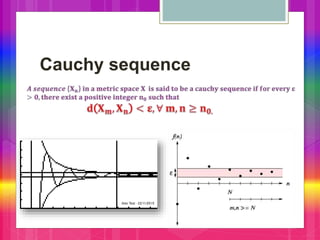
Cauchy sequence
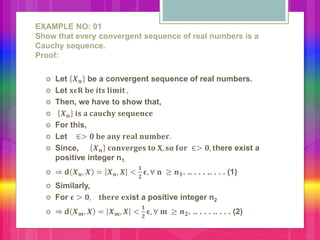
EXAMPLE NO: 01
Show that every convergent sequence of real numbers is a
Cauchy sequence.
Proof:
 Let 𝑿 𝒏 be a convergent sequence of real numbers.
 Let 𝐱𝛜𝐑 𝐛𝐞 𝐢𝐭𝐬 𝐥𝐢𝐦𝐢𝐭 ,
 Then, we have to show that,
 𝑿 𝒏 𝐢𝐬 𝐚 𝐜𝐚𝐮𝐜𝐡𝐲 𝐬𝐞𝐪𝐮𝐞𝐧𝐜𝐞
 For this,
 Let ∈> 𝟎 𝐛𝐞 𝐚𝐧𝐲 𝐫𝐞𝐚𝐥 𝐧𝐮𝐦𝐛𝐞𝐫.
 Since, 𝑿 𝒏 𝐜𝐨𝐧𝐯𝐞𝐫𝐠𝐞𝐬 𝐭𝐨 𝐗, 𝐬𝐨 𝐟𝐨𝐫 ∈> 𝟎, 𝐭here exist a
positive integer n1.
 ⇒ 𝐝 𝑿 𝒏, 𝑿 = 𝑿 𝒏, 𝑿 <
𝟏
𝟐
𝛜, ∀ 𝐧 ≥ 𝒏 𝟏. .. . . . .. . . . (1)
 Similarly,
 For 𝛜 > 𝟎, 𝐭𝐡𝐞𝐫𝐞 𝐞𝐱ist a positive integer n2
 ⇒ 𝐝 𝑿 𝒎, 𝑿 = 𝑿 𝒎, 𝑿 <
𝟏
𝟐
𝛜, ∀ 𝐦 ≥ 𝒏 𝟐. .. . . . .. . . . (2)
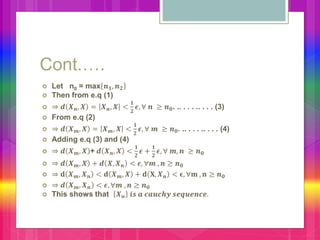
Cont.….
 Let n0 = max 𝒏 𝟏, 𝒏 𝟐
 Then from e.q (1)
 ⇒ 𝒅 𝑿 𝒏, 𝑿 = 𝑿 𝒏, 𝑿 <
𝟏
𝟐
𝝐, ∀ 𝒏 ≥ 𝒏 𝟎. .. . . . .. . . . (3)
 From e.q (2)
 ⇒ 𝒅 𝑿 𝒎, 𝑿 = 𝑿 𝒎, 𝑿 <
𝟏
𝟐
𝝐, ∀ 𝒎 ≥ 𝒏 𝟎. .. . . . .. . . . (4)
 Adding e.q (3) and (4)
 ⇒ 𝒅 𝑿 𝒎, 𝑿 + 𝒅 𝑿 𝒏, 𝑿 <
𝟏
𝟐
𝝐 +
𝟏
𝟐
𝝐, ∀ 𝒎, 𝒏 ≥ 𝒏 𝟎
 ⇒ 𝒅 𝑿 𝒎, 𝑿 + 𝒅 𝑿, 𝑿 𝒏 < 𝝐, ∀𝒎 , 𝒏 ≥ 𝒏 𝟎
 ⇒ 𝐝 𝑿 𝒎, 𝑿 𝒏 < 𝐝 𝑿 𝒎, 𝑿 + 𝐝 𝐗, 𝑿 𝒏 < 𝛜, ∀𝐦 , 𝐧 ≥ 𝒏 𝟎
 ⇒ 𝒅 𝑿 𝒎, 𝑿 𝒏 < 𝝐, ∀𝒎 , 𝒏 ≥ 𝒏 𝟎
 This shows that 𝑿 𝒏 𝒊𝒔 𝒂 𝒄𝒂𝒖𝒄𝒉𝒚 𝒔𝒆𝒒𝒖𝒆𝒏𝒄𝒆.
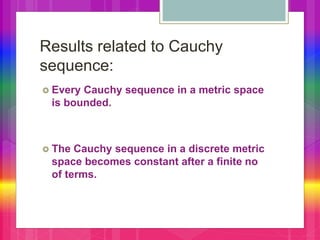
Results related to Cauchy
sequence:
 Every Cauchy sequence in a metric space
is bounded.
 The Cauchy sequence in a discrete metric
space becomes constant after a finite no
of terms.
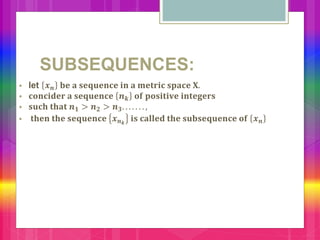
SUBSEQUENCES:
 let 𝒙 𝒏 𝐛𝐞 𝐚 𝐬𝐞𝐪𝐮𝐞𝐧𝐜𝐞 𝐢𝐧 𝐚 𝐦𝐞𝐭𝐫𝐢𝐜 𝐬𝐩𝐚𝐜𝐞 𝐗.
 𝐜𝐨𝐧𝐜𝐢𝐝𝐞𝐫 𝐚 𝐬𝐞𝐪𝐮𝐞𝐧𝐜𝐞 𝒏 𝒌 𝐨𝐟 𝐩𝐨𝐬𝐢𝐭𝐢𝐯𝐞 𝐢𝐧𝐭𝐞𝐠𝐞𝐫𝐬
 𝐬𝐮𝐜𝐡 𝐭𝐡𝐚𝐭 𝒏 𝟏 > 𝒏 𝟐 > 𝒏 𝟑. . . . . . . ,
 𝐭𝐡𝐞𝐧 𝐭𝐡𝐞 𝐬𝐞𝐪𝐮𝐞𝐧𝐜𝐞 𝒙 𝒏 𝒌
𝐢𝐬 𝐜𝐚𝐥𝐥𝐞𝐝 𝐭𝐡𝐞 𝐬𝐮𝐛𝐬𝐞𝐪𝐮𝐞𝐧𝐜𝐞 𝐨𝐟 𝒙 𝒏
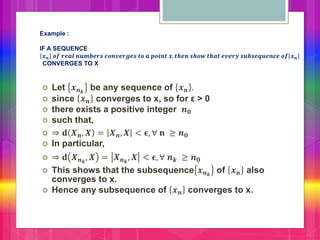
Example :
IF A SEQUENCE
𝒙 𝒏 𝒐𝒇 𝒓𝒆𝒂𝒍 𝒏𝒖𝒎𝒃𝒆𝒓𝒔 𝒄𝒐𝒏𝒗𝒆𝒓𝒈𝒆𝒔 𝒕𝒐 𝒂 𝒑𝒐𝒊𝒏𝒕 𝒙, 𝒕𝒉𝒆𝒏 𝒔𝒉𝒐𝒘 𝒕𝒉𝒂𝒕 𝒆𝒗𝒆𝒓𝒚 𝒔𝒖𝒃𝒔𝒆𝒒𝒖𝒆𝒏𝒄𝒆 𝒐𝒇 𝒙 𝒏
CONVERGES TO X
 Let 𝒙 𝒏 𝒌
be any sequence of 𝒙 𝒏 .
 since 𝒙 𝒏 converges to x, so for ε > 0
 there exists a positive integer 𝒏 𝟎
 such that,
 ⇒ 𝐝 𝑿 𝒏, 𝑿 = 𝑿 𝒏, 𝑿 < 𝛜, ∀ 𝐧 ≥ 𝒏 𝟎
 In particular,
 ⇒ 𝐝 𝑿 𝒏 𝒌
, 𝑿 = 𝑿 𝒏 𝒌
, 𝑿 < 𝛜, ∀ 𝒏 𝒌 ≥ 𝒏 𝟎
 This shows that the subsequence 𝒙 𝒏 𝒌
of 𝒙 𝒏 also
converges to x.
 Hence any subsequence of 𝒙 𝒏 converges to x.
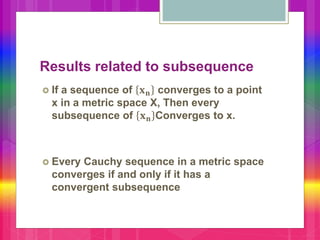
Results related to subsequence
 If a sequence of 𝐱 𝐧 converges to a point
x in a metric space X, Then every
subsequence of 𝐱 𝐧 Converges to x.
 Every Cauchy sequence in a metric space
converges if and only if it has a
convergent subsequence
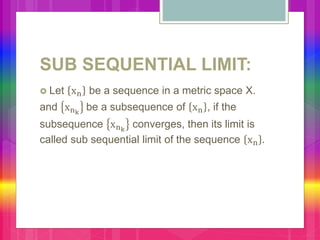
SUB SEQUENTIAL LIMIT:
 Let xn be a sequence in a metric space X.
and xnk
be a subsequence of xn , if the
subsequence xnk
converges, then its limit is
called sub sequential limit of the sequence xn .
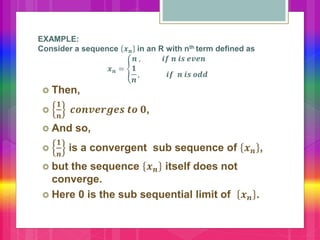
EXAMPLE:
Consider a sequence 𝒙 𝒏 in an R with nth term defined as
𝒙 𝒏 =
𝒏 , 𝒊𝒇 𝒏 𝒊𝒔 𝒆𝒗𝒆𝒏
𝟏
𝒏
, 𝒊𝒇 𝒏 𝒊𝒔 𝒐𝒅𝒅
 Then,

𝟏
𝒏
𝒄𝒐𝒏𝒗𝒆𝒓𝒈𝒆𝒔 𝒕𝒐 𝟎,
 And so,

𝟏
𝒏
is a convergent sub sequence of 𝒙 𝒏 ,
 but the sequence 𝒙 𝒏 itself does not
converge.
 Here 0 is the sub sequential limit of 𝒙 𝒏 .
Complete metric space
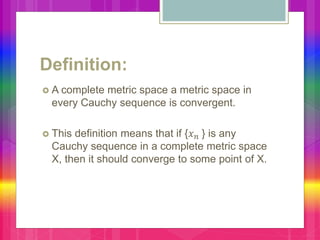
Definition:
 A complete metric space a metric space in
every Cauchy sequence is convergent.
 This definition means that if {𝑥 𝑛 } is any
Cauchy sequence in a complete metric space
X, then it should converge to some point of X.
Example:
 X=├]0,1┤[ is not a complete metric space,
because {𝑥 𝑛 }={1/n} is a Cauchy sequence
in]0,1[ and tends to converge at 0 but 0 Ɇ X
=]0,1[. so, {𝑥 𝑛 }={1/n} is not a convergent
sequence in X.
APPLICATIONS:
• Complete metric space is important in
computer forensics and cryptography in securing
data and information.
• It has direct application to elliptic curve
cryptography.
• Hence, this enhances application in ICT
and other areas of computer.
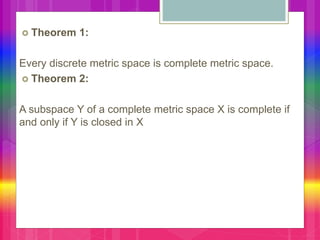
 Theorem 1:
Every discrete metric space is complete metric space.
 Theorem 2:
A subspace Y of a complete metric space X is complete if
and only if Y is closed in X
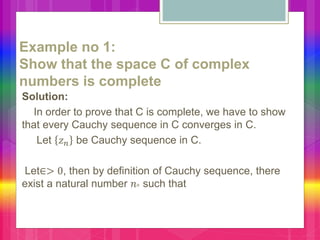
Example no 1:
Show that the space C of complex
numbers is complete
Solution:
In order to prove that C is complete, we have to show
that every Cauchy sequence in C converges in C.
Let 𝑧 𝑛 be Cauchy sequence in C.
Let∈> 0, then by definition of Cauchy sequence, there
exist a natural number 𝑛° such that
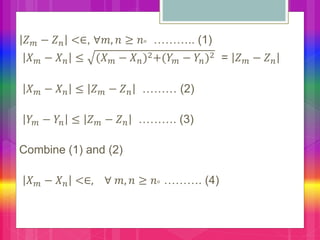
𝑍 𝑚 − 𝑍 𝑛 <∈, ∀𝑚, 𝑛 ≥ 𝑛° ……….. (1)
𝑋 𝑚 − 𝑋 𝑛 ≤ (𝑋 𝑚 − 𝑋 𝑛)2+(𝑌 𝑚 − 𝑌𝑛)2 = 𝑍 𝑚 − 𝑍 𝑛
𝑋 𝑚 − 𝑋 𝑛 ≤ 𝑍 𝑚 − 𝑍 𝑛 ……… (2)
𝑌 𝑚 − 𝑌𝑛 ≤ 𝑍 𝑚 − 𝑍 𝑛 ………. (3)
Combine (1) and (2)
𝑋 𝑚 − 𝑋 𝑛 <∈, ∀ 𝑚, 𝑛 ≥ 𝑛° ………. (4)
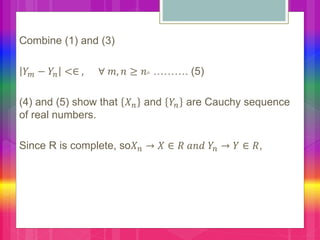
Combine (1) and (3)
𝑌 𝑚 − 𝑌𝑛 <∈ , ∀ 𝑚, 𝑛 ≥ 𝑛° ………. (5)
(4) and (5) show that 𝑋 𝑛 and 𝑌𝑛 are Cauchy sequence
of real numbers.
Since R is complete, so𝑋 𝑛 → 𝑋 ∈ 𝑅 𝑎𝑛𝑑 𝑌𝑛 → 𝑌 ∈ 𝑅,
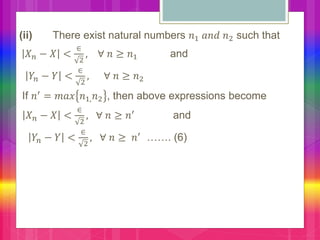
(ii) There exist natural numbers 𝑛1 𝑎𝑛𝑑 𝑛2 such that
𝑋 𝑛 − 𝑋 <
∈
2
, ∀ 𝑛 ≥ 𝑛1 and
𝑌𝑛 − 𝑌 <
∈
2
, ∀ 𝑛 ≥ 𝑛2
If 𝑛′ = 𝑚𝑎𝑥 𝑛1, 𝑛2 , then above expressions become
𝑋 𝑛 − 𝑋 <
∈
2
, ∀ 𝑛 ≥ 𝑛′ and
𝑌𝑛 − 𝑌 <
∈
2
, ∀ 𝑛 ≥ 𝑛′ ……. (6)
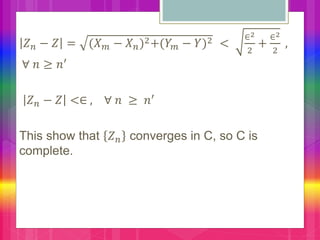
𝑍 𝑛 − 𝑍 = (𝑋 𝑚 − 𝑋 𝑛)2+(𝑌 𝑚 − 𝑌)2 <
∈2
2
+
∈2
2
,
∀ 𝑛 ≥ 𝑛′
𝑍 𝑛 − 𝑍 <∈ , ∀ 𝑛 ≥ 𝑛′
This show that 𝑍 𝑛 converges in C, so C is
complete.
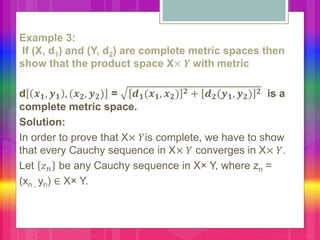
Example 3:
If (X, d1) and (Y, d2) are complete metric spaces then
show that the product space X× 𝒀 with metric
d 𝒙 𝟏, 𝒚 𝟏 , (𝒙 𝟐, 𝒚 𝟐) = 𝒅 𝟏(𝒙 𝟏, 𝒙 𝟐) 𝟐 + 𝒅 𝟐(𝒚 𝟏, 𝒚 𝟐) 𝟐 is a
complete metric space.
Solution:
In order to prove that X× 𝑌is complete, we have to show
that every Cauchy sequence in X× 𝑌 converges in X× 𝑌.
Let 𝑧 𝑛 be any Cauchy sequence in X× Y, where zn =
(xn , yn) ∈ X× Y.
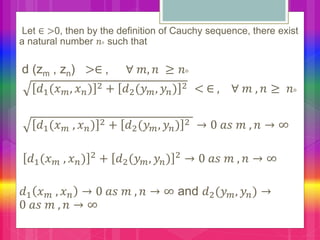
Let ∈ >0, then by the definition of Cauchy sequence, there exist
a natural number 𝑛° such that
d (zm , zn) >∈ , ∀ 𝑚, 𝑛 ≥ 𝑛°
𝑑1(𝑥 𝑚, 𝑥 𝑛) 2 + 𝑑2(𝑦 𝑚, 𝑦𝑛) 2 < ∈ , ∀ 𝑚 , 𝑛 ≥ 𝑛°
𝑑1(𝑥 𝑚 , 𝑥 𝑛) 2 + 𝑑2(𝑦 𝑚, 𝑦𝑛) 2 → 0 𝑎𝑠 𝑚 , 𝑛 → ∞
𝑑1(𝑥 𝑚 , 𝑥 𝑛) 2
+ 𝑑2(𝑦 𝑚, 𝑦𝑛) 2
→ 0 𝑎𝑠 𝑚 , 𝑛 → ∞
𝑑1 𝑥 𝑚 , 𝑥 𝑛 → 0 𝑎𝑠 𝑚 , 𝑛 → ∞ and 𝑑2(𝑦 𝑚, 𝑦𝑛) →
0 𝑎𝑠 𝑚 , 𝑛 → ∞
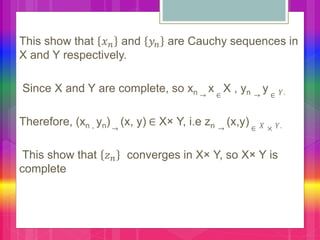
This show that 𝑥 𝑛 and 𝑦𝑛 are Cauchy sequences in
X and Y respectively.
Since X and Y are complete, so xn →
x ∈
X , yn →
y ∈ 𝑌.
Therefore, (xn , yn)→
(x, y) ∈ X× Y, i.e zn →
(x,y) ∈ 𝑋 × 𝑌.
This show that 𝑧 𝑛 converges in X× Y, so X× Y is
complete
Metric space
Metric space

Metric space

  • 2.
    Submitted to:  Ma’amMehak Submitted by:  Beenish Ebad  Bushra Razzaq Subject :  Math -B
  • 3.
    Content: Topics Definition of CauchySequence Example of Cauchy Sequence Result of Cauchy Sequence Definition of Subsequence Example of Subsequence Result of Subsequence Definition of Sub sequential Limit Example of Sub sequential Definition of Complete Metric Space Example of Complete Metric Space Results of Complete Metric Space Application of Complete Metric Space
  • 5.
  • 6.
    EXAMPLE NO: 01 Showthat every convergent sequence of real numbers is a Cauchy sequence. Proof:  Let 𝑿 𝒏 be a convergent sequence of real numbers.  Let 𝐱𝛜𝐑 𝐛𝐞 𝐢𝐭𝐬 𝐥𝐢𝐦𝐢𝐭 ,  Then, we have to show that,  𝑿 𝒏 𝐢𝐬 𝐚 𝐜𝐚𝐮𝐜𝐡𝐲 𝐬𝐞𝐪𝐮𝐞𝐧𝐜𝐞  For this,  Let ∈> 𝟎 𝐛𝐞 𝐚𝐧𝐲 𝐫𝐞𝐚𝐥 𝐧𝐮𝐦𝐛𝐞𝐫.  Since, 𝑿 𝒏 𝐜𝐨𝐧𝐯𝐞𝐫𝐠𝐞𝐬 𝐭𝐨 𝐗, 𝐬𝐨 𝐟𝐨𝐫 ∈> 𝟎, 𝐭here exist a positive integer n1.  ⇒ 𝐝 𝑿 𝒏, 𝑿 = 𝑿 𝒏, 𝑿 < 𝟏 𝟐 𝛜, ∀ 𝐧 ≥ 𝒏 𝟏. .. . . . .. . . . (1)  Similarly,  For 𝛜 > 𝟎, 𝐭𝐡𝐞𝐫𝐞 𝐞𝐱ist a positive integer n2  ⇒ 𝐝 𝑿 𝒎, 𝑿 = 𝑿 𝒎, 𝑿 < 𝟏 𝟐 𝛜, ∀ 𝐦 ≥ 𝒏 𝟐. .. . . . .. . . . (2)
  • 7.
    Cont.….  Let n0= max 𝒏 𝟏, 𝒏 𝟐  Then from e.q (1)  ⇒ 𝒅 𝑿 𝒏, 𝑿 = 𝑿 𝒏, 𝑿 < 𝟏 𝟐 𝝐, ∀ 𝒏 ≥ 𝒏 𝟎. .. . . . .. . . . (3)  From e.q (2)  ⇒ 𝒅 𝑿 𝒎, 𝑿 = 𝑿 𝒎, 𝑿 < 𝟏 𝟐 𝝐, ∀ 𝒎 ≥ 𝒏 𝟎. .. . . . .. . . . (4)  Adding e.q (3) and (4)  ⇒ 𝒅 𝑿 𝒎, 𝑿 + 𝒅 𝑿 𝒏, 𝑿 < 𝟏 𝟐 𝝐 + 𝟏 𝟐 𝝐, ∀ 𝒎, 𝒏 ≥ 𝒏 𝟎  ⇒ 𝒅 𝑿 𝒎, 𝑿 + 𝒅 𝑿, 𝑿 𝒏 < 𝝐, ∀𝒎 , 𝒏 ≥ 𝒏 𝟎  ⇒ 𝐝 𝑿 𝒎, 𝑿 𝒏 < 𝐝 𝑿 𝒎, 𝑿 + 𝐝 𝐗, 𝑿 𝒏 < 𝛜, ∀𝐦 , 𝐧 ≥ 𝒏 𝟎  ⇒ 𝒅 𝑿 𝒎, 𝑿 𝒏 < 𝝐, ∀𝒎 , 𝒏 ≥ 𝒏 𝟎  This shows that 𝑿 𝒏 𝒊𝒔 𝒂 𝒄𝒂𝒖𝒄𝒉𝒚 𝒔𝒆𝒒𝒖𝒆𝒏𝒄𝒆.
  • 8.
    Results related toCauchy sequence:  Every Cauchy sequence in a metric space is bounded.  The Cauchy sequence in a discrete metric space becomes constant after a finite no of terms.
  • 9.
    SUBSEQUENCES:  let 𝒙𝒏 𝐛𝐞 𝐚 𝐬𝐞𝐪𝐮𝐞𝐧𝐜𝐞 𝐢𝐧 𝐚 𝐦𝐞𝐭𝐫𝐢𝐜 𝐬𝐩𝐚𝐜𝐞 𝐗.  𝐜𝐨𝐧𝐜𝐢𝐝𝐞𝐫 𝐚 𝐬𝐞𝐪𝐮𝐞𝐧𝐜𝐞 𝒏 𝒌 𝐨𝐟 𝐩𝐨𝐬𝐢𝐭𝐢𝐯𝐞 𝐢𝐧𝐭𝐞𝐠𝐞𝐫𝐬  𝐬𝐮𝐜𝐡 𝐭𝐡𝐚𝐭 𝒏 𝟏 > 𝒏 𝟐 > 𝒏 𝟑. . . . . . . ,  𝐭𝐡𝐞𝐧 𝐭𝐡𝐞 𝐬𝐞𝐪𝐮𝐞𝐧𝐜𝐞 𝒙 𝒏 𝒌 𝐢𝐬 𝐜𝐚𝐥𝐥𝐞𝐝 𝐭𝐡𝐞 𝐬𝐮𝐛𝐬𝐞𝐪𝐮𝐞𝐧𝐜𝐞 𝐨𝐟 𝒙 𝒏
  • 10.
    Example : IF ASEQUENCE 𝒙 𝒏 𝒐𝒇 𝒓𝒆𝒂𝒍 𝒏𝒖𝒎𝒃𝒆𝒓𝒔 𝒄𝒐𝒏𝒗𝒆𝒓𝒈𝒆𝒔 𝒕𝒐 𝒂 𝒑𝒐𝒊𝒏𝒕 𝒙, 𝒕𝒉𝒆𝒏 𝒔𝒉𝒐𝒘 𝒕𝒉𝒂𝒕 𝒆𝒗𝒆𝒓𝒚 𝒔𝒖𝒃𝒔𝒆𝒒𝒖𝒆𝒏𝒄𝒆 𝒐𝒇 𝒙 𝒏 CONVERGES TO X  Let 𝒙 𝒏 𝒌 be any sequence of 𝒙 𝒏 .  since 𝒙 𝒏 converges to x, so for ε > 0  there exists a positive integer 𝒏 𝟎  such that,  ⇒ 𝐝 𝑿 𝒏, 𝑿 = 𝑿 𝒏, 𝑿 < 𝛜, ∀ 𝐧 ≥ 𝒏 𝟎  In particular,  ⇒ 𝐝 𝑿 𝒏 𝒌 , 𝑿 = 𝑿 𝒏 𝒌 , 𝑿 < 𝛜, ∀ 𝒏 𝒌 ≥ 𝒏 𝟎  This shows that the subsequence 𝒙 𝒏 𝒌 of 𝒙 𝒏 also converges to x.  Hence any subsequence of 𝒙 𝒏 converges to x.
  • 11.
    Results related tosubsequence  If a sequence of 𝐱 𝐧 converges to a point x in a metric space X, Then every subsequence of 𝐱 𝐧 Converges to x.  Every Cauchy sequence in a metric space converges if and only if it has a convergent subsequence
  • 12.
    SUB SEQUENTIAL LIMIT: Let xn be a sequence in a metric space X. and xnk be a subsequence of xn , if the subsequence xnk converges, then its limit is called sub sequential limit of the sequence xn .
  • 13.
    EXAMPLE: Consider a sequence𝒙 𝒏 in an R with nth term defined as 𝒙 𝒏 = 𝒏 , 𝒊𝒇 𝒏 𝒊𝒔 𝒆𝒗𝒆𝒏 𝟏 𝒏 , 𝒊𝒇 𝒏 𝒊𝒔 𝒐𝒅𝒅  Then,  𝟏 𝒏 𝒄𝒐𝒏𝒗𝒆𝒓𝒈𝒆𝒔 𝒕𝒐 𝟎,  And so,  𝟏 𝒏 is a convergent sub sequence of 𝒙 𝒏 ,  but the sequence 𝒙 𝒏 itself does not converge.  Here 0 is the sub sequential limit of 𝒙 𝒏 .
  • 14.
  • 15.
    Definition:  A completemetric space a metric space in every Cauchy sequence is convergent.  This definition means that if {𝑥 𝑛 } is any Cauchy sequence in a complete metric space X, then it should converge to some point of X.
  • 16.
    Example:  X=├]0,1┤[ isnot a complete metric space, because {𝑥 𝑛 }={1/n} is a Cauchy sequence in]0,1[ and tends to converge at 0 but 0 Ɇ X =]0,1[. so, {𝑥 𝑛 }={1/n} is not a convergent sequence in X.
  • 17.
    APPLICATIONS: • Complete metricspace is important in computer forensics and cryptography in securing data and information. • It has direct application to elliptic curve cryptography. • Hence, this enhances application in ICT and other areas of computer.
  • 18.
     Theorem 1: Everydiscrete metric space is complete metric space.  Theorem 2: A subspace Y of a complete metric space X is complete if and only if Y is closed in X
  • 19.
    Example no 1: Showthat the space C of complex numbers is complete Solution: In order to prove that C is complete, we have to show that every Cauchy sequence in C converges in C. Let 𝑧 𝑛 be Cauchy sequence in C. Let∈> 0, then by definition of Cauchy sequence, there exist a natural number 𝑛° such that
  • 20.
    𝑍 𝑚 −𝑍 𝑛 <∈, ∀𝑚, 𝑛 ≥ 𝑛° ……….. (1) 𝑋 𝑚 − 𝑋 𝑛 ≤ (𝑋 𝑚 − 𝑋 𝑛)2+(𝑌 𝑚 − 𝑌𝑛)2 = 𝑍 𝑚 − 𝑍 𝑛 𝑋 𝑚 − 𝑋 𝑛 ≤ 𝑍 𝑚 − 𝑍 𝑛 ……… (2) 𝑌 𝑚 − 𝑌𝑛 ≤ 𝑍 𝑚 − 𝑍 𝑛 ………. (3) Combine (1) and (2) 𝑋 𝑚 − 𝑋 𝑛 <∈, ∀ 𝑚, 𝑛 ≥ 𝑛° ………. (4)
  • 21.
    Combine (1) and(3) 𝑌 𝑚 − 𝑌𝑛 <∈ , ∀ 𝑚, 𝑛 ≥ 𝑛° ………. (5) (4) and (5) show that 𝑋 𝑛 and 𝑌𝑛 are Cauchy sequence of real numbers. Since R is complete, so𝑋 𝑛 → 𝑋 ∈ 𝑅 𝑎𝑛𝑑 𝑌𝑛 → 𝑌 ∈ 𝑅,
  • 22.
    (ii) There existnatural numbers 𝑛1 𝑎𝑛𝑑 𝑛2 such that 𝑋 𝑛 − 𝑋 < ∈ 2 , ∀ 𝑛 ≥ 𝑛1 and 𝑌𝑛 − 𝑌 < ∈ 2 , ∀ 𝑛 ≥ 𝑛2 If 𝑛′ = 𝑚𝑎𝑥 𝑛1, 𝑛2 , then above expressions become 𝑋 𝑛 − 𝑋 < ∈ 2 , ∀ 𝑛 ≥ 𝑛′ and 𝑌𝑛 − 𝑌 < ∈ 2 , ∀ 𝑛 ≥ 𝑛′ ……. (6)
  • 23.
    𝑍 𝑛 −𝑍 = (𝑋 𝑚 − 𝑋 𝑛)2+(𝑌 𝑚 − 𝑌)2 < ∈2 2 + ∈2 2 , ∀ 𝑛 ≥ 𝑛′ 𝑍 𝑛 − 𝑍 <∈ , ∀ 𝑛 ≥ 𝑛′ This show that 𝑍 𝑛 converges in C, so C is complete.
  • 24.
    Example 3: If (X,d1) and (Y, d2) are complete metric spaces then show that the product space X× 𝒀 with metric d 𝒙 𝟏, 𝒚 𝟏 , (𝒙 𝟐, 𝒚 𝟐) = 𝒅 𝟏(𝒙 𝟏, 𝒙 𝟐) 𝟐 + 𝒅 𝟐(𝒚 𝟏, 𝒚 𝟐) 𝟐 is a complete metric space. Solution: In order to prove that X× 𝑌is complete, we have to show that every Cauchy sequence in X× 𝑌 converges in X× 𝑌. Let 𝑧 𝑛 be any Cauchy sequence in X× Y, where zn = (xn , yn) ∈ X× Y.
  • 25.
    Let ∈ >0,then by the definition of Cauchy sequence, there exist a natural number 𝑛° such that d (zm , zn) >∈ , ∀ 𝑚, 𝑛 ≥ 𝑛° 𝑑1(𝑥 𝑚, 𝑥 𝑛) 2 + 𝑑2(𝑦 𝑚, 𝑦𝑛) 2 < ∈ , ∀ 𝑚 , 𝑛 ≥ 𝑛° 𝑑1(𝑥 𝑚 , 𝑥 𝑛) 2 + 𝑑2(𝑦 𝑚, 𝑦𝑛) 2 → 0 𝑎𝑠 𝑚 , 𝑛 → ∞ 𝑑1(𝑥 𝑚 , 𝑥 𝑛) 2 + 𝑑2(𝑦 𝑚, 𝑦𝑛) 2 → 0 𝑎𝑠 𝑚 , 𝑛 → ∞ 𝑑1 𝑥 𝑚 , 𝑥 𝑛 → 0 𝑎𝑠 𝑚 , 𝑛 → ∞ and 𝑑2(𝑦 𝑚, 𝑦𝑛) → 0 𝑎𝑠 𝑚 , 𝑛 → ∞
  • 26.
    This show that𝑥 𝑛 and 𝑦𝑛 are Cauchy sequences in X and Y respectively. Since X and Y are complete, so xn → x ∈ X , yn → y ∈ 𝑌. Therefore, (xn , yn)→ (x, y) ∈ X× Y, i.e zn → (x,y) ∈ 𝑋 × 𝑌. This show that 𝑧 𝑛 converges in X× Y, so X× Y is complete