Geo
ff
rey Goetz - January 2026
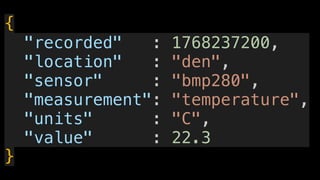
{
"recorded": 1768237200,
"location": "den",
"sensor": "bmp280",
"measurement": "temperature",
"units": "C",
"value": 22.3
}
One String, Many Prompts
A Hands-On Workshop in AI Code Generation
Hands-On Pre-Requisites
TOOLING
SETUP
ENVIRONMENT
SETUP
Install Docker, VS Code and Ollama (optional)
Create GitHub CoPilot Account
Create Docker (optional)
Create Postman and/or Ollama Account (optional)
Select primary Development Language
Run Docker Image for development language
Select primary Database Server
Run Docker Image for database server
Download Ollama LLM (optional)
MINIMAL REQUIREMENTS
VSCode
{
"recorded" : 1768237200,
"location" : "den",
"sensor" : "bmp280",
"measurement": "temperature",
"units" : "C",
"value" : 22.3
}
NO-SQL
5
Sensors
5
Microcontrollers
5
Platforms
5
Languages
5
Frameworks
5
Databases
1
String
5
AI LLMs
1K
AI Prompts
10K
Lines of Code
Combinations
5
~
5
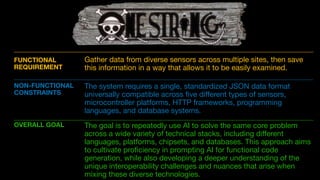
The goal is to repeatedly use AI to solve the same core problem
across a wide variety of technical stacks, including di
ff
erent
languages, platforms, chipsets, and databases. This approach aims
to cultivate pro
fi
ciency in prompting AI for functional code
generation, while also developing a deeper understanding of the
unique interoperability challenges and nuances that arise when
mixing these diverse technologies.
FUNCTIONAL
REQUIREMENT
NON-FUNCTIONAL
CONSTRAINTS
OVERALL GOAL
Gather data from diverse sensors across multiple sites, then save
this information in a way that allows it to be easily examined.
The system requires a single, standardized JSON data format
universally compatible across
fi
ve di
ff
erent types of sensors,
microcontroller platforms, HTTP frameworks, programming
languages, and database systems.
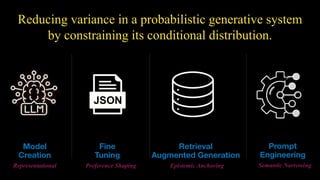
Reducing variance in a probabilistic generative system
by constraining its conditional distribution.
Model
Creation
Fine
Tuning
Retrieval
Augmented Generation
Prompt
Engineering
Representational Preference Shaping Epistemic Anchoring Semantic Narrowing
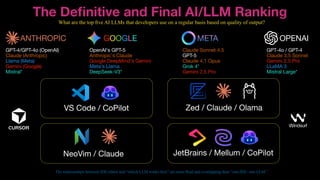
The De
fi
nitive and Final AI/LLM Ranking
What are the top
fi
ve AI LLMs that developers use on a regular basis based on quality of output?
GPT-4/GPT-4o (OpenAI)
Claude (Anthropic)
Llama (Meta)
Gemini (Google)
Mistral*
ANTHROPIC
OpenAI's GPT-5
Anthropic's Claude
Google DeepMind's Gemini
Meta's Llama
DeepSeek-V3*
GOOGLE
Claude Sonnet 4.5
GPT-5
Claude 4.1 Opus
Grok 4*
Gemini 2.5 Pro
META
GPT‑4o / GPT-4
Claude 3.5 Sonnet
Gemini 2.5 Pro
LLaMA 3
Mistral Large*
OPENAI
JetBrains / Mellum / CoPilot
Zed / Claude / Olama
VS Code / CoPilot
NeoVim / Claude
The relationships between IDE/editor and “which LLM works best” are more
fl
uid and overlapping than “one-IDE: one-LLM.”
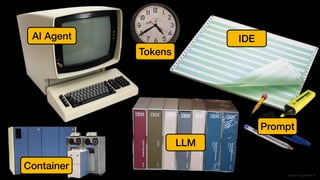
LLM
Tokens
Prompt
IDE
Container
AI Agent
copyright © ggeo
ff
re, llc
copyright © ggeo
ff
re, llc
externalized knowledge
scarcity constraint
intent expression
feedback surface
execution environment
interface layer
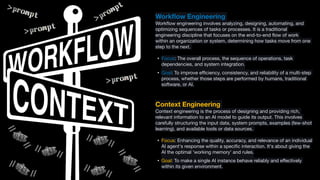
Context Engineering
Context engineering is the process of designing and providing rich,
relevant information to an AI model to guide its output. This involves
carefully structuring the input data, system prompts, examples (few-shot
learning), and available tools or data sources.
• Focus: Enhancing the quality, accuracy, and relevance of an individual
AI agent's response within a speci
fi
c interaction. It's about giving the
AI the optimal 'working memory' and rules.
• Goal: To make a single AI instance behave reliably and e
ff
ectively
within its given environment.
Work
fl
ow Engineering
Work
fl
ow engineering involves analyzing, designing, automating, and
optimizing sequences of tasks or processes. It is a traditional
engineering discipline that focuses on the end-to-end
fl
ow of work
within an organization or system, determining how tasks move from one
step to the next.
• Focus: The overall process, the sequence of operations, task
dependencies, and system integration.
• Goal: To improve e
ffi
ciency, consistency, and reliability of a multi-step
process, whether those steps are performed by humans, traditional
software, or AI.
>
>
>
>
{
"recorded": 1768570200,
"location": "den",
"sensor": "bmp280",
"measurement": "temperature",
"units": "C",
"value": 22.3
}
BMP280
SHT45
AHT20
HDC302x
MCP9808
Pico
ESP32
ATmega
SAMD21
nRF52
Pico-SDK
ESP-IDF
Arduino
CircuitPython
MicroPython
Python
Java
Swift
GO
Rust
Flask
Spring Boot
Vapor
Gin
Actix
Redis
Mongo
Cassandra
Postgres
MySQL
SENSOR
MICROCONTROLLER
PLATFORM
LANGUAGE
FRAMEWORK
DATABASE
NO-SQL
Read Sensor
Connect to Wi-Fi
Send Data Record Data
Retrieve Report
Purge Data
Gather data from diverse
sensors across multiple
sites…
then save this information in
a way that allows it to be
easily examined.
Read Sensor
Connect to Wi-Fi
Send Data Record Data
Retrieve Report
Purge Data
Establish a connection to the I²C Bus
Read the Sensor Data
Create the JSON String
Establish a Wi-Fi Connection
Send the JSON String to the HTTP API
Recorded Time of Data Collection*
Listen for HTTP POST/GET API Calls
Receive the JSON String
Store JSON data into a Database
Retrieve JSON data from a Database
Purge JSON data from a Database
RecordedTime of Data Recording*
NO-SQL
PLATFORMS
SENSORS & LIBRARIES
what are the most used and best maintained microcontroller platforms
what are the most reputable online sites that rank microcontroller platforms
what are the di
ff
erent categories of microcontroller platforms
what are the most used and easy to source microcontroller development boards
which microcontroller development boards can connect to Wi-Fi
which microcontroller development boards have a STEMMA/QT connector
what is the best way to collect data from a wide variety of sensors using a
microcontroller without soldering, think carefully about this
which I2C sensors have supporting libraries for all $XYZ platforms, think
carefully about this
for the $XYZ microcontroller platform, what are the most popular and recently
maintained libraries that communicate over I2C supporting the $XYZ sensor,
think carefully about this
DEV
BOARDS
LANGUAGES
DATABASES
FRAMEWORKS & LIBRARIES
what are the most used and best maintained programming languages
what are the most reputable online sites that rank programming languages
what are the di
ff
erent categories of programming languages
what are the most used and best maintained databases
what are the most reputable online sites that rank databases
what are the di
ff
erent types of databases
what is the best way to send a JSON string from a microcontroller over the
network to be stored into a database, think carefully about this
for the $XYZ programming language, what are the most popular and recently
maintained frameworks that send and receive JSON via HTTP POST and GET,
think carefully about this
for the $XYZ programming language, what are the most popular and recently
maintained libraries used with the $XYZ database, think carefully about this
Read Sensor
Connect to Wi-Fi
Send Data Record Data
Retrieve Report
Purge Data
Establish a connection to the I²C Bus
Read the Sensor Data
Create the JSON String
Establish a Wi-Fi Connection
Send the JSON String to the HTTP API
Record Time of Data Collection*
Listen for HTTP POST/GET API Calls
Receive the JSON String
Store JSON data into a Database
Retrieve JSON data from a Database
Purge JSON data from a Database
Record Time of Data Recording*
NO-SQL
Hands On Exercises
Inserting the One String
Feedback
Code
Your First Two Prompts
docker run -d --name python-container -p 8080:8080 -v
$MY_LOCAL_CODE_DIRECTORY:/usr/src/python python:3.13.5 sleep in
fi
nity
docker run -d --name mongo-container -p 27017:27017 mongo:8.2.2
Docker Terminal
docker exec -it -w /home/projects/python python-container /bin/bash
pip install --upgrade pip
VS Code Terminal
create a simple
python method
to connect to a
mongo db
database
what python
library do i need to
install to support
the import of
MongoClient
PROMPT
#1
PROMPT
#2
Using
Container
Runtime,
Accessing
Local Code
docker run -d --name python-container -p 8080:8080 -v
$MY_LOCAL_CODE_DIRECTORY:/usr/src/python python:3.13.5 sleep
in
fi
nity
docker run -d --name mongo-container -p 27017:27017 mongo:8.2.2
Docker Terminal
docker exec -it -w /usr/src/python python-container /bin/bash
python --version; pip --version; pwd; ls
pip install --upgrade pip
VS Code Terminal
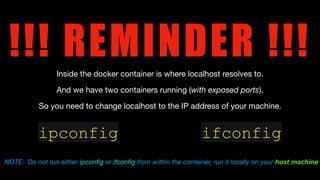
!!! REMINDER !!!
Inside the docker container is where localhost resolves to.
And we have two containers running (with exposed ports).
So you need to change localhost to the IP address of your machine.
ipconfig ifconfig
NOTE: Do not run either ipcon
fi
g or ifcon
fi
g from within the container, run it locally on your host machine
https://github.com/ggeo
ff
re/onestring
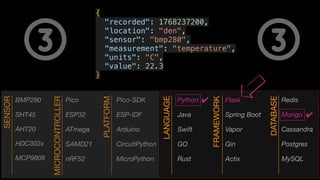
{
"recorded": 1768237200,
"location": "den",
"sensor": "bmp280",
"measurement": "temperature",
"units": "C",
"value": 22.3
}
Pico
ESP32
ATmega
SAMD21
nRF52
Pico-SDK
ESP-IDF
Arduino
CircuitPython
MicroPython
Python
Java
Swift
GO
Rust
Flask
Spring Boot
Vapor
Gin
Actix
Redis
Mongo
Cassandra
Postgres
MySQL
SENSOR
MICROCONTROLLER
PLATFORM
LANGUAGE
FRAMEWORK
DATABASE
✔
BMP280
SHT45
AHT20
HDC302x
MCP9808
Your First 5 Prompts
n
PYTHON
create a simple python method to connect to a mongo database
create a simple python method to connect to a redis database
create a simple python method to connect to a cassandra database
create a simple python method to connect to a postgres database
create a simple python method to connect to a mysql database
JAVA
create a simple java method to connect to a mongo database
create a simple java method to connect to a redis database
create a simple java method to connect to a cassandra database
create a simple java method to connect to a postgres database
create a simple java method to connect to a mysql database
SWIFT
create a simple swift method to connect to a mongo database
create a simple swift method to connect to a redis database
create a simple swift method to connect to a cassandra database
create a simple swift method to connect to a postgres database
create a simple swift method to connect to a mysql database
GO
create a simple go method to connect to a mongo database
create a simple go method to connect to a redis database
create a simple go method to connect to a cassandra database
create a simple go method to connect to a postgres database
create a simple go method to connect to a mysql database
create a simple rust method to connect to a mongo database
create a simple rust method to connect to a redis database
create a simple rust method to connect to a cassandra database
create a simple rust method to connect to a postgres database
create a simple rust method to connect to a mysql database
RUST
AI Lessons Learned Already…
• Programming Language Age Matters
• Database Library Selection Criteria
• Language, Library and Database
Versions Matter
• Using “localhost” with Docker
Images
• Resolving port con
fl
icts can be tricky
• Not every database library has a
‘connection’ or a ‘table’
• Code does not take ‘initialization’ into
account
create a simple python v3.12 method
to connect to a mongo v8.0 database
with the pymongo v4.15.3 pip3 library
using ip address 192.168.1.60 to connect
UPDATE
from pymongo import MongoClient
def connect_to_mongodb(host='192.168.1.60', port=27017):
try:
client = MongoClient(host, port)
client.admin.command('ping')
print("Connected to MongoDB successfully!")
return client
except Exception as e:
print(f"Failed to connect to MongoDB: {e}")
return None
if __name__ == '__main__':
client = connect_to_mongodb()
if client:
db = client['mydatabase']
collection = db['mycollection']
print(db.list_collection_names())
client.close()
from pymongo import MongoClient
def connect_to_mongodb(host=‘localhost', port=27017):
client = MongoClient(host, port)
return client
if __name__ == '__main__':
client = connect_to_mongodb()
print("Connected to MongoDB:", client)
create a simple python method
to connect to a mongo database
create a safe python v3.12 method
to connect to a mongo v8.0 database
with the pymongo v4.15.3 pip3 library
using ip address 192.168.1.60 to connect
Your First 5 Prompts
n
VERSION A VERSION B
Accept
Accept
Your First 5 Prompts
n
in the Python language, create a method that recursively removes a speci
fi
ed key from either a JSON string or a list of dictionaries, preserving the
nested structure and handling both input types automatically
in the Python language, create a method that transforms a JSON list into a CSV string, with the keys as the column headers
in the Python language, create a method that modi
fi
es the value of a speci
fi
ed key in a JSON string
in the Python language, set a variable to a randomly generated
fl
oat value between 20.9 and 34.4 with one decimal place of precision
in the Python language, set a variable to the current timestamp
DATA
STORAGE
DATA
REPORTING
in the python language v3.12, create a method to connect to a mongo v8.0 database with the pymongo v4.15.3 pip3 library using ip address
192.168.1.60 to connect
in the python language using pymongo, create a method that will create a database named sensor_data_db and a collection named sensor_data in
the mongo database
in the Python language using pymongo, create a method that will store the following JSON string into a mongo collection named sensor_data in the
db named sensor_data_db: {“recorded":1234567890,"location":"den","sensor":"bmp280","measurement":"temperature","units":"C","value":22.3}
in the Python language using pymongo, create a method that will fetch all members of the collection named sensor_data in the db named
sensor_data_db
in the Python language using pymongo, create a method that will remove all members of the collection named sensor_data in the db named
sensor_data_db
Your First 5 Prompts
n
• Complexity and Edge Cases: LLMs are good at generating small, isolated functions but
struggle signi
fi
cantly with large-scale architecture, complex interactions across multiple les,
and subtle edge cases. The probability of errors compounds with complexity.
• Lack of Deep Understanding: AI doesn't "understand" the underlying hardware trade-o s
(e.g., speci
fi
c memory access patterns or cache optimizations) in the same way an expert
systems programmer does. It generates plausible code based on patterns it was trained on,
which might be functional but ine
ffi
cient or suboptimal for extreme performance requirements.
• Debugging Is Still a Human Task: When AI-generated code breaks (which happens
frequently), debugging it can be harder than debugging manually written code because the user
didn't write it and might not understand the logic the AI used.
• Performance vs. Readability Trade-o
ff
s: Human experts balance readability and optimization.
AI might produce code that is technically correct but messy, making maintenance di cult and
introducing technical debt.
• Need for Human Oversight: The consensus among industry experts is that AI-generated code
still requires thorough human review, testing, and validation to ensure correctness, security, and
performance.
ORIGINAL
REFACTOR
Hands On Exercises
Posting the One String
Feedback
Code
{
"recorded": 1768237200,
"location": "den",
"sensor": "bmp280",
"measurement": "temperature",
"units": "C",
"value": 22.3
}
Pico
ESP32
ATmega
SAMD21
nRF52
Pico-SDK
ESP-IDF
Arduino
CircuitPython
MicroPython
Python
Java
Swift
GO
Rust
Flask
Spring Boot
Vapor
Gin
Actix
Redis
Mongo
Cassandra
Postgres
MySQL
SENSOR
MICROCONTROLLER
PLATFORM
LANGUAGE
FRAMEWORK
DATABASE
✔
✔
BMP280
SHT45
AHT20
HDC302x
MCP9808
PYTHON
create a very basic web app using the python language
fl
ask framework
add routes for the following:
GET / POST /echo POST /log GET /report POST or GET /purge
create a very basic web app using the python language django framework
add routes for the following:
GET / POST /echo POST /log GET /report POST or GET /purge
GO
create a very basic web app using the go language echo framework
add routes for the following:
GET / POST /echo POST /log GET /report POST or GET /purge
create a very basic web app using the go language gin framework
add routes for the following:
GET / POST /echo POST /log GET /report POST or GET /purge
create a very basic web app using the python language actix framework
add routes for the following:
GET / POST /echo POST /log GET /report POST or GET /purge
create a very basic web app using the python language axum framework
add routes for the following:
GET / POST /echo POST /log GET /report POST or GET /purge
RUST
More AI Lessons Learned…
• Supported data types are a real
pain…
• Language, Database, JSON
• Timestamp & Float Precision
• Multiple ‘styles’ for storing and
retrieving data…
• POJO for Java’s Spring Boot
• Row/Column traversal
• To Struct or not to Struct (obj,
class, etc)
create a simple python v3.12 web app
using
fl
ask v8.0 database
that can bind to any address
UPDATE
Your Second 5 Prompts
n
JAVA
create a very basic web app using the java language quarkus framework
add routes for the following:
GET / POST /echo POST /log GET /report POST or GET /purge
create a very basic web app using the java language spring framework
add routes for the following:
GET / POST /echo POST /log GET /report POST or GET /purge
SWIFT
create a very basic web app using the swift language vapor framework
add routes for the following:
GET / POST /echo POST /log GET /report POST or GET /purge
!!! REMINDER !!!
Inside the docker container is where localhost resolves to.
And we have two containers running (with exposed ports).
So you need to change which IP address and port your framework binds to.
python app.py runserver 0.0.0.0:8080
NOTE: Each framework has a di
ff
erent technique to con
fi
gure which IP address it binds to.
Hands On Exercises
Dependency Injection
Feedback
Code
TOOLS
Dependency
Injection
Inversion of Control
Service
Locator
Template
Method
Event
Driven
Aspect
Oriented
DI
Container
Composition
Root
Builder
Pattern
Proxy
Pattern
Event
Bus
Message
Broker
Mediator
Pattern
Strategy
Pattern
Hook
Callback
Decorator
Pattern
Interceptor
Registry
Context
Object
Dependency
Lookup
the goal
S T R A G E G I E S
Hands On Exercises
Putting it all Together
Feedback
Code
Copy code from tasks two
and three and reuse the
“helper” implementation
from the stretch goals in
task one.
Use AI/LLM to cherry pick
database code from other
projects to implement in
the legos project.
Use AI/LLM to wire
everything together.
Stretch the OneString
(5+n)
(5+n)
Feedback
Code
are ‘prompts’ the new ‘code’?
projector.tensor
fl
ow.org
Embeddings
platform.openai.com/tokenizer
Create a python function to connect to a
mongo database
[5104, 261, 22752, 1114, 316, 4837, 316,
261, 63752, 7862]
Prompt Tokenizer
Concurrency and Thread Safety
• Is this method or function stateless and thread-safe?
• Are there any shared resources being accessed? If so, how are they synchronized?
• Does the code use any locks or mutexes? If so, how are these managed?
Architecture, Design, and Structure
• Is there a high-level overview or documentation explaining the purpose, inputs, and outputs of the code?
• Are all external dependencies clearly listed, including their versions?
• Are there instructions on how to set up the environment and install dependencies?
• Is the code portable and can it run on different operating systems or environments?
• Does the code follow the principles of object-oriented programming (OOP) or functional programming (FP),
whichever is appropriate for the context?
• Is the separation of concerns clearly maintained within the code?
• Are there any design patterns being used, and are they applied correctly?
• Does the code adhere to the single responsibility principle (SRP)?
Error Handling and Resilience
• Does this method or function follow best practices for error handling?
• Are there any edge cases or exceptional situations that need special attention?
• Is error information being logged or propagated correctly?
• Does the code handle potential failures or unavailability of external dependencies gracefully?
Logging and Monitoring
• What would be a better way to implement logging?
• Confirm whether the code uses an effective logging mechanism that provides useful information without
overwhelming the system.
• Are there any logging frameworks or libraries being used? If so, are they properly configured?
• Can the logging level be adjusted dynamically?
Performance and Scalability
• Can this code scale infinitely?
• Can the code can handle increased traffic or workload without experiencing significant performance degradation.
• Has the code been designed to scale horizontally or vertically and can it adapt to changing conditions.
• Are there any performance bottlenecks or hotspots in the code?
• Can the code be optimized for specific hardware or infrastructure configurations?
Security
• Are there any security vulnerabilities, such as SQL injection, XSS, or CSRF risks?
• Does the code properly handle and sanitize all user inputs to prevent injection attacks?
• Are sensitive data (e.g., passwords, API keys) handled securely, and not hardcoded?
• Does the code use secure communication protocols (e.g., HTTPS) for data transmission?
• Confirm that access controls and authorization checks are correctly implemented.
Testing and Validation
• Is the code covered by unit tests, and do these tests cover edge cases?
• Can you generate a comprehensive set of unit tests (including test data) for this code?
• Are there clear steps provided on how to run and verify the tests?
• Does the code have meaningful assertions to validate inputs and outputs?
• How can this code be tested in an automated fashion?
Code Quality, Readability, and Maintainability
• Has this code complied with the principles of clean code?
• Are there any duplicate code blocks or overlapping logic?
• Can the code be refactored to improve readability or maintainability?
• Does the code have clear and concise comments where necessary, explaining complex logic?
• Does the code follow established style guides (e.g., PEP 8 for Python, Google Style Guide for Java)?
• Are the variable and function names descriptive and meaningful?
• Is the code modular and broken down into small, manageable functions or methods?
Even More Prompt Opportunities
Thank
You!

One String, Many Prompts: AI Code Generation

  • 1.
    Geo ff rey Goetz -January 2026 { "recorded": 1768237200, "location": "den", "sensor": "bmp280", "measurement": "temperature", "units": "C", "value": 22.3 } One String, Many Prompts A Hands-On Workshop in AI Code Generation
  • 3.
    Hands-On Pre-Requisites TOOLING SETUP ENVIRONMENT SETUP Install Docker,VS Code and Ollama (optional) Create GitHub CoPilot Account Create Docker (optional) Create Postman and/or Ollama Account (optional) Select primary Development Language Run Docker Image for development language Select primary Database Server Run Docker Image for database server Download Ollama LLM (optional) MINIMAL REQUIREMENTS VSCode
  • 4.
    { "recorded" : 1768237200, "location": "den", "sensor" : "bmp280", "measurement": "temperature", "units" : "C", "value" : 22.3 }
  • 5.
  • 6.
    The goal isto repeatedly use AI to solve the same core problem across a wide variety of technical stacks, including di ff erent languages, platforms, chipsets, and databases. This approach aims to cultivate pro fi ciency in prompting AI for functional code generation, while also developing a deeper understanding of the unique interoperability challenges and nuances that arise when mixing these diverse technologies. FUNCTIONAL REQUIREMENT NON-FUNCTIONAL CONSTRAINTS OVERALL GOAL Gather data from diverse sensors across multiple sites, then save this information in a way that allows it to be easily examined. The system requires a single, standardized JSON data format universally compatible across fi ve di ff erent types of sensors, microcontroller platforms, HTTP frameworks, programming languages, and database systems.
  • 8.
    Reducing variance ina probabilistic generative system by constraining its conditional distribution. Model Creation Fine Tuning Retrieval Augmented Generation Prompt Engineering Representational Preference Shaping Epistemic Anchoring Semantic Narrowing
  • 9.
    The De fi nitive andFinal AI/LLM Ranking What are the top fi ve AI LLMs that developers use on a regular basis based on quality of output? GPT-4/GPT-4o (OpenAI) Claude (Anthropic) Llama (Meta) Gemini (Google) Mistral* ANTHROPIC OpenAI's GPT-5 Anthropic's Claude Google DeepMind's Gemini Meta's Llama DeepSeek-V3* GOOGLE Claude Sonnet 4.5 GPT-5 Claude 4.1 Opus Grok 4* Gemini 2.5 Pro META GPT‑4o / GPT-4 Claude 3.5 Sonnet Gemini 2.5 Pro LLaMA 3 Mistral Large* OPENAI JetBrains / Mellum / CoPilot Zed / Claude / Olama VS Code / CoPilot NeoVim / Claude The relationships between IDE/editor and “which LLM works best” are more fl uid and overlapping than “one-IDE: one-LLM.”
  • 10.
  • 11.
    copyright © ggeo ff re,llc externalized knowledge scarcity constraint intent expression feedback surface execution environment interface layer
  • 12.
    Context Engineering Context engineeringis the process of designing and providing rich, relevant information to an AI model to guide its output. This involves carefully structuring the input data, system prompts, examples (few-shot learning), and available tools or data sources. • Focus: Enhancing the quality, accuracy, and relevance of an individual AI agent's response within a speci fi c interaction. It's about giving the AI the optimal 'working memory' and rules. • Goal: To make a single AI instance behave reliably and e ff ectively within its given environment. Work fl ow Engineering Work fl ow engineering involves analyzing, designing, automating, and optimizing sequences of tasks or processes. It is a traditional engineering discipline that focuses on the end-to-end fl ow of work within an organization or system, determining how tasks move from one step to the next. • Focus: The overall process, the sequence of operations, task dependencies, and system integration. • Goal: To improve e ffi ciency, consistency, and reliability of a multi-step process, whether those steps are performed by humans, traditional software, or AI. > > > >
  • 13.
    { "recorded": 1768570200, "location": "den", "sensor":"bmp280", "measurement": "temperature", "units": "C", "value": 22.3 } BMP280 SHT45 AHT20 HDC302x MCP9808 Pico ESP32 ATmega SAMD21 nRF52 Pico-SDK ESP-IDF Arduino CircuitPython MicroPython Python Java Swift GO Rust Flask Spring Boot Vapor Gin Actix Redis Mongo Cassandra Postgres MySQL SENSOR MICROCONTROLLER PLATFORM LANGUAGE FRAMEWORK DATABASE
  • 14.
    NO-SQL Read Sensor Connect toWi-Fi Send Data Record Data Retrieve Report Purge Data Gather data from diverse sensors across multiple sites… then save this information in a way that allows it to be easily examined.
  • 15.
    Read Sensor Connect toWi-Fi Send Data Record Data Retrieve Report Purge Data Establish a connection to the I²C Bus Read the Sensor Data Create the JSON String Establish a Wi-Fi Connection Send the JSON String to the HTTP API Recorded Time of Data Collection* Listen for HTTP POST/GET API Calls Receive the JSON String Store JSON data into a Database Retrieve JSON data from a Database Purge JSON data from a Database RecordedTime of Data Recording* NO-SQL
  • 16.
    PLATFORMS SENSORS & LIBRARIES whatare the most used and best maintained microcontroller platforms what are the most reputable online sites that rank microcontroller platforms what are the di ff erent categories of microcontroller platforms what are the most used and easy to source microcontroller development boards which microcontroller development boards can connect to Wi-Fi which microcontroller development boards have a STEMMA/QT connector what is the best way to collect data from a wide variety of sensors using a microcontroller without soldering, think carefully about this which I2C sensors have supporting libraries for all $XYZ platforms, think carefully about this for the $XYZ microcontroller platform, what are the most popular and recently maintained libraries that communicate over I2C supporting the $XYZ sensor, think carefully about this DEV BOARDS
  • 17.
    LANGUAGES DATABASES FRAMEWORKS & LIBRARIES whatare the most used and best maintained programming languages what are the most reputable online sites that rank programming languages what are the di ff erent categories of programming languages what are the most used and best maintained databases what are the most reputable online sites that rank databases what are the di ff erent types of databases what is the best way to send a JSON string from a microcontroller over the network to be stored into a database, think carefully about this for the $XYZ programming language, what are the most popular and recently maintained frameworks that send and receive JSON via HTTP POST and GET, think carefully about this for the $XYZ programming language, what are the most popular and recently maintained libraries used with the $XYZ database, think carefully about this
  • 18.
    Read Sensor Connect toWi-Fi Send Data Record Data Retrieve Report Purge Data Establish a connection to the I²C Bus Read the Sensor Data Create the JSON String Establish a Wi-Fi Connection Send the JSON String to the HTTP API Record Time of Data Collection* Listen for HTTP POST/GET API Calls Receive the JSON String Store JSON data into a Database Retrieve JSON data from a Database Purge JSON data from a Database Record Time of Data Recording* NO-SQL
  • 20.
    Hands On Exercises Insertingthe One String Feedback Code
  • 21.
    Your First TwoPrompts docker run -d --name python-container -p 8080:8080 -v $MY_LOCAL_CODE_DIRECTORY:/usr/src/python python:3.13.5 sleep in fi nity docker run -d --name mongo-container -p 27017:27017 mongo:8.2.2 Docker Terminal docker exec -it -w /home/projects/python python-container /bin/bash pip install --upgrade pip VS Code Terminal create a simple python method to connect to a mongo db database what python library do i need to install to support the import of MongoClient PROMPT #1 PROMPT #2 Using Container Runtime, Accessing Local Code
  • 22.
    docker run -d--name python-container -p 8080:8080 -v $MY_LOCAL_CODE_DIRECTORY:/usr/src/python python:3.13.5 sleep in fi nity docker run -d --name mongo-container -p 27017:27017 mongo:8.2.2 Docker Terminal docker exec -it -w /usr/src/python python-container /bin/bash python --version; pip --version; pwd; ls pip install --upgrade pip VS Code Terminal
  • 23.
    !!! REMINDER !!! Insidethe docker container is where localhost resolves to. And we have two containers running (with exposed ports). So you need to change localhost to the IP address of your machine. ipconfig ifconfig NOTE: Do not run either ipcon fi g or ifcon fi g from within the container, run it locally on your host machine
  • 24.
  • 25.
    { "recorded": 1768237200, "location": "den", "sensor":"bmp280", "measurement": "temperature", "units": "C", "value": 22.3 } Pico ESP32 ATmega SAMD21 nRF52 Pico-SDK ESP-IDF Arduino CircuitPython MicroPython Python Java Swift GO Rust Flask Spring Boot Vapor Gin Actix Redis Mongo Cassandra Postgres MySQL SENSOR MICROCONTROLLER PLATFORM LANGUAGE FRAMEWORK DATABASE ✔ BMP280 SHT45 AHT20 HDC302x MCP9808
  • 26.
    Your First 5Prompts n PYTHON create a simple python method to connect to a mongo database create a simple python method to connect to a redis database create a simple python method to connect to a cassandra database create a simple python method to connect to a postgres database create a simple python method to connect to a mysql database JAVA create a simple java method to connect to a mongo database create a simple java method to connect to a redis database create a simple java method to connect to a cassandra database create a simple java method to connect to a postgres database create a simple java method to connect to a mysql database SWIFT create a simple swift method to connect to a mongo database create a simple swift method to connect to a redis database create a simple swift method to connect to a cassandra database create a simple swift method to connect to a postgres database create a simple swift method to connect to a mysql database GO create a simple go method to connect to a mongo database create a simple go method to connect to a redis database create a simple go method to connect to a cassandra database create a simple go method to connect to a postgres database create a simple go method to connect to a mysql database create a simple rust method to connect to a mongo database create a simple rust method to connect to a redis database create a simple rust method to connect to a cassandra database create a simple rust method to connect to a postgres database create a simple rust method to connect to a mysql database RUST AI Lessons Learned Already… • Programming Language Age Matters • Database Library Selection Criteria • Language, Library and Database Versions Matter • Using “localhost” with Docker Images • Resolving port con fl icts can be tricky • Not every database library has a ‘connection’ or a ‘table’ • Code does not take ‘initialization’ into account create a simple python v3.12 method to connect to a mongo v8.0 database with the pymongo v4.15.3 pip3 library using ip address 192.168.1.60 to connect UPDATE
  • 27.
    from pymongo importMongoClient def connect_to_mongodb(host='192.168.1.60', port=27017): try: client = MongoClient(host, port) client.admin.command('ping') print("Connected to MongoDB successfully!") return client except Exception as e: print(f"Failed to connect to MongoDB: {e}") return None if __name__ == '__main__': client = connect_to_mongodb() if client: db = client['mydatabase'] collection = db['mycollection'] print(db.list_collection_names()) client.close() from pymongo import MongoClient def connect_to_mongodb(host=‘localhost', port=27017): client = MongoClient(host, port) return client if __name__ == '__main__': client = connect_to_mongodb() print("Connected to MongoDB:", client) create a simple python method to connect to a mongo database create a safe python v3.12 method to connect to a mongo v8.0 database with the pymongo v4.15.3 pip3 library using ip address 192.168.1.60 to connect Your First 5 Prompts n VERSION A VERSION B Accept Accept
  • 28.
    Your First 5Prompts n in the Python language, create a method that recursively removes a speci fi ed key from either a JSON string or a list of dictionaries, preserving the nested structure and handling both input types automatically in the Python language, create a method that transforms a JSON list into a CSV string, with the keys as the column headers in the Python language, create a method that modi fi es the value of a speci fi ed key in a JSON string in the Python language, set a variable to a randomly generated fl oat value between 20.9 and 34.4 with one decimal place of precision in the Python language, set a variable to the current timestamp DATA STORAGE DATA REPORTING in the python language v3.12, create a method to connect to a mongo v8.0 database with the pymongo v4.15.3 pip3 library using ip address 192.168.1.60 to connect in the python language using pymongo, create a method that will create a database named sensor_data_db and a collection named sensor_data in the mongo database in the Python language using pymongo, create a method that will store the following JSON string into a mongo collection named sensor_data in the db named sensor_data_db: {“recorded":1234567890,"location":"den","sensor":"bmp280","measurement":"temperature","units":"C","value":22.3} in the Python language using pymongo, create a method that will fetch all members of the collection named sensor_data in the db named sensor_data_db in the Python language using pymongo, create a method that will remove all members of the collection named sensor_data in the db named sensor_data_db
  • 29.
    Your First 5Prompts n • Complexity and Edge Cases: LLMs are good at generating small, isolated functions but struggle signi fi cantly with large-scale architecture, complex interactions across multiple les, and subtle edge cases. The probability of errors compounds with complexity. • Lack of Deep Understanding: AI doesn't "understand" the underlying hardware trade-o s (e.g., speci fi c memory access patterns or cache optimizations) in the same way an expert systems programmer does. It generates plausible code based on patterns it was trained on, which might be functional but ine ffi cient or suboptimal for extreme performance requirements. • Debugging Is Still a Human Task: When AI-generated code breaks (which happens frequently), debugging it can be harder than debugging manually written code because the user didn't write it and might not understand the logic the AI used. • Performance vs. Readability Trade-o ff s: Human experts balance readability and optimization. AI might produce code that is technically correct but messy, making maintenance di cult and introducing technical debt. • Need for Human Oversight: The consensus among industry experts is that AI-generated code still requires thorough human review, testing, and validation to ensure correctness, security, and performance.
  • 30.
  • 31.
    Hands On Exercises Postingthe One String Feedback Code
  • 32.
    { "recorded": 1768237200, "location": "den", "sensor":"bmp280", "measurement": "temperature", "units": "C", "value": 22.3 } Pico ESP32 ATmega SAMD21 nRF52 Pico-SDK ESP-IDF Arduino CircuitPython MicroPython Python Java Swift GO Rust Flask Spring Boot Vapor Gin Actix Redis Mongo Cassandra Postgres MySQL SENSOR MICROCONTROLLER PLATFORM LANGUAGE FRAMEWORK DATABASE ✔ ✔ BMP280 SHT45 AHT20 HDC302x MCP9808
  • 33.
    PYTHON create a verybasic web app using the python language fl ask framework add routes for the following: GET / POST /echo POST /log GET /report POST or GET /purge create a very basic web app using the python language django framework add routes for the following: GET / POST /echo POST /log GET /report POST or GET /purge GO create a very basic web app using the go language echo framework add routes for the following: GET / POST /echo POST /log GET /report POST or GET /purge create a very basic web app using the go language gin framework add routes for the following: GET / POST /echo POST /log GET /report POST or GET /purge create a very basic web app using the python language actix framework add routes for the following: GET / POST /echo POST /log GET /report POST or GET /purge create a very basic web app using the python language axum framework add routes for the following: GET / POST /echo POST /log GET /report POST or GET /purge RUST More AI Lessons Learned… • Supported data types are a real pain… • Language, Database, JSON • Timestamp & Float Precision • Multiple ‘styles’ for storing and retrieving data… • POJO for Java’s Spring Boot • Row/Column traversal • To Struct or not to Struct (obj, class, etc) create a simple python v3.12 web app using fl ask v8.0 database that can bind to any address UPDATE Your Second 5 Prompts n JAVA create a very basic web app using the java language quarkus framework add routes for the following: GET / POST /echo POST /log GET /report POST or GET /purge create a very basic web app using the java language spring framework add routes for the following: GET / POST /echo POST /log GET /report POST or GET /purge SWIFT create a very basic web app using the swift language vapor framework add routes for the following: GET / POST /echo POST /log GET /report POST or GET /purge
  • 34.
    !!! REMINDER !!! Insidethe docker container is where localhost resolves to. And we have two containers running (with exposed ports). So you need to change which IP address and port your framework binds to. python app.py runserver 0.0.0.0:8080 NOTE: Each framework has a di ff erent technique to con fi gure which IP address it binds to.
  • 35.
    Hands On Exercises DependencyInjection Feedback Code
  • 36.
  • 37.
    Hands On Exercises Puttingit all Together Feedback Code
  • 38.
    Copy code fromtasks two and three and reuse the “helper” implementation from the stretch goals in task one. Use AI/LLM to cherry pick database code from other projects to implement in the legos project. Use AI/LLM to wire everything together.
  • 39.
  • 40.
    are ‘prompts’ thenew ‘code’? projector.tensor fl ow.org Embeddings platform.openai.com/tokenizer Create a python function to connect to a mongo database [5104, 261, 22752, 1114, 316, 4837, 316, 261, 63752, 7862] Prompt Tokenizer
  • 43.
    Concurrency and ThreadSafety • Is this method or function stateless and thread-safe? • Are there any shared resources being accessed? If so, how are they synchronized? • Does the code use any locks or mutexes? If so, how are these managed? Architecture, Design, and Structure • Is there a high-level overview or documentation explaining the purpose, inputs, and outputs of the code? • Are all external dependencies clearly listed, including their versions? • Are there instructions on how to set up the environment and install dependencies? • Is the code portable and can it run on different operating systems or environments? • Does the code follow the principles of object-oriented programming (OOP) or functional programming (FP), whichever is appropriate for the context? • Is the separation of concerns clearly maintained within the code? • Are there any design patterns being used, and are they applied correctly? • Does the code adhere to the single responsibility principle (SRP)? Error Handling and Resilience • Does this method or function follow best practices for error handling? • Are there any edge cases or exceptional situations that need special attention? • Is error information being logged or propagated correctly? • Does the code handle potential failures or unavailability of external dependencies gracefully? Logging and Monitoring • What would be a better way to implement logging? • Confirm whether the code uses an effective logging mechanism that provides useful information without overwhelming the system. • Are there any logging frameworks or libraries being used? If so, are they properly configured? • Can the logging level be adjusted dynamically? Performance and Scalability • Can this code scale infinitely? • Can the code can handle increased traffic or workload without experiencing significant performance degradation. • Has the code been designed to scale horizontally or vertically and can it adapt to changing conditions. • Are there any performance bottlenecks or hotspots in the code? • Can the code be optimized for specific hardware or infrastructure configurations? Security • Are there any security vulnerabilities, such as SQL injection, XSS, or CSRF risks? • Does the code properly handle and sanitize all user inputs to prevent injection attacks? • Are sensitive data (e.g., passwords, API keys) handled securely, and not hardcoded? • Does the code use secure communication protocols (e.g., HTTPS) for data transmission? • Confirm that access controls and authorization checks are correctly implemented. Testing and Validation • Is the code covered by unit tests, and do these tests cover edge cases? • Can you generate a comprehensive set of unit tests (including test data) for this code? • Are there clear steps provided on how to run and verify the tests? • Does the code have meaningful assertions to validate inputs and outputs? • How can this code be tested in an automated fashion? Code Quality, Readability, and Maintainability • Has this code complied with the principles of clean code? • Are there any duplicate code blocks or overlapping logic? • Can the code be refactored to improve readability or maintainability? • Does the code have clear and concise comments where necessary, explaining complex logic? • Does the code follow established style guides (e.g., PEP 8 for Python, Google Style Guide for Java)? • Are the variable and function names descriptive and meaningful? • Is the code modular and broken down into small, manageable functions or methods? Even More Prompt Opportunities
  • 45.