MATHEMATICS-I
CONTENTS
   Ordinary Differential Equations of First Order and First Degree
   Linear Differential Equations of Second and Higher Order
   Mean Value Theorems
   Functions of Several Variables
   Curvature, Evolutes and Envelopes
   Curve Tracing
   Applications of Integration
   Multiple Integrals
   Series and Sequences
   Vector Differentiation and Vector Operators
   Vector Integration
   Vector Integral Theorems
   Laplace transforms
TEXT BOOKS
   A text book of Engineering Mathematics, Vol-I
    T.K.V.Iyengar, B.Krishna Gandhi and Others,
    S.Chand & Company
   A text book of Engineering Mathematics,
    C.Sankaraiah, V.G.S.Book Links
   A text book of Engineering Mathematics, Shahnaz A
    Bathul, Right Publishers
   A text book of Engineering Mathematics,
    P.Nageshwara Rao, Y.Narasimhulu & N.Prabhakar
    Rao, Deepthi Publications
REFERENCES
 A text book of Engineering Mathematics,
  B.V.Raman, Tata Mc Graw Hill
 Advanced Engineering Mathematics, Irvin
  Kreyszig, Wiley India Pvt. Ltd.
 A text Book of Engineering Mathematics,
  Thamson Book collection
UNIT - II

  LINEAR DIFFERENTIAL
EQUATIONS OF SECOND AND
     HIGHER ORDER
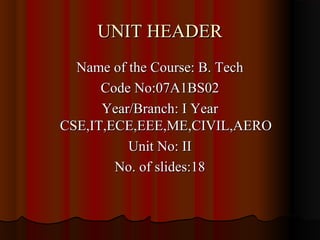
UNIT HEADER
  Name of the Course: B. Tech
      Code No:07A1BS02
      Year/Branch: I Year
CSE,IT,ECE,EEE,ME,CIVIL,AERO
          Unit No: II
        No. of slides:18
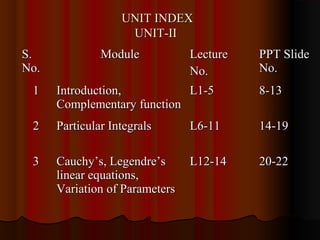
UNIT INDEX
                    UNIT-II
S.             Module           Lecture   PPT Slide
No.                             No.       No.
 1    Introduction,          L1-5         8-13
      Complementary function
 2    Particular Integrals      L6-11     14-19

 3    Cauchy’s, Legendre’s      L12-14    20-22
      linear equations,
      Variation of Parameters
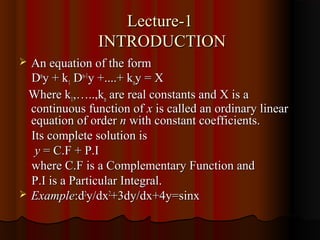
Lecture-1
                INTRODUCTION
 An equation of the form
  Dny + k1 Dn-1y +....+ kny = X
 Where k1,…..,kn are real constants and X is a
  continuous function of x is called an ordinary linear
  equation of order n with constant coefficients.
  Its complete solution is
   y = C.F + P.I
  where C.F is a Complementary Function and
  P.I is a Particular Integral.
 Example:d2y/dx2+3dy/dx+4y=sinx
COMPLEMENTARY FUNCTION

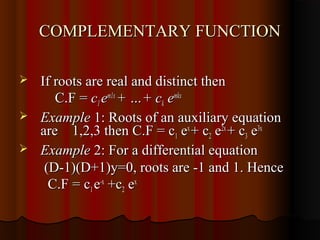
 If roots are real and distinct then
     C.F = c1 em1x + …+ ck emkx
 Example 1: Roots of an auxiliary equation
  are 1,2,3 then C.F = c1 ex + c2 e2x + c3 e3x
 Example 2: For a differential equation
   (D-1)(D+1)y=0, roots are -1 and 1. Hence
    C.F = c1 e-x +c2 ex
Lecture-2
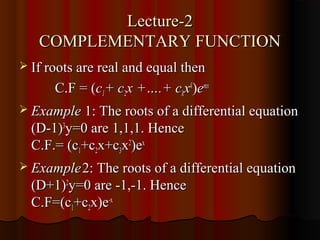
   COMPLEMENTARY FUNCTION
 If roots are real and equal then

      C.F = (c1+ c2x +….+ ckxk)emx
 Example 1: The roots of a differential equation
  (D-1)3y=0 are 1,1,1. Hence
  C.F.= (c1+c2x+c3x2)ex
 Example 2: The roots of a differential equation
  (D+1)2y=0 are -1,-1. Hence
  C.F=(c1+c2x)e-x
Lecture-3
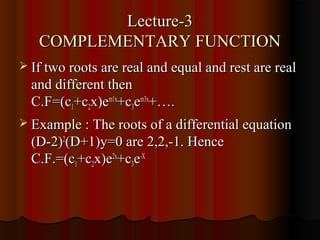
   COMPLEMENTARY FUNCTION
 If two roots are real and equal and rest are real
  and different then
  C.F=(c1+c2x)em1x+c3em3x+….
 Example : The roots of a differential equation
  (D-2)2(D+1)y=0 are 2,2,-1. Hence
  C.F.=(c1+c2x)e2x+c3e-X
Lecture-4
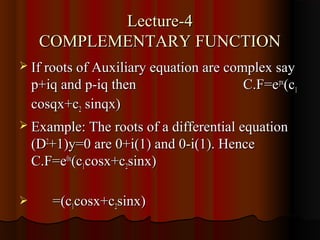
     COMPLEMENTARY FUNCTION
 If roots of Auxiliary equation are complex say
    p+iq and p-iq then                 C.F=e px(c1
    cosqx+c2 sinqx)
 Example: The roots of a differential equation
    (D2+1)y=0 are 0+i(1) and 0-i(1). Hence
    C.F=e0x(c1cosx+c2sinx)

      =(c1cosx+c2sinx)
Lecture-5
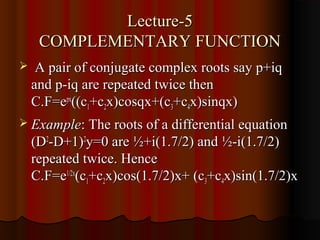
     COMPLEMENTARY FUNCTION
    A pair of conjugate complex roots say p+iq
    and p-iq are repeated twice then
    C.F=epx((c1+c2x)cosqx+(c3+c4x)sinqx)
 Example: The roots of a differential equation
    (D2-D+1)2y=0 are ½+i(1.7/2) and ½-i(1.7/2)
    repeated twice. Hence
    C.F=e1/2x(c1+c2x)cos(1.7/2)x+ (c3+c4x)sin(1.7/2)x
Lecture-6
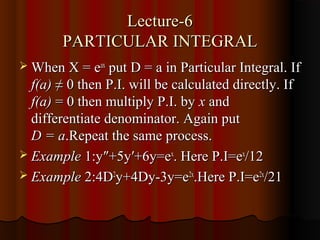
        PARTICULAR INTEGRAL
 When X = eax put D = a in Particular Integral. If
  f(a) ≠ 0 then P.I. will be calculated directly. If
  f(a) = 0 then multiply P.I. by x and
  differentiate denominator. Again put
  D = a.Repeat the same process.
 Example 1:y″+5y′+6y=ex. Here P.I=ex/12
 Example 2:4D2y+4Dy-3y=e2x.Here P.I=e2x/21
Lecture-7
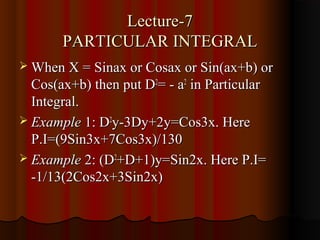
       PARTICULAR INTEGRAL
 When X = Sinax or Cosax or Sin(ax+b) or
  Cos(ax+b) then put D2= - a2 in Particular
  Integral.
 Example 1: D2y-3Dy+2y=Cos3x. Here
  P.I=(9Sin3x+7Cos3x)/130
 Example 2: (D2+D+1)y=Sin2x. Here P.I=
  -1/13(2Cos2x+3Sin2x)
Lecture-8
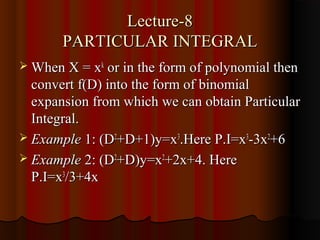
       PARTICULAR INTEGRAL
 When X = xk or in the form of polynomial then
  convert f(D) into the form of binomial
  expansion from which we can obtain Particular
  Integral.
 Example 1: (D2+D+1)y=x3.Here P.I=x3-3x2+6
 Example 2: (D2+D)y=x2+2x+4. Here
  P.I=x3/3+4x
Lecture-9
       PARTICULAR INTEGRAL
 When X = eaxv then put D = D+a and take out
  eax to the left of f(D). Now using previous
  methods we can obtain Particular Integral.
 Example 1:(D4-1)y=ex Cosx. Here
  P.I=-exCosx/5
 Example 2: (D2-3D+2)y=xe3x+Sin2x. Here
  P.I=e3x/2(x-3/2)+1/20(3Cos2x-Sin2x)
Lecture-10
      PARTICULAR INTEGRAL
 When X = x.v then

  P.I = [{x – f "(D)/f(D)}/f(D)]v
 Example 1: (D2+2D+1)y=x Cosx. Here
  P.I=x/2Sinx+1/2(Cosx-Sinx)
 Example 2: (D2+3D+2)y=x ex Sinx. Here
  P.I=ex[x/10(Sinx-Cosx)-1/25Sinx+Cosx/10]
Lecture-11
       PARTICULAR INTEGRAL
 When X is any other function then Particular
  Integral can be obtained by resolving 1/ f(D)
  into partial fractions.
 Example 1: (D2+a2)y=Secax. Here P.I=x/a
  Sinax+Cosax log(Cosax)/a2
Lecture-12
   CAUCHY’S LINEAR EQUATION
 Its general form is

  xnDny + …. +y = X
  then to solve this equation put x = ez and
  convert into ordinary form.
 Example 1: x2D2y+xDy+y=1
 Example 2: x3D3y+3x2D2y+2xDy+6y=x2
Lecture-13
 LEGENDRE’S LINEAR EQUATION
 Its general form is

  (ax + b)n Dny +…..+y = X
  then to solve this equation put ax + b = e z and
  convert into ordinary form.
 Example 1: (x+1)2D2y-3(x+1)Dy+4y=x2+x+1
 Example 2: (2x-1)3D3y+(2x-1)Dy-2y=x
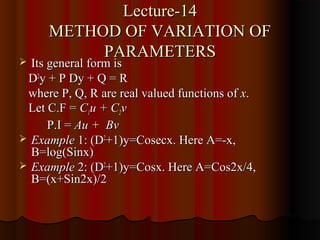
Lecture-14
     METHOD OF VARIATION OF
          PARAMETERS
 Its general form is
 D2y + P Dy + Q = R
 where P, Q, R are real valued functions of x.
 Let C.F = C1u + C2v
      P.I = Au + Bv
 Example 1: (D2+1)y=Cosecx. Here A=-x,
  B=log(Sinx)
 Example 2: (D2+1)y=Cosx. Here A=Cos2x/4,
  B=(x+Sin2x)/2

M1 unit ii-jntuworld

  • 1.
  • 2.
    CONTENTS  Ordinary Differential Equations of First Order and First Degree  Linear Differential Equations of Second and Higher Order  Mean Value Theorems  Functions of Several Variables  Curvature, Evolutes and Envelopes  Curve Tracing  Applications of Integration  Multiple Integrals  Series and Sequences  Vector Differentiation and Vector Operators  Vector Integration  Vector Integral Theorems  Laplace transforms
  • 3.
    TEXT BOOKS  A text book of Engineering Mathematics, Vol-I T.K.V.Iyengar, B.Krishna Gandhi and Others, S.Chand & Company  A text book of Engineering Mathematics, C.Sankaraiah, V.G.S.Book Links  A text book of Engineering Mathematics, Shahnaz A Bathul, Right Publishers  A text book of Engineering Mathematics, P.Nageshwara Rao, Y.Narasimhulu & N.Prabhakar Rao, Deepthi Publications
  • 4.
    REFERENCES  A textbook of Engineering Mathematics, B.V.Raman, Tata Mc Graw Hill  Advanced Engineering Mathematics, Irvin Kreyszig, Wiley India Pvt. Ltd.  A text Book of Engineering Mathematics, Thamson Book collection
  • 5.
    UNIT - II LINEAR DIFFERENTIAL EQUATIONS OF SECOND AND HIGHER ORDER
  • 6.
    UNIT HEADER Name of the Course: B. Tech Code No:07A1BS02 Year/Branch: I Year CSE,IT,ECE,EEE,ME,CIVIL,AERO Unit No: II No. of slides:18
  • 7.
    UNIT INDEX UNIT-II S. Module Lecture PPT Slide No. No. No. 1 Introduction, L1-5 8-13 Complementary function 2 Particular Integrals L6-11 14-19 3 Cauchy’s, Legendre’s L12-14 20-22 linear equations, Variation of Parameters
  • 8.
    Lecture-1 INTRODUCTION  An equation of the form Dny + k1 Dn-1y +....+ kny = X Where k1,…..,kn are real constants and X is a continuous function of x is called an ordinary linear equation of order n with constant coefficients. Its complete solution is y = C.F + P.I where C.F is a Complementary Function and P.I is a Particular Integral.  Example:d2y/dx2+3dy/dx+4y=sinx
  • 9.
    COMPLEMENTARY FUNCTION  Ifroots are real and distinct then C.F = c1 em1x + …+ ck emkx  Example 1: Roots of an auxiliary equation are 1,2,3 then C.F = c1 ex + c2 e2x + c3 e3x  Example 2: For a differential equation (D-1)(D+1)y=0, roots are -1 and 1. Hence C.F = c1 e-x +c2 ex
  • 10.
    Lecture-2 COMPLEMENTARY FUNCTION  If roots are real and equal then C.F = (c1+ c2x +….+ ckxk)emx  Example 1: The roots of a differential equation (D-1)3y=0 are 1,1,1. Hence C.F.= (c1+c2x+c3x2)ex  Example 2: The roots of a differential equation (D+1)2y=0 are -1,-1. Hence C.F=(c1+c2x)e-x
  • 11.
    Lecture-3 COMPLEMENTARY FUNCTION  If two roots are real and equal and rest are real and different then C.F=(c1+c2x)em1x+c3em3x+….  Example : The roots of a differential equation (D-2)2(D+1)y=0 are 2,2,-1. Hence C.F.=(c1+c2x)e2x+c3e-X
  • 12.
    Lecture-4 COMPLEMENTARY FUNCTION  If roots of Auxiliary equation are complex say p+iq and p-iq then C.F=e px(c1 cosqx+c2 sinqx)  Example: The roots of a differential equation (D2+1)y=0 are 0+i(1) and 0-i(1). Hence C.F=e0x(c1cosx+c2sinx)  =(c1cosx+c2sinx)
  • 13.
    Lecture-5 COMPLEMENTARY FUNCTION  A pair of conjugate complex roots say p+iq and p-iq are repeated twice then C.F=epx((c1+c2x)cosqx+(c3+c4x)sinqx)  Example: The roots of a differential equation (D2-D+1)2y=0 are ½+i(1.7/2) and ½-i(1.7/2) repeated twice. Hence C.F=e1/2x(c1+c2x)cos(1.7/2)x+ (c3+c4x)sin(1.7/2)x
  • 14.
    Lecture-6 PARTICULAR INTEGRAL  When X = eax put D = a in Particular Integral. If f(a) ≠ 0 then P.I. will be calculated directly. If f(a) = 0 then multiply P.I. by x and differentiate denominator. Again put D = a.Repeat the same process.  Example 1:y″+5y′+6y=ex. Here P.I=ex/12  Example 2:4D2y+4Dy-3y=e2x.Here P.I=e2x/21
  • 15.
    Lecture-7 PARTICULAR INTEGRAL  When X = Sinax or Cosax or Sin(ax+b) or Cos(ax+b) then put D2= - a2 in Particular Integral.  Example 1: D2y-3Dy+2y=Cos3x. Here P.I=(9Sin3x+7Cos3x)/130  Example 2: (D2+D+1)y=Sin2x. Here P.I= -1/13(2Cos2x+3Sin2x)
  • 16.
    Lecture-8 PARTICULAR INTEGRAL  When X = xk or in the form of polynomial then convert f(D) into the form of binomial expansion from which we can obtain Particular Integral.  Example 1: (D2+D+1)y=x3.Here P.I=x3-3x2+6  Example 2: (D2+D)y=x2+2x+4. Here P.I=x3/3+4x
  • 17.
    Lecture-9 PARTICULAR INTEGRAL  When X = eaxv then put D = D+a and take out eax to the left of f(D). Now using previous methods we can obtain Particular Integral.  Example 1:(D4-1)y=ex Cosx. Here P.I=-exCosx/5  Example 2: (D2-3D+2)y=xe3x+Sin2x. Here P.I=e3x/2(x-3/2)+1/20(3Cos2x-Sin2x)
  • 18.
    Lecture-10 PARTICULAR INTEGRAL  When X = x.v then P.I = [{x – f "(D)/f(D)}/f(D)]v  Example 1: (D2+2D+1)y=x Cosx. Here P.I=x/2Sinx+1/2(Cosx-Sinx)  Example 2: (D2+3D+2)y=x ex Sinx. Here P.I=ex[x/10(Sinx-Cosx)-1/25Sinx+Cosx/10]
  • 19.
    Lecture-11 PARTICULAR INTEGRAL  When X is any other function then Particular Integral can be obtained by resolving 1/ f(D) into partial fractions.  Example 1: (D2+a2)y=Secax. Here P.I=x/a Sinax+Cosax log(Cosax)/a2
  • 20.
    Lecture-12 CAUCHY’S LINEAR EQUATION  Its general form is xnDny + …. +y = X then to solve this equation put x = ez and convert into ordinary form.  Example 1: x2D2y+xDy+y=1  Example 2: x3D3y+3x2D2y+2xDy+6y=x2
  • 21.
    Lecture-13 LEGENDRE’S LINEAREQUATION  Its general form is (ax + b)n Dny +…..+y = X then to solve this equation put ax + b = e z and convert into ordinary form.  Example 1: (x+1)2D2y-3(x+1)Dy+4y=x2+x+1  Example 2: (2x-1)3D3y+(2x-1)Dy-2y=x
  • 22.
    Lecture-14 METHOD OF VARIATION OF PARAMETERS  Its general form is D2y + P Dy + Q = R where P, Q, R are real valued functions of x. Let C.F = C1u + C2v P.I = Au + Bv  Example 1: (D2+1)y=Cosecx. Here A=-x, B=log(Sinx)  Example 2: (D2+1)y=Cosx. Here A=Cos2x/4, B=(x+Sin2x)/2