NUMERICAL SOLUTION OF
ORDINARY DIFFERENTIAL EQUATION
BY Dixi patel
INTRODUCTION
• A number of numerical methods are available
for the solution of first order differential
equation of form:
• dy/ dx = f(x ,y)
• These methods yield solution either as power
series or in x form which the values of y can be
found by direct substitution, or a set of values
of x and y.
NUMERICAL METHODS
• The numerical methods for ODE include:
Picard
Taylor series
Euler series
Runge-kutta methods
Milne
Adams-Bashforth
RUNGE-KUTTA METHOD
• For the first time, the methods were
presented by Runge and Kutta two German
mathematicians.
• These methods were very accurate and
efficient and instead direct calculation of
higher derivatives only function used for
different values.
WORKING RULE
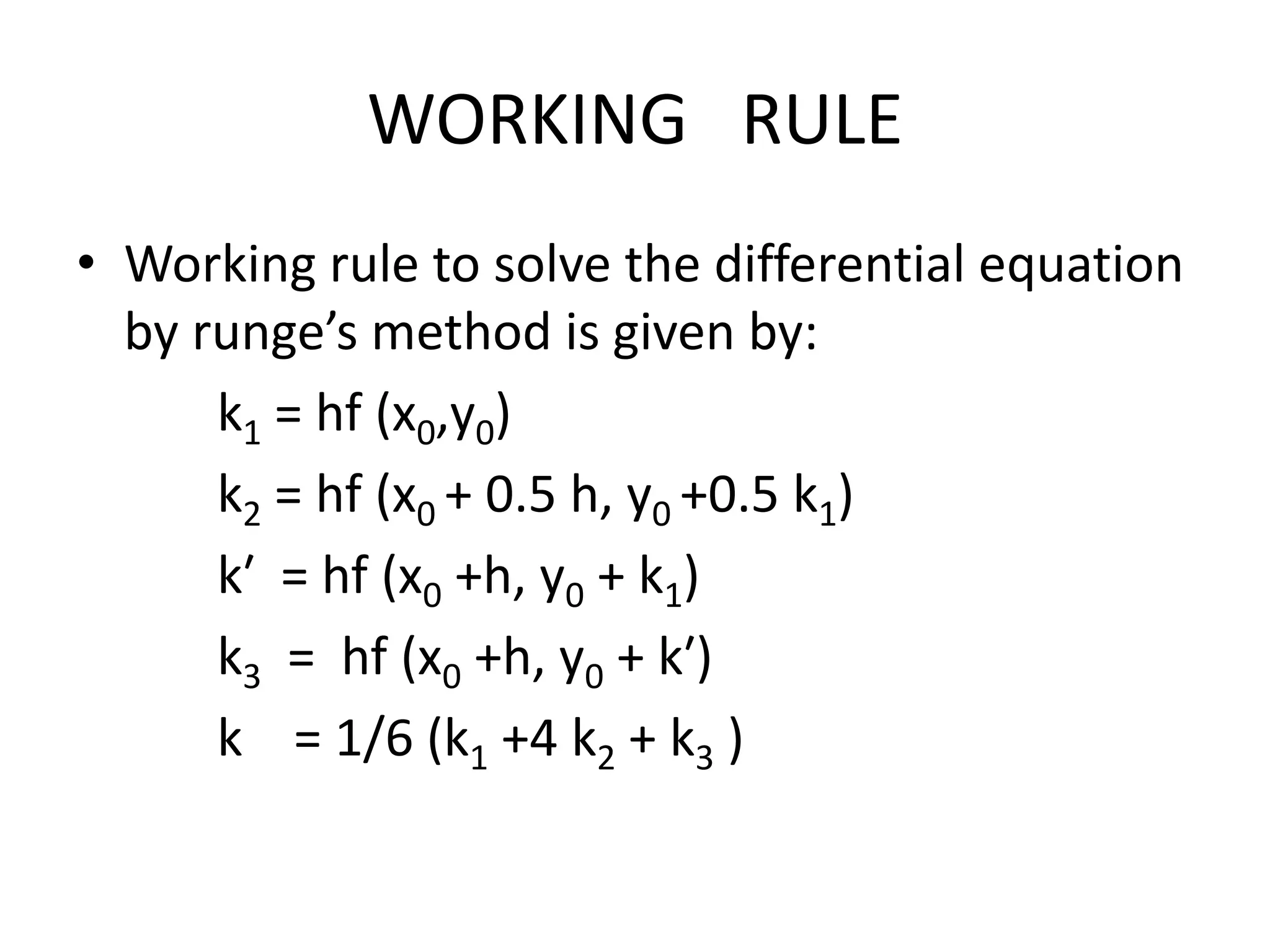
• Working rule to solve the differential equation
by runge’s method is given by:
k1 = hf (x0,y0)
k2 = hf (x0 + 0.5 h, y0 +0.5 k1)
k′ = hf (x0 +h, y0 + k1)
k3 = hf (x0 +h, y0 + k′)
k = 1/6 (k1 +4 k2 + k3 )
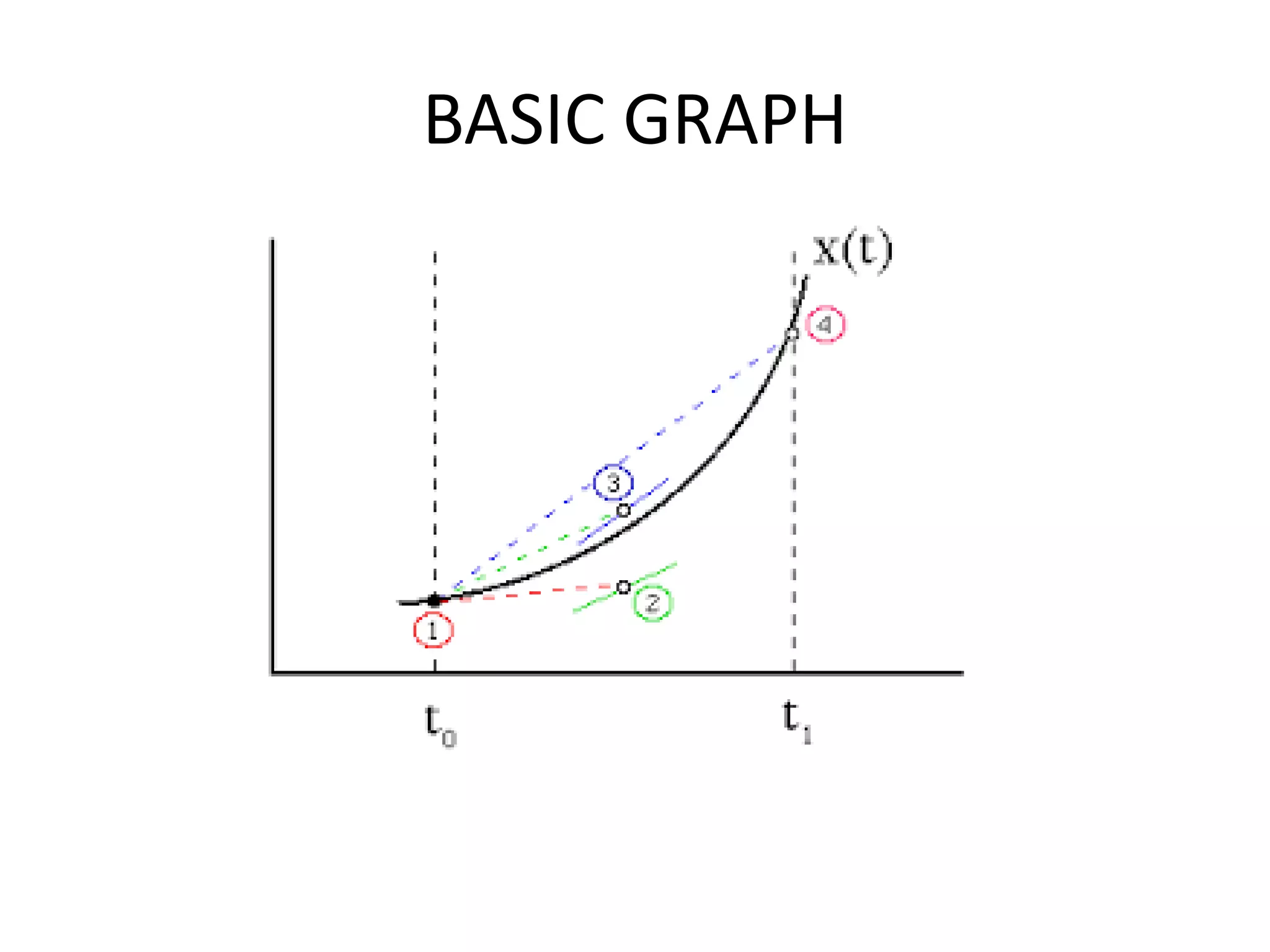
BASIC GRAPH
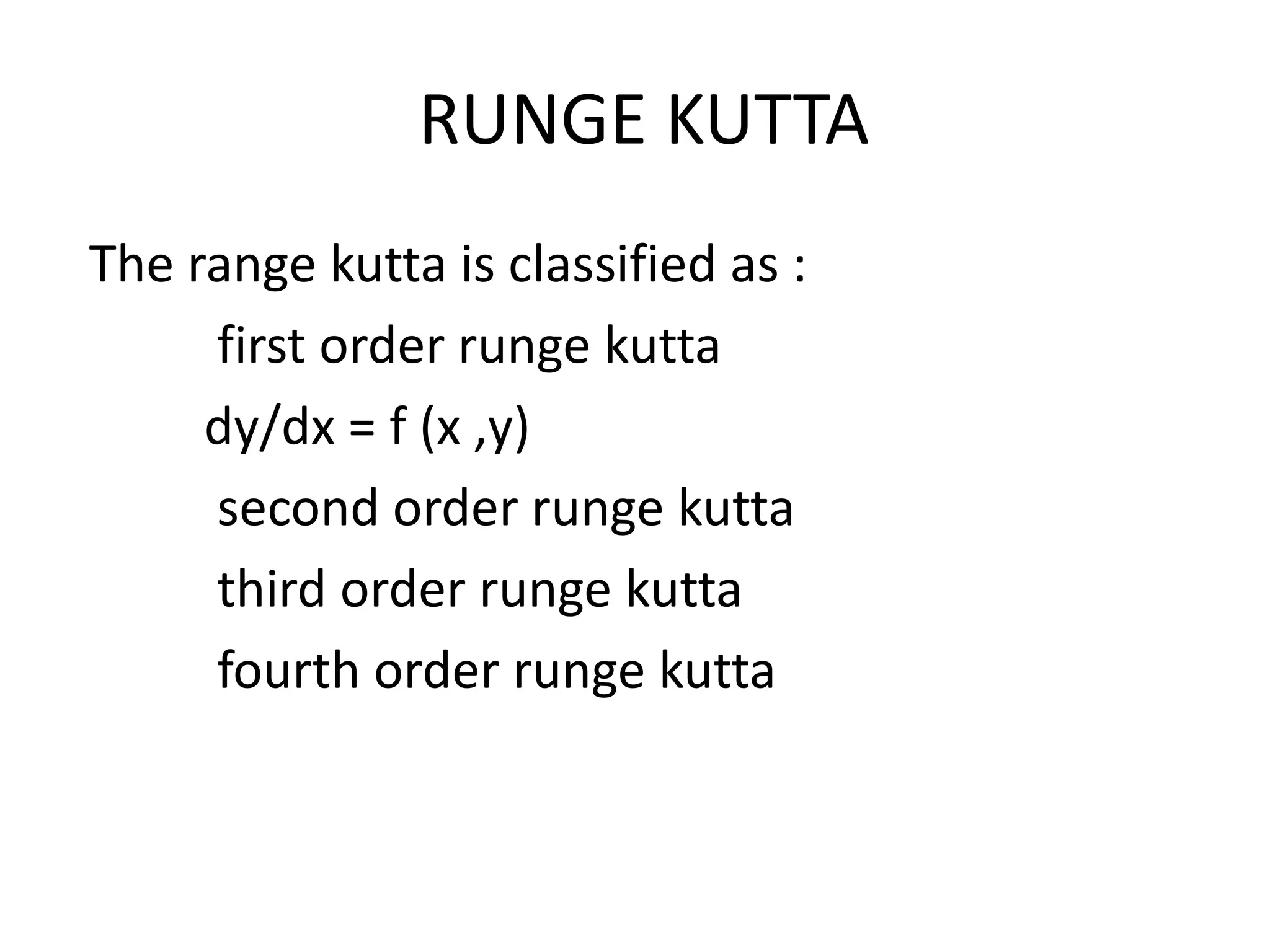
RUNGE KUTTA
The range kutta is classified as :
first order runge kutta
dy/dx = f (x ,y)
second order runge kutta
third order runge kutta
fourth order runge kutta
APPLICATIONS
APPLICATIONS
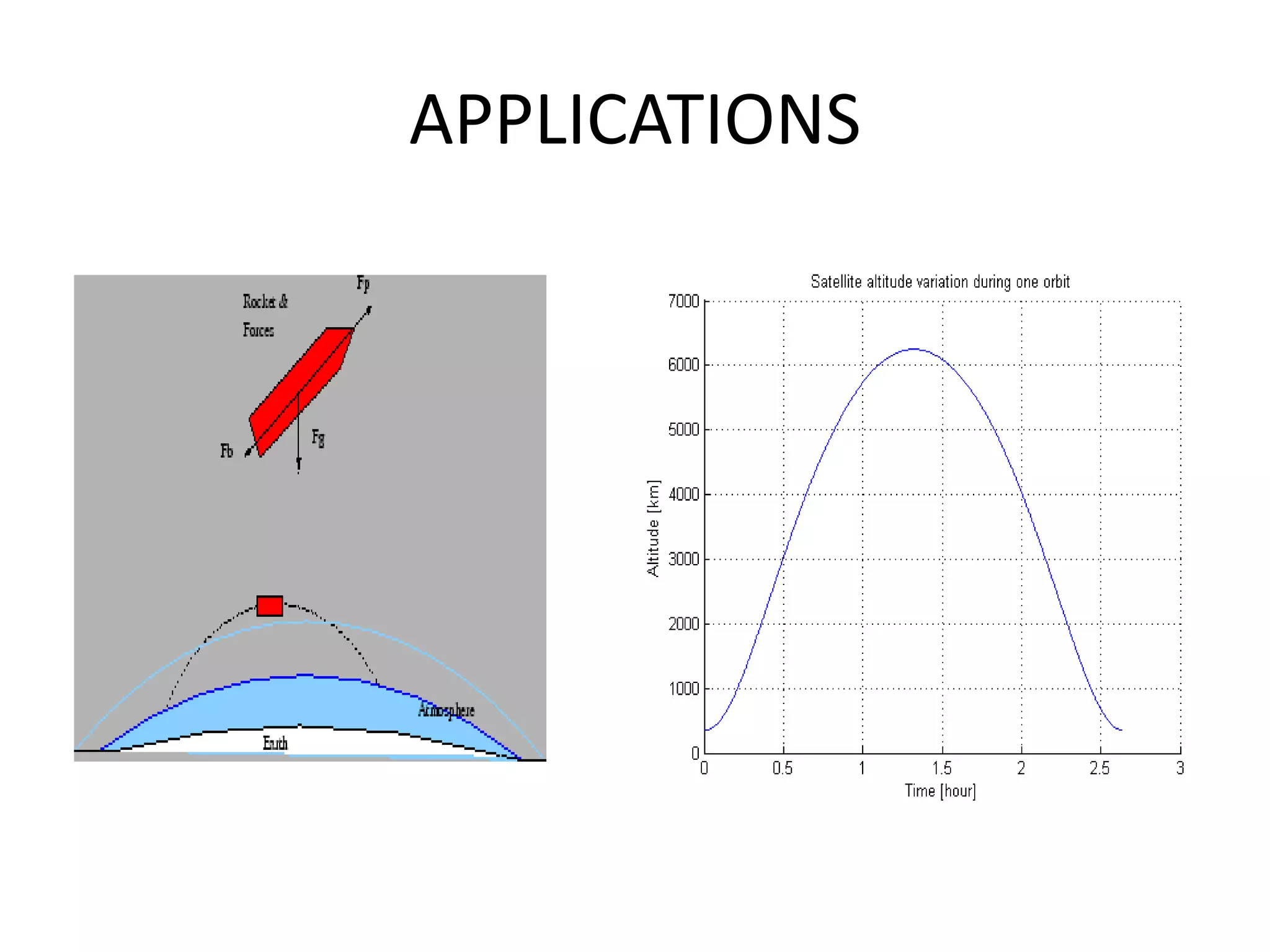
• If a model rocket is prepared this method can
be used for successive iterations of the
differential equations for lift off the rocket.
• Runge kutta method is used to know the
ballistic missile trajectory of a rocket.
• In the study of self propelled missiles.
CONCLUSION
• Rocket trajectories are optimized to achieve
target by either minimum time or control
surfaces or fuel.
• First we calculate using the steepest descent
method and then it is compared to runge
kutta method and results say that the runge
kutta method is more efficient and accurate .
• But takes time compared to others .
THANK YOU

Numerical solution of ordinary differential equation

  • 1.
    NUMERICAL SOLUTION OF ORDINARYDIFFERENTIAL EQUATION BY Dixi patel
  • 2.
    INTRODUCTION • A numberof numerical methods are available for the solution of first order differential equation of form: • dy/ dx = f(x ,y) • These methods yield solution either as power series or in x form which the values of y can be found by direct substitution, or a set of values of x and y.
  • 3.
    NUMERICAL METHODS • Thenumerical methods for ODE include: Picard Taylor series Euler series Runge-kutta methods Milne Adams-Bashforth
  • 4.
    RUNGE-KUTTA METHOD • Forthe first time, the methods were presented by Runge and Kutta two German mathematicians. • These methods were very accurate and efficient and instead direct calculation of higher derivatives only function used for different values.
  • 5.
    WORKING RULE • Workingrule to solve the differential equation by runge’s method is given by: k1 = hf (x0,y0) k2 = hf (x0 + 0.5 h, y0 +0.5 k1) k′ = hf (x0 +h, y0 + k1) k3 = hf (x0 +h, y0 + k′) k = 1/6 (k1 +4 k2 + k3 )
  • 6.
  • 7.
    RUNGE KUTTA The rangekutta is classified as : first order runge kutta dy/dx = f (x ,y) second order runge kutta third order runge kutta fourth order runge kutta
  • 8.
  • 9.
    APPLICATIONS • If amodel rocket is prepared this method can be used for successive iterations of the differential equations for lift off the rocket. • Runge kutta method is used to know the ballistic missile trajectory of a rocket. • In the study of self propelled missiles.
  • 10.
    CONCLUSION • Rocket trajectoriesare optimized to achieve target by either minimum time or control surfaces or fuel. • First we calculate using the steepest descent method and then it is compared to runge kutta method and results say that the runge kutta method is more efficient and accurate . • But takes time compared to others .
  • 11.