
4.1 
Angles and 
Their 
Measures 
Copyright © 2011 Pearson, Inc.
What you’ll learn about 
 The Problem of Angular Measure 
 Degrees and Radians 
 Circular Arc Length 
 Angular and Linear Motion 
… and why 
Angles are the domain elements of the trigonometric 
functions. 
Copyright © 2011 Pearson, Inc. Slide 4.1 - 2
Why 360º ? 
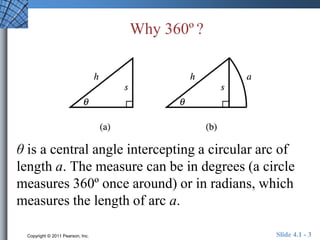
θ is a central angle intercepting a circular arc of 
length a. The measure can be in degrees (a circle 
measures 360º once around) or in radians, which 
measures the length of arc a. 
Copyright © 2011 Pearson, Inc. Slide 4.1 - 3
Navigation 
In navigation, the course or bearing of an object 
is sometimes given as the angle of the line of 
travel measured clockwise from due north. 
Copyright © 2011 Pearson, Inc. Slide 4.1 - 4
Radian 
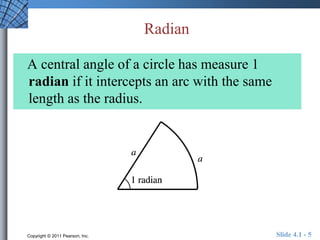
A central angle of a circle has measure 1 
radian if it intercepts an arc with the same 
length as the radius. 
Copyright © 2011 Pearson, Inc. Slide 4.1 - 5
Degree-Radian Conversion 
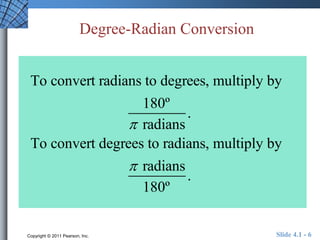
To convert radians to degrees, multiply by 
180º 
 radians 
. 
To convert degrees to radians, multiply by 
 radians 
180º 
. 
Copyright © 2011 Pearson, Inc. Slide 4.1 - 6
Example Working with Degree and 
Radian Measure 
a. How many radians are in 135º? 
b. How many degrees are in radians? 
7 
6 
c. Find the length of an arc intercepted by a central 
angle of 1/4 radian in a circle of radius 3 in. 
Copyright © 2011 Pearson, Inc. Slide 4.1 - 7
Example Working with Degree and 
Radian Measure 
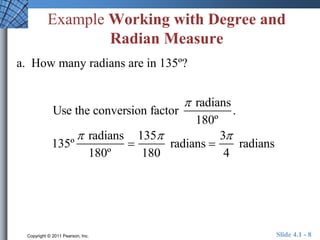
a. How many radians are in 135º? 
Use the conversion factor 
 radians 
180º 
. 
135º 
 radians 
180º 
 
135 
180 
radians  
3 
4 
radians 
Copyright © 2011 Pearson, Inc. Slide 4.1 - 8
Example Working with Degree and 
Radian Measure 
7 
6 
b. How many degrees are in radians? 
Use the conversion factor 
180º 
 radians 
. 
7 
6 
 
  
 
 
180º 
 radians 
 
  
 
  
1260º 
6 
 210º 
Copyright © 2011 Pearson, Inc. Slide 4.1 - 9
Example Working with Degree and 
Radian Measure 
c. Find the length of an arc intercepted by a central 
angle of 1/4 radian in a circle of radius 3 in. 
A central angle of 1 radian intercepts an arc length 
of 1 radius, which is 3 in. So a central angle of 1/4 
radian intercepts an arc of length 1/4 radius, which 
is 3/4 in. 
Copyright © 2011 Pearson, Inc. Slide 4.1 - 10
Arc Length Formula (Radian Measure) 
If  is a central angle in a circle of radius r, and if  
is measured in radians, then the length s of the 
intercepted arc is given by 
s  r . 
Copyright © 2011 Pearson, Inc. Slide 4.1 - 11
Arc Length Formula (Degree Measure) 
If  is a central angle in a circle of radius r, and if  
is measured in degrees, then the length s of the 
intercepted arc is given by 
s  
 r 
180 
. 
Copyright © 2011 Pearson, Inc. Slide 4.1 - 12
Example Perimeter of a Pizza Slice 
Find the perimeter of a 30º slice of a large 8 in. radius pizza. 
Copyright © 2011 Pearson, Inc. Slide 4.1 - 13
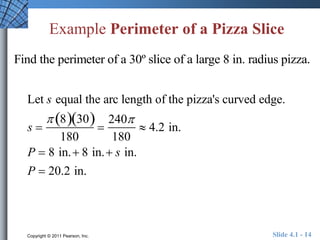
Example Perimeter of a Pizza Slice 
Find the perimeter of a 30º slice of a large 8 in. radius pizza. 
Let s equal the arc length of the pizza's curved edge. 
s  
 830 
180 
 
240 
180 
 4.2 in. 
P  8 in.  8 in.  s in. 
P  20.2 in. 
Copyright © 2011 Pearson, Inc. Slide 4.1 - 14
Angular and Linear Motion 
 Angular speed is measured in units like 
revolutions per minute. 
 Linear speed is measured in units like miles 
per hour. 
Copyright © 2011 Pearson, Inc. Slide 4.1 - 15
Nautical Mile 
A nautical mile (naut mi) is the length of 1 
minute of arc along Earth’s equator. 
Copyright © 2011 Pearson, Inc. Slide 4.1 - 16
Distance Conversions 
1 statute mile 0.87 nautical mile 
1 nautical mile 1.15 statute mile 
 
 
Copyright © 2011 Pearson, Inc. Slide 4.1 - 17
Quick Review 
1. Find the circumference of the circle with a radius of 4.5 in. 
2. Find the radius of the circle with a circumference of 14 cm. 
3. Given s  r . Find s if r  2.2 cm and   4 radians. 
4. Convert 65 miles per hour into feet per second. 
5. Convert 9.8 feet per second to miles per hour. 
Copyright © 2011 Pearson, Inc. Slide 4.1 - 18
Quick Review Solutions 
1. Find the circumference of the circle with a radius of 4.5 in. 
9 in 
2. Find the radius of the circle with a circumference of 14 cm. 
7 / cm 
3. Given s  r . Find s if r  2.2 cm and   4 radians. 
8.8 cm 
4. Convert 65 miles per hour into feet per second. 
95.3 feet per second 
5. Convert 9.8 feet per second to miles per hour. 
6.681 miles per hour 
Copyright © 2011 Pearson, Inc. Slide 4.1 - 19

Unit 4.1

  • 1.
    4.1 Angles and Their Measures Copyright © 2011 Pearson, Inc.
  • 2.
    What you’ll learnabout  The Problem of Angular Measure  Degrees and Radians  Circular Arc Length  Angular and Linear Motion … and why Angles are the domain elements of the trigonometric functions. Copyright © 2011 Pearson, Inc. Slide 4.1 - 2
  • 3.
    Why 360º ? θ is a central angle intercepting a circular arc of length a. The measure can be in degrees (a circle measures 360º once around) or in radians, which measures the length of arc a. Copyright © 2011 Pearson, Inc. Slide 4.1 - 3
  • 4.
    Navigation In navigation,the course or bearing of an object is sometimes given as the angle of the line of travel measured clockwise from due north. Copyright © 2011 Pearson, Inc. Slide 4.1 - 4
  • 5.
    Radian A centralangle of a circle has measure 1 radian if it intercepts an arc with the same length as the radius. Copyright © 2011 Pearson, Inc. Slide 4.1 - 5
  • 6.
    Degree-Radian Conversion Toconvert radians to degrees, multiply by 180º  radians . To convert degrees to radians, multiply by  radians 180º . Copyright © 2011 Pearson, Inc. Slide 4.1 - 6
  • 7.
    Example Working withDegree and Radian Measure a. How many radians are in 135º? b. How many degrees are in radians? 7 6 c. Find the length of an arc intercepted by a central angle of 1/4 radian in a circle of radius 3 in. Copyright © 2011 Pearson, Inc. Slide 4.1 - 7
  • 8.
    Example Working withDegree and Radian Measure a. How many radians are in 135º? Use the conversion factor  radians 180º . 135º  radians 180º  135 180 radians  3 4 radians Copyright © 2011 Pearson, Inc. Slide 4.1 - 8
  • 9.
    Example Working withDegree and Radian Measure 7 6 b. How many degrees are in radians? Use the conversion factor 180º  radians . 7 6      180º  radians       1260º 6  210º Copyright © 2011 Pearson, Inc. Slide 4.1 - 9
  • 10.
    Example Working withDegree and Radian Measure c. Find the length of an arc intercepted by a central angle of 1/4 radian in a circle of radius 3 in. A central angle of 1 radian intercepts an arc length of 1 radius, which is 3 in. So a central angle of 1/4 radian intercepts an arc of length 1/4 radius, which is 3/4 in. Copyright © 2011 Pearson, Inc. Slide 4.1 - 10
  • 11.
    Arc Length Formula(Radian Measure) If  is a central angle in a circle of radius r, and if  is measured in radians, then the length s of the intercepted arc is given by s  r . Copyright © 2011 Pearson, Inc. Slide 4.1 - 11
  • 12.
    Arc Length Formula(Degree Measure) If  is a central angle in a circle of radius r, and if  is measured in degrees, then the length s of the intercepted arc is given by s   r 180 . Copyright © 2011 Pearson, Inc. Slide 4.1 - 12
  • 13.
    Example Perimeter ofa Pizza Slice Find the perimeter of a 30º slice of a large 8 in. radius pizza. Copyright © 2011 Pearson, Inc. Slide 4.1 - 13
  • 14.
    Example Perimeter ofa Pizza Slice Find the perimeter of a 30º slice of a large 8 in. radius pizza. Let s equal the arc length of the pizza's curved edge. s   830 180  240 180  4.2 in. P  8 in.  8 in.  s in. P  20.2 in. Copyright © 2011 Pearson, Inc. Slide 4.1 - 14
  • 15.
    Angular and LinearMotion  Angular speed is measured in units like revolutions per minute.  Linear speed is measured in units like miles per hour. Copyright © 2011 Pearson, Inc. Slide 4.1 - 15
  • 16.
    Nautical Mile Anautical mile (naut mi) is the length of 1 minute of arc along Earth’s equator. Copyright © 2011 Pearson, Inc. Slide 4.1 - 16
  • 17.
    Distance Conversions 1statute mile 0.87 nautical mile 1 nautical mile 1.15 statute mile   Copyright © 2011 Pearson, Inc. Slide 4.1 - 17
  • 18.
    Quick Review 1.Find the circumference of the circle with a radius of 4.5 in. 2. Find the radius of the circle with a circumference of 14 cm. 3. Given s  r . Find s if r  2.2 cm and   4 radians. 4. Convert 65 miles per hour into feet per second. 5. Convert 9.8 feet per second to miles per hour. Copyright © 2011 Pearson, Inc. Slide 4.1 - 18
  • 19.
    Quick Review Solutions 1. Find the circumference of the circle with a radius of 4.5 in. 9 in 2. Find the radius of the circle with a circumference of 14 cm. 7 / cm 3. Given s  r . Find s if r  2.2 cm and   4 radians. 8.8 cm 4. Convert 65 miles per hour into feet per second. 95.3 feet per second 5. Convert 9.8 feet per second to miles per hour. 6.681 miles per hour Copyright © 2011 Pearson, Inc. Slide 4.1 - 19