Angles and Angle Measure
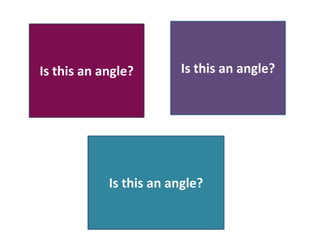
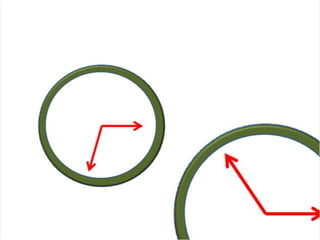
Is this an angle? Is this an angle?
Is this an angle?
Trigonometry
• Trigonometry is the
study of triangles and
the relationship
among their sides and
angles.
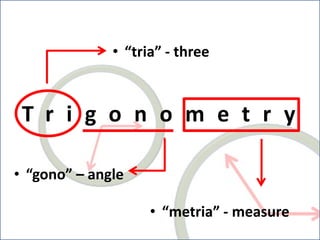
T r i g o n o m e t r y
• “gono” – angle
• “tria” - three
• “metria” - measure
Angles
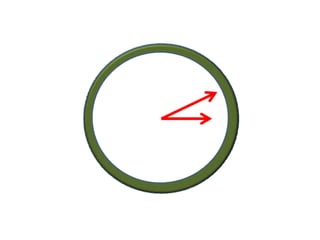
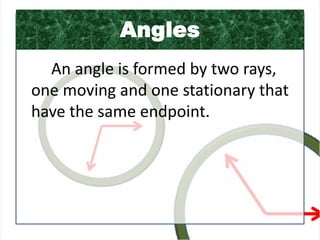
An angle is formed by two rays,
one moving and one stationary that
have the same endpoint.
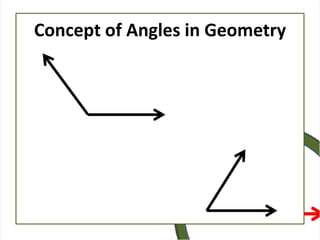
Concept of Angles in Geometry
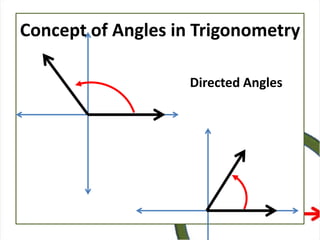
Concept of Angles in Trigonometry
Directed Angles
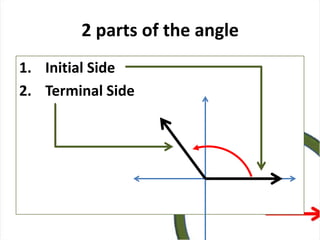
2 parts of the angle
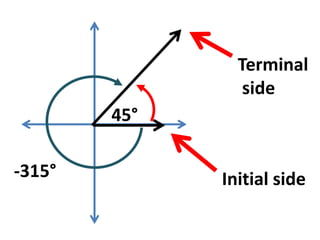
1. Initial Side
2. Terminal Side
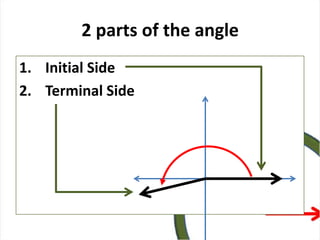
2 parts of the angle
1. Initial Side
2. Terminal Side
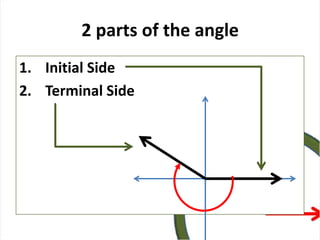
2 parts of the angle
1. Initial Side
2. Terminal Side
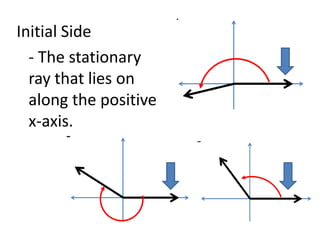
Initial Side
- The stationary
ray that lies on
along the positive
x-axis.
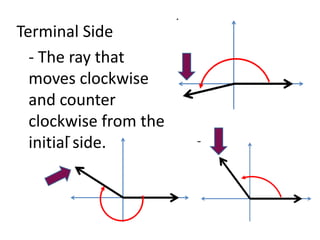
Terminal Side
- The ray that
moves clockwise
and counter
clockwise from the
initial side.
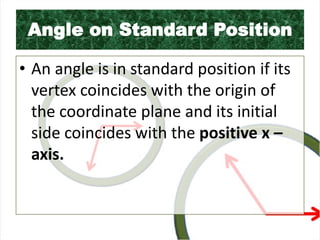
Angle on Standard Position
• An angle is in standard position if its
vertex coincides with the origin of
the coordinate plane and its initial
side coincides with the positive x –
axis.
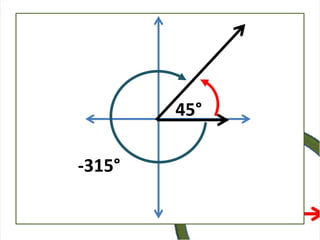
45°
-315°
• Positive angles are generated by
counterclockwise rotations and
negative angles are generated by
clockwise rotations.
• Angles are often named by Greek
letters such as α (Alpha), β (Beta), θ
(Theta)
45°
-315° Initial side
Terminal
side
45°
-315°
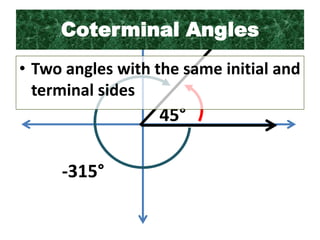
Coterminal Angles
• Two angles with the same initial and
terminal sides
45°
-315°
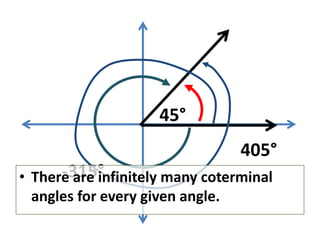
405°
• There are infinitely many coterminal
angles for every given angle.
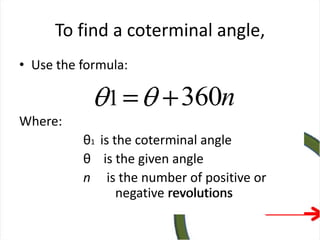
To find a coterminal angle,
• Use the formula:
Where:
θ1 is the coterminal angle
θ is the given angle
n is the number of positive or
negative revolutions
n3601
revolutions
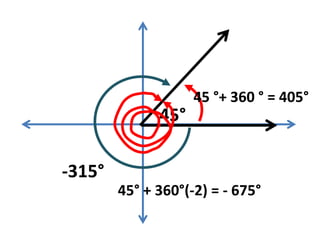
Example:
• Find one positive after one revolution and one
negative coterminal after 2 revoltuions of 45
degrees.
45°
-315°
45 °+ 360 ° = 405°
45° + 360°(-2) = - 675°
Angle Location
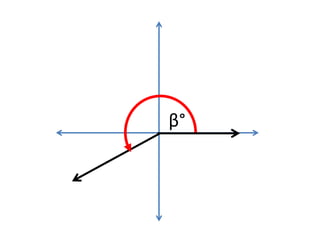
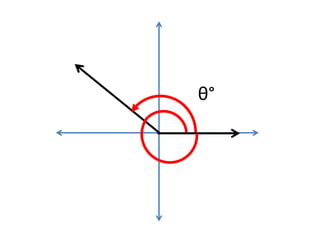
• If the terminal side of an angle lies in
a given quadrant, then the angle is
said to lie in that quadrant.
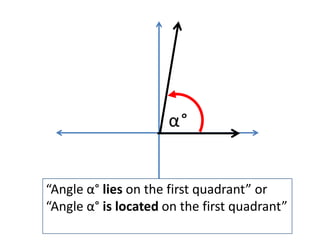
α°
“Angle α° lies on the first quadrant” or
“Angle α° is located on the first quadrant”
β°
θ°
Angle Location
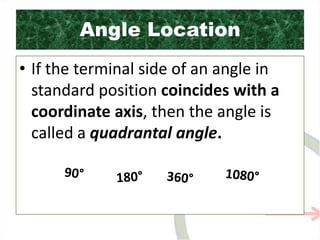
• If the terminal side of an angle in
standard position coincides with a
coordinate axis, then the angle is
called a quadrantal angle.
Exercises
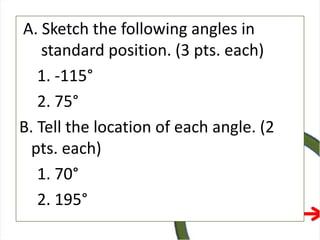
A. Sketch the following angles in
standard position. (3 pts. each)
1. -115°
2. 75°
B. Tell the location of each angle. (2
pts. each)
1. 70°
2. 195°
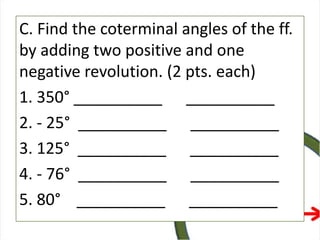
C. Find the coterminal angles of the ff.
by adding two positive and one
negative revolution. (2 pts. each)
1. 350° __________ __________
2. - 25° __________ __________
3. 125° __________ __________
4. - 76° __________ __________
5. 80° __________ __________
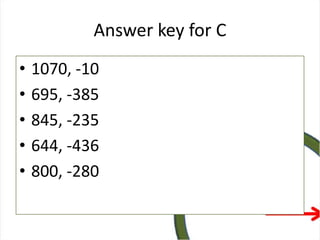
Answer key for C
• 1070, -10
• 695, -385
• 845, -235
• 644, -436
• 800, -280
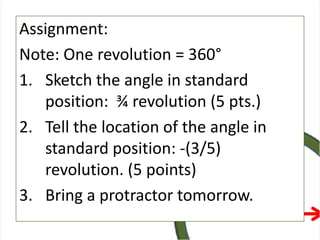
Assignment:
Note: One revolution = 360°
1. Sketch the angle in standard
position: ¾ revolution (5 pts.)
2. Tell the location of the angle in
standard position: -(3/5)
revolution. (5 points)
3. Bring a protractor tomorrow.

Angles

  • 2.
  • 3.
    Is this anangle? Is this an angle? Is this an angle?
  • 4.
    Trigonometry • Trigonometry isthe study of triangles and the relationship among their sides and angles.
  • 5.
    T r ig o n o m e t r y • “gono” – angle • “tria” - three • “metria” - measure
  • 6.
    Angles An angle isformed by two rays, one moving and one stationary that have the same endpoint.
  • 7.
    Concept of Anglesin Geometry
  • 8.
    Concept of Anglesin Trigonometry Directed Angles
  • 9.
    2 parts ofthe angle 1. Initial Side 2. Terminal Side
  • 10.
    2 parts ofthe angle 1. Initial Side 2. Terminal Side
  • 11.
    2 parts ofthe angle 1. Initial Side 2. Terminal Side
  • 12.
    Initial Side - Thestationary ray that lies on along the positive x-axis.
  • 13.
    Terminal Side - Theray that moves clockwise and counter clockwise from the initial side.
  • 14.
    Angle on StandardPosition • An angle is in standard position if its vertex coincides with the origin of the coordinate plane and its initial side coincides with the positive x – axis.
  • 15.
  • 16.
    • Positive anglesare generated by counterclockwise rotations and negative angles are generated by clockwise rotations. • Angles are often named by Greek letters such as α (Alpha), β (Beta), θ (Theta)
  • 17.
  • 18.
    45° -315° Coterminal Angles • Twoangles with the same initial and terminal sides
  • 19.
    45° -315° 405° • There areinfinitely many coterminal angles for every given angle.
  • 20.
    To find acoterminal angle, • Use the formula: Where: θ1 is the coterminal angle θ is the given angle n is the number of positive or negative revolutions n3601 revolutions
  • 21.
    Example: • Find onepositive after one revolution and one negative coterminal after 2 revoltuions of 45 degrees.
  • 22.
    45° -315° 45 °+ 360° = 405° 45° + 360°(-2) = - 675°
  • 23.
    Angle Location • Ifthe terminal side of an angle lies in a given quadrant, then the angle is said to lie in that quadrant.
  • 24.
    α° “Angle α° lieson the first quadrant” or “Angle α° is located on the first quadrant”
  • 25.
  • 26.
  • 27.
    Angle Location • Ifthe terminal side of an angle in standard position coincides with a coordinate axis, then the angle is called a quadrantal angle.
  • 29.
  • 30.
    A. Sketch thefollowing angles in standard position. (3 pts. each) 1. -115° 2. 75° B. Tell the location of each angle. (2 pts. each) 1. 70° 2. 195°
  • 31.
    C. Find thecoterminal angles of the ff. by adding two positive and one negative revolution. (2 pts. each) 1. 350° __________ __________ 2. - 25° __________ __________ 3. 125° __________ __________ 4. - 76° __________ __________ 5. 80° __________ __________
  • 32.
    Answer key forC • 1070, -10 • 695, -385 • 845, -235 • 644, -436 • 800, -280
  • 33.
    Assignment: Note: One revolution= 360° 1. Sketch the angle in standard position: ¾ revolution (5 pts.) 2. Tell the location of the angle in standard position: -(3/5) revolution. (5 points) 3. Bring a protractor tomorrow.