1.2 
Functions and 
Their 
Properties 
Copyright © 2011 Pearson, Inc.
What you’ll learn about 
 Function Definition and Notation 
 Domain and Range 
 Continuity 
 Increasing and Decreasing Functions 
 Boundedness 
 Local and Absolute Extrema 
 Symmetry 
 Asymptotes 
 End Behavior 
… and why 
Functions and graphs form the basis for understanding 
the mathematics and applications you will see both in 
your work place and in coursework in college. 
Copyright © 2011 Pearson, Inc. Slide 1.2 - 2
Function, Domain, and Range 
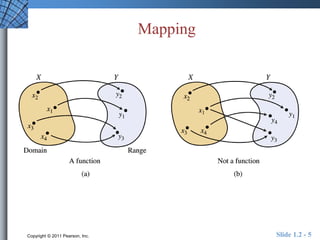
A function from a set D to a set R is a rule that 
assigns to every element in D a unique element 
in R. The set D of all input values is the domain 
of the function, and the set R of all output values 
is the range of the function. 
Copyright © 2011 Pearson, Inc. Slide 1.2 - 3
Function Notation 
To indicate that y comes from the function acting on x, 
we use Euler’s elegant function notation y = f (x) 
(which we read as “y equals f of x” or “the value of f 
at x”). 
Here x is the independent variable and y is the 
dependent variable. 
Copyright © 2011 Pearson, Inc. Slide 1.2 - 4
Mapping 
Copyright © 2011 Pearson, Inc. Slide 1.2 - 5
Example Seeing a Function 
Graphically 
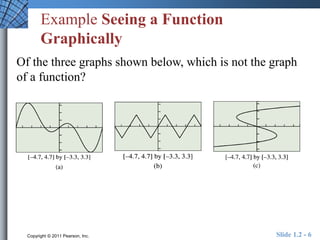
Of the three graphs shown below, which is not the graph 
of a function? 
Copyright © 2011 Pearson, Inc. Slide 1.2 - 6
Solution 
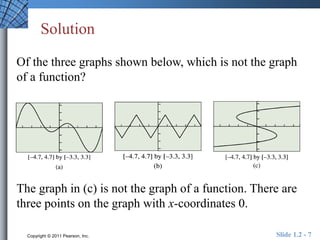
Of the three graphs shown below, which is not the graph 
of a function? 
The graph in (c) is not the graph of a function. There are 
three points on the graph with x-coordinates 0. 
Copyright © 2011 Pearson, Inc. Slide 1.2 - 7
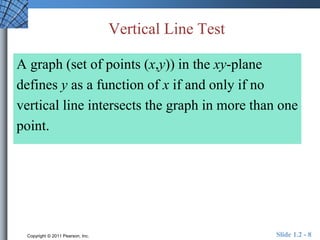
Vertical Line Test 
A graph (set of points (x,y)) in the xy-plane 
defines y as a function of x if and only if no 
vertical line intersects the graph in more than one 
point. 
Copyright © 2011 Pearson, Inc. Slide 1.2 - 8
Agreement 
Unless we are dealing with a model that 
necessitates a restricted domain, we will assume 
that the domain of a function defined by an 
algebraic expression is the same as the domain of 
the algebraic expression, the implied domain. 
For models, we will use a domain that fits the 
situation, the relevant domain. 
Copyright © 2011 Pearson, Inc. Slide 1.2 - 9
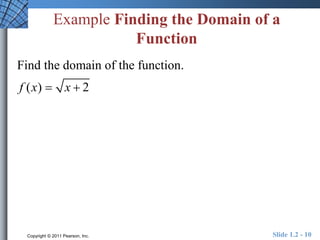
Example Finding the Domain of a 
Function 
Find the domain of the function. 
f (x)  x  2 
Copyright © 2011 Pearson, Inc. Slide 1.2 - 10
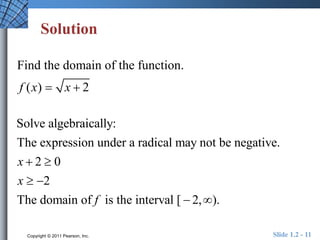
Solution 
Find the domain of the function. 
f (x)  x  2 
Solve algebraically: 
The expression under a radical may not be negative. 
2 0 
2 
The domain of is the interval [ 2, ). 
Copyright © 2011 Pearson, Inc. Slide 1.2 - 11 
x 
x 
f 
  
  
 
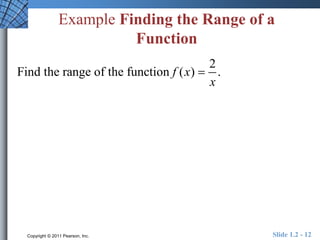
Example Finding the Range of a 
Function 
2 
Find the range of the function f (x) . 
x 
 
Copyright © 2011 Pearson, Inc. Slide 1.2 - 12
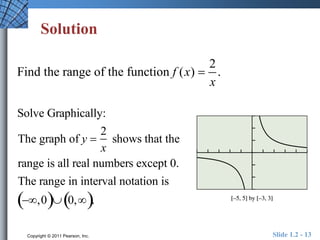
Solution 
Find the range of the function f (x) . 
Solve Graphically: 
The graph of y  
2 
x 
shows that the 
range is all real numbers except 0. 
The range in interval notation is 
,00,. 
2 
x 
 
Copyright © 2011 Pearson, Inc. Slide 1.2 - 13
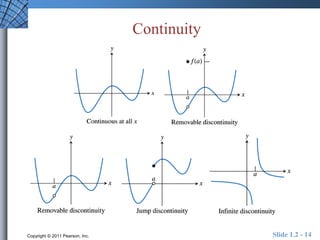
Continuity 
Copyright © 2011 Pearson, Inc. Slide 1.2 - 14
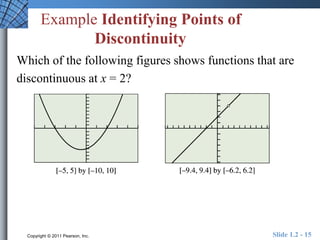
Example Identifying Points of 
Discontinuity 
Which of the following figures shows functions that are 
discontinuous at x = 2? 
Copyright © 2011 Pearson, Inc. Slide 1.2 - 15
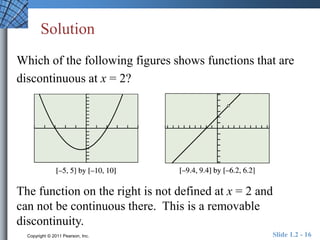
Solution 
Which of the following figures shows functions that are 
discontinuous at x = 2? 
The function on the right is not defined at x = 2 and 
can not be continuous there. This is a removable 
discontinuity. 
Copyright © 2011 Pearson, Inc. Slide 1.2 - 16
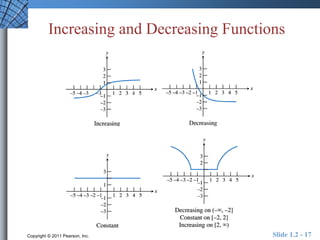
Increasing and Decreasing Functions 
Copyright © 2011 Pearson, Inc. Slide 1.2 - 17
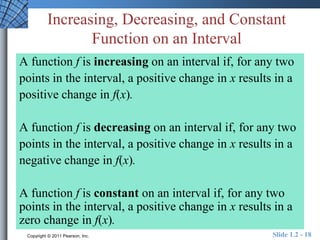
Increasing, Decreasing, and Constant 
Function on an Interval 
A function f is increasing on an interval if, for any two 
points in the interval, a positive change in x results in a 
positive change in f(x). 
A function f is decreasing on an interval if, for any two 
points in the interval, a positive change in x results in a 
negative change in f(x). 
A function f is constant on an interval if, for any two 
points in the interval, a positive change in x results in a 
zero change in f(x). 
Copyright © 2011 Pearson, Inc. Slide 1.2 - 18
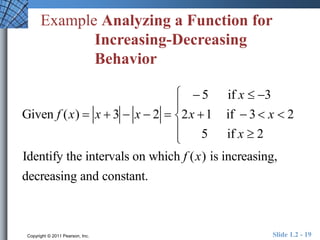
Example Analyzing a Function for 
Increasing-Decreasing 
Behavior 
Given f (x)  x  3  x  2  
 5 if x  3 
2x 1 if  3  x  2 
5 if x  2 
 
 
 
 
 
Identify the intervals on which f (x) is increasing, 
decreasing and constant. 
Copyright © 2011 Pearson, Inc. Slide 1.2 - 19
Solution 
Given f (x)  x  3  x  2  
 
 
 
 
 
Identify the intervals on which f (x) is increasing, 
decreasing and constant. 
The graph suggests, f (x) 
is constant on (  , 3] 
and 2,. 
On the interval [  3,2] f (x) 
appears to be increasing. 
 5 if x  3 
2x 1 if  3  x  2 
5 if x  2 
Copyright © 2011 Pearson, Inc. Slide 1.2 - 20
Lower Bound, Upper Bound and 
Bounded 
A function f is bounded below if there is some number 
b that is less than or equal to every number in the range 
of f. Any such number b is called a lower bound of f. 
A function f is bounded above if there is some number 
B that is greater than or equal to every number in the 
range of f. Any such number B is called a upper bound 
of f. 
A function f is bounded if it is bounded both above and 
below. 
Copyright © 2011 Pearson, Inc. Slide 1.2 - 21
Local and Absolute Extrema 
A local maximum of a function f is a value f (c) that is 
greater than or equal to all range values of f on some 
open interval containing c. If f (c) is greater than or equal 
to all range values of f, then f (c) is the maximum (or 
absolute maximum) value of f. 
A local minimum of a function f is a value f (c) that is 
less than or equal to all range values of f on some open 
interval containing c. If f (c) is less than or equal to all 
range values of f, then f (c) is the minimum (or absolute 
minimum) value of f. 
Local extrema are also called relative extrema. 
Copyright © 2011 Pearson, Inc. Slide 1.2 - 22
Example Identifying Local Extrema 
Decide whether f (x) = x4 – 7x2 + 6x has any local 
maxima or minima. If so, find each local maximum value 
or minimum value and the value at which each occurs. 
Copyright © 2011 Pearson, Inc. Slide 1.2 - 23
Solution 
The graph of f (x) = x4 – 7x2 + 6x suggests that there are 
two local maximum values and one local minimum value. 
We use the graphing calculator to approximate local 
minima as –24.06 (which occurs at x < –2.06) and –1.77 
(which occurs at x > 1.60). Similarly, we identify the 
(approximate) local maximum as 1.32 (which occurs at 
x > 0.46). 
Copyright © 2011 Pearson, Inc. Slide 1.2 - 24
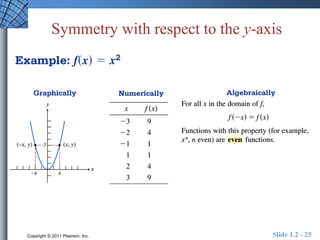
Symmetry with respect to the y-axis 
Copyright © 2011 Pearson, Inc. Slide 1.2 - 25
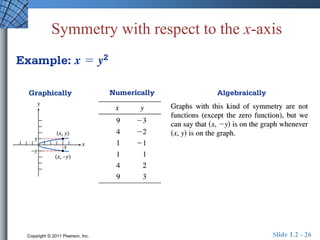
Symmetry with respect to the x-axis 
Copyright © 2011 Pearson, Inc. Slide 1.2 - 26
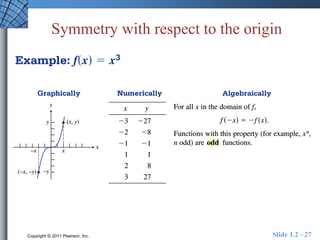
Symmetry with respect to the origin 
Copyright © 2011 Pearson, Inc. Slide 1.2 - 27
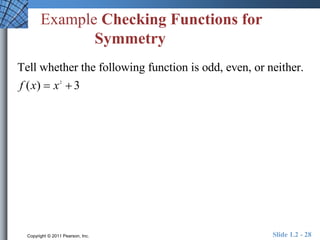
Example Checking Functions for 
Symmetry 
Tell whether the following function is odd, even, or neither. 
f (x)  x 2 
 3 
Copyright © 2011 Pearson, Inc. Slide 1.2 - 28
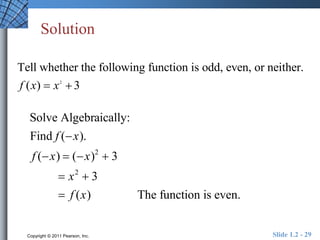
Solution 
Tell whether the following function is odd, even, or neither. 
f (x)  x 2 
 3 
Solve Algebraically: 
Find f (x). 
f (x)  (x)2  3 
 x2  3 
 f (x) The function is even. 
Copyright © 2011 Pearson, Inc. Slide 1.2 - 29
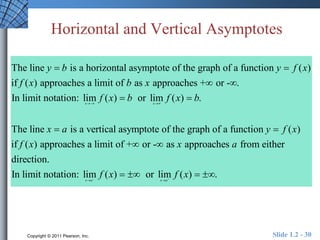
Horizontal and Vertical Asymptotes 
y b y f x 
The line is a horizontal asymptote of the graph of a function ( ) 
if ( ) approaches a limit of as approaches + or - . 
In limit notation: lim ( ) or lim ( ) . 
  
f x b x 
f x b f x b 
  
  
x x 
x a 
  
The line is a ver 
y f x 
 tical asymptote of the graph of a function ( ) 
f x x a 
 
if ( ) approaches a limit of +  or -  
as approaches from either 
direction. 
In limit notation: lim ( ) or lim ( ) . 
f x   f x   
   
 x a x a 
Copyright © 2011 Pearson, Inc. Slide 1.2 - 30
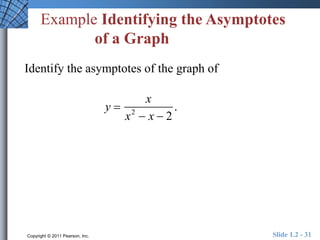
Example Identifying the Asymptotes 
of a Graph 
Identify the asymptotes of the graph of 
y  
x 
x2  x  2 
. 
Copyright © 2011 Pearson, Inc. Slide 1.2 - 31
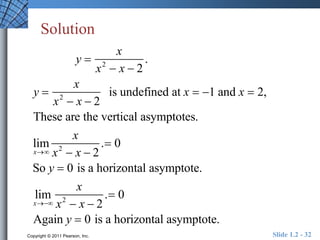
Solution 
y  
y  
x 
x2  x  2 
x2  x  2 
x 
. 
is undefined at x  1 and x  2, 
These are the vertical asymptotes. 
lim 
x 
x 
x2  x  2 
. 0 
So y  0 is a horizontal asymptote. 
lim 
x 
x 
x2  x  2 
. 0 
Again y  0 is a horizontal asymptote. 
Copyright © 2011 Pearson, Inc. Slide 1.2 - 32
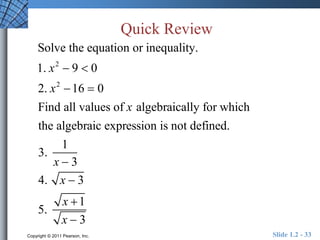
Quick Review 
Solve the equation or inequality. 
1. x2  9  0 
2. x2 16  0 
Find all values of x algebraically for which 
the algebraic expression is not defined. 
3. 
1 
x  3 
4. x  3 
5. 
x 1 
x  3 
Copyright © 2011 Pearson, Inc. Slide 1.2 - 33
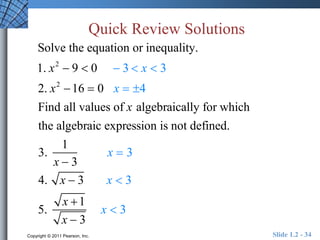
Quick Review Solutions 
Solve the equation or inequality. 
1. x2  9  0  3  x  3 
2. x2 16  0 x  4 
Find all values of x algebraically for which 
the algebraic expression is not defined. 
3. 
1 
x  3 
x  3 
4. x  3 x  3 
5. 
x 1 
x  3 
x  3 
Copyright © 2011 Pearson, Inc. Slide 1.2 - 34

Unit 1.2

  • 1.
    1.2 Functions and Their Properties Copyright © 2011 Pearson, Inc.
  • 2.
    What you’ll learnabout  Function Definition and Notation  Domain and Range  Continuity  Increasing and Decreasing Functions  Boundedness  Local and Absolute Extrema  Symmetry  Asymptotes  End Behavior … and why Functions and graphs form the basis for understanding the mathematics and applications you will see both in your work place and in coursework in college. Copyright © 2011 Pearson, Inc. Slide 1.2 - 2
  • 3.
    Function, Domain, andRange A function from a set D to a set R is a rule that assigns to every element in D a unique element in R. The set D of all input values is the domain of the function, and the set R of all output values is the range of the function. Copyright © 2011 Pearson, Inc. Slide 1.2 - 3
  • 4.
    Function Notation Toindicate that y comes from the function acting on x, we use Euler’s elegant function notation y = f (x) (which we read as “y equals f of x” or “the value of f at x”). Here x is the independent variable and y is the dependent variable. Copyright © 2011 Pearson, Inc. Slide 1.2 - 4
  • 5.
    Mapping Copyright ©2011 Pearson, Inc. Slide 1.2 - 5
  • 6.
    Example Seeing aFunction Graphically Of the three graphs shown below, which is not the graph of a function? Copyright © 2011 Pearson, Inc. Slide 1.2 - 6
  • 7.
    Solution Of thethree graphs shown below, which is not the graph of a function? The graph in (c) is not the graph of a function. There are three points on the graph with x-coordinates 0. Copyright © 2011 Pearson, Inc. Slide 1.2 - 7
  • 8.
    Vertical Line Test A graph (set of points (x,y)) in the xy-plane defines y as a function of x if and only if no vertical line intersects the graph in more than one point. Copyright © 2011 Pearson, Inc. Slide 1.2 - 8
  • 9.
    Agreement Unless weare dealing with a model that necessitates a restricted domain, we will assume that the domain of a function defined by an algebraic expression is the same as the domain of the algebraic expression, the implied domain. For models, we will use a domain that fits the situation, the relevant domain. Copyright © 2011 Pearson, Inc. Slide 1.2 - 9
  • 10.
    Example Finding theDomain of a Function Find the domain of the function. f (x)  x  2 Copyright © 2011 Pearson, Inc. Slide 1.2 - 10
  • 11.
    Solution Find thedomain of the function. f (x)  x  2 Solve algebraically: The expression under a radical may not be negative. 2 0 2 The domain of is the interval [ 2, ). Copyright © 2011 Pearson, Inc. Slide 1.2 - 11 x x f      
  • 12.
    Example Finding theRange of a Function 2 Find the range of the function f (x) . x  Copyright © 2011 Pearson, Inc. Slide 1.2 - 12
  • 13.
    Solution Find therange of the function f (x) . Solve Graphically: The graph of y  2 x shows that the range is all real numbers except 0. The range in interval notation is ,00,. 2 x  Copyright © 2011 Pearson, Inc. Slide 1.2 - 13
  • 14.
    Continuity Copyright ©2011 Pearson, Inc. Slide 1.2 - 14
  • 15.
    Example Identifying Pointsof Discontinuity Which of the following figures shows functions that are discontinuous at x = 2? Copyright © 2011 Pearson, Inc. Slide 1.2 - 15
  • 16.
    Solution Which ofthe following figures shows functions that are discontinuous at x = 2? The function on the right is not defined at x = 2 and can not be continuous there. This is a removable discontinuity. Copyright © 2011 Pearson, Inc. Slide 1.2 - 16
  • 17.
    Increasing and DecreasingFunctions Copyright © 2011 Pearson, Inc. Slide 1.2 - 17
  • 18.
    Increasing, Decreasing, andConstant Function on an Interval A function f is increasing on an interval if, for any two points in the interval, a positive change in x results in a positive change in f(x). A function f is decreasing on an interval if, for any two points in the interval, a positive change in x results in a negative change in f(x). A function f is constant on an interval if, for any two points in the interval, a positive change in x results in a zero change in f(x). Copyright © 2011 Pearson, Inc. Slide 1.2 - 18
  • 19.
    Example Analyzing aFunction for Increasing-Decreasing Behavior Given f (x)  x  3  x  2   5 if x  3 2x 1 if  3  x  2 5 if x  2      Identify the intervals on which f (x) is increasing, decreasing and constant. Copyright © 2011 Pearson, Inc. Slide 1.2 - 19
  • 20.
    Solution Given f(x)  x  3  x  2       Identify the intervals on which f (x) is increasing, decreasing and constant. The graph suggests, f (x) is constant on (  , 3] and 2,. On the interval [  3,2] f (x) appears to be increasing.  5 if x  3 2x 1 if  3  x  2 5 if x  2 Copyright © 2011 Pearson, Inc. Slide 1.2 - 20
  • 21.
    Lower Bound, UpperBound and Bounded A function f is bounded below if there is some number b that is less than or equal to every number in the range of f. Any such number b is called a lower bound of f. A function f is bounded above if there is some number B that is greater than or equal to every number in the range of f. Any such number B is called a upper bound of f. A function f is bounded if it is bounded both above and below. Copyright © 2011 Pearson, Inc. Slide 1.2 - 21
  • 22.
    Local and AbsoluteExtrema A local maximum of a function f is a value f (c) that is greater than or equal to all range values of f on some open interval containing c. If f (c) is greater than or equal to all range values of f, then f (c) is the maximum (or absolute maximum) value of f. A local minimum of a function f is a value f (c) that is less than or equal to all range values of f on some open interval containing c. If f (c) is less than or equal to all range values of f, then f (c) is the minimum (or absolute minimum) value of f. Local extrema are also called relative extrema. Copyright © 2011 Pearson, Inc. Slide 1.2 - 22
  • 23.
    Example Identifying LocalExtrema Decide whether f (x) = x4 – 7x2 + 6x has any local maxima or minima. If so, find each local maximum value or minimum value and the value at which each occurs. Copyright © 2011 Pearson, Inc. Slide 1.2 - 23
  • 24.
    Solution The graphof f (x) = x4 – 7x2 + 6x suggests that there are two local maximum values and one local minimum value. We use the graphing calculator to approximate local minima as –24.06 (which occurs at x < –2.06) and –1.77 (which occurs at x > 1.60). Similarly, we identify the (approximate) local maximum as 1.32 (which occurs at x > 0.46). Copyright © 2011 Pearson, Inc. Slide 1.2 - 24
  • 25.
    Symmetry with respectto the y-axis Copyright © 2011 Pearson, Inc. Slide 1.2 - 25
  • 26.
    Symmetry with respectto the x-axis Copyright © 2011 Pearson, Inc. Slide 1.2 - 26
  • 27.
    Symmetry with respectto the origin Copyright © 2011 Pearson, Inc. Slide 1.2 - 27
  • 28.
    Example Checking Functionsfor Symmetry Tell whether the following function is odd, even, or neither. f (x)  x 2  3 Copyright © 2011 Pearson, Inc. Slide 1.2 - 28
  • 29.
    Solution Tell whetherthe following function is odd, even, or neither. f (x)  x 2  3 Solve Algebraically: Find f (x). f (x)  (x)2  3  x2  3  f (x) The function is even. Copyright © 2011 Pearson, Inc. Slide 1.2 - 29
  • 30.
    Horizontal and VerticalAsymptotes y b y f x The line is a horizontal asymptote of the graph of a function ( ) if ( ) approaches a limit of as approaches + or - . In limit notation: lim ( ) or lim ( ) .   f x b x f x b f x b     x x x a   The line is a ver y f x  tical asymptote of the graph of a function ( ) f x x a  if ( ) approaches a limit of +  or -  as approaches from either direction. In limit notation: lim ( ) or lim ( ) . f x   f x       x a x a Copyright © 2011 Pearson, Inc. Slide 1.2 - 30
  • 31.
    Example Identifying theAsymptotes of a Graph Identify the asymptotes of the graph of y  x x2  x  2 . Copyright © 2011 Pearson, Inc. Slide 1.2 - 31
  • 32.
    Solution y  y  x x2  x  2 x2  x  2 x . is undefined at x  1 and x  2, These are the vertical asymptotes. lim x x x2  x  2 . 0 So y  0 is a horizontal asymptote. lim x x x2  x  2 . 0 Again y  0 is a horizontal asymptote. Copyright © 2011 Pearson, Inc. Slide 1.2 - 32
  • 33.
    Quick Review Solvethe equation or inequality. 1. x2  9  0 2. x2 16  0 Find all values of x algebraically for which the algebraic expression is not defined. 3. 1 x  3 4. x  3 5. x 1 x  3 Copyright © 2011 Pearson, Inc. Slide 1.2 - 33
  • 34.
    Quick Review Solutions Solve the equation or inequality. 1. x2  9  0  3  x  3 2. x2 16  0 x  4 Find all values of x algebraically for which the algebraic expression is not defined. 3. 1 x  3 x  3 4. x  3 x  3 5. x 1 x  3 x  3 Copyright © 2011 Pearson, Inc. Slide 1.2 - 34