MAHIP
SINGH
X-B
SOME APPLICATION OF
TRIGNOMETRY
INTRODUCTION
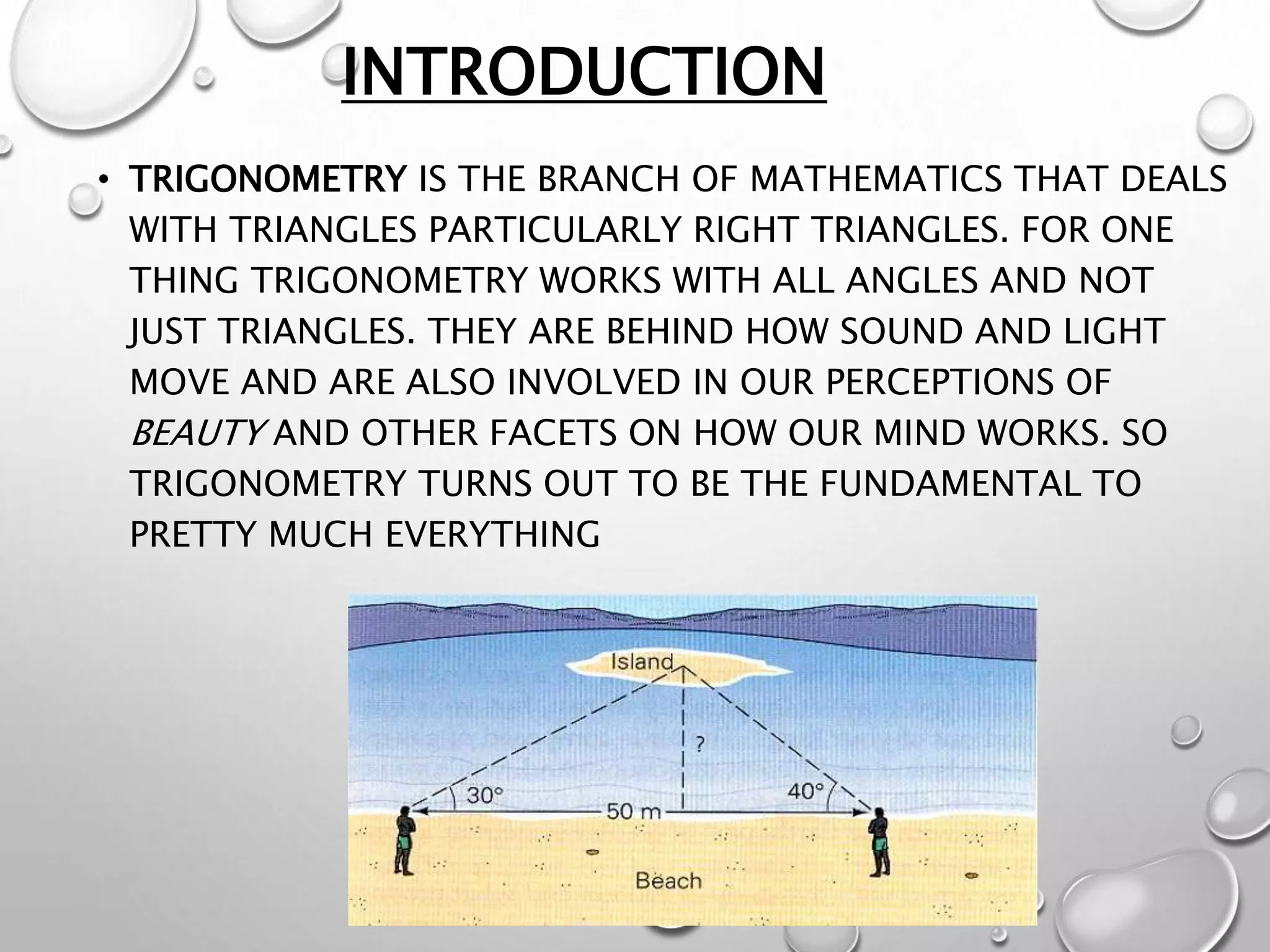
• TRIGONOMETRY IS THE BRANCH OF MATHEMATICS THAT DEALS
WITH TRIANGLES PARTICULARLY RIGHT TRIANGLES. FOR ONE
THING TRIGONOMETRY WORKS WITH ALL ANGLES AND NOT
JUST TRIANGLES. THEY ARE BEHIND HOW SOUND AND LIGHT
MOVE AND ARE ALSO INVOLVED IN OUR PERCEPTIONS OF
BEAUTY AND OTHER FACETS ON HOW OUR MIND WORKS. SO
TRIGONOMETRY TURNS OUT TO BE THE FUNDAMENTAL TO
PRETTY MUCH EVERYTHING
BASIC FUNDAMENTALS
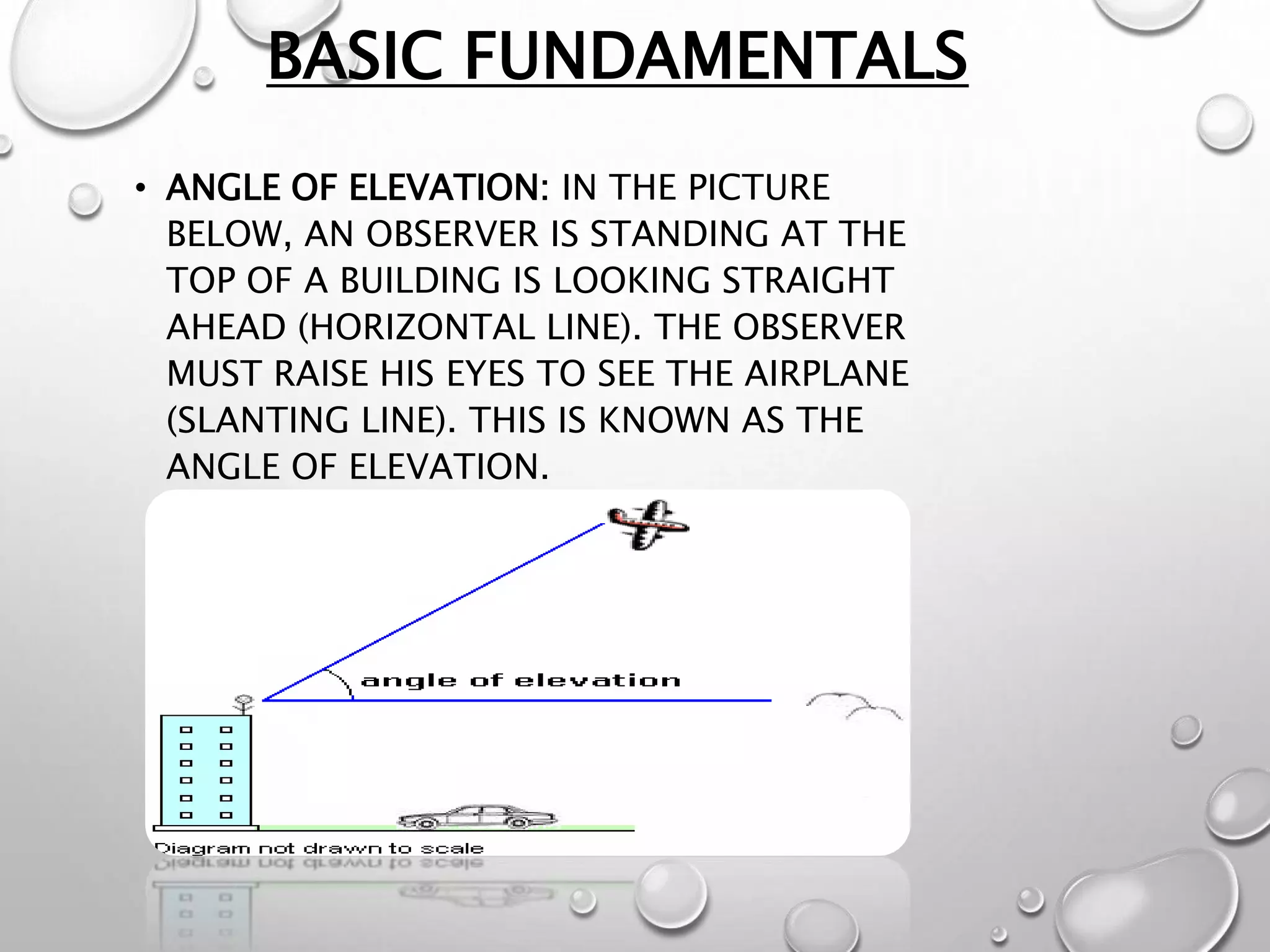
• ANGLE OF ELEVATION: IN THE PICTURE
BELOW, AN OBSERVER IS STANDING AT THE
TOP OF A BUILDING IS LOOKING STRAIGHT
AHEAD (HORIZONTAL LINE). THE OBSERVER
MUST RAISE HIS EYES TO SEE THE AIRPLANE
(SLANTING LINE). THIS IS KNOWN AS THE
ANGLE OF ELEVATION.
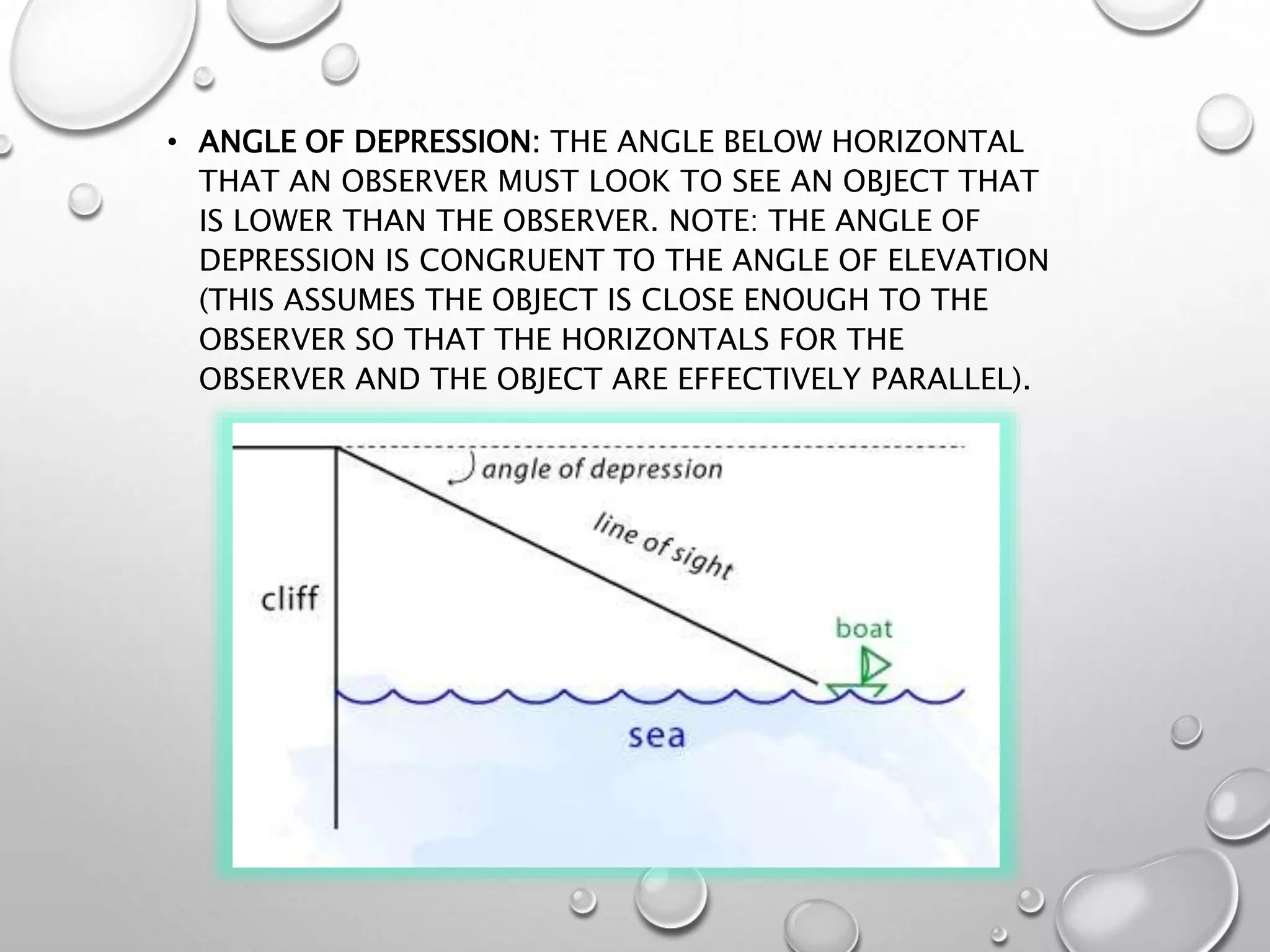
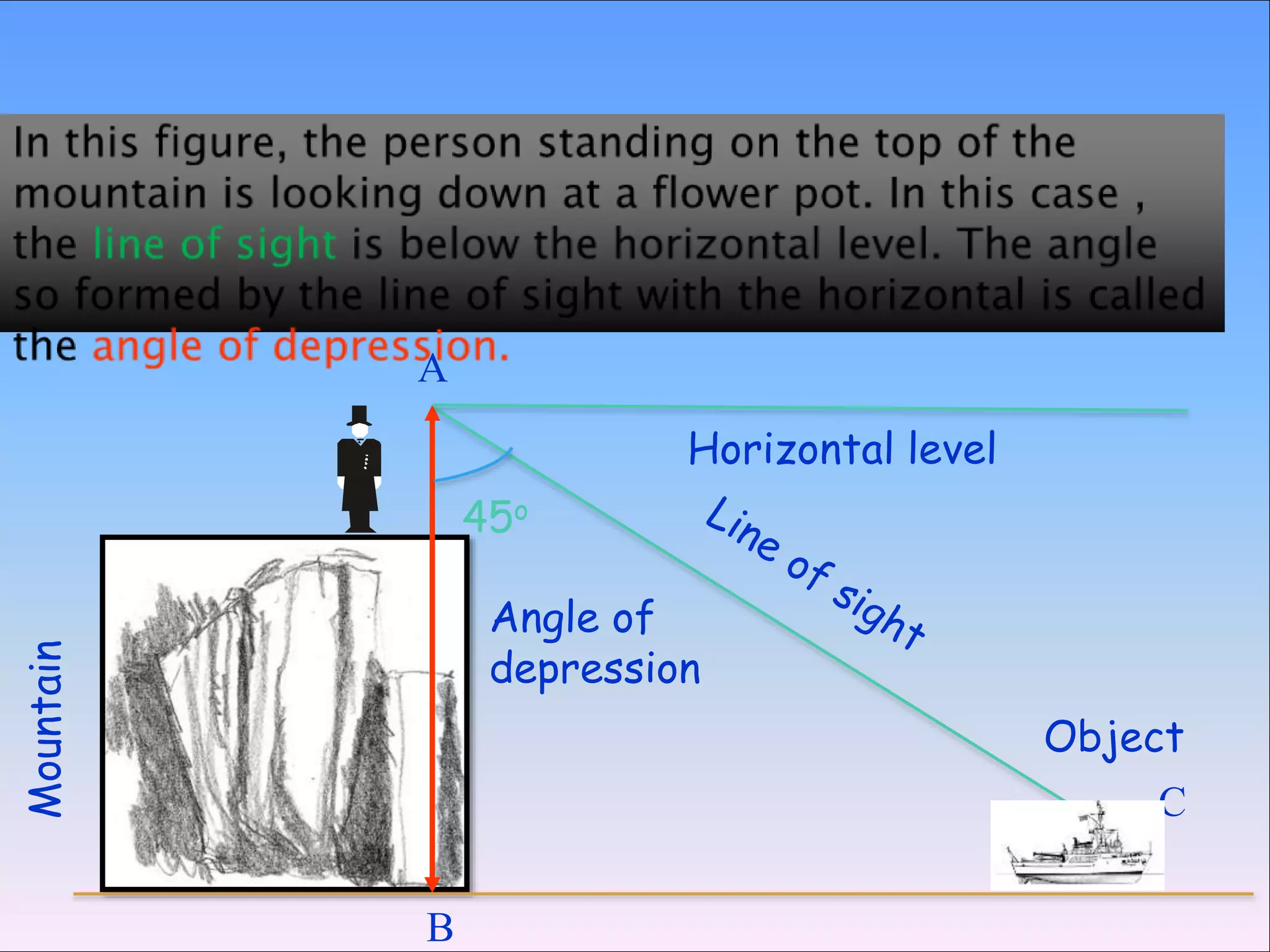
• ANGLE OF DEPRESSION: THE ANGLE BELOW HORIZONTAL
THAT AN OBSERVER MUST LOOK TO SEE AN OBJECT THAT
IS LOWER THAN THE OBSERVER. NOTE: THE ANGLE OF
DEPRESSION IS CONGRUENT TO THE ANGLE OF ELEVATION
(THIS ASSUMES THE OBJECT IS CLOSE ENOUGH TO THE
OBSERVER SO THAT THE HORIZONTALS FOR THE
OBSERVER AND THE OBJECT ARE EFFECTIVELY PARALLEL).
600
300
600
a
2a2a
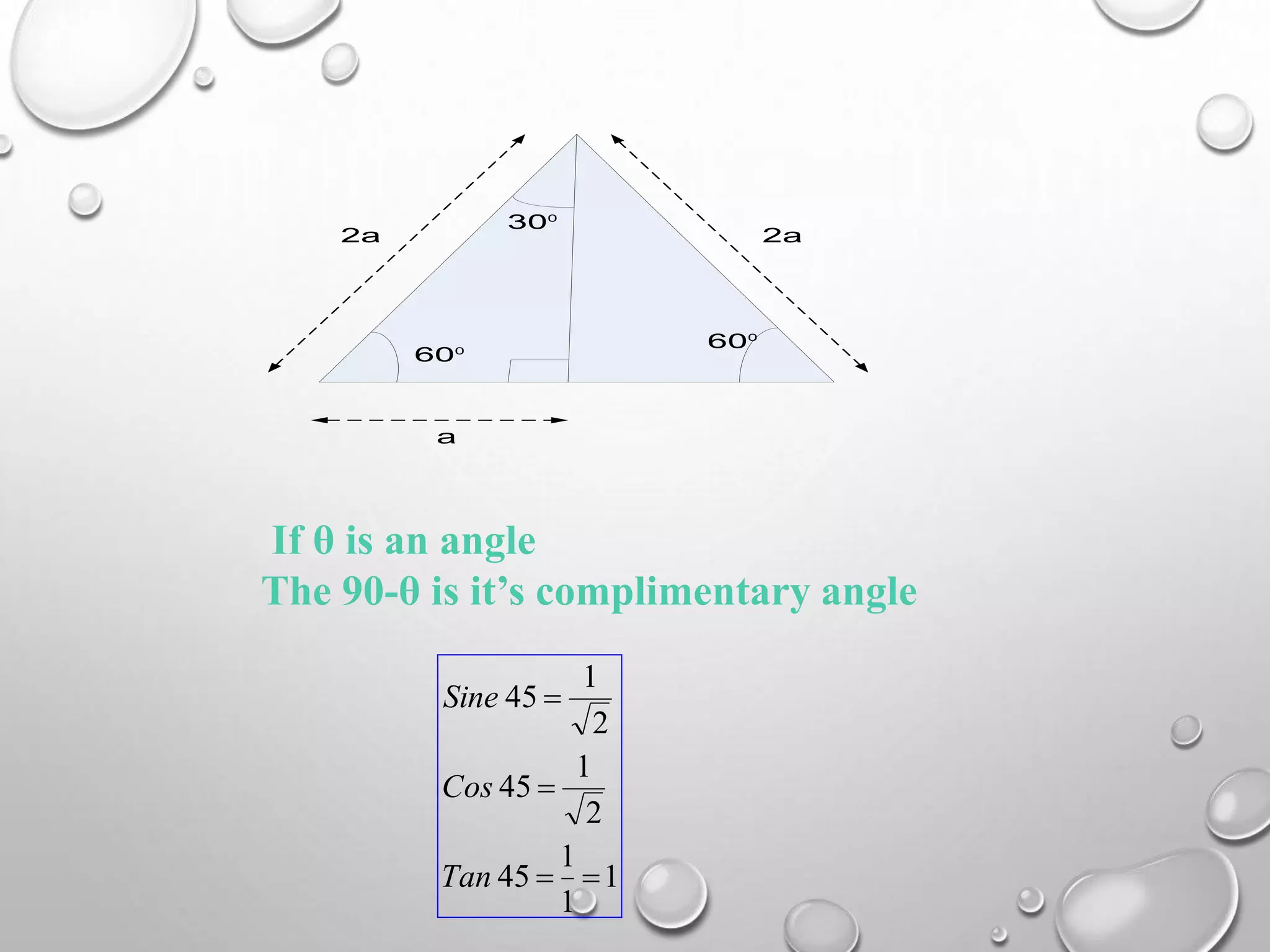
If θ is an angle
The 90-θ is it’s complimentary angle
1
1
1
45
2
1
45
2
1
45



Tan
Cos
Sine
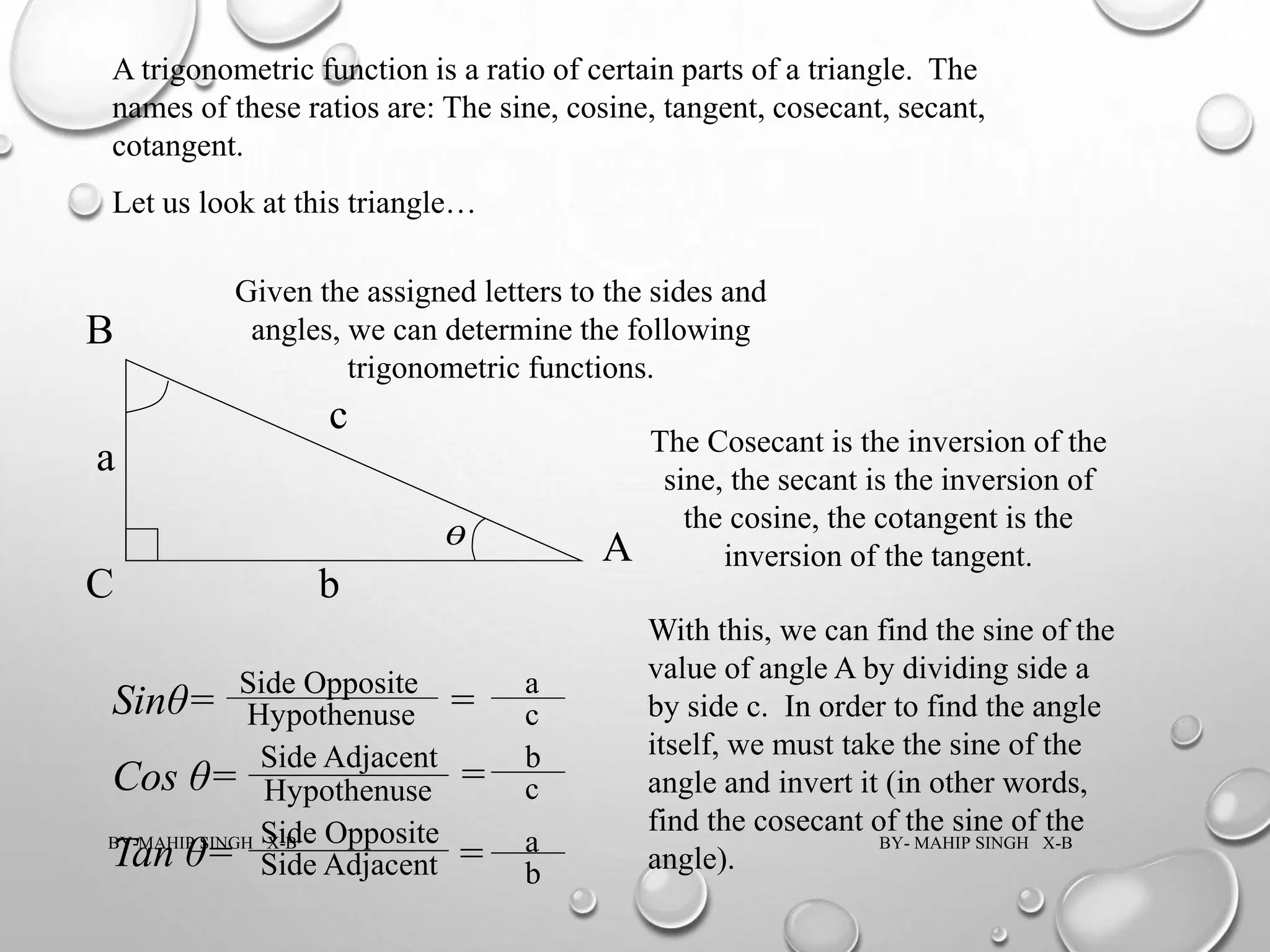
A trigonometric function is a ratio of certain parts of a triangle. The
names of these ratios are: The sine, cosine, tangent, cosecant, secant,
cotangent.
Let us look at this triangle…
a
c
b
ө A
B
C
Given the assigned letters to the sides and
angles, we can determine the following
trigonometric functions.
The Cosecant is the inversion of the
sine, the secant is the inversion of
the cosine, the cotangent is the
inversion of the tangent.
With this, we can find the sine of the
value of angle A by dividing side a
by side c. In order to find the angle
itself, we must take the sine of the
angle and invert it (in other words,
find the cosecant of the sine of the
angle).
Sinθ=
Cos θ=
Tan θ=
Side Opposite
Side Adjacent
Side Adjacent
Side Opposite
Hypothenuse
Hypothenuse
=
=
= a
b
c
a
b
c
BY- MAHIP SINGH X-BBY-MAHIP SINGH X-B
4560
12
h
d
dtoequalsalsois39.16
732.0
12
732.0732.112
;732.1
12h
(2)(1)..inngSubstituti
)2(732.13
12
60
(1)-------hd;..145








h
hhh
h
d
h
Tan
or
d
h
Tan
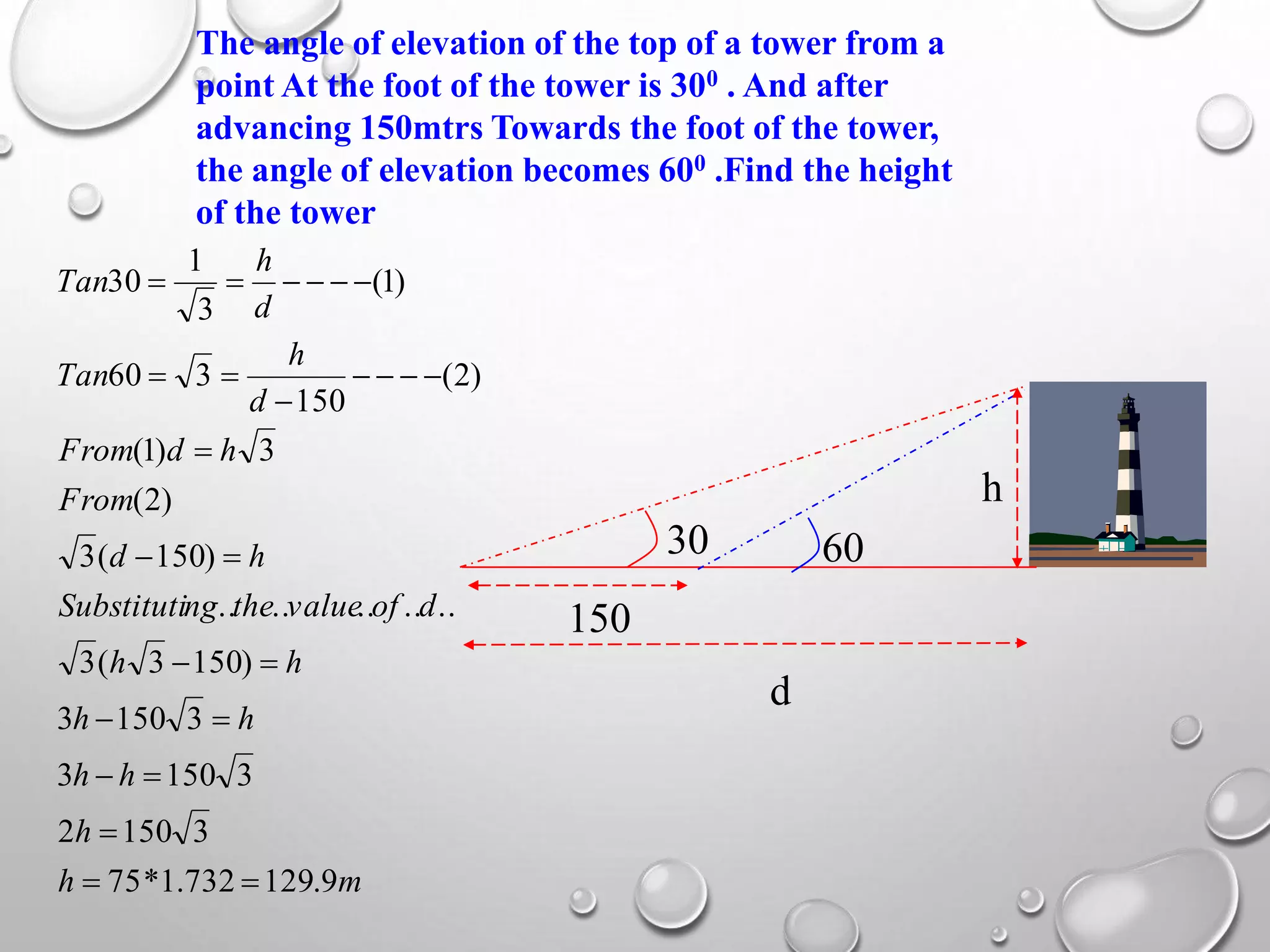
The angle of elevation of the top of a tower from a
point At the foot of the tower is 300 . And after
advancing 150mtrs Towards the foot of the tower,
the angle of elevation becomes 600 .Find the height
of the tower
150
h
d
30 60
mh
h
hh
hh
hh
dofvaluethengSubstituti
hd
From
hdFrom
d
h
Tan
d
h
Tan
9.129732.1*75
31502
31503
31503
)1503(3
..........
)150(3
)2(
3)1(
)2(
150
360
)1(
3
1
30











?
45o
?
What you’re
going to do
next?
Heights and
Distances
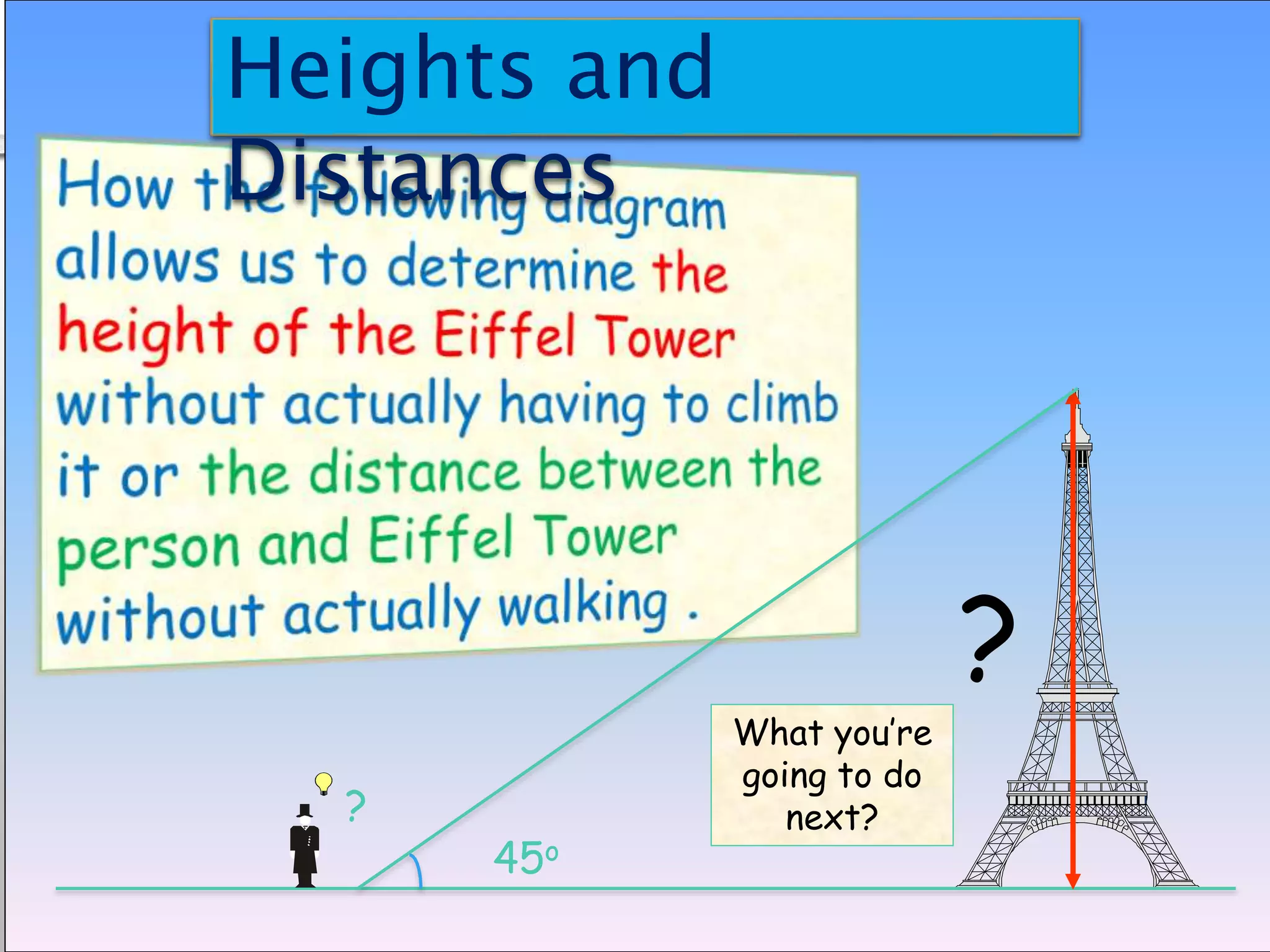
In this situation , the distance or the heights can
be founded by using mathematical techniques,
which comes under a branch of ‘trigonometry’.
The word ‘ trigonometry’ is derived from the
Greek word ‘tri’ meaning three , ‘gon’ meaning
sides and ‘metron’ meaning measures.
Trigonometry is concerned with the relationship
between the angles and sides of triangles. An
understanding of these relationships enables
unknown angles and sides to be calculated
without recourse to direct measurement.
Applications include finding heights/distances of
objects.
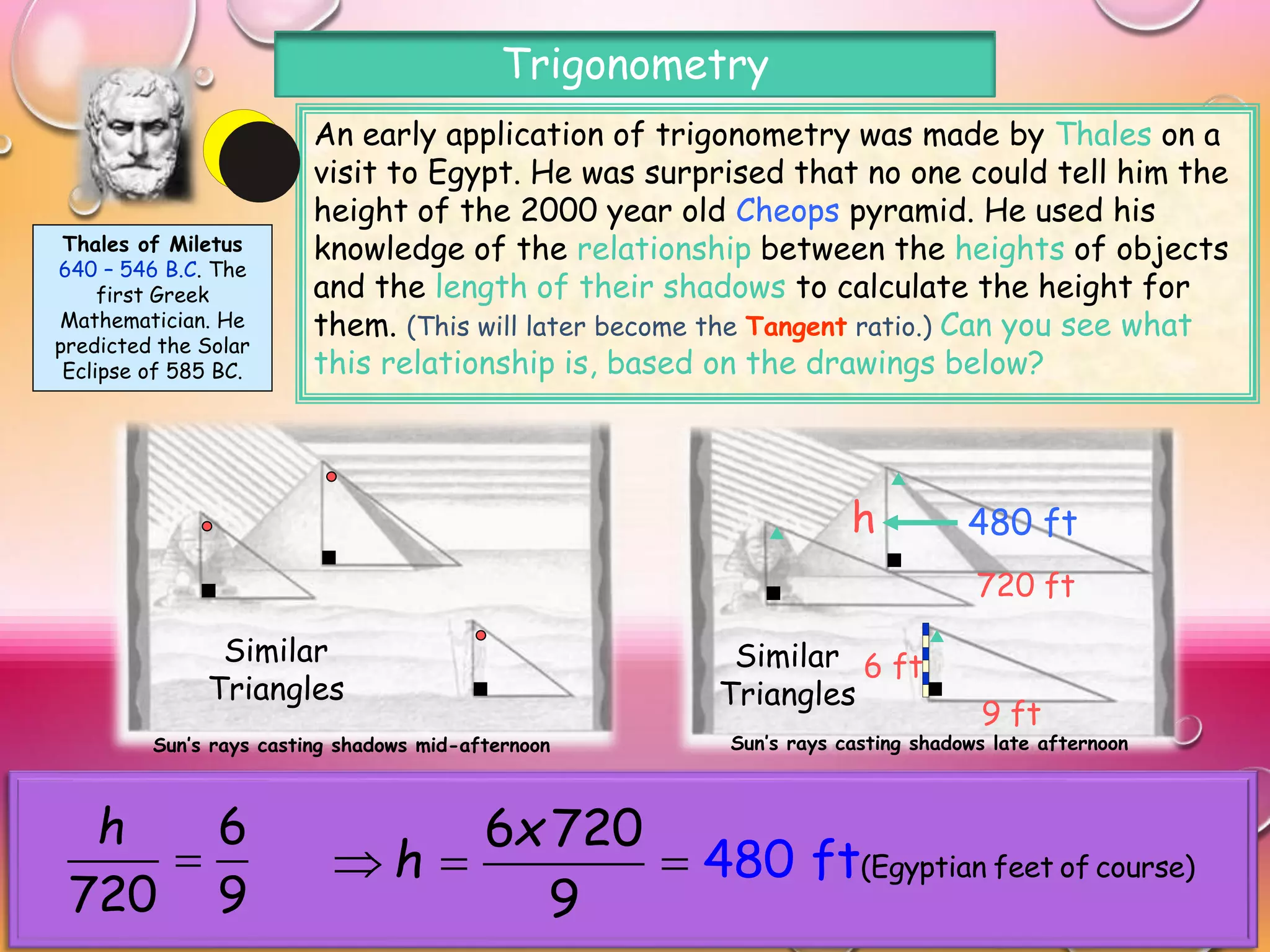
Sun’s rays casting shadows mid-afternoon Sun’s rays casting shadows late afternoon
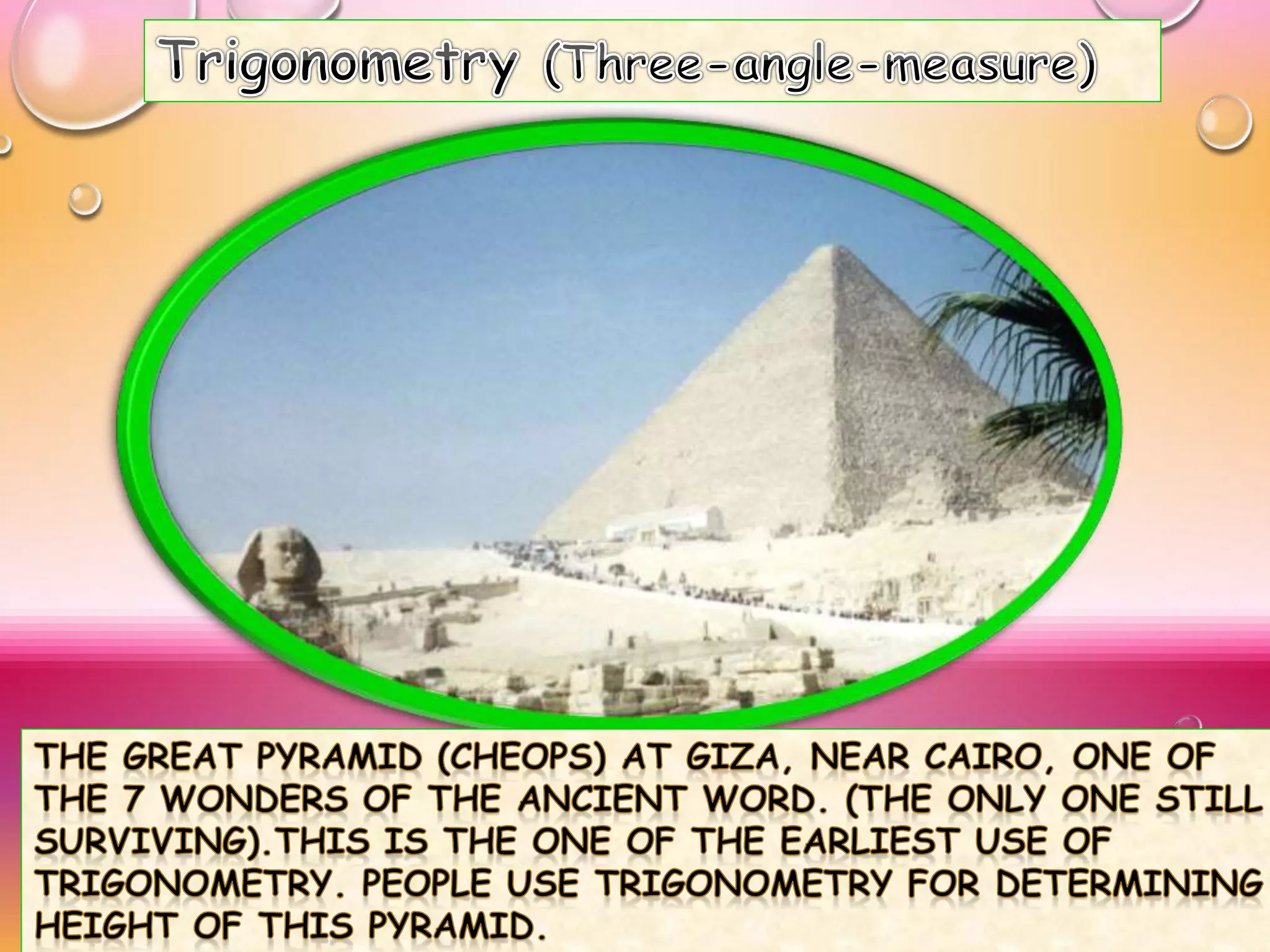
An early application of trigonometry was made by Thales on a
visit to Egypt. He was surprised that no one could tell him the
height of the 2000 year old Cheops pyramid. He used his
knowledge of the relationship between the heights of objects
and the length of their shadows to calculate the height for
them. (This will later become the Tangent ratio.) Can you see what
this relationship is, based on the drawings below?
Thales of Miletus
640 – 546 B.C. The
first Greek
Mathematician. He
predicted the Solar
Eclipse of 585 BC.
Trigonometry
Similar
Triangles
Similar
Triangles
Thales may not have used similar triangles directly to solve the problem but
he knew that the ratio of the vertical to horizontal sides of each triangle was
constant and unchanging for different heights of the sun. Can you use the
measurements shown above to find the height of Cheops?
6 ft
9 ft
720 ft
h
6
720 9
h

480 ft
(Egyptian feet of course)4
6 720
9
80 ft
x
h  
h
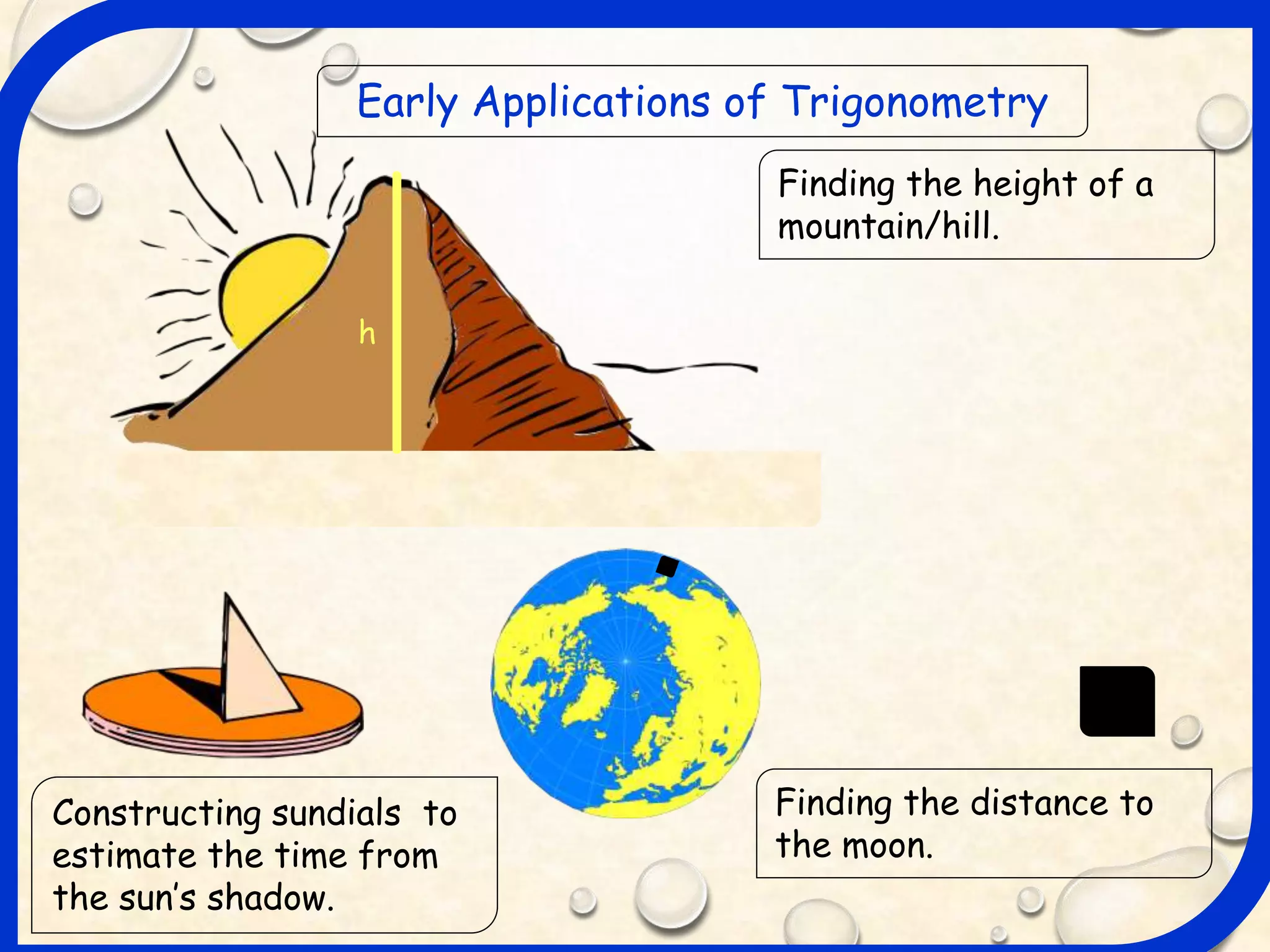
Early Applications of Trigonometry
Finding the height of a
mountain/hill.
Finding the distance to
the moon.
Constructing sundials to
estimate the time from
the sun’s shadow.
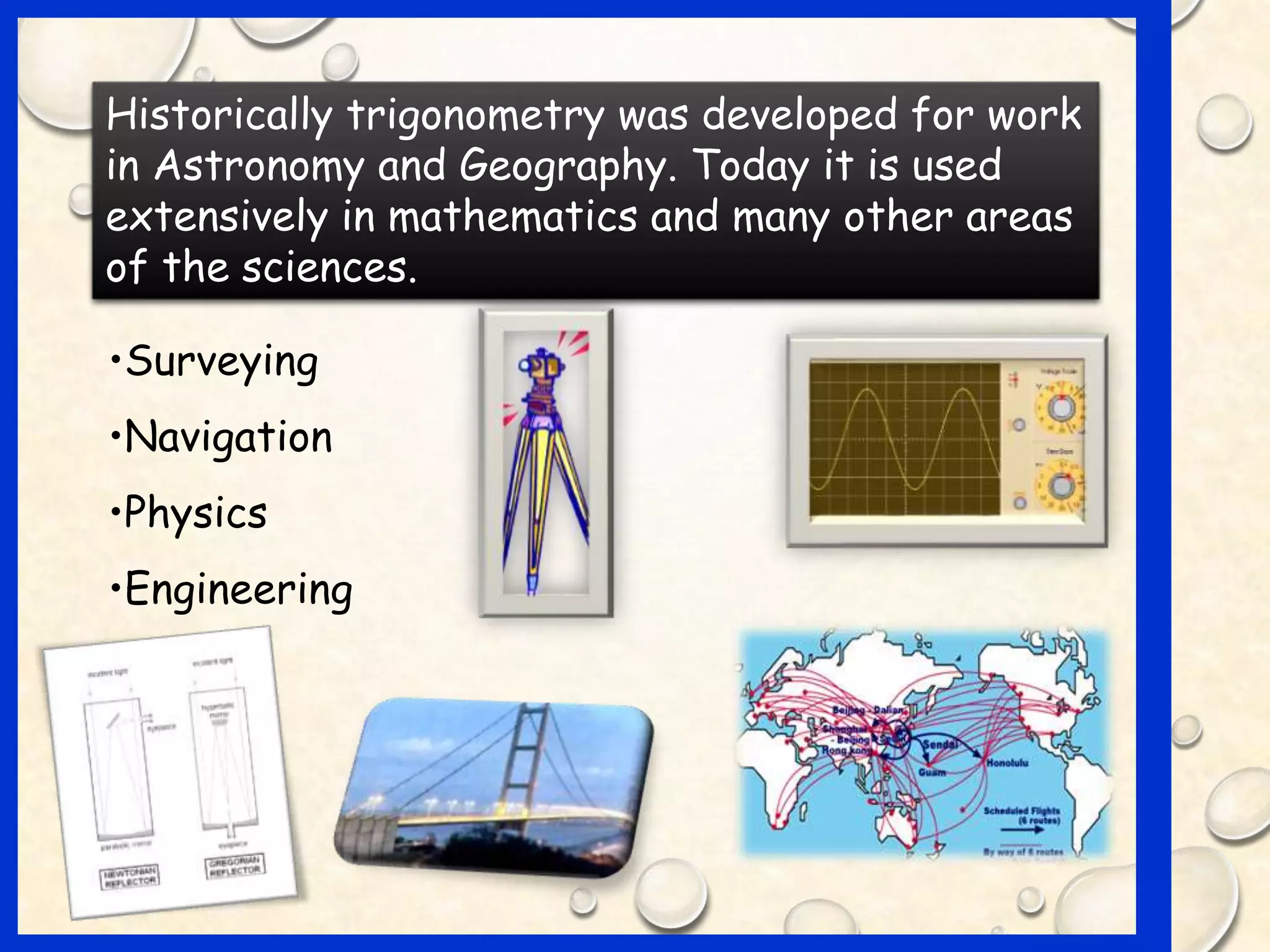
Historically trigonometry was developed for work
in Astronomy and Geography. Today it is used
extensively in mathematics and many other areas
of the sciences.
•Surveying
•Navigation
•Physics
•Engineering
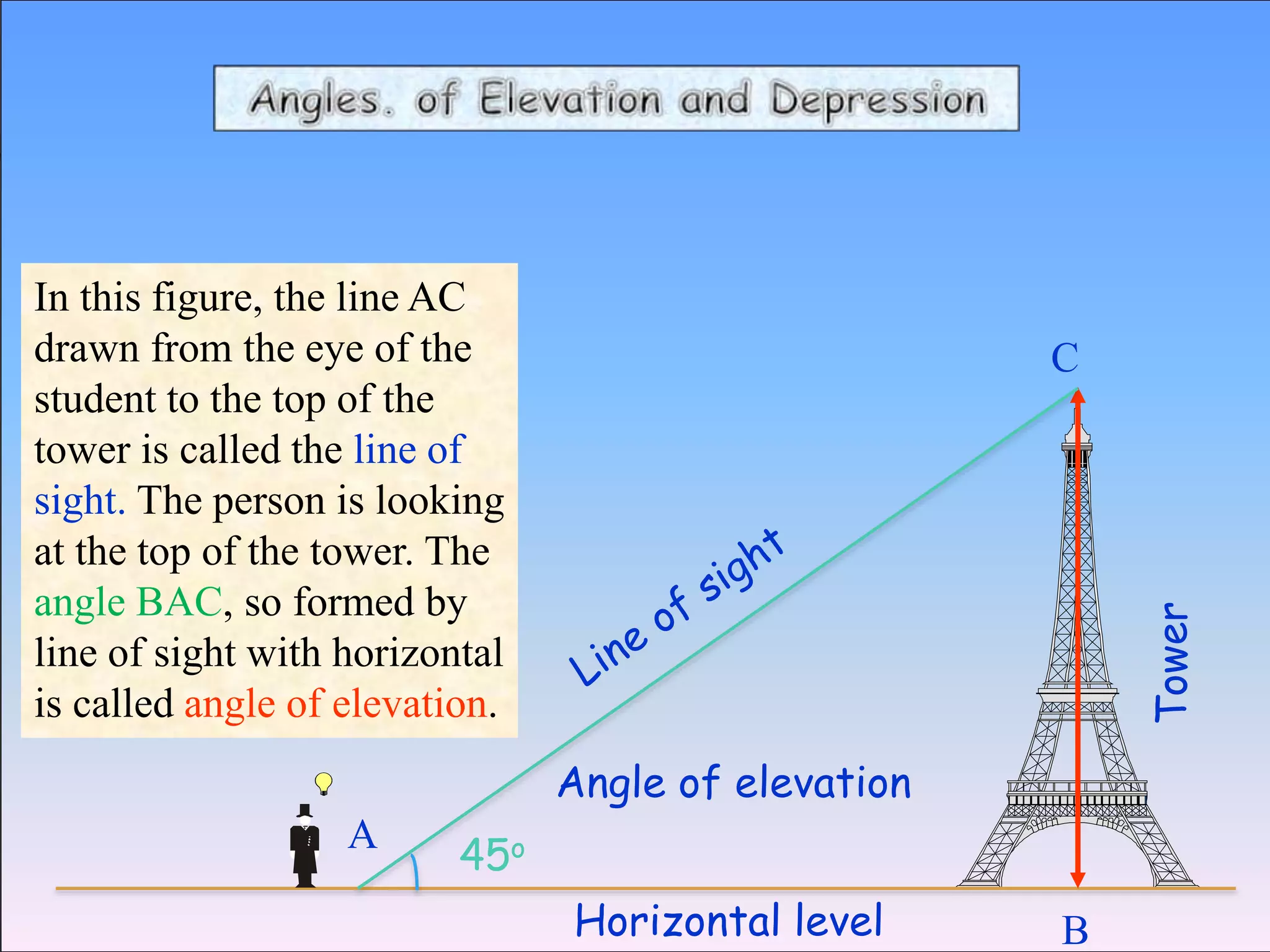
45o
Angle of elevation
A
C
B
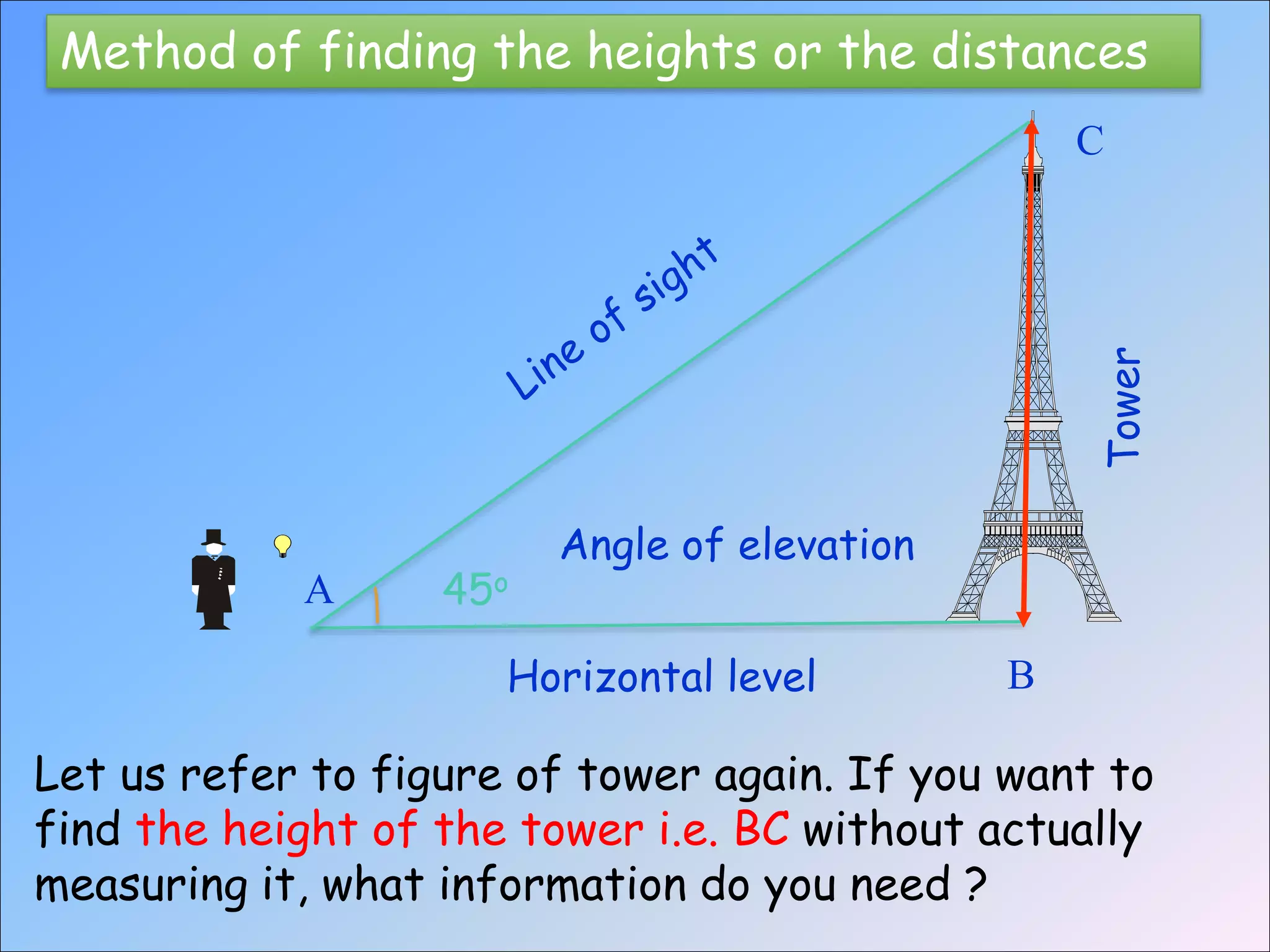
In this figure, the line AC
drawn from the eye of the
student to the top of the
tower is called the line of
sight. The person is looking
at the top of the tower. The
angle BAC, so formed by
line of sight with horizontal
is called angle of elevation.
Tower
Horizontal level
45o
Mountain
Angle of
depression
A
B
C
Object
Horizontal level
45o
Angle of elevation
A
C
B
Tower
Horizontal level
Method of finding the heights or the distances
Let us refer to figure of tower again. If you want to
find the height of the tower i.e. BC without actually
measuring it, what information do you need ?
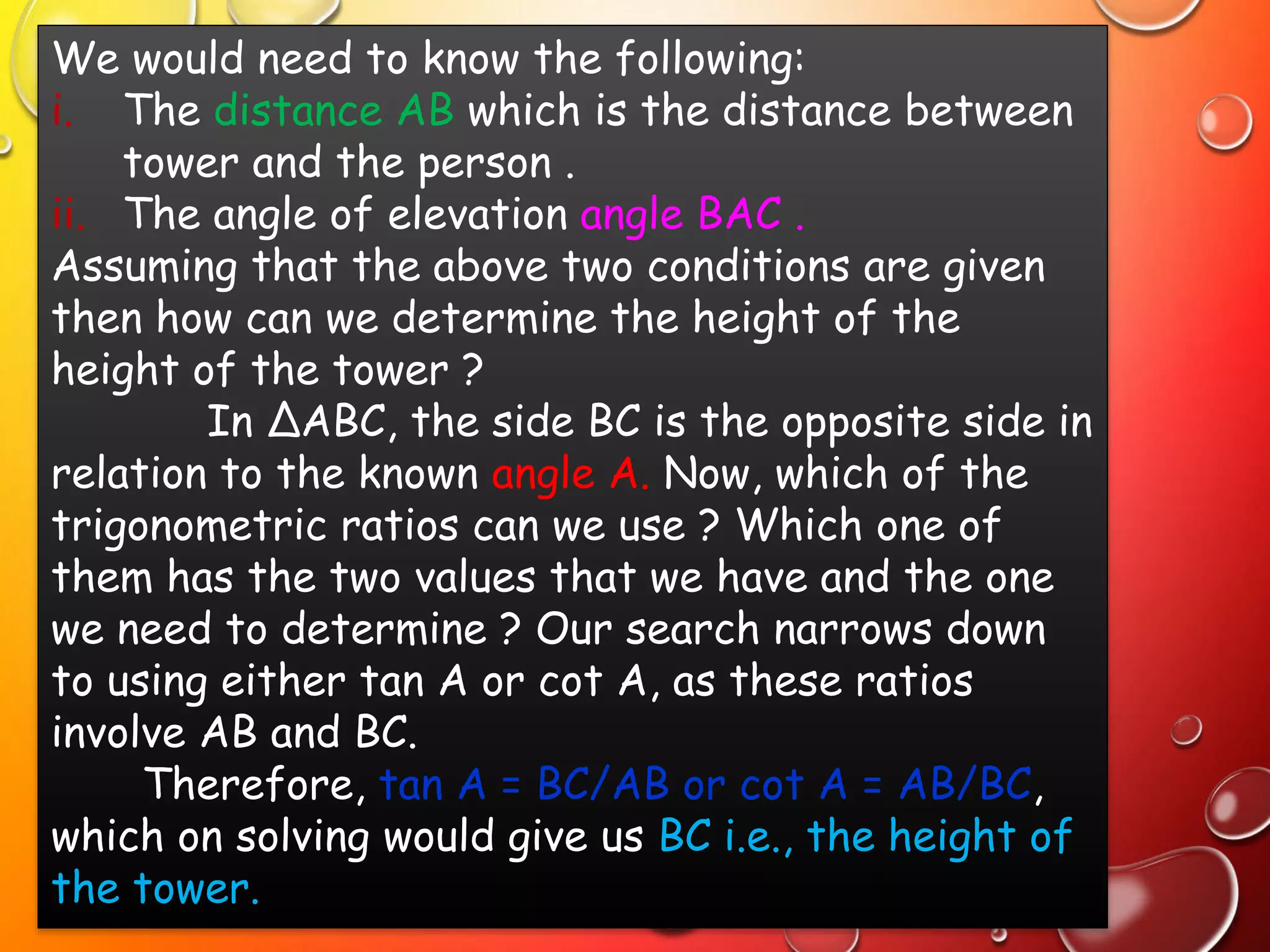
We would need to know the following:
i. The distance AB which is the distance between
tower and the person .
ii. The angle of elevation angle BAC .
Assuming that the above two conditions are given
then how can we determine the height of the
height of the tower ?
In ∆ABC, the side BC is the opposite side in
relation to the known angle A. Now, which of the
trigonometric ratios can we use ? Which one of
them has the two values that we have and the one
we need to determine ? Our search narrows down
to using either tan A or cot A, as these ratios
involve AB and BC.
Therefore, tan A = BC/AB or cot A = AB/BC,
which on solving would give us BC i.e., the height of
the tower.
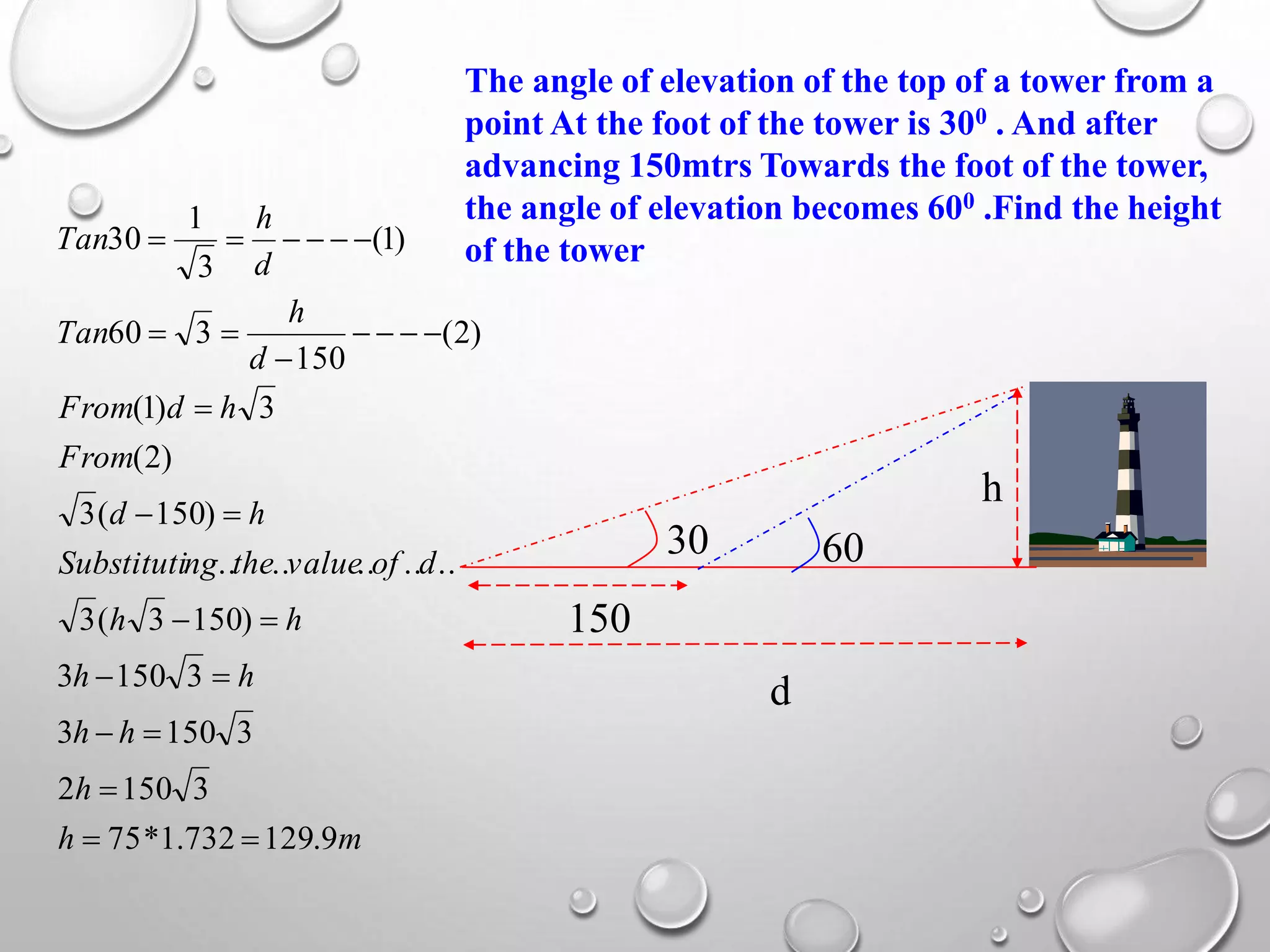
The angle of elevation of the top of a tower from a
point At the foot of the tower is 300 . And after
advancing 150mtrs Towards the foot of the tower,
the angle of elevation becomes 600 .Find the height
of the tower
150
h
d
30 60
mh
h
hh
hh
hh
dofvaluethengSubstituti
hd
From
hdFrom
d
h
Tan
d
h
Tan
9.129732.1*75
31502
31503
31503
)1503(3
..........
)150(3
)2(
3)1(
)2(
150
360
)1(
3
1
30











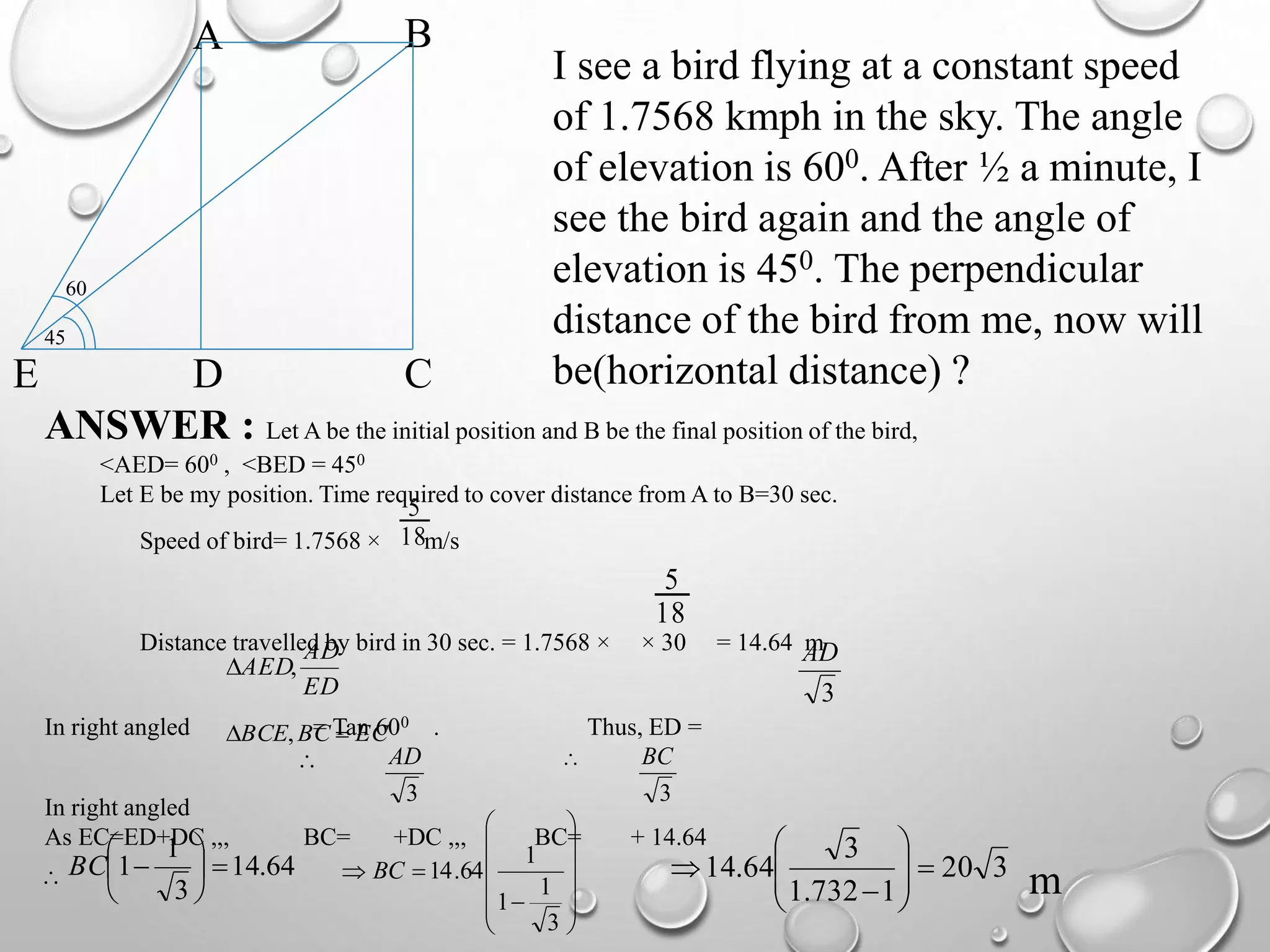
45
BA
CDE
60
I see a bird flying at a constant speed
of 1.7568 kmph in the sky. The angle
of elevation is 600. After ½ a minute, I
see the bird again and the angle of
elevation is 450. The perpendicular
distance of the bird from me, now will
be(horizontal distance) ?
ANSWER : Let A be the initial position and B be the final position of the bird,
<AED= 600 , <BED = 450
Let E be my position. Time required to cover distance from A to B=30 sec.
Speed of bird= 1.7568 × m/s
Distance travelled by bird in 30 sec. = 1.7568 × × 30 = 14.64 m
In right angled = Tan 600 . Thus, ED =
In right angled
As EC=ED+DC ,,, BC= +DC ,,, BC= + 14.64
18
5
18
5
ED
AD
AED,
3
AD
ECBCBCE  ,

3
AD 
3
BC
 64.14
3
1
1 





BC














3
1
1
1
64.14BC 320
1732.1
3
64.14 









m
Thank you
BY- MAHIP SINGH X-BX-B

Maths project --some applications of trignometry--class 10

  • 1.
  • 2.
    INTRODUCTION • TRIGONOMETRY ISTHE BRANCH OF MATHEMATICS THAT DEALS WITH TRIANGLES PARTICULARLY RIGHT TRIANGLES. FOR ONE THING TRIGONOMETRY WORKS WITH ALL ANGLES AND NOT JUST TRIANGLES. THEY ARE BEHIND HOW SOUND AND LIGHT MOVE AND ARE ALSO INVOLVED IN OUR PERCEPTIONS OF BEAUTY AND OTHER FACETS ON HOW OUR MIND WORKS. SO TRIGONOMETRY TURNS OUT TO BE THE FUNDAMENTAL TO PRETTY MUCH EVERYTHING
  • 3.
    BASIC FUNDAMENTALS • ANGLEOF ELEVATION: IN THE PICTURE BELOW, AN OBSERVER IS STANDING AT THE TOP OF A BUILDING IS LOOKING STRAIGHT AHEAD (HORIZONTAL LINE). THE OBSERVER MUST RAISE HIS EYES TO SEE THE AIRPLANE (SLANTING LINE). THIS IS KNOWN AS THE ANGLE OF ELEVATION.
  • 4.
    • ANGLE OFDEPRESSION: THE ANGLE BELOW HORIZONTAL THAT AN OBSERVER MUST LOOK TO SEE AN OBJECT THAT IS LOWER THAN THE OBSERVER. NOTE: THE ANGLE OF DEPRESSION IS CONGRUENT TO THE ANGLE OF ELEVATION (THIS ASSUMES THE OBJECT IS CLOSE ENOUGH TO THE OBSERVER SO THAT THE HORIZONTALS FOR THE OBSERVER AND THE OBJECT ARE EFFECTIVELY PARALLEL).
  • 5.
    600 300 600 a 2a2a If θ isan angle The 90-θ is it’s complimentary angle 1 1 1 45 2 1 45 2 1 45    Tan Cos Sine
  • 6.
    A trigonometric functionis a ratio of certain parts of a triangle. The names of these ratios are: The sine, cosine, tangent, cosecant, secant, cotangent. Let us look at this triangle… a c b ө A B C Given the assigned letters to the sides and angles, we can determine the following trigonometric functions. The Cosecant is the inversion of the sine, the secant is the inversion of the cosine, the cotangent is the inversion of the tangent. With this, we can find the sine of the value of angle A by dividing side a by side c. In order to find the angle itself, we must take the sine of the angle and invert it (in other words, find the cosecant of the sine of the angle). Sinθ= Cos θ= Tan θ= Side Opposite Side Adjacent Side Adjacent Side Opposite Hypothenuse Hypothenuse = = = a b c a b c BY- MAHIP SINGH X-BBY-MAHIP SINGH X-B
  • 7.
  • 8.
    The angle ofelevation of the top of a tower from a point At the foot of the tower is 300 . And after advancing 150mtrs Towards the foot of the tower, the angle of elevation becomes 600 .Find the height of the tower 150 h d 30 60 mh h hh hh hh dofvaluethengSubstituti hd From hdFrom d h Tan d h Tan 9.129732.1*75 31502 31503 31503 )1503(3 .......... )150(3 )2( 3)1( )2( 150 360 )1( 3 1 30           
  • 9.
    ? 45o ? What you’re going todo next? Heights and Distances
  • 10.
    In this situation, the distance or the heights can be founded by using mathematical techniques, which comes under a branch of ‘trigonometry’. The word ‘ trigonometry’ is derived from the Greek word ‘tri’ meaning three , ‘gon’ meaning sides and ‘metron’ meaning measures. Trigonometry is concerned with the relationship between the angles and sides of triangles. An understanding of these relationships enables unknown angles and sides to be calculated without recourse to direct measurement. Applications include finding heights/distances of objects.
  • 13.
    Sun’s rays castingshadows mid-afternoon Sun’s rays casting shadows late afternoon An early application of trigonometry was made by Thales on a visit to Egypt. He was surprised that no one could tell him the height of the 2000 year old Cheops pyramid. He used his knowledge of the relationship between the heights of objects and the length of their shadows to calculate the height for them. (This will later become the Tangent ratio.) Can you see what this relationship is, based on the drawings below? Thales of Miletus 640 – 546 B.C. The first Greek Mathematician. He predicted the Solar Eclipse of 585 BC. Trigonometry Similar Triangles Similar Triangles Thales may not have used similar triangles directly to solve the problem but he knew that the ratio of the vertical to horizontal sides of each triangle was constant and unchanging for different heights of the sun. Can you use the measurements shown above to find the height of Cheops? 6 ft 9 ft 720 ft h 6 720 9 h  480 ft (Egyptian feet of course)4 6 720 9 80 ft x h  
  • 14.
    h Early Applications ofTrigonometry Finding the height of a mountain/hill. Finding the distance to the moon. Constructing sundials to estimate the time from the sun’s shadow.
  • 15.
    Historically trigonometry wasdeveloped for work in Astronomy and Geography. Today it is used extensively in mathematics and many other areas of the sciences. •Surveying •Navigation •Physics •Engineering
  • 16.
    45o Angle of elevation A C B Inthis figure, the line AC drawn from the eye of the student to the top of the tower is called the line of sight. The person is looking at the top of the tower. The angle BAC, so formed by line of sight with horizontal is called angle of elevation. Tower Horizontal level
  • 17.
  • 18.
    45o Angle of elevation A C B Tower Horizontallevel Method of finding the heights or the distances Let us refer to figure of tower again. If you want to find the height of the tower i.e. BC without actually measuring it, what information do you need ?
  • 19.
    We would needto know the following: i. The distance AB which is the distance between tower and the person . ii. The angle of elevation angle BAC . Assuming that the above two conditions are given then how can we determine the height of the height of the tower ? In ∆ABC, the side BC is the opposite side in relation to the known angle A. Now, which of the trigonometric ratios can we use ? Which one of them has the two values that we have and the one we need to determine ? Our search narrows down to using either tan A or cot A, as these ratios involve AB and BC. Therefore, tan A = BC/AB or cot A = AB/BC, which on solving would give us BC i.e., the height of the tower.
  • 20.
    The angle ofelevation of the top of a tower from a point At the foot of the tower is 300 . And after advancing 150mtrs Towards the foot of the tower, the angle of elevation becomes 600 .Find the height of the tower 150 h d 30 60 mh h hh hh hh dofvaluethengSubstituti hd From hdFrom d h Tan d h Tan 9.129732.1*75 31502 31503 31503 )1503(3 .......... )150(3 )2( 3)1( )2( 150 360 )1( 3 1 30           
  • 21.
    45 BA CDE 60 I see abird flying at a constant speed of 1.7568 kmph in the sky. The angle of elevation is 600. After ½ a minute, I see the bird again and the angle of elevation is 450. The perpendicular distance of the bird from me, now will be(horizontal distance) ? ANSWER : Let A be the initial position and B be the final position of the bird, <AED= 600 , <BED = 450 Let E be my position. Time required to cover distance from A to B=30 sec. Speed of bird= 1.7568 × m/s Distance travelled by bird in 30 sec. = 1.7568 × × 30 = 14.64 m In right angled = Tan 600 . Thus, ED = In right angled As EC=ED+DC ,,, BC= +DC ,,, BC= + 14.64 18 5 18 5 ED AD AED, 3 AD ECBCBCE  ,  3 AD  3 BC  64.14 3 1 1       BC               3 1 1 1 64.14BC 320 1732.1 3 64.14           m
  • 22.
    Thank you BY- MAHIPSINGH X-BX-B