6.1 Radian Measure
Chapter 6 Circular Functions and Their Graphs
Concepts and Objectives
 Convert between degrees and radians
 Calculate the length of an arc intercepted by a given
angle
 Calculate the area of a sector
Radian Measure
 Up until now, we have measured angles in degrees.
Another unit of measure that mathematicians use is
called radian measure.
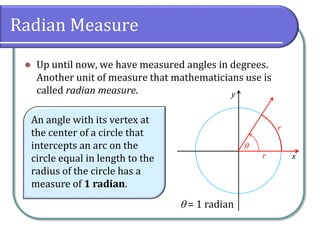
An angle with its vertex at
the center of a circle that
intercepts an arc on the
circle equal in length to the
radius of the circle has a
measure of 1 radian.
r
r
x
y

 = 1 radian
Radian Measure (cont.)
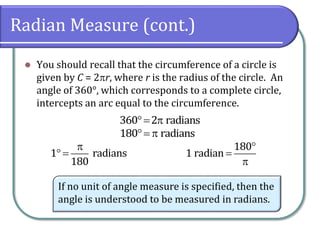
 You should recall that the circumference of a circle is
given by C = 2r, where r is the radius of the circle. An
angle of 360°, which corresponds to a complete circle,
intercepts an arc equal to the circumference.
 360 2 radians
 180 radians



180
1 radian

 1 radians
180
If no unit of angle measure is specified, then the
angle is understood to be measured in radians.
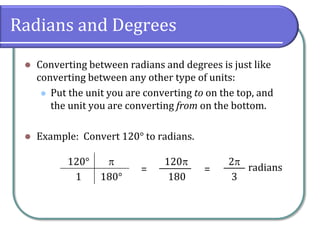
Radians and Degrees
 Converting between radians and degrees is just like
converting between any other type of units:
 Put the unit you are converting to on the top, and
the unit you are converting from on the bottom.
 Example: Convert 120° to radians.
120120°
180° 180
 2
3
= =
1
radians
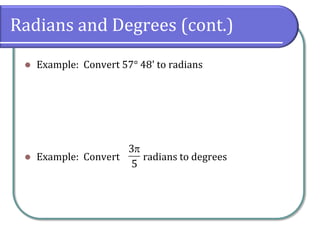
Radians and Degrees (cont.)
 Example: Convert 57° 48' to radians
 Example: Convert radians to degrees
3
5
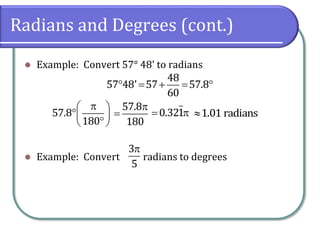
Radians and Degrees (cont.)
 Example: Convert 57° 48' to radians
 Example: Convert radians to degrees
3
5
 
  
57.8
180
    
48
57 48' 57 57.8
60


57.8
180
 0.321 1.01 radians
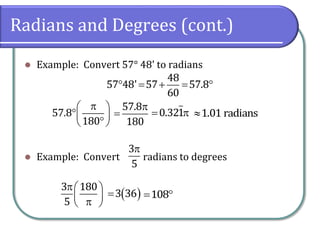
Radians and Degrees (cont.)
 Example: Convert 57° 48' to radians
 Example: Convert radians to degrees
3
5
 
  
57.8
180
    
48
57 48' 57 57.8
60


57.8
180
 0.321 1.01 radians
 
  
3 180
5
 3 36  108
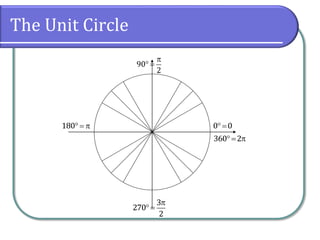
The Unit Circle
0 0

 90
2
  180


3
270
2
  360 2
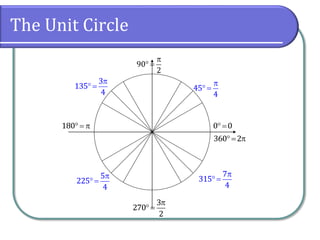
The Unit Circle
0 0

 45
4

 90
2

 
3
135
4
  180

 
5
225
4


3
270
2

 
7
315
4
  360 2
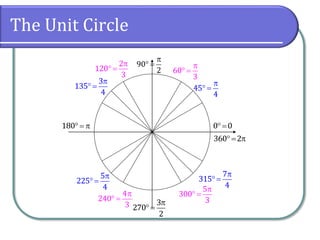
The Unit Circle
0 0

 45
4

 60
3

 90
2

 
2
120
3

 
3
135
4
  180

 
5
225
4

 
4
240
3 

3
270
2

 
5
300
3

 
7
315
4
  360 2
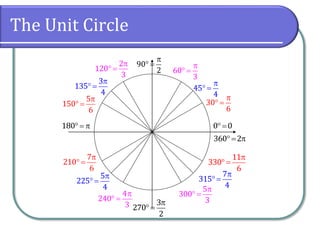
The Unit Circle
0 0

 30
6

 45
4

 60
3

 90
2

 
2
120
3

 
3
135
4

 
5
150
6
  180

 
7
210
6

 
5
225
4

 
4
240
3 

3
270
2

 
5
300
3

 
7
315
4


11
330
6
  360 2
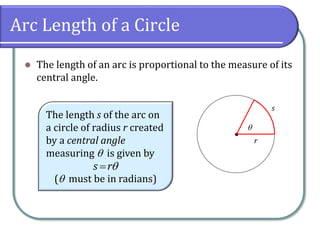
Arc Length of a Circle
 The length of an arc is proportional to the measure of its
central angle.
•
r
s

The length s of the arc on
a circle of radius r created
by a central angle
measuring  is given by
( must be in radians)
s r
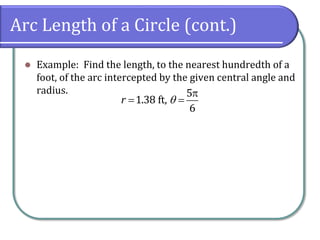
Arc Length of a Circle (cont.)
 Example: Find the length, to the nearest hundredth of a
foot, of the arc intercepted by the given central angle and
radius. 
 
5
1.38 ft,
6
r 
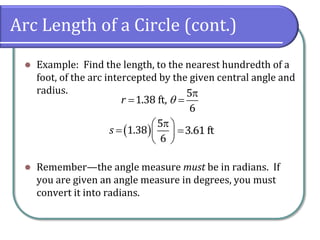
Arc Length of a Circle (cont.)
 Example: Find the length, to the nearest hundredth of a
foot, of the arc intercepted by the given central angle and
radius.
 Remember—the angle measure must be in radians. If
you are given an angle measure in degrees, you must
convert it into radians.

 
5
1.38 ft,
6
r 
 
 
  
 
5
1.38
6
s 3.61 ft
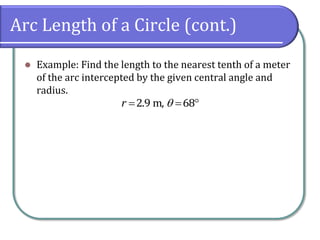
Arc Length of a Circle (cont.)
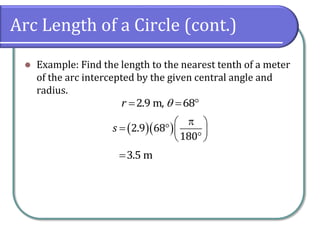
 Example: Find the length to the nearest tenth of a meter
of the arc intercepted by the given central angle and
radius.
  2.9 m, 68r 
Arc Length of a Circle (cont.)
 Example: Find the length to the nearest tenth of a meter
of the arc intercepted by the given central angle and
radius.
  2.9 m, 68r 
  
 
    
2.9 68
180
s
3.5 m
Using Latitudes
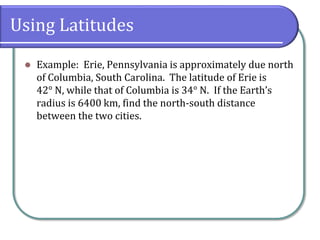
 Example: Erie, Pennsylvania is approximately due north
of Columbia, South Carolina. The latitude of Erie is
42° N, while that of Columbia is 34° N. If the Earth’s
radius is 6400 km, find the north-south distance
between the two cities.
Using Latitudes
 Example: Erie, Pennsylvania is approximately due north
of Columbia, South Carolina. The latitude of Erie is
42° N, while that of Columbia is 34° N. If the Earth’s
radius is 6400 km, find the north-south distance
between the two cities.
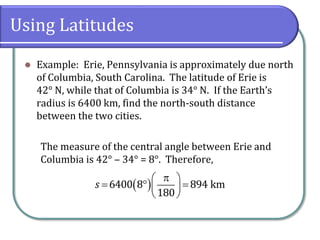
The measure of the central angle between Erie and
Columbia is 42° ‒ 34° = 8°. Therefore,
 6400 8 894 km
180
s
 
   
 
Area of a Sector of a Circle
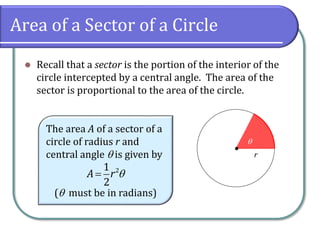
 Recall that a sector is the portion of the interior of the
circle intercepted by a central angle. The area of the
sector is proportional to the area of the circle.
r

•
The area A of a sector of a
circle of radius r and
central angle  is given by
( must be in radians)
 21
2
A r 
Area of a Sector of a Circle
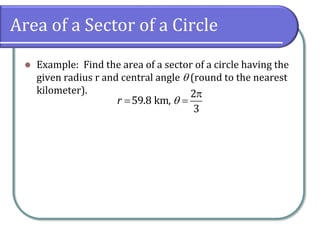
 Example: Find the area of a sector of a circle having the
given radius r and central angle  (round to the nearest
kilometer). 
 
2
59.8 km,
3
r 
Area of a Sector of a Circle
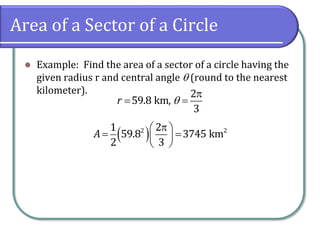
 Example: Find the area of a sector of a circle having the
given radius r and central angle  (round to the nearest
kilometer). 
 
2
59.8 km,
3
r 
   
  
 
21 2
59.8
2 3
A  2
3745 km
Classwork
 College Algebra
 Page 565: 26-52, page 539: 14-28, page 513: 74-80
(all evens)

6.1 Radian Measure

  • 1.
    6.1 Radian Measure Chapter6 Circular Functions and Their Graphs
  • 2.
    Concepts and Objectives Convert between degrees and radians  Calculate the length of an arc intercepted by a given angle  Calculate the area of a sector
  • 3.
    Radian Measure  Upuntil now, we have measured angles in degrees. Another unit of measure that mathematicians use is called radian measure. An angle with its vertex at the center of a circle that intercepts an arc on the circle equal in length to the radius of the circle has a measure of 1 radian. r r x y   = 1 radian
  • 4.
    Radian Measure (cont.) You should recall that the circumference of a circle is given by C = 2r, where r is the radius of the circle. An angle of 360°, which corresponds to a complete circle, intercepts an arc equal to the circumference.  360 2 radians  180 radians    180 1 radian   1 radians 180 If no unit of angle measure is specified, then the angle is understood to be measured in radians.
  • 5.
    Radians and Degrees Converting between radians and degrees is just like converting between any other type of units:  Put the unit you are converting to on the top, and the unit you are converting from on the bottom.  Example: Convert 120° to radians. 120120° 180° 180  2 3 = = 1 radians
  • 6.
    Radians and Degrees(cont.)  Example: Convert 57° 48' to radians  Example: Convert radians to degrees 3 5
  • 7.
    Radians and Degrees(cont.)  Example: Convert 57° 48' to radians  Example: Convert radians to degrees 3 5      57.8 180      48 57 48' 57 57.8 60   57.8 180  0.321 1.01 radians
  • 8.
    Radians and Degrees(cont.)  Example: Convert 57° 48' to radians  Example: Convert radians to degrees 3 5      57.8 180      48 57 48' 57 57.8 60   57.8 180  0.321 1.01 radians      3 180 5  3 36  108
  • 9.
    The Unit Circle 00   90 2   180   3 270 2   360 2
  • 10.
    The Unit Circle 00   45 4   90 2    3 135 4   180    5 225 4   3 270 2    7 315 4   360 2
  • 11.
    The Unit Circle 00   45 4   60 3   90 2    2 120 3    3 135 4   180    5 225 4    4 240 3   3 270 2    5 300 3    7 315 4   360 2
  • 12.
    The Unit Circle 00   30 6   45 4   60 3   90 2    2 120 3    3 135 4    5 150 6   180    7 210 6    5 225 4    4 240 3   3 270 2    5 300 3    7 315 4   11 330 6   360 2
  • 13.
    Arc Length ofa Circle  The length of an arc is proportional to the measure of its central angle. • r s  The length s of the arc on a circle of radius r created by a central angle measuring  is given by ( must be in radians) s r
  • 14.
    Arc Length ofa Circle (cont.)  Example: Find the length, to the nearest hundredth of a foot, of the arc intercepted by the given central angle and radius.    5 1.38 ft, 6 r 
  • 15.
    Arc Length ofa Circle (cont.)  Example: Find the length, to the nearest hundredth of a foot, of the arc intercepted by the given central angle and radius.  Remember—the angle measure must be in radians. If you are given an angle measure in degrees, you must convert it into radians.    5 1.38 ft, 6 r           5 1.38 6 s 3.61 ft
  • 16.
    Arc Length ofa Circle (cont.)  Example: Find the length to the nearest tenth of a meter of the arc intercepted by the given central angle and radius.   2.9 m, 68r 
  • 17.
    Arc Length ofa Circle (cont.)  Example: Find the length to the nearest tenth of a meter of the arc intercepted by the given central angle and radius.   2.9 m, 68r            2.9 68 180 s 3.5 m
  • 18.
    Using Latitudes  Example:Erie, Pennsylvania is approximately due north of Columbia, South Carolina. The latitude of Erie is 42° N, while that of Columbia is 34° N. If the Earth’s radius is 6400 km, find the north-south distance between the two cities.
  • 19.
    Using Latitudes  Example:Erie, Pennsylvania is approximately due north of Columbia, South Carolina. The latitude of Erie is 42° N, while that of Columbia is 34° N. If the Earth’s radius is 6400 km, find the north-south distance between the two cities. The measure of the central angle between Erie and Columbia is 42° ‒ 34° = 8°. Therefore,  6400 8 894 km 180 s        
  • 20.
    Area of aSector of a Circle  Recall that a sector is the portion of the interior of the circle intercepted by a central angle. The area of the sector is proportional to the area of the circle. r  • The area A of a sector of a circle of radius r and central angle  is given by ( must be in radians)  21 2 A r 
  • 21.
    Area of aSector of a Circle  Example: Find the area of a sector of a circle having the given radius r and central angle  (round to the nearest kilometer).    2 59.8 km, 3 r 
  • 22.
    Area of aSector of a Circle  Example: Find the area of a sector of a circle having the given radius r and central angle  (round to the nearest kilometer).    2 59.8 km, 3 r           21 2 59.8 2 3 A  2 3745 km
  • 23.
    Classwork  College Algebra Page 565: 26-52, page 539: 14-28, page 513: 74-80 (all evens)