TRIGONOMETRYMath 12Plane and Spherical Trigonometry
                      TRIGONOMETRYDerived from the Greek words “trigonon” which means triangle and “metron” which means to measure.Branch of mathematics which deals with measurement of triangles (i.e., their sides and angles), or more specifically, with the indirect measurement of line segments and angles.
                    TRIANGLESDefinition:    A triangle is a polygon with three sides and three interior angles. The sum of the interior angles of a triangle is 180°.Classification of triangles according to angles:Oblique triangle – a triangle with no right angle      -  Acute triangle    -  Obtuse triangleRight triangle – a triangle with a right angleEquiangular triangle – a triangle with equal angles 
                    TRIANGLESClassification of triangles according to sides:Scalene Triangle -  a triangle with no two sides equal.Isosceles Triangle -  a triangle with two sides equal.Equilateral triangle – a triangle with three sides equal.
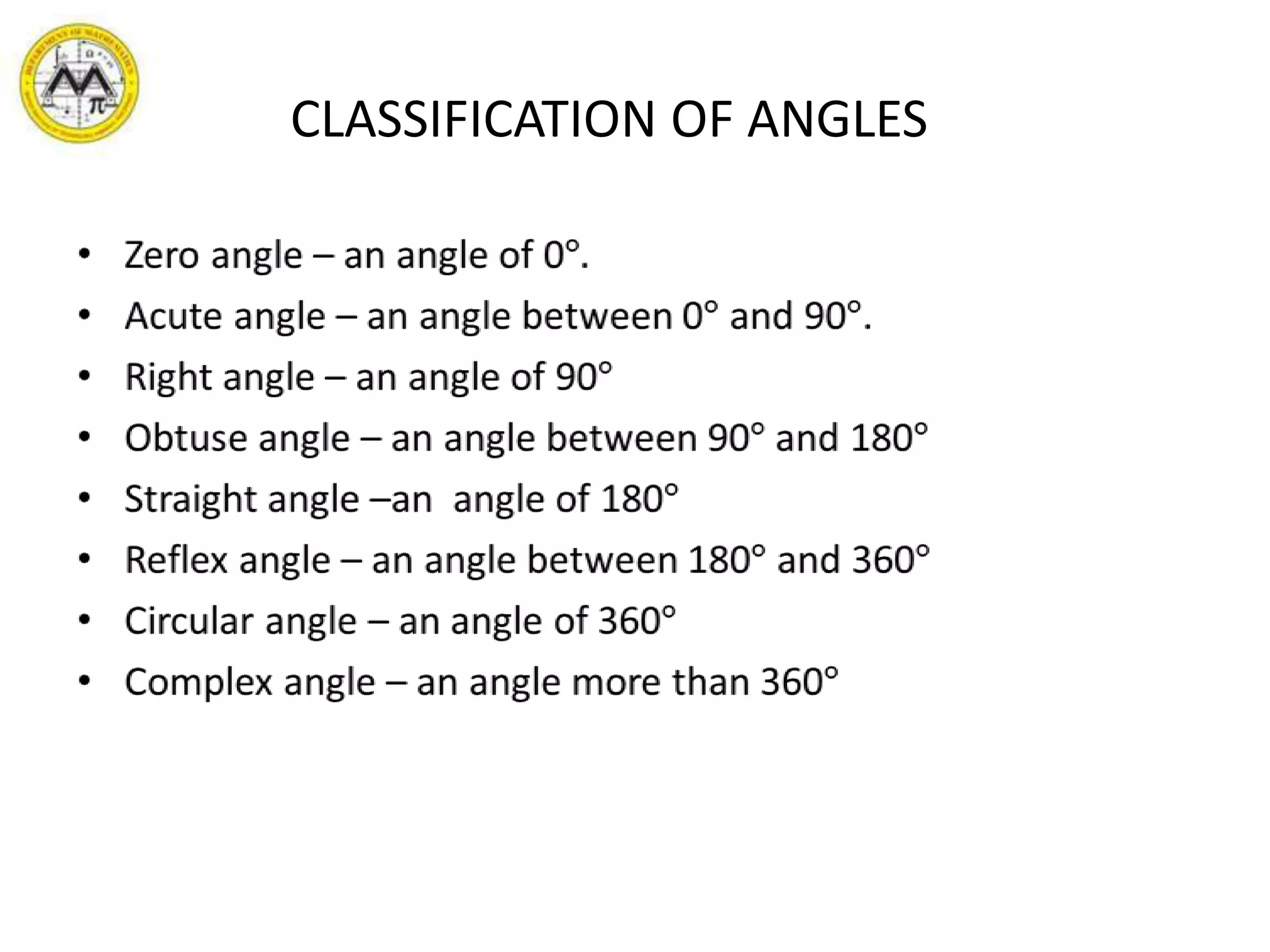
      CLASSIFICATION OF ANGLESZero angle – an angle of 0°.Acute angle – an angle between 0° and 90°.Right angle – an angle of 90°Obtuse angle – an angle between 90° and 180°Straight angle –an  angle of 180°Reflex angle – an angle between 180° and 360°Circular angle – an angle of 360°Complex angle – an angle more than 360° 
Lesson 1:   ANGLE MEASUREMath 12Plane and Spherical Trigonometry
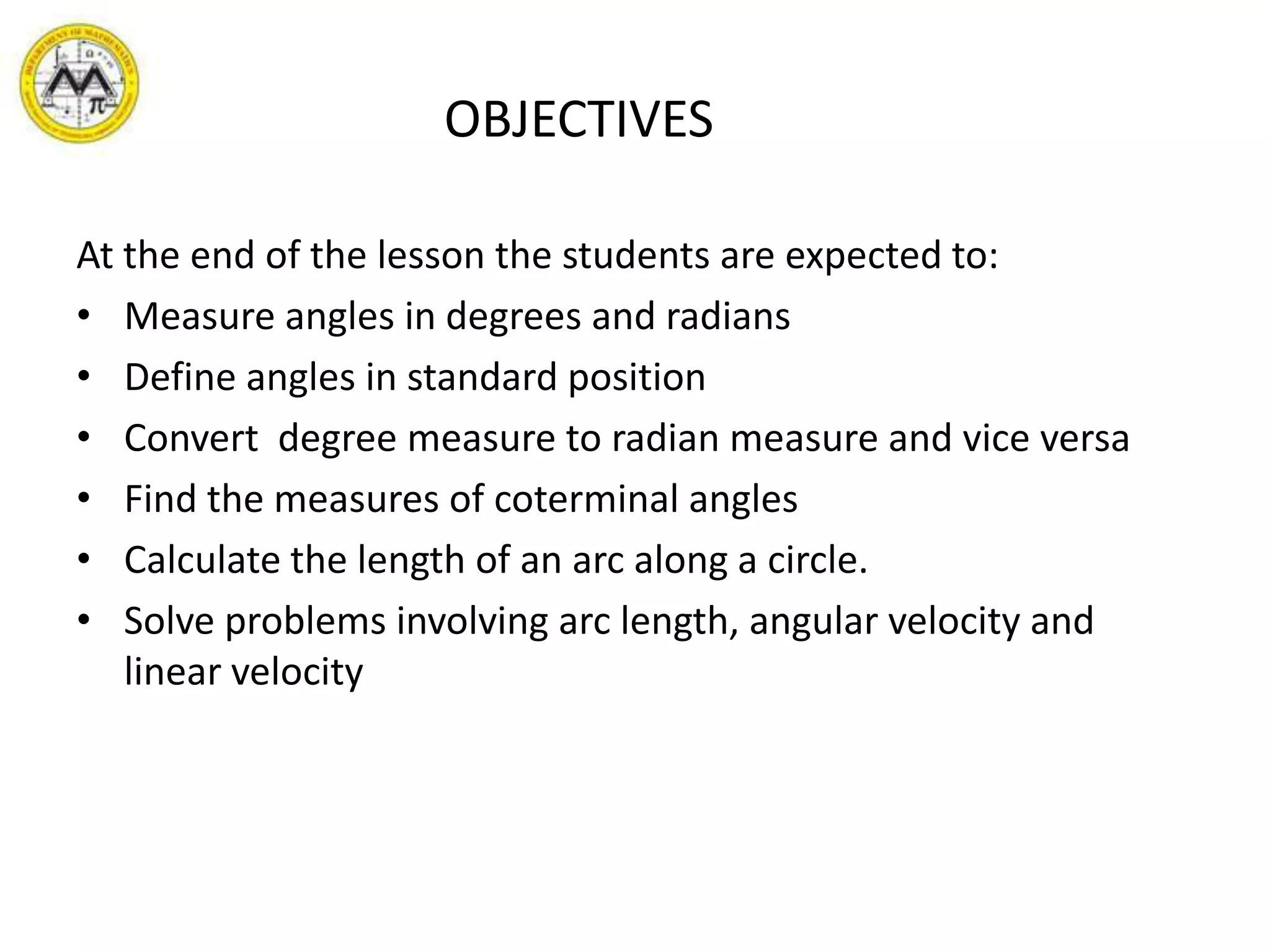
                  OBJECTIVESAt the end of the lesson the students are expected to:Measure angles in degrees and radiansDefine angles in standard positionConvert  degree measure to radian measure and vice versaFind the measures of coterminal anglesCalculate the length of an arc along a circle.Solve problems involving arc length, angular velocity and linear velocity
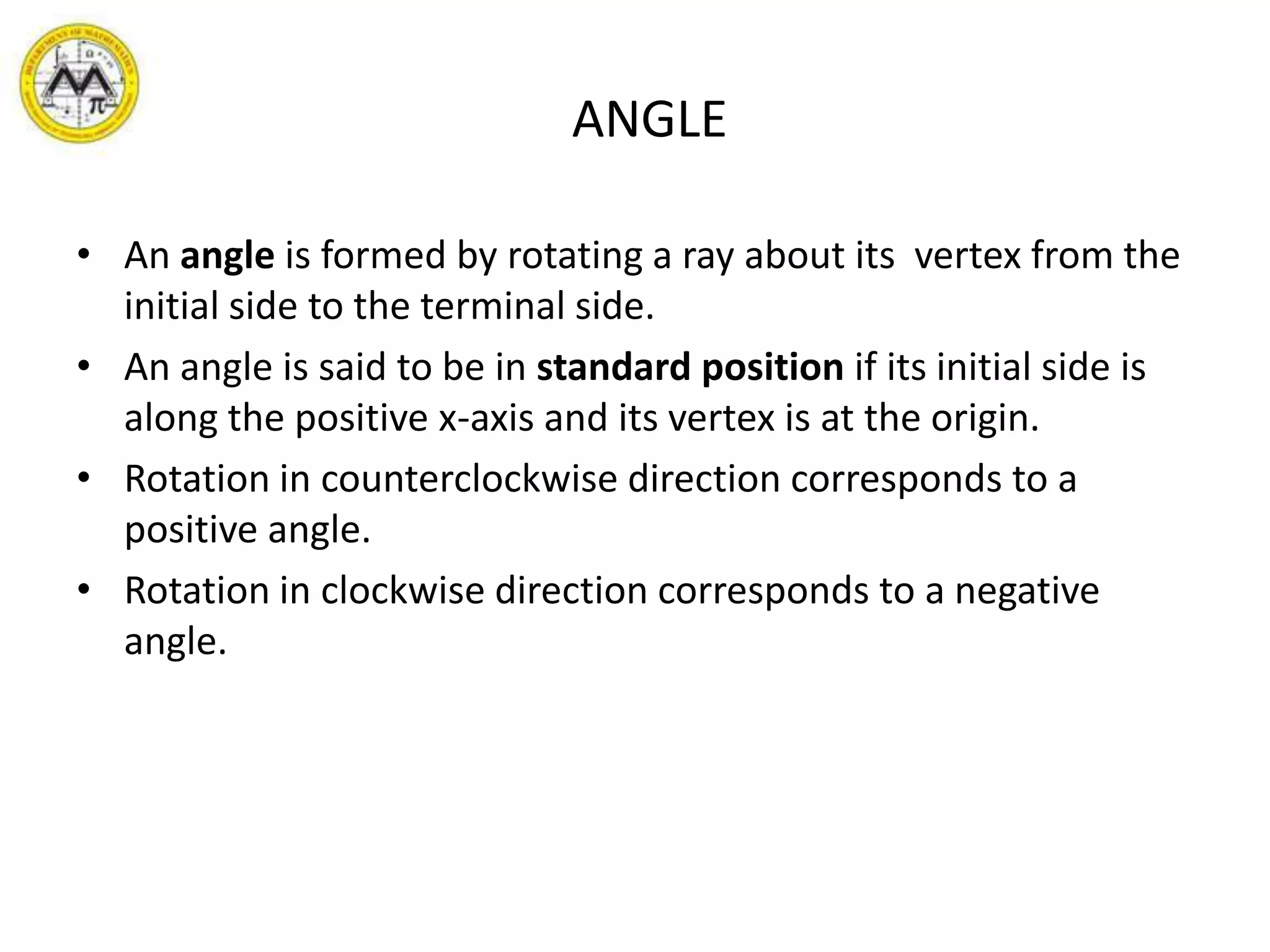
       ANGLEAn angle is formed by rotating a ray about its  vertex from the initial side to the terminal side.An angle is said to be in standard position if its initial side is along the positive x-axis and its vertex is at the origin.Rotation in counterclockwise direction corresponds to a positive angle.Rotation in clockwise direction corresponds to a negative angle.
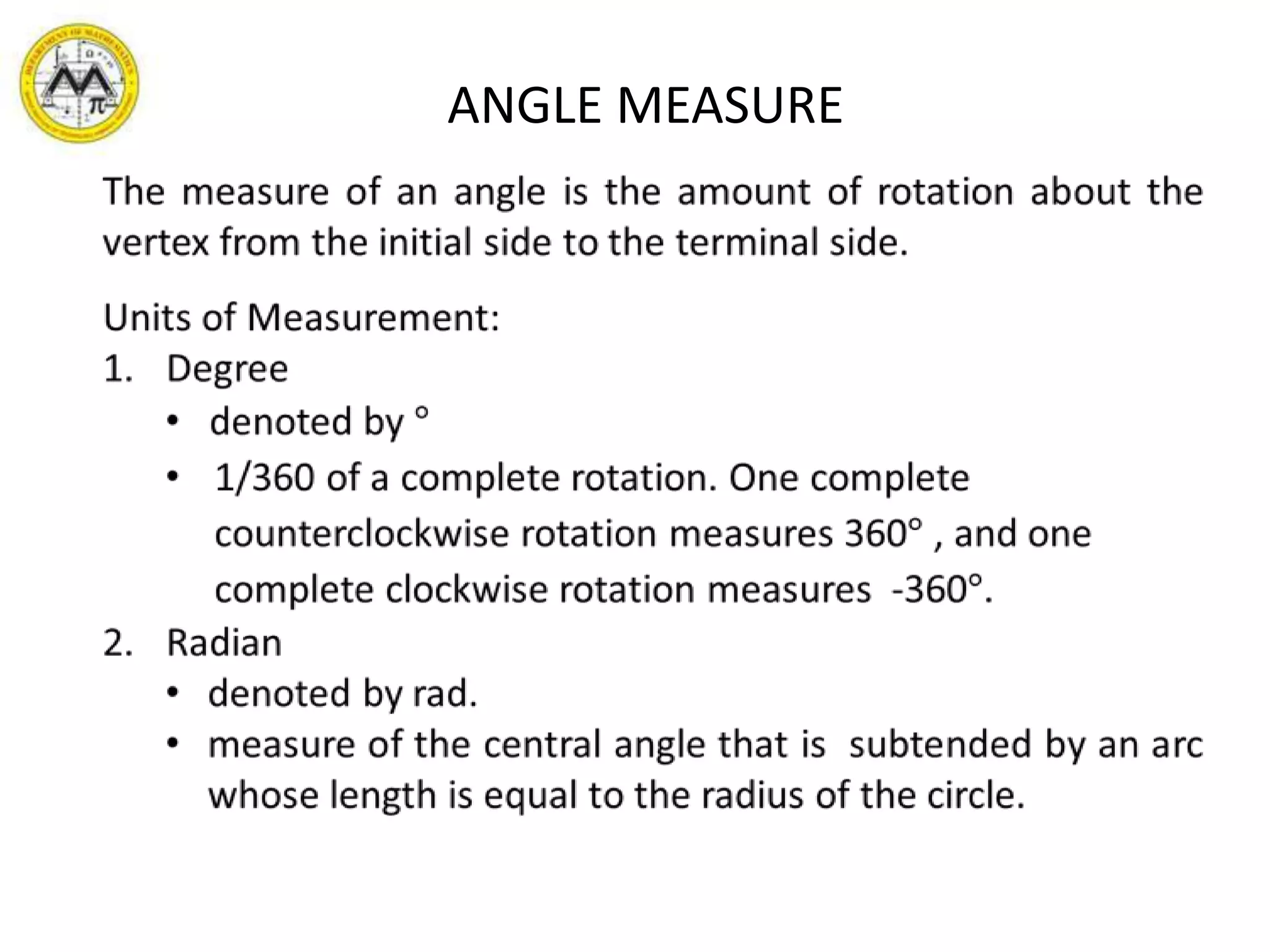
ANGLE MEASUREThe measure of an angle is the amount of rotation about the vertex from the initial side to the terminal side.Units of Measurement:Degree  denoted by °1/360 of a complete rotation. One complete counterclockwise rotation measures 360° , and one complete clockwise rotation measures  -360°.Radiandenoted by rad.measure of the central angle that is  subtended by an arc whose length is equal to the radius of the circle.  
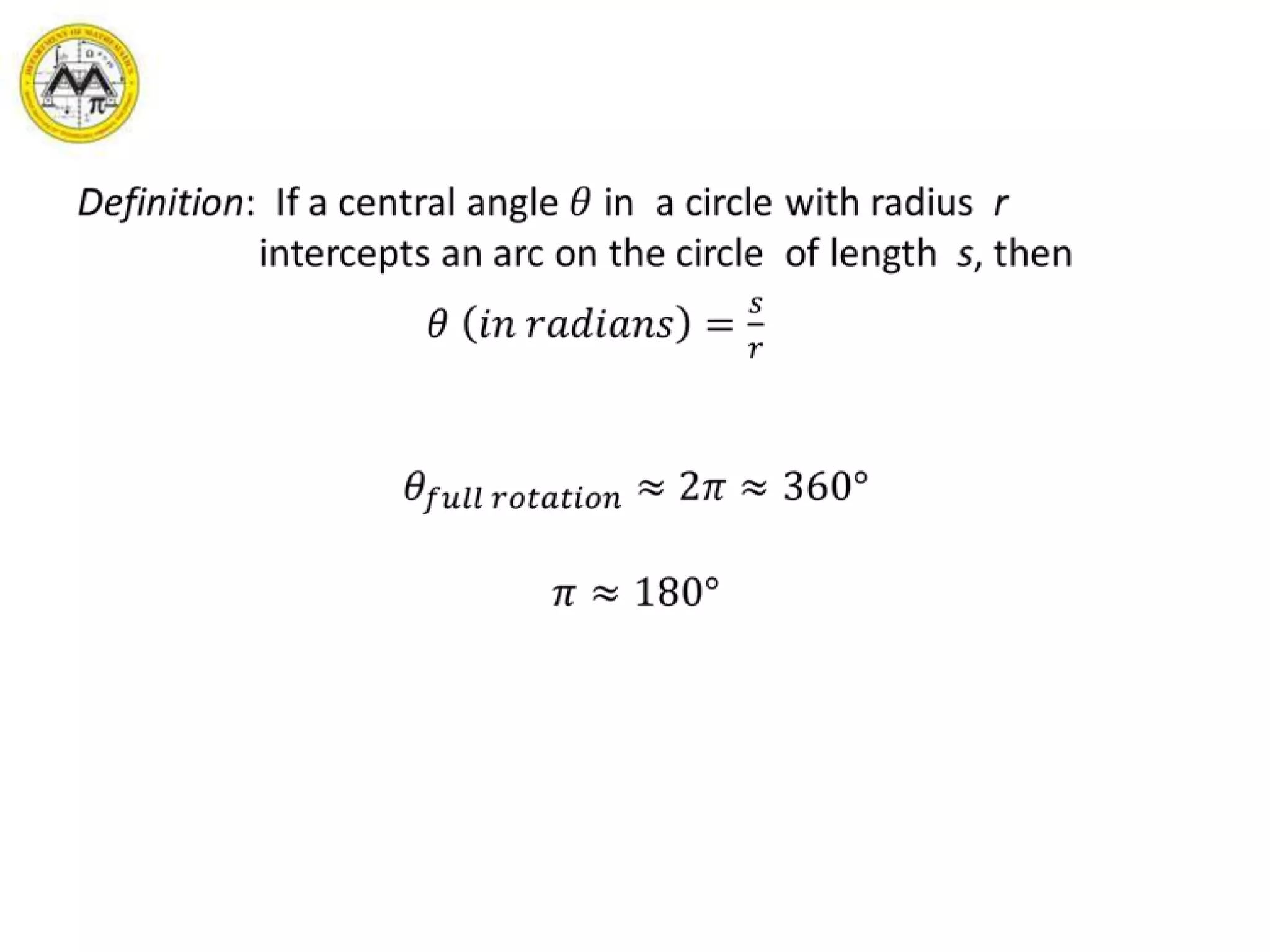
Definition:  If a central angle 𝜃 in  a circle with radius  r  intercepts an arc on the circle  of length  s, then 𝜃 𝑖𝑛 𝑟𝑎𝑑𝑖𝑎𝑛𝑠=𝑠𝑟𝜃𝑓𝑢𝑙𝑙 𝑟𝑜𝑡𝑎𝑡𝑖𝑜𝑛≈2𝜋≈360°𝜋≈180° 
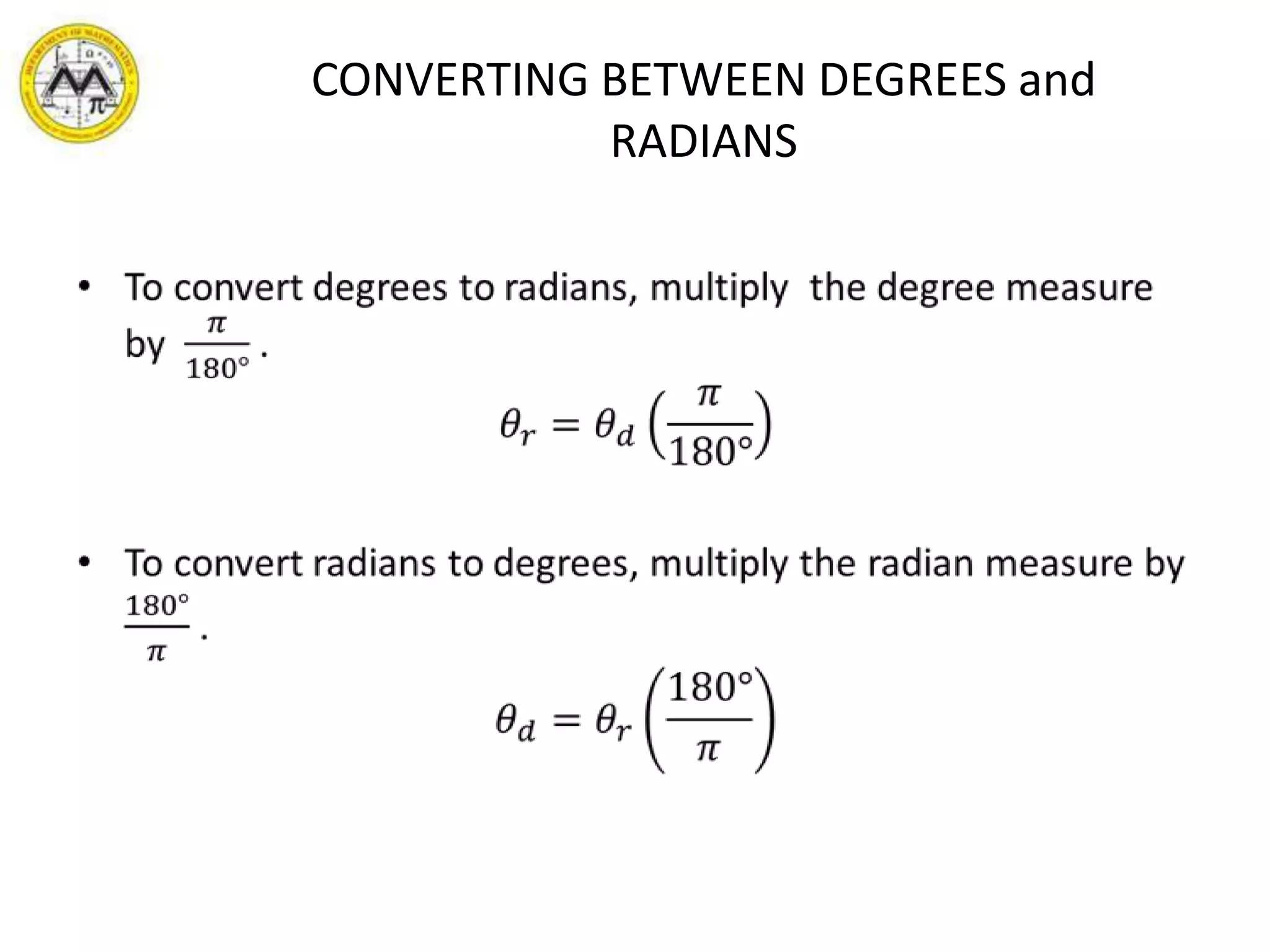
CONVERTING BETWEEN DEGREES and RADIANSTo convert degrees to radians, multiply  the degree measure by  𝜋180° .𝜃𝑟=𝜃𝑑𝜋180°To convert radians to degrees, multiply the radian measure by 180°𝜋 .𝜃𝑑=𝜃𝑟180°𝜋 
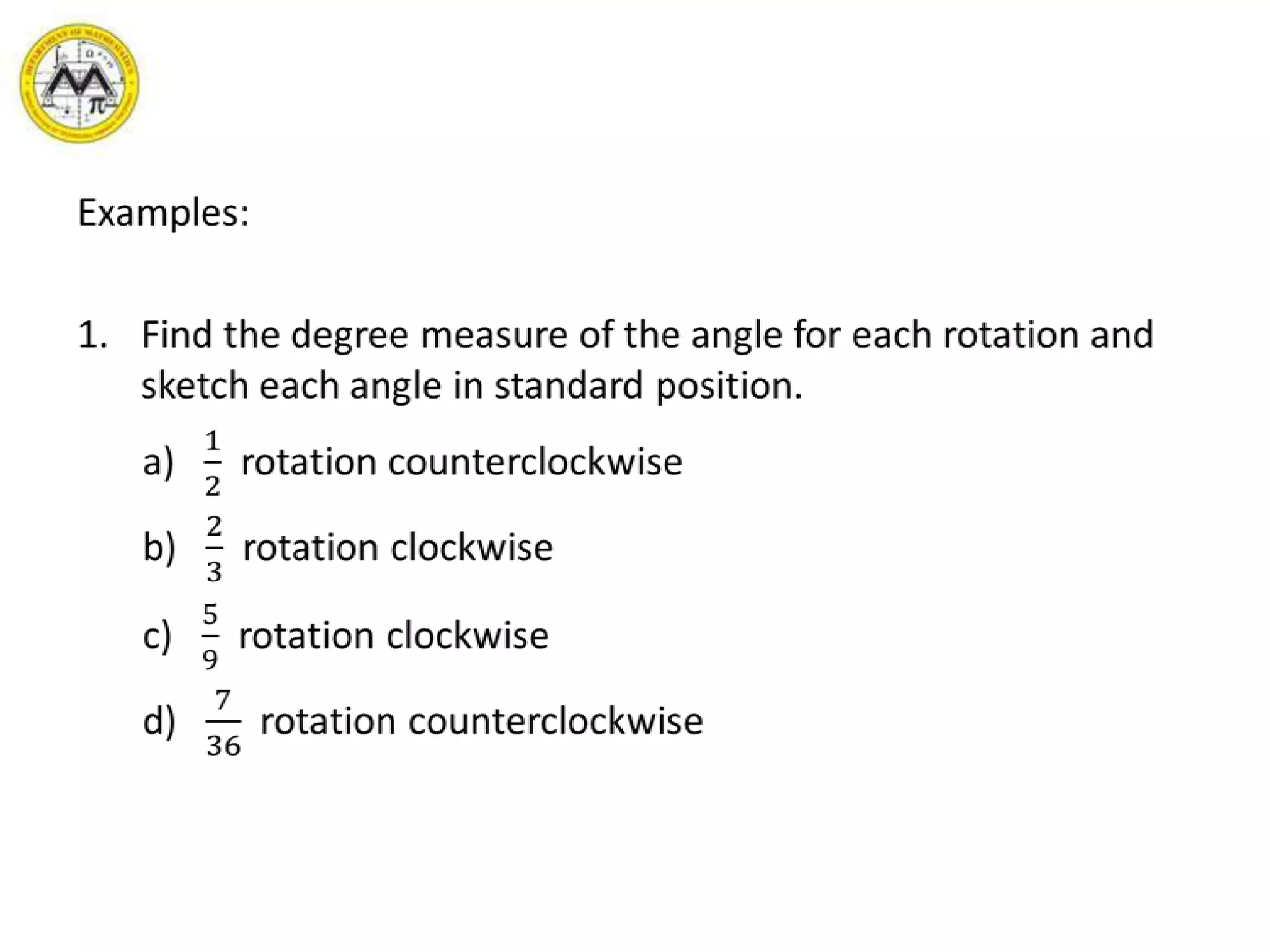
Examples:Find the degree measure of the angle for each rotation and sketch each angle in standard position.	a)   12  rotation counterclockwiseb)   23  rotation clockwisec)   59  rotation clockwised)   736  rotation counterclockwise  
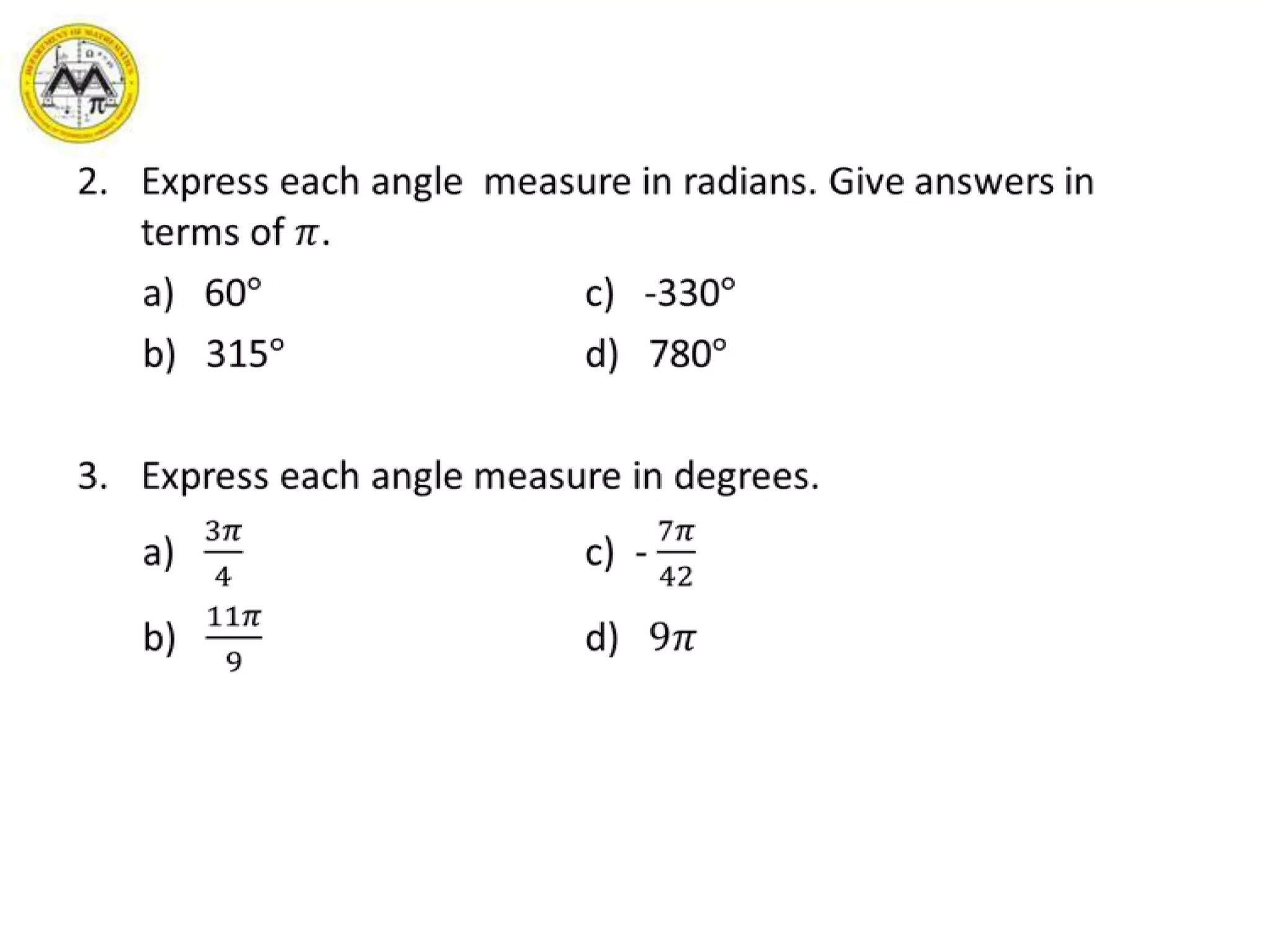
Express each angle  measure in radians. Give answers in terms of 𝜋.	a)   60°			c)   -330°	b)   315°			d)   780°Express each angle measure in degrees.a)   3𝜋4			c)  - 7𝜋42b)   11𝜋9			d)   9𝜋 
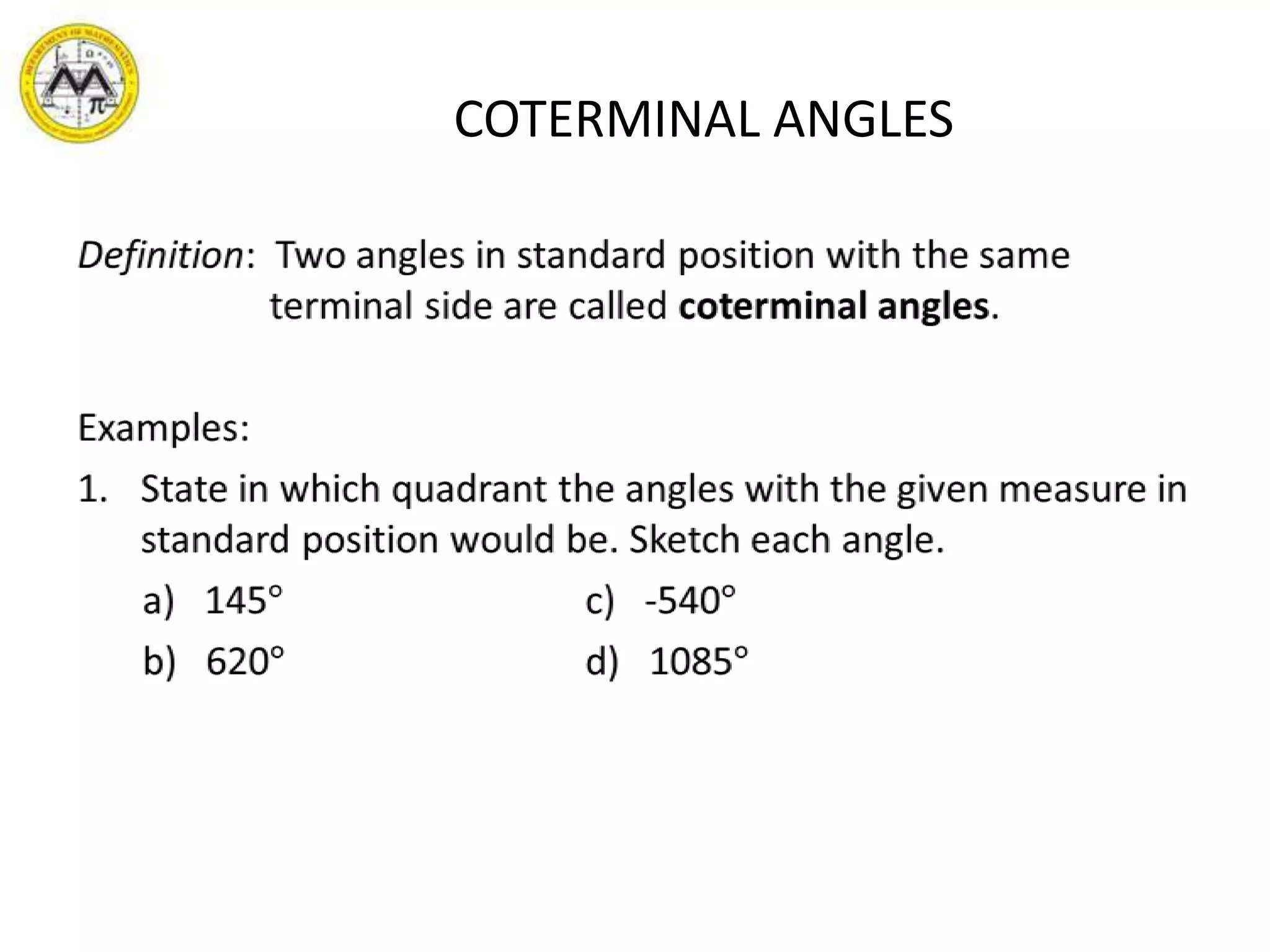
COTERMINAL ANGLESDefinition:  Two angles in standard position with the same terminal side are called coterminal angles.Examples:State in which quadrant the angles with the given measure in standard position would be. Sketch each angle.	a)   145°			c)   -540°b)   620°			d)   1085° 
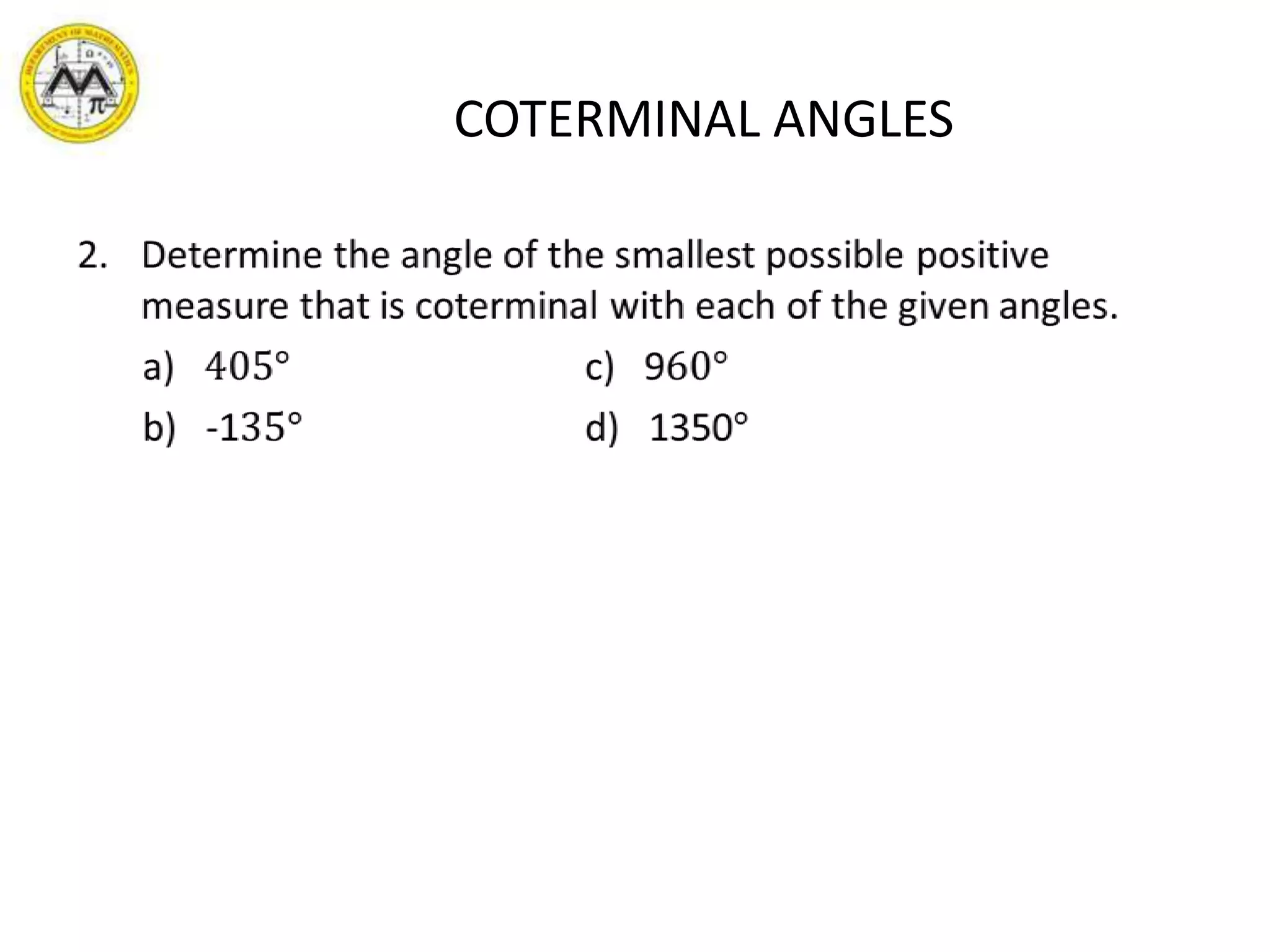
COTERMINAL ANGLESDetermine the angle of the smallest possible positive measure that is coterminal with each of the given angles.a)   405°			c)   960°b)   -135°			d)   1350° 
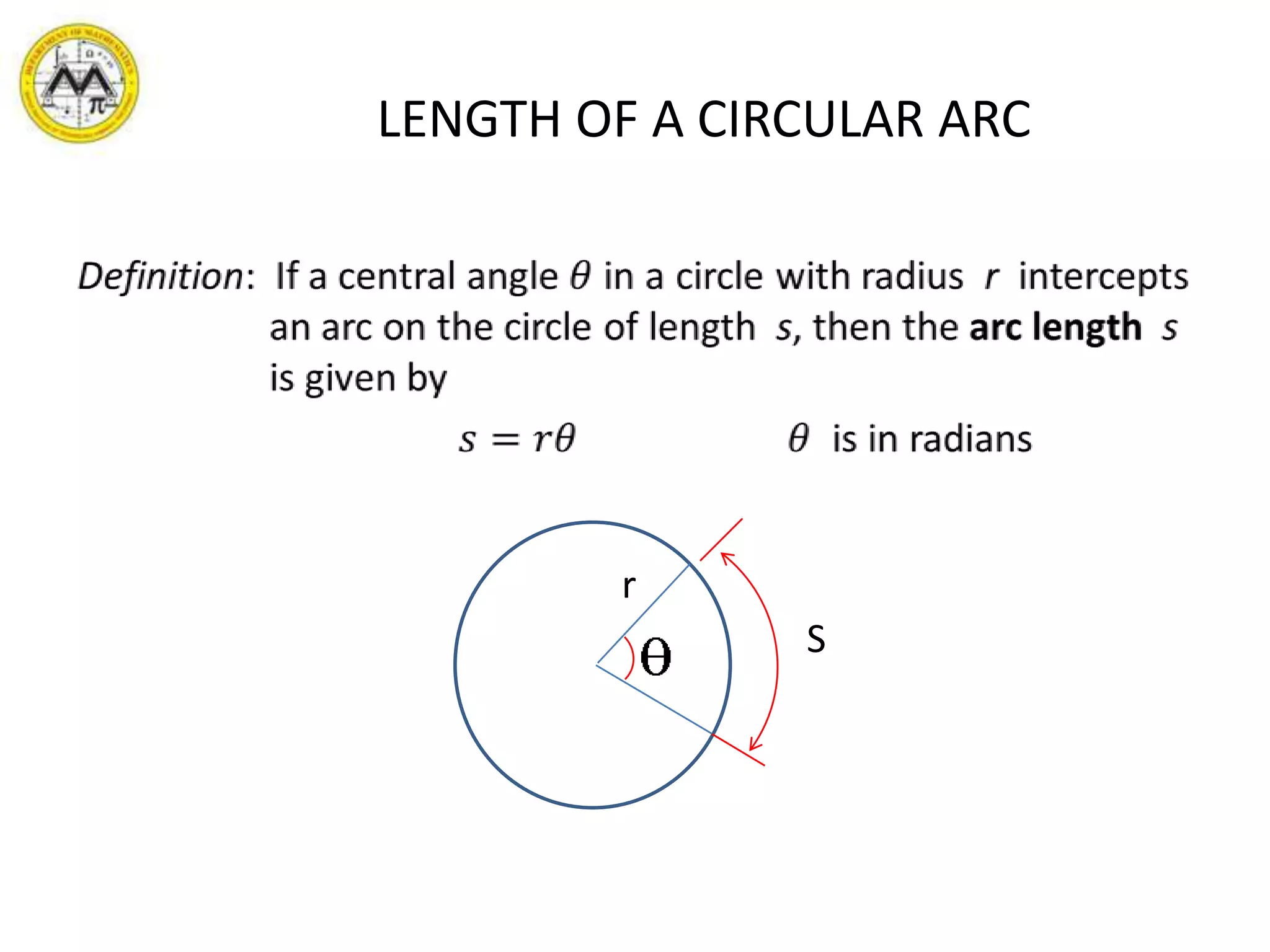
LENGTH OF A CIRCULAR ARCDefinition:  If a central angle 𝜃 in a circle with radius  r  intercepts an arc on the circle of length  s, then the arc lengths  is given by𝑠=𝑟𝜃𝜃  is in radians rS
LENGTH OF A CIRCULAR ARCExamples:Find the length of the arc intercepted by a central angle of 14° in a circle of radius of 15 cm.The famous clock tower in London has a minute hand that is 14 feet long. How far does the tip of the minute hand of Big Ben travel in 35 minutes?The London Eye has 32 capsules and a diameter of 400 feet. What is the distance you will have traveled once you reach the highest point for the first time? 
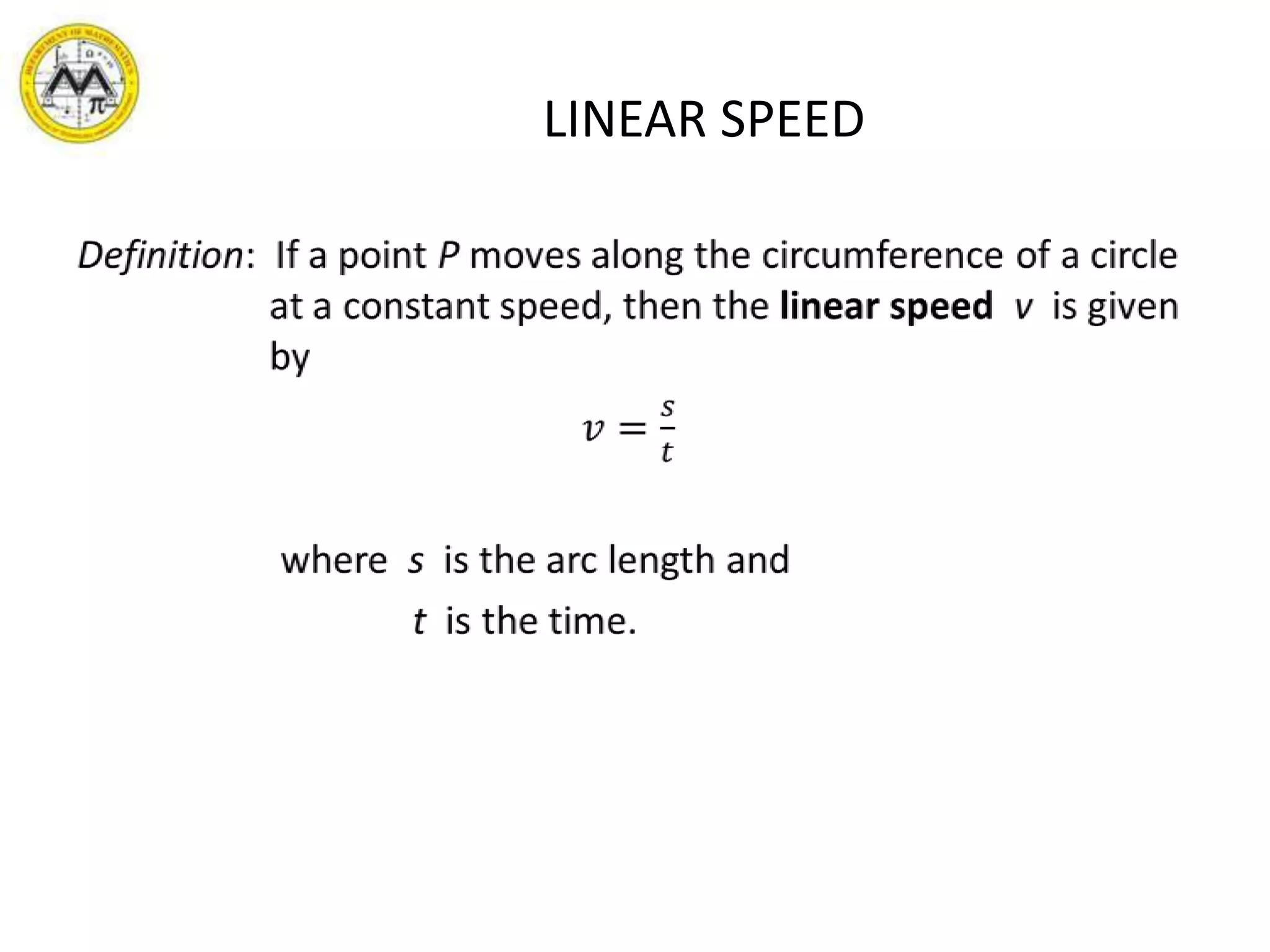
LINEAR SPEEDDefinition:  If a point P moves along the circumference of a circle at a constant speed, then the linear speedv  is given by𝑣=𝑠𝑡where  s  is the arc length andt  is the time. 
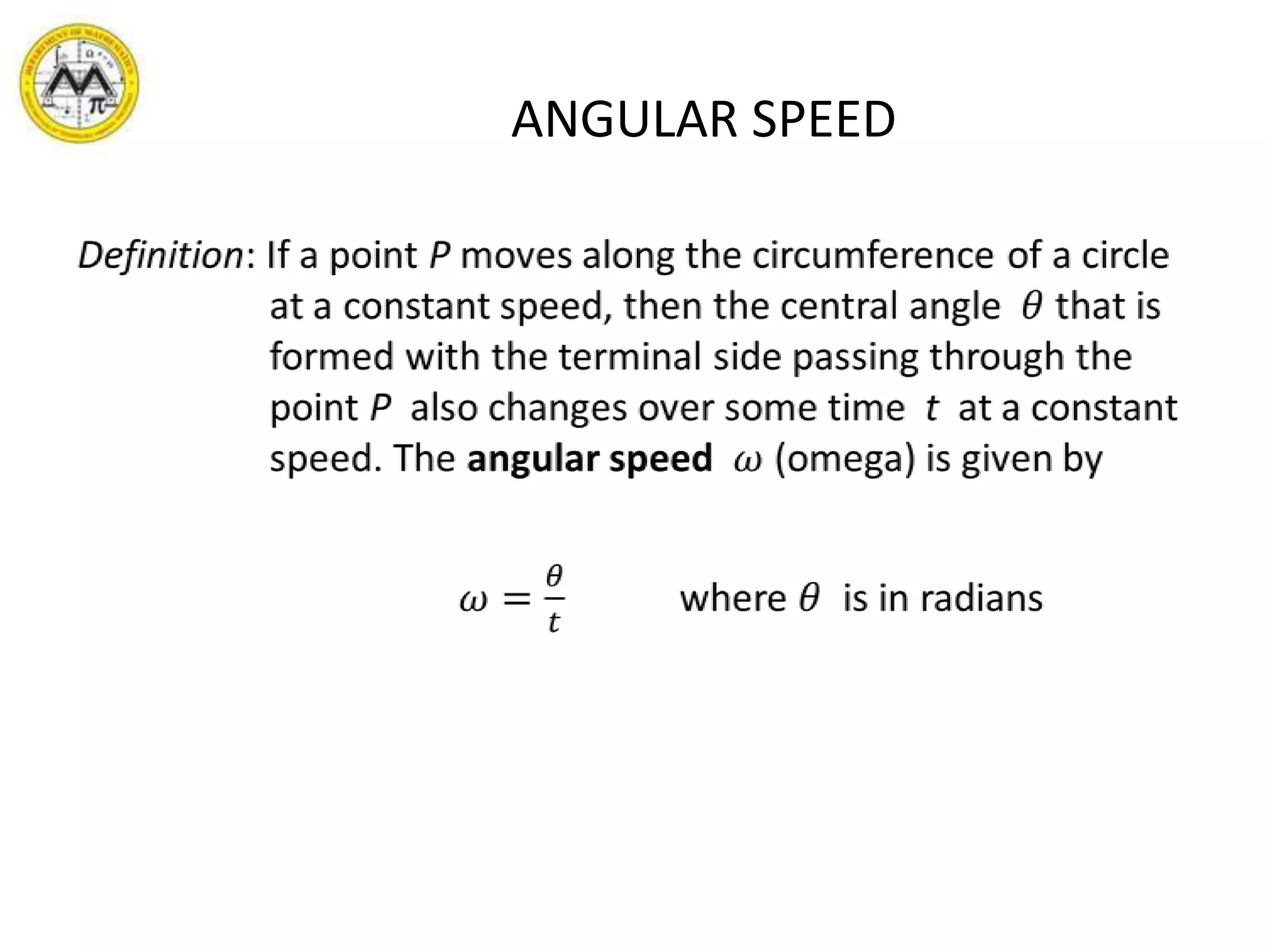
ANGULAR SPEEDDefinition: If a point P moves along the circumference of a circle at a constant speed, then the central angle  𝜃that is formed with the terminal side passing through the point P  also changes over some time  t  at a constant speed. The angular speed 𝜔(omega) is given by𝜔=𝜃𝑡            where 𝜃  is in radians 
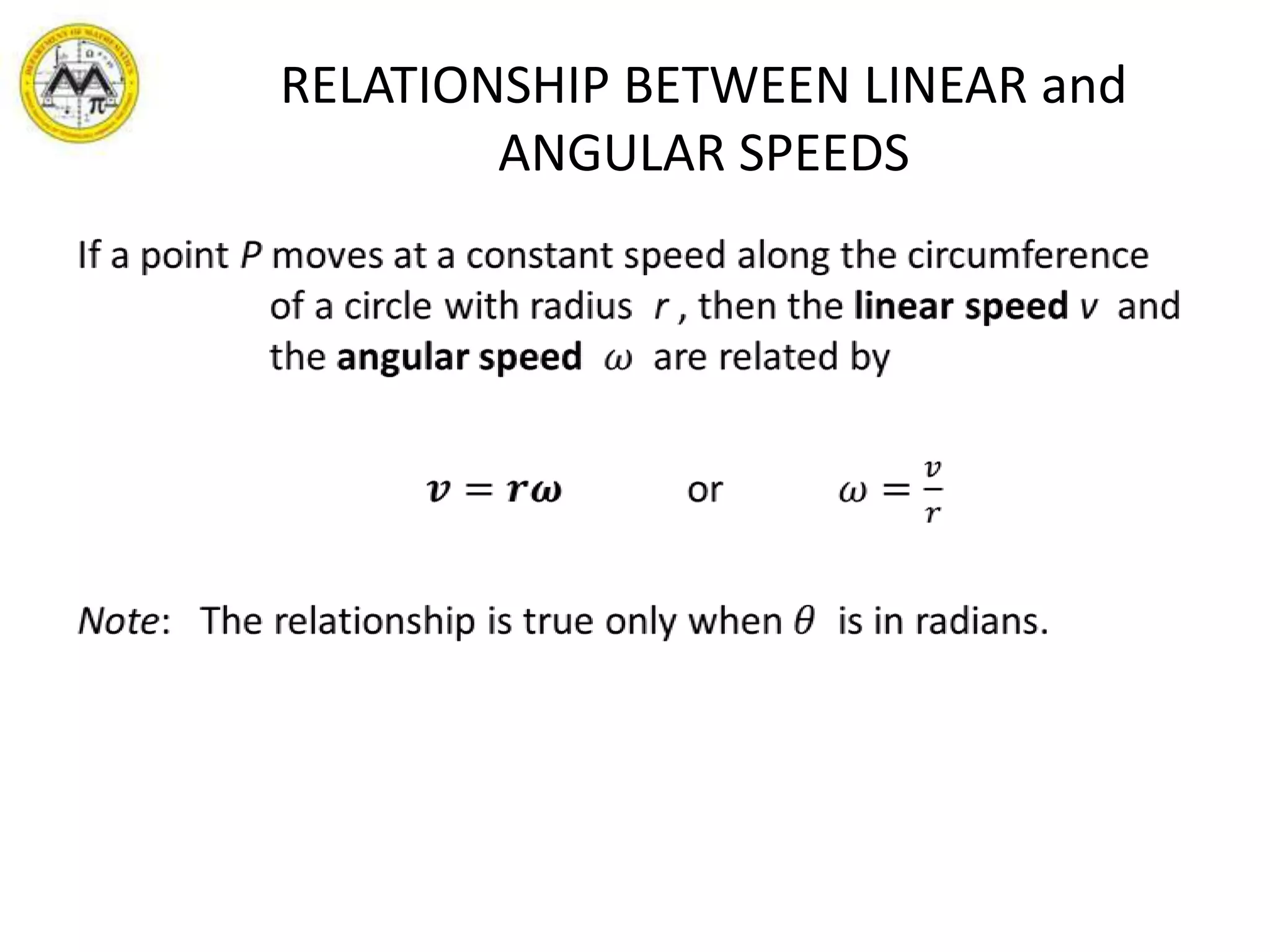
RELATIONSHIP BETWEEN LINEAR and ANGULAR SPEEDSIf a point P moves at a constant speed along the circumference of a circle with radius  r , then the linear speed v  and the angular speed𝜔are related by𝒗=𝒓𝝎or            𝜔=𝑣𝑟Note:   The relationship is true only when 𝜃is in radians. 
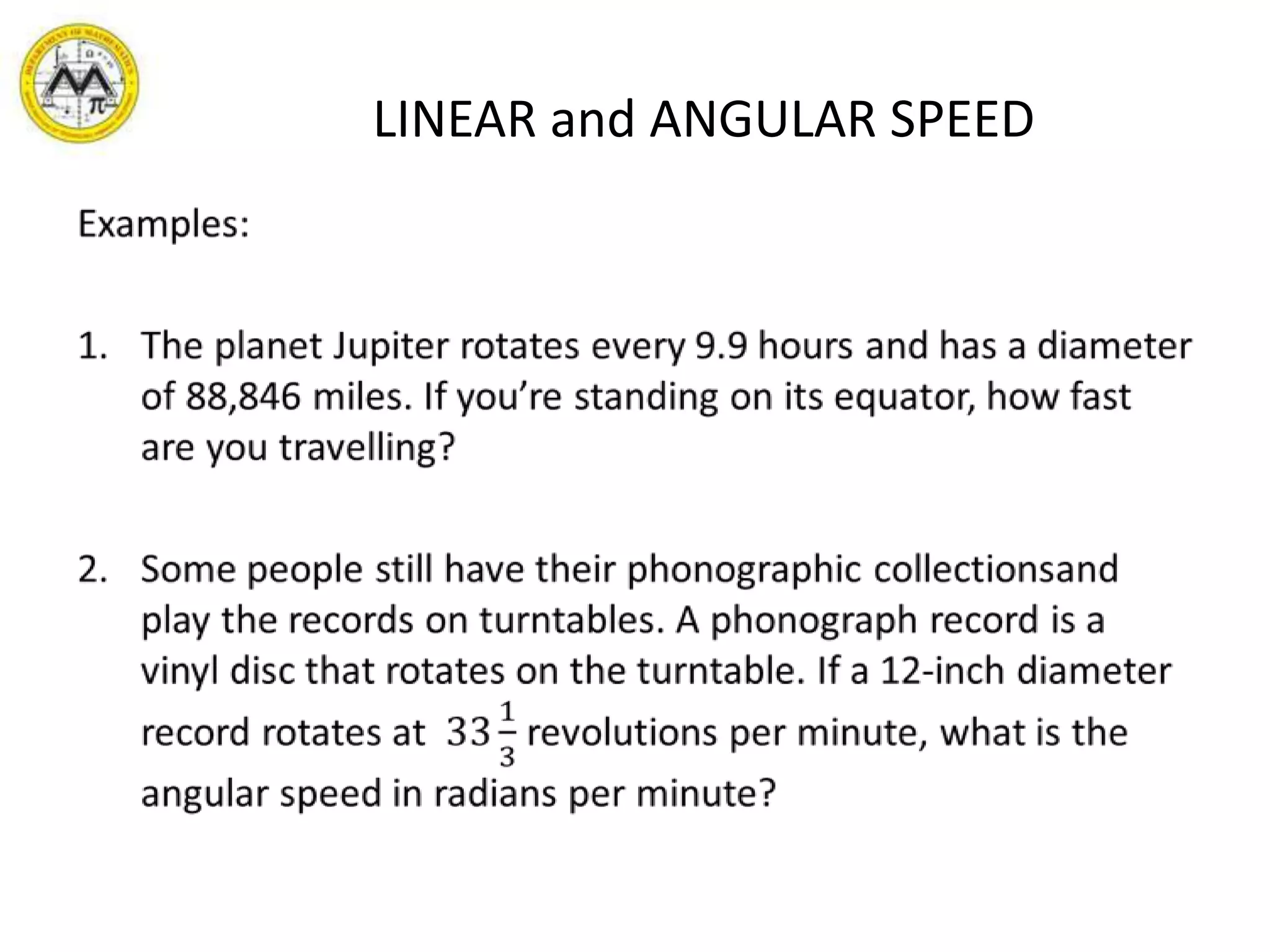
LINEAR and ANGULAR SPEEDExamples: The planet Jupiter rotates every 9.9 hours and has a diameter of 88,846 miles. If you’re standing on its equator, how fast are you travelling?Some people still have their phonographic collectionsand play the records on turntables. A phonograph record is a  vinyl disc that rotates on the turntable. If a 12-inch diameter record rotates at  3313 revolutions per minute, what is the angular speed in radians per minute? 
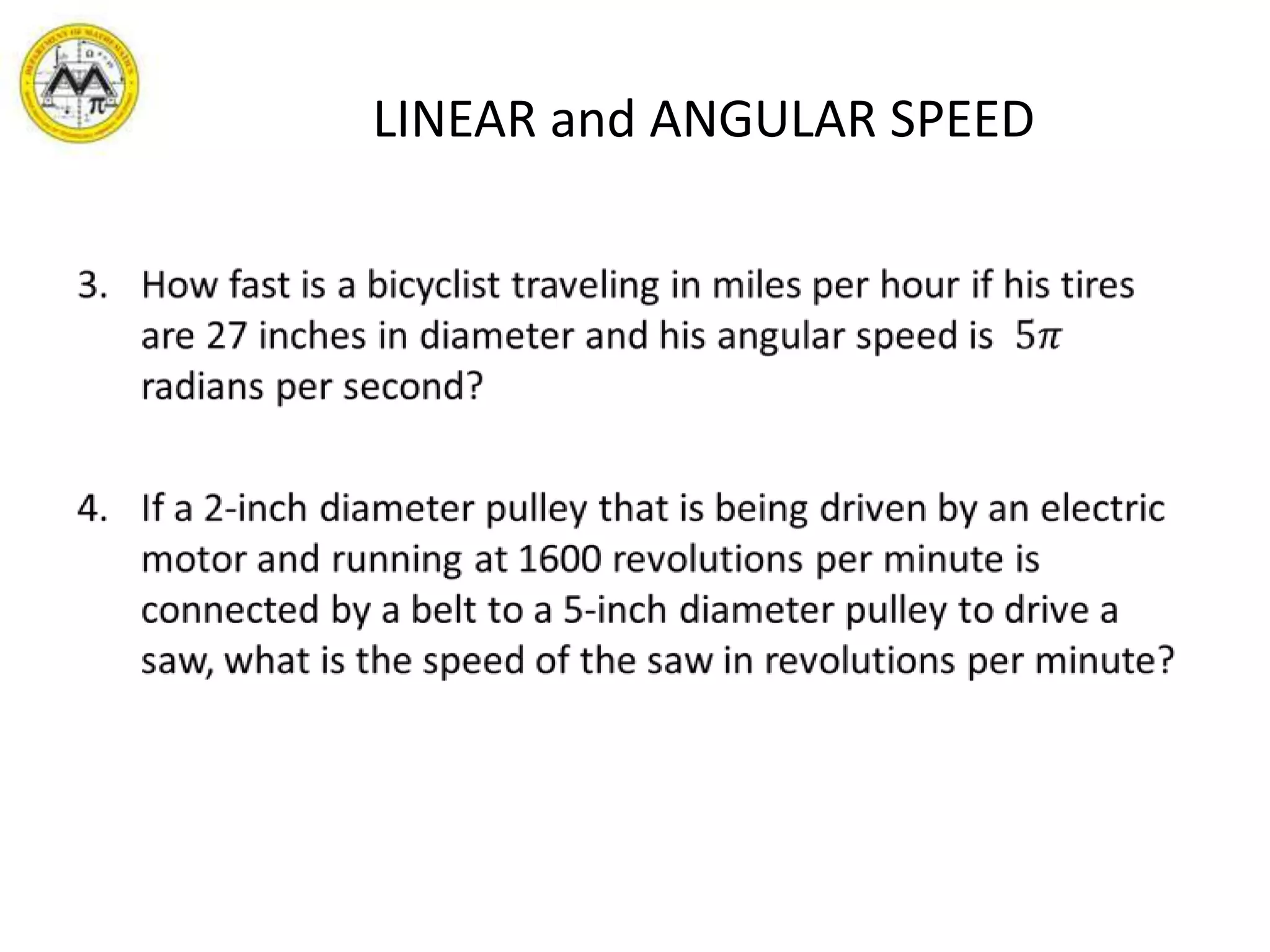
LINEAR and ANGULAR SPEEDHow fast is a bicyclist traveling in miles per hour if his tires are 27 inches in diameter and his angular speed is  5𝜋 radians per second?If a 2-inch diameter pulley that is being driven by an electric motor and running at 1600 revolutions per minute is connected by a belt to a 5-inch diameter pulley to drive a saw, what is the speed of the saw in revolutions per minute? 
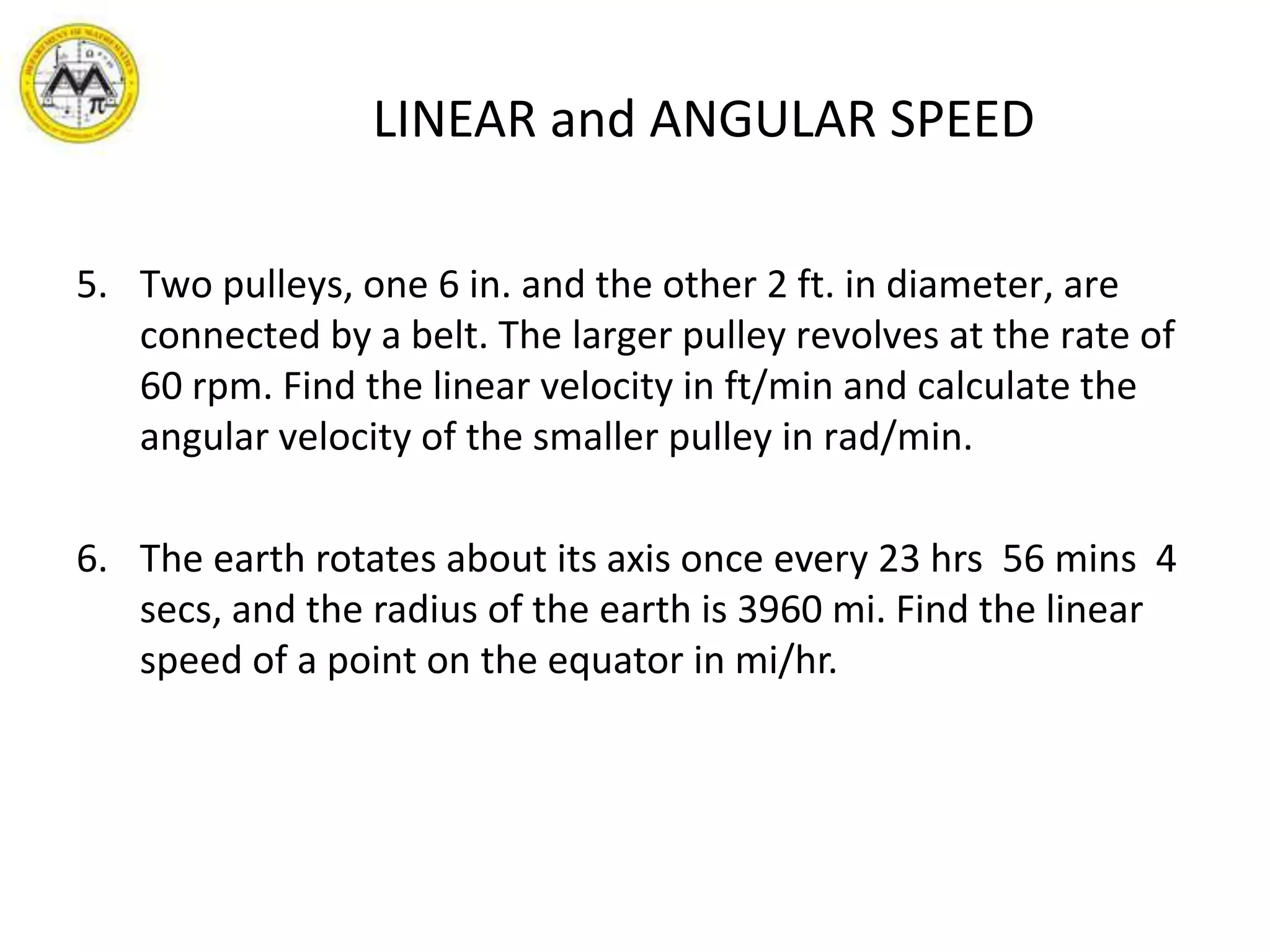
LINEAR and ANGULAR SPEEDTwo pulleys, one 6 in. and the other 2 ft. in diameter, are connected by a belt. The larger pulley revolves at the rate of 60 rpm. Find the linear velocity in ft/min and calculate the angular velocity of the smaller pulley in rad/min. The earth rotates about its axis once every 23 hrs 56 mins 4 secs, and the radius of the earth is 3960 mi. Find the linear speed of a point on the equator in mi/hr.
REFERENCESAlgebra and Trigonometry by  Cynthia YoungTrigonometry by Jerome Hayden and Bettye Hall

Math12 lesson201[1]

  • 1.
    TRIGONOMETRYMath 12Plane andSpherical Trigonometry
  • 2.
    TRIGONOMETRYDerived from the Greek words “trigonon” which means triangle and “metron” which means to measure.Branch of mathematics which deals with measurement of triangles (i.e., their sides and angles), or more specifically, with the indirect measurement of line segments and angles.
  • 3.
    TRIANGLESDefinition: A triangle is a polygon with three sides and three interior angles. The sum of the interior angles of a triangle is 180°.Classification of triangles according to angles:Oblique triangle – a triangle with no right angle - Acute triangle - Obtuse triangleRight triangle – a triangle with a right angleEquiangular triangle – a triangle with equal angles 
  • 4.
    TRIANGLESClassification of triangles according to sides:Scalene Triangle - a triangle with no two sides equal.Isosceles Triangle - a triangle with two sides equal.Equilateral triangle – a triangle with three sides equal.
  • 5.
    CLASSIFICATION OF ANGLESZero angle – an angle of 0°.Acute angle – an angle between 0° and 90°.Right angle – an angle of 90°Obtuse angle – an angle between 90° and 180°Straight angle –an angle of 180°Reflex angle – an angle between 180° and 360°Circular angle – an angle of 360°Complex angle – an angle more than 360° 
  • 6.
    Lesson 1: ANGLE MEASUREMath 12Plane and Spherical Trigonometry
  • 7.
    OBJECTIVESAt the end of the lesson the students are expected to:Measure angles in degrees and radiansDefine angles in standard positionConvert degree measure to radian measure and vice versaFind the measures of coterminal anglesCalculate the length of an arc along a circle.Solve problems involving arc length, angular velocity and linear velocity
  • 8.
    ANGLEAn angle is formed by rotating a ray about its vertex from the initial side to the terminal side.An angle is said to be in standard position if its initial side is along the positive x-axis and its vertex is at the origin.Rotation in counterclockwise direction corresponds to a positive angle.Rotation in clockwise direction corresponds to a negative angle.
  • 9.
    ANGLE MEASUREThe measureof an angle is the amount of rotation about the vertex from the initial side to the terminal side.Units of Measurement:Degree denoted by °1/360 of a complete rotation. One complete counterclockwise rotation measures 360° , and one complete clockwise rotation measures -360°.Radiandenoted by rad.measure of the central angle that is subtended by an arc whose length is equal to the radius of the circle.  
  • 10.
    Definition: Ifa central angle 𝜃 in a circle with radius r intercepts an arc on the circle of length s, then 𝜃 𝑖𝑛 𝑟𝑎𝑑𝑖𝑎𝑛𝑠=𝑠𝑟𝜃𝑓𝑢𝑙𝑙 𝑟𝑜𝑡𝑎𝑡𝑖𝑜𝑛≈2𝜋≈360°𝜋≈180° 
  • 11.
    CONVERTING BETWEEN DEGREESand RADIANSTo convert degrees to radians, multiply the degree measure by 𝜋180° .𝜃𝑟=𝜃𝑑𝜋180°To convert radians to degrees, multiply the radian measure by 180°𝜋 .𝜃𝑑=𝜃𝑟180°𝜋 
  • 12.
    Examples:Find the degreemeasure of the angle for each rotation and sketch each angle in standard position. a) 12 rotation counterclockwiseb) 23 rotation clockwisec) 59 rotation clockwised) 736 rotation counterclockwise  
  • 13.
    Express each angle measure in radians. Give answers in terms of 𝜋. a) 60° c) -330° b) 315° d) 780°Express each angle measure in degrees.a) 3𝜋4 c) - 7𝜋42b) 11𝜋9 d) 9𝜋 
  • 14.
    COTERMINAL ANGLESDefinition: Two angles in standard position with the same terminal side are called coterminal angles.Examples:State in which quadrant the angles with the given measure in standard position would be. Sketch each angle. a) 145° c) -540°b) 620° d) 1085° 
  • 15.
    COTERMINAL ANGLESDetermine theangle of the smallest possible positive measure that is coterminal with each of the given angles.a) 405° c) 960°b) -135° d) 1350° 
  • 16.
    LENGTH OF ACIRCULAR ARCDefinition: If a central angle 𝜃 in a circle with radius r intercepts an arc on the circle of length s, then the arc lengths is given by𝑠=𝑟𝜃𝜃 is in radians rS
  • 17.
    LENGTH OF ACIRCULAR ARCExamples:Find the length of the arc intercepted by a central angle of 14° in a circle of radius of 15 cm.The famous clock tower in London has a minute hand that is 14 feet long. How far does the tip of the minute hand of Big Ben travel in 35 minutes?The London Eye has 32 capsules and a diameter of 400 feet. What is the distance you will have traveled once you reach the highest point for the first time? 
  • 18.
    LINEAR SPEEDDefinition: If a point P moves along the circumference of a circle at a constant speed, then the linear speedv is given by𝑣=𝑠𝑡where s is the arc length andt is the time. 
  • 19.
    ANGULAR SPEEDDefinition: Ifa point P moves along the circumference of a circle at a constant speed, then the central angle 𝜃that is formed with the terminal side passing through the point P also changes over some time t at a constant speed. The angular speed 𝜔(omega) is given by𝜔=𝜃𝑡 where 𝜃  is in radians 
  • 20.
    RELATIONSHIP BETWEEN LINEARand ANGULAR SPEEDSIf a point P moves at a constant speed along the circumference of a circle with radius r , then the linear speed v and the angular speed𝜔are related by𝒗=𝒓𝝎or 𝜔=𝑣𝑟Note: The relationship is true only when 𝜃is in radians. 
  • 21.
    LINEAR and ANGULARSPEEDExamples: The planet Jupiter rotates every 9.9 hours and has a diameter of 88,846 miles. If you’re standing on its equator, how fast are you travelling?Some people still have their phonographic collectionsand play the records on turntables. A phonograph record is a vinyl disc that rotates on the turntable. If a 12-inch diameter record rotates at 3313 revolutions per minute, what is the angular speed in radians per minute? 
  • 22.
    LINEAR and ANGULARSPEEDHow fast is a bicyclist traveling in miles per hour if his tires are 27 inches in diameter and his angular speed is 5𝜋 radians per second?If a 2-inch diameter pulley that is being driven by an electric motor and running at 1600 revolutions per minute is connected by a belt to a 5-inch diameter pulley to drive a saw, what is the speed of the saw in revolutions per minute? 
  • 23.
    LINEAR and ANGULARSPEEDTwo pulleys, one 6 in. and the other 2 ft. in diameter, are connected by a belt. The larger pulley revolves at the rate of 60 rpm. Find the linear velocity in ft/min and calculate the angular velocity of the smaller pulley in rad/min. The earth rotates about its axis once every 23 hrs 56 mins 4 secs, and the radius of the earth is 3960 mi. Find the linear speed of a point on the equator in mi/hr.
  • 24.
    REFERENCESAlgebra and Trigonometryby Cynthia YoungTrigonometry by Jerome Hayden and Bettye Hall

Editor's Notes