Section 5.1 
Angles and Arcs 
Objectives of this Section•Convert Between Degrees, Minutes, Seconds, and Decimal Forms for Angles•Find the Arc Length of a Circle•Convert From Degrees to Radians, Radians to DegreesFind the Linear Speed of Objects in Circular Motion
A ray, or half-line, is that portion of a line that starts at a point Von the line and extends indefinitely in one direction. The starting point Vof a ray is called its vertex. VRay
If two lines are drawn with a common vertex, they form an angle. One of the rays of an angle is called the initial sideand the other the terminal side. α VertexInitial Side Terminal side Counterclockwise rotationPositive Angle
VertexInitial Side Terminal side β Clockwise rotation Negative Angle VertexInitial Side Terminal sideγ Counterclockwise rotation Positive Angle
An angle is said to be in if its vertex is at the origin of a rectangular coordinate system and its initial side coincides with with positive -axis. θstandard positionx θ Initial sideVertexTerminal sidexy
When an angle is in standard position, the terminal side either will lie in a quadrant, in which case we say lies in that quadrant, or it will lie on the x-axis or the y-axis, in which case we say is a quadrantalangle. θθθθ xy θ is a quadrantal angley θx θlies in Quadrant III
Angles are commonly measured in either Degrees or RadiansThe angle formed by rotating the initial side exactly once in the counterclockwise direction until it coincides with itself (1 revolution) is said to measure 360 degrees, abbreviated360o. Initial sideTerminal sideVertexOnedegree is 1360 revolution.,,1o
A is an angle of 90 or 14 revolution. rightangleo, Initial sideTerminal sideVertex90o angle; 14 revolution
A is an angle of 180or 12 revolution. straightangleo, Terminal sideVertexInitial side180o angle; 12 revolution
Draw a -135angle.oxyInitial sideVertex Terminal side −135o
Oneminute denoted, is defined as 160 degree. ,,′1 Onesecond denoted, is defined as second, or 13600 degree. ,,′′1160 1 counterclockwise revolution = 360 60=1 60=1oo′′′′
Consider a circle of radius r. Construct an angle whose vertex is at the center of this circle, called the central angle, and whose rays subtend an arc on the circle whose length is r. The measure of such an angle is 1 radian. r123r1 radian
For a circle of radius r, a central angle of radians subtends an arc whose length sissr=θ Find the length of the arc of a circle of radius 4 meters subtended by a central angle of 2 radians. r=4meters and =2 radiansθ ()sr===θ428meters
1 revolution =2 radiansπ 180o=πradians1 degree= 180 radian 1 radian=180 degrees ππ
degrees.in decimal a to552130Convert ′′′o oo⎟⎠ ⎞ ⎜⎝ ⎛⋅+⋅+=′′′ 36001556011230552130 ()o015278.02.030++= o215278.30=
form. SMD to45.413Convert ′′′oo87.24106413.0413.0′= ′ ⋅=ooo748.4610687.087.0′′≈′′= ′ ′′ ⋅′=′ 744245413.45′′′=oo
Suppose an object moves along a circle of radius rat a constant speed. If sis the distance traveled in time talong this circle, then the linear speedvof the object is defined asvst=
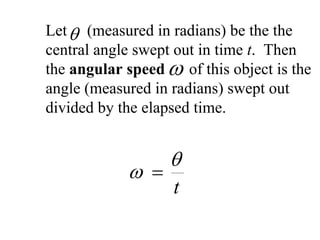
Let (measured in radians) be the thecentral angle swept out in time t. Then the angular speedof this object is the angle (measured in radians) swept out divided by the elapsed time. ωθωθ= t
To find relation between angular speed and linear speed, consider the following derivation. sr=θ strt=θ vr=ω θrs= trtsθ = ωrv=
Acknowledgement 
Thanks to Addison Wesley and Prentice Hall. 
These notes are taken from 
Sullivan Algebra and Trigonometry

Chap5 sec5.1

  • 1.
    Section 5.1 Anglesand Arcs Objectives of this Section•Convert Between Degrees, Minutes, Seconds, and Decimal Forms for Angles•Find the Arc Length of a Circle•Convert From Degrees to Radians, Radians to DegreesFind the Linear Speed of Objects in Circular Motion
  • 2.
    A ray, orhalf-line, is that portion of a line that starts at a point Von the line and extends indefinitely in one direction. The starting point Vof a ray is called its vertex. VRay
  • 3.
    If two linesare drawn with a common vertex, they form an angle. One of the rays of an angle is called the initial sideand the other the terminal side. α VertexInitial Side Terminal side Counterclockwise rotationPositive Angle
  • 4.
    VertexInitial Side Terminalside β Clockwise rotation Negative Angle VertexInitial Side Terminal sideγ Counterclockwise rotation Positive Angle
  • 5.
    An angle issaid to be in if its vertex is at the origin of a rectangular coordinate system and its initial side coincides with with positive -axis. θstandard positionx θ Initial sideVertexTerminal sidexy
  • 6.
    When an angleis in standard position, the terminal side either will lie in a quadrant, in which case we say lies in that quadrant, or it will lie on the x-axis or the y-axis, in which case we say is a quadrantalangle. θθθθ xy θ is a quadrantal angley θx θlies in Quadrant III
  • 7.
    Angles are commonlymeasured in either Degrees or RadiansThe angle formed by rotating the initial side exactly once in the counterclockwise direction until it coincides with itself (1 revolution) is said to measure 360 degrees, abbreviated360o. Initial sideTerminal sideVertexOnedegree is 1360 revolution.,,1o
  • 8.
    A is anangle of 90 or 14 revolution. rightangleo, Initial sideTerminal sideVertex90o angle; 14 revolution
  • 9.
    A is anangle of 180or 12 revolution. straightangleo, Terminal sideVertexInitial side180o angle; 12 revolution
  • 10.
    Draw a -135angle.oxyInitialsideVertex Terminal side −135o
  • 11.
    Oneminute denoted, isdefined as 160 degree. ,,′1 Onesecond denoted, is defined as second, or 13600 degree. ,,′′1160 1 counterclockwise revolution = 360 60=1 60=1oo′′′′
  • 12.
    Consider a circleof radius r. Construct an angle whose vertex is at the center of this circle, called the central angle, and whose rays subtend an arc on the circle whose length is r. The measure of such an angle is 1 radian. r123r1 radian
  • 13.
    For a circleof radius r, a central angle of radians subtends an arc whose length sissr=θ Find the length of the arc of a circle of radius 4 meters subtended by a central angle of 2 radians. r=4meters and =2 radiansθ ()sr===θ428meters
  • 14.
    1 revolution =2radiansπ 180o=πradians1 degree= 180 radian 1 radian=180 degrees ππ
  • 15.
    degrees.in decimal ato552130Convert ′′′o oo⎟⎠ ⎞ ⎜⎝ ⎛⋅+⋅+=′′′ 36001556011230552130 ()o015278.02.030++= o215278.30=
  • 16.
    form. SMD to45.413Convert′′′oo87.24106413.0413.0′= ′ ⋅=ooo748.4610687.087.0′′≈′′= ′ ′′ ⋅′=′ 744245413.45′′′=oo
  • 17.
    Suppose an objectmoves along a circle of radius rat a constant speed. If sis the distance traveled in time talong this circle, then the linear speedvof the object is defined asvst=
  • 18.
    Let (measured inradians) be the thecentral angle swept out in time t. Then the angular speedof this object is the angle (measured in radians) swept out divided by the elapsed time. ωθωθ= t
  • 19.
    To find relationbetween angular speed and linear speed, consider the following derivation. sr=θ strt=θ vr=ω θrs= trtsθ = ωrv=
  • 20.
    Acknowledgement Thanks toAddison Wesley and Prentice Hall. These notes are taken from Sullivan Algebra and Trigonometry