Trigonometry
The study of triangles and the
relationships between their sides
and angles
Standard Position
of an Angle
Angle in Standard Position
It is easy to see the direction of an angle if it
is presented in reference to a rectangular
coordinate system. Let the origin of the
coordinate system be at the vertex of the
angle and let the positive half of the x-axis
form the initial side of the angle. The
terminal side shall be in any of the four
quadrants of the coordinate system. Angle
drawn in this manner are called angles in
standard position.
Angle in Standard
Position
An angle in standard position
has for its initial side the
positive half of the x-axis in a
rectangular coordinate
system.
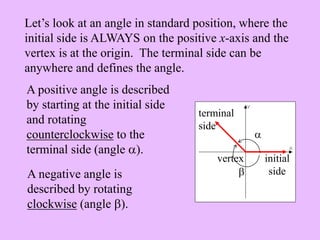
Let’s look at an angle in standard position, where the
initial side is ALWAYS on the positive x-axis and the
vertex is at the origin. The terminal side can be
anywhere and defines the angle.
A positive angle is described
by starting at the initial side
and rotating
counterclockwise to the
terminal side (angle ).
terminal
side
initial
side
vertex


A negative angle is
described by rotating
clockwise (angle ).
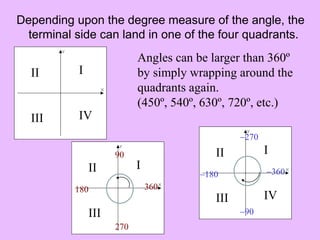
Depending upon the degree measure of the angle, the
terminal side can land in one of the four quadrants.
Angles can be larger than 360º
by simply wrapping around the
quadrants again.
(450º, 540º, 630º, 720º, etc.)
I
II
III IV
I
II
III IV
-90
-180
-270
-360
I
II
III
90
180
270
360
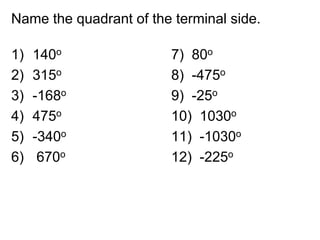
Name the quadrant of the terminal side.
1) 140o 7) 80o
2) 315o 8) -475o
3) -168o 9) -25o
4) 475o 10) 1030o
5) -340o 11) -1030o
6) 670o 12) -225o


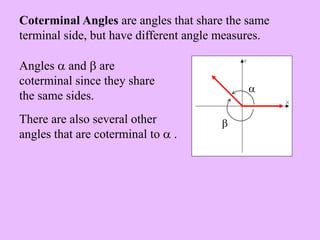
Angles  and  are
coterminal since they share
the same sides.
Coterminal Angles are angles that share the same
terminal side, but have different angle measures.
There are also several other
angles that are coterminal to  .
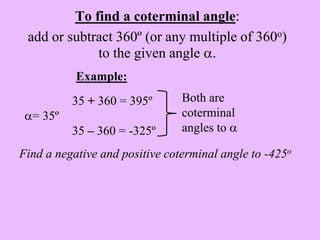
To find a coterminal angle:
add or subtract 360º (or any multiple of 360o)
to the given angle .
Both are
coterminal
angles to 
Example:
35 + 360 = 395º
= 35º
35 – 360 = -325º
Find a negative and positive coterminal angle to -425o
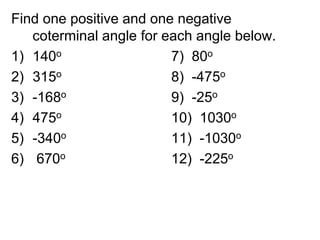
Find one positive and one negative
coterminal angle for each angle below.
1) 140o 7) 80o
2) 315o 8) -475o
3) -168o 9) -25o
4) 475o 10) 1030o
5) -340o 11) -1030o
6) 670o 12) -225o
Botanical Name
Narcissus
'Trigonometry'
Plant Common Name
Trigonometry Daffodil
The flowers of a Trigonometry Daffodil are of almost
geometric precision with their repeating patterns.
Repeating patterns occur in sound, light, tides, time, and
nature.
To analyse these repeating, cyclical patterns, we need to
study the cyclical functions branch of trigonometry.
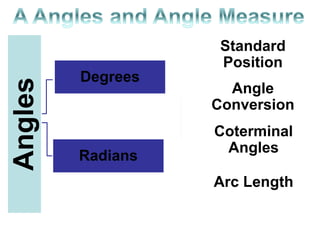
Angles
Degrees
Standard
Position
Angle
Conversion
Radians
Coterminal
Angles
Arc Length
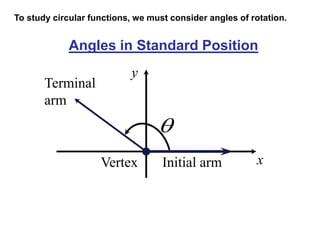
Angles in Standard Position

Initial arm
Vertex
Terminal
arm
x
y
To study circular functions, we must consider angles of rotation.
If the terminal arm
moves counter-
clockwise, angle A
is positive.
A x
y
If the terminal side
moves clockwise,
angle A is
negative.
A
x
y
Positive or Negative Rotation Angle
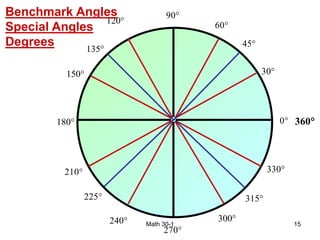
30
60
120
150
210
240 300
330
90
180
270
0
Benchmark Angles
Special Angles
Degrees 45
135
225 315
360
Math 30-1 15
Sketch each rotation angle in standard position.
State the quadrant in which the terminal arm lies.
400° - 170°
-1020°
1280°
Math 30-1 16
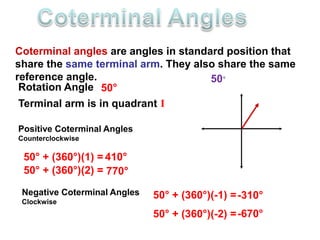
Coterminal angles are angles in standard position that
share the same terminal arm. They also share the same
reference angle. 50°
Rotation Angle 50°
Terminal arm is in quadrant I
Positive Coterminal Angles
Counterclockwise
50° + (360°)(1) =
Negative Coterminal Angles
Clockwise
-310°
770°
-670°
410°
50° + (360°)(2) =
50° + (360°)(-1) =
50° + (360°)(-2) =
Coterminal Angles in General Form
By adding or subtracting multiples of one full
rotation, you can write an infinite number of angles
that are coterminal with any given angle.
θ ± (360°)n, where n is any natural number
Why must n be a natural number?
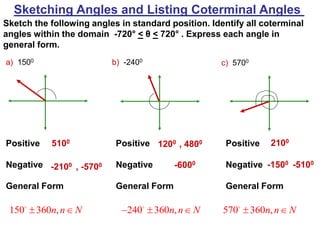
Sketching Angles and Listing Coterminal Angles
Sketch the following angles in standard position. Identify all coterminal
angles within the domain -720° < θ < 720° . Express each angle in
general form.
a) 1500 b) -2400
c) 5700
Positive
Negative
General Form
5100
-2100
1200
-6000
2100
-1500
150 360 ,
n n N
  240 360 ,
n n N
-   570 360 ,
n n N
 
Positive
Negative
General Form
Positive
Negative
General Form
, -5700
, 4800
-5100
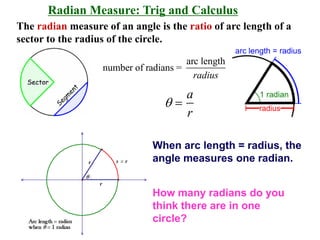
Radian Measure: Trig and Calculus
The radian measure of an angle is the ratio of arc length of a
sector to the radius of the circle.
 
a
r
number of radians =
arc length
radius
When arc length = radius, the
angle measures one radian.
How many radians do you
think there are in one
circle?
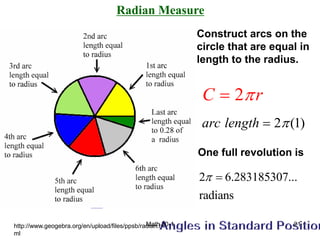
Construct arcs on the
circle that are equal in
length to the radius.
Radian Measure
2 6.283185307...
radians
 
C  2r
arc length  2(1)
http://www.geogebra.org/en/upload/files/ppsb/radian.ht
ml
One full revolution is
Math 30-1 21
Radian Measure
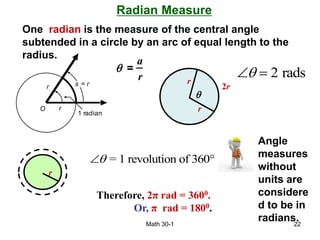
One radian is the measure of the central angle
subtended in a circle by an arc of equal length to the
radius.
2r
r
r

 =
a
r
O r
r s = r
1 radian
 = 1 revolution of 360
Therefore, 2π rad = 3600.
Or, π rad = 1800.
r
  2 rads
Angle
measures
without
units are
considere
d to be in
radians.
Math 30-1 22
Math 30-1 23
6

3

2


3
2

0
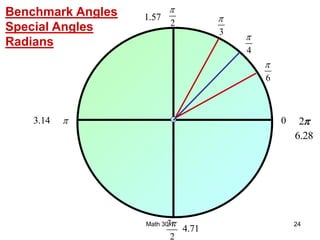
Benchmark Angles
Special Angles
Radians
4

2
1.57
3.14
4.71
6.28
Math 30-1 24
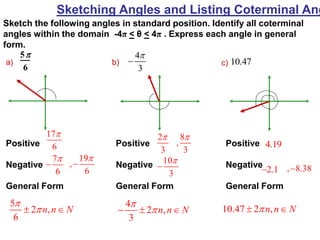
Sketching Angles and Listing Coterminal Ang
Sketch the following angles in standard position. Identify all coterminal
angles within the domain -4π < θ < 4π . Express each angle in general
form.
a) b) c)
Positive
Negative
General Form
5
2 ,
6
n n N


 
4
2 ,
3
n n N


-   10.47 2 ,
n n N

 
Positive
Negative
General Form
Positive
Negative
General Form
5
6
4
3

- 10.47
17
6

7
6

-
19
,
6

-
2
3
 8
,
3

10
3

-
4.19
2.1
- , 8.38
-
Angles and Coterminal Angles
Degrees and Radians
Page 175
1, 6, 7, 8, 9, 11a, c, d, e, h

Standard-Position-of-an-Angle-FULL.ppt

  • 1.
    Trigonometry The study oftriangles and the relationships between their sides and angles
  • 2.
  • 3.
    Angle in StandardPosition It is easy to see the direction of an angle if it is presented in reference to a rectangular coordinate system. Let the origin of the coordinate system be at the vertex of the angle and let the positive half of the x-axis form the initial side of the angle. The terminal side shall be in any of the four quadrants of the coordinate system. Angle drawn in this manner are called angles in standard position.
  • 4.
    Angle in Standard Position Anangle in standard position has for its initial side the positive half of the x-axis in a rectangular coordinate system.
  • 5.
    Let’s look atan angle in standard position, where the initial side is ALWAYS on the positive x-axis and the vertex is at the origin. The terminal side can be anywhere and defines the angle. A positive angle is described by starting at the initial side and rotating counterclockwise to the terminal side (angle ). terminal side initial side vertex   A negative angle is described by rotating clockwise (angle ).
  • 6.
    Depending upon thedegree measure of the angle, the terminal side can land in one of the four quadrants. Angles can be larger than 360º by simply wrapping around the quadrants again. (450º, 540º, 630º, 720º, etc.) I II III IV I II III IV -90 -180 -270 -360 I II III 90 180 270 360
  • 7.
    Name the quadrantof the terminal side. 1) 140o 7) 80o 2) 315o 8) -475o 3) -168o 9) -25o 4) 475o 10) 1030o 5) -340o 11) -1030o 6) 670o 12) -225o
  • 8.
      Angles  and are coterminal since they share the same sides. Coterminal Angles are angles that share the same terminal side, but have different angle measures. There are also several other angles that are coterminal to  .
  • 9.
    To find acoterminal angle: add or subtract 360º (or any multiple of 360o) to the given angle . Both are coterminal angles to  Example: 35 + 360 = 395º = 35º 35 – 360 = -325º Find a negative and positive coterminal angle to -425o
  • 10.
    Find one positiveand one negative coterminal angle for each angle below. 1) 140o 7) 80o 2) 315o 8) -475o 3) -168o 9) -25o 4) 475o 10) 1030o 5) -340o 11) -1030o 6) 670o 12) -225o
  • 11.
    Botanical Name Narcissus 'Trigonometry' Plant CommonName Trigonometry Daffodil The flowers of a Trigonometry Daffodil are of almost geometric precision with their repeating patterns. Repeating patterns occur in sound, light, tides, time, and nature. To analyse these repeating, cyclical patterns, we need to study the cyclical functions branch of trigonometry.
  • 12.
  • 13.
    Angles in StandardPosition  Initial arm Vertex Terminal arm x y To study circular functions, we must consider angles of rotation.
  • 14.
    If the terminalarm moves counter- clockwise, angle A is positive. A x y If the terminal side moves clockwise, angle A is negative. A x y Positive or Negative Rotation Angle
  • 15.
  • 16.
    Sketch each rotationangle in standard position. State the quadrant in which the terminal arm lies. 400° - 170° -1020° 1280° Math 30-1 16
  • 17.
    Coterminal angles areangles in standard position that share the same terminal arm. They also share the same reference angle. 50° Rotation Angle 50° Terminal arm is in quadrant I Positive Coterminal Angles Counterclockwise 50° + (360°)(1) = Negative Coterminal Angles Clockwise -310° 770° -670° 410° 50° + (360°)(2) = 50° + (360°)(-1) = 50° + (360°)(-2) =
  • 18.
    Coterminal Angles inGeneral Form By adding or subtracting multiples of one full rotation, you can write an infinite number of angles that are coterminal with any given angle. θ ± (360°)n, where n is any natural number Why must n be a natural number?
  • 19.
    Sketching Angles andListing Coterminal Angles Sketch the following angles in standard position. Identify all coterminal angles within the domain -720° < θ < 720° . Express each angle in general form. a) 1500 b) -2400 c) 5700 Positive Negative General Form 5100 -2100 1200 -6000 2100 -1500 150 360 , n n N   240 360 , n n N -   570 360 , n n N   Positive Negative General Form Positive Negative General Form , -5700 , 4800 -5100
  • 20.
    Radian Measure: Trigand Calculus The radian measure of an angle is the ratio of arc length of a sector to the radius of the circle.   a r number of radians = arc length radius When arc length = radius, the angle measures one radian. How many radians do you think there are in one circle?
  • 21.
    Construct arcs onthe circle that are equal in length to the radius. Radian Measure 2 6.283185307... radians   C  2r arc length  2(1) http://www.geogebra.org/en/upload/files/ppsb/radian.ht ml One full revolution is Math 30-1 21
  • 22.
    Radian Measure One radianis the measure of the central angle subtended in a circle by an arc of equal length to the radius. 2r r r   = a r O r r s = r 1 radian  = 1 revolution of 360 Therefore, 2π rad = 3600. Or, π rad = 1800. r   2 rads Angle measures without units are considere d to be in radians. Math 30-1 22
  • 23.
  • 24.
  • 25.
    Sketching Angles andListing Coterminal Ang Sketch the following angles in standard position. Identify all coterminal angles within the domain -4π < θ < 4π . Express each angle in general form. a) b) c) Positive Negative General Form 5 2 , 6 n n N     4 2 , 3 n n N   -   10.47 2 , n n N    Positive Negative General Form Positive Negative General Form 5 6 4 3  - 10.47 17 6  7 6  - 19 , 6  - 2 3  8 , 3  10 3  - 4.19 2.1 - , 8.38 -
  • 26.
    Angles and CoterminalAngles Degrees and Radians Page 175 1, 6, 7, 8, 9, 11a, c, d, e, h