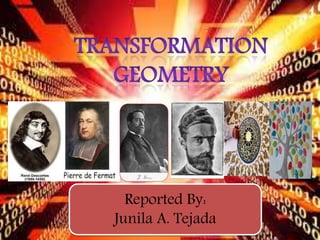
Reported By:
Junila A. Tejada
Measurement of the Earth.
In today’s usage, it is a branch of
mathematics dealing with spatial
figures.
 a process which changes the position
(and possibly the size and orientation)
of a shape. There are four types of
transformations: reflection, rotation,
translation and enlargement.
Historical Overview of Transformation
Geometry
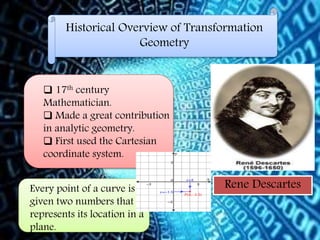
 17th century
Mathematician.
 Made a great contribution
in analytic geometry.
 First used the Cartesian
coordinate system.
Every point of a curve is
given two numbers that
represents its location in a
plane.
Rene Descartes
Historical Overview of Transformation
Geometry
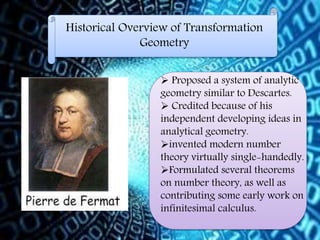
 Proposed a system of analytic
geometry similar to Descartes.
 Credited because of his
independent developing ideas in
analytical geometry.
invented modern number
theory virtually single-handedly.
Formulated several theorems
on number theory, as well as
contributing some early work on
infinitesimal calculus.
Historical Overview of Transformation
Geometry
 assign algebraic ideas to
geometric figures led to the
study of group theory in
geometry.
 Enlanger Program
Study in geometry defined
as the study of transformations
that leave objects invariant.
 Rearranged the unrelated
geometry know at his time
into a cohesive system.
Felix Klein ( 1849-1925)
Klein’s Idea
• A geometry is a set of objects with the
rules determined by its symmetries, i.e., its
transformations. Two geometries may have
the same objects but different
transformations.
• The properties of the geometry are
properties that are not changed by the
transformations.
Different transformations
have been used in art,
architecture, crafts, and quilts
throughout history. Historians
have found numerous
transformation designs in
pottery, architecture, rugs,
quilts, and art pieces from
almost every culture. The
design used can help to
determine where and to
whom an artifact belonged.
 Developed in the 7th, 8th,
9th centuries from beliefs
that creating a living
objects in art was
blasphemous or that God
should create animals and
other creatures in art work.
 Due to this belief, many
did not use living creatures
in their art work, instead
they used different
transformations and
geometric designs to
increase the appeal of their
art and architecture.
Arabesque
Appliqué
 a process when one
piece of fabric is sewn
onto another and then
stitched together with an
intricate design,
traditionally had
elaborate geometric
transformations that were
typically symmetric; such
as flowers and houses
that are not necessarily
symmetric.
Transformational geometry is quite important in
many fields, such as the study of architecture,
anthropology, and art, to name a few. The study of
which forms of transformations were used helps to
distinguish time frames for artifacts and helps to
illustrate which cultures may have made the item
being studied.
For example, architects are able to study the history
of very old buildings, taking note of which
transformations were used. A classical example that
involves this study is the illustration of the study of
the history of the Parthenon in Athens, Greece.
M. C. Escher (1898–1972)
 Dutch graphic artist.
Escher would go to work on his pieces.
Escher read a few mathematics papers
regarding symmetry,
specifically George Pólya’s (1887–1985)
1924 paper on 17 plane symmetry
groups, and although he
did not understand many of the ideas and
the mathematical theory of why it worked,
he did understand
the concepts of the paper and was able to
apply the ideas in his work. These
concepts helped him to use
mathematics more extensively throughout
many of his later pieces.
Types of
Transformation
 Reflection
 Translations
 Rotation
 Dilation
Reflection
You can reflect a figure using a line
or a point. All measures (lines and
angles) are preserved but in a mirror
image.
Example: The figure is reflected
across line l .
You could fold the picture along
line l and the left figure would
coincide with the corresponding
parts of right figure.
l
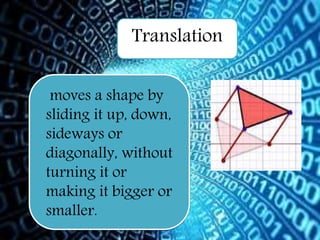
moves a shape by
sliding it up, down,
sideways or
diagonally, without
turning it or
making it bigger or
smaller.
Translation
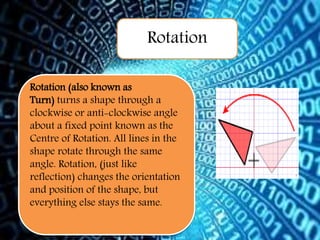
Rotation
Rotation (also known as
Turn) turns a shape through a
clockwise or anti-clockwise angle
about a fixed point known as the
Centre of Rotation. All lines in the
shape rotate through the same
angle. Rotation, (just like
reflection) changes the orientation
and position of the shape, but
everything else stays the same.
Dilation
A dilation is a
transformation which
changes the size of a
figure but not its shape.
This is called a
similarity
transformation.
“Do not just pay attention
to the words;
Instead pay attention to
meaning behind the words.
But, do not just pay
attention to meanings
behind the words;
Instead pay attention to
your deep experience of
those meanings.”
Tenzin Gyatso, The 14th
Dalai Lama
END

Transformation geometry

  • 1.
  • 2.
    Measurement of theEarth. In today’s usage, it is a branch of mathematics dealing with spatial figures.
  • 3.
     a processwhich changes the position (and possibly the size and orientation) of a shape. There are four types of transformations: reflection, rotation, translation and enlargement.
  • 4.
    Historical Overview ofTransformation Geometry  17th century Mathematician.  Made a great contribution in analytic geometry.  First used the Cartesian coordinate system. Every point of a curve is given two numbers that represents its location in a plane. Rene Descartes
  • 5.
    Historical Overview ofTransformation Geometry  Proposed a system of analytic geometry similar to Descartes.  Credited because of his independent developing ideas in analytical geometry. invented modern number theory virtually single-handedly. Formulated several theorems on number theory, as well as contributing some early work on infinitesimal calculus.
  • 6.
    Historical Overview ofTransformation Geometry  assign algebraic ideas to geometric figures led to the study of group theory in geometry.  Enlanger Program Study in geometry defined as the study of transformations that leave objects invariant.  Rearranged the unrelated geometry know at his time into a cohesive system. Felix Klein ( 1849-1925)
  • 7.
    Klein’s Idea • Ageometry is a set of objects with the rules determined by its symmetries, i.e., its transformations. Two geometries may have the same objects but different transformations. • The properties of the geometry are properties that are not changed by the transformations.
  • 8.
    Different transformations have beenused in art, architecture, crafts, and quilts throughout history. Historians have found numerous transformation designs in pottery, architecture, rugs, quilts, and art pieces from almost every culture. The design used can help to determine where and to whom an artifact belonged.
  • 9.
     Developed inthe 7th, 8th, 9th centuries from beliefs that creating a living objects in art was blasphemous or that God should create animals and other creatures in art work.  Due to this belief, many did not use living creatures in their art work, instead they used different transformations and geometric designs to increase the appeal of their art and architecture. Arabesque
  • 10.
    Appliqué  a processwhen one piece of fabric is sewn onto another and then stitched together with an intricate design, traditionally had elaborate geometric transformations that were typically symmetric; such as flowers and houses that are not necessarily symmetric.
  • 11.
    Transformational geometry isquite important in many fields, such as the study of architecture, anthropology, and art, to name a few. The study of which forms of transformations were used helps to distinguish time frames for artifacts and helps to illustrate which cultures may have made the item being studied. For example, architects are able to study the history of very old buildings, taking note of which transformations were used. A classical example that involves this study is the illustration of the study of the history of the Parthenon in Athens, Greece.
  • 12.
    M. C. Escher(1898–1972)  Dutch graphic artist. Escher would go to work on his pieces. Escher read a few mathematics papers regarding symmetry, specifically George Pólya’s (1887–1985) 1924 paper on 17 plane symmetry groups, and although he did not understand many of the ideas and the mathematical theory of why it worked, he did understand the concepts of the paper and was able to apply the ideas in his work. These concepts helped him to use mathematics more extensively throughout many of his later pieces.
  • 13.
    Types of Transformation  Reflection Translations  Rotation  Dilation
  • 14.
    Reflection You can reflecta figure using a line or a point. All measures (lines and angles) are preserved but in a mirror image. Example: The figure is reflected across line l . You could fold the picture along line l and the left figure would coincide with the corresponding parts of right figure. l
  • 15.
    moves a shapeby sliding it up, down, sideways or diagonally, without turning it or making it bigger or smaller. Translation
  • 16.
    Rotation Rotation (also knownas Turn) turns a shape through a clockwise or anti-clockwise angle about a fixed point known as the Centre of Rotation. All lines in the shape rotate through the same angle. Rotation, (just like reflection) changes the orientation and position of the shape, but everything else stays the same.
  • 17.
    Dilation A dilation isa transformation which changes the size of a figure but not its shape. This is called a similarity transformation.
  • 18.
    “Do not justpay attention to the words; Instead pay attention to meaning behind the words. But, do not just pay attention to meanings behind the words; Instead pay attention to your deep experience of those meanings.” Tenzin Gyatso, The 14th Dalai Lama END