UNIT 4.3 TRIANGLEUNIT 4.3 TRIANGLE
CONGRUENCE BY ASA ANDCONGRUENCE BY ASA AND
AASAAS
Warm Up
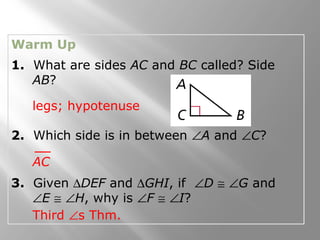
1. What are sides AC and BC called? Side
AB?
2. Which side is in between ∠A and ∠C?
3. Given ∆DEF and ∆GHI, if ∠D ≅ ∠G and
∠E ≅ ∠H, why is ∠F ≅ ∠I?
legs; hypotenuse
AC
Third ∠s Thm.
Apply ASA, AAS, and HL to construct
triangles and to solve problems.
Prove triangles congruent by using
ASA, AAS, and HL.
Objectives
included side
Vocabulary
Participants in an orienteering race use
a map and a compass to find their way
to checkpoints along an unfamiliar
course.
Directions are given by bearings, which
are based on compass headings. For
example, to travel along the bearing S
43° E, you face south and then turn
43° to the east.
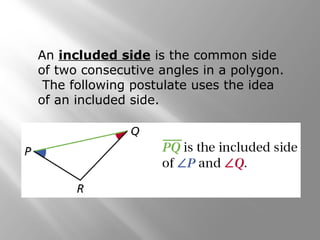
An included side is the common side
of two consecutive angles in a polygon.
The following postulate uses the idea
of an included side.
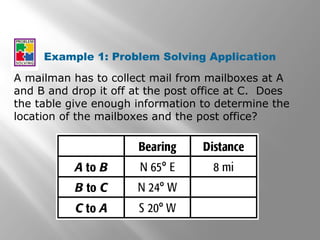
Example 1: Problem Solving Application
A mailman has to collect mail from mailboxes at A
and B and drop it off at the post office at C. Does
the table give enough information to determine the
location of the mailboxes and the post office?
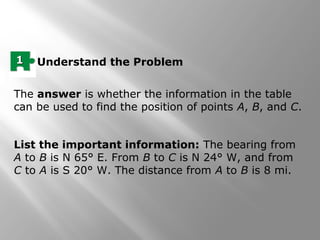
The answer is whether the information in the table
can be used to find the position of points A, B, and C.
List the important information: The bearing from
A to B is N 65° E. From B to C is N 24° W, and from
C to A is S 20° W. The distance from A to B is 8 mi.
11 Understand the Problem
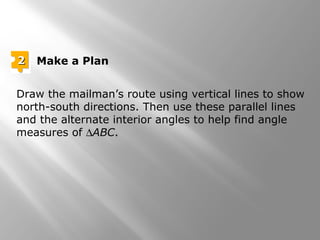
Draw the mailman’s route using vertical lines to show
north-south directions. Then use these parallel lines
and the alternate interior angles to help find angle
measures of ∆ABC.
22 Make a Plan
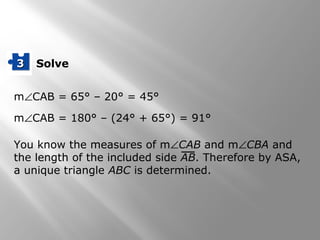
m∠CAB = 65° – 20° = 45°
m∠CAB = 180° – (24° + 65°) = 91°
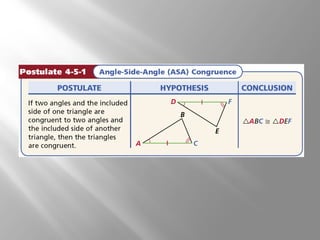
You know the measures of m∠CAB and m∠CBA and
the length of the included side AB. Therefore by ASA,
a unique triangle ABC is determined.
Solve33
One and only one triangle can be made using the
information in the table, so the table does give
enough information to determine the location of the
mailboxes and the post office.
Look Back44
Check It Out! Example 1
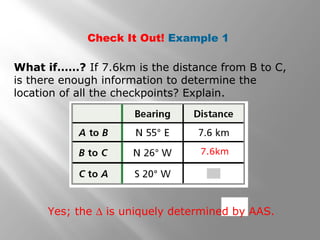
What if……? If 7.6km is the distance from B to C,
is there enough information to determine the
location of all the checkpoints? Explain.
7.6km
Yes; the ∆ is uniquely determined by AAS.
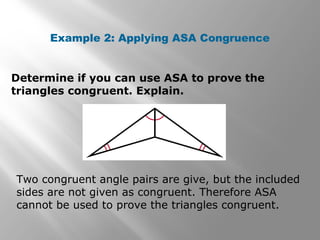
Example 2: Applying ASA Congruence
Determine if you can use ASA to prove the
triangles congruent. Explain.
Two congruent angle pairs are give, but the included
sides are not given as congruent. Therefore ASA
cannot be used to prove the triangles congruent.
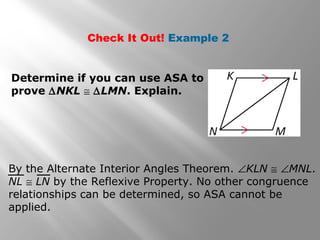
Check It Out! Example 2
Determine if you can use ASA to
prove ∆NKL ≅ ∆LMN. Explain.
By the Alternate Interior Angles Theorem. ∠KLN ≅ ∠MNL.
NL ≅ LN by the Reflexive Property. No other congruence
relationships can be determined, so ASA cannot be
applied.
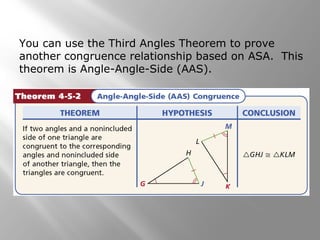
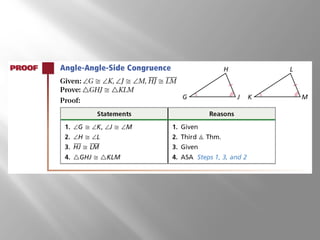
You can use the Third Angles Theorem to prove
another congruence relationship based on ASA. This
theorem is Angle-Angle-Side (AAS).
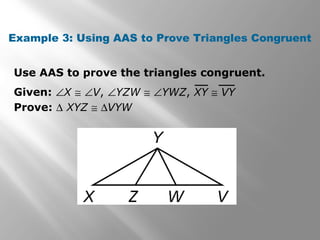
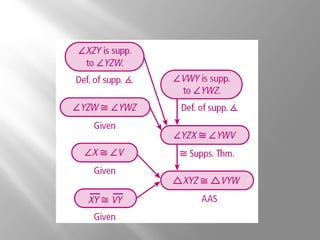
Example 3: Using AAS to Prove Triangles Congruent
Use AAS to prove the triangles congruent.
Given: ∠X ≅ ∠V, ∠YZW ≅ ∠YWZ, XY ≅ VY
Prove: ∆ XYZ ≅ ∆VYW
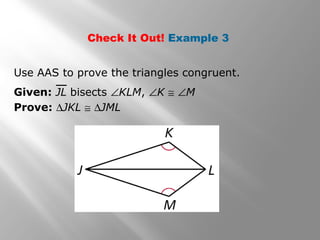
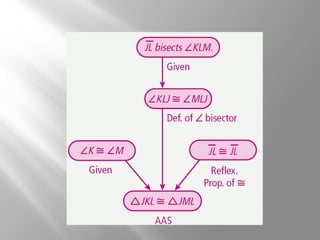
Check It Out! Example 3
Use AAS to prove the triangles congruent.
Given: JL bisects ∠KLM, ∠K ≅ ∠M
Prove: ∆JKL ≅ ∆JML
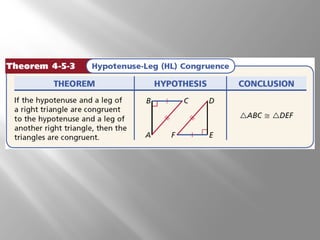
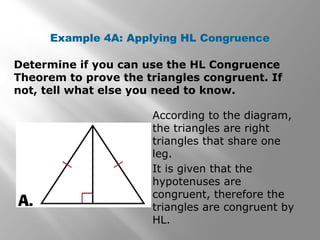
Example 4A: Applying HL Congruence
Determine if you can use the HL Congruence
Theorem to prove the triangles congruent. If
not, tell what else you need to know.
According to the diagram,
the triangles are right
triangles that share one
leg.
It is given that the
hypotenuses are
congruent, therefore the
triangles are congruent by
HL.
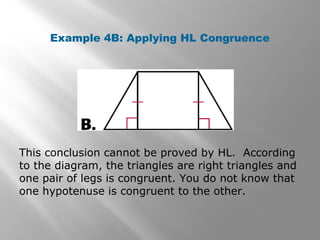
Example 4B: Applying HL Congruence
This conclusion cannot be proved by HL. According
to the diagram, the triangles are right triangles and
one pair of legs is congruent. You do not know that
one hypotenuse is congruent to the other.
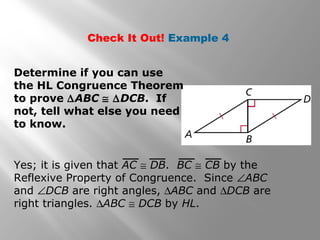
Check It Out! Example 4
Determine if you can use
the HL Congruence Theorem
to prove ∆ABC ≅ ∆DCB. If
not, tell what else you need
to know.
Yes; it is given that AC ≅ DB. BC ≅ CB by the
Reflexive Property of Congruence. Since ∠ABC
and ∠DCB are right angles, ∆ABC and ∆DCB are
right triangles. ∆ABC ≅ DCB by HL.
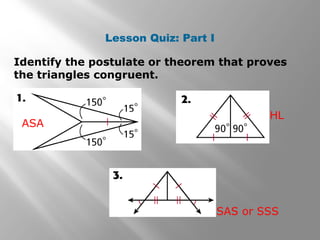
Lesson Quiz: Part I
Identify the postulate or theorem that proves
the triangles congruent.
ASA
HL
SAS or SSS
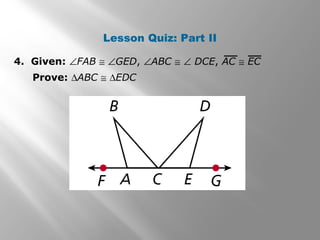
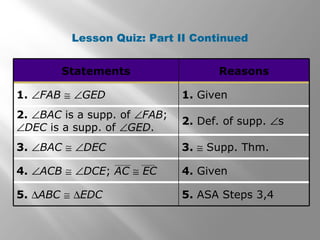
Lesson Quiz: Part II
4. Given: ∠FAB ≅ ∠GED, ∠ABC ≅ ∠ DCE, AC ≅ EC
Prove: ∆ABC ≅ ∆EDC
Lesson Quiz: Part II Continued
5. ASA Steps 3,45. ∆ABC ≅ ∆EDC
4. Given4. ∠ACB ≅ ∠DCE; AC ≅ EC
3. ≅ Supp. Thm.3. ∠BAC ≅ ∠DEC
2. Def. of supp. ∠s
2. ∠BAC is a supp. of ∠FAB;
∠DEC is a supp. of ∠GED.
1. Given1. ∠FAB ≅ ∠GED
ReasonsStatements
All rights belong to their
respective owners.
Copyright Disclaimer Under
Section 107 of the
Copyright Act 1976,
allowance is made for "fair
use" for purposes such as
criticism, comment, news
reporting, TEACHING,
scholarship, and research.
Fair use is a use permitted
by copyright statute that
might otherwise be
infringing.
Non-profit, EDUCATIONAL
or personal use tips the
balance in favor of fair use.

Geometry 201 unit 4.3

  • 1.
    UNIT 4.3 TRIANGLEUNIT4.3 TRIANGLE CONGRUENCE BY ASA ANDCONGRUENCE BY ASA AND AASAAS
  • 2.
    Warm Up 1. Whatare sides AC and BC called? Side AB? 2. Which side is in between ∠A and ∠C? 3. Given ∆DEF and ∆GHI, if ∠D ≅ ∠G and ∠E ≅ ∠H, why is ∠F ≅ ∠I? legs; hypotenuse AC Third ∠s Thm.
  • 3.
    Apply ASA, AAS,and HL to construct triangles and to solve problems. Prove triangles congruent by using ASA, AAS, and HL. Objectives
  • 4.
  • 5.
    Participants in anorienteering race use a map and a compass to find their way to checkpoints along an unfamiliar course. Directions are given by bearings, which are based on compass headings. For example, to travel along the bearing S 43° E, you face south and then turn 43° to the east.
  • 6.
    An included sideis the common side of two consecutive angles in a polygon. The following postulate uses the idea of an included side.
  • 8.
    Example 1: ProblemSolving Application A mailman has to collect mail from mailboxes at A and B and drop it off at the post office at C. Does the table give enough information to determine the location of the mailboxes and the post office?
  • 9.
    The answer iswhether the information in the table can be used to find the position of points A, B, and C. List the important information: The bearing from A to B is N 65° E. From B to C is N 24° W, and from C to A is S 20° W. The distance from A to B is 8 mi. 11 Understand the Problem
  • 10.
    Draw the mailman’sroute using vertical lines to show north-south directions. Then use these parallel lines and the alternate interior angles to help find angle measures of ∆ABC. 22 Make a Plan
  • 11.
    m∠CAB = 65°– 20° = 45° m∠CAB = 180° – (24° + 65°) = 91° You know the measures of m∠CAB and m∠CBA and the length of the included side AB. Therefore by ASA, a unique triangle ABC is determined. Solve33
  • 12.
    One and onlyone triangle can be made using the information in the table, so the table does give enough information to determine the location of the mailboxes and the post office. Look Back44
  • 13.
    Check It Out!Example 1 What if……? If 7.6km is the distance from B to C, is there enough information to determine the location of all the checkpoints? Explain. 7.6km Yes; the ∆ is uniquely determined by AAS.
  • 14.
    Example 2: ApplyingASA Congruence Determine if you can use ASA to prove the triangles congruent. Explain. Two congruent angle pairs are give, but the included sides are not given as congruent. Therefore ASA cannot be used to prove the triangles congruent.
  • 15.
    Check It Out!Example 2 Determine if you can use ASA to prove ∆NKL ≅ ∆LMN. Explain. By the Alternate Interior Angles Theorem. ∠KLN ≅ ∠MNL. NL ≅ LN by the Reflexive Property. No other congruence relationships can be determined, so ASA cannot be applied.
  • 16.
    You can usethe Third Angles Theorem to prove another congruence relationship based on ASA. This theorem is Angle-Angle-Side (AAS).
  • 18.
    Example 3: UsingAAS to Prove Triangles Congruent Use AAS to prove the triangles congruent. Given: ∠X ≅ ∠V, ∠YZW ≅ ∠YWZ, XY ≅ VY Prove: ∆ XYZ ≅ ∆VYW
  • 20.
    Check It Out!Example 3 Use AAS to prove the triangles congruent. Given: JL bisects ∠KLM, ∠K ≅ ∠M Prove: ∆JKL ≅ ∆JML
  • 23.
    Example 4A: ApplyingHL Congruence Determine if you can use the HL Congruence Theorem to prove the triangles congruent. If not, tell what else you need to know. According to the diagram, the triangles are right triangles that share one leg. It is given that the hypotenuses are congruent, therefore the triangles are congruent by HL.
  • 24.
    Example 4B: ApplyingHL Congruence This conclusion cannot be proved by HL. According to the diagram, the triangles are right triangles and one pair of legs is congruent. You do not know that one hypotenuse is congruent to the other.
  • 25.
    Check It Out!Example 4 Determine if you can use the HL Congruence Theorem to prove ∆ABC ≅ ∆DCB. If not, tell what else you need to know. Yes; it is given that AC ≅ DB. BC ≅ CB by the Reflexive Property of Congruence. Since ∠ABC and ∠DCB are right angles, ∆ABC and ∆DCB are right triangles. ∆ABC ≅ DCB by HL.
  • 26.
    Lesson Quiz: PartI Identify the postulate or theorem that proves the triangles congruent. ASA HL SAS or SSS
  • 27.
    Lesson Quiz: PartII 4. Given: ∠FAB ≅ ∠GED, ∠ABC ≅ ∠ DCE, AC ≅ EC Prove: ∆ABC ≅ ∆EDC
  • 28.
    Lesson Quiz: PartII Continued 5. ASA Steps 3,45. ∆ABC ≅ ∆EDC 4. Given4. ∠ACB ≅ ∠DCE; AC ≅ EC 3. ≅ Supp. Thm.3. ∠BAC ≅ ∠DEC 2. Def. of supp. ∠s 2. ∠BAC is a supp. of ∠FAB; ∠DEC is a supp. of ∠GED. 1. Given1. ∠FAB ≅ ∠GED ReasonsStatements
  • 29.
    All rights belongto their respective owners. Copyright Disclaimer Under Section 107 of the Copyright Act 1976, allowance is made for "fair use" for purposes such as criticism, comment, news reporting, TEACHING, scholarship, and research. Fair use is a use permitted by copyright statute that might otherwise be infringing. Non-profit, EDUCATIONAL or personal use tips the balance in favor of fair use.