Translations, Rotations, 
Reflections, and Dilations 
.
In geometry, a 
transformation is a way 
to change the position 
of a figure.
In some transformations, the figure 
retains its size and only its position is 
changed. 
Examples of this type of transformation 
are: 
translations, rotations, and reflections 
In other transformations, such as 
dilations, the size of the figure will 
change.
TRANSLATION
TRANSLATION 
A translation is a transformation that 
slides a figure across a plane or through 
space. 
With translation all points of a figure 
move the same distance and the same 
direction.
TRANSLATION 
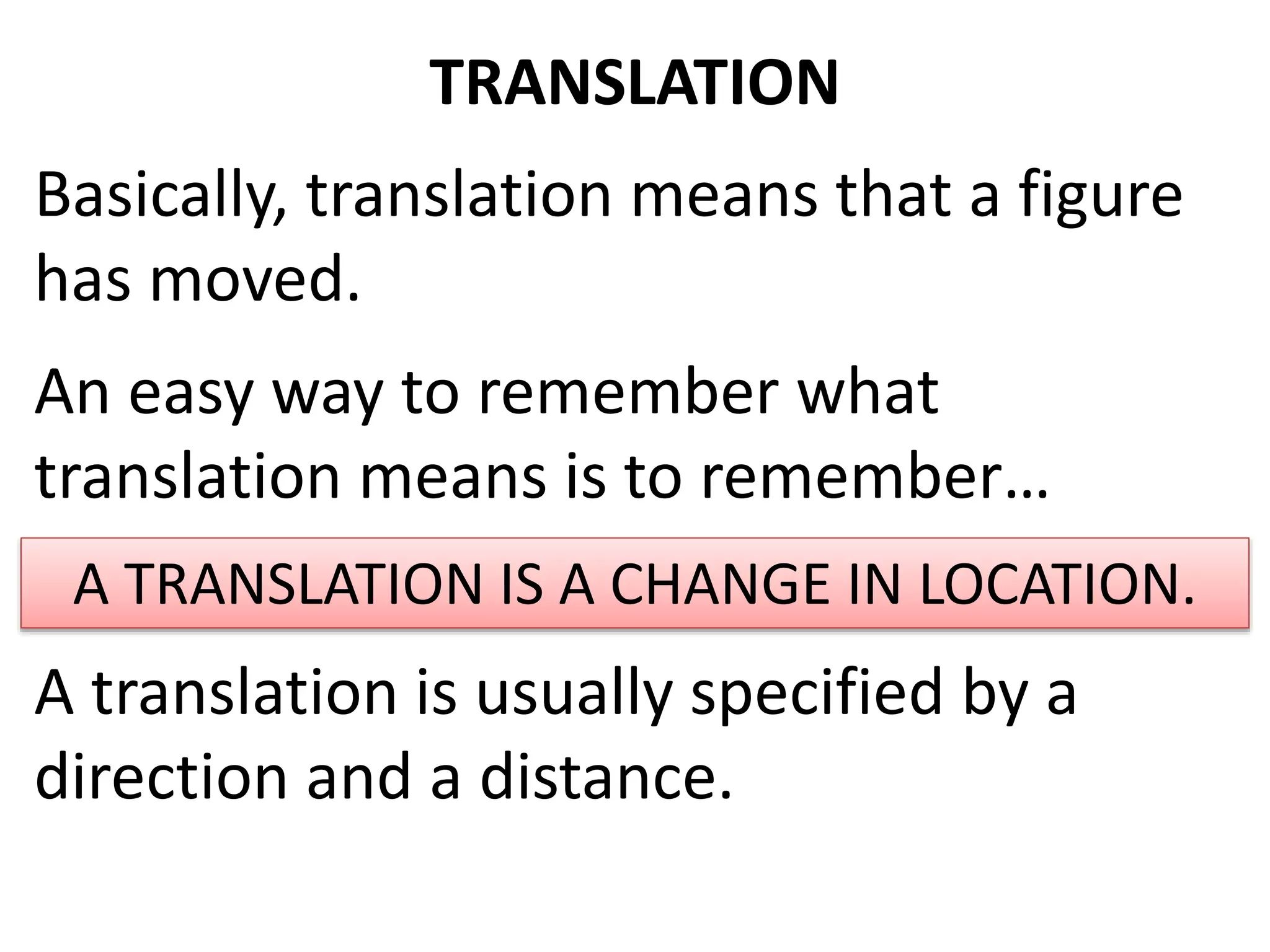
Basically, translation means that a figure 
has moved. 
An easy way to remember what 
translation means is to remember… 
A TRANSLATION IS A CHANGE IN LOCATION. 
A translation is usually specified by a 
direction and a distance.
TRANSLATION 
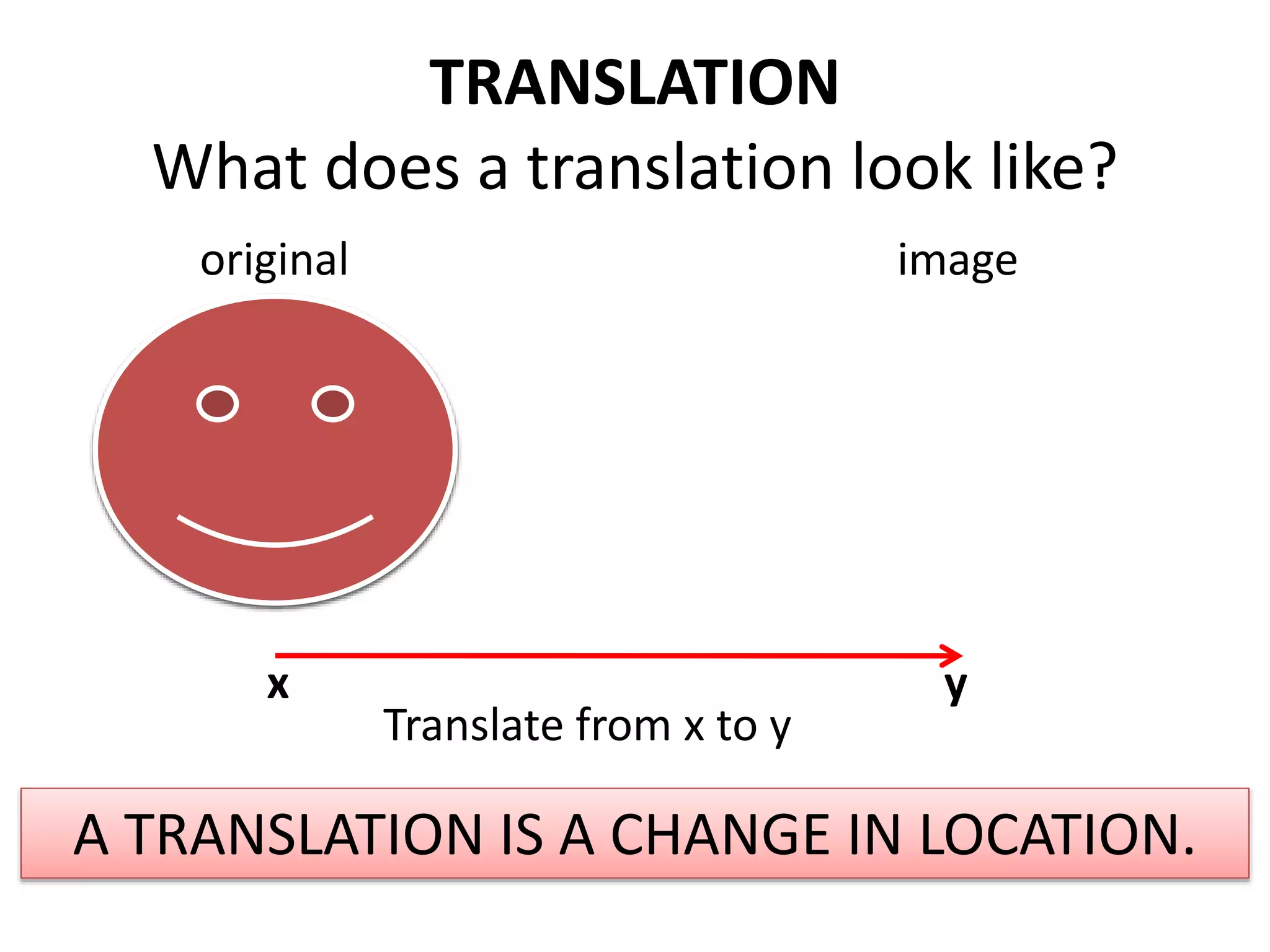
What does a translation look like? 
original image 
x y 
Translate from x to y 
A TRANSLATION IS A CHANGE IN LOCATION.
TRANSLATION 
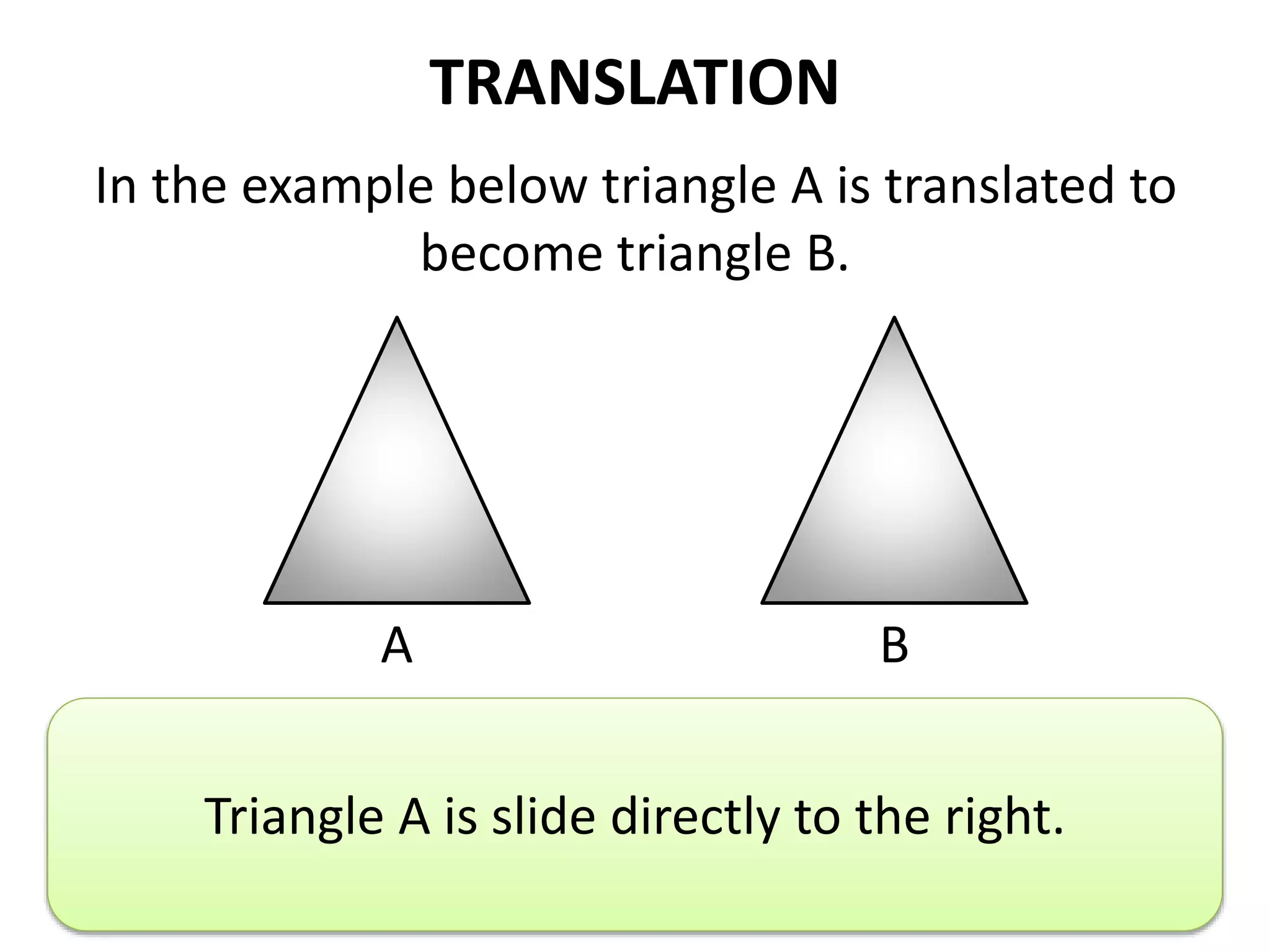
In the example below triangle A is translated to 
become triangle B. 
A B 
Describe the translation. 
Triangle A is slide directly to the right.
TRANSLATION 
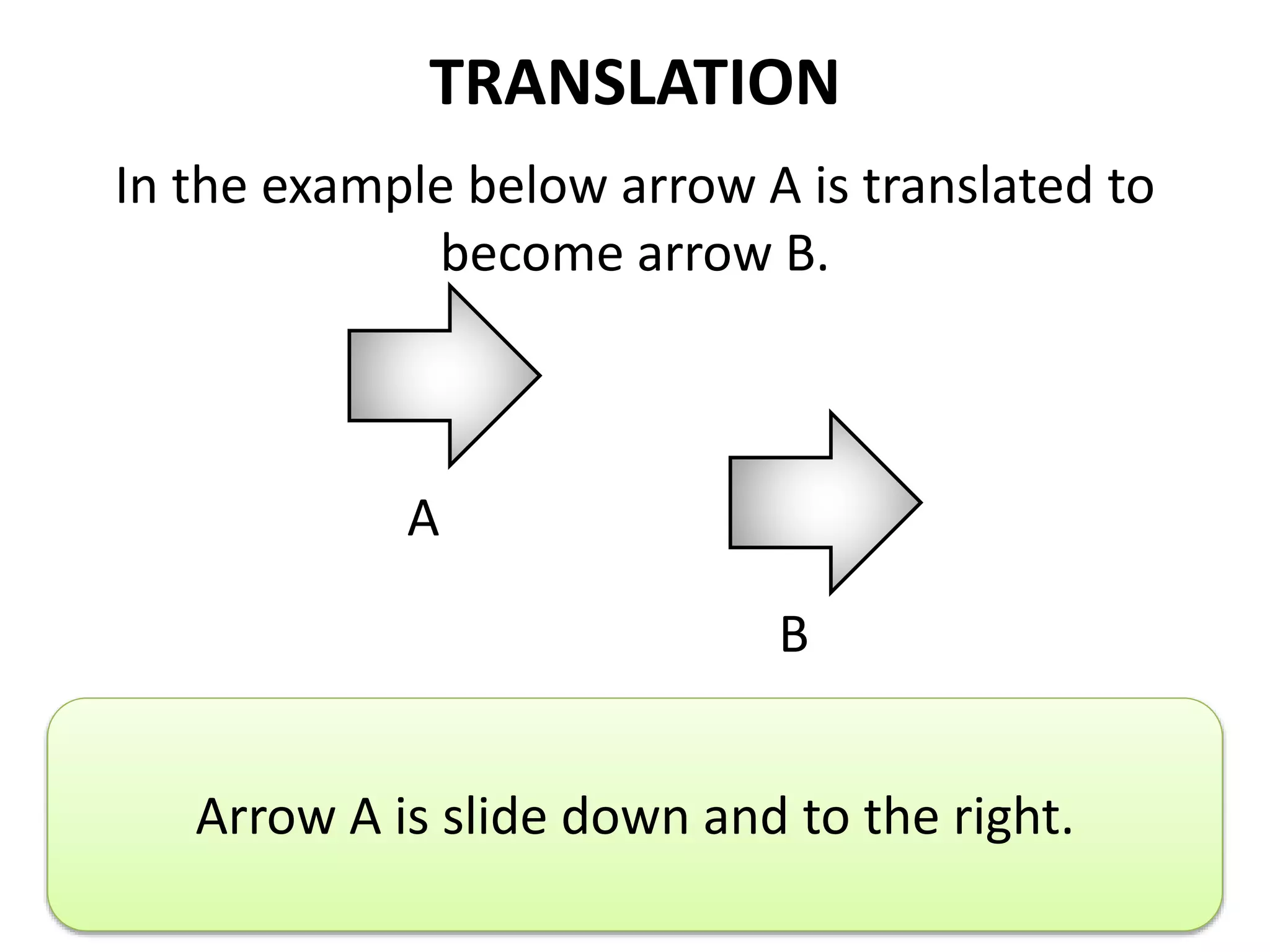
In the example below arrow A is translated to 
become arrow B. 
A 
B 
Describe the translation. 
Arrow A is slide down and to the right.
ROTATION
ROTATION 
A rotation is a transformation that turns a 
figure about (around) a point or a line. 
Basically, rotation means to spin a shape. 
The point a figure turns around is called 
the center of rotation. 
The center of rotation can be on or 
outside the shape.
ROTATION 
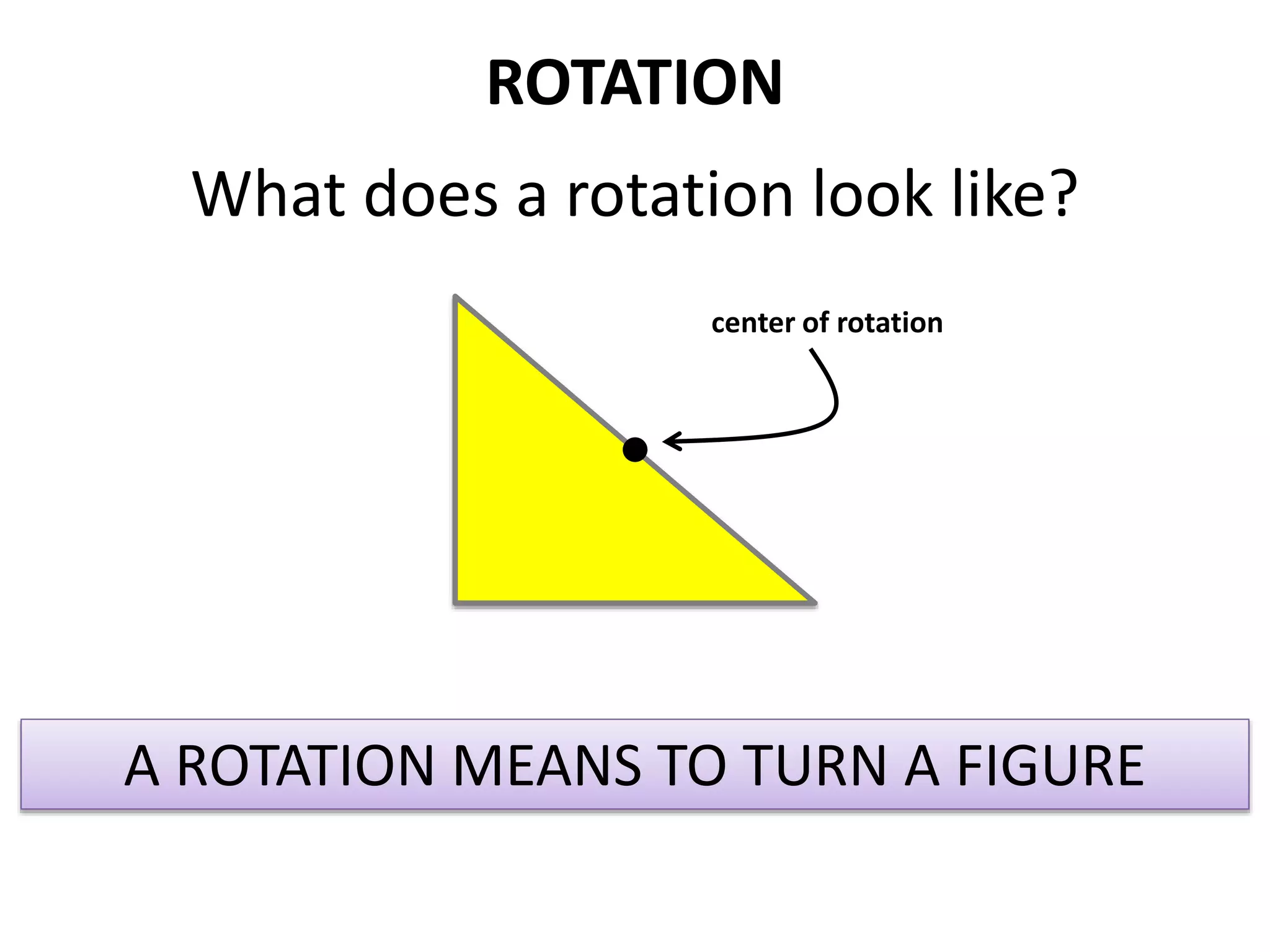
What does a rotation look like? 
center of rotation 
A ROTATION MEANS TO TURN A FIGURE
ROTATION 
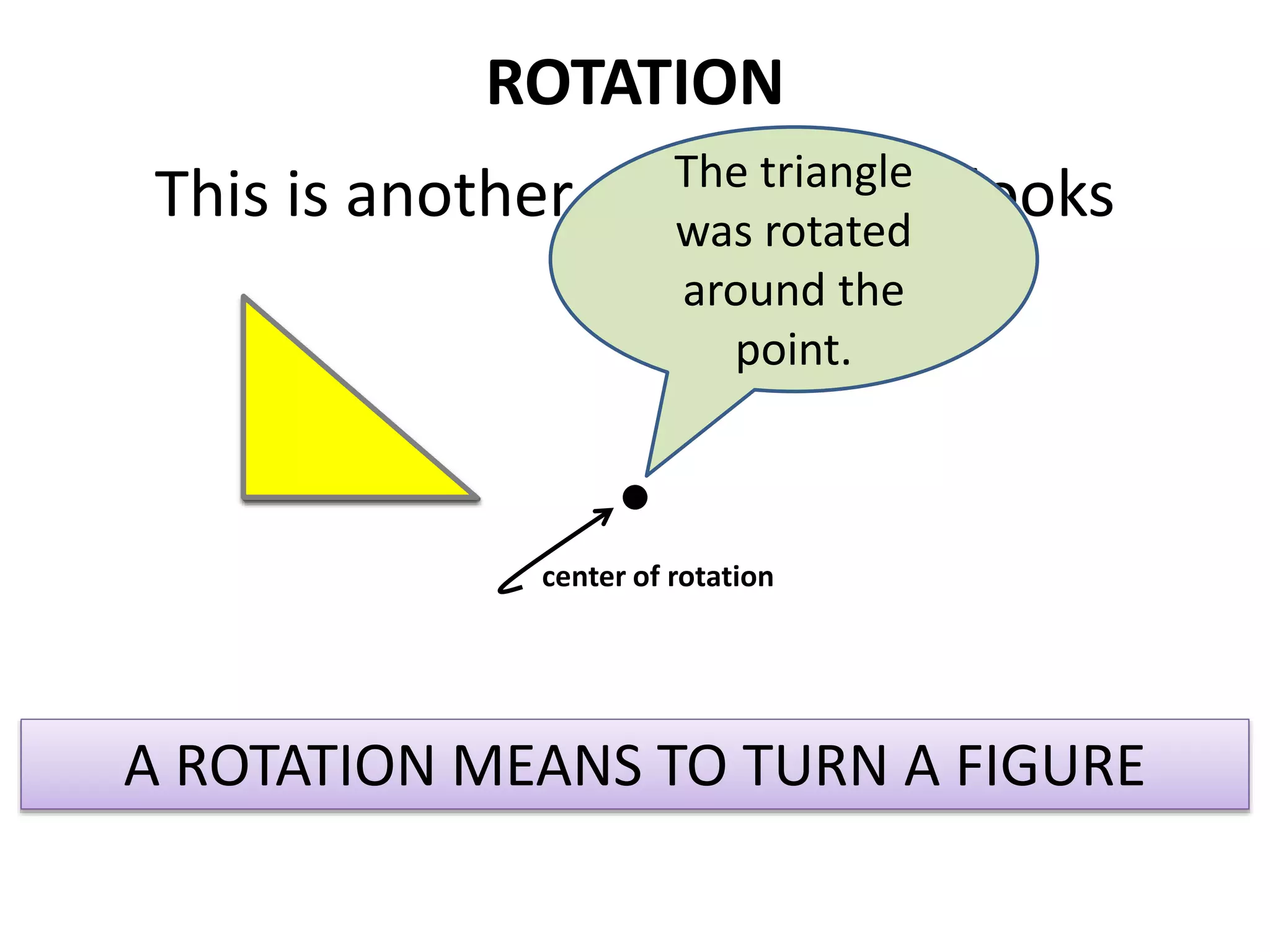
The triangle 
was rotated 
around the 
This is another way rotation looks 
point. 
center of rotation 
A ROTATION MEANS TO TURN A FIGURE
ROTATION 
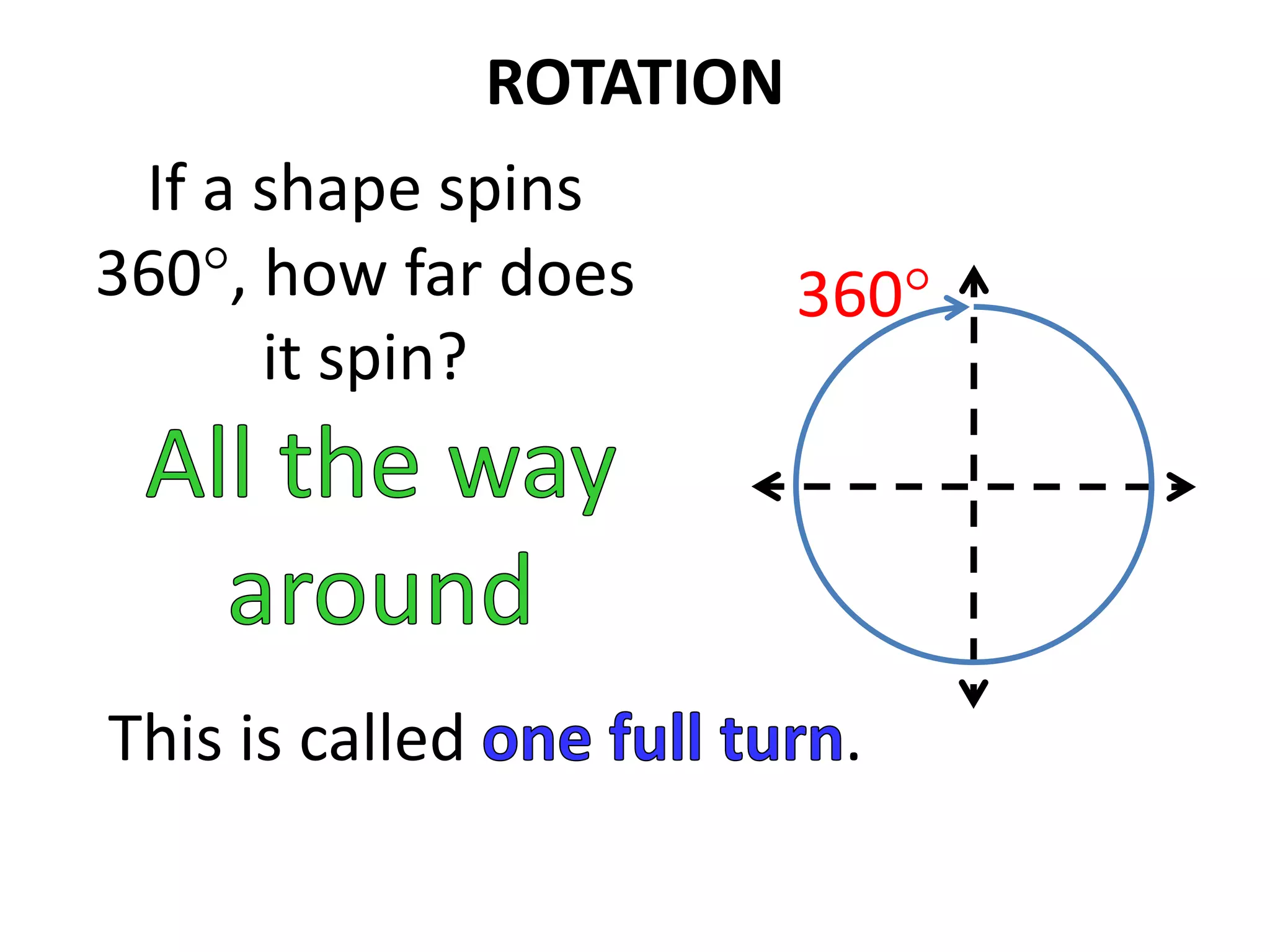
If a shape spins 
360, how far does 
it spin? 
360 
This is called .
ROTATION 
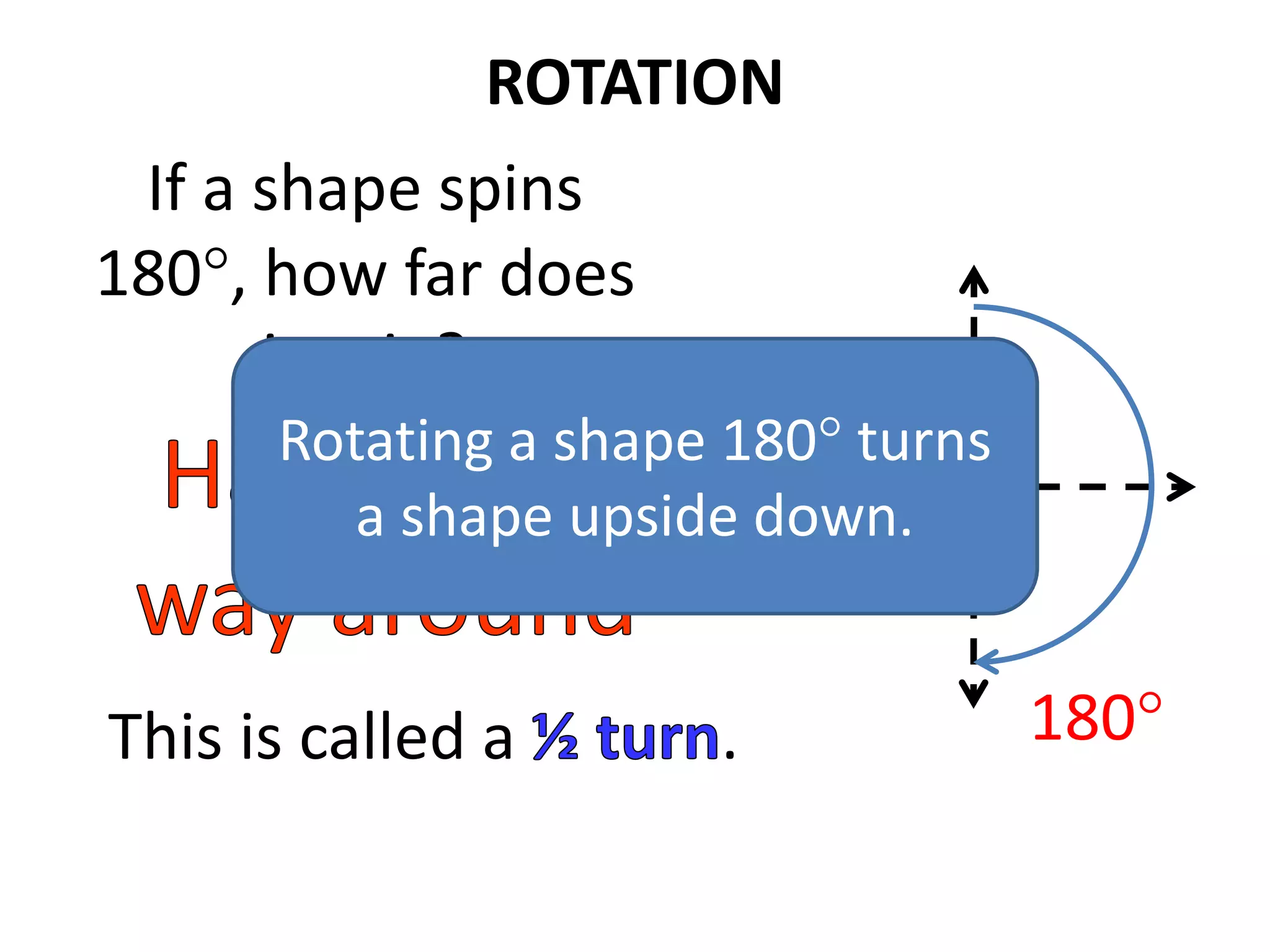
If a shape spins 
180, how far does 
it spin? 
Rotating a shape 180 turns 
a shape upside down. 
This is called a . 180
ROTATION 
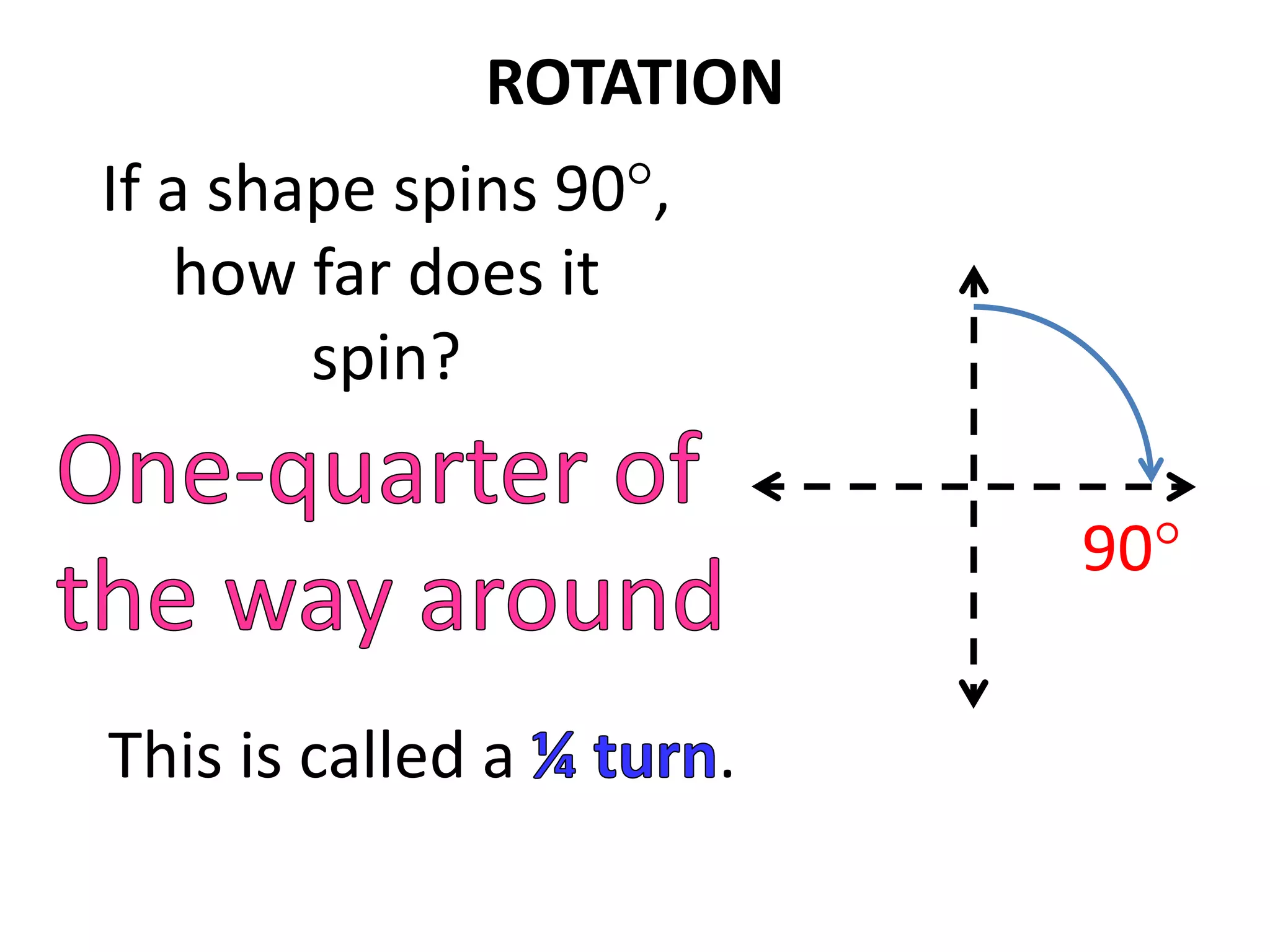
If a shape spins 90, 
how far does it 
spin? 
This is called a . 
90
ROTATION 
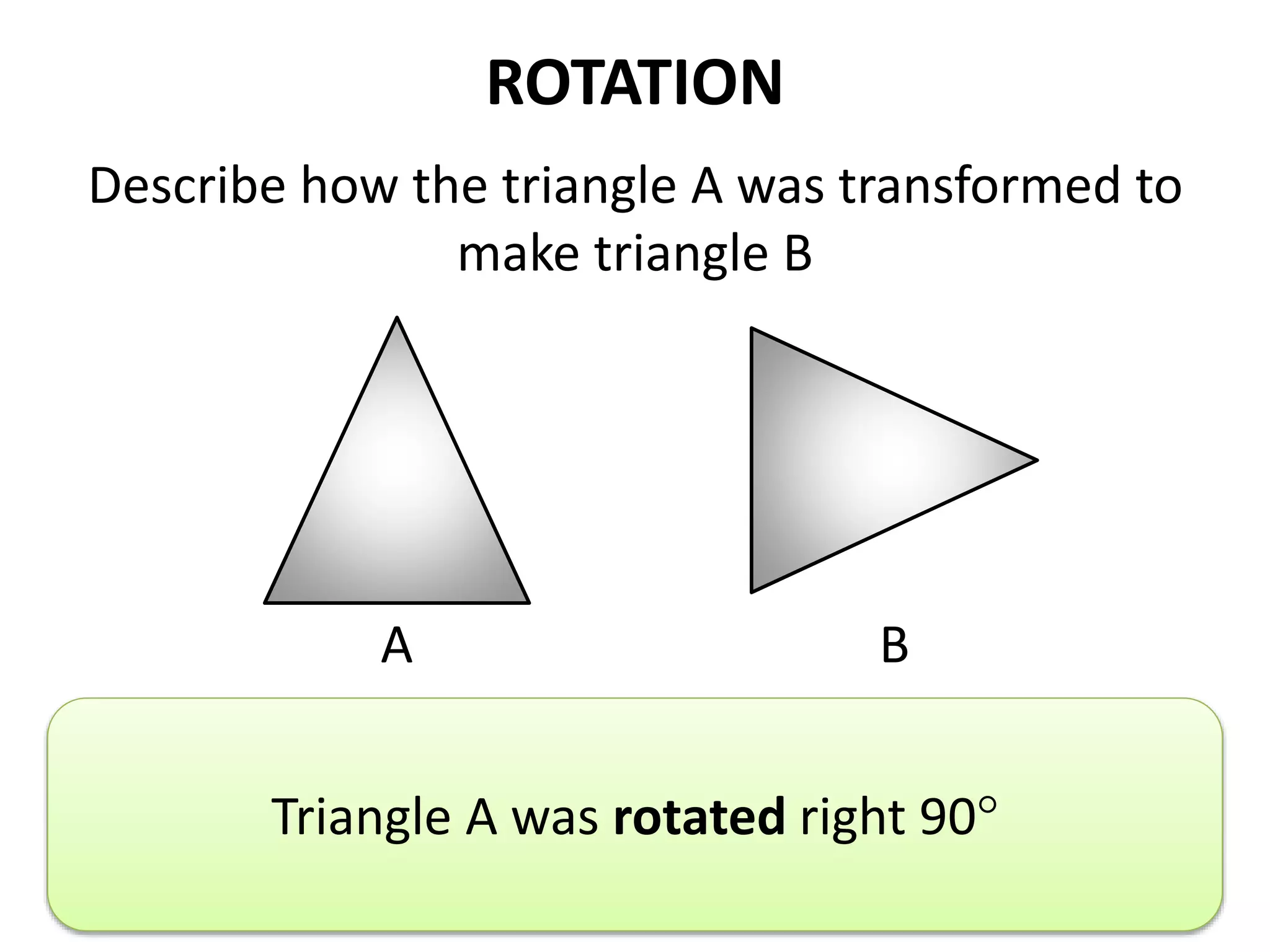
Describe how the triangle A was transformed to 
make triangle B 
A B 
Describe the translation. 
Triangle A was rotated right 90
ROTATION 
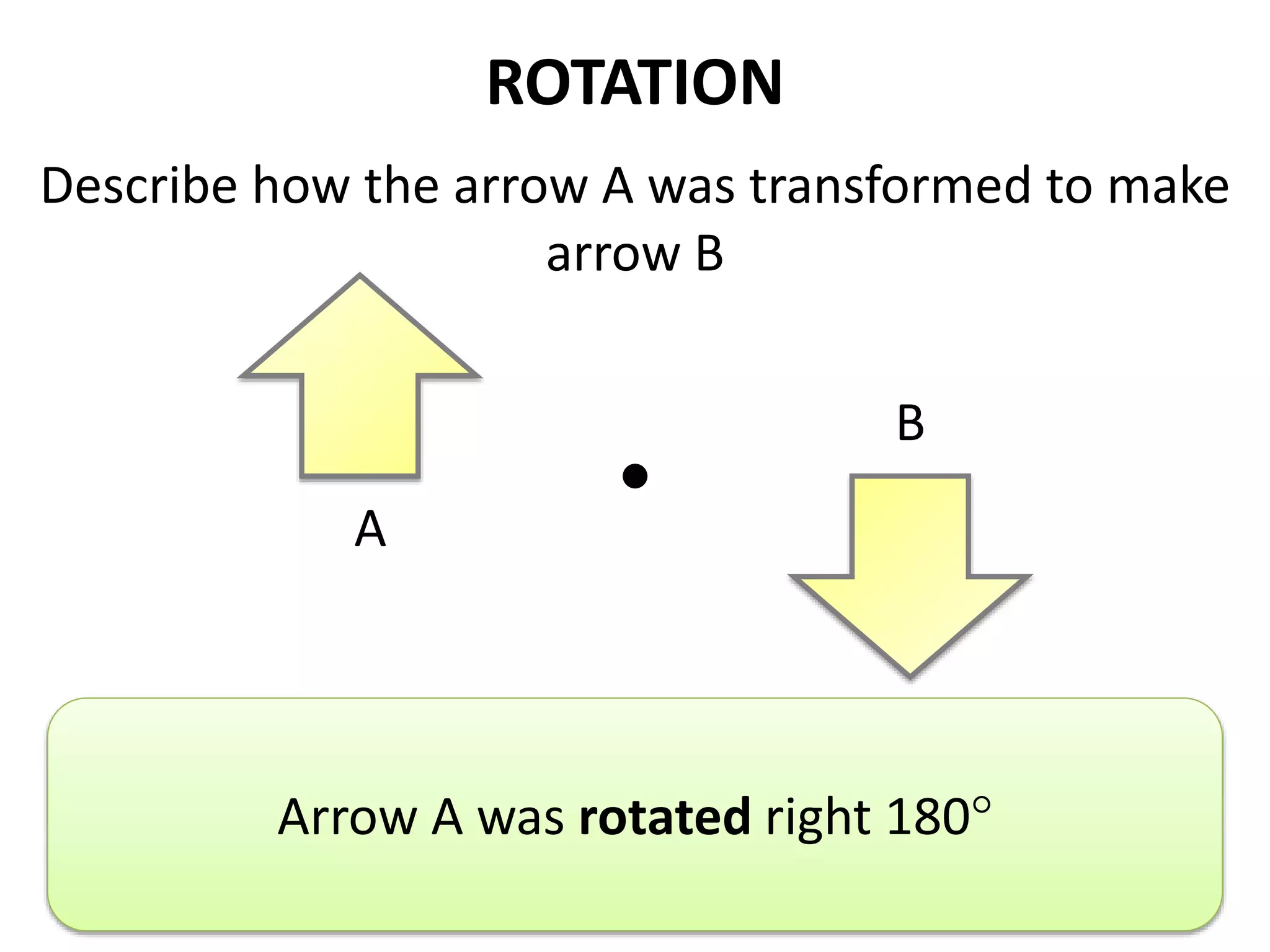
Describe how the arrow A was transformed to make 
arrow B 
A 
B 
Describe the translation. 
Arrow A was rotated right 180
ROTATION 
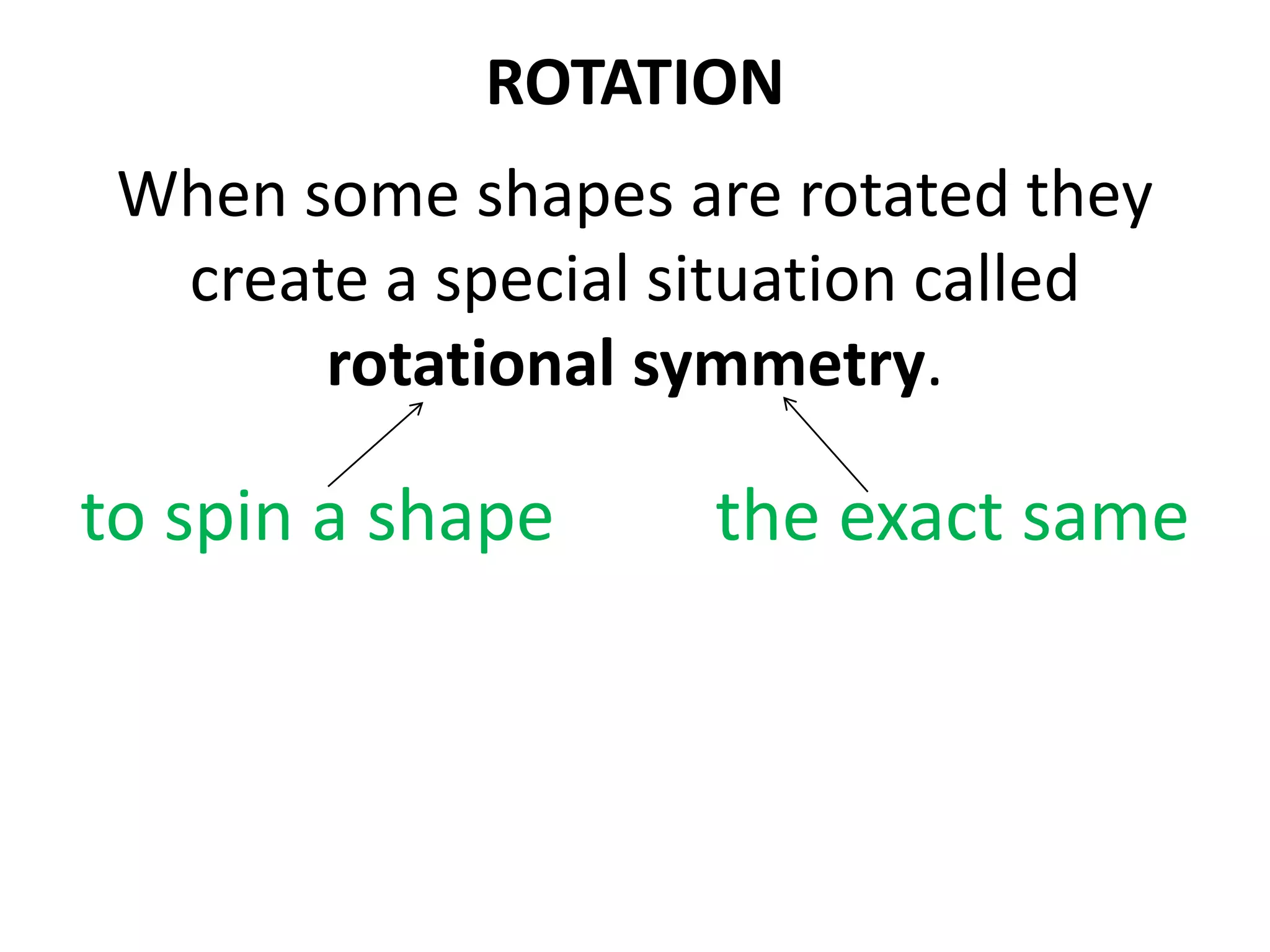
When some shapes are rotated they 
create a special situation called 
rotational symmetry. 
to spin a shape the exact same
ROTATIONAL SYMMETRY 
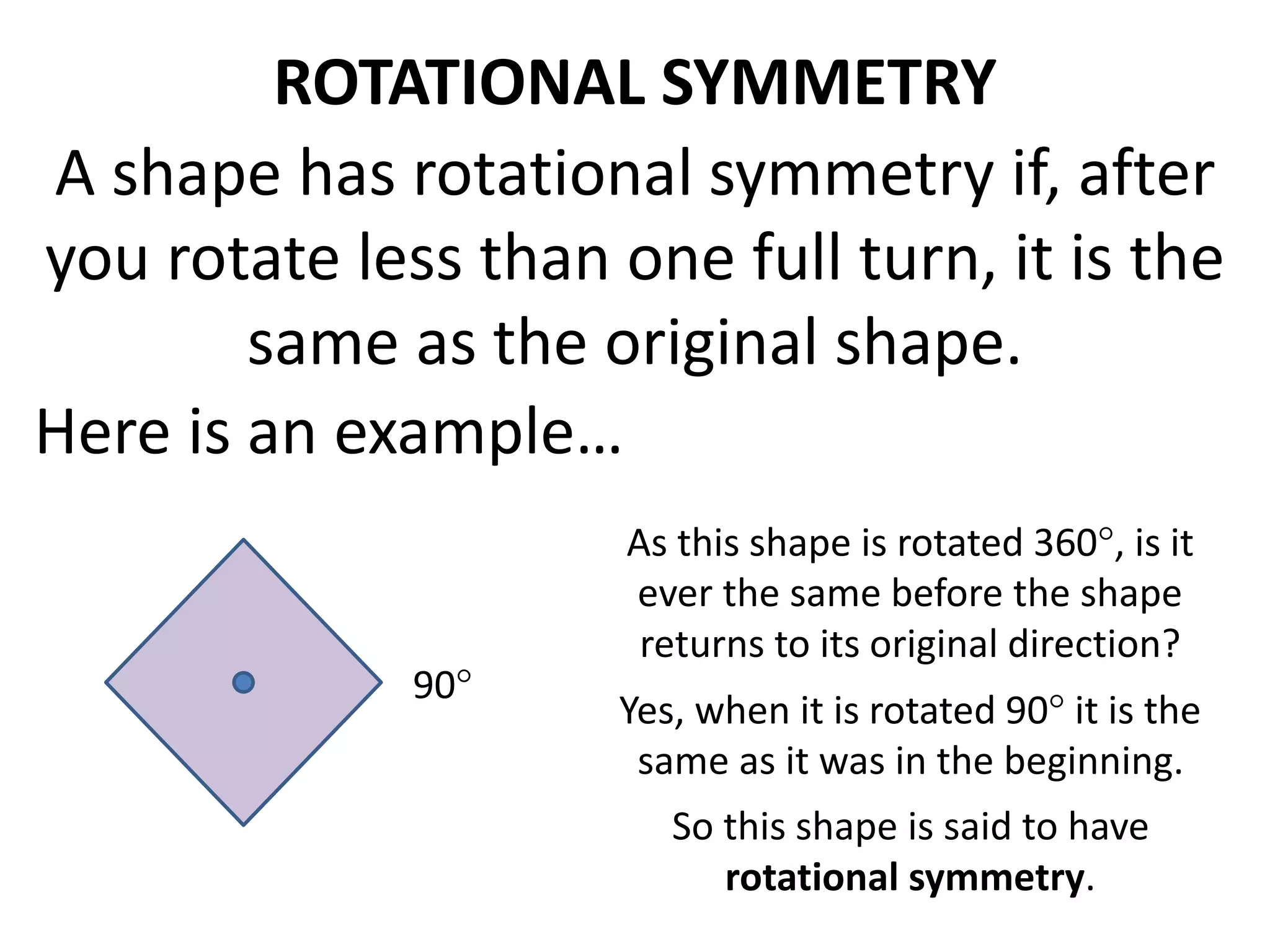
A shape has rotational symmetry if, after 
you rotate less than one full turn, it is the 
same as the original shape. 
Here is an example… 
As this shape is rotated 360, is it 
ever the same before the shape 
returns to its original direction? 
Yes, when it is rotated 90 it is the 
same as it was in the beginning. 
So this shape is said to have 
rotational symmetry. 
90
ROTATIONAL SYMMETRY 
A shape has rotational symmetry if, after 
you rotate less than one full turn, it is the 
same as the original shape. 
Here is another example… 
As this shape is rotated 360, is it 
ever the same before the shape 
returns to its original direction? 
Yes, when it is rotated 180 it is the 
same as it was in the beginning. 
So this shape is said to have 
180 rotational symmetry.
ROTATIONAL SYMMETRY 
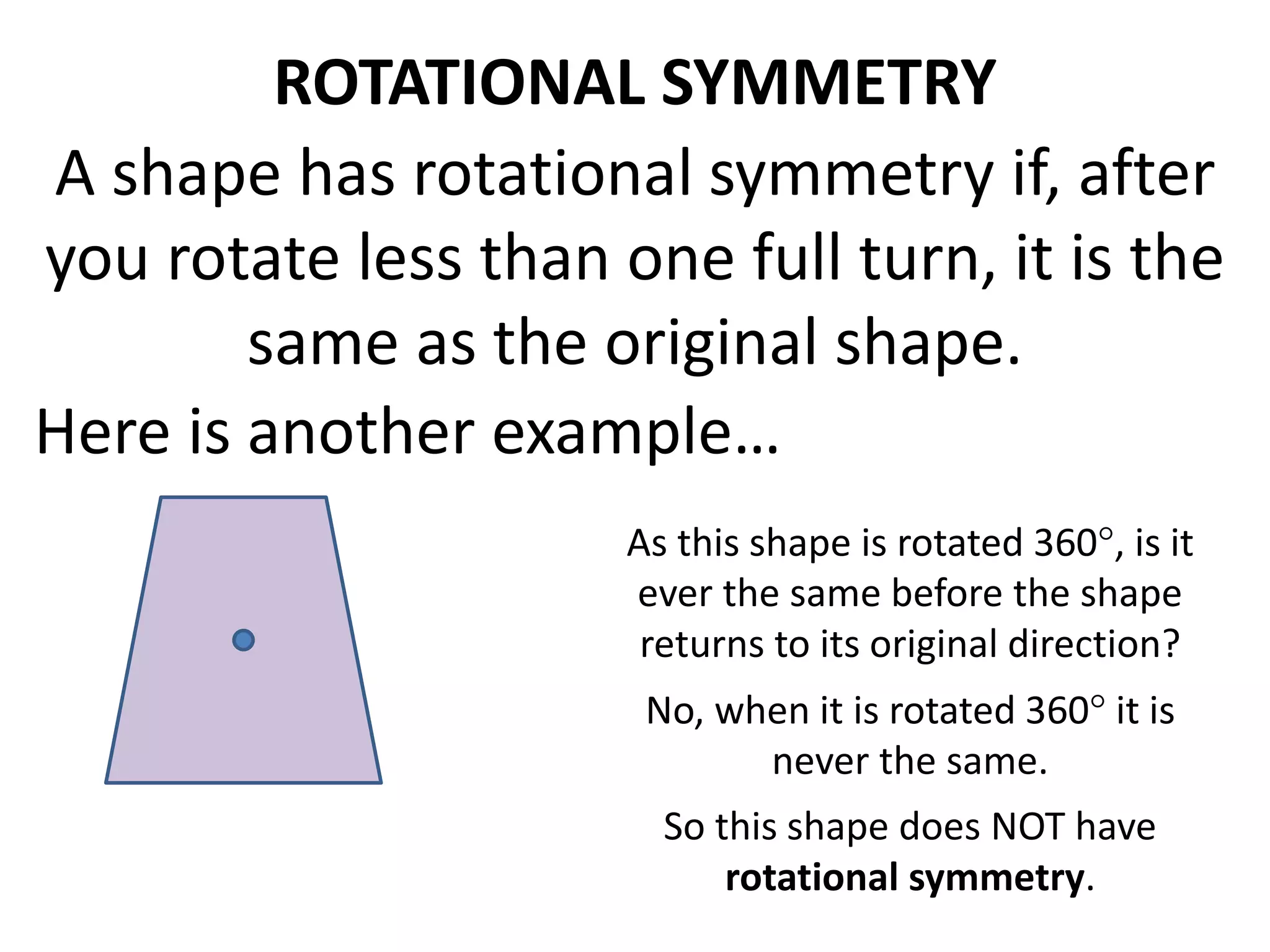
A shape has rotational symmetry if, after 
you rotate less than one full turn, it is the 
same as the original shape. 
Here is another example… 
As this shape is rotated 360, is it 
ever the same before the shape 
returns to its original direction? 
No, when it is rotated 360 it is 
never the same. 
So this shape does NOT have 
rotational symmetry.
ROTATION SYMMETRY 
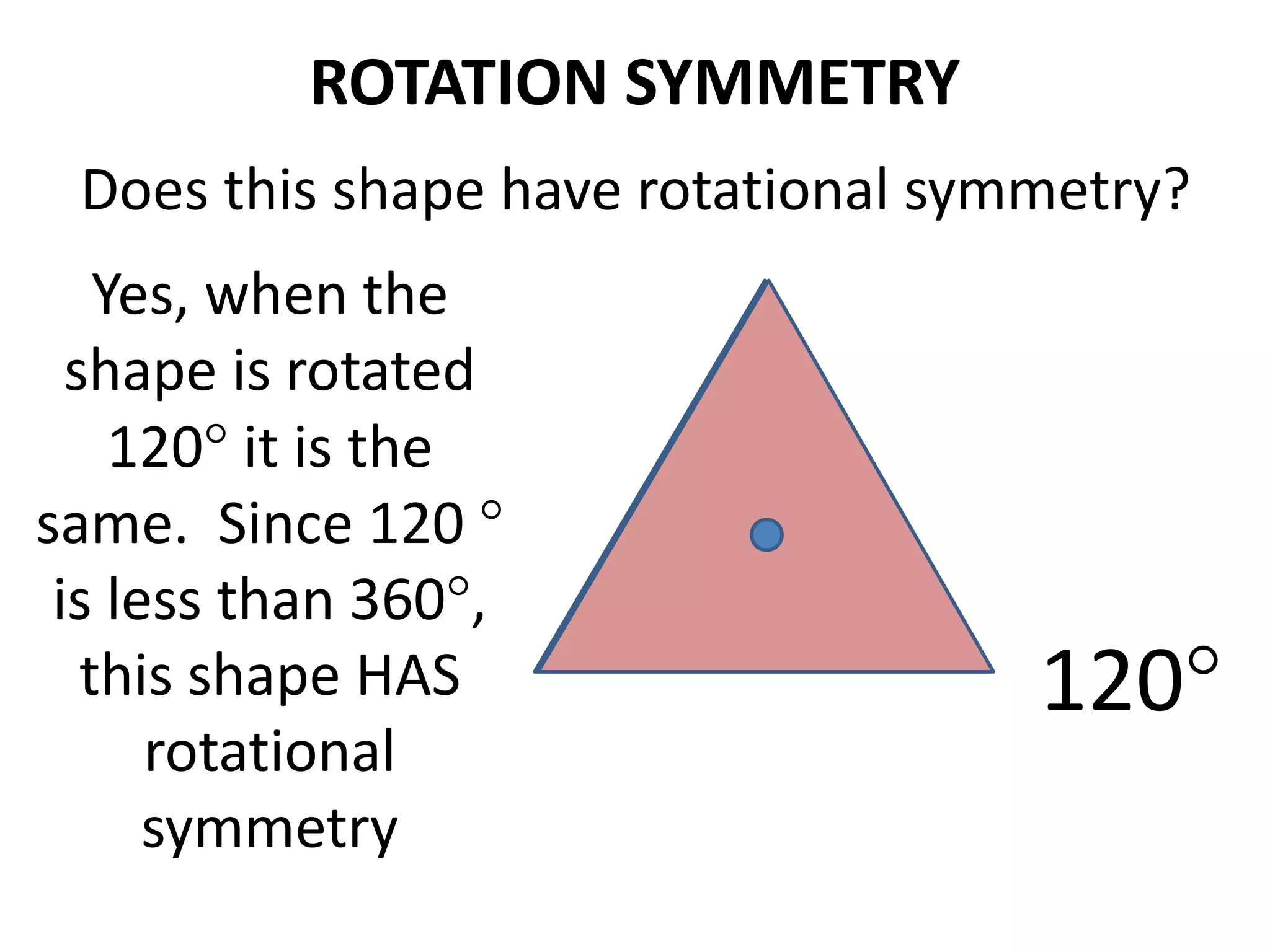
Does this shape have rotational symmetry? 
120 
Yes, when the 
shape is rotated 
120 it is the 
same. Since 120  
is less than 360, 
this shape HAS 
rotational 
symmetry
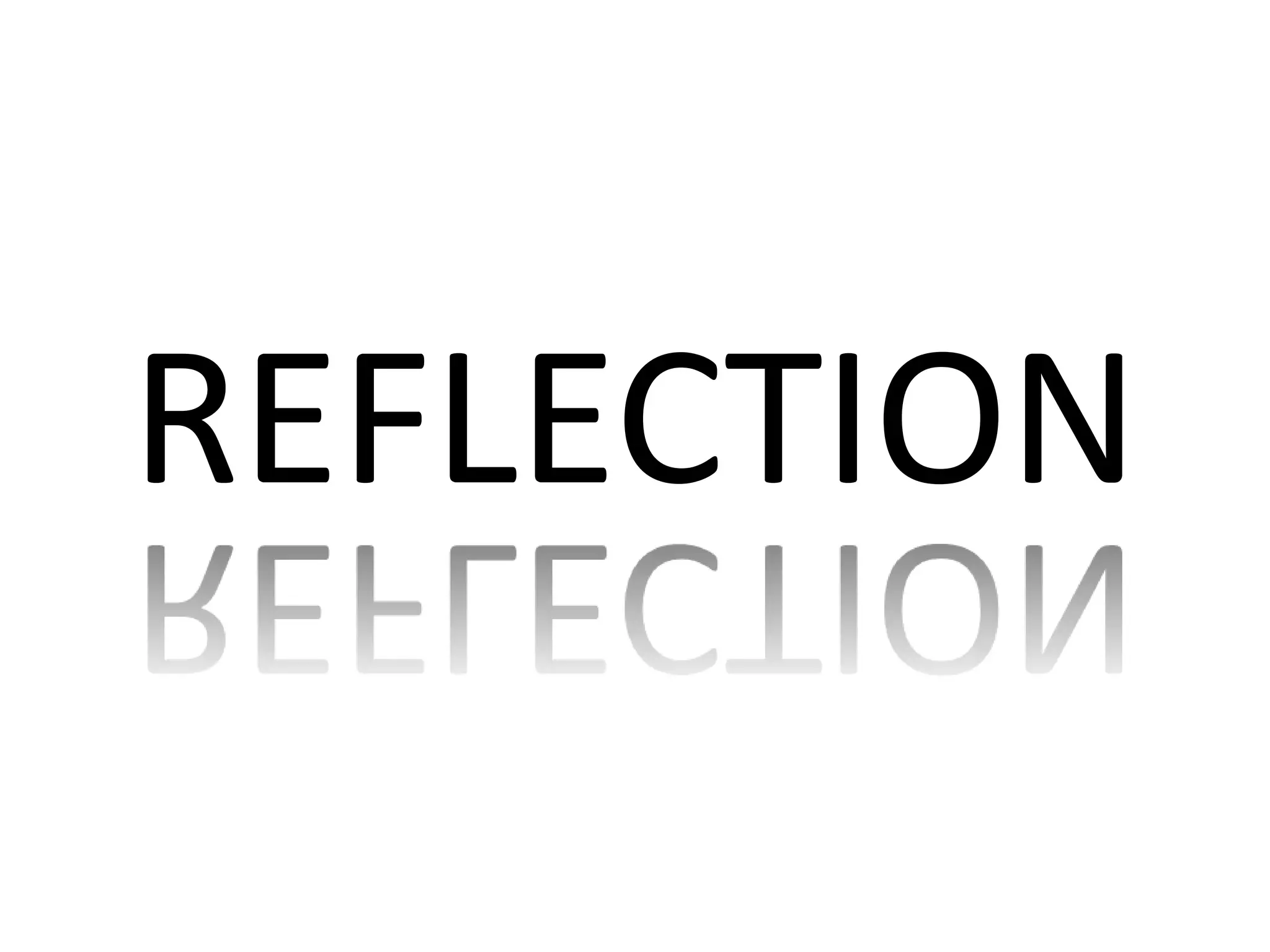
RREEFFLLEECCTTIIOONN
REFLECTION 
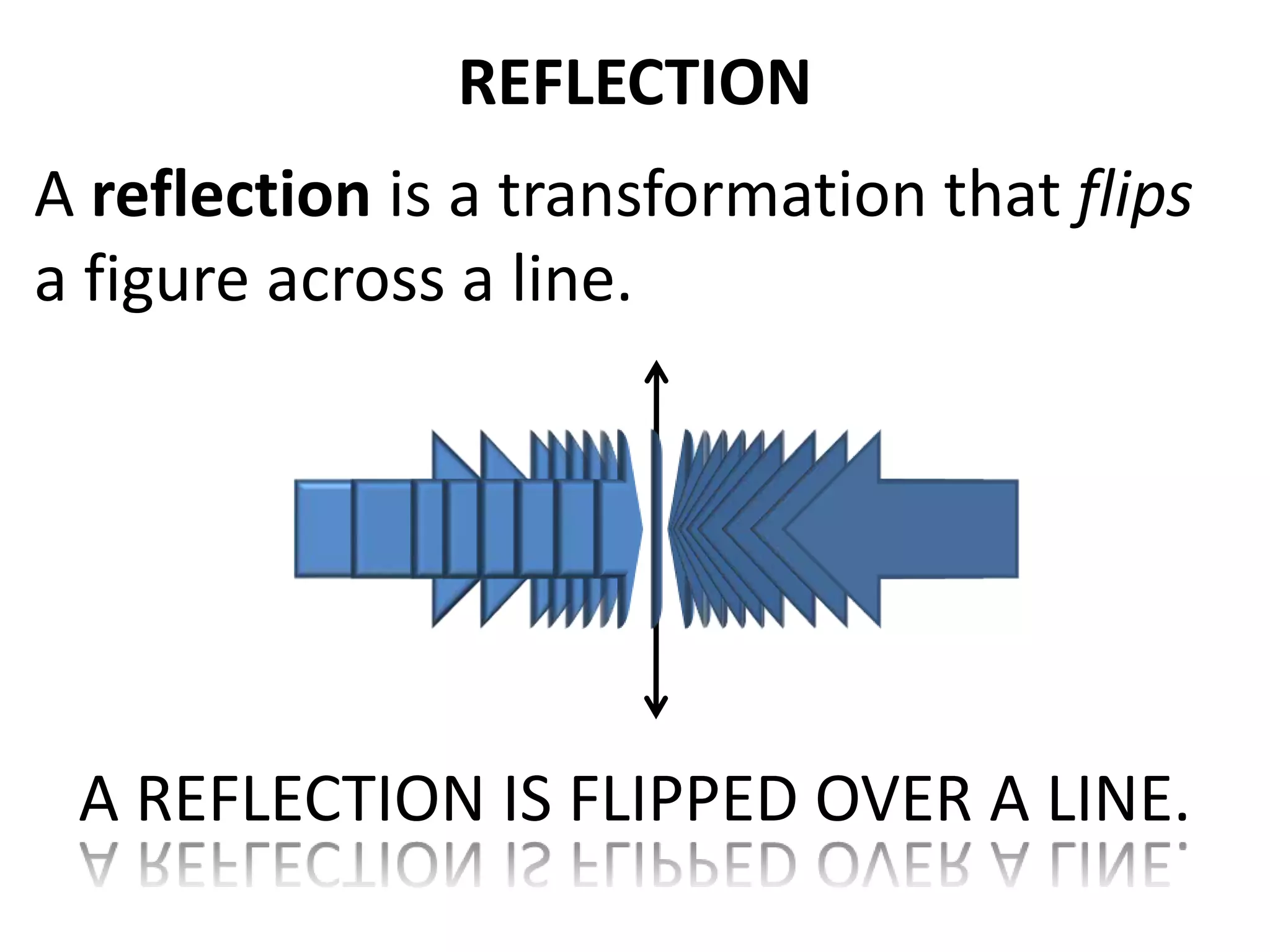
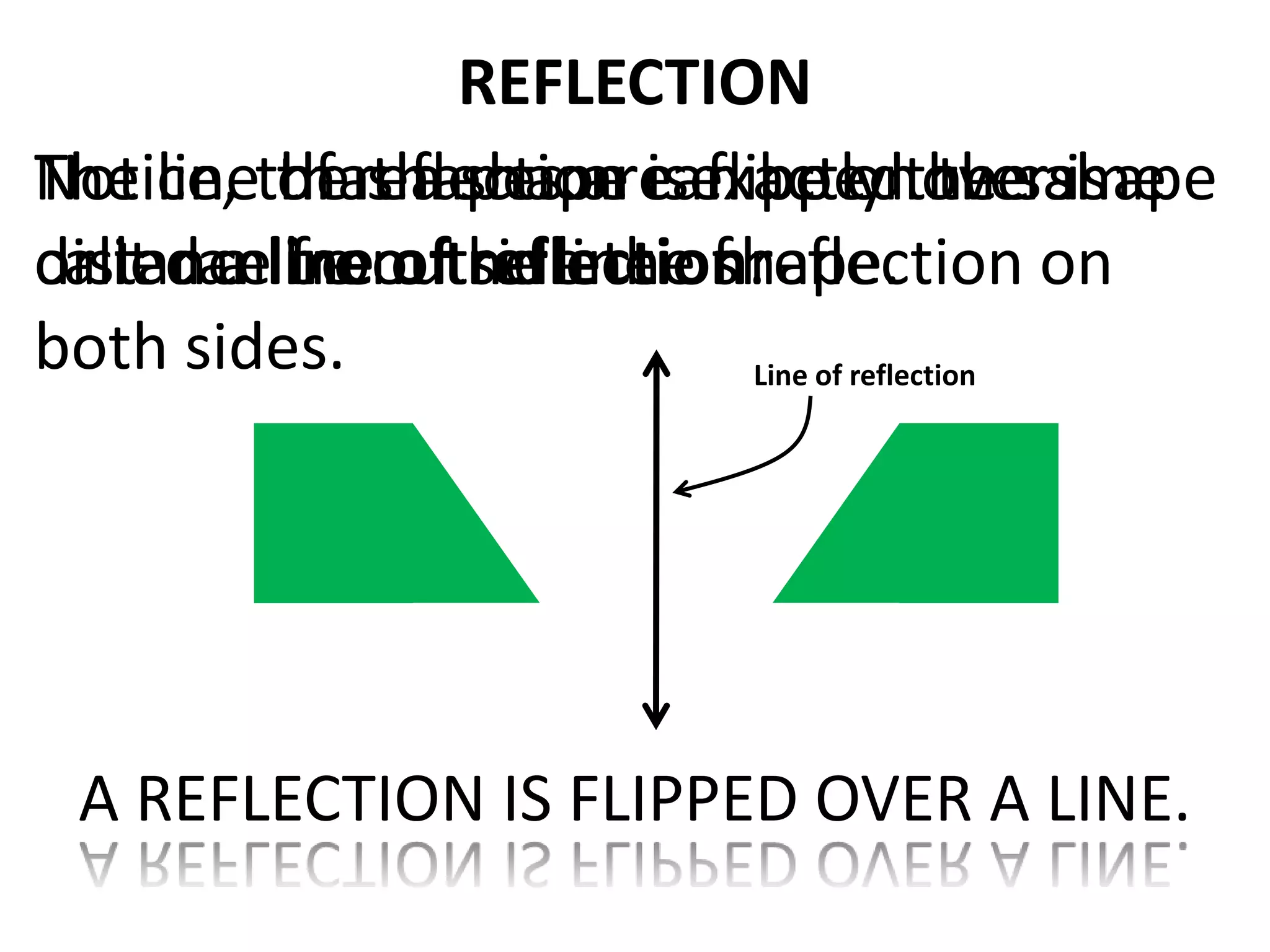
A reflection is a transformation that flips 
a figure across a line. 
A REFLECTION IS FLIPPED OVER A LINE.
REFLECTION 
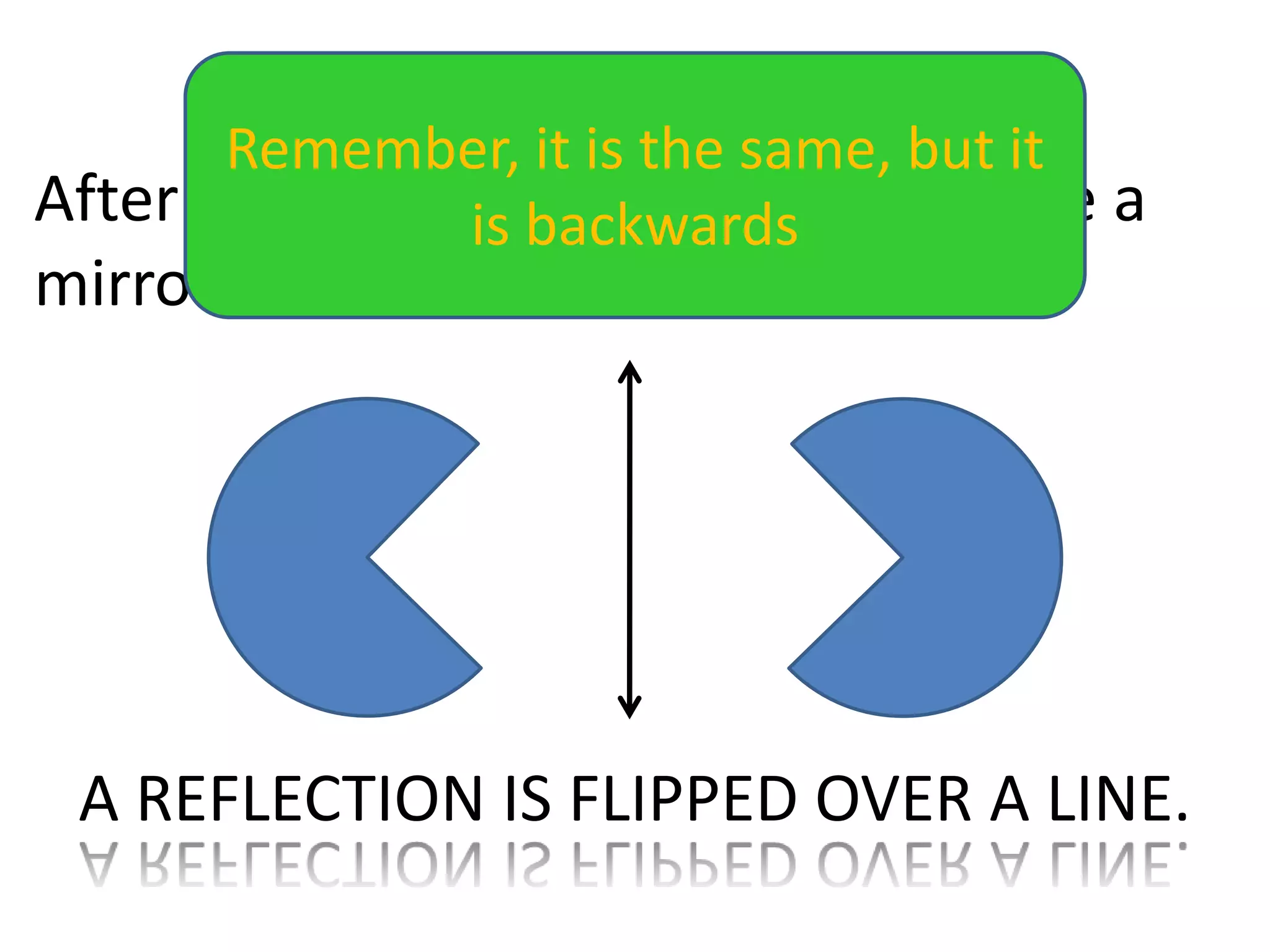
Remember, it is the same, but it 
After a shape is is reflected, backwards 
it looks like a 
mirror image of itself. 
A REFLECTION IS FLIPPED OVER A LINE.
REFLECTION 
Notice, The line the that shapes a shape are is exactly flipped the over same 
is 
distance called a line from of the reflection. 
line of reflection on 
both sides. 
of reflection can be on the shape 
or it can be outside the shape. 
Line of reflection 
A REFLECTION IS FLIPPED OVER A LINE.
REFLECTION 
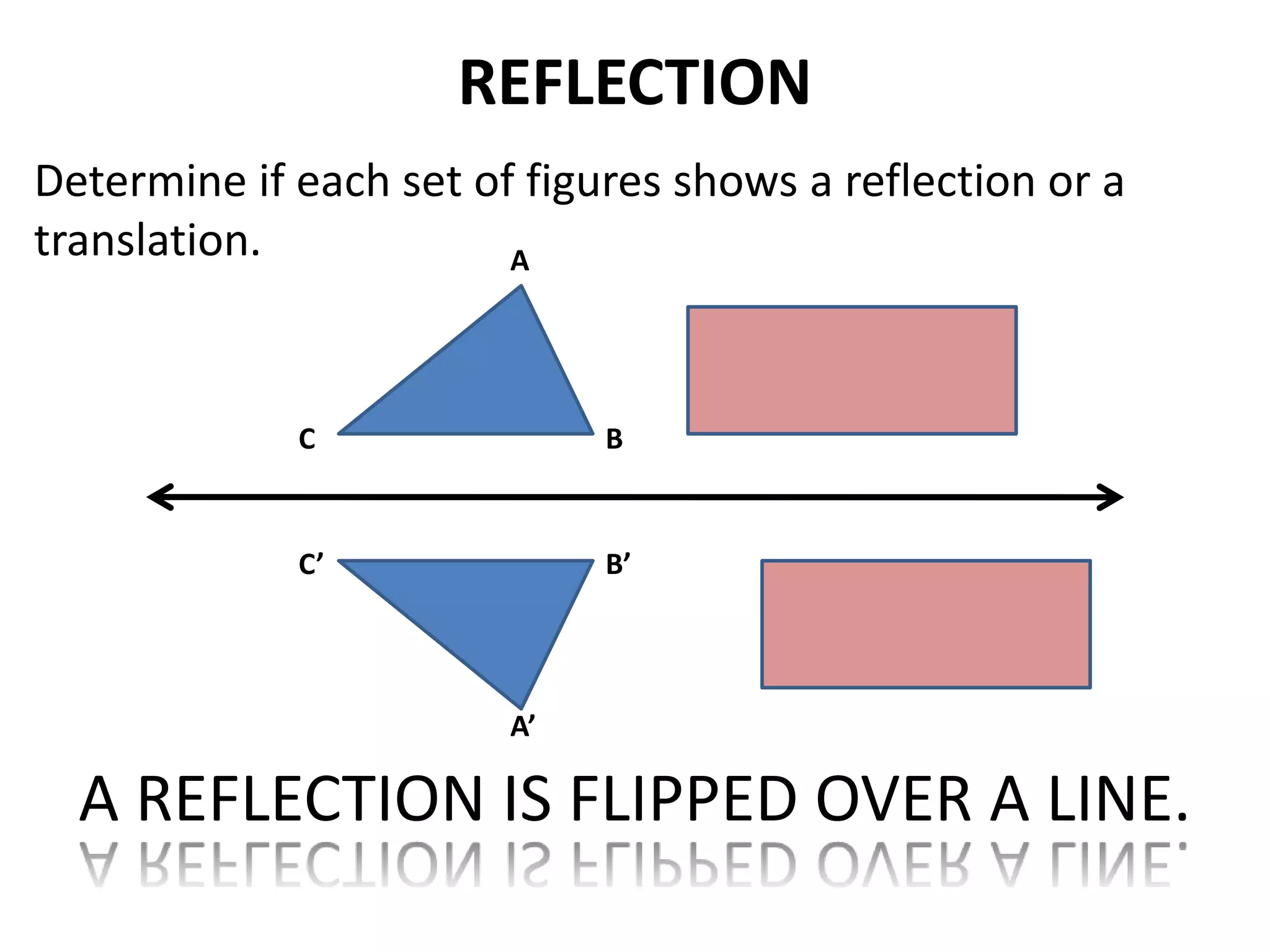
Determine if each set of figures shows a reflection or a 
translation. 
A 
C B 
C’ B’ 
A’ 
A REFLECTION IS FLIPPED OVER A LINE.
REFLECTION 
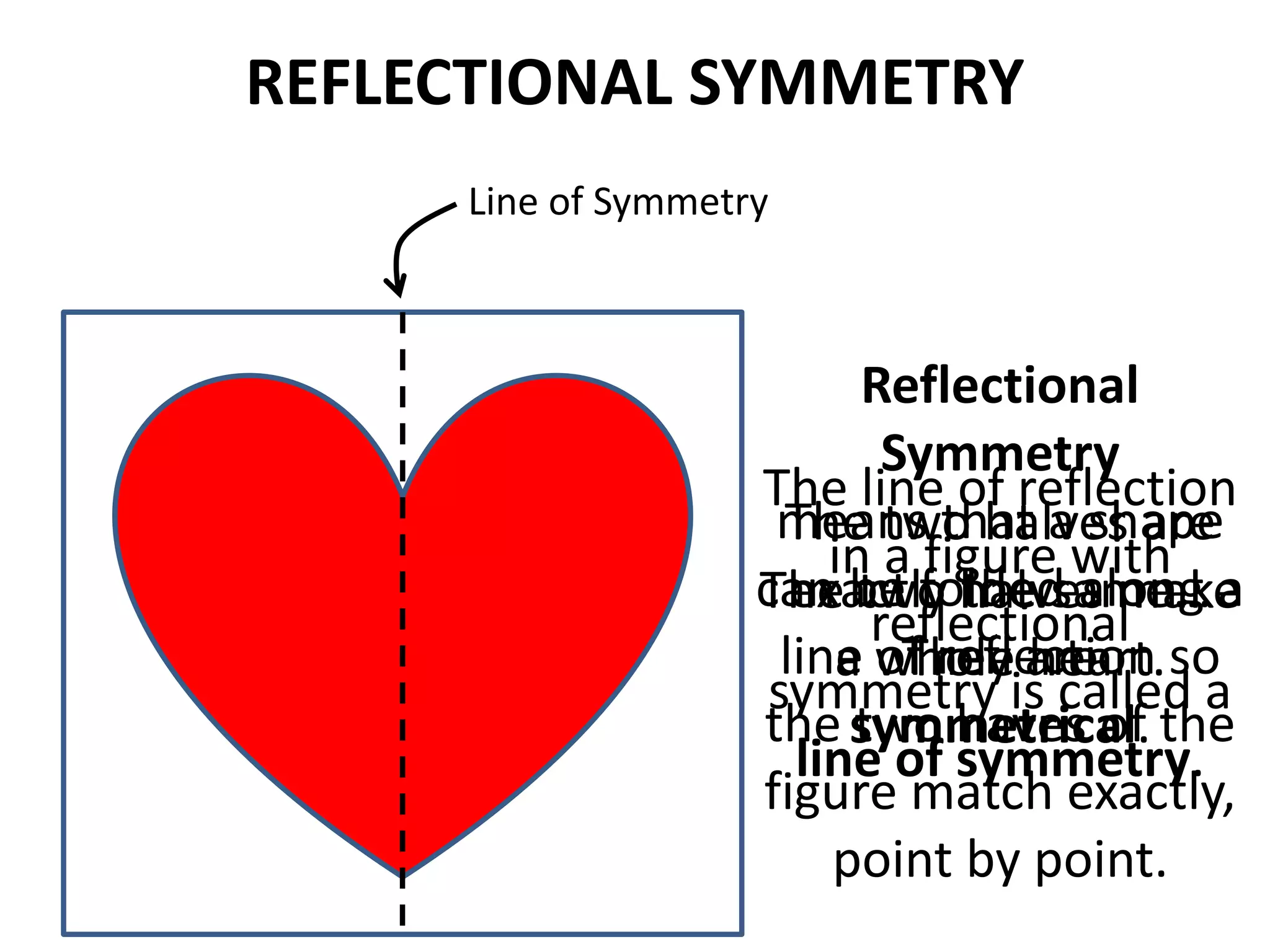
Sometimes, a figure has 
reflectional symmetry. 
This means that it can be folded along a line of 
reflection within itself so that the two halves of the 
figure match exactly, point by point. 
Basically, if you can fold a shape in half and it 
matches up exactly, it has reflectional symmetry.
REFLECTIONAL SYMMETRY 
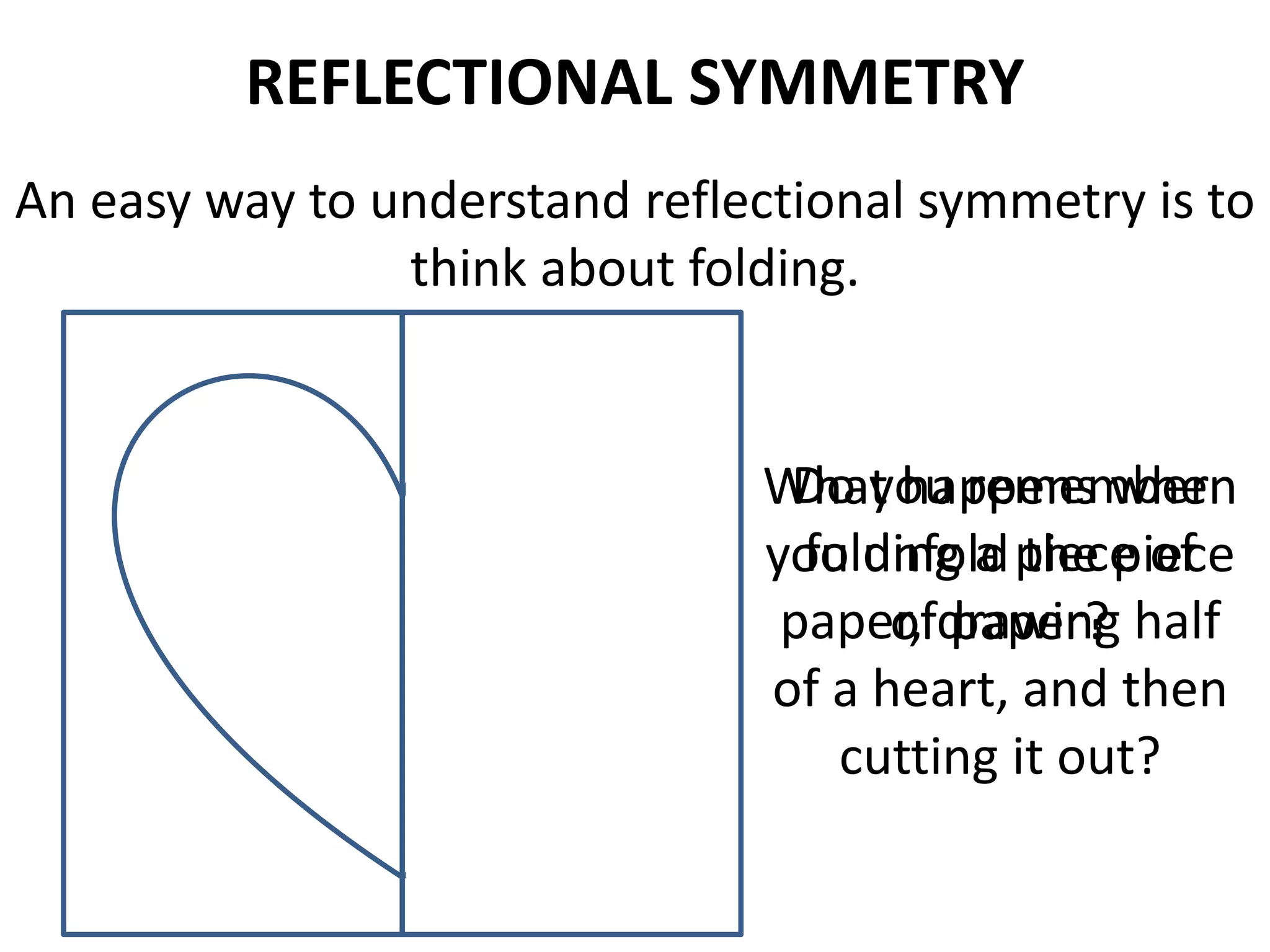
An easy way to understand reflectional symmetry is to 
think about folding. 
Do you remember 
folding a piece of 
paper, drawing half 
of a heart, and then 
What happens when 
you unfold the piece 
of paper? 
cutting it out?
REFLECTIONAL SYMMETRY 
Reflectional 
Symmetry 
The line of reflection 
means The two that halves a shape 
are 
in a figure with 
can The exactly be two folded halves the same… 
along make 
a 
reflectional 
line a whole of They reflection are 
heart. 
so 
symmetry is called a 
the symmetrical. 
two haves of the 
line of symmetry. 
figure match exactly, 
point by point. 
Line of Symmetry
REFLECTIONAL SYMMETRY 
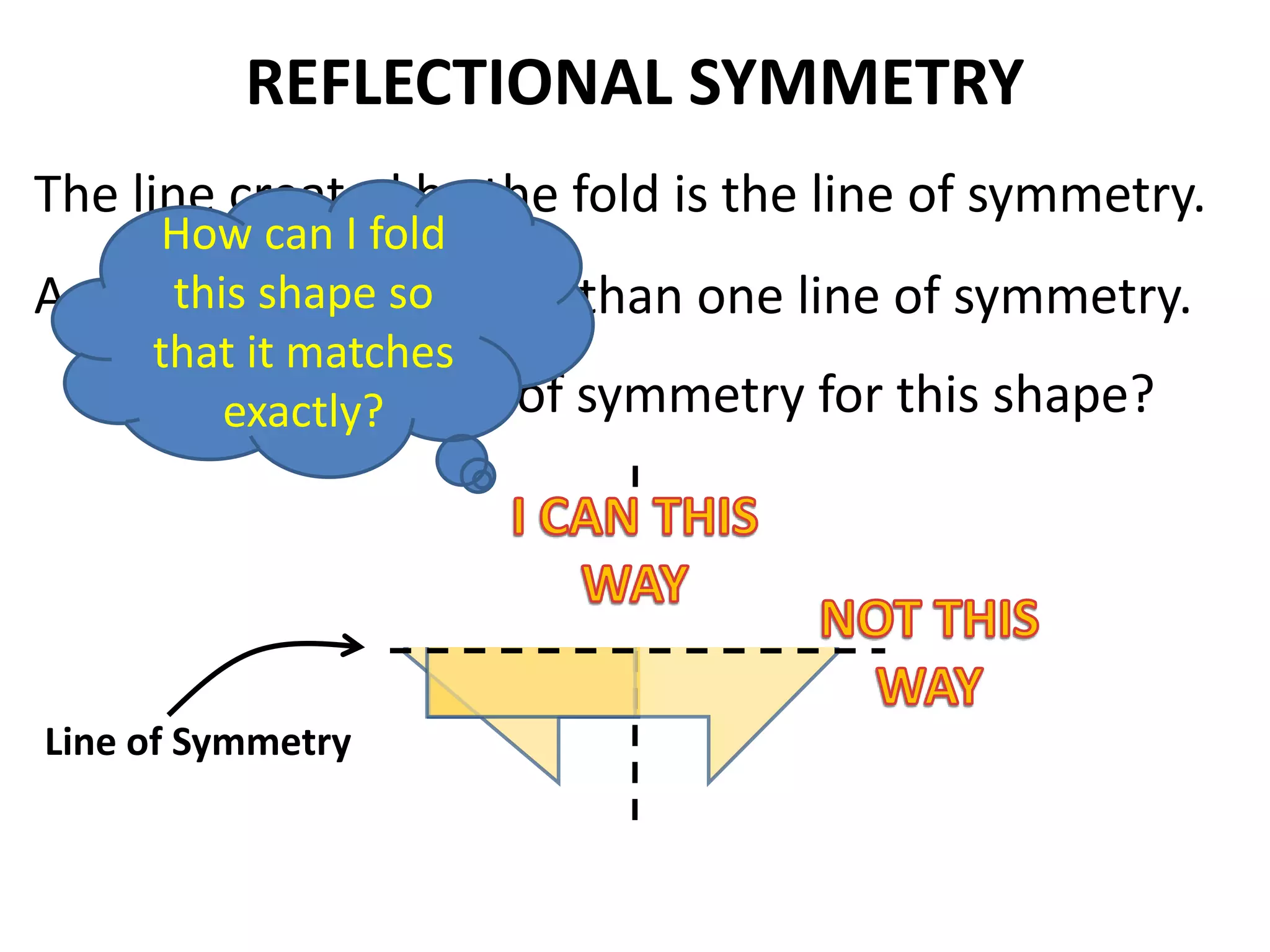
The line created by the fold is the line of symmetry. 
A shape can have more than one line of symmetry. 
How can I fold 
this shape so 
that it matches 
Where is the line of symmetry for this shape? 
exactly? 
Line of Symmetry
REFLECTIONAL SYMMETRY 
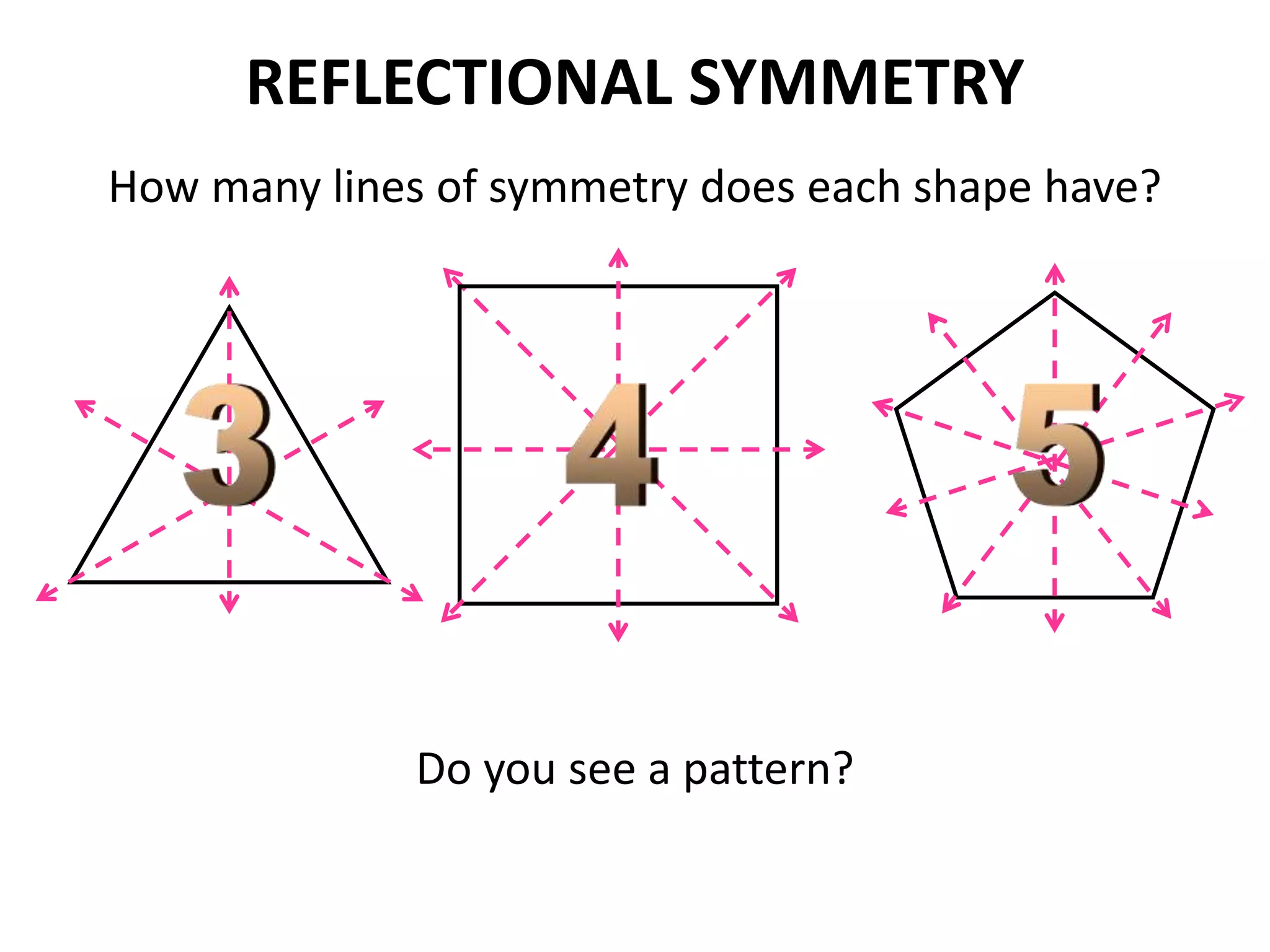
How many lines of symmetry does each shape have? 
Do you see a pattern?
REFLECTIONAL SYMMETRY 
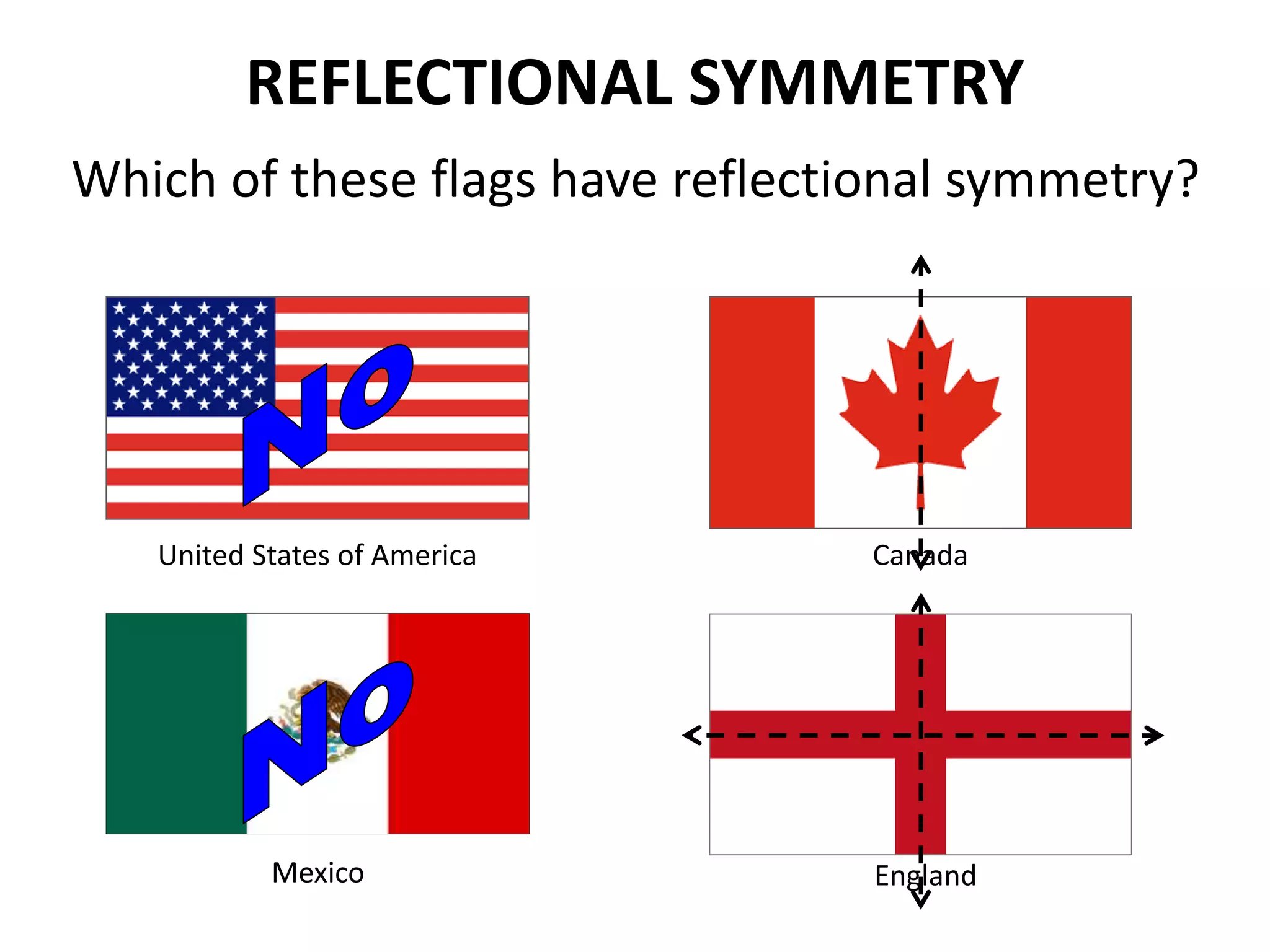
Which of these flags have reflectional symmetry? 
United States of America 
Mexico 
Canada 
England
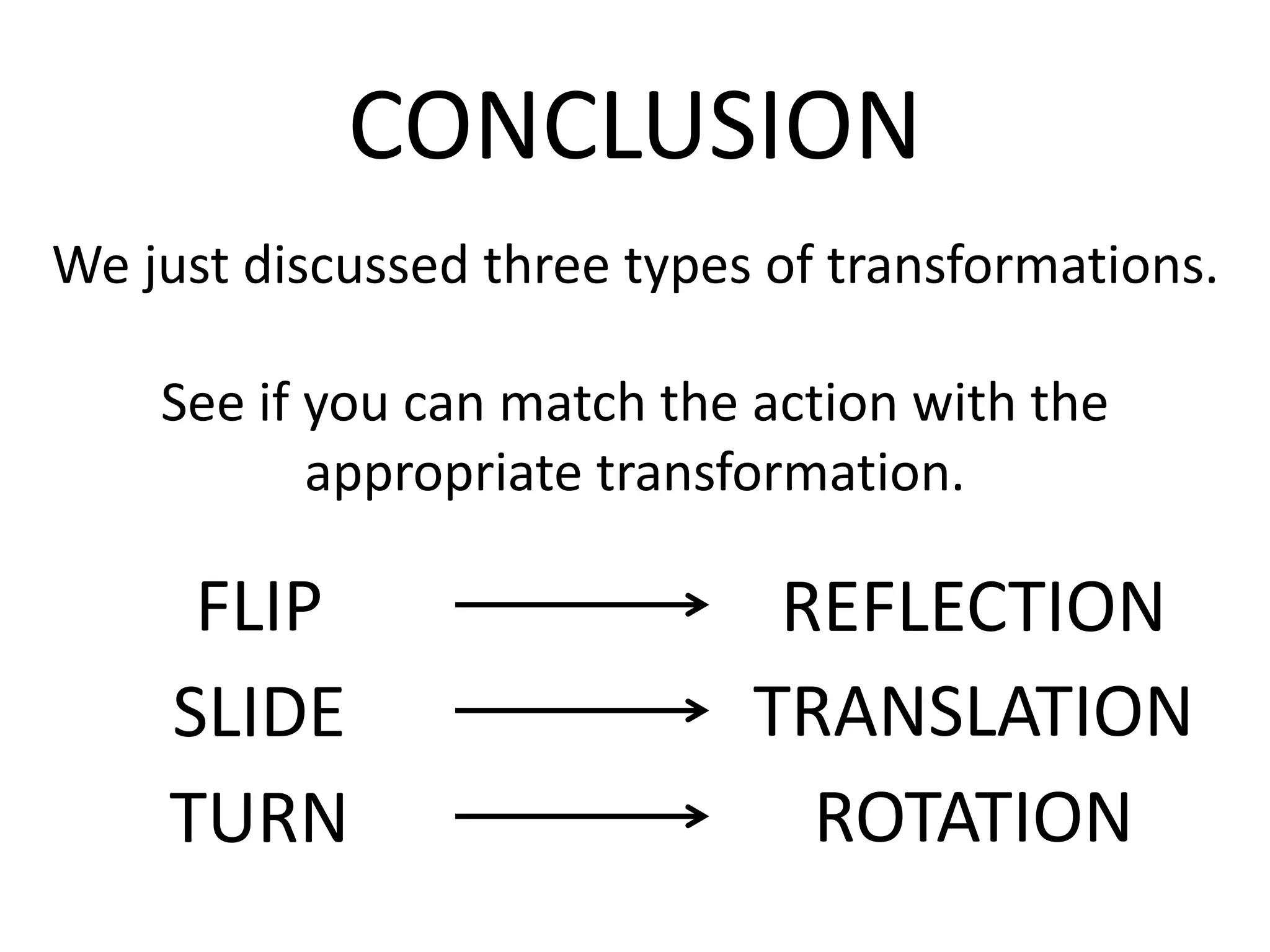
CONCLUSION 
We just discussed three types of transformations. 
See if you can match the action with the 
appropriate transformation. 
FLIP 
SLIDE 
TURN 
REFLECTION 
TRANSLATION 
ROTATION
Translation, Rotation, and Reflection all 
change the position of a shape, while the 
size remains the same. 
The fourth transformation that we are 
going to discuss is called dilation.
DILATION 
Dilation changes the size of the shape 
without changing the shape. 
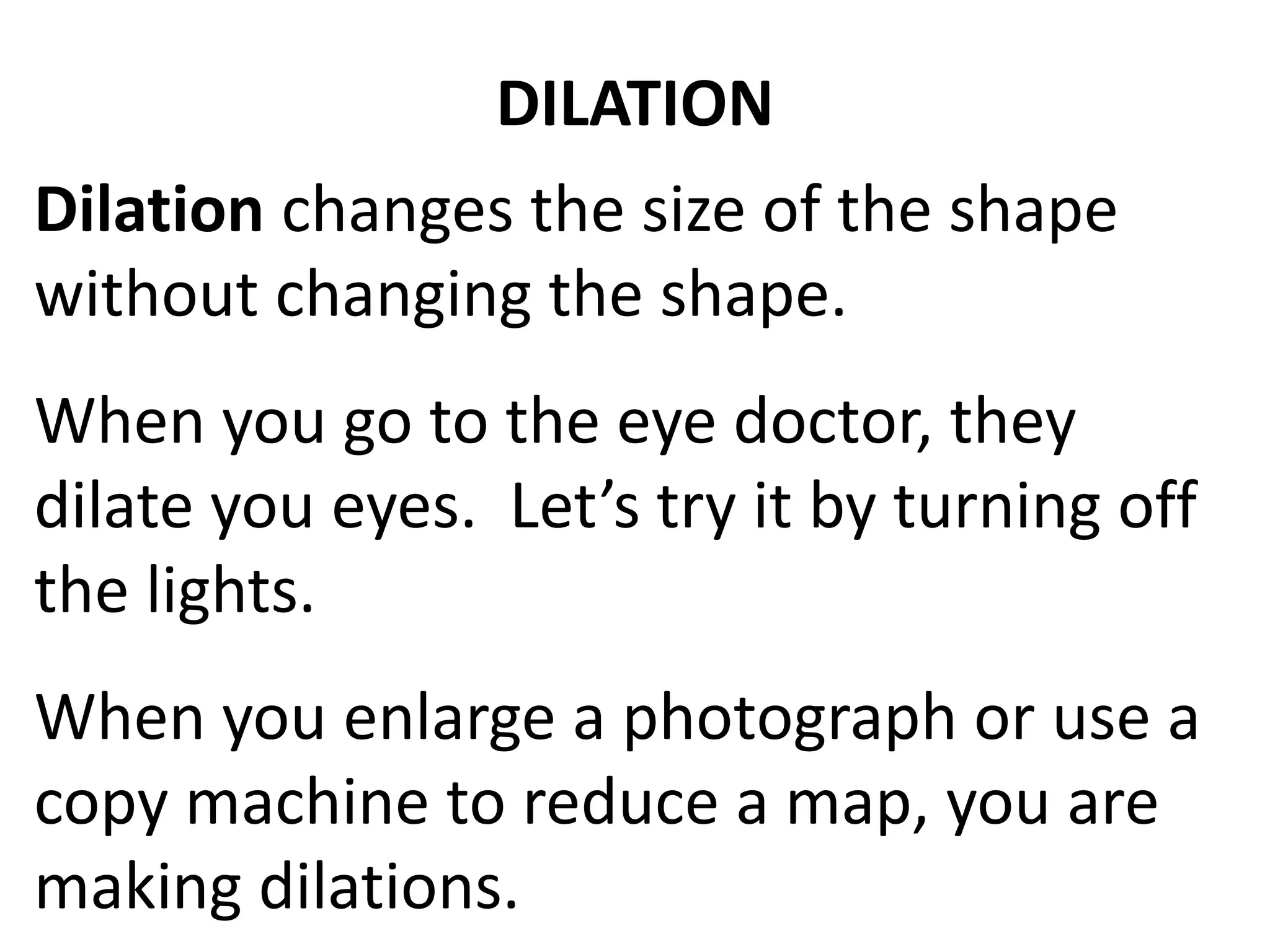
When you go to the eye doctor, they 
dilate you eyes. Let’s try it by turning off 
the lights. 
When you enlarge a photograph or use a 
copy machine to reduce a map, you are 
making dilations.
DILATION 
Enlarge means to make a shape bigger. 
Reduce means to make a shape smaller. 
The scale factor tells you how much 
something is enlarged or reduced.
DILATION 
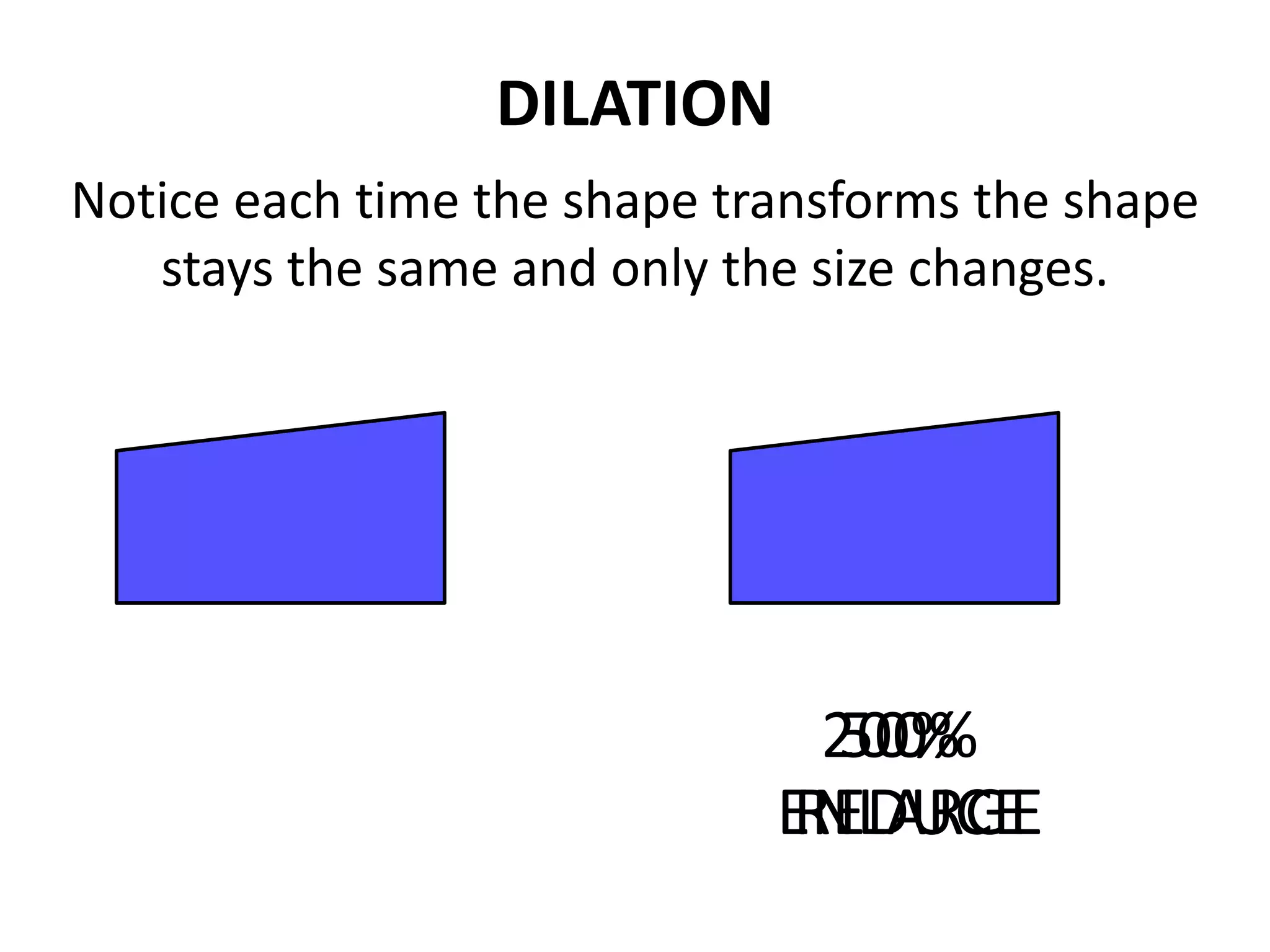
Notice each time the shape transforms the shape 
stays the same and only the size changes. 
25000%% 
ERNELDAURCGEE
DILATION 
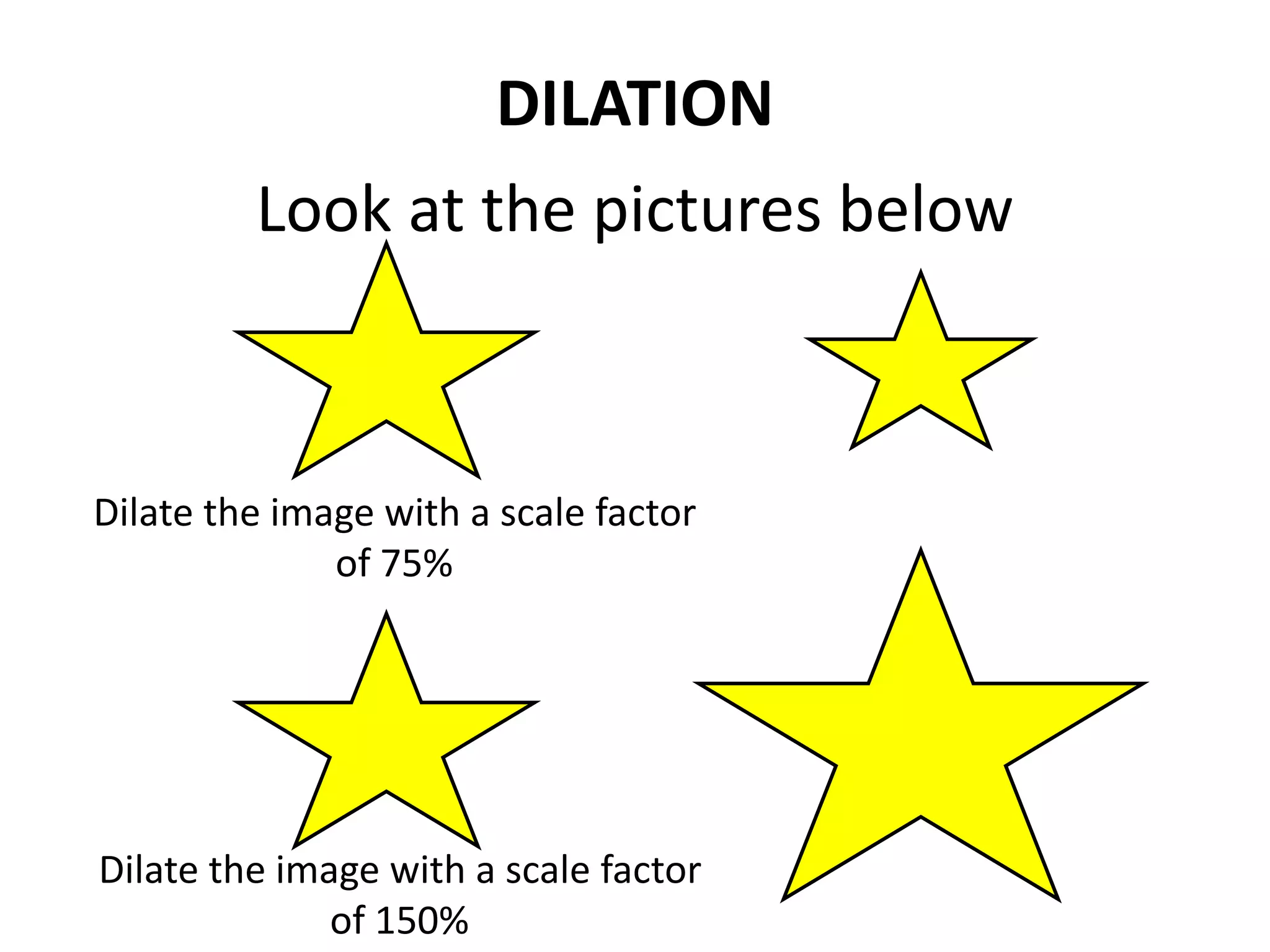
Look at the pictures below 
Dilate the image with a scale factor 
of 75% 
Dilate the image with a scale factor 
of 150%
DILATION 
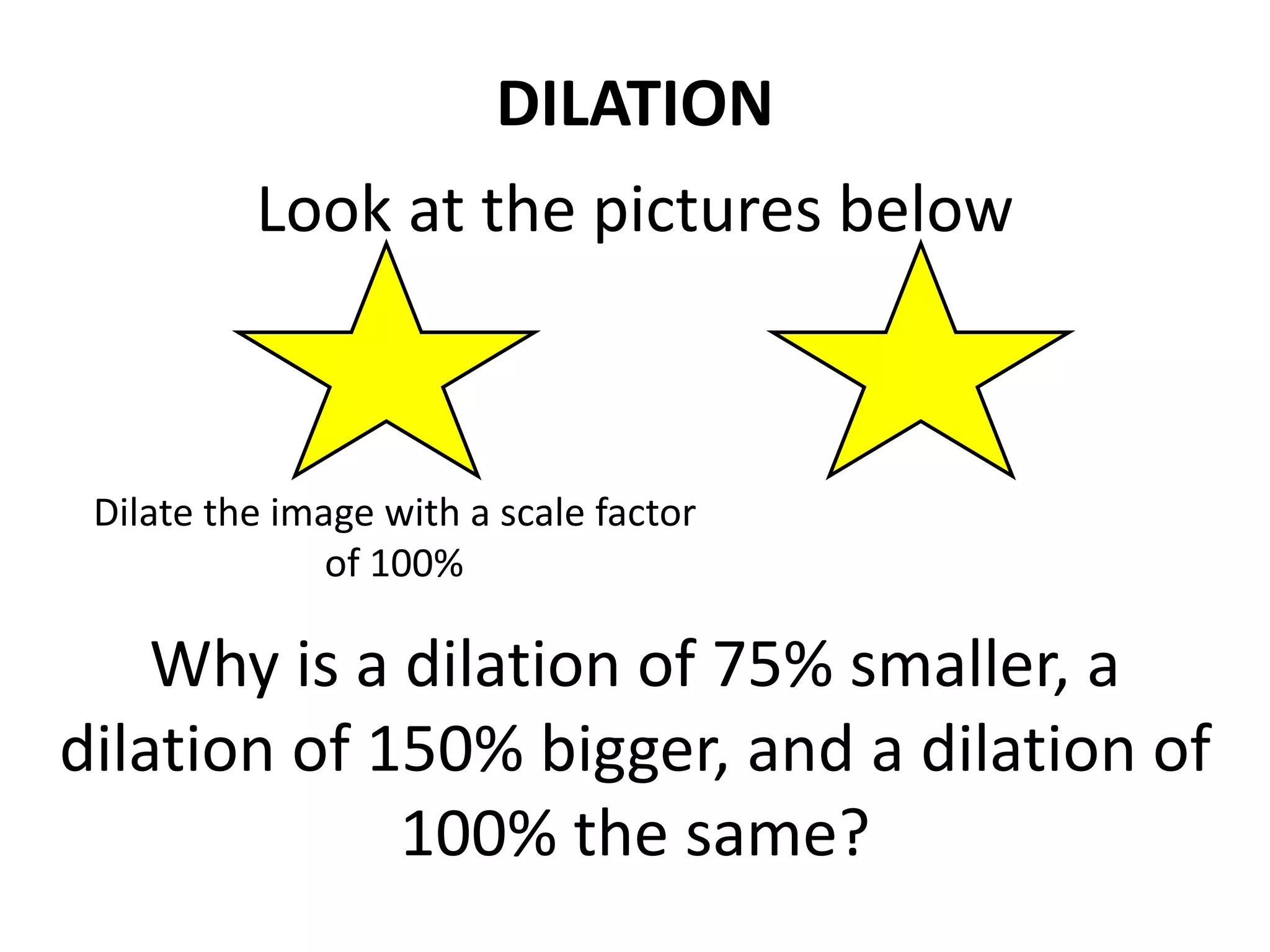
Look at the pictures below 
Dilate the image with a scale factor 
of 100% 
Why is a dilation of 75% smaller, a 
dilation of 150% bigger, and a dilation of 
100% the same?
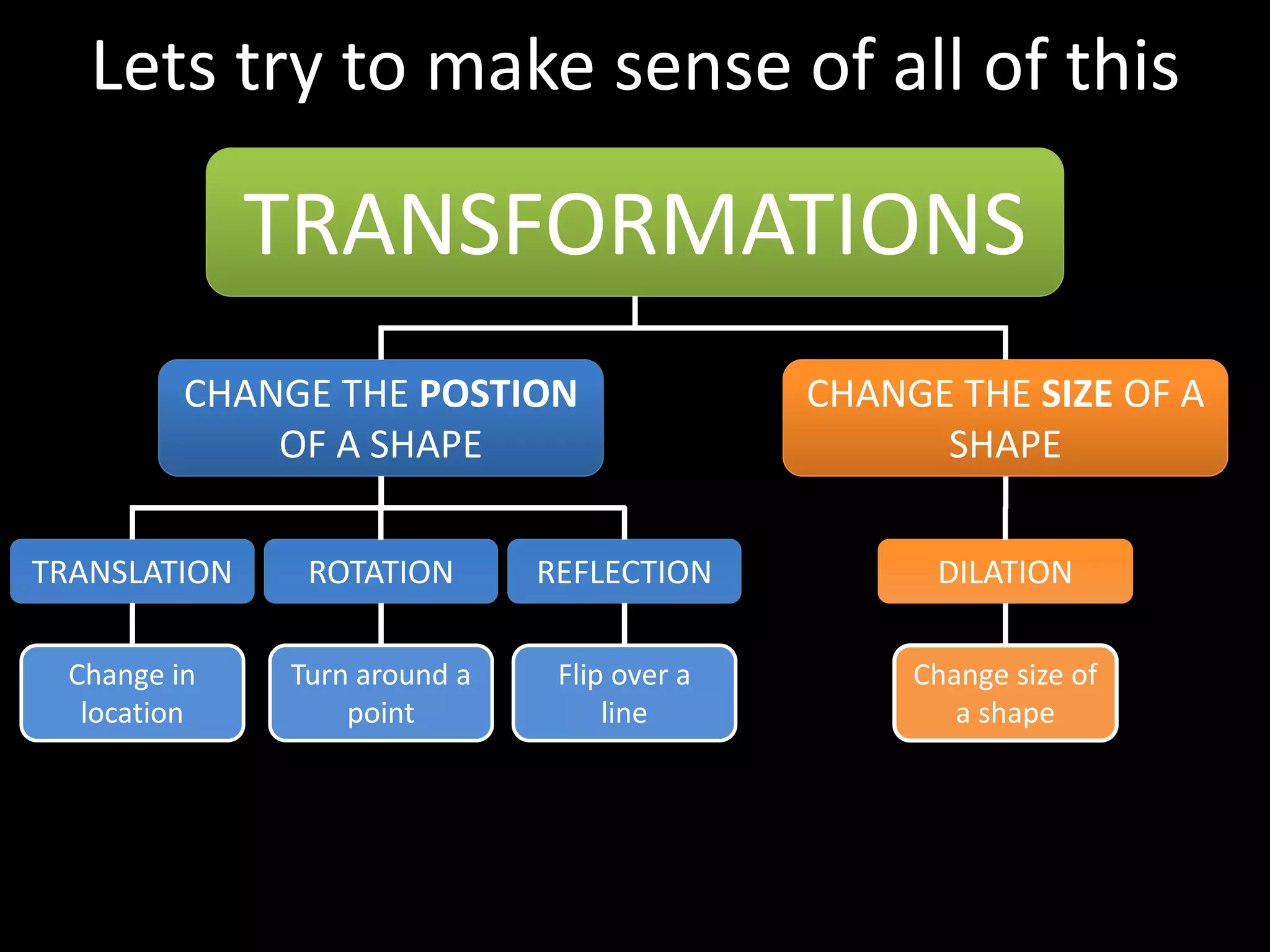
Lets try to make sense of all of this 
TRANSFORMATIONS 
CHANGE THE POSTION 
OF A SHAPE 
CHANGE THE SIZE OF A 
SHAPE 
TRANSLATION ROTATION REFLECTION 
Change in 
location 
Turn around a 
point 
Flip over a 
line 
DILATION 
Change size of 
a shape
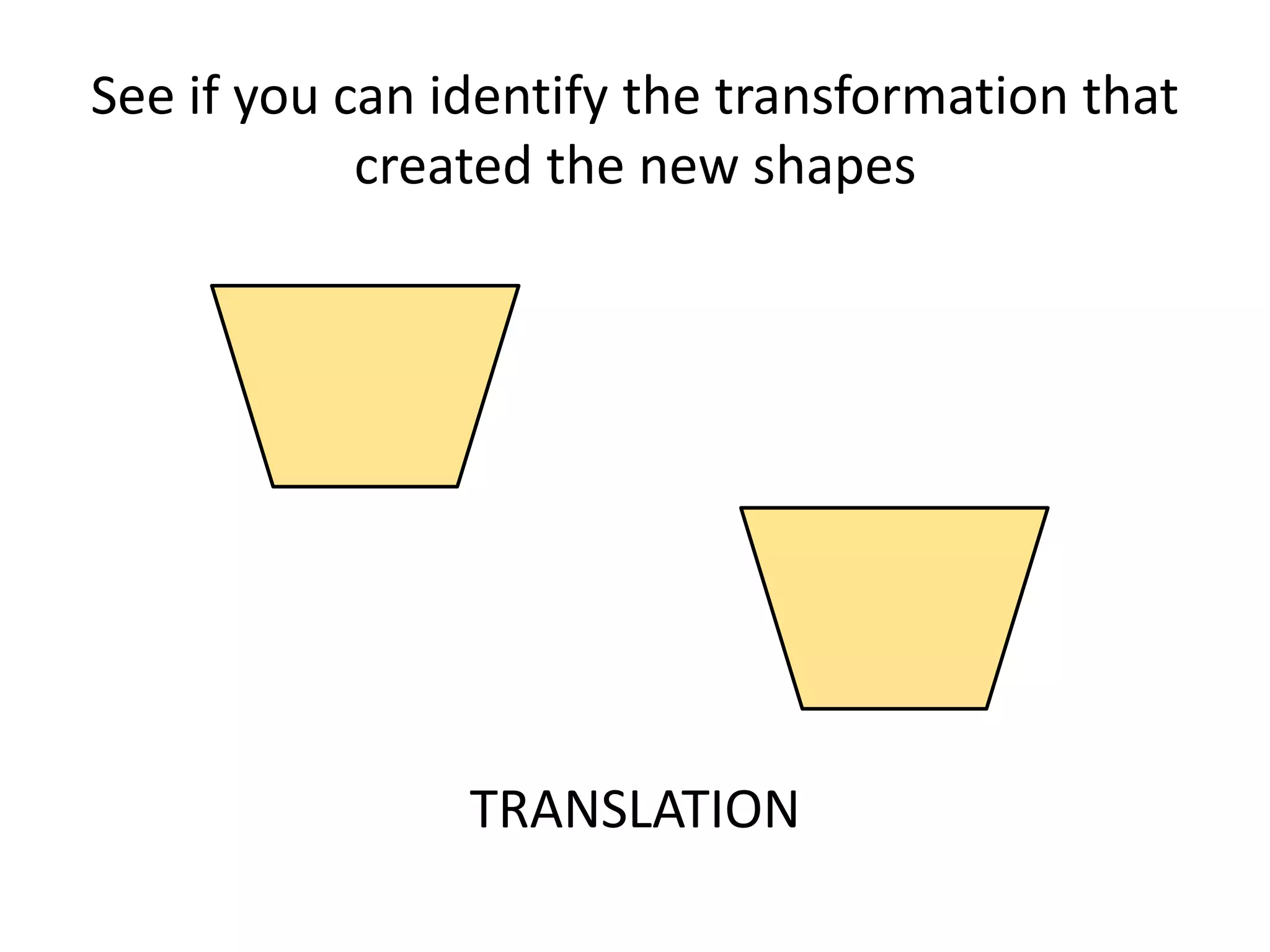
See if you can identify the transformation that 
created the new shapes 
TRANSLATION
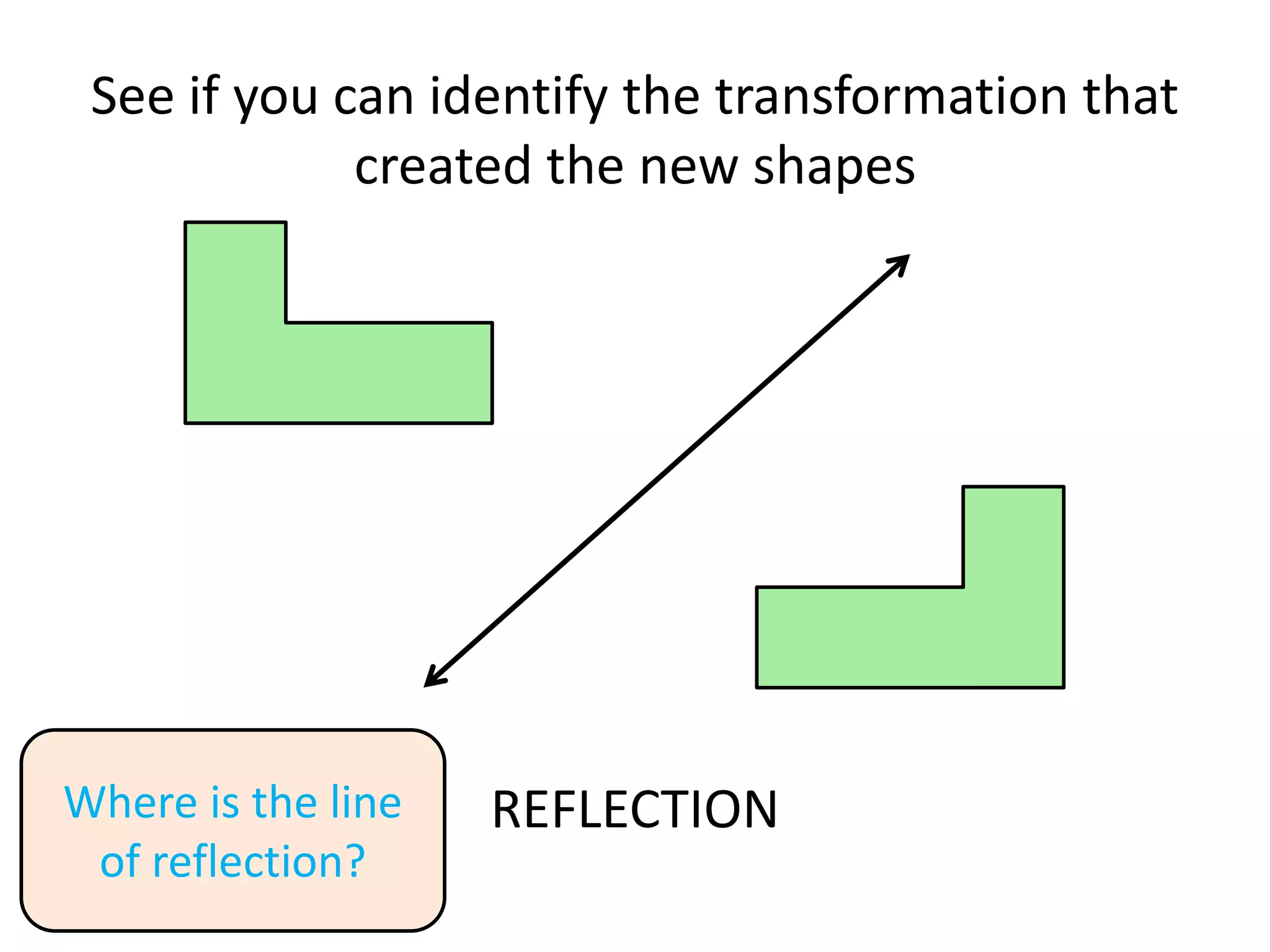
See if you can identify the transformation that 
created the new shapes 
Where is the line REFLECTION 
of reflection?
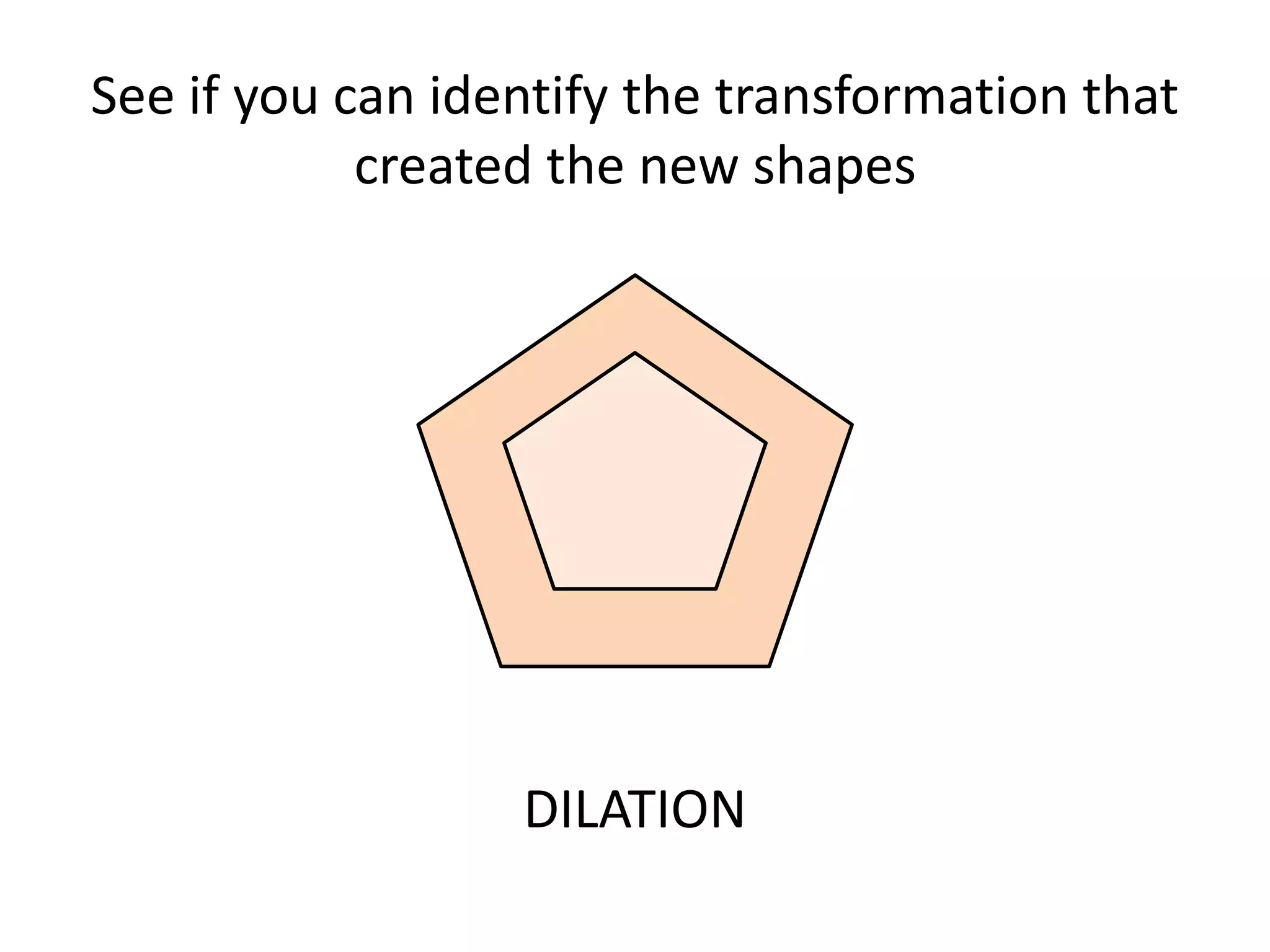
See if you can identify the transformation that 
created the new shapes 
DILATION
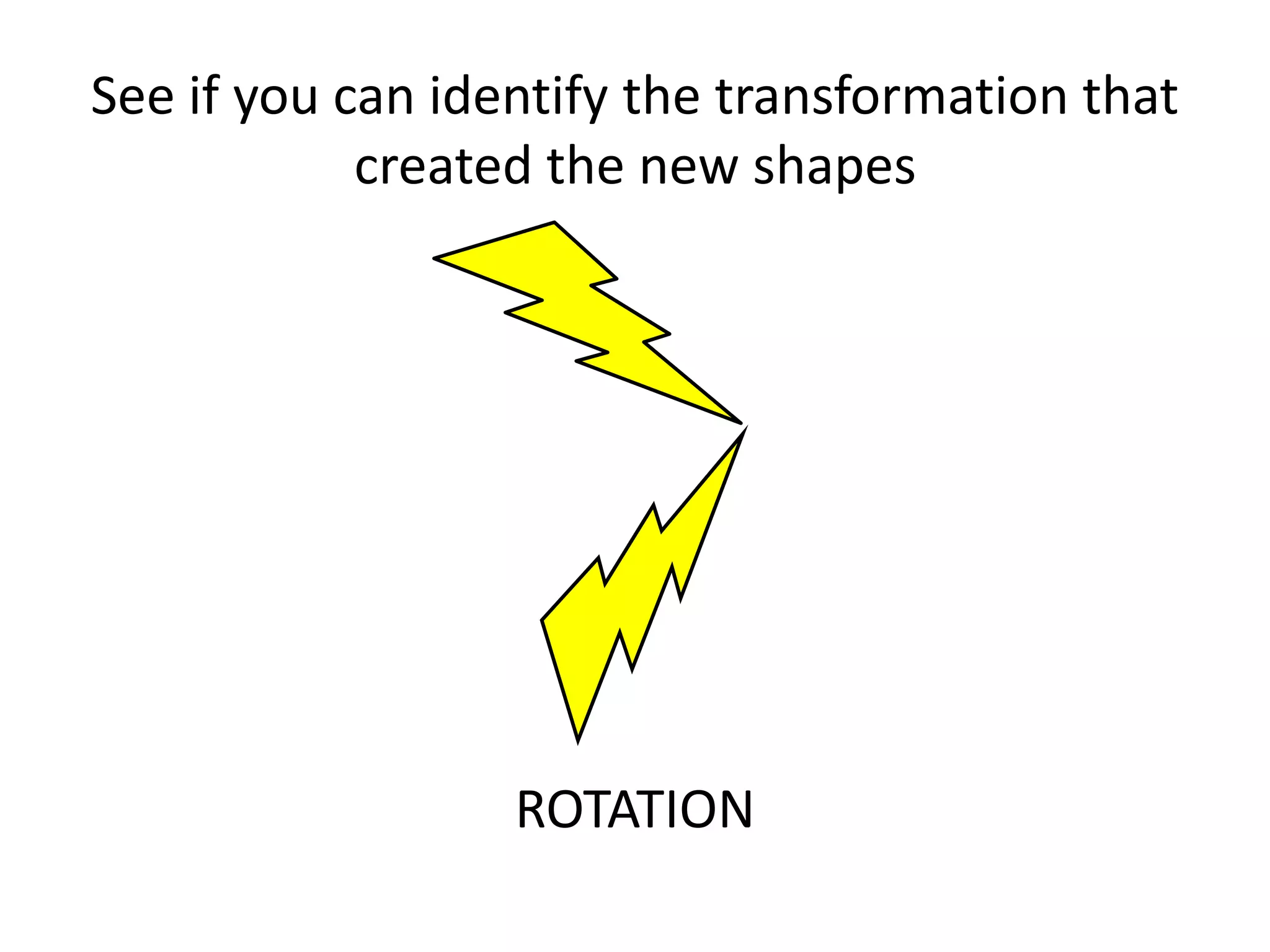
See if you can identify the transformation that 
created the new shapes 
ROTATION
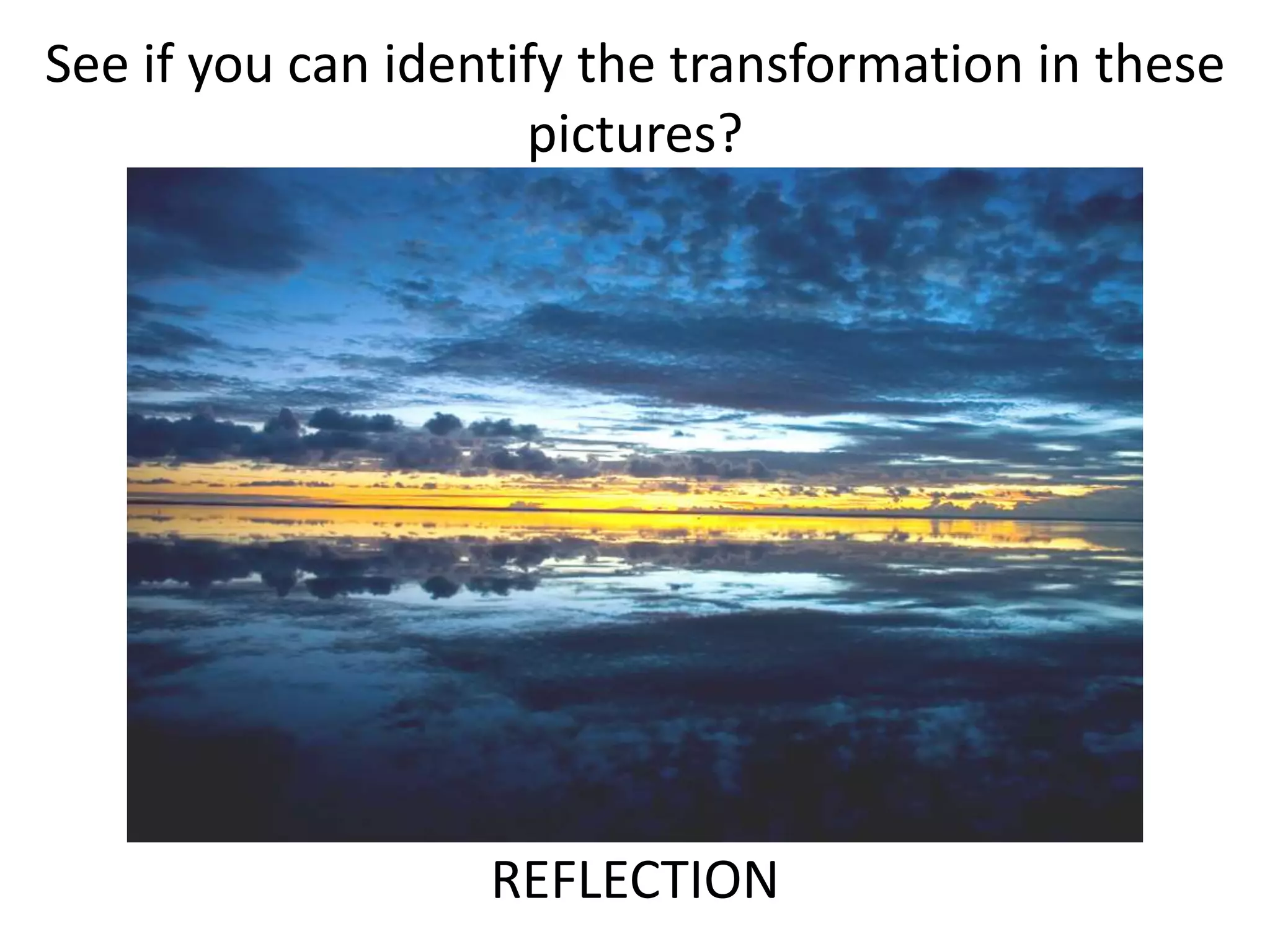
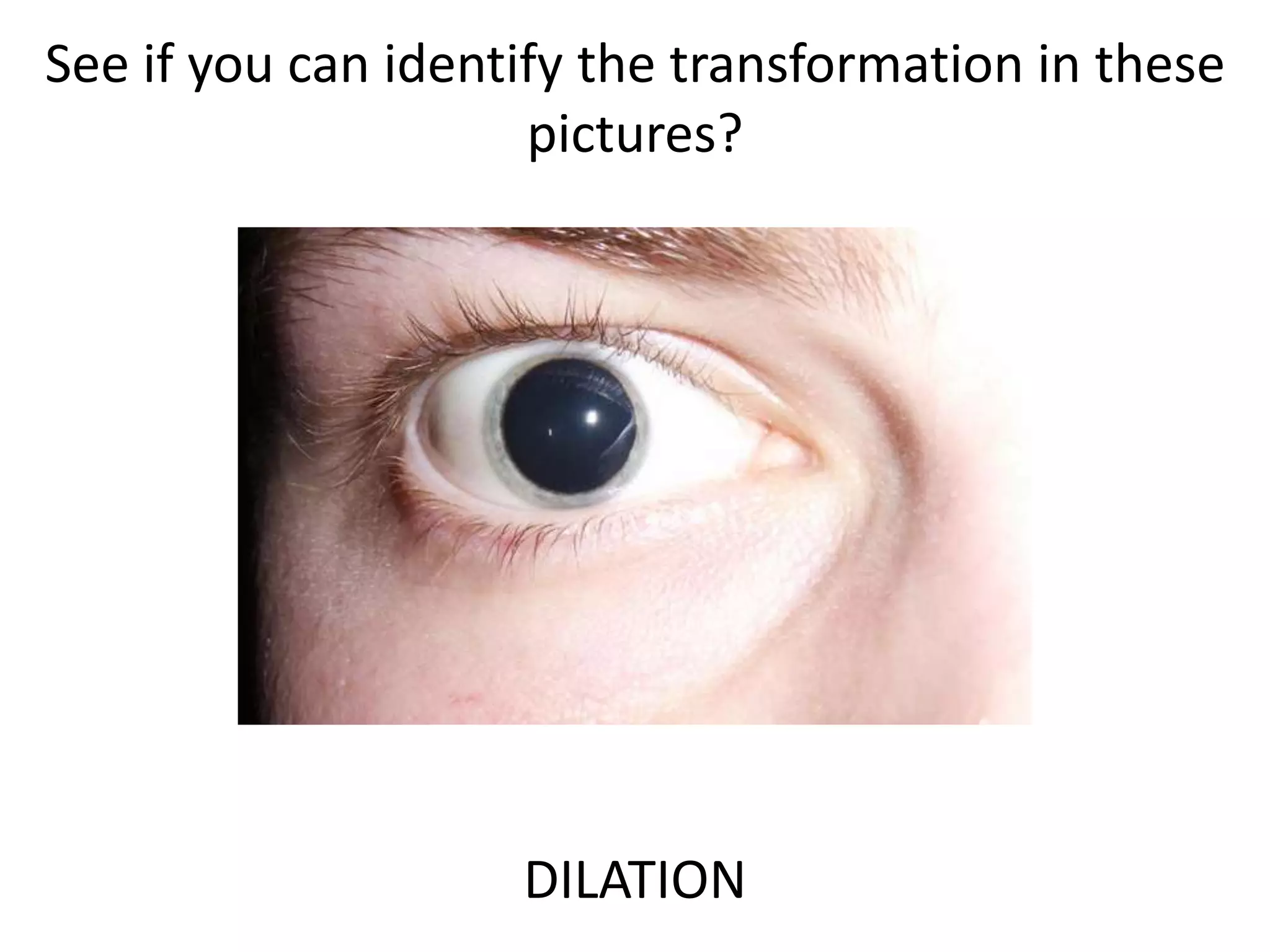
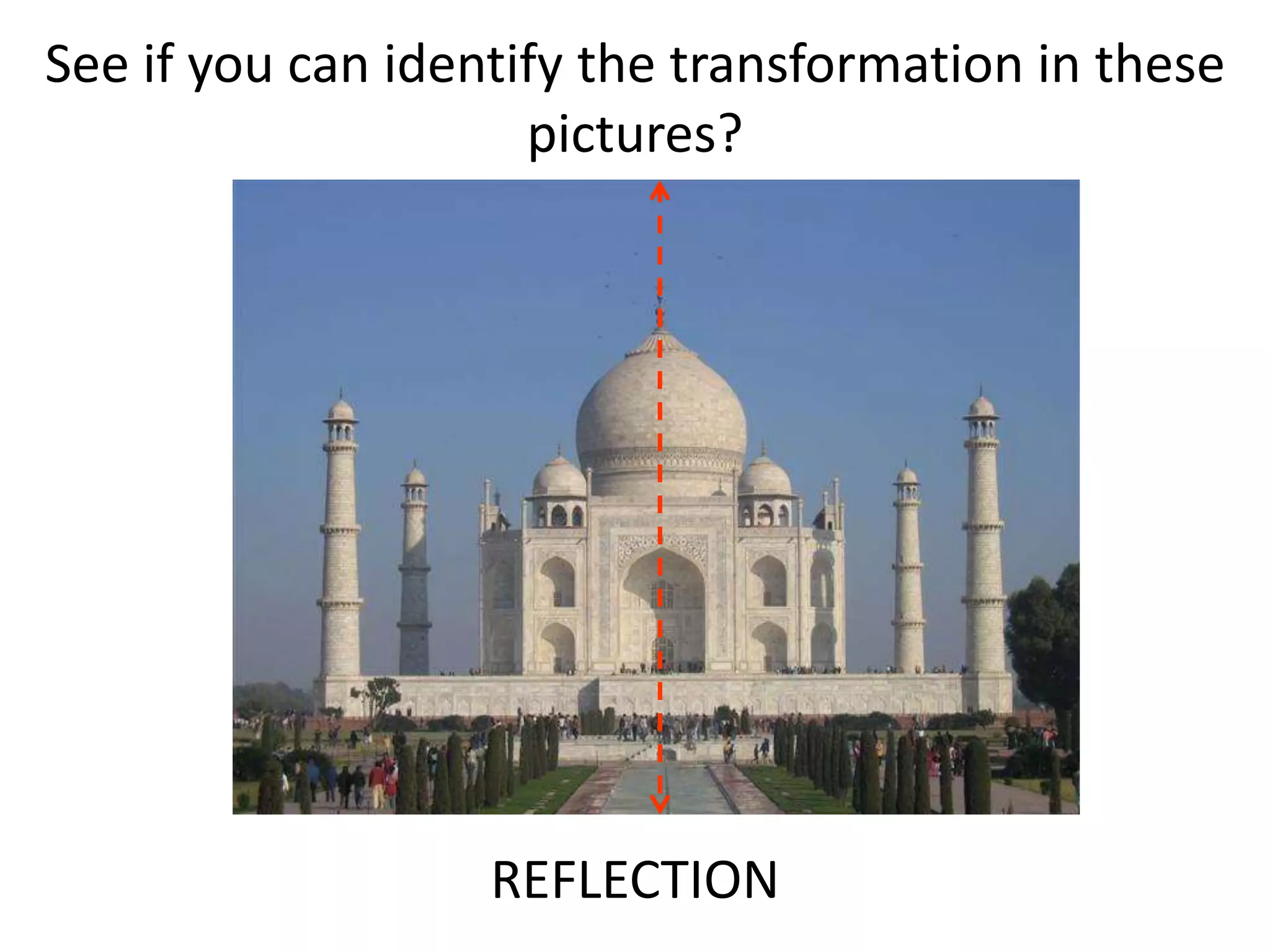
See if you can identify the transformation in these 
pictures? 
REFLECTION
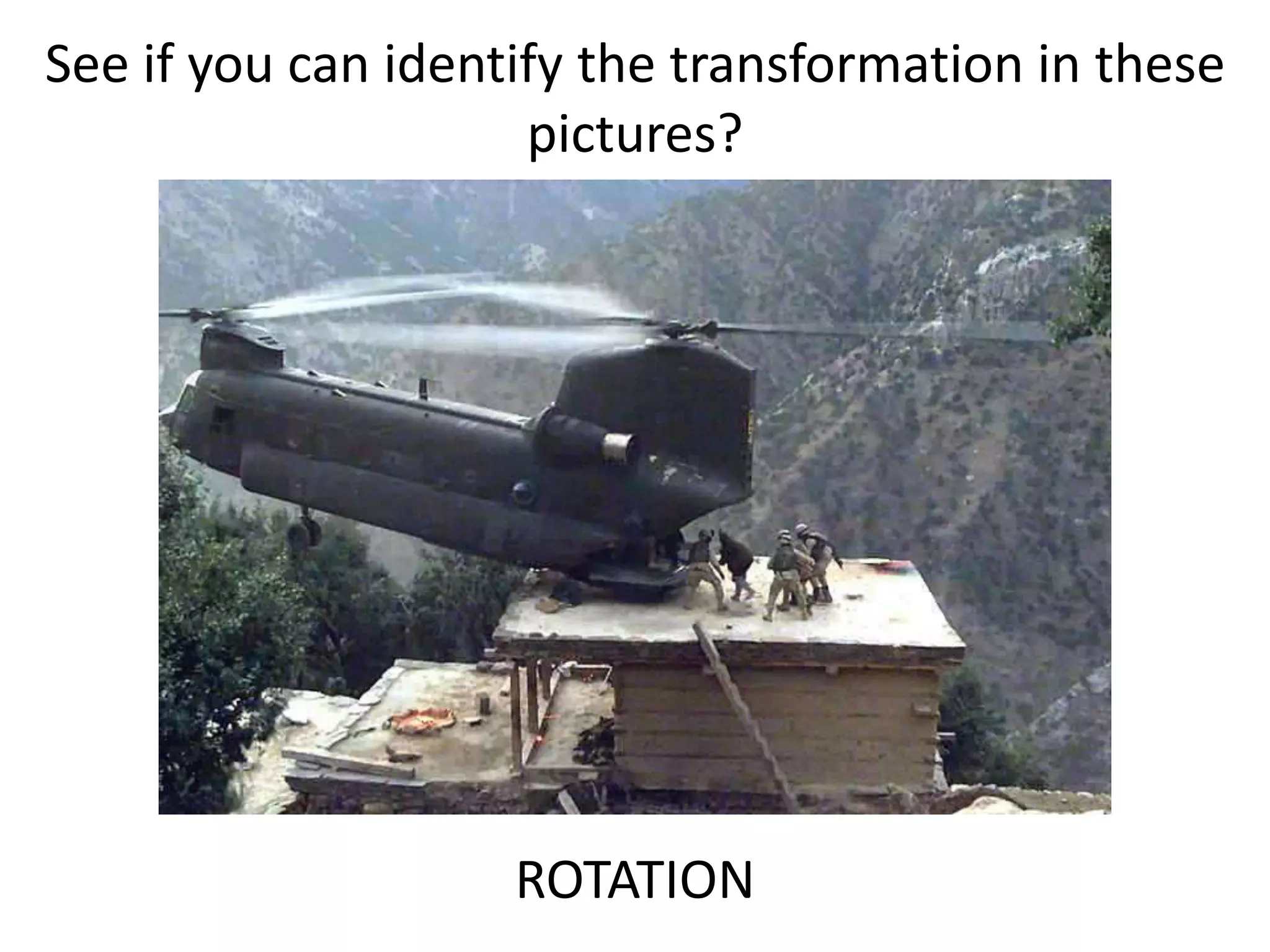
See if you can identify the transformation in these 
pictures? 
ROTATION
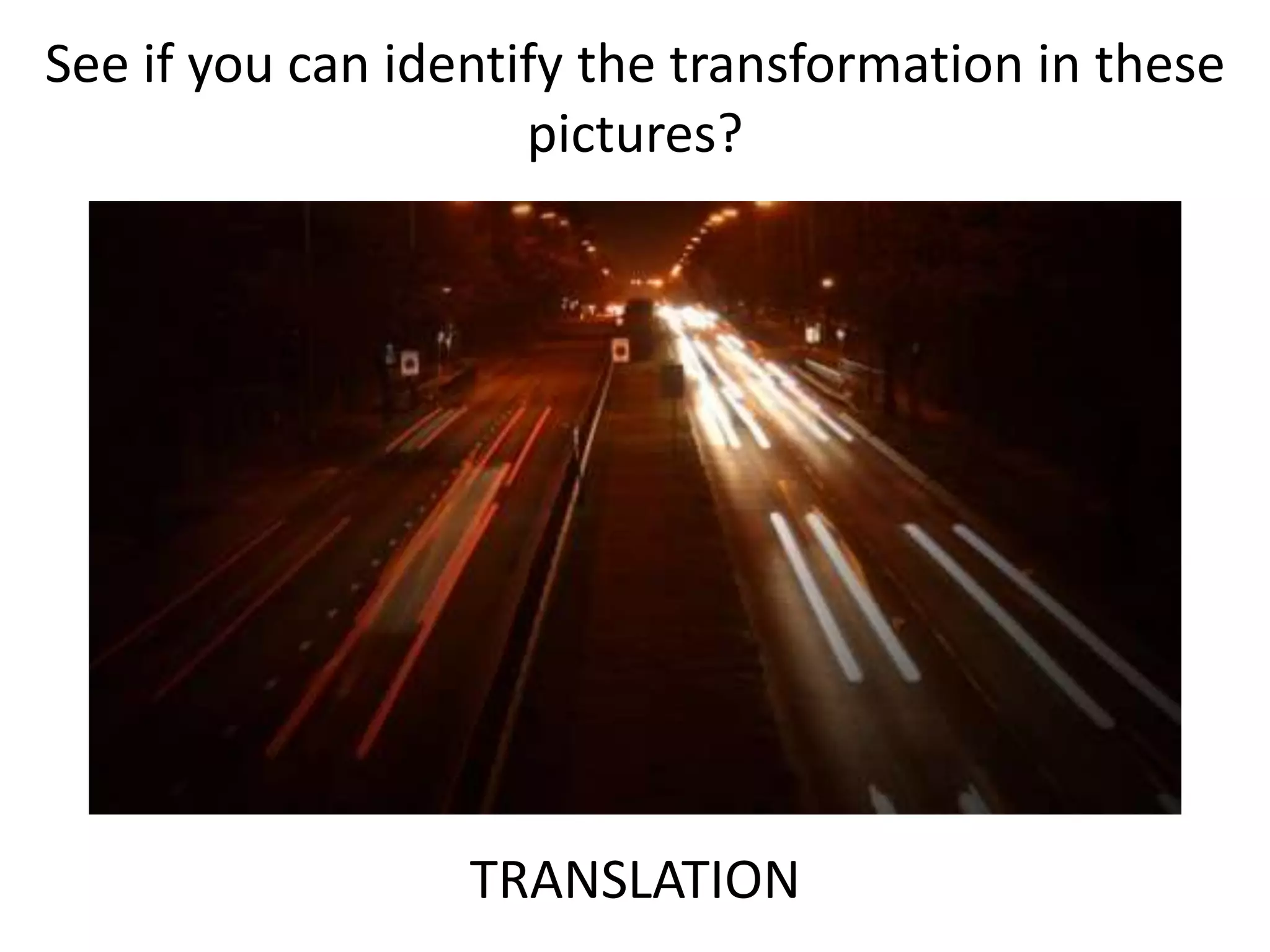
See if you can identify the transformation in these 
pictures? 
TRANSLATION
See if you can identify the transformation in these 
pictures? 
DILATION
See if you can identify the transformation in these 
pictures? 
REFLECTION

Translations, rotations, reflections, and dilations

  • 1.
  • 2.
    In geometry, a transformation is a way to change the position of a figure.
  • 3.
    In some transformations,the figure retains its size and only its position is changed. Examples of this type of transformation are: translations, rotations, and reflections In other transformations, such as dilations, the size of the figure will change.
  • 4.
  • 5.
    TRANSLATION A translationis a transformation that slides a figure across a plane or through space. With translation all points of a figure move the same distance and the same direction.
  • 6.
    TRANSLATION Basically, translationmeans that a figure has moved. An easy way to remember what translation means is to remember… A TRANSLATION IS A CHANGE IN LOCATION. A translation is usually specified by a direction and a distance.
  • 7.
    TRANSLATION What doesa translation look like? original image x y Translate from x to y A TRANSLATION IS A CHANGE IN LOCATION.
  • 8.
    TRANSLATION In theexample below triangle A is translated to become triangle B. A B Describe the translation. Triangle A is slide directly to the right.
  • 9.
    TRANSLATION In theexample below arrow A is translated to become arrow B. A B Describe the translation. Arrow A is slide down and to the right.
  • 10.
  • 11.
    ROTATION A rotationis a transformation that turns a figure about (around) a point or a line. Basically, rotation means to spin a shape. The point a figure turns around is called the center of rotation. The center of rotation can be on or outside the shape.
  • 12.
    ROTATION What doesa rotation look like? center of rotation A ROTATION MEANS TO TURN A FIGURE
  • 13.
    ROTATION The triangle was rotated around the This is another way rotation looks point. center of rotation A ROTATION MEANS TO TURN A FIGURE
  • 14.
    ROTATION If ashape spins 360, how far does it spin? 360 This is called .
  • 15.
    ROTATION If ashape spins 180, how far does it spin? Rotating a shape 180 turns a shape upside down. This is called a . 180
  • 16.
    ROTATION If ashape spins 90, how far does it spin? This is called a . 90
  • 17.
    ROTATION Describe howthe triangle A was transformed to make triangle B A B Describe the translation. Triangle A was rotated right 90
  • 18.
    ROTATION Describe howthe arrow A was transformed to make arrow B A B Describe the translation. Arrow A was rotated right 180
  • 19.
    ROTATION When someshapes are rotated they create a special situation called rotational symmetry. to spin a shape the exact same
  • 20.
    ROTATIONAL SYMMETRY Ashape has rotational symmetry if, after you rotate less than one full turn, it is the same as the original shape. Here is an example… As this shape is rotated 360, is it ever the same before the shape returns to its original direction? Yes, when it is rotated 90 it is the same as it was in the beginning. So this shape is said to have rotational symmetry. 90
  • 21.
    ROTATIONAL SYMMETRY Ashape has rotational symmetry if, after you rotate less than one full turn, it is the same as the original shape. Here is another example… As this shape is rotated 360, is it ever the same before the shape returns to its original direction? Yes, when it is rotated 180 it is the same as it was in the beginning. So this shape is said to have 180 rotational symmetry.
  • 22.
    ROTATIONAL SYMMETRY Ashape has rotational symmetry if, after you rotate less than one full turn, it is the same as the original shape. Here is another example… As this shape is rotated 360, is it ever the same before the shape returns to its original direction? No, when it is rotated 360 it is never the same. So this shape does NOT have rotational symmetry.
  • 23.
    ROTATION SYMMETRY Doesthis shape have rotational symmetry? 120 Yes, when the shape is rotated 120 it is the same. Since 120  is less than 360, this shape HAS rotational symmetry
  • 24.
  • 25.
    REFLECTION A reflectionis a transformation that flips a figure across a line. A REFLECTION IS FLIPPED OVER A LINE.
  • 26.
    REFLECTION Remember, itis the same, but it After a shape is is reflected, backwards it looks like a mirror image of itself. A REFLECTION IS FLIPPED OVER A LINE.
  • 27.
    REFLECTION Notice, Theline the that shapes a shape are is exactly flipped the over same is distance called a line from of the reflection. line of reflection on both sides. of reflection can be on the shape or it can be outside the shape. Line of reflection A REFLECTION IS FLIPPED OVER A LINE.
  • 28.
    REFLECTION Determine ifeach set of figures shows a reflection or a translation. A C B C’ B’ A’ A REFLECTION IS FLIPPED OVER A LINE.
  • 29.
    REFLECTION Sometimes, afigure has reflectional symmetry. This means that it can be folded along a line of reflection within itself so that the two halves of the figure match exactly, point by point. Basically, if you can fold a shape in half and it matches up exactly, it has reflectional symmetry.
  • 30.
    REFLECTIONAL SYMMETRY Aneasy way to understand reflectional symmetry is to think about folding. Do you remember folding a piece of paper, drawing half of a heart, and then What happens when you unfold the piece of paper? cutting it out?
  • 31.
    REFLECTIONAL SYMMETRY Reflectional Symmetry The line of reflection means The two that halves a shape are in a figure with can The exactly be two folded halves the same… along make a reflectional line a whole of They reflection are heart. so symmetry is called a the symmetrical. two haves of the line of symmetry. figure match exactly, point by point. Line of Symmetry
  • 32.
    REFLECTIONAL SYMMETRY Theline created by the fold is the line of symmetry. A shape can have more than one line of symmetry. How can I fold this shape so that it matches Where is the line of symmetry for this shape? exactly? Line of Symmetry
  • 33.
    REFLECTIONAL SYMMETRY Howmany lines of symmetry does each shape have? Do you see a pattern?
  • 34.
    REFLECTIONAL SYMMETRY Whichof these flags have reflectional symmetry? United States of America Mexico Canada England
  • 35.
    CONCLUSION We justdiscussed three types of transformations. See if you can match the action with the appropriate transformation. FLIP SLIDE TURN REFLECTION TRANSLATION ROTATION
  • 36.
    Translation, Rotation, andReflection all change the position of a shape, while the size remains the same. The fourth transformation that we are going to discuss is called dilation.
  • 37.
    DILATION Dilation changesthe size of the shape without changing the shape. When you go to the eye doctor, they dilate you eyes. Let’s try it by turning off the lights. When you enlarge a photograph or use a copy machine to reduce a map, you are making dilations.
  • 38.
    DILATION Enlarge meansto make a shape bigger. Reduce means to make a shape smaller. The scale factor tells you how much something is enlarged or reduced.
  • 39.
    DILATION Notice eachtime the shape transforms the shape stays the same and only the size changes. 25000%% ERNELDAURCGEE
  • 40.
    DILATION Look atthe pictures below Dilate the image with a scale factor of 75% Dilate the image with a scale factor of 150%
  • 41.
    DILATION Look atthe pictures below Dilate the image with a scale factor of 100% Why is a dilation of 75% smaller, a dilation of 150% bigger, and a dilation of 100% the same?
  • 42.
    Lets try tomake sense of all of this TRANSFORMATIONS CHANGE THE POSTION OF A SHAPE CHANGE THE SIZE OF A SHAPE TRANSLATION ROTATION REFLECTION Change in location Turn around a point Flip over a line DILATION Change size of a shape
  • 43.
    See if youcan identify the transformation that created the new shapes TRANSLATION
  • 44.
    See if youcan identify the transformation that created the new shapes Where is the line REFLECTION of reflection?
  • 45.
    See if youcan identify the transformation that created the new shapes DILATION
  • 46.
    See if youcan identify the transformation that created the new shapes ROTATION
  • 47.
    See if youcan identify the transformation in these pictures? REFLECTION
  • 48.
    See if youcan identify the transformation in these pictures? ROTATION
  • 49.
    See if youcan identify the transformation in these pictures? TRANSLATION
  • 50.
    See if youcan identify the transformation in these pictures? DILATION
  • 51.
    See if youcan identify the transformation in these pictures? REFLECTION