Chapter 3 Conics
3.4


                   MATHPOWERTM 12, WESTERN EDITION 3.4.1
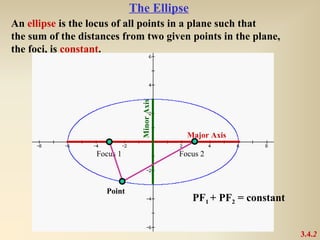
The Ellipse
An ellipse is the locus of all points in a plane such that
the sum of the distances from two given points in the plane,
the foci, is constant.


                               Minor Axis
                                              Major Axis

                   Focus 1                  Focus 2


                     Point
                                               PF1 + PF2 = constant


                                                                      3.4.2
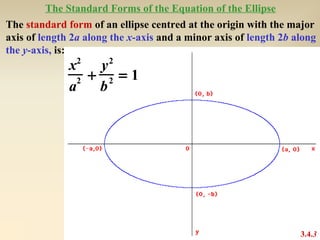
The Standard Forms of the Equation of the Ellipse
The standard form of an ellipse centred at the origin with the major
axis of length 2a along the x-axis and a minor axis of length 2b along
the y-axis, is:
               2       2
              x    y
                2 + 2 = 1
              a    b


                                                                  3.4.3
The Standard Forms of the Equation of the Ellipse [cont’d]
The standard form of an ellipse centred at the origin with
the major axis of length 2a along the y-axis and a minor axis
of length 2b along the x-axis, is:


         x2 y 2
           2 + 2 = 1
         b    a


                                                                3.4.4
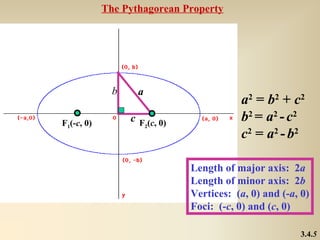
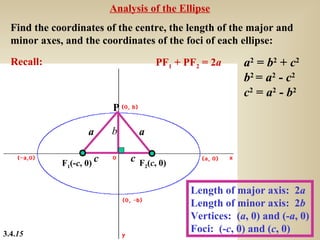
The Pythagorean Property


              b     a
                                          a2 = b2 + c2
F1(-c, 0)         c F (c, 0)              b2 = a2 - c2
                     2
                                          c2 = a2 - b2

                               Length of major axis: 2a
                               Length of minor axis: 2b
                               Vertices: (a, 0) and (-a, 0)
                               Foci: (-c, 0) and (c, 0)

                                                        3.4.5
The Standard Forms of the Equation of the Ellipse [cont’d]

The standard form of an ellipse centred at any point (h, k)
with the major axis of length 2a parallel to the x-axis and
a minor axis of length 2b parallel to the y-axis, is:
(x − h)   (y − k)
          2             2

     2  +      2  =1
   a         b
                                              (h, k)


                                                              3.4.6
The Standard Forms of the Equation of the Ellipse [cont’d]
The standard form of an ellipse centred at any point (h, k)
with the major axis of length 2a parallel to the y-axis and
a minor axis of length 2b parallel to the x-axis, is:

 (x − h) (y − k)
          2             2

      2 +     2  =1
    b       a


                                                     (h, k)


                                                              3.4.7
Finding the General Form of the Ellipse
The general form of the ellipse is:
                   Ax2 + Cy2 + Dx + Ey + F = 0

                          A x C > 0 and A ≠ C
The general form may be found by expanding the
standard form and then simplifying:
                     (x − 4)2 (y + 2)2
                          2   +    2   =1
                        3        5
             x2 − 8x + 16 y 2 + 4y + 4            225
         [        9
                            +
                                25
                                       =1  ]
     25(x 2 − 8x + 16) + 9(y 2 + 4 y + 4) = 225
  25x 2 − 200x + 400 + 9 y 2 + 36y + 36 = 225
       25x2 + 9y2 - 200x + 36y + 211 = 0
                                                        3.4.8
Finding the Centre, Axes, and Foci
State the coordinates of the vertices, the coordinates of the foci,
and the lengths of the major and minor axes of the ellipse,
defined by each equation.
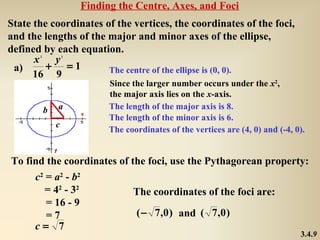
      x2
           y       2


 a)      + =1          The centre of the ellipse is (0, 0).
      16 9
                             Since the larger number occurs under the x2,
                             the major axis lies on the x-axis.
           b   a             The length of the major axis is 8.
                             The length of the minor axis is 6.
               c
                             The coordinates of the vertices are (4, 0) and (-4, 0).


To find the coordinates of the foci, use the Pythagorean property:
     c2 = a2 - b2
        = 4 2 - 32          The coordinates of the foci are:
        = 16 - 9
        =7                  ( − 7,0 ) and ( 7,0 )
     c= 7
                                                                                  3.4.9
Finding the Centre, Axes, and Foci
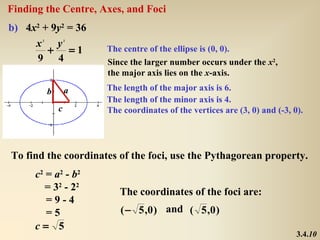
b) 4x2 + 9y2 = 36
     x y
       2           2


        + =1           The centre of the ellipse is (0, 0).
     9 4               Since the larger number occurs under the x2,
                       the major axis lies on the x-axis.

           b       a   The length of the major axis is 6.
                       The length of the minor axis is 4.
               c       The coordinates of the vertices are (3, 0) and (-3, 0).


To find the coordinates of the foci, use the Pythagorean property.
     c2 = a2 - b2
        = 3 2 - 22        The coordinates of the foci are:
        =9-4
        =5                ( − 5 ,0 ) and ( 5 ,0 )
     c= 5
                                                                            3.4.10
Finding the Equation of the Ellipse With Centre at (0, 0)
a) Find the equation of the ellipse with centre at (0, 0),
   foci at (5, 0) and (-5, 0), a major axis of length 16 units,
   and a minor axis of length 8 units.
     Since the foci are on the x-axis, the major axis is the x-axis.
       x2 y 2                The length of the major axis is 16 so a = 8.
        2 + 2 = 1            The length of the minor axis is 8 so b = 4.
       a    b
       x2 y 2
         2 + 2 = 1
       8    4
      x2 y 2
        +    =1         Standard form
      64 16
64
      x2 y 2 
      +  = [1]
                 64
                                     x2 + 4y2 = 64
      64 16                   x2 + 4y2 - 64 = 0 General form
                                                                            3.4.11
Finding the Equation of the Ellipse With Centre at (0, 0)
b)
                            The length of the major axis is 12 so a = 6.
                            The length of the minor axis is 6 so b = 3.


 x2 y 2
   2 + 2 = 1
                               36
                                     x2 y 2 
 b     a                             9 + 36  = [1]
                                                     36

 x2 y 2                                     
   2 + 2 = 1
 3     6                                4x2 + y2 = 36
                                    4x2 + y2 - 36 = 0         General
 x2 y 2                                                       form
     +   =1        Standard form
 9 36
                                                                      3.4.12
Finding the Equation of the Ellipse With Centre at (h, k)
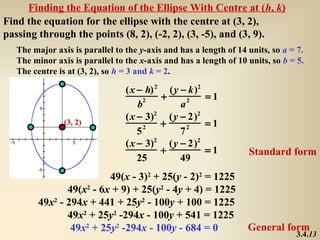
Find the equation for the ellipse with the centre at (3, 2),
passing through the points (8, 2), (-2, 2), (3, -5), and (3, 9).
   The major axis is parallel to the y-axis and has a length of 14 units, so a = 7.
   The minor axis is parallel to the x-axis and has a length of 10 units, so b = 5.
   The centre is at (3, 2), so h = 3 and k = 2.

                                 (x − h) 2 (y − k)2
                                      2   +     2   =1
                                    b         a
                                 (x − 3)2 (y − 2)2
                (3, 2)
                                      2   +     2   =1
                                    5         7
                                 (x − 3)2 (y − 2)2
                                          +         =1             Standard form
                                    25        49
                          49(x - 3)2 + 25(y - 2)2 = 1225
                49(x2 - 6x + 9) + 25(y2 - 4y + 4) = 1225
         49x2 - 294x + 441 + 25y2 - 100y + 100 = 1225
                49x2 + 25y2 -294x - 100y + 541 = 1225
                 49x2 + 25y2 -294x - 100y - 684 = 0                General form
                                                                                3.4.13
Finding the Equation of the Ellipse With Centre at (h, k)
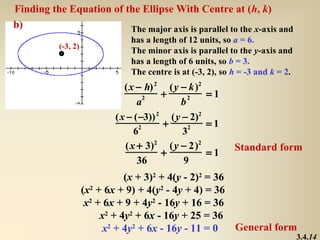
b)                       The major axis is parallel to the x-axis and
                                has a length of 12 units, so a = 6.
           (-3, 2)
                                The minor axis is parallel to the y-axis and
                                has a length of 6 units, so b = 3.
                                The centre is at (-3, 2), so h = -3 and k = 2.
                              (x − h) 2 (y − k)2
                                    2   +    2    =1
                                  a        b
                            (x − (−3)) 2 (y − 2)2
                                  2     +     2   =1
                                 6          3
                              (x + 3)2 (y − 2)2              Standard form
                                        +         =1
                                  36        9
                                (x + 3)2 + 4(y - 2)2 = 36
                     (x2 + 6x + 9) + 4(y2 - 4y + 4) = 36
                      x2 + 6x + 9 + 4y2 - 16y + 16 = 36
                          x2 + 4y2 + 6x - 16y + 25 = 36
                           x2 + 4y2 + 6x - 16y - 11 = 0   General form
                                                                                 3.4.14
Analysis of the Ellipse
  Find the coordinates of the centre, the length of the major and
  minor axes, and the coordinates of the foci of each ellipse:
  Recall:                             PF1 + PF2 = 2a     a2 = b2 + c2
                                                         b2 = a2 - c2
                                                         c2 = a2 - b2
                           P

                     a     b     a

             F1(-c, 0) c       c F (c, 0)
                                  2


                                             Length of major axis: 2a
                                             Length of minor axis: 2b
                                             Vertices: (a, 0) and (-a, 0)
3.4.15
                                             Foci: (-c, 0) and (c, 0)
Analysis of the Ellipse [cont’d]
 a) x2 + 4y2 - 2x + 8y - 11 = 0
                             x2 + 4y2 - 2x + 8y - 11 = 0
                         (x2 - 2x ) + (4y2 + 8y) - 11 = 0
                        1                       1          1
       (x2 - 2x + _____) + 4(y2 + 2y + _____) = 11 + _____ + _____  4
                                 (x - 1)2 + 4(y + 1)2 = 16
 Since the larger number
                                  ( x − 1) ( y + 1)
                                  2         2

 occurs under the x2, the                  +          =1     h= 1
 major axis is parallel to           16         4            k = -1
 the x-axis.                                             a= 4
                                                         b= 2
         c2 = a2 - b2
            = 4 2 - 22   The centre is at (1, -1).
            = 16 - 4     The major axis, parallel to the x-axis,
            = 12         has a length of 8 units.
         c = 12          The minor axis, parallel to the y-axis,
                         has a length of 4 units.
         c=2 3           The foci are at
                         (1 + 2 3, −1) and (1 − 2 3, −1).
3.4.16
Sketching the Graph of the Ellipse [cont’d]
                                          (x − 1)2 ( y + 1)2
  x2 + 4y2 - 2x + 8y - 11 = 0                     +          =1
                                             16        4
                                           Centre (1, -1)


           (1- 2 3, - 1)        (1, -1)                     (1 + 2 3, − 1)
          F1                                                F2
                 c =2 3                    c =2 3


3.4.17
Analysis of the Ellipse
b) 9x2 + 4y2 - 18x + 40y - 35 = 0
                    9x2 + 4y2 - 18x + 40y - 35 = 0
                (9x2 - 18x ) + (4y2 + 40y) - 35 = 0
                  1                      25          9
   9(x2 - 2x + _____) + 4(y2 + 10y + _____) = 35 + _____ + _____
                                                            100
                               9(x - 1)2 + 4(y + 5)2 = 144
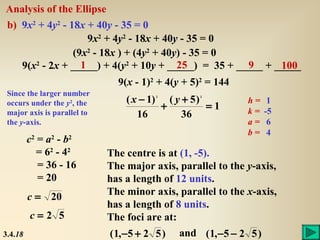
 Since the larger number
                                 ( x − 1) ( y + 5 )
                                        2         2
                                                             h=    1
 occurs under the y2, the                +          =1       k=   -5
 major axis is parallel to          16        36
 the y-axis.                                                 a=    6
                                                             b=    4
         c2 = a2 - b2
            = 6 2 - 42       The centre is at (1, -5).
            = 36 - 16        The major axis, parallel to the y-axis,
            = 20             has a length of 12 units.
         c = 20              The minor axis, parallel to the x-axis,
                             has a length of 8 units.
         c=2 5               The foci are at:
3.4.18                       (1, −5 + 2 5 ) and (1, −5 − 2 5 )
Sketching the Graph of the Ellipse [cont’d]
     2   2                                      (x − 1)2 ( y + 5)2
  9x + 4y - 18x + 40y - 35 = 0                          +          =1
                                                  16         36

                                 F1 (1, − 5 + 2 5 )

                                        c =2 5


                                        c =2 5


                                 F2   (1 -5 - 2 5)
                                        ,
3.4.19
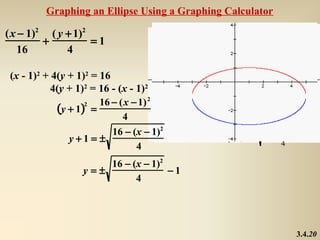
Graphing an Ellipse Using a Graphing Calculator

(x − 1)2 ( y + 1)2
        +          =1                                 16 − (x − 1)2
  16         4                                    y=+               −1
                                                            4

 (x - 1)2 + 4(y + 1)2 = 16
            4(y + 1)2 = 16 - (x - 1)2
                        16 − (x − 1) 2
             (y + 1) =
                    2

                              4
                           16 − (x − 1)2              16 − (x − 1)2
                y+1= ±                            y=−
                                                            4
                                                                    −1
                                  4
                       16 − (x − 1)2
                   y=±               −1
                             4


                                                                3.4.20
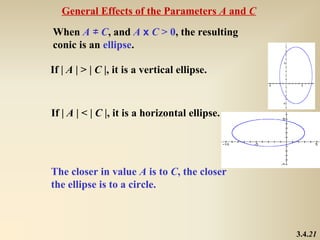
General Effects of the Parameters A and C
When A ≠ C, and A x C > 0, the resulting
conic is an ellipse.

If | A | > | C |, it is a vertical ellipse.


If | A | < | C |, it is a horizontal ellipse.


The closer in value A is to C, the closer
the ellipse is to a circle.


                                                3.4.21
Suggested Questions:
Pages 150-152
A 1-20
B 21, 23, 25, 33,
   36, 39, 40


                       3.4.22

34 the ellipse

  • 1.
    Chapter 3 Conics 3.4 MATHPOWERTM 12, WESTERN EDITION 3.4.1
  • 2.
    The Ellipse An ellipseis the locus of all points in a plane such that the sum of the distances from two given points in the plane, the foci, is constant. Minor Axis Major Axis Focus 1 Focus 2 Point PF1 + PF2 = constant 3.4.2
  • 3.
    The Standard Formsof the Equation of the Ellipse The standard form of an ellipse centred at the origin with the major axis of length 2a along the x-axis and a minor axis of length 2b along the y-axis, is: 2 2 x y 2 + 2 = 1 a b 3.4.3
  • 4.
    The Standard Formsof the Equation of the Ellipse [cont’d] The standard form of an ellipse centred at the origin with the major axis of length 2a along the y-axis and a minor axis of length 2b along the x-axis, is: x2 y 2 2 + 2 = 1 b a 3.4.4
  • 5.
    The Pythagorean Property b a a2 = b2 + c2 F1(-c, 0) c F (c, 0) b2 = a2 - c2 2 c2 = a2 - b2 Length of major axis: 2a Length of minor axis: 2b Vertices: (a, 0) and (-a, 0) Foci: (-c, 0) and (c, 0) 3.4.5
  • 6.
    The Standard Formsof the Equation of the Ellipse [cont’d] The standard form of an ellipse centred at any point (h, k) with the major axis of length 2a parallel to the x-axis and a minor axis of length 2b parallel to the y-axis, is: (x − h) (y − k) 2 2 2 + 2 =1 a b (h, k) 3.4.6
  • 7.
    The Standard Formsof the Equation of the Ellipse [cont’d] The standard form of an ellipse centred at any point (h, k) with the major axis of length 2a parallel to the y-axis and a minor axis of length 2b parallel to the x-axis, is: (x − h) (y − k) 2 2 2 + 2 =1 b a (h, k) 3.4.7
  • 8.
    Finding the GeneralForm of the Ellipse The general form of the ellipse is: Ax2 + Cy2 + Dx + Ey + F = 0 A x C > 0 and A ≠ C The general form may be found by expanding the standard form and then simplifying: (x − 4)2 (y + 2)2 2 + 2 =1 3 5 x2 − 8x + 16 y 2 + 4y + 4 225 [ 9 + 25 =1 ] 25(x 2 − 8x + 16) + 9(y 2 + 4 y + 4) = 225 25x 2 − 200x + 400 + 9 y 2 + 36y + 36 = 225 25x2 + 9y2 - 200x + 36y + 211 = 0 3.4.8
  • 9.
    Finding the Centre,Axes, and Foci State the coordinates of the vertices, the coordinates of the foci, and the lengths of the major and minor axes of the ellipse, defined by each equation. x2 y 2 a) + =1 The centre of the ellipse is (0, 0). 16 9 Since the larger number occurs under the x2, the major axis lies on the x-axis. b a The length of the major axis is 8. The length of the minor axis is 6. c The coordinates of the vertices are (4, 0) and (-4, 0). To find the coordinates of the foci, use the Pythagorean property: c2 = a2 - b2 = 4 2 - 32 The coordinates of the foci are: = 16 - 9 =7 ( − 7,0 ) and ( 7,0 ) c= 7 3.4.9
  • 10.
    Finding the Centre,Axes, and Foci b) 4x2 + 9y2 = 36 x y 2 2 + =1 The centre of the ellipse is (0, 0). 9 4 Since the larger number occurs under the x2, the major axis lies on the x-axis. b a The length of the major axis is 6. The length of the minor axis is 4. c The coordinates of the vertices are (3, 0) and (-3, 0). To find the coordinates of the foci, use the Pythagorean property. c2 = a2 - b2 = 3 2 - 22 The coordinates of the foci are: =9-4 =5 ( − 5 ,0 ) and ( 5 ,0 ) c= 5 3.4.10
  • 11.
    Finding the Equationof the Ellipse With Centre at (0, 0) a) Find the equation of the ellipse with centre at (0, 0), foci at (5, 0) and (-5, 0), a major axis of length 16 units, and a minor axis of length 8 units. Since the foci are on the x-axis, the major axis is the x-axis. x2 y 2 The length of the major axis is 16 so a = 8. 2 + 2 = 1 The length of the minor axis is 8 so b = 4. a b x2 y 2 2 + 2 = 1 8 4 x2 y 2 + =1 Standard form 64 16 64  x2 y 2   +  = [1] 64 x2 + 4y2 = 64  64 16  x2 + 4y2 - 64 = 0 General form 3.4.11
  • 12.
    Finding the Equationof the Ellipse With Centre at (0, 0) b) The length of the major axis is 12 so a = 6. The length of the minor axis is 6 so b = 3. x2 y 2 2 + 2 = 1 36  x2 y 2  b a  9 + 36  = [1] 36 x2 y 2   2 + 2 = 1 3 6 4x2 + y2 = 36 4x2 + y2 - 36 = 0 General x2 y 2 form + =1 Standard form 9 36 3.4.12
  • 13.
    Finding the Equationof the Ellipse With Centre at (h, k) Find the equation for the ellipse with the centre at (3, 2), passing through the points (8, 2), (-2, 2), (3, -5), and (3, 9). The major axis is parallel to the y-axis and has a length of 14 units, so a = 7. The minor axis is parallel to the x-axis and has a length of 10 units, so b = 5. The centre is at (3, 2), so h = 3 and k = 2. (x − h) 2 (y − k)2 2 + 2 =1 b a (x − 3)2 (y − 2)2 (3, 2) 2 + 2 =1 5 7 (x − 3)2 (y − 2)2 + =1 Standard form 25 49 49(x - 3)2 + 25(y - 2)2 = 1225 49(x2 - 6x + 9) + 25(y2 - 4y + 4) = 1225 49x2 - 294x + 441 + 25y2 - 100y + 100 = 1225 49x2 + 25y2 -294x - 100y + 541 = 1225 49x2 + 25y2 -294x - 100y - 684 = 0 General form 3.4.13
  • 14.
    Finding the Equationof the Ellipse With Centre at (h, k) b) The major axis is parallel to the x-axis and has a length of 12 units, so a = 6. (-3, 2) The minor axis is parallel to the y-axis and has a length of 6 units, so b = 3. The centre is at (-3, 2), so h = -3 and k = 2. (x − h) 2 (y − k)2 2 + 2 =1 a b (x − (−3)) 2 (y − 2)2 2 + 2 =1 6 3 (x + 3)2 (y − 2)2 Standard form + =1 36 9 (x + 3)2 + 4(y - 2)2 = 36 (x2 + 6x + 9) + 4(y2 - 4y + 4) = 36 x2 + 6x + 9 + 4y2 - 16y + 16 = 36 x2 + 4y2 + 6x - 16y + 25 = 36 x2 + 4y2 + 6x - 16y - 11 = 0 General form 3.4.14
  • 15.
    Analysis of theEllipse Find the coordinates of the centre, the length of the major and minor axes, and the coordinates of the foci of each ellipse: Recall: PF1 + PF2 = 2a a2 = b2 + c2 b2 = a2 - c2 c2 = a2 - b2 P a b a F1(-c, 0) c c F (c, 0) 2 Length of major axis: 2a Length of minor axis: 2b Vertices: (a, 0) and (-a, 0) 3.4.15 Foci: (-c, 0) and (c, 0)
  • 16.
    Analysis of theEllipse [cont’d] a) x2 + 4y2 - 2x + 8y - 11 = 0 x2 + 4y2 - 2x + 8y - 11 = 0 (x2 - 2x ) + (4y2 + 8y) - 11 = 0 1 1 1 (x2 - 2x + _____) + 4(y2 + 2y + _____) = 11 + _____ + _____ 4 (x - 1)2 + 4(y + 1)2 = 16 Since the larger number ( x − 1) ( y + 1) 2 2 occurs under the x2, the + =1 h= 1 major axis is parallel to 16 4 k = -1 the x-axis. a= 4 b= 2 c2 = a2 - b2 = 4 2 - 22 The centre is at (1, -1). = 16 - 4 The major axis, parallel to the x-axis, = 12 has a length of 8 units. c = 12 The minor axis, parallel to the y-axis, has a length of 4 units. c=2 3 The foci are at (1 + 2 3, −1) and (1 − 2 3, −1). 3.4.16
  • 17.
    Sketching the Graphof the Ellipse [cont’d] (x − 1)2 ( y + 1)2 x2 + 4y2 - 2x + 8y - 11 = 0 + =1 16 4 Centre (1, -1) (1- 2 3, - 1) (1, -1) (1 + 2 3, − 1) F1 F2 c =2 3 c =2 3 3.4.17
  • 18.
    Analysis of theEllipse b) 9x2 + 4y2 - 18x + 40y - 35 = 0 9x2 + 4y2 - 18x + 40y - 35 = 0 (9x2 - 18x ) + (4y2 + 40y) - 35 = 0 1 25 9 9(x2 - 2x + _____) + 4(y2 + 10y + _____) = 35 + _____ + _____ 100 9(x - 1)2 + 4(y + 5)2 = 144 Since the larger number ( x − 1) ( y + 5 ) 2 2 h= 1 occurs under the y2, the + =1 k= -5 major axis is parallel to 16 36 the y-axis. a= 6 b= 4 c2 = a2 - b2 = 6 2 - 42 The centre is at (1, -5). = 36 - 16 The major axis, parallel to the y-axis, = 20 has a length of 12 units. c = 20 The minor axis, parallel to the x-axis, has a length of 8 units. c=2 5 The foci are at: 3.4.18 (1, −5 + 2 5 ) and (1, −5 − 2 5 )
  • 19.
    Sketching the Graphof the Ellipse [cont’d] 2 2 (x − 1)2 ( y + 5)2 9x + 4y - 18x + 40y - 35 = 0 + =1 16 36 F1 (1, − 5 + 2 5 ) c =2 5 c =2 5 F2 (1 -5 - 2 5) , 3.4.19
  • 20.
    Graphing an EllipseUsing a Graphing Calculator (x − 1)2 ( y + 1)2 + =1 16 − (x − 1)2 16 4 y=+ −1 4 (x - 1)2 + 4(y + 1)2 = 16 4(y + 1)2 = 16 - (x - 1)2 16 − (x − 1) 2 (y + 1) = 2 4 16 − (x − 1)2 16 − (x − 1)2 y+1= ± y=− 4 −1 4 16 − (x − 1)2 y=± −1 4 3.4.20
  • 21.
    General Effects ofthe Parameters A and C When A ≠ C, and A x C > 0, the resulting conic is an ellipse. If | A | > | C |, it is a vertical ellipse. If | A | < | C |, it is a horizontal ellipse. The closer in value A is to C, the closer the ellipse is to a circle. 3.4.21
  • 22.
    Suggested Questions: Pages 150-152 A1-20 B 21, 23, 25, 33, 36, 39, 40 3.4.22