8.3 Vectors
Chapter 8 Applications of Trigonometry
Concepts and Objectives
 Vectors and Vector Operations
 Find the magnitude and direction angle for a vector.
 Find the horizontal and vertical components of a
vector.
 Find the magnitude of a resultant.
 Perform vector operations.
 Use vectors to solve problems.
Vectors – Vocabulary
 Magnitude is a word used to describe the size of
something, such as 35 lb or 100 mph.
 A vector quantity is a quantity that has both magnitude
and direction. For example, 60 mph east represents a
vector quantity.
 A vector quantity is often represented with a directed
line segment called a vector.
 The length of the vector represents the magnitude of
the vector quantity.
 The direction of the vector represents the direction of
the vector quantity.
Vectors
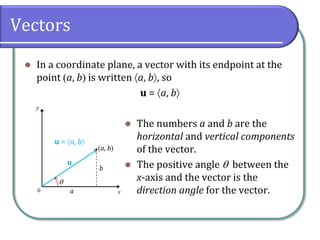
 In a coordinate plane, a vector with its endpoint at the
point a, b is written a, b, so
u = a, b
 The numbers a and b are the
horizontal and vertical components
of the vector.
 The positive angle  between the
x-axis and the vector is the
direction angle for the vector.a
b
a, b
u
u = a, b

Magnitude and Direction Angle
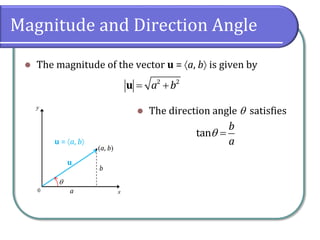
 The magnitude of the vector u = a, b is given by
 The direction angle  satisfies
a
b
a, b
u
u = a, b

2 2
a b u
tan
b
a

Magnitude and Direction Angle
 Example: Find the magnitude and direction angle for
u = ‒5, 4.
Magnitude and Direction Angle
 Example: Find the magnitude and direction angle for
u = ‒5, 4.
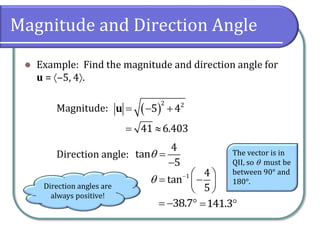
Magnitude:
Direction angle:
   
2 2
5 4u
 41 6.403


4
tan
5

1 4
tan
5
  
  
 

38.7    141.3
Direction angles are
always positive!
The vector is in
QII, so  must be
between 90° and
180°.
Magnitude and Direction Angle
 Example: Find the magnitude and direction angle for
u = ‒5, 4.
Magnitude:
Direction angle:
41u
141.3 
Horizontal & Vertical Components
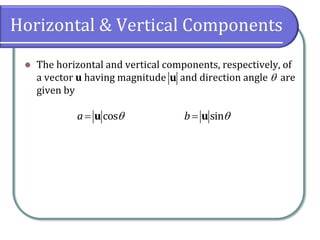
 The horizontal and vertical components, respectively, of
a vector u having magnitude and direction angle  are
given by
u
cosa u  sinb  u 
Horizontal & Vertical Components
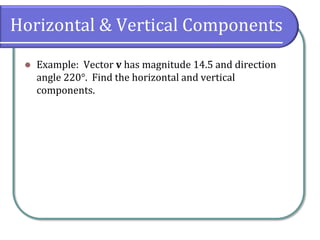
 Example: Vector v has magnitude 14.5 and direction
angle 220°. Find the horizontal and vertical
components.
Horizontal & Vertical Components
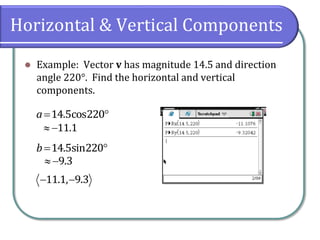
 Example: Vector v has magnitude 14.5 and direction
angle 220°. Find the horizontal and vertical
components.
14.5cos220a 
11.1 
14.5sin220b 
9.3 
11.1, 9.3 
Vector Addition
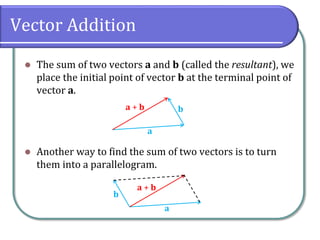
 The sum of two vectors a and b (called the resultant), we
place the initial point of vector b at the terminal point of
vector a.
 Another way to find the sum of two vectors is to turn
them into a parallelogram.
a
ba + b
a
b
a + b
Vector Addition
 Recall that a parallelogram is a quadrilateral whose
 Opposite sides are parallel
 Opposite sides are congruent
 Opposite angles are congruent
 Consecutive angles are supplementary
Magnitude of a Resultant
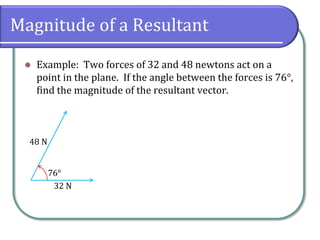
 Example: Two forces of 32 and 48 newtons act on a
point in the plane. If the angle between the forces is 76°,
find the magnitude of the resultant vector.
32 N
48 N
76°
Magnitude of a Resultant
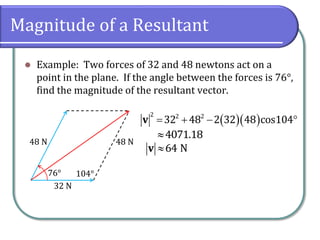
 Example: Two forces of 32 and 48 newtons act on a
point in the plane. If the angle between the forces is 76°,
find the magnitude of the resultant vector.
32 N
48 N
76° 104°
48 N
  2 2 2
32 48 2 32 48 cos104   v
4071.18
64 Nv
Vector Operations
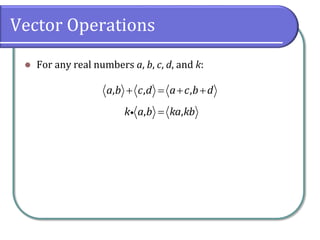
 For any real numbers a, b, c, d, and k:
, , ,a b c d a c b d   
, ,k a b ka kb
Vector Applications
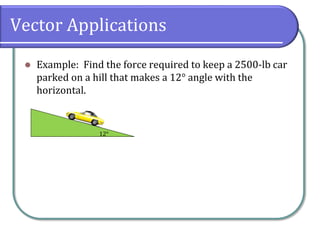
 Example: Find the force required to keep a 2500-lb car
parked on a hill that makes a 12° angle with the
horizontal.
12°
Vector Applications
 Example: Find the force required to keep a 2500-lb car
parked on a hill that makes a 12° angle with the
horizontal.
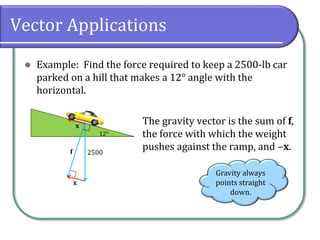
The gravity vector is the sum of f,
the force with which the weight
pushes against the ramp, and ‒x.
12°
2500
Gravity always
points straight
down.
x
x
f
Vector Applications
 Example: Find the force required to keep a 2500-lb car
parked on a hill that makes a 12° angle with the
horizontal.
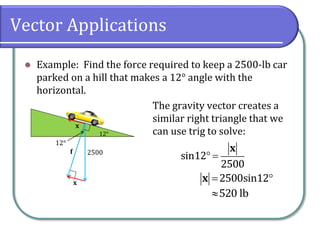
The gravity vector creates a
similar right triangle that we
can use trig to solve:12°
2500
12°
x
x
f
sin12
2500
 
x
2500sin12 x
520 lb
Vector Operations
 Example: Let u = 6, ‒3 and v = ‒14, 8. Find the
following: (a) u + v, (b) ‒2u, (c) 5u – 2v.
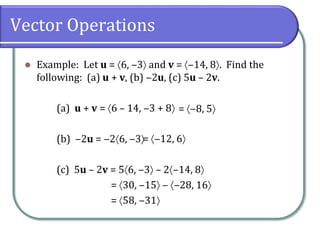
Vector Operations
 Example: Let u = 6, ‒3 and v = ‒14, 8. Find the
following: (a) u + v, (b) ‒2u, (c) 5u – 2v.
(a) u + v = 6 – 14, ‒3 + 8
(b) ‒2u = ‒26, ‒3
(c) 5u – 2v = 56, ‒3 – 2‒14, 8
= 30, ‒15 ‒ ‒28, 16
= 58, ‒31
= ‒8, 5
= ‒12, 6
Classwork
 College Algebra
 Page 770: 20-28 (even); page 756: 40, 42, 48-52, 60;
page 747: 76-84 (even)

8.3 Vectors

  • 1.
    8.3 Vectors Chapter 8Applications of Trigonometry
  • 2.
    Concepts and Objectives Vectors and Vector Operations  Find the magnitude and direction angle for a vector.  Find the horizontal and vertical components of a vector.  Find the magnitude of a resultant.  Perform vector operations.  Use vectors to solve problems.
  • 3.
    Vectors – Vocabulary Magnitude is a word used to describe the size of something, such as 35 lb or 100 mph.  A vector quantity is a quantity that has both magnitude and direction. For example, 60 mph east represents a vector quantity.  A vector quantity is often represented with a directed line segment called a vector.  The length of the vector represents the magnitude of the vector quantity.  The direction of the vector represents the direction of the vector quantity.
  • 4.
    Vectors  In acoordinate plane, a vector with its endpoint at the point a, b is written a, b, so u = a, b  The numbers a and b are the horizontal and vertical components of the vector.  The positive angle  between the x-axis and the vector is the direction angle for the vector.a b a, b u u = a, b 
  • 5.
    Magnitude and DirectionAngle  The magnitude of the vector u = a, b is given by  The direction angle  satisfies a b a, b u u = a, b  2 2 a b u tan b a 
  • 6.
    Magnitude and DirectionAngle  Example: Find the magnitude and direction angle for u = ‒5, 4.
  • 7.
    Magnitude and DirectionAngle  Example: Find the magnitude and direction angle for u = ‒5, 4. Magnitude: Direction angle:     2 2 5 4u  41 6.403   4 tan 5  1 4 tan 5          38.7    141.3 Direction angles are always positive! The vector is in QII, so  must be between 90° and 180°.
  • 8.
    Magnitude and DirectionAngle  Example: Find the magnitude and direction angle for u = ‒5, 4. Magnitude: Direction angle: 41u 141.3 
  • 9.
    Horizontal & VerticalComponents  The horizontal and vertical components, respectively, of a vector u having magnitude and direction angle  are given by u cosa u  sinb  u 
  • 10.
    Horizontal & VerticalComponents  Example: Vector v has magnitude 14.5 and direction angle 220°. Find the horizontal and vertical components.
  • 11.
    Horizontal & VerticalComponents  Example: Vector v has magnitude 14.5 and direction angle 220°. Find the horizontal and vertical components. 14.5cos220a  11.1  14.5sin220b  9.3  11.1, 9.3 
  • 12.
    Vector Addition  Thesum of two vectors a and b (called the resultant), we place the initial point of vector b at the terminal point of vector a.  Another way to find the sum of two vectors is to turn them into a parallelogram. a ba + b a b a + b
  • 13.
    Vector Addition  Recallthat a parallelogram is a quadrilateral whose  Opposite sides are parallel  Opposite sides are congruent  Opposite angles are congruent  Consecutive angles are supplementary
  • 14.
    Magnitude of aResultant  Example: Two forces of 32 and 48 newtons act on a point in the plane. If the angle between the forces is 76°, find the magnitude of the resultant vector. 32 N 48 N 76°
  • 15.
    Magnitude of aResultant  Example: Two forces of 32 and 48 newtons act on a point in the plane. If the angle between the forces is 76°, find the magnitude of the resultant vector. 32 N 48 N 76° 104° 48 N   2 2 2 32 48 2 32 48 cos104   v 4071.18 64 Nv
  • 16.
    Vector Operations  Forany real numbers a, b, c, d, and k: , , ,a b c d a c b d    , ,k a b ka kb
  • 17.
    Vector Applications  Example:Find the force required to keep a 2500-lb car parked on a hill that makes a 12° angle with the horizontal. 12°
  • 18.
    Vector Applications  Example:Find the force required to keep a 2500-lb car parked on a hill that makes a 12° angle with the horizontal. The gravity vector is the sum of f, the force with which the weight pushes against the ramp, and ‒x. 12° 2500 Gravity always points straight down. x x f
  • 19.
    Vector Applications  Example:Find the force required to keep a 2500-lb car parked on a hill that makes a 12° angle with the horizontal. The gravity vector creates a similar right triangle that we can use trig to solve:12° 2500 12° x x f sin12 2500   x 2500sin12 x 520 lb
  • 20.
    Vector Operations  Example:Let u = 6, ‒3 and v = ‒14, 8. Find the following: (a) u + v, (b) ‒2u, (c) 5u – 2v.
  • 21.
    Vector Operations  Example:Let u = 6, ‒3 and v = ‒14, 8. Find the following: (a) u + v, (b) ‒2u, (c) 5u – 2v. (a) u + v = 6 – 14, ‒3 + 8 (b) ‒2u = ‒26, ‒3 (c) 5u – 2v = 56, ‒3 – 2‒14, 8 = 30, ‒15 ‒ ‒28, 16 = 58, ‒31 = ‒8, 5 = ‒12, 6
  • 22.
    Classwork  College Algebra Page 770: 20-28 (even); page 756: 40, 42, 48-52, 60; page 747: 76-84 (even)