
Dr. Ashraf El Adawy 
Consultant Chest Physician 
TB TEAM EXPERT – WHO 
Mansoura-Egypt 
Basic concepts of Tuberculosis
What is Tuberculosis 
Tuberculosis (TB) is an infectious granulomatous disease caused by Mycobacterium tuberculosis human type or rarely M. bovis. 
TB disease most often affects the lungs, but can occur anywhere in the body.
4 
TB Transmission
Module 1 – Transmission and Pathogenesis of Tuberculosis 
5 
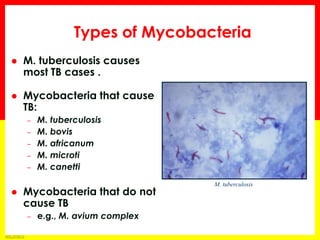
M. tuberculosis causes most TB cases . 
Mycobacteria that cause TB: 
–M. tuberculosis 
–M. bovis 
–M. africanum 
–M. microti 
–M. canetti 
Mycobacteria that do not cause TB 
–e.g., M. avium complex 
M. tuberculosis 
Types of Mycobacteria
Module 1 – Transmission and Pathogenesis of Tuberculosis 
6 
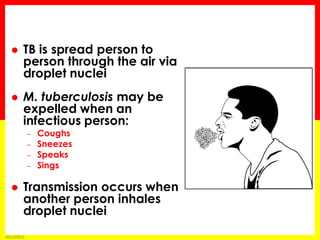
TB is spread person to person through the air via droplet nuclei 
M. tuberculosis may be expelled when an infectious person: 
–Coughs 
–Sneezes 
–Speaks 
–Sings 
Transmission occurs when another person inhales droplet nuclei
Module 1 – Transmission and Pathogenesis of Tuberculosis 
7 
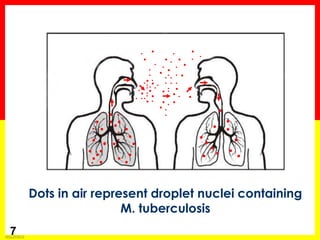
Dots in air represent droplet nuclei containing 
M. tuberculosis
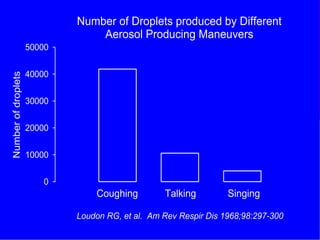
Number of Droplets produced by DifferentAerosol Producing Maneuvers Number of droplets 01000020000300004000050000CoughingTalkingSingingLoudon RG, et al. Am Rev Respir Dis 1968;98:297-300
Characteristics of an infectious patient 
Patient must be able to produce airborne infectious droplets. 
It requires some 5,000 bacilli in 1 ml. of sputum to yield positive a smear, and 10,000 to identify a smear as positive with a 95% probability. 
Patients with a positive smear are by far more infectious than those with a negative one and positive culture. 
Probability of becoming infected varies depending on the distance between source and receptor.
Module 1 – Transmission and Pathogenesis of Tuberculosis 
10 
Probability that TB will be transmitted depends on: Infectiousness of person with TB disease Environment in which exposure occurred Length of exposure Virulence (strength) of the tubercle bacilli 
Not Everyone Exposed Becomes Infected
11 
Infectiousness - 1 
Patients should be considered infectious if they: 
–Are undergoing cough-inducing procedures 
–Have sputum smears positive for acid-fast bacilli (AFB) and: 
Are not receiving treatment 
Have just started treatment, or 
Have a poor clinical or bacterial response to treatment 
–Have cavitary disease 
Extrapulmonary TB patients are not infectious
12 
Infectiousness - 2 
Patients are not considered infectious if they meet all these criteria: 
–Received adequate treatment for 2-3 weeks 
–Favorable clinical response to treatment 
–3 consecutive negative sputum smears results from sputum collected on different days
Extra-pulmonary cases are almost not infectious, unless they have pulmonary tuberculosis as well. 
Individuals with latent tuberculosis infection are not infectious, as they do not have replicating bacteria and cannot transmit the organism. 
Direct sunlight quickly kills tuberculosis bacilli, but they can survive in the dark for several hours. 
13
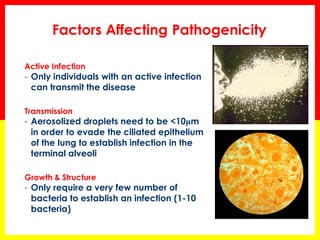
Factors Affecting Pathogenicity 
Active Infection 
-Only individuals with an active infection can transmit the disease Transmission 
-Aerosolized droplets need to be <10μm in order to evade the ciliated epithelium of the lung to establish infection in the terminal alveoli Growth & Structure 
-Only require a very few number of bacteria to establish an infection (1-10 bacteria) 
M. Tuberculosis in sputum (stained in red)
 Tuberculosis is usually spread from person-to- person through the air by droplet nuclei that are produced when a person with pulmonary or laryngeal tuberculosis coughs, sneezes or sings. 
Droplet nuclei may also be produced by aerosol- producing investigations such as sputum induction, bronchoscopy and through manipulation of lesions or processing of tissue or secretions in the laboratory. 
15
The larger droplets containing higher numbers of bacteria do not serve as effective vehicles for TB transmission as they do not remain airborne for long periods. 
If they are inhaled, they do not reach the alveoli because they deposit in the upper airways where they are trapped in the mucous blanket, carried by muco-ciliary action to the oropharynx and swallowed or expectorated. 
16
Micro-droplets, 1 to 5 μm in diameter containing 1-5 bacilli, are highly infectious. 
They can remain suspended in air for long periods of time. These droplets are small enough to reach the alveolar spaces within the lungs, where the organisms replicate. 
17
Exposure Time 
-Most infected individuals expel relatively few bacilli, transmission of TB usually occurs only after prolonged exposure to someone with active TB. 
-On average, 50% of people are likely to become infected with TB if they spend 8hrs/day for six months or 24hrs/day for two months working or living with someone with active TB.
Health of Individuals 
19 
-Active TB typically occur in individuals whose immune systems have been weakened by age, disease, improper nutrition or use of immunosuppresive drugs.
The susceptible individual 
Compromised immune system 
HIV 
Diabetic 
Steroid therapy 
Chemotherapy (cancer) 
Children <5years 
Poor nutrition
The environment 
Presence of someone with active TB disease who is not on effective therapy ( undiagnosed, untreated, non-compliant, unrecognized drug resistance) 
Exposure of susceptible individuals to an infectious person in small enclosed settings 
Inadequate ventilation that results in insufficient dilution or removal of infectious droplet nuclei 
Re-circulation of air containing infectious droplet nuclei
TB Transmission 
4 steps in TB pathogenesis: 
1. Exposure 
2. Infection 
3. Disease 
4. Death
23 
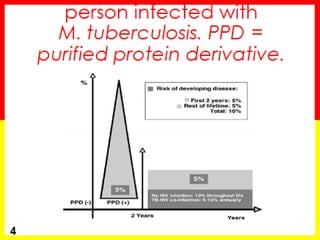
10% of infected persons will develop TB disease at some point in their lives 
– 5% within 1-2 years 
– 5% at some point in their lives
TB Infection
Source of Infection: 
The source of infection can be either: 
Human: Mycobacterium Tuberculosis 
Animal: Mycobacterium Bovis 
Human infection with M bovis has decreased significantly as a result of the pasteurization of milk and effective tuberculosis control amongst cattle.
Tuberculosis can affect most organs in the body, but the lung is the main organ affected. 
If left untreated, each person with smear-positive pulmonary TB will infect, on average, between 10 and 15 persons in each year. 
Those who will be infected with TB will not necessarily get the disease. The immune system “walls off” the TB bacilli, which can lie dormant for years. 
On average, 10 percent of the infected individuals develop the disease during their lifetime. 
When someone’s immune system is weakened, chances of developing TB are increased.
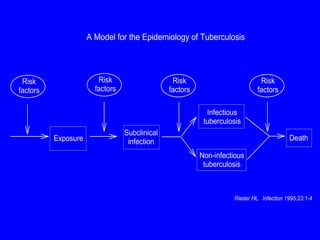
ExposureInfectioustuberculosisNon-infectioustuberculosisDeathRiskfactorsRiskfactorsRiskfactorsRiskfactorsA Model for the Epidemiology of TuberculosisRieder HL. Infection 1995;23:1-4Subclinicalinfection
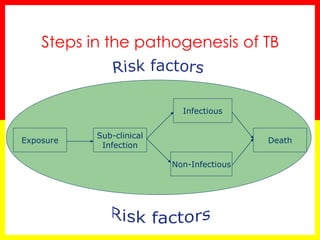
Steps in the pathogenesis of TB 
Exposure 
Sub-clinical Infection 
Non-Infectious 
Infectious 
Death
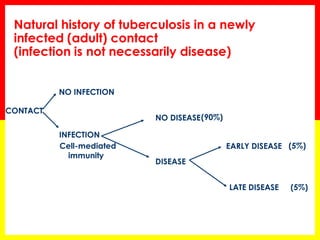
Natural history of tuberculosis in a newly infected (adult) contact (infection is not necessarily disease) 
CONTACT 
NO INFECTION 
INFECTION 
NO DISEASE 
DISEASE 
EARLY DISEASE 
LATE DISEASE 
Cell-mediated 
immunity 
(5%) 
(5%) 
(90%)
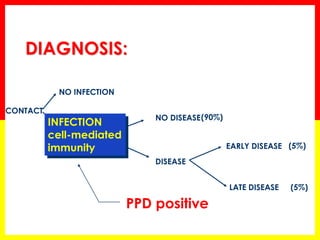
DIAGNOSIS: 
CONTACT 
NO INFECTION 
NO DISEASE 
DISEASE 
EARLY DISEASE 
LATE DISEASE 
(5%) 
(5%) 
(90%) 
INFECTION 
cell-mediated 
immunity 
PPD positive
31
Module 1 – Transmission and Pathogenesis of Tuberculosis 
32 
Occurs when tubercle bacilli are in the body, but the immune system is keeping them under control 
Detected by the Mantoux tuberculin skin test (TST) or by blood tests such as interferon-gamma release assays (IGRAs) which include: 
–QuantiFERON®-TB Gold test (QFT-G) 
–QuantiFERON®-TB Gold In-Tube (QFT-GIT) 
–T-Spot®.TB test (T-SPOT) 
People with LTBI are NOT infectious 
Latent TB Infection (LTBI)
Module 1 – Transmission and Pathogenesis of Tuberculosis 
33 
Develops when immune system cannot keep tubercle bacilli under control 
–May develop very soon after infection or many years after infection 
About 10% of all people with normal immune systems who have LTBI will develop TB disease at some point in their lives 
People with TB disease are often infectious 
TB Disease
34 
TB Disease 
• Occurs when immune system cannot keep bacilli contained 
•Bacilli begin to multiply rapidly 
• Person develops TB symptoms
Natural history of untreated TB 
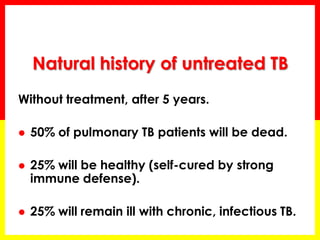
Without treatment, after 5 years. 
50% of pulmonary TB patients will be dead. 
25% will be healthy (self-cured by strong immune defense). 
25% will remain ill with chronic, infectious TB.
Module 1 – Transmission and Pathogenesis of Tuberculosis 
36 
LTBI vs. TB Disease 
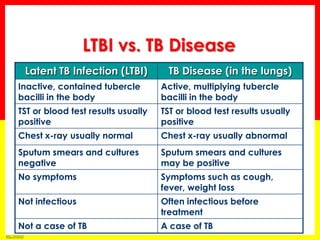
Latent TB Infection (LTBI) 
TB Disease (in the lungs) 
Inactive, contained tubercle bacilli in the body 
Active, multiplying tubercle bacilli in the body 
TST or blood test results usually positive 
Chest x-ray usually normal 
Chest x-ray usually abnormal 
Sputum smears and cultures negative 
Sputum smears and cultures may be positive 
No symptoms 
Symptoms such as cough, fever, weight loss 
Not infectious 
Often infectious before treatment 
Not a case of TB 
A case of TB
37 
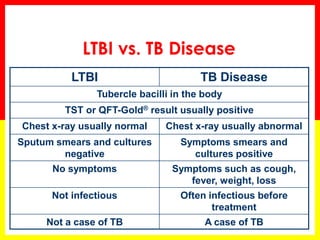
LTBI vs. TB Disease 
LTBI 
TB Disease 
Tubercle bacilli in the body 
TST or QFT-Gold® result usually positive 
Chest x-ray usually normal 
Chest x-ray usually abnormal 
Sputum smears and cultures negative 
Symptoms smears and cultures positive 
No symptoms 
Symptoms such as cough, fever, weight, loss 
Not infectious 
Often infectious before treatment 
Not a case of TB 
A case of TB
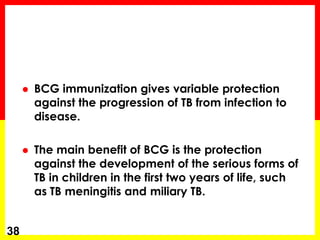
BCG immunization gives variable protection against the progression of TB from infection to disease. 
The main benefit of BCG is the protection against the development of the serious forms of TB in children in the first two years of life, such as TB meningitis and miliary TB. 
38
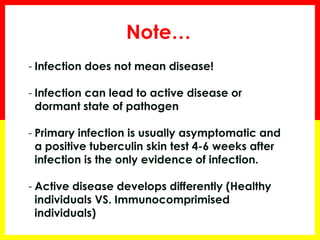
Note… 
-Infection does not mean disease! 
-Infection can lead to active disease or dormant state of pathogen 
-Primary infection is usually asymptomatic and a positive tuberculin skin test 4-6 weeks after infection is the only evidence of infection. 
-Active disease develops differently (Healthy individuals VS. Immunocomprimised individuals)
40 
TB Pathogenesis 
Progression from LTBI to TB Disease
Module 1 – Transmission and Pathogenesis of Tuberculosis 
41 
Infection with HIV 
Chest x-ray findings suggestive of previous TB 
Substance abuse 
Recent TB infection 
Prolonged therapy with corticosteroids and other immunosuppressive therapy, such as prednisone and tumor necrosis factor-alpha [TNF-α] antagonists 
Organ transplant 
Silicosis 
Diabetes mellitus 
Severe kidney disease 
Certain types of cancer 
Certain intestinal conditions 
Low body weight 
Some conditions increase probability of LTBI progressing to TB disease
Module 1 – Transmission and Pathogenesis of Tuberculosis 
42 
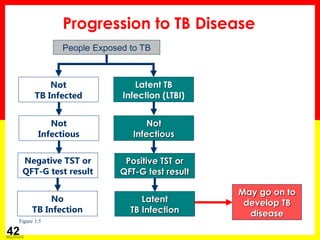
Progression to TB Disease 
People Exposed to TB 
Not TB Infected Latent TB Infection (LTBI) Not Infectious 
Positive TST or QFT-G test result 
Latent TB Infection May go on to develop TB disease 
Not Infectious 
Negative TST or QFT-G test result 
No TB Infection 
Figure 1.5
Module 1 – Transmission and Pathogenesis of Tuberculosis 
43 
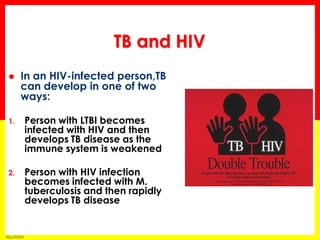
In an HIV-infected person,TB can develop in one of two ways: 
1.Person with LTBI becomes infected with HIV and then develops TB disease as the immune system is weakened 
2.Person with HIV infection becomes infected with M. tuberculosis and then rapidly develops TB disease 
TB and HIV
Module 1 – Transmission and Pathogenesis of Tuberculosis 
44 TB and HIV 
People who are infected with both M. tuberculosis and HIV are much more likely to develop TB disease 
TB infection and NO risk factors 
TB infection and HIV infection 
(pre-Highly Active Antiretroviral Treatment [HAART]) 
Risk is about 5% in the first 2 years after infection and about 10% over a lifetime 
Risk is about 7% to 10% PER YEAR, a very high risk over a lifetime
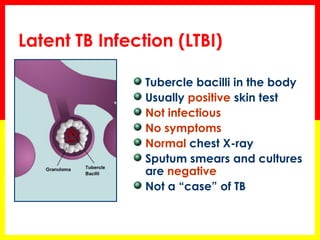
Latent TB Infection (LTBI) Tubercle bacilli in the body Usually positive skin test Not infectious No symptoms Normal chest X-ray Sputum smears and cultures are negative Not a “case” of TB
Tuberculin skin Test (TST) 
When a healthy person is infected for the first time with the tubercle bacilli, the body will develop a specific immune response. This immune reaction (cell-mediated immunity) can be assessed by TST. 
Tuberculin is an antigen produced from dead tubercle bacilli, purified protein derivative PPD of. In the Mantoux test, 0.1 ml of tuberculin is injected intradermally.
Most people infected by M. tuberculosis or vaccinated by BCG will react to TST and develop an induration at the site of injection. 
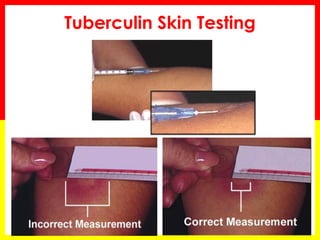
The diameter of this induration is measured after 48 to 72 hours. 
Results are recorded in millimeters. 
47 
Tuberculin skin Test (TST)
Tuberculin Skin Testing
A positive TST is of no diagnostic value for adult TB, but in a non-BCG-vaccinated individual it indicates infection by Mycobacterium, without proof of tuberculosis disease.. 
A negative TST is a fairly good indication that there is no TB infection.
Interpretation of the Tuberculin skin Test: 
According the used cut off point in Egypt 
The TST will be considered positive if the induration diameter is 15 mm or more within the 5 years after BCG vaccination. 
The TST will be considered positive if the diameter of the indurated area is 10 mm or more when there is no history o f BCG vaccination regardless the age or after 5 years of vaccination. 
50
According the used cut off point in Egypt 
If the investigated patient is known to be immune- compromised, the TST will be considered positive if the induration diameter is 5 mm or more at any age. 
51 
Interpretation of the Tuberculin skin Test:
Limitations of TST 
TST will be positive in cases with either infection or active disease, so it cannot differentiate between both conditions. 
TST also cannot differentiate infection with M tuberculosis from other mycobacteria. 
After BCG vaccination, it is not possible to distinguish between a tuberculin skin test reaction caused by virulent mycobacterial infection or by vaccination itself. 
52
False negative Reactions to Tuberculin: 
1. Factors related to the person being tested: 
Infection:- 
A.Viral (HIV, measles, chicken pox). 
B.Bacterial (typhoid fever, brucellosis, typhus, leprosy pertussis, overwhelming TB). 
C.Live virus vaccinations (measles, mumps, polio). 
53
False negative Reactions to Tuberculin: 
1. Factors related to the person being tested: 
Metabolic derangements (chronic renal failure). 
Nutritional factors (severe protein depletion). 
Disease affecting lymphoid organs (Hodgkin’s disease, lymphoma, sarcoidosis) 
Age (newly born). 
Recent or overwhelming infection with M. tuberculosis. 
 Stress (surgery, burns…etc). 
54
2. Factors related to the tuberculin used: 
• Improper storage (physical denaturation: exposure to light and heat). 
• Improper dilutions. 
• Chemical denaturation. 
• Contamination. 
55 
False negative Reactions to Tuberculin:
3. Factors related to the method of administration: 
• Injection of too little antigen. , 
• Delayed administration after drawing into syringe. 
• Injection too deep 
56 
False negative Reactions to Tuberculin:
4. Factors related to reading the test and recording results: 
• Inexperienced reading. 
• Error in reading 
57 
False negative Reactions to Tuberculin:
58 
TB Pathogenesis 
Sites of TB Disease
Module 1 – Transmission and Pathogenesis of Tuberculosis 
59 
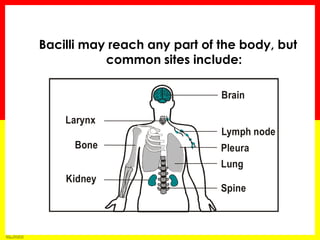
Bacilli may reach any part of the body, but common sites include: 
BrainLymph nodePleuraLungSpineKidneyBoneLarynx
Module 1 – Transmission and Pathogenesis of Tuberculosis 
60 
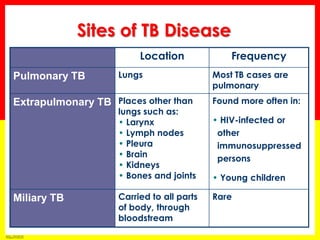
Sites of TB Disease 
Location 
Frequency 
Pulmonary TB 
Lungs 
Most TB cases are pulmonary 
Extrapulmonary TB 
Places other than lungs such as: 
• Larynx 
• Lymph nodes 
• Pleura 
• Brain 
• Kidneys 
• Bones and joints 
Found more often in: 
• HIV-infected or 
other 
immunosuppressed 
persons 
• Young children 
Miliary TB 
Carried to all parts of body, through bloodstream 
Rare
Module 1 – Transmission and Pathogenesis of Tuberculosis 
61 
Question 
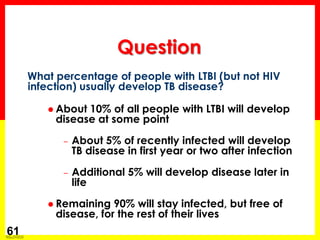
What percentage of people with LTBI (but not HIV infection) usually develop TB disease? 
About 10% of all people with LTBI will develop disease at some point 
–About 5% of recently infected will develop TB disease in first year or two after infection 
–Additional 5% will develop disease later in life 
Remaining 90% will stay infected, but free of disease, for the rest of their lives
Module 1 – Transmission and Pathogenesis of Tuberculosis 
62 
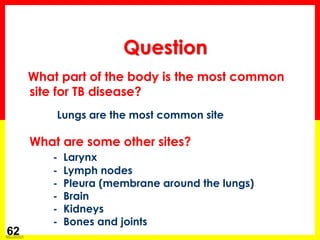
What part of the body is the most common 
site for TB disease? 
Lungs are the most common site 
What are some other sites? 
- Larynx 
- Lymph nodes 
- Pleura (membrane around the lungs) 
- Brain 
- Kidneys 
- Bones and joints 
Question
Module 1 – Transmission and Pathogenesis of Tuberculosis 
63 
Case Study 
A 30-year-old man visits the health department for a TST because he is required to have one before starting his new job as a health care worker. He has an 18mm positive reaction to the TST. He has no symptoms of TB, and his chest x-ray findings are normal.
Module 1 – Transmission and Pathogenesis of Tuberculosis 
64 
Should this be considered a case of TB? 
No. The man described above has TB infection. He has an 18mm positive reaction to TST, but no evidence of TB disease. Therefore, this is not a case of TB. 
Should this man be considered infectious? 
No, he should not be considered infectious. This man has LTBI, not TB disease. People with TB infection and no evidence of TB disease are not infectious.
Tb transmission

Tb transmission

  • 2.
    Dr. Ashraf ElAdawy Consultant Chest Physician TB TEAM EXPERT – WHO Mansoura-Egypt Basic concepts of Tuberculosis
  • 3.
    What is Tuberculosis Tuberculosis (TB) is an infectious granulomatous disease caused by Mycobacterium tuberculosis human type or rarely M. bovis. TB disease most often affects the lungs, but can occur anywhere in the body.
  • 4.
  • 5.
    Module 1 –Transmission and Pathogenesis of Tuberculosis 5 M. tuberculosis causes most TB cases . Mycobacteria that cause TB: –M. tuberculosis –M. bovis –M. africanum –M. microti –M. canetti Mycobacteria that do not cause TB –e.g., M. avium complex M. tuberculosis Types of Mycobacteria
  • 6.
    Module 1 –Transmission and Pathogenesis of Tuberculosis 6 TB is spread person to person through the air via droplet nuclei M. tuberculosis may be expelled when an infectious person: –Coughs –Sneezes –Speaks –Sings Transmission occurs when another person inhales droplet nuclei
  • 7.
    Module 1 –Transmission and Pathogenesis of Tuberculosis 7 Dots in air represent droplet nuclei containing M. tuberculosis
  • 8.
    Number of Dropletsproduced by DifferentAerosol Producing Maneuvers Number of droplets 01000020000300004000050000CoughingTalkingSingingLoudon RG, et al. Am Rev Respir Dis 1968;98:297-300
  • 9.
    Characteristics of aninfectious patient Patient must be able to produce airborne infectious droplets. It requires some 5,000 bacilli in 1 ml. of sputum to yield positive a smear, and 10,000 to identify a smear as positive with a 95% probability. Patients with a positive smear are by far more infectious than those with a negative one and positive culture. Probability of becoming infected varies depending on the distance between source and receptor.
  • 10.
    Module 1 –Transmission and Pathogenesis of Tuberculosis 10 Probability that TB will be transmitted depends on: Infectiousness of person with TB disease Environment in which exposure occurred Length of exposure Virulence (strength) of the tubercle bacilli Not Everyone Exposed Becomes Infected
  • 11.
    11 Infectiousness -1 Patients should be considered infectious if they: –Are undergoing cough-inducing procedures –Have sputum smears positive for acid-fast bacilli (AFB) and: Are not receiving treatment Have just started treatment, or Have a poor clinical or bacterial response to treatment –Have cavitary disease Extrapulmonary TB patients are not infectious
  • 12.
    12 Infectiousness -2 Patients are not considered infectious if they meet all these criteria: –Received adequate treatment for 2-3 weeks –Favorable clinical response to treatment –3 consecutive negative sputum smears results from sputum collected on different days
  • 13.
    Extra-pulmonary cases arealmost not infectious, unless they have pulmonary tuberculosis as well. Individuals with latent tuberculosis infection are not infectious, as they do not have replicating bacteria and cannot transmit the organism. Direct sunlight quickly kills tuberculosis bacilli, but they can survive in the dark for several hours. 13
  • 14.
    Factors Affecting Pathogenicity Active Infection -Only individuals with an active infection can transmit the disease Transmission -Aerosolized droplets need to be <10μm in order to evade the ciliated epithelium of the lung to establish infection in the terminal alveoli Growth & Structure -Only require a very few number of bacteria to establish an infection (1-10 bacteria) M. Tuberculosis in sputum (stained in red)
  • 15.
     Tuberculosis isusually spread from person-to- person through the air by droplet nuclei that are produced when a person with pulmonary or laryngeal tuberculosis coughs, sneezes or sings. Droplet nuclei may also be produced by aerosol- producing investigations such as sputum induction, bronchoscopy and through manipulation of lesions or processing of tissue or secretions in the laboratory. 15
  • 16.
    The larger dropletscontaining higher numbers of bacteria do not serve as effective vehicles for TB transmission as they do not remain airborne for long periods. If they are inhaled, they do not reach the alveoli because they deposit in the upper airways where they are trapped in the mucous blanket, carried by muco-ciliary action to the oropharynx and swallowed or expectorated. 16
  • 17.
    Micro-droplets, 1 to5 μm in diameter containing 1-5 bacilli, are highly infectious. They can remain suspended in air for long periods of time. These droplets are small enough to reach the alveolar spaces within the lungs, where the organisms replicate. 17
  • 18.
    Exposure Time -Mostinfected individuals expel relatively few bacilli, transmission of TB usually occurs only after prolonged exposure to someone with active TB. -On average, 50% of people are likely to become infected with TB if they spend 8hrs/day for six months or 24hrs/day for two months working or living with someone with active TB.
  • 19.
    Health of Individuals 19 -Active TB typically occur in individuals whose immune systems have been weakened by age, disease, improper nutrition or use of immunosuppresive drugs.
  • 20.
    The susceptible individual Compromised immune system HIV Diabetic Steroid therapy Chemotherapy (cancer) Children <5years Poor nutrition
  • 21.
    The environment Presenceof someone with active TB disease who is not on effective therapy ( undiagnosed, untreated, non-compliant, unrecognized drug resistance) Exposure of susceptible individuals to an infectious person in small enclosed settings Inadequate ventilation that results in insufficient dilution or removal of infectious droplet nuclei Re-circulation of air containing infectious droplet nuclei
  • 22.
    TB Transmission 4steps in TB pathogenesis: 1. Exposure 2. Infection 3. Disease 4. Death
  • 23.
    23 10% ofinfected persons will develop TB disease at some point in their lives – 5% within 1-2 years – 5% at some point in their lives
  • 24.
  • 25.
    Source of Infection: The source of infection can be either: Human: Mycobacterium Tuberculosis Animal: Mycobacterium Bovis Human infection with M bovis has decreased significantly as a result of the pasteurization of milk and effective tuberculosis control amongst cattle.
  • 26.
    Tuberculosis can affectmost organs in the body, but the lung is the main organ affected. If left untreated, each person with smear-positive pulmonary TB will infect, on average, between 10 and 15 persons in each year. Those who will be infected with TB will not necessarily get the disease. The immune system “walls off” the TB bacilli, which can lie dormant for years. On average, 10 percent of the infected individuals develop the disease during their lifetime. When someone’s immune system is weakened, chances of developing TB are increased.
  • 27.
    ExposureInfectioustuberculosisNon-infectioustuberculosisDeathRiskfactorsRiskfactorsRiskfactorsRiskfactorsA Model forthe Epidemiology of TuberculosisRieder HL. Infection 1995;23:1-4Subclinicalinfection
  • 28.
    Steps in thepathogenesis of TB Exposure Sub-clinical Infection Non-Infectious Infectious Death
  • 29.
    Natural history oftuberculosis in a newly infected (adult) contact (infection is not necessarily disease) CONTACT NO INFECTION INFECTION NO DISEASE DISEASE EARLY DISEASE LATE DISEASE Cell-mediated immunity (5%) (5%) (90%)
  • 30.
    DIAGNOSIS: CONTACT NOINFECTION NO DISEASE DISEASE EARLY DISEASE LATE DISEASE (5%) (5%) (90%) INFECTION cell-mediated immunity PPD positive
  • 31.
  • 32.
    Module 1 –Transmission and Pathogenesis of Tuberculosis 32 Occurs when tubercle bacilli are in the body, but the immune system is keeping them under control Detected by the Mantoux tuberculin skin test (TST) or by blood tests such as interferon-gamma release assays (IGRAs) which include: –QuantiFERON®-TB Gold test (QFT-G) –QuantiFERON®-TB Gold In-Tube (QFT-GIT) –T-Spot®.TB test (T-SPOT) People with LTBI are NOT infectious Latent TB Infection (LTBI)
  • 33.
    Module 1 –Transmission and Pathogenesis of Tuberculosis 33 Develops when immune system cannot keep tubercle bacilli under control –May develop very soon after infection or many years after infection About 10% of all people with normal immune systems who have LTBI will develop TB disease at some point in their lives People with TB disease are often infectious TB Disease
  • 34.
    34 TB Disease • Occurs when immune system cannot keep bacilli contained •Bacilli begin to multiply rapidly • Person develops TB symptoms
  • 35.
    Natural history ofuntreated TB Without treatment, after 5 years. 50% of pulmonary TB patients will be dead. 25% will be healthy (self-cured by strong immune defense). 25% will remain ill with chronic, infectious TB.
  • 36.
    Module 1 –Transmission and Pathogenesis of Tuberculosis 36 LTBI vs. TB Disease Latent TB Infection (LTBI) TB Disease (in the lungs) Inactive, contained tubercle bacilli in the body Active, multiplying tubercle bacilli in the body TST or blood test results usually positive TST or blood test results usually positive Chest x-ray usually normal Chest x-ray usually abnormal Sputum smears and cultures negative Sputum smears and cultures may be positive No symptoms Symptoms such as cough, fever, weight loss Not infectious Often infectious before treatment Not a case of TB A case of TB
  • 37.
    37 LTBI vs.TB Disease LTBI TB Disease Tubercle bacilli in the body TST or QFT-Gold® result usually positive Chest x-ray usually normal Chest x-ray usually abnormal Sputum smears and cultures negative Symptoms smears and cultures positive No symptoms Symptoms such as cough, fever, weight, loss Not infectious Often infectious before treatment Not a case of TB A case of TB
  • 38.
    BCG immunization givesvariable protection against the progression of TB from infection to disease. The main benefit of BCG is the protection against the development of the serious forms of TB in children in the first two years of life, such as TB meningitis and miliary TB. 38
  • 39.
    Note… -Infection doesnot mean disease! -Infection can lead to active disease or dormant state of pathogen -Primary infection is usually asymptomatic and a positive tuberculin skin test 4-6 weeks after infection is the only evidence of infection. -Active disease develops differently (Healthy individuals VS. Immunocomprimised individuals)
  • 40.
    40 TB Pathogenesis Progression from LTBI to TB Disease
  • 41.
    Module 1 –Transmission and Pathogenesis of Tuberculosis 41 Infection with HIV Chest x-ray findings suggestive of previous TB Substance abuse Recent TB infection Prolonged therapy with corticosteroids and other immunosuppressive therapy, such as prednisone and tumor necrosis factor-alpha [TNF-α] antagonists Organ transplant Silicosis Diabetes mellitus Severe kidney disease Certain types of cancer Certain intestinal conditions Low body weight Some conditions increase probability of LTBI progressing to TB disease
  • 42.
    Module 1 –Transmission and Pathogenesis of Tuberculosis 42 Progression to TB Disease People Exposed to TB Not TB Infected Latent TB Infection (LTBI) Not Infectious Positive TST or QFT-G test result Latent TB Infection May go on to develop TB disease Not Infectious Negative TST or QFT-G test result No TB Infection Figure 1.5
  • 43.
    Module 1 –Transmission and Pathogenesis of Tuberculosis 43 In an HIV-infected person,TB can develop in one of two ways: 1.Person with LTBI becomes infected with HIV and then develops TB disease as the immune system is weakened 2.Person with HIV infection becomes infected with M. tuberculosis and then rapidly develops TB disease TB and HIV
  • 44.
    Module 1 –Transmission and Pathogenesis of Tuberculosis 44 TB and HIV People who are infected with both M. tuberculosis and HIV are much more likely to develop TB disease TB infection and NO risk factors TB infection and HIV infection (pre-Highly Active Antiretroviral Treatment [HAART]) Risk is about 5% in the first 2 years after infection and about 10% over a lifetime Risk is about 7% to 10% PER YEAR, a very high risk over a lifetime
  • 45.
    Latent TB Infection(LTBI) Tubercle bacilli in the body Usually positive skin test Not infectious No symptoms Normal chest X-ray Sputum smears and cultures are negative Not a “case” of TB
  • 46.
    Tuberculin skin Test(TST) When a healthy person is infected for the first time with the tubercle bacilli, the body will develop a specific immune response. This immune reaction (cell-mediated immunity) can be assessed by TST. Tuberculin is an antigen produced from dead tubercle bacilli, purified protein derivative PPD of. In the Mantoux test, 0.1 ml of tuberculin is injected intradermally.
  • 47.
    Most people infectedby M. tuberculosis or vaccinated by BCG will react to TST and develop an induration at the site of injection. The diameter of this induration is measured after 48 to 72 hours. Results are recorded in millimeters. 47 Tuberculin skin Test (TST)
  • 48.
  • 49.
    A positive TSTis of no diagnostic value for adult TB, but in a non-BCG-vaccinated individual it indicates infection by Mycobacterium, without proof of tuberculosis disease.. A negative TST is a fairly good indication that there is no TB infection.
  • 50.
    Interpretation of theTuberculin skin Test: According the used cut off point in Egypt The TST will be considered positive if the induration diameter is 15 mm or more within the 5 years after BCG vaccination. The TST will be considered positive if the diameter of the indurated area is 10 mm or more when there is no history o f BCG vaccination regardless the age or after 5 years of vaccination. 50
  • 51.
    According the usedcut off point in Egypt If the investigated patient is known to be immune- compromised, the TST will be considered positive if the induration diameter is 5 mm or more at any age. 51 Interpretation of the Tuberculin skin Test:
  • 52.
    Limitations of TST TST will be positive in cases with either infection or active disease, so it cannot differentiate between both conditions. TST also cannot differentiate infection with M tuberculosis from other mycobacteria. After BCG vaccination, it is not possible to distinguish between a tuberculin skin test reaction caused by virulent mycobacterial infection or by vaccination itself. 52
  • 53.
    False negative Reactionsto Tuberculin: 1. Factors related to the person being tested: Infection:- A.Viral (HIV, measles, chicken pox). B.Bacterial (typhoid fever, brucellosis, typhus, leprosy pertussis, overwhelming TB). C.Live virus vaccinations (measles, mumps, polio). 53
  • 54.
    False negative Reactionsto Tuberculin: 1. Factors related to the person being tested: Metabolic derangements (chronic renal failure). Nutritional factors (severe protein depletion). Disease affecting lymphoid organs (Hodgkin’s disease, lymphoma, sarcoidosis) Age (newly born). Recent or overwhelming infection with M. tuberculosis.  Stress (surgery, burns…etc). 54
  • 55.
    2. Factors relatedto the tuberculin used: • Improper storage (physical denaturation: exposure to light and heat). • Improper dilutions. • Chemical denaturation. • Contamination. 55 False negative Reactions to Tuberculin:
  • 56.
    3. Factors relatedto the method of administration: • Injection of too little antigen. , • Delayed administration after drawing into syringe. • Injection too deep 56 False negative Reactions to Tuberculin:
  • 57.
    4. Factors relatedto reading the test and recording results: • Inexperienced reading. • Error in reading 57 False negative Reactions to Tuberculin:
  • 58.
    58 TB Pathogenesis Sites of TB Disease
  • 59.
    Module 1 –Transmission and Pathogenesis of Tuberculosis 59 Bacilli may reach any part of the body, but common sites include: BrainLymph nodePleuraLungSpineKidneyBoneLarynx
  • 60.
    Module 1 –Transmission and Pathogenesis of Tuberculosis 60 Sites of TB Disease Location Frequency Pulmonary TB Lungs Most TB cases are pulmonary Extrapulmonary TB Places other than lungs such as: • Larynx • Lymph nodes • Pleura • Brain • Kidneys • Bones and joints Found more often in: • HIV-infected or other immunosuppressed persons • Young children Miliary TB Carried to all parts of body, through bloodstream Rare
  • 61.
    Module 1 –Transmission and Pathogenesis of Tuberculosis 61 Question What percentage of people with LTBI (but not HIV infection) usually develop TB disease? About 10% of all people with LTBI will develop disease at some point –About 5% of recently infected will develop TB disease in first year or two after infection –Additional 5% will develop disease later in life Remaining 90% will stay infected, but free of disease, for the rest of their lives
  • 62.
    Module 1 –Transmission and Pathogenesis of Tuberculosis 62 What part of the body is the most common site for TB disease? Lungs are the most common site What are some other sites? - Larynx - Lymph nodes - Pleura (membrane around the lungs) - Brain - Kidneys - Bones and joints Question
  • 63.
    Module 1 –Transmission and Pathogenesis of Tuberculosis 63 Case Study A 30-year-old man visits the health department for a TST because he is required to have one before starting his new job as a health care worker. He has an 18mm positive reaction to the TST. He has no symptoms of TB, and his chest x-ray findings are normal.
  • 64.
    Module 1 –Transmission and Pathogenesis of Tuberculosis 64 Should this be considered a case of TB? No. The man described above has TB infection. He has an 18mm positive reaction to TST, but no evidence of TB disease. Therefore, this is not a case of TB. Should this man be considered infectious? No, he should not be considered infectious. This man has LTBI, not TB disease. People with TB infection and no evidence of TB disease are not infectious.