INFLUENZA
BRIG (DR) HEMANT KUMAR
8/15/2016 2HEMANT KUMAR
INTRODUCTION
Influenza, commonly referred to as the flu, is
an infectious viral disease caused by RNA
viruses of the family Ortho-myxoviridae (the
influenza viruses), that
affects birds and mammals.
Common symptoms are chills, fever, sore
throat, muscle pains, severe headache, coughing,
fatigue and general discomfort.
Although confused with other influenza-like
illnesses, especially the common cold, influenza is
a more severe disease .
8/15/2016 3HEMANT KUMAR
DEFINITION
WHO : Influenza is a viral infection that
affects mainly the nose, throat, bronchi
and, occasionally, lungs. Infection
usually lasts for about a week, and is
characterized by sudden onset of high
fever, aching muscles, headache and
severe malaise, non-productive cough,
sore throat and rhinitis.
8/15/2016 4HEMANT KUMAR
HISTORY
Influenza can be traced as far back as 400 BC
In Hippocrates’ Of the Epidemics, he describes a cough
outbreak that occurred in 412 BC in modern-day Turkey at the turn of
the autumn season
17th century:-
• Between 1781-1782, an influenza epidemic infected 2/3 of Rome’s
population and ¾ of Britain’s population. Later, disease spread to
North America, West Indies, and South America. Spread of pandemic
culminated in New England, New York, and Nova Scotia in 1789.
• 1781 marked the beginning of the of influenza epidemics and
pandemics
8/15/2016 5HEMANT KUMAR
8/15/2016 6HEMANT KUMAR
American Red Cross nurses keep the flu patients in
temporary wards set up inside the Oakland municipal
Auditorium.
8/15/2016 7HEMANT KUMAR
EPIDEMILOGICAL
DETERMINANTS
8/15/2016 8HEMANT KUMAR
AGENT
 Influenza viruses are classified within the
family of Ortho-myxoviridae.
 There are three viral sub–types, namely
influenza type A, type B and type C.
 These three viruses are antigenically distinct.
There is no cross–immunity between them.
 Of importance are the influenza A and B
viruses which are responsible for epidemics
of disease throughout the world.
8/15/2016 9HEMANT KUMAR
CONTD..
I. Both influenza A and B viruses have two
distinct surface antigens – the
Hemoglutinin (H) and the
Neuraminidase (N) antigens.
II. The H antigen initiates infection
following attachment of the virus to
susceptible cells. The N antigen is
responsible for the release of the
virus from the infected cell.
8/15/2016 10HEMANT KUMAR
I. The influenza A virus is unique among
the viruses because it is frequently
subject virus to antigenic variation, both
major and minor.
I. When there is a sudden, complete or
major change, it is called a shift, and
when the antigenic change is gradual,
over a period of time, it is called a drift..
8/15/2016 11HEMANT KUMAR
CONTD...
Antigenic shift appears to result from
genetic recombination of human with
animal or avian virus, providing a
major antigenic change.
This can cause a major epidemic or
pandemic involving most or all age
groups.
8/15/2016 12HEMANT KUMAR
CONTD...
Antigenic drift involves “Point
mutation” in the gene owing to
selection pressure by immunity in the
host population.
Antigenic changes occur to a lesser
degree in the B group influenza
viruses. Influenza C appears to be
antigenically stable.
8/15/2016 13HEMANT KUMAR
• Since the isolation of the virus A in 1933,
major antigenic changes have occurred twice
– once in 1957 (H2N2) and then again in
1968 (H3N2).
• Strains occurring between 1946 and 1957
have been called H1N1 strains. The shift in
1968 involved only the H antigen.
• In 1977, a new antigenic type appeared in
China and the USSR and the virus was
identified as A (H1N1). Within a year, it had
been isolated in countries all over the world.
8/15/2016 14HEMANT KUMAR
• Curiously, this was an earlier virus which
has appeared after a lapse of over 20
years.
• In the past, the emergence of a new,
influenza A sub–type led to the prompt
disappearance of the previously prevalent
sub–type. In the 1977 episode, however,
this did not happen.
8/15/2016 15HEMANT KUMAR
The prevailing A (H3N2) was not displaced.
Dual infection with both viruses were
reported.
As of now, three types of influenza viruses
– A (H1N1), A (H3N2) and B exist.
Influenza viruses of the H1N1 sub–type
have caused epidemics of the disease in
two periods of this century – from about
1946 up until 1957, and from 1977 until the
present.
8/15/2016 16HEMANT KUMAR
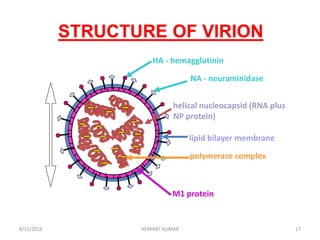
STRUCTURE OF VIRION
M1 protein
helical nucleocapsid (RNA plus
NP protein)
HA - hemagglutinin
polymerase complex
lipid bilayer membrane
NA - neuraminidase
100 n m
Influenza virions are SMALL. The average eukaryotic cell diameter is 10,000 nm
(10 microns), which is 100 times bigger than the influenza virion diameter.
8/15/2016 17HEMANT KUMAR
8/15/2016 18HEMANT KUMAR
RESERVOIR OF INFECTION
It has become increasingly evident that
a major reservoir of influenza virus
exists in animals and birds.
Many influenza viruses have been
isolated from a wide variety of animals
and birds (e.g. swine, horses, dogs,
cats, domestic poultry, wild birds, etc.)
8/15/2016 19HEMANT KUMAR
CONTD...
Some of these include the major H and
N antigens related to human strains.
There is increasing evidence that the
animal reservoir provides new strains of
the influenza virus by recombination
between the influenza viruses of man,
animals and birds.
8/15/2016 20HEMANT KUMAR
SOURCE OF INFECTION
The source of infection usually is a case
or sub–clinical case.
During epidemics, a large number of mild
and asymptomatic infections occur, which
play an important role in the spread of
infection.
The secretions of the respiratory tract are
infective.
8/15/2016 21HEMANT KUMAR
PERIOD OF INFECTIVITY
The virus is
present in the
naso-pharynx a
couple of days
before and a
couple of days
after the onset of
symptoms.
8/15/2016 22HEMANT KUMAR
HOST FACTORS
8/15/2016 23HEMANT KUMAR
AGE AND SEX
o Influenza affects all ages and people of both
sexes. In general, the attack rate is lower
among adults. Children constitute an
important link in the transmission chain.
o The highest mortality rate during an epidemic
occurs among certain high–risk groups in the
population such as old people (generally over
65 years of age), infants under 18 months,
and persons with diabetes or chronic heart
disease, kidney and respiratory ailments.
8/15/2016 24HEMANT KUMAR
HUMAN MOBILITY
This is an important factor in the spread of the
infection.
8/15/2016 25HEMANT KUMAR
IMMUNITY
Antibodies appear in about seven days
after an attack and reach a maximum
level in about two weeks. After about 8
to 12 months, antibody levels drop to
pre–infection levels.
The antibody to H neutralizes the virus
while the antibody to N modifies the
infection.
8/15/2016 26HEMANT KUMAR
CONTD...
Secondary antibodies develop in the
respiratory tract after infection and
consist predominantly of lgG.
Antibodies must be present in sufficient
concentrations at the superficial cells (the
site of virus invasion) of the respiratory
tract.
8/15/2016 27HEMANT KUMAR
ENVIRONMENTAL FACTORS OF INFLUENZA
Season
The seasonal incidence is striking, epidemics usually
occur in the winter months in the northern
hemisphere. In India, however, epidemics have
often occurred in summer
Overcrowding
Overcrowding enhances transmission of the
infection. The attack rates are high in closed
population groups e.g. schools, institutions, ships,
etc.
8/15/2016 28HEMANT KUMAR
INCUBATION PERIOD FOR INFLUENZA
The incubation period is about 18 to 72 hours.
8/15/2016 29HEMANT KUMAR
PATHOGENESIS
 The virus enters the respiratory tract and
causes inflammation and necrosis of the
superficial epithelium of the tracheal
and bronchial mucosa, followed by
secondary bacterial invasion.
There is no viraemia.
8/15/2016 30HEMANT KUMAR
SIGNS AND SYMPTOMS
Symptoms begin 1-4 days after infection.
The following symptoms of the flu can vary
depending on the type of virus, a person’s age and
overall health:
• Sudden onset of chills and fever (101 – 103 F)
• Sore throat, dry cough
• Fatigue, malaise
• Terrible muscle aches, headaches
• Diarrhea
• Dizziness
Contd.....
Both viruses cause the same symptoms.
Fever lasts from one to five days,
averaging about three days in adults.
The most dreaded complication is
pneumonia, which should be suspected
if fever persists beyond four or five days,
or recurs abruptly after convalescence.
8/15/2016 32HEMANT KUMAR
COMPLICATIONS IN CHILDREN
Studies show a link between the
development of Reye’s syndrome and the
use of aspirin for relieving fevers caused by
the influenza virus.
The disease involves the CNS and the liver
and children exhibit symptoms of
drowsiness, persistent vomiting and change
in personality.
8/15/2016 33HEMANT KUMAR
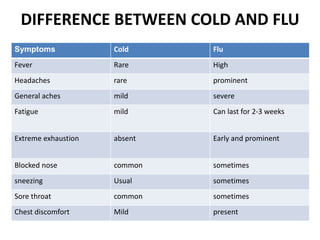
DIFFERENCE BETWEEN COLD AND FLU
Symptoms Cold Flu
Fever Rare High
Headaches rare prominent
General aches mild severe
Fatigue mild Can last for 2-3 weeks
Extreme exhaustion absent Early and prominent
Blocked nose common sometimes
sneezing Usual sometimes
Sore throat common sometimes
Chest discomfort Mild present
DIAGNOSIS
OF
INFLUENZA
8/15/2016 35HEMANT KUMAR
1. VIRUS ISOLATION
 Nasopharyngeal secretions are the best
specimens for obtaining large quantities of
virus–infected cells.
 The virus can be detected by the indirect
fluorescent antibody technique.
 However, egg inoculation is required for virus
isolation and antigenic analysis.
8/15/2016 36HEMANT KUMAR
2. Paired Sera
A sero diagnosis of influenza A or B can be made by the
examination of two serum specimens from a patient. One
taken as early as possible in the acute phase of the
disease (not later than the fifth day), and another taken
about 10 to 14 days after the onset, i.e. the convalescent
stage of illness.
The titer of influenza antibodies in the human sera is so
variable that only by detecting a rise in Complement Fixing
(CF) antibodies during the course of illness, can a diagnosis
be established. Hence, the need for two specimens.
Fourfold or greater rise in titer are considered diagnostic of
infection.
8/15/2016 37HEMANT KUMAR
In India, facilities for isolation of the
influenza virus are available at:-
1. Government of India Influenza Center, Pasteur
Institute, Coonoor, South India.
2. Haskine Institute, Mumbai.
3. School of Tropical Medicine, Calcutta
4. All India Institute of Medical Sciences, New
Delhi.
1. Vallabhbhai Patel Chest Institute, Delhi,
2. & Armed Forces Medical College, Pune.
8/15/2016 38HEMANT KUMAR
RAPID INFLUENZA TESTS
These tests are 70% accurate for determining if
the patient has been infected with the influenza
virus and 90% accurate for determining the type
of influenza pathogen.
Examples of rapid influenza tests: Directigen
Flu A, Directigen Flu A + B, Flu OIA, Quick Vue,
and Zstat flu.
Rapid influenza tests provide results in 24 hours
and can be performed in the physician’s office.
ANTI-VIRAL DRUGS
All anti-viral drugs inhibit viral replication but they act in different
ways to achieve this. Drugs that are effective against influenza A
viruses: amantadine and rimantadine.Drugs that are effective
against influenza A viruses and influenza B viruses: zanamivir and
oseltamivir.
Amantadine Rimantadine Zanamivir Oseltamivir
Type of Influenza virus infection
indicated for use
Influenza A Influenza A
Influenza A
Influenza B
Influenza A
Influenza B
Administration oral oral oral inhalation oral
Ages approved for treatment of
flu
1 year 14 year 7 years 18 years
Ages approved for prevention
of flu
1 year 1 year not approved not approved
8/15/2016 40HEMANT KUMAR
8/15/2016 41HEMANT KUMAR
SYMPTOMATIC DRUGS
OTC medicines provide relief for 'flu symptoms
Symptom(s) OTC Medicine
fever, ache,
pains, sinus pressure, sore
throat
analgesics
nasal congestion, sinus
pressure
decongestants
sinus pressure, runny
nose, watery eyes, cough
antihistamines
cough cough suppressant
sore throat local anaesthetics
PREVENTION
OF
INFLUENZA
8/15/2016 43HEMANT KUMAR
The only proven method for preventing influenza
is a yearly vaccination approximately 2 weeks
before the “flu season” begins.
Since the influenza virus is subject to genetic
mutations with the HA and NA proteins, new
vaccines that consist of different influenza
strains need to be developed each year.
Vaccine is trivalent, meaning that it provides
resistance to three strains of influenza viruses.
The vaccine consists of 2 influenza A virus
pathogens and 1 influenza B pathogen.
• Since influenza vaccines will not control
epidemics, they are recommended only in certain
select population groups – e.g. in industry, to
reduce absenteeism and in public services, to
prevent disruption of critical public services such
as the police, fire protection, transport and
medical care.
• Moreover, certain groups e.g. the elderly and
individuals in any age group who have a known
underlying chronic or debilitating disease are
selectively immunized because of the high risk of
severe complications including death.
8/15/2016 45HEMANT KUMAR
INFLUENZA
VACCINES
8/15/2016 46HEMANT KUMAR
KILLED VACCINES
Most influenza vaccination programs make
use of inactivated vaccines.
Subcutaneous route. A single inoculation
(0.5ml) is usually given. However, in persons
with no previous immunological experience
two doses of the vaccine, separated by an
interval of three to four weeks are considered
necessary to induce satisfactory antibody
levels
8/15/2016 47HEMANT KUMAR
• The protective value of the vaccine varies between
70 to 90 per cent and immunity lasts for only three
to six months. Re–vaccination on an annual basis
is recommended.
• The killed vaccine can produce fever, local
inflammation at the site of injection, and very
rarely Guillain–Barre syndrome (an ascending
paralysis).
• Since the vaccine strains are grown in eggs,
persons allergic to eggs may develop the
symptoms and signs of hypersensitivity.
8/15/2016 48HEMANT KUMAR
LIVE ATTENUATED VACCINES
Live attenuated vaccines based on
temperature–sensitive (ts) mutants have been
extensively used in the USSR. They may be
administered as “Nose drops” into the
respiratory tract.
They stimulate local as well as systemic
immunity. The frequent antigenic mutations
of the influenza virus present difficulties in
the production of effective vaccines,
particularly live vaccines.
8/15/2016 49HEMANT KUMAR
NEWER VACCINES
Split–virus Vaccine
It is also known as the sub–virion vaccine. It
is a highly purified vaccine, producing
fewer side effects than the “Whole virus”
vaccine. Due to its lower antigenicity, it
requires several injections instead of a
single one. It is recommended for children.
8/15/2016 50HEMANT KUMAR
NEURAMINIDASE–SPECIFIC VACCINE
It is a sub–unit vaccine containing only
the N antigen, which induces antibodies
only to the neuraminidase antigen of
the prevailing influenza virus.
The antibody to neuraminidase reduces
both the amount of virus replicating in
the respiratory tract and the ability to
transmit virus to contacts.
8/15/2016 51HEMANT KUMAR
RECOMBINANT VACCINE
By recombinant
techniques, the
desirable antigenic
properties of a virulent
strain can be
transferred to another
strain known to be of
low virulence. Efforts
to improve the
influenza vaccine have
been continuing.
8/15/2016 52HEMANT KUMAR
8/15/2016 53HEMANT KUMAR
Influenza

Influenza

  • 1.
  • 2.
  • 3.
    INTRODUCTION Influenza, commonly referredto as the flu, is an infectious viral disease caused by RNA viruses of the family Ortho-myxoviridae (the influenza viruses), that affects birds and mammals. Common symptoms are chills, fever, sore throat, muscle pains, severe headache, coughing, fatigue and general discomfort. Although confused with other influenza-like illnesses, especially the common cold, influenza is a more severe disease . 8/15/2016 3HEMANT KUMAR
  • 4.
    DEFINITION WHO : Influenzais a viral infection that affects mainly the nose, throat, bronchi and, occasionally, lungs. Infection usually lasts for about a week, and is characterized by sudden onset of high fever, aching muscles, headache and severe malaise, non-productive cough, sore throat and rhinitis. 8/15/2016 4HEMANT KUMAR
  • 5.
    HISTORY Influenza can betraced as far back as 400 BC In Hippocrates’ Of the Epidemics, he describes a cough outbreak that occurred in 412 BC in modern-day Turkey at the turn of the autumn season 17th century:- • Between 1781-1782, an influenza epidemic infected 2/3 of Rome’s population and ¾ of Britain’s population. Later, disease spread to North America, West Indies, and South America. Spread of pandemic culminated in New England, New York, and Nova Scotia in 1789. • 1781 marked the beginning of the of influenza epidemics and pandemics 8/15/2016 5HEMANT KUMAR
  • 6.
  • 7.
    American Red Crossnurses keep the flu patients in temporary wards set up inside the Oakland municipal Auditorium. 8/15/2016 7HEMANT KUMAR
  • 8.
  • 9.
    AGENT  Influenza virusesare classified within the family of Ortho-myxoviridae.  There are three viral sub–types, namely influenza type A, type B and type C.  These three viruses are antigenically distinct. There is no cross–immunity between them.  Of importance are the influenza A and B viruses which are responsible for epidemics of disease throughout the world. 8/15/2016 9HEMANT KUMAR
  • 10.
    CONTD.. I. Both influenzaA and B viruses have two distinct surface antigens – the Hemoglutinin (H) and the Neuraminidase (N) antigens. II. The H antigen initiates infection following attachment of the virus to susceptible cells. The N antigen is responsible for the release of the virus from the infected cell. 8/15/2016 10HEMANT KUMAR
  • 11.
    I. The influenzaA virus is unique among the viruses because it is frequently subject virus to antigenic variation, both major and minor. I. When there is a sudden, complete or major change, it is called a shift, and when the antigenic change is gradual, over a period of time, it is called a drift.. 8/15/2016 11HEMANT KUMAR
  • 12.
    CONTD... Antigenic shift appearsto result from genetic recombination of human with animal or avian virus, providing a major antigenic change. This can cause a major epidemic or pandemic involving most or all age groups. 8/15/2016 12HEMANT KUMAR
  • 13.
    CONTD... Antigenic drift involves“Point mutation” in the gene owing to selection pressure by immunity in the host population. Antigenic changes occur to a lesser degree in the B group influenza viruses. Influenza C appears to be antigenically stable. 8/15/2016 13HEMANT KUMAR
  • 14.
    • Since theisolation of the virus A in 1933, major antigenic changes have occurred twice – once in 1957 (H2N2) and then again in 1968 (H3N2). • Strains occurring between 1946 and 1957 have been called H1N1 strains. The shift in 1968 involved only the H antigen. • In 1977, a new antigenic type appeared in China and the USSR and the virus was identified as A (H1N1). Within a year, it had been isolated in countries all over the world. 8/15/2016 14HEMANT KUMAR
  • 15.
    • Curiously, thiswas an earlier virus which has appeared after a lapse of over 20 years. • In the past, the emergence of a new, influenza A sub–type led to the prompt disappearance of the previously prevalent sub–type. In the 1977 episode, however, this did not happen. 8/15/2016 15HEMANT KUMAR
  • 16.
    The prevailing A(H3N2) was not displaced. Dual infection with both viruses were reported. As of now, three types of influenza viruses – A (H1N1), A (H3N2) and B exist. Influenza viruses of the H1N1 sub–type have caused epidemics of the disease in two periods of this century – from about 1946 up until 1957, and from 1977 until the present. 8/15/2016 16HEMANT KUMAR
  • 17.
    STRUCTURE OF VIRION M1protein helical nucleocapsid (RNA plus NP protein) HA - hemagglutinin polymerase complex lipid bilayer membrane NA - neuraminidase 100 n m Influenza virions are SMALL. The average eukaryotic cell diameter is 10,000 nm (10 microns), which is 100 times bigger than the influenza virion diameter. 8/15/2016 17HEMANT KUMAR
  • 18.
  • 19.
    RESERVOIR OF INFECTION Ithas become increasingly evident that a major reservoir of influenza virus exists in animals and birds. Many influenza viruses have been isolated from a wide variety of animals and birds (e.g. swine, horses, dogs, cats, domestic poultry, wild birds, etc.) 8/15/2016 19HEMANT KUMAR
  • 20.
    CONTD... Some of theseinclude the major H and N antigens related to human strains. There is increasing evidence that the animal reservoir provides new strains of the influenza virus by recombination between the influenza viruses of man, animals and birds. 8/15/2016 20HEMANT KUMAR
  • 21.
    SOURCE OF INFECTION Thesource of infection usually is a case or sub–clinical case. During epidemics, a large number of mild and asymptomatic infections occur, which play an important role in the spread of infection. The secretions of the respiratory tract are infective. 8/15/2016 21HEMANT KUMAR
  • 22.
    PERIOD OF INFECTIVITY Thevirus is present in the naso-pharynx a couple of days before and a couple of days after the onset of symptoms. 8/15/2016 22HEMANT KUMAR
  • 23.
  • 24.
    AGE AND SEX oInfluenza affects all ages and people of both sexes. In general, the attack rate is lower among adults. Children constitute an important link in the transmission chain. o The highest mortality rate during an epidemic occurs among certain high–risk groups in the population such as old people (generally over 65 years of age), infants under 18 months, and persons with diabetes or chronic heart disease, kidney and respiratory ailments. 8/15/2016 24HEMANT KUMAR
  • 25.
    HUMAN MOBILITY This isan important factor in the spread of the infection. 8/15/2016 25HEMANT KUMAR
  • 26.
    IMMUNITY Antibodies appear inabout seven days after an attack and reach a maximum level in about two weeks. After about 8 to 12 months, antibody levels drop to pre–infection levels. The antibody to H neutralizes the virus while the antibody to N modifies the infection. 8/15/2016 26HEMANT KUMAR
  • 27.
    CONTD... Secondary antibodies developin the respiratory tract after infection and consist predominantly of lgG. Antibodies must be present in sufficient concentrations at the superficial cells (the site of virus invasion) of the respiratory tract. 8/15/2016 27HEMANT KUMAR
  • 28.
    ENVIRONMENTAL FACTORS OFINFLUENZA Season The seasonal incidence is striking, epidemics usually occur in the winter months in the northern hemisphere. In India, however, epidemics have often occurred in summer Overcrowding Overcrowding enhances transmission of the infection. The attack rates are high in closed population groups e.g. schools, institutions, ships, etc. 8/15/2016 28HEMANT KUMAR
  • 29.
    INCUBATION PERIOD FORINFLUENZA The incubation period is about 18 to 72 hours. 8/15/2016 29HEMANT KUMAR
  • 30.
    PATHOGENESIS  The virusenters the respiratory tract and causes inflammation and necrosis of the superficial epithelium of the tracheal and bronchial mucosa, followed by secondary bacterial invasion. There is no viraemia. 8/15/2016 30HEMANT KUMAR
  • 31.
    SIGNS AND SYMPTOMS Symptomsbegin 1-4 days after infection. The following symptoms of the flu can vary depending on the type of virus, a person’s age and overall health: • Sudden onset of chills and fever (101 – 103 F) • Sore throat, dry cough • Fatigue, malaise • Terrible muscle aches, headaches • Diarrhea • Dizziness
  • 32.
    Contd..... Both viruses causethe same symptoms. Fever lasts from one to five days, averaging about three days in adults. The most dreaded complication is pneumonia, which should be suspected if fever persists beyond four or five days, or recurs abruptly after convalescence. 8/15/2016 32HEMANT KUMAR
  • 33.
    COMPLICATIONS IN CHILDREN Studiesshow a link between the development of Reye’s syndrome and the use of aspirin for relieving fevers caused by the influenza virus. The disease involves the CNS and the liver and children exhibit symptoms of drowsiness, persistent vomiting and change in personality. 8/15/2016 33HEMANT KUMAR
  • 34.
    DIFFERENCE BETWEEN COLDAND FLU Symptoms Cold Flu Fever Rare High Headaches rare prominent General aches mild severe Fatigue mild Can last for 2-3 weeks Extreme exhaustion absent Early and prominent Blocked nose common sometimes sneezing Usual sometimes Sore throat common sometimes Chest discomfort Mild present
  • 35.
  • 36.
    1. VIRUS ISOLATION Nasopharyngeal secretions are the best specimens for obtaining large quantities of virus–infected cells.  The virus can be detected by the indirect fluorescent antibody technique.  However, egg inoculation is required for virus isolation and antigenic analysis. 8/15/2016 36HEMANT KUMAR
  • 37.
    2. Paired Sera Asero diagnosis of influenza A or B can be made by the examination of two serum specimens from a patient. One taken as early as possible in the acute phase of the disease (not later than the fifth day), and another taken about 10 to 14 days after the onset, i.e. the convalescent stage of illness. The titer of influenza antibodies in the human sera is so variable that only by detecting a rise in Complement Fixing (CF) antibodies during the course of illness, can a diagnosis be established. Hence, the need for two specimens. Fourfold or greater rise in titer are considered diagnostic of infection. 8/15/2016 37HEMANT KUMAR
  • 38.
    In India, facilitiesfor isolation of the influenza virus are available at:- 1. Government of India Influenza Center, Pasteur Institute, Coonoor, South India. 2. Haskine Institute, Mumbai. 3. School of Tropical Medicine, Calcutta 4. All India Institute of Medical Sciences, New Delhi. 1. Vallabhbhai Patel Chest Institute, Delhi, 2. & Armed Forces Medical College, Pune. 8/15/2016 38HEMANT KUMAR
  • 39.
    RAPID INFLUENZA TESTS Thesetests are 70% accurate for determining if the patient has been infected with the influenza virus and 90% accurate for determining the type of influenza pathogen. Examples of rapid influenza tests: Directigen Flu A, Directigen Flu A + B, Flu OIA, Quick Vue, and Zstat flu. Rapid influenza tests provide results in 24 hours and can be performed in the physician’s office.
  • 40.
    ANTI-VIRAL DRUGS All anti-viraldrugs inhibit viral replication but they act in different ways to achieve this. Drugs that are effective against influenza A viruses: amantadine and rimantadine.Drugs that are effective against influenza A viruses and influenza B viruses: zanamivir and oseltamivir. Amantadine Rimantadine Zanamivir Oseltamivir Type of Influenza virus infection indicated for use Influenza A Influenza A Influenza A Influenza B Influenza A Influenza B Administration oral oral oral inhalation oral Ages approved for treatment of flu 1 year 14 year 7 years 18 years Ages approved for prevention of flu 1 year 1 year not approved not approved 8/15/2016 40HEMANT KUMAR
  • 41.
  • 42.
    SYMPTOMATIC DRUGS OTC medicinesprovide relief for 'flu symptoms Symptom(s) OTC Medicine fever, ache, pains, sinus pressure, sore throat analgesics nasal congestion, sinus pressure decongestants sinus pressure, runny nose, watery eyes, cough antihistamines cough cough suppressant sore throat local anaesthetics
  • 43.
  • 44.
    The only provenmethod for preventing influenza is a yearly vaccination approximately 2 weeks before the “flu season” begins. Since the influenza virus is subject to genetic mutations with the HA and NA proteins, new vaccines that consist of different influenza strains need to be developed each year. Vaccine is trivalent, meaning that it provides resistance to three strains of influenza viruses. The vaccine consists of 2 influenza A virus pathogens and 1 influenza B pathogen.
  • 45.
    • Since influenzavaccines will not control epidemics, they are recommended only in certain select population groups – e.g. in industry, to reduce absenteeism and in public services, to prevent disruption of critical public services such as the police, fire protection, transport and medical care. • Moreover, certain groups e.g. the elderly and individuals in any age group who have a known underlying chronic or debilitating disease are selectively immunized because of the high risk of severe complications including death. 8/15/2016 45HEMANT KUMAR
  • 46.
  • 47.
    KILLED VACCINES Most influenzavaccination programs make use of inactivated vaccines. Subcutaneous route. A single inoculation (0.5ml) is usually given. However, in persons with no previous immunological experience two doses of the vaccine, separated by an interval of three to four weeks are considered necessary to induce satisfactory antibody levels 8/15/2016 47HEMANT KUMAR
  • 48.
    • The protectivevalue of the vaccine varies between 70 to 90 per cent and immunity lasts for only three to six months. Re–vaccination on an annual basis is recommended. • The killed vaccine can produce fever, local inflammation at the site of injection, and very rarely Guillain–Barre syndrome (an ascending paralysis). • Since the vaccine strains are grown in eggs, persons allergic to eggs may develop the symptoms and signs of hypersensitivity. 8/15/2016 48HEMANT KUMAR
  • 49.
    LIVE ATTENUATED VACCINES Liveattenuated vaccines based on temperature–sensitive (ts) mutants have been extensively used in the USSR. They may be administered as “Nose drops” into the respiratory tract. They stimulate local as well as systemic immunity. The frequent antigenic mutations of the influenza virus present difficulties in the production of effective vaccines, particularly live vaccines. 8/15/2016 49HEMANT KUMAR
  • 50.
    NEWER VACCINES Split–virus Vaccine Itis also known as the sub–virion vaccine. It is a highly purified vaccine, producing fewer side effects than the “Whole virus” vaccine. Due to its lower antigenicity, it requires several injections instead of a single one. It is recommended for children. 8/15/2016 50HEMANT KUMAR
  • 51.
    NEURAMINIDASE–SPECIFIC VACCINE It isa sub–unit vaccine containing only the N antigen, which induces antibodies only to the neuraminidase antigen of the prevailing influenza virus. The antibody to neuraminidase reduces both the amount of virus replicating in the respiratory tract and the ability to transmit virus to contacts. 8/15/2016 51HEMANT KUMAR
  • 52.
    RECOMBINANT VACCINE By recombinant techniques,the desirable antigenic properties of a virulent strain can be transferred to another strain known to be of low virulence. Efforts to improve the influenza vaccine have been continuing. 8/15/2016 52HEMANT KUMAR
  • 53.