Tuberculosis By Hari Mitra, Melvin Young, Kristin Do, & Robert Reza
Incidence and Prevalence Over 9 million new cases and 2 million deaths per year worldwide 1/3rd of the world’s population is infected with  M. tuberculosis Tuberculosis remains one of the top three killers In the U.S.- estimated that 10-15 million people are infected  Less than 15,000 cases in US per year
Picture courtesy of ref. 6
Causes Mycobacterium tuberculosis Highly aerobic Infects lungs Divides every 15-20 hours  Unable to be digested by microphages Very resistant to many disinfectants, acid, alkali, drying, etc. Contagious, spread through air by inhalation of airborne bacteria from infected Easier to contract with weak immune system
Symptoms Cough (with bloody sputum), loss of appetite, fever, loss of energy/weight, night sweats, SOB Could spread to other parts of the body causing other symptoms
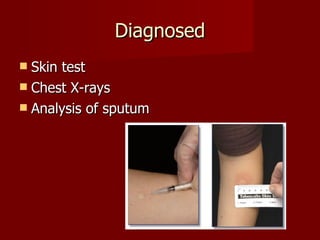
Diagnosed Skin test Chest X-rays Analysis of sputum
Treatment/Prevention Positive Skin Test, Negative X-Ray: Antibiotic: Isoniazid Positive Skin Test, Positive X-Ray: Antibiotics Isoniazid, Rifampin, Ethambutol, Pyrazinamide Prevention: BCG Vaccine
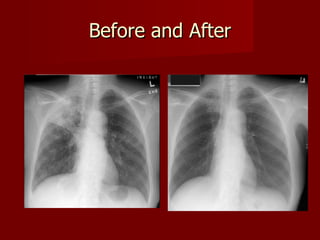
Before and After
Stop TB Partnership Launched by WHO (World Health Org.) in 1998  Its aim is to realize the goal of eliminating TB as a public health problem and, ultimately, to obtain a world free of TB comprised of many organizations and international countries
References http://www.medicinenet.com/tuberculosis http://www.stoptb.org http://www.who.int/tb http://www.microbiologybytes.com/video/Mtuberculosis.html   http://www.cdc.gov/TB/topic/basics/default.htm   All pictures from: http://www.clarian.org/ADAM/doc/HealthIllustratedEncyclopedia/2/19099.htm http://www.barking-moonbat.com/index.php/weblog/2006/09/ http://symptoms-checker.com/sp_images/medis.jpg http://www.medicinenet.com/tuberculosis
Questions

Tuberculosis presentation

  • 1.
    Tuberculosis By HariMitra, Melvin Young, Kristin Do, & Robert Reza
  • 2.
    Incidence and PrevalenceOver 9 million new cases and 2 million deaths per year worldwide 1/3rd of the world’s population is infected with M. tuberculosis Tuberculosis remains one of the top three killers In the U.S.- estimated that 10-15 million people are infected Less than 15,000 cases in US per year
  • 3.
  • 4.
    Causes Mycobacterium tuberculosisHighly aerobic Infects lungs Divides every 15-20 hours Unable to be digested by microphages Very resistant to many disinfectants, acid, alkali, drying, etc. Contagious, spread through air by inhalation of airborne bacteria from infected Easier to contract with weak immune system
  • 5.
    Symptoms Cough (withbloody sputum), loss of appetite, fever, loss of energy/weight, night sweats, SOB Could spread to other parts of the body causing other symptoms
  • 6.
    Diagnosed Skin testChest X-rays Analysis of sputum
  • 7.
    Treatment/Prevention Positive SkinTest, Negative X-Ray: Antibiotic: Isoniazid Positive Skin Test, Positive X-Ray: Antibiotics Isoniazid, Rifampin, Ethambutol, Pyrazinamide Prevention: BCG Vaccine
  • 8.
  • 9.
    Stop TB PartnershipLaunched by WHO (World Health Org.) in 1998 Its aim is to realize the goal of eliminating TB as a public health problem and, ultimately, to obtain a world free of TB comprised of many organizations and international countries
  • 10.
    References http://www.medicinenet.com/tuberculosis http://www.stoptb.orghttp://www.who.int/tb http://www.microbiologybytes.com/video/Mtuberculosis.html http://www.cdc.gov/TB/topic/basics/default.htm All pictures from: http://www.clarian.org/ADAM/doc/HealthIllustratedEncyclopedia/2/19099.htm http://www.barking-moonbat.com/index.php/weblog/2006/09/ http://symptoms-checker.com/sp_images/medis.jpg http://www.medicinenet.com/tuberculosis
  • 11.

Editor's Notes

  • #3 Tuberculosis remains one of the top three killers worldwide Malaria, HIV, and TB 1/3rd of the world’s population is infected with M. tuberculosis ~ 8 million new cases and 2 million deaths each year In developing countries TB is responsible for: 6% of all infant deaths 20% of adult deaths 26% of avoidable deaths Currently in US, incidence of TB has decreased to fewer than 15,000 reported cases per year Less than 15,000 cases in US per year http://www.medicinenet.com/tuberculosis/page3.htm
  • #4 Most likely due to poor health care, lack of resources/treatment, a less education on the infection
  • #5 Also , kidneys brain and bone marrow It is estimated that only about 10% of people infected with M. tuberculosis ever develop tuberculosis disease and many of those have the disease only for the first few years following infection even though the bacillus may lie dormant in the body for decades. It may take many months from the time the infection initially gets into the lungs until symptoms develop. Immune system will typically develop scare tissue to isolate TB. - High content of cell wall lipid (up to 60%) Surface is very hydrophobic Mycobacteria are very resistant to many disinfectants, acid, alkali, drying, etc. Gram stain is invalid—ACID FAST stain is used to identify organism TB is NOT spread by shaking someone’s hand sharing food or drink touching bed linens or toilet seats sharing toothbrushes Kissing Persons who are infected with M. tuberculosis but who do not have TB disease are not infectious to others. TB infection in a person who does not have TB disease is not considered a case of TB and is often referred to as latent TB infection.
  • #6 f the infection spreads to the abdominal cavity , symptoms such as fatigue , swelling, slight tenderness and appendicitis-like pain are likely to occur. Also, painful urination or urinating pee might be a sign that the infection has reached the bladder . In children, M. tuberculosis infections may affect the bones causing mild swelling and minimal pain. Fever, headache, nausea , drowsiness , and, if untreated, coma and brain damage may occur if the brain has been affected. If affects kidneys could cause kidney damage. TB disease should be suspected in persons who have the following symptoms: Unexplained weight loss Loss of appetite Night sweats Fever Fatigue If TB disease is in the lungs (pulmonary), symptoms may include: Coughing for ³ 3 weeks Hemoptysis (coughing up blood) Chest pain
  • #7 X-rays can reveal evidence of active tuberculosis pneumonia. Other times, the X-rays may show scarring (fibrosis) or hardening (calcification) in the lungs, suggesting that the TB is contained and inactive. They may also find legions/cavities in the upper part of the lung if there is active TB Skin test- a small amount of purified extract from dead tuberculosis bacteria is injected under the skin. If a person is not infected with TB, then no reaction will occur at the site of the injection (a negative skin test). If a person is infected with tuberculosis, however, a raised and reddened area will occur around the site of the test injection. If TB infection recent then false positive. Vaccine if take as a child, still possible to catch as an adult. Will give a false positive on skin Tb test so need x ray to confirm A positive TB skin test or TB blood test only tells that a person has been infected with TB bacteria.   It does not tell whether the person has  latent TB infection  (LTBI)   or has progressed to  TB disease .   If the body is able to form scar tissue (fibrosis) around the TB bacteria, then the infection is contained in an inactive state. Such an individual typically has no symptoms and cannot spread TB to other people. The scar tissue and lymph nodes may eventually harden, like stone, due to the process of calcification of the  scars  (deposition of calcium from the bloodstream in the scar tissue). These scars often appear on X-rays and imaging studies like round marbles and are referred to as a granuloma.
  • #8 Isoniazid takes 6-12 months to work. The four drug cocktail you take all four for 2 months to kill any potentially resistant strains of bacteria then you cut back down to two and can last months to years. Drug-resistant TB is a serious, as yet unsolved, public-health problem, especially in Southeast Asia, the countries of the former Soviet Union, Africa, and in prison populations. Poor patient compliance, lack of detection of resistant strains, and unavailable therapy are key reasons for the development of drug-resistant TB. Tuberculous meningitis is the most severe form of tuberculosis. It causes severe neurologic deficits or death in more than half of cases.
  • #9 A 48-year-old foreign-born woman developed cough, sputum production, and blood-tinged sputum. Sputum staining showed tubercle bacilli. Her chest X-ray showed a cavity-like lesion in right upper lobe of her lung.
  • #10 Guidelines can be found at all three organization websites CDC= center for disease control and prevention
  • #11 http://en.wikipedia.org/wiki/Tuberculosis#Causes