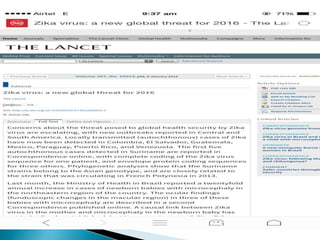
Moderater: Dr. Anjum B Fazili
Presented by: Dr Walied K Balwan
Deptt. Of community medicine SKIMS,Srinagar
 Introduction.
 History.
 Problem Statement.
 Epidemiology.
 Clinical Features.
 Diagnosis.
 Treatment.
 Prevention.
 Zika virus is an emerging mosquito-borne
virus that was first identified in Zika forest of
Uganda in 1947 in rhesus monkeys through a
monitoring network of sylvatic yellow fever.
 When the monkey developed a fever,
researchers isolated from its serum a
transmissible agent that was first described
as Zika virus in 1952.
 In 1954, it was isolated for the first time from
humans in Nigeria.
 From its discovery until 2007, confirmed
cases of Zika virus infection from Africa and
Southeast Asia were rare. However, serum
samples from patients in the acute phase of
illness contained RNA of Zika virus. There
were 49 confirmed cases, 59 unconfirmed
cases, no hospitalizations, and no deaths.
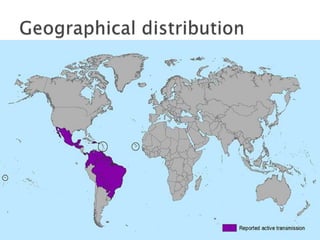
 Since April 2015, a large, ongoing outbreak of
Zika virus that began in Brazil has spread to
much of South and Central America, and the
Caribbean.
 In January 2016, According to the CDC, Brazilian
health authorities reported more than 3,500
microcephaly cases between October 2015 and
January 2016. Some of the affected infants have
had a severe type of microcephaly and some have
died.In the worst affected region of Brazil,
approximately 1 percent of newborns are
suspected of being microcephalic.
 Group IV ((+)ssRNA)
 Family:Flaviviridae
 Genus:Flavivirus
 Species:Zika virus
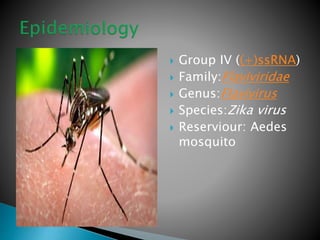
 Reserviour: Aedes
mosquito
 Zika virus is transmitted to people primarily
through the bite of an infected Aedes species
mosquito. These are the same mosquitoes
that spread dengue,chikungunya and yellow
fever viruses.
 Species as A.aegypti,and arboreal mosquitoes
such as A. africanus, A. apicoargenteus, A.
furcifer, A. hensilli, A. luteocephalus, and A.
vitattus.
 These mosquitoes typically lay eggs in and near
standing water in things like
 Buckets,
 Bowls,
 Animal dishes,
 Flower pots and vases.
They are aggressive daytime biters, prefer to bite
people, and live indoors and outdoors near
people.
Mosquitoes become infected when they feed on a
person already infected with the virus. Infected
mosquitoes can then spread the virus to other
people through bites.
 A mother already infected with Zika virus near
the time of delivery can pass on the virus to
her newborn around the time of birth.
 It is possible that Zika virus could be passed
from mother to fetus during pregnancy.
 To date, there are no reports of infants
getting Zika virus through breastfeeding.
Because of the benefits of breastfeeding,
mothers are encouraged to breastfeed even
in areas where Zika virus is found.
 About 1 in 5 people infected with Zika virus
become ill (i.e., develop Zika).
 The most common symptoms of Zika are
 fever,
 rash,
 joint pain, or conjunctivitis (red eyes).
 Other common symptoms include muscle
pain and headache.
The incubation period (the time from exposure
to symptoms) for Zika virus disease is not
known, but is likely to be a few days to a
week.
 The illness is usually mild with symptoms
lasting for several days to a week.
 Zika virus usually remains in the blood of an
infected person for a few days but it can be
found longer in some people.
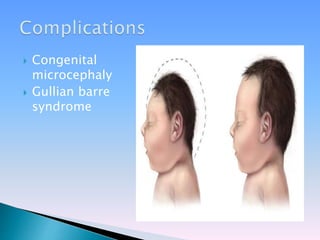
 Congenital
microcephaly
 Gullian barre
syndrome
 There are no commercially available
diagnostic tests for Zika virus disease.
 Zika virus is diagnosed through PCR
(polymerase chain reaction) and virus
isolation from blood samples.
 Diagnosis by serology can be difficult as the
virus can cross-react with other flaviviruses
such as dengue, West Nile and yellow fever.
NOTE: Testing will not be initiated without the
inclusion of:
 date of onset of symptoms
 date of specimen collection
NOTE: If the specimen collection occurs within 8
days after the onset of symptoms, a convalescent
specimen will be requested.
 any pertinent travel history (3 months prior to
the date of symptom
onset)
 the patient's name (REQUIRED for submitting
specimens)
 SpecimenTiming
 Acute :3 to 10 days after onset of symptoms
 Convalescent:2-3 weeks after acute sample
 No vaccine or medications are available to
prevent or treat Zika infections.
 Treat the symptoms:
◦ Get plenty of rest
◦ Drink fluids to prevent dehydration
◦ Take medicine such as acetaminophen to relieve
fever and pain
 No vaccine exists to prevent Zika virus
disease (Zika)
Prevent Zika by avoiding mosquito bites.
1. Mosquitoes that spread Zika virus bite
mostly during the daytime.
2. Mosquitoes that spread Zika virus also
spread dengue and chikungunya viruses.
When traveling to countries where Zika virus or
other viruses spread by mosquitoes are
found, take the following steps:
 Wear long-sleeved shirts and long pants.
 Stay in places with air conditioning or that
use window and door screens to keep
mosquitoes outside.
 Sleep under a mosquito bed net if you are
overseas or outside and are not able to
protect yourself from mosquito bites
 It is also important to empty, clean or cover
containers that can hold water such as
buckets, flower pots or tyres, so that places
where mosquitoes can breed are removed.
 All EPA-registered insect repellents are
evaluated for effectiveness.
 Always follow the product label instructions
 Reapply insect repellent as directed.
 Do not spray repellent on the skin under
clothing.
 If you are also using sunscreen, apply
sunscreen before applying insect repellent
 DEET: (N,N‐diethyl‐m‐toluamide or
N,N‐diethly‐3‐ methyl‐benzamide)
 Picaridin: (KBR 3023), 2‐(2‐hydroxyethyl)‐1‐
piperidinecarboxylic acid 1‐methylpropyl
ester )
 Oil of Lemon Eucalyptus* or PMD
(para‐Menthane‐3,8‐ diol) the synthesized
version of oil of lemon eucalyptus
 IR3535 (Chemical (Chemical Name:
3‐[N‐Butyl‐N‐acetyl] acetyl]‐ aminopropionic
acid, ethyl ester)
 Achillea Achillea alpina
 Eucalyptus oil
 Alpha Terpinene
 Fennel oil
 Castor oil
 Catnip oil
 Lemongrass oil (Cymbopogon species)
 Cedar oil
 Citronella oil
 Cloves Oil
 Rosemary (Rosmarinus officinalis)
 Tea tree oil
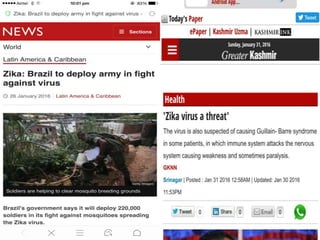
 WHO declared Zika as global emergency on 31st jan
 A rare case of the Zika virus being transmitted through sex,
not a mosquito bite, has been reported in the US. (BBC world)
 The American Red Cross has meanwhile urged prospective
blood donors returning from Zika-hit countries to wait at
least 28 days before donating their blood. (NY Times)
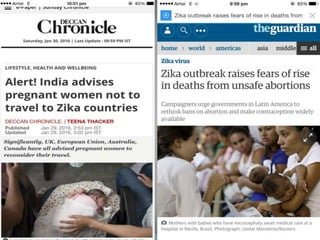
 The CDC recommends that pregnant women avoid travel to
more than two dozen countries with Zika outbreaks, mostly in
the Caribbean and Latin America including venezula. (CDC)
 India has developed first vaccine against zika.
(timesofindia)
Thank You?

Zika virus

  • 1.
    Moderater: Dr. AnjumB Fazili Presented by: Dr Walied K Balwan Deptt. Of community medicine SKIMS,Srinagar
  • 2.
     Introduction.  History. Problem Statement.  Epidemiology.  Clinical Features.  Diagnosis.  Treatment.  Prevention.
  • 4.
     Zika virusis an emerging mosquito-borne virus that was first identified in Zika forest of Uganda in 1947 in rhesus monkeys through a monitoring network of sylvatic yellow fever.  When the monkey developed a fever, researchers isolated from its serum a transmissible agent that was first described as Zika virus in 1952.  In 1954, it was isolated for the first time from humans in Nigeria.
  • 5.
     From itsdiscovery until 2007, confirmed cases of Zika virus infection from Africa and Southeast Asia were rare. However, serum samples from patients in the acute phase of illness contained RNA of Zika virus. There were 49 confirmed cases, 59 unconfirmed cases, no hospitalizations, and no deaths.
  • 6.
     Since April2015, a large, ongoing outbreak of Zika virus that began in Brazil has spread to much of South and Central America, and the Caribbean.  In January 2016, According to the CDC, Brazilian health authorities reported more than 3,500 microcephaly cases between October 2015 and January 2016. Some of the affected infants have had a severe type of microcephaly and some have died.In the worst affected region of Brazil, approximately 1 percent of newborns are suspected of being microcephalic.
  • 8.
     Group IV((+)ssRNA)  Family:Flaviviridae  Genus:Flavivirus  Species:Zika virus  Reserviour: Aedes mosquito
  • 9.
     Zika virusis transmitted to people primarily through the bite of an infected Aedes species mosquito. These are the same mosquitoes that spread dengue,chikungunya and yellow fever viruses.  Species as A.aegypti,and arboreal mosquitoes such as A. africanus, A. apicoargenteus, A. furcifer, A. hensilli, A. luteocephalus, and A. vitattus.
  • 10.
     These mosquitoestypically lay eggs in and near standing water in things like  Buckets,  Bowls,  Animal dishes,  Flower pots and vases. They are aggressive daytime biters, prefer to bite people, and live indoors and outdoors near people. Mosquitoes become infected when they feed on a person already infected with the virus. Infected mosquitoes can then spread the virus to other people through bites.
  • 11.
     A motheralready infected with Zika virus near the time of delivery can pass on the virus to her newborn around the time of birth.  It is possible that Zika virus could be passed from mother to fetus during pregnancy.  To date, there are no reports of infants getting Zika virus through breastfeeding. Because of the benefits of breastfeeding, mothers are encouraged to breastfeed even in areas where Zika virus is found.
  • 13.
     About 1in 5 people infected with Zika virus become ill (i.e., develop Zika).  The most common symptoms of Zika are  fever,  rash,  joint pain, or conjunctivitis (red eyes).  Other common symptoms include muscle pain and headache.
  • 14.
    The incubation period(the time from exposure to symptoms) for Zika virus disease is not known, but is likely to be a few days to a week.  The illness is usually mild with symptoms lasting for several days to a week.  Zika virus usually remains in the blood of an infected person for a few days but it can be found longer in some people.
  • 15.
  • 16.
     There areno commercially available diagnostic tests for Zika virus disease.  Zika virus is diagnosed through PCR (polymerase chain reaction) and virus isolation from blood samples.  Diagnosis by serology can be difficult as the virus can cross-react with other flaviviruses such as dengue, West Nile and yellow fever.
  • 17.
    NOTE: Testing willnot be initiated without the inclusion of:  date of onset of symptoms  date of specimen collection NOTE: If the specimen collection occurs within 8 days after the onset of symptoms, a convalescent specimen will be requested.  any pertinent travel history (3 months prior to the date of symptom onset)  the patient's name (REQUIRED for submitting specimens)
  • 18.
     SpecimenTiming  Acute:3 to 10 days after onset of symptoms  Convalescent:2-3 weeks after acute sample
  • 19.
     No vaccineor medications are available to prevent or treat Zika infections.  Treat the symptoms: ◦ Get plenty of rest ◦ Drink fluids to prevent dehydration ◦ Take medicine such as acetaminophen to relieve fever and pain
  • 20.
     No vaccineexists to prevent Zika virus disease (Zika) Prevent Zika by avoiding mosquito bites. 1. Mosquitoes that spread Zika virus bite mostly during the daytime. 2. Mosquitoes that spread Zika virus also spread dengue and chikungunya viruses.
  • 21.
    When traveling tocountries where Zika virus or other viruses spread by mosquitoes are found, take the following steps:  Wear long-sleeved shirts and long pants.  Stay in places with air conditioning or that use window and door screens to keep mosquitoes outside.  Sleep under a mosquito bed net if you are overseas or outside and are not able to protect yourself from mosquito bites
  • 22.
     It isalso important to empty, clean or cover containers that can hold water such as buckets, flower pots or tyres, so that places where mosquitoes can breed are removed.
  • 23.
     All EPA-registeredinsect repellents are evaluated for effectiveness.  Always follow the product label instructions  Reapply insect repellent as directed.  Do not spray repellent on the skin under clothing.  If you are also using sunscreen, apply sunscreen before applying insect repellent
  • 24.
     DEET: (N,N‐diethyl‐m‐toluamideor N,N‐diethly‐3‐ methyl‐benzamide)  Picaridin: (KBR 3023), 2‐(2‐hydroxyethyl)‐1‐ piperidinecarboxylic acid 1‐methylpropyl ester )  Oil of Lemon Eucalyptus* or PMD (para‐Menthane‐3,8‐ diol) the synthesized version of oil of lemon eucalyptus  IR3535 (Chemical (Chemical Name: 3‐[N‐Butyl‐N‐acetyl] acetyl]‐ aminopropionic acid, ethyl ester)
  • 25.
     Achillea Achilleaalpina  Eucalyptus oil  Alpha Terpinene  Fennel oil  Castor oil  Catnip oil  Lemongrass oil (Cymbopogon species)  Cedar oil  Citronella oil  Cloves Oil  Rosemary (Rosmarinus officinalis)  Tea tree oil
  • 27.
     WHO declaredZika as global emergency on 31st jan  A rare case of the Zika virus being transmitted through sex, not a mosquito bite, has been reported in the US. (BBC world)  The American Red Cross has meanwhile urged prospective blood donors returning from Zika-hit countries to wait at least 28 days before donating their blood. (NY Times)  The CDC recommends that pregnant women avoid travel to more than two dozen countries with Zika outbreaks, mostly in the Caribbean and Latin America including venezula. (CDC)  India has developed first vaccine against zika. (timesofindia)
  • 28.