1
Prepared by : Amera saeed
Introduction
 TB is one of the oldest recorded
human afflictions
 Still one of the biggest killers
among the infectious diseases
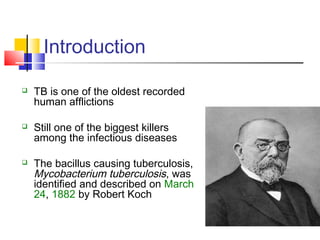
 The bacillus causing tuberculosis,
Mycobacterium tuberculosis, was
identified and described on March
24, 1882 by Robert Koch
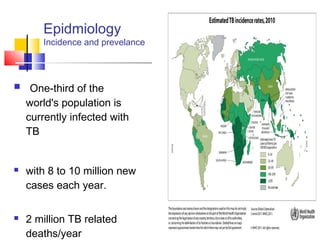
 One-third of the
world's population is
currently infected with
TB
 with 8 to 10 million new
cases each year.
 2 million TB related
deaths/year
Epidmiology
Incidence and prevelance
M. tuberculosis
M. bovis
M. africanum
M. microti
M. canettii
M. caprae
M. pinnipedii
Etiology
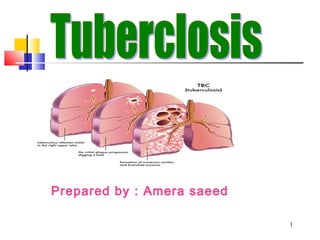
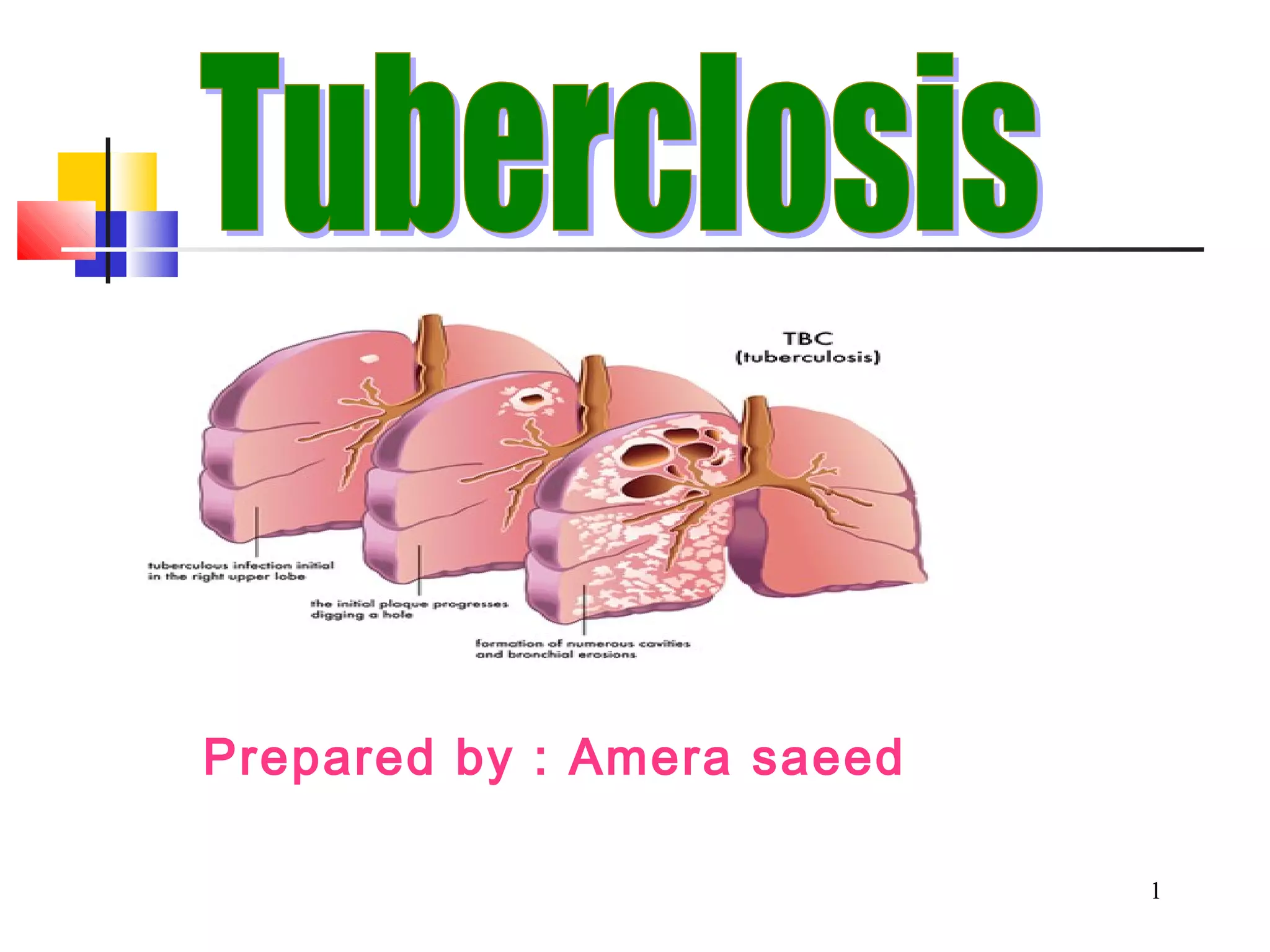
Human tuberculosis (TB) is caused by
infection with members of the
Mycobacterium tuberculosis complex, which
includes :
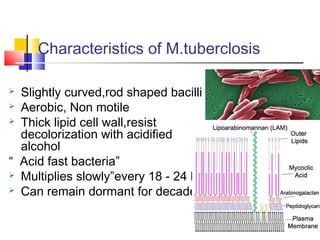
Characteristics of M.tuberclosis
 Slightly curved,rod shaped bacilli
 Aerobic, Non motile
 Thick lipid cell wall,resist
decolorization with acidified
alcohol
“ Acid fast bacteria”
 Multiplies slowly”every 18 - 24 hrs”
 Can remain dormant for decades
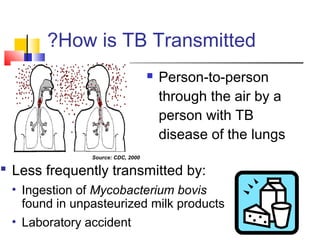
 Person-to-person
through the air by a
person with TB
disease of the lungs
 Less frequently transmitted by:
• Ingestion of Mycobacterium bovis
found in unpasteurized milk products
• Laboratory accident
How is TB Transmitted?
Source: CDC, 2000
The probability that TB will be transmitted
from one person to another depends on a
number of factors
 The concentration of TB bacteria in the air
 The environment in which exposure to the
bacteria occurs
 The length of time of exposure
 Person‘ s immune system
Risk factors
 Co infection with HIV
 Diabetic person
 Persons undergo chemotherapy
 Person undergo organ transplantation
 Extreme ages,children and geriatric
 Malnutration
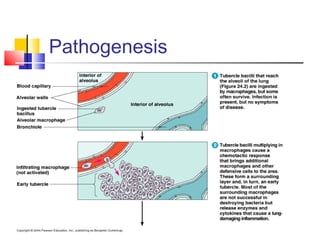
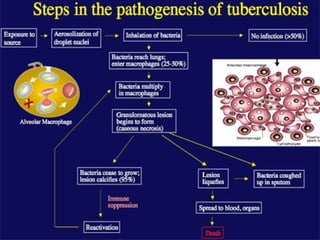
Pathogenesis
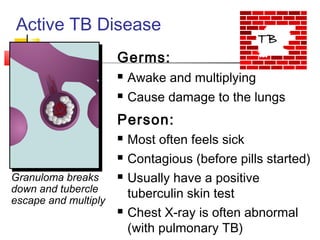
Active TB Disease
Germs:
 Awake and multiplying
 Cause damage to the lungs
Person:
 Most often feels sick
 Contagious (before pills started)
 Usually have a positive
tuberculin skin test
 Chest X-ray is often abnormal
(with pulmonary TB)
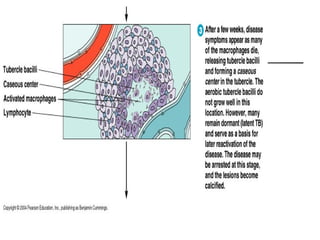
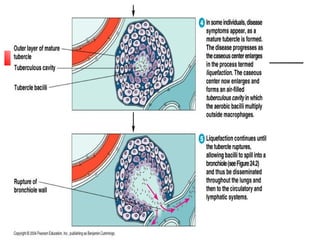
Granuloma breaks
down and tubercle
escape and multiply
TB
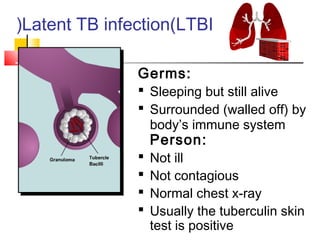
Germs:
 Sleeping but still alive
 Surrounded (walled off) by
body’s immune system
Person:
 Not ill
 Not contagious
 Normal chest x-ray
 Usually the tuberculin skin
test is positive
Latent TB infection(LTBI(
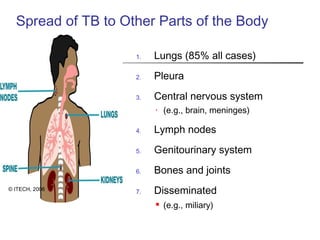
Spread of TB to Other Parts of the Body
1. Lungs (85% all cases)
2. Pleura
3. Central nervous system
• (e.g., brain, meninges)
4. Lymph nodes
5. Genitourinary system
6. Bones and joints
7. Disseminated
 (e.g., miliary)
© ITECH, 2006
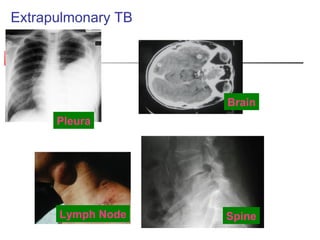
Extrapulmonary TB
Pleura
Lymph Node
Brain
Spine
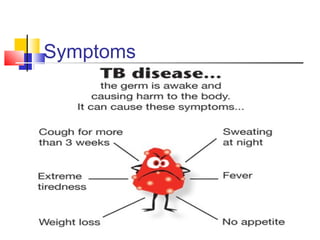
Symptoms
Diagnosis
 Medical history
 Physical examination
 Sputum smear microscopy
Acid fast staining (Ziehl–Neelsen stain)
Fluorochrome stain using fluorescence microscopy
 Culture
 Immunological tests
 TB skin test(Tuberculin skin test )
 TB blood tests
 Chest radiograph (X-ray)
 PCR
Bacteriologic Examination of Clinical
Specimens
 The bacteriologic examination has five
parts:
 Specimen collection, processing, and review
 AFB smear classification and results
 Direct detection of M. tuberculosis in clinical specimen
using nucleic acid amplification (NAA)
 Specimen culturing and identification
 Drug-susceptibility testing
Specimen Collection, Processing, and
Review
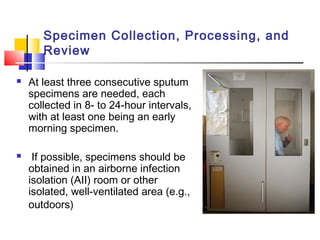
 At least three consecutive sputum
specimens are needed, each
collected in 8- to 24-hour intervals,
with at least one being an early
morning specimen.
 If possible, specimens should be
obtained in an airborne infection
isolation (AII) room or other
isolated, well-ventilated area (e.g.,
outdoors)
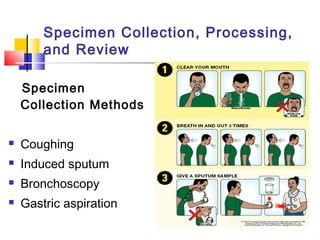
Specimen
Collection Methods
 Coughing
 Induced sputum
 Bronchoscopy
 Gastric aspiration
Specimen Collection, Processing,
and Review
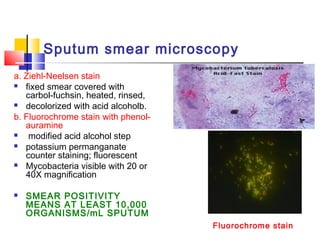
Sputum smear microscopy
a. Ziehl-Neelsen stain
 fixed smear covered with
carbol-fuchsin, heated, rinsed,
 decolorized with acid alcoholb.
b. Fluorochrome stain with phenol-
auramine
 modified acid alcohol step
 potassium permanganate
counter staining; fluorescent
 Mycobacteria visible with 20 or
40X magnification
 SMEAR POSITIVITY
MEANS AT LEAST 10,000
ORGANISMS/mL SPUTUM
Fluorochrome stain
Culture (Gold Standard(
a. Solid media
Lowenstein Jensen (egg based)
Middlebrook 7H11 (agar based)
 can detect colony morphology,
mixed infections; can detect 10-
100
 organisms/mL; 3-8 weeks
incubation to detect organisms
b. Liquid broth
Middlebrook 7H12, BACTEC
systems
 1-3 weeks of incubation to
detect organisms
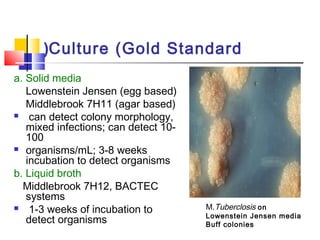
M.Tuberclosis on
Lowenstein Jensen media
Buff colonies
TB skin test(Tuberculin skin test(
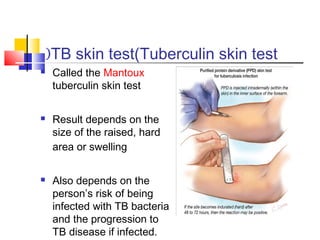
 Called the Mantoux
tuberculin skin test
 Result depends on the
size of the raised, hard
area or swelling
 Also depends on the
person’s risk of being
infected with TB bacteria
and the progression to
TB disease if infected.
 TB blood tests
(Interferon-Gamma Release Assays, IGRAs(
 Measures how strong a person’s
immune system reacts to TB bacteria
 Two IGRAs

QuantiFERON®–TB Gold In-Tube test (QFT-
GIT

T-SPOT®.TB test (T-Spot)
 IGRAs are the preferred method of TB
infection testing for
 People who have received bacille
Calmette–Guérin (BCG). BCG is a vaccine
for TB disease.
 People who have a difficult time returning
for a second appointment to look for a
reaction to the TST.
 TB blood tests
(interferon-gamma release assays, IGRAs(
TB treatment is challenging, requiring
accurate and early diagnosis,
drug‑resistance screening and the
administration of effective treatment
regimens for at least 6 months through
( Directly Observed Therapy (DOT) and
follow‑up support.
 
Treatment for tuberculosis (TB) depends
on which type you have, although a long
course of antibiotics is most often used
Treatment 
 The goals of TB treatment are to:
1. Shorten the clinical course of TB
2. Prevent complications
3. Prevent the development of latency
and/or subsequent recurrences
4. Decrease the likelihood of TB
transmission
Treatment 
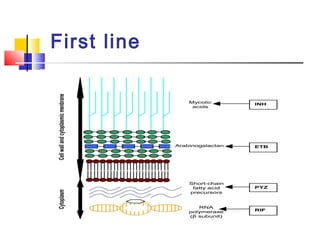
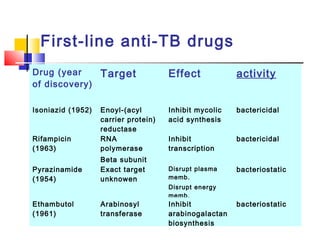
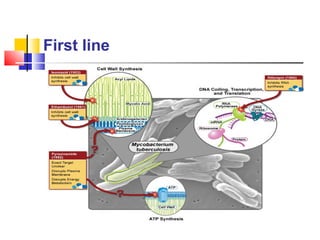
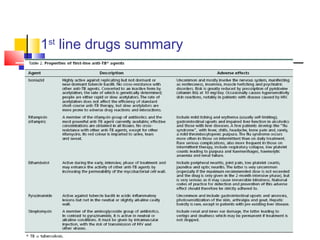
 First-line anti-TB drugs
recommended in a four-drug
combination
for the treatment of drug-susceptible
TB.
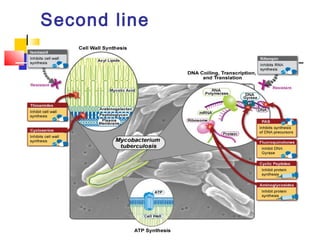
 Second-line anti-TB drugs
for drug-resistant TB.
Treatment 
First line
Drug (year
of discovery)
Target Effect activity
Isoniazid (1952) Enoyl-(acyl
carrier protein)
reductase
Inhibit mycolic
acid synthesis
bactericidal
Rifampicin
(1963)
RNA
polymerase
Beta subunit
Inhibit
transcription
bactericidal
Pyrazinamide
(1954)
Exact target
unknowen
Disrupt plasma
memb.
Disrupt energy
memb.
bacteriostatic
Ethambutol
(1961)
Arabinosyl
transferase
Inhibit
arabinogalactan
biosynthesis
bacteriostatic
First-line anti-TB drugs
  First line
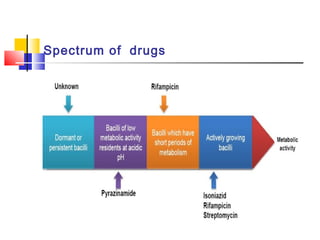
Spectrum of  drugs
1st
line drugs summary
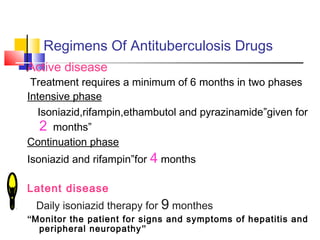
Regimens Of Antituberculosis Drugs
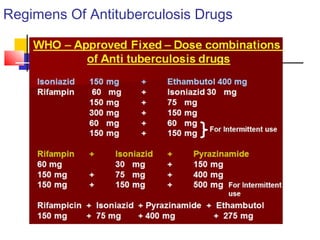
Active disease
Treatment requires a minimum of 6 months in two phases
Intensive phase
Isoniazid,rifampin,ethambutol and pyrazinamide”given for
2 months”
Continuation phase
Isoniazid and rifampin”for 4 months
Latent disease
Daily isoniazid therapy for 9 monthes
“Monitor the patient for signs and symptoms of hepatitis and
peripheral neuropathy”
Regimens Of Antituberculosis Drugs
Second line
Drug target effect
Para-amino
salicylic
acid )PAS`)
Dihydro _pteroate
synthase
Inhibits folate
biosynthesis
Ethionamide Enoyl-[acyl-carrier-
protein] reductase
Inhibits mycolic acid
biosynthesis
Ofloxacin DNA gyrase and DNA
topoisomerase Inhibits DNA
supercoiling
Kanamycin 30S ribosomal subunit Inhibits protein
synthesis
Amikacin 30S ribosomal subunit Inhibits protein
synthesis
Cycloserin d-alanine racemase and
ligase
Inhibits
peptidoglycan
Second line
 
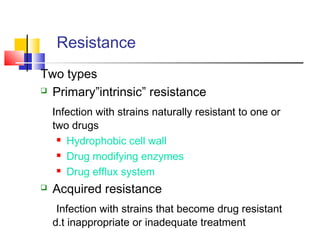
Resistance 
Two types
 Primary”intrinsic” resistance
Infection with strains naturally resistant to one or
two drugs
 Hydrophobic cell wall
 Drug modifying enzymes
 Drug efflux system
 Acquired resistance
Infection with strains that become drug resistant
d.t inappropriate or inadequate treatment
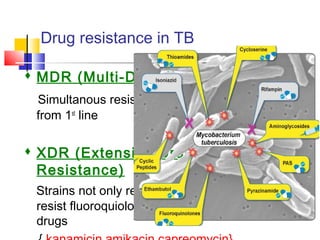
Drug resistance in TB
 MDR (Multi-Drug Resistant)
Simultanous resistance to 2 or more drugs
from 1st
line
 XDR (Extensive Drug
Resistance)
Strains not only resistant to 1st
line but also
resist fluoroquiolones and one of injectible
drugs
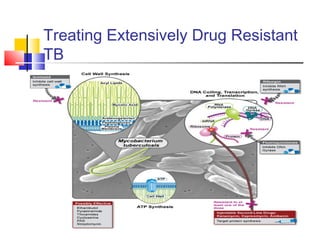
Treating Extensively Drug Resistant
TB
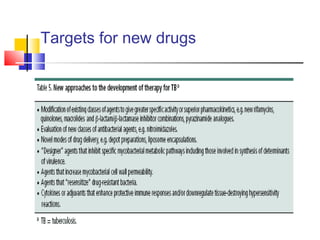
Targets for new drugs
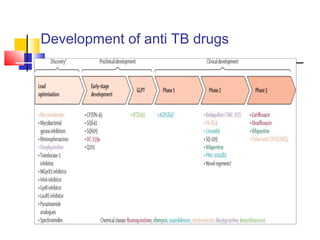
Development of anti TB drugs
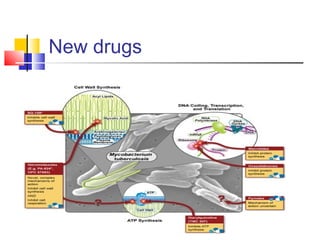
New drugs
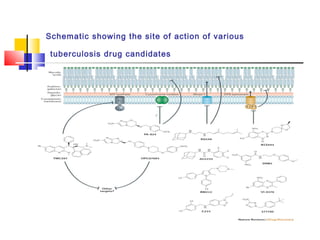
Schematic showing the site of action of various
tuberculosis drug candidates 
How can tuberculosis be prevented?
 The BCG vaccine.
It usually protects children and infants from the
disease, but its effects wear off when the patient
reaches adulthood.
 Eating a healthful diet that boosts the immune
system
 Having regular TB tests if you work or live in
a high risk environment
 Completing a TB medication regimen.
 If you are infected, stay home, cover your mouth,
and ensure proper ventilation.
Tuberclosis

Tuberclosis

  • 1.
    1 Prepared by :Amera saeed
  • 2.
    Introduction  TB isone of the oldest recorded human afflictions  Still one of the biggest killers among the infectious diseases  The bacillus causing tuberculosis, Mycobacterium tuberculosis, was identified and described on March 24, 1882 by Robert Koch
  • 3.
     One-third ofthe world's population is currently infected with TB  with 8 to 10 million new cases each year.  2 million TB related deaths/year Epidmiology Incidence and prevelance
  • 4.
    M. tuberculosis M. bovis M.africanum M. microti M. canettii M. caprae M. pinnipedii Etiology Human tuberculosis (TB) is caused by infection with members of the Mycobacterium tuberculosis complex, which includes :
  • 5.
    Characteristics of M.tuberclosis Slightly curved,rod shaped bacilli  Aerobic, Non motile  Thick lipid cell wall,resist decolorization with acidified alcohol “ Acid fast bacteria”  Multiplies slowly”every 18 - 24 hrs”  Can remain dormant for decades
  • 6.
     Person-to-person through theair by a person with TB disease of the lungs  Less frequently transmitted by: • Ingestion of Mycobacterium bovis found in unpasteurized milk products • Laboratory accident How is TB Transmitted? Source: CDC, 2000
  • 7.
    The probability thatTB will be transmitted from one person to another depends on a number of factors  The concentration of TB bacteria in the air  The environment in which exposure to the bacteria occurs  The length of time of exposure  Person‘ s immune system
  • 8.
    Risk factors  Coinfection with HIV  Diabetic person  Persons undergo chemotherapy  Person undergo organ transplantation  Extreme ages,children and geriatric  Malnutration
  • 9.
  • 14.
    Active TB Disease Germs: Awake and multiplying  Cause damage to the lungs Person:  Most often feels sick  Contagious (before pills started)  Usually have a positive tuberculin skin test  Chest X-ray is often abnormal (with pulmonary TB) Granuloma breaks down and tubercle escape and multiply TB
  • 15.
    Germs:  Sleeping butstill alive  Surrounded (walled off) by body’s immune system Person:  Not ill  Not contagious  Normal chest x-ray  Usually the tuberculin skin test is positive Latent TB infection(LTBI(
  • 17.
    Spread of TBto Other Parts of the Body 1. Lungs (85% all cases) 2. Pleura 3. Central nervous system • (e.g., brain, meninges) 4. Lymph nodes 5. Genitourinary system 6. Bones and joints 7. Disseminated  (e.g., miliary) © ITECH, 2006
  • 18.
  • 19.
  • 20.
    Diagnosis  Medical history Physical examination  Sputum smear microscopy Acid fast staining (Ziehl–Neelsen stain) Fluorochrome stain using fluorescence microscopy  Culture  Immunological tests  TB skin test(Tuberculin skin test )  TB blood tests  Chest radiograph (X-ray)  PCR
  • 21.
    Bacteriologic Examination ofClinical Specimens  The bacteriologic examination has five parts:  Specimen collection, processing, and review  AFB smear classification and results  Direct detection of M. tuberculosis in clinical specimen using nucleic acid amplification (NAA)  Specimen culturing and identification  Drug-susceptibility testing
  • 22.
    Specimen Collection, Processing,and Review  At least three consecutive sputum specimens are needed, each collected in 8- to 24-hour intervals, with at least one being an early morning specimen.  If possible, specimens should be obtained in an airborne infection isolation (AII) room or other isolated, well-ventilated area (e.g., outdoors)
  • 23.
    Specimen Collection Methods  Coughing Induced sputum  Bronchoscopy  Gastric aspiration Specimen Collection, Processing, and Review
  • 24.
    Sputum smear microscopy a.Ziehl-Neelsen stain  fixed smear covered with carbol-fuchsin, heated, rinsed,  decolorized with acid alcoholb. b. Fluorochrome stain with phenol- auramine  modified acid alcohol step  potassium permanganate counter staining; fluorescent  Mycobacteria visible with 20 or 40X magnification  SMEAR POSITIVITY MEANS AT LEAST 10,000 ORGANISMS/mL SPUTUM Fluorochrome stain
  • 25.
    Culture (Gold Standard( a.Solid media Lowenstein Jensen (egg based) Middlebrook 7H11 (agar based)  can detect colony morphology, mixed infections; can detect 10- 100  organisms/mL; 3-8 weeks incubation to detect organisms b. Liquid broth Middlebrook 7H12, BACTEC systems  1-3 weeks of incubation to detect organisms M.Tuberclosis on Lowenstein Jensen media Buff colonies
  • 26.
    TB skin test(Tuberculinskin test(  Called the Mantoux tuberculin skin test  Result depends on the size of the raised, hard area or swelling  Also depends on the person’s risk of being infected with TB bacteria and the progression to TB disease if infected.
  • 27.
     TB blood tests (Interferon-GammaRelease Assays, IGRAs(  Measures how strong a person’s immune system reacts to TB bacteria  Two IGRAs  QuantiFERON®–TB Gold In-Tube test (QFT- GIT  T-SPOT®.TB test (T-Spot)
  • 28.
     IGRAs arethe preferred method of TB infection testing for  People who have received bacille Calmette–Guérin (BCG). BCG is a vaccine for TB disease.  People who have a difficult time returning for a second appointment to look for a reaction to the TST.  TB blood tests (interferon-gamma release assays, IGRAs(
  • 29.
    TB treatment ischallenging, requiring accurate and early diagnosis, drug‑resistance screening and the administration of effective treatment regimens for at least 6 months through ( Directly Observed Therapy (DOT) and follow‑up support.   Treatment for tuberculosis (TB) depends on which type you have, although a long course of antibiotics is most often used Treatment 
  • 30.
     The goalsof TB treatment are to: 1. Shorten the clinical course of TB 2. Prevent complications 3. Prevent the development of latency and/or subsequent recurrences 4. Decrease the likelihood of TB transmission Treatment 
  • 31.
     First-line anti-TBdrugs recommended in a four-drug combination for the treatment of drug-susceptible TB.  Second-line anti-TB drugs for drug-resistant TB. Treatment 
  • 32.
  • 33.
    Drug (year of discovery) TargetEffect activity Isoniazid (1952) Enoyl-(acyl carrier protein) reductase Inhibit mycolic acid synthesis bactericidal Rifampicin (1963) RNA polymerase Beta subunit Inhibit transcription bactericidal Pyrazinamide (1954) Exact target unknowen Disrupt plasma memb. Disrupt energy memb. bacteriostatic Ethambutol (1961) Arabinosyl transferase Inhibit arabinogalactan biosynthesis bacteriostatic First-line anti-TB drugs
  • 34.
  • 35.
  • 36.
  • 37.
    Regimens Of AntituberculosisDrugs Active disease Treatment requires a minimum of 6 months in two phases Intensive phase Isoniazid,rifampin,ethambutol and pyrazinamide”given for 2 months” Continuation phase Isoniazid and rifampin”for 4 months Latent disease Daily isoniazid therapy for 9 monthes “Monitor the patient for signs and symptoms of hepatitis and peripheral neuropathy”
  • 38.
  • 39.
    Second line Drug targeteffect Para-amino salicylic acid )PAS`) Dihydro _pteroate synthase Inhibits folate biosynthesis Ethionamide Enoyl-[acyl-carrier- protein] reductase Inhibits mycolic acid biosynthesis Ofloxacin DNA gyrase and DNA topoisomerase Inhibits DNA supercoiling Kanamycin 30S ribosomal subunit Inhibits protein synthesis Amikacin 30S ribosomal subunit Inhibits protein synthesis Cycloserin d-alanine racemase and ligase Inhibits peptidoglycan
  • 40.
  • 41.
    Resistance  Two types  Primary”intrinsic”resistance Infection with strains naturally resistant to one or two drugs  Hydrophobic cell wall  Drug modifying enzymes  Drug efflux system  Acquired resistance Infection with strains that become drug resistant d.t inappropriate or inadequate treatment
  • 42.
    Drug resistance inTB  MDR (Multi-Drug Resistant) Simultanous resistance to 2 or more drugs from 1st line  XDR (Extensive Drug Resistance) Strains not only resistant to 1st line but also resist fluoroquiolones and one of injectible drugs
  • 43.
  • 44.
  • 45.
  • 46.
  • 47.
    Schematic showing thesite of action of various tuberculosis drug candidates 
  • 48.
    How can tuberculosisbe prevented?  The BCG vaccine. It usually protects children and infants from the disease, but its effects wear off when the patient reaches adulthood.  Eating a healthful diet that boosts the immune system  Having regular TB tests if you work or live in a high risk environment  Completing a TB medication regimen.  If you are infected, stay home, cover your mouth, and ensure proper ventilation.

Editor's Notes

  • #5 There are several other species and subspecies that are included in the Mycobacterium tuberculosis complex because of their close genetic relationship to tuberculosis: [Review the slide content] With the exception of M. pinnipedii, all of the species in the Mycobacterium tuberculosis complex have been shown to cause disease in humans; however, M. tuberculosis is by far the most prevalent Mycobacterium tuberculosis is the organism responsible for most of the tuberculosis infection and disease seen in the Caribbean Image Credit: CDC Public Health Image Library/Dr. George P. Kubica
  • #7 Pose question to participants “How is TB transmitted?” Solicit their responses then proceed to review slide content Transmission is the spread of organisms, such as M. tuberculosis, from one person to another The primary mode of transmission for tuberculosis is through inhalation of infectious particles Less frequently, TB can be transmitted by:…[Review slide content] *Slide Animation Image Credit: Cartoon from clip art.; Graphic from CDC Core Curriculum. 2000.
  • #15 Review the slide content Tuberculosis disease can develop very soon after infection or many years after infection In individuals without HIV co-infection, about 5% of people who have been recently infected with M. tuberculosis will develop TB disease in the first year or two after infection. Another 5% will develop disease later in their lives. The remaining 90% will stay infected, but free of disease for the rest of their lives It’s important to remember that not all patients with active TB disease will have a positive Mantoux TST (approx. 75% will have +TST and this percentage is lower in HIV infected patients). Never stop evaluating a patient for active TB simply because the Mantoux TST is 00mm! The chest X-ray will often show abnormalities suggestive of active TB but may be within normal limits for some patients with active disease, particularly if they also have HIV. This will be covered in more detail in Module 4 on Case Finding and Diagnosis Image Source: Centers for Disease Control and Prevention (CDC)
  • #16 If the immune system is compromised, then the bacilli multiply and spread to other sites in the body. People who have TB infection but not TB disease are NOT infectious - in other words, they cannot spread the infection to other people Persons with LTBI have a low bacillary load (e.g., ≤~103) It is very important to remember that TB infection is not considered a case of TB Image Source: Centers for Disease Control and Prevention (CDC)
  • #18 This next section describes the pathogenesis of TB (the way TB infection and disease develop in the body) At first, the tubercle bacilli multiply in the alveoli and a small number enter the bloodstream and spread throughout the body (dissemination) Bacilli may reach any part of the body, including areas where TB disease is more likely to develop. These areas include the upper portions of the lungs, as well as the kidneys, the brain, and bone Disseminated TB refers to TB that simultaneously involves multiple organs. While “miliary” is given as an example of disseminated TB, it really refers to a radiographic manifestation of disseminated TB. It’s important to note that not all patients with disseminated TB have a miliary pattern on CXR Image source: I-TECH
  • #19 This slide shows different sites where TB has caused disease outside of the lungs Image Sources: Scrofula: http://farm1.static.flickr.com/110/283397827_f071de4335_m.jpg Radiographic images: Francis J. Curry National Tuberculosis Center