What You Need to Know About
      Tuberculosis (TB)
What is Tuberculosis?
• Tuberculosis is a disease caused by tiny germs
  that enter your lungs when you breathe them
  in; It is called “TB” for short

• TB germs are most commonly found in the
  lungs, but sometimes they can move to other
  parts of the body

• When you have TB disease of the lungs, you
  can spread it to other people
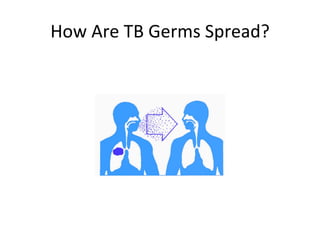
How Are TB Germs Spread?
• TB germs are passed through the air when a person
  who is sick with TB disease coughs, sings, sneezes, or
  laughs
• To become infected with TB germs, a person usually
  needs to share air space with someone sick with TB
  disease (e.g., live, work, or play together)
• The amount of time, the environment, and how sick
  the person is all contribute to whether or not you get
  infected
• In most cases, your body is able to fight off the germs
How Are TB Germs NOT Spread?
• Through quick, casual contact, like passing
  someone on the street
• By sharing cigarettes or drinking containers
• By shaking hands
TB Infection vs. TB Disease
• There is a difference between TB “infection” and TB
  “disease”

• TB infection: TB germs stay in your lungs, but they do
  not multiply or make you sick
   – You cannot pass TB germs to others

• TB disease: TB germs stay in your lungs or move to
  other parts of your body, multiply, and make you sick
   – You can pass the TB germs to other people
Treatment for TB Infection
• TB infection is treated with medicine, usually for
  4-9 months

• If TB infection is not treated, it can turn into TB
  disease

• It is important to take all your medicine, even
  though you don’t feel sick
Common Symptoms of TB Disease
•   Cough (2-3 weeks or more)
•   Coughing up blood
•   Chest pains
•   Fever
•   Night sweats
•   Feeling weak and tired
•   Losing weight without trying
•   Decreased or no appetite
•   If you have TB outside the lungs, you may have
    other symptoms
Treatment for TB Disease
• TB disease is treated with medicine to kill the TB
  germs

• Usually, the treatment will last for 6-9 months

• TB disease can be cured if the medicine is taken
  as prescribed, even after you no longer feel sick
Contact Investigation
• When a person is found to have TB disease, the
  health department looks for people who might
  have been exposed to TB germs

• If the health department thinks that you might have
  been exposed to TB germs, they will give you a TB
  test
The TB Test - 1
• Two types of tests can be used to see if a person
  has TB:
  – A TB skin test
  – A TB blood test
  – A TB phlegm check
• A trained nurse will give you the TB test
• The TB test is simple and safe
• The TB test is mandatory, and will help us
  protect your health and the health of others
The TB Test - 2
• A negative test most likely means have not been
  infected with TB germs
  – A second TB test might be required in 8-10 weeks to
    ensure you have not been infected with TB germs
• A positive test means you have probably been
  infected with TB germs, but it does not mean
  you have TB disease
  – Other tests (like a chest x-ray) will be needed to see
    if you have TB disease
The TB Test - 3
• If the health department finds that you have TB
  infection, you will be offered treatment to keep you
  from getting TB disease
• Treatment for TB infection is voluntary, but taking it
  will help protect your health
• Your name and the results of your TB test will be
  kept confidential
Take-home Message - 1
• The health department will decide if you need to
  have a TB test
• The TB test is mandatory, but is simple and safe
• The health department will keep all information
  about you confidential
• The purpose of giving you the TB test and
  offering you treatment is to protect your health
  and the health of others
Take-home Message - 2
• TB infection is not the same as TB disease
• It is not easy to spread TB germs to others
• Usually, you have to be around a person with TB
  disease for a period of time to become infected
• If you have been infected with TB germs:
   – Taking medicine will keep you from getting sick with TB
     disease
• TB can be prevented, treated and cured
Questions?
Frequently Asked Questions
• The person who sits next to me got tested and I didn’t. Why
  isn’t everyone tested?
• How were you able to decide who needs to be tested if you
  cannot reveal the patient’s identity?
• Even though I have not been informed I need to be tested, I
  am concerned about my family. What should I do?
• If my TB test is positive, should I get my family tested too?
• I had BCG in my country and was told that my TB test would
  always be positive. Why should I still be tested?
• If I shook the TB patient’s hand or used the same water
  fountain, will I get TB?
For Additional Information
• If you have any questions or concerns, please
  call <health department, healthcare worker
  name> at <phone number>, or e-mail at <e-
  mail address>

• Your questions and concerns will be kept
  confidential

Tuberculosis slides

  • 1.
    What You Needto Know About Tuberculosis (TB)
  • 2.
    What is Tuberculosis? •Tuberculosis is a disease caused by tiny germs that enter your lungs when you breathe them in; It is called “TB” for short • TB germs are most commonly found in the lungs, but sometimes they can move to other parts of the body • When you have TB disease of the lungs, you can spread it to other people
  • 3.
    How Are TBGerms Spread?
  • 4.
    How Are TBGerms Spread? • TB germs are passed through the air when a person who is sick with TB disease coughs, sings, sneezes, or laughs • To become infected with TB germs, a person usually needs to share air space with someone sick with TB disease (e.g., live, work, or play together) • The amount of time, the environment, and how sick the person is all contribute to whether or not you get infected • In most cases, your body is able to fight off the germs
  • 5.
    How Are TBGerms NOT Spread? • Through quick, casual contact, like passing someone on the street • By sharing cigarettes or drinking containers • By shaking hands
  • 6.
    TB Infection vs.TB Disease • There is a difference between TB “infection” and TB “disease” • TB infection: TB germs stay in your lungs, but they do not multiply or make you sick – You cannot pass TB germs to others • TB disease: TB germs stay in your lungs or move to other parts of your body, multiply, and make you sick – You can pass the TB germs to other people
  • 7.
    Treatment for TBInfection • TB infection is treated with medicine, usually for 4-9 months • If TB infection is not treated, it can turn into TB disease • It is important to take all your medicine, even though you don’t feel sick
  • 8.
    Common Symptoms ofTB Disease • Cough (2-3 weeks or more) • Coughing up blood • Chest pains • Fever • Night sweats • Feeling weak and tired • Losing weight without trying • Decreased or no appetite • If you have TB outside the lungs, you may have other symptoms
  • 9.
    Treatment for TBDisease • TB disease is treated with medicine to kill the TB germs • Usually, the treatment will last for 6-9 months • TB disease can be cured if the medicine is taken as prescribed, even after you no longer feel sick
  • 10.
    Contact Investigation • Whena person is found to have TB disease, the health department looks for people who might have been exposed to TB germs • If the health department thinks that you might have been exposed to TB germs, they will give you a TB test
  • 11.
    The TB Test- 1 • Two types of tests can be used to see if a person has TB: – A TB skin test – A TB blood test – A TB phlegm check • A trained nurse will give you the TB test • The TB test is simple and safe • The TB test is mandatory, and will help us protect your health and the health of others
  • 12.
    The TB Test- 2 • A negative test most likely means have not been infected with TB germs – A second TB test might be required in 8-10 weeks to ensure you have not been infected with TB germs • A positive test means you have probably been infected with TB germs, but it does not mean you have TB disease – Other tests (like a chest x-ray) will be needed to see if you have TB disease
  • 13.
    The TB Test- 3 • If the health department finds that you have TB infection, you will be offered treatment to keep you from getting TB disease • Treatment for TB infection is voluntary, but taking it will help protect your health • Your name and the results of your TB test will be kept confidential
  • 14.
    Take-home Message -1 • The health department will decide if you need to have a TB test • The TB test is mandatory, but is simple and safe • The health department will keep all information about you confidential • The purpose of giving you the TB test and offering you treatment is to protect your health and the health of others
  • 15.
    Take-home Message -2 • TB infection is not the same as TB disease • It is not easy to spread TB germs to others • Usually, you have to be around a person with TB disease for a period of time to become infected • If you have been infected with TB germs: – Taking medicine will keep you from getting sick with TB disease • TB can be prevented, treated and cured
  • 16.
  • 17.
    Frequently Asked Questions •The person who sits next to me got tested and I didn’t. Why isn’t everyone tested? • How were you able to decide who needs to be tested if you cannot reveal the patient’s identity? • Even though I have not been informed I need to be tested, I am concerned about my family. What should I do? • If my TB test is positive, should I get my family tested too? • I had BCG in my country and was told that my TB test would always be positive. Why should I still be tested? • If I shook the TB patient’s hand or used the same water fountain, will I get TB?
  • 18.
    For Additional Information •If you have any questions or concerns, please call <health department, healthcare worker name> at <phone number>, or e-mail at <e- mail address> • Your questions and concerns will be kept confidential