









1
By
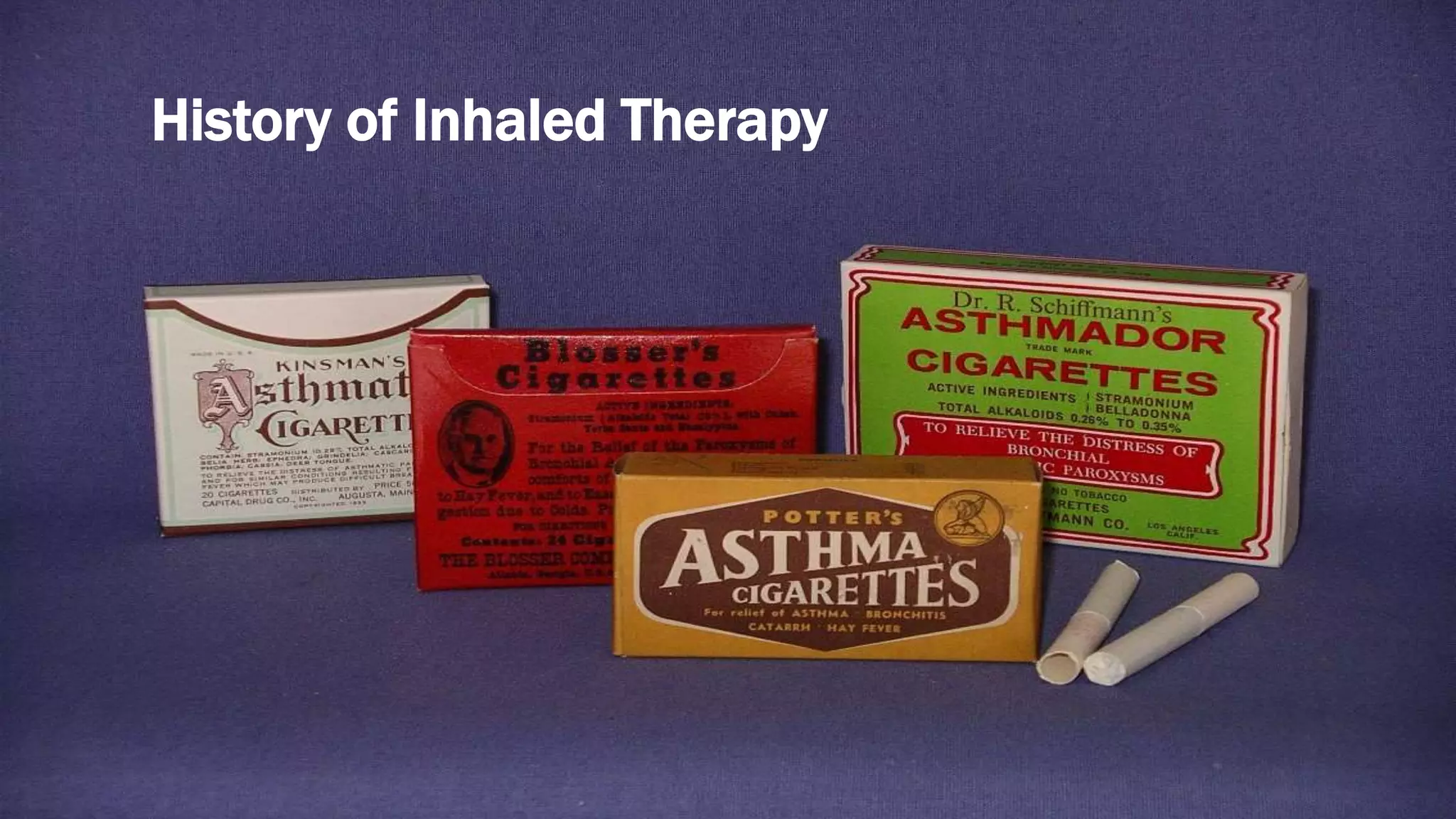
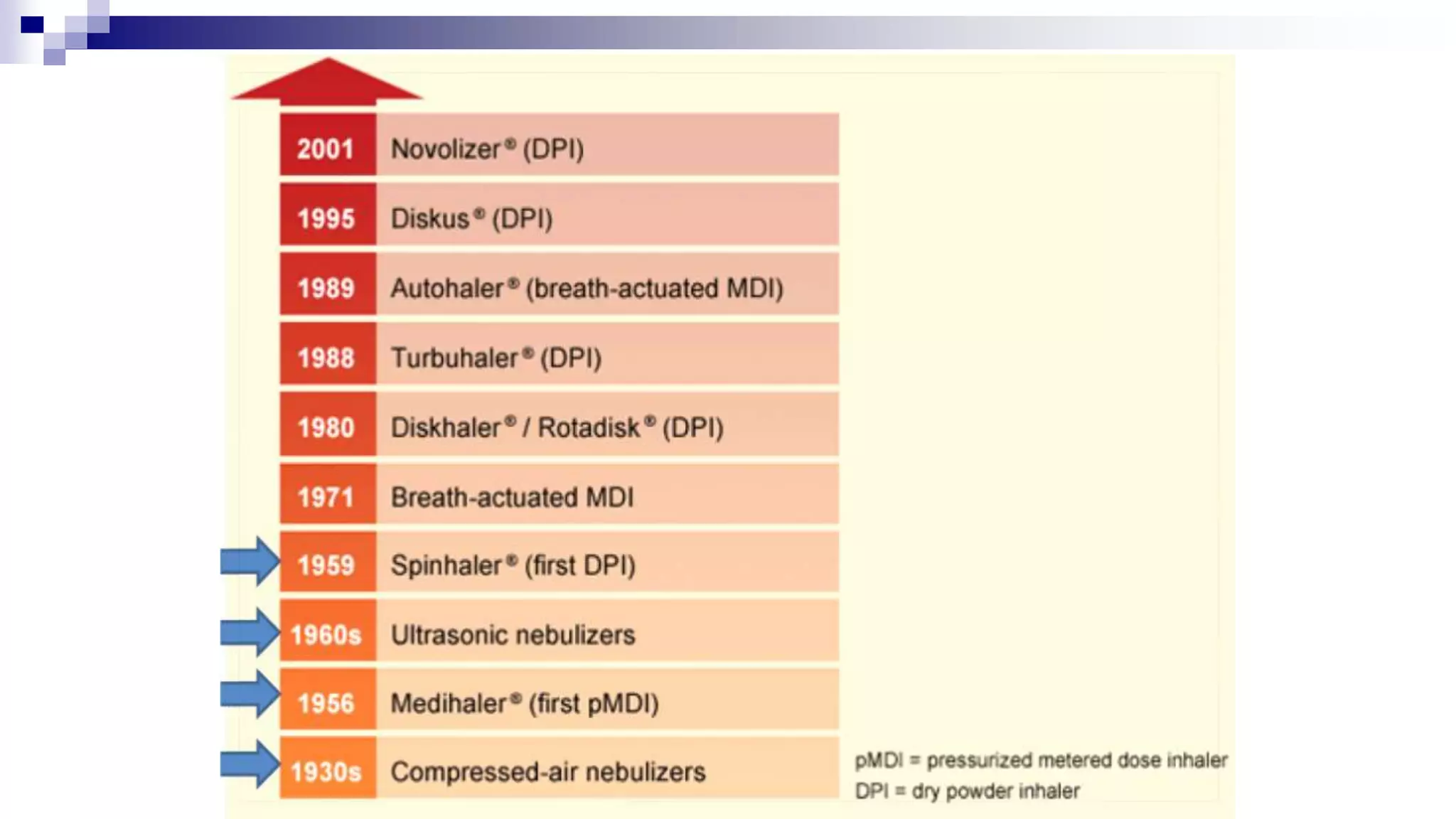
History of Inhaled Therapy
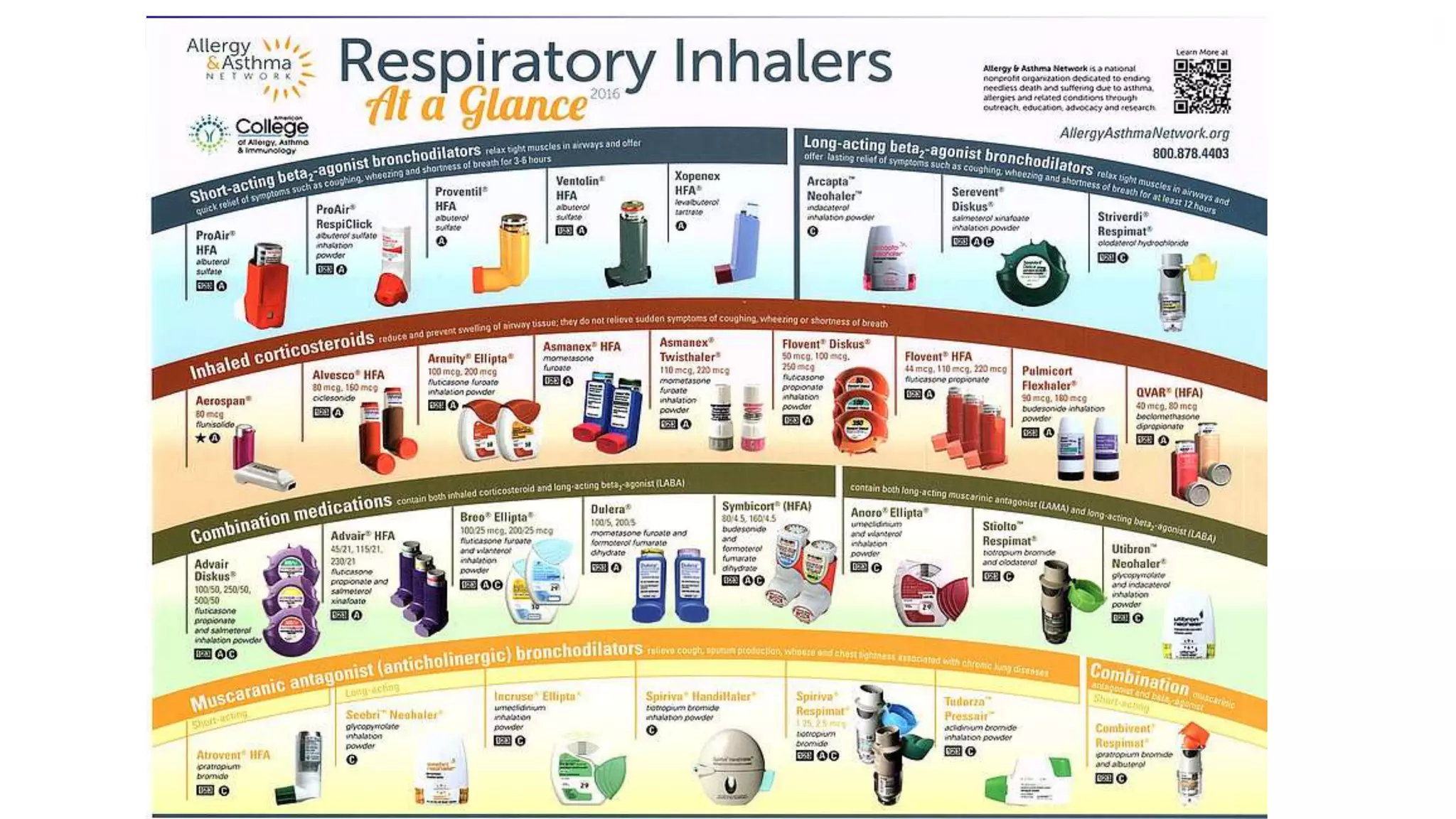
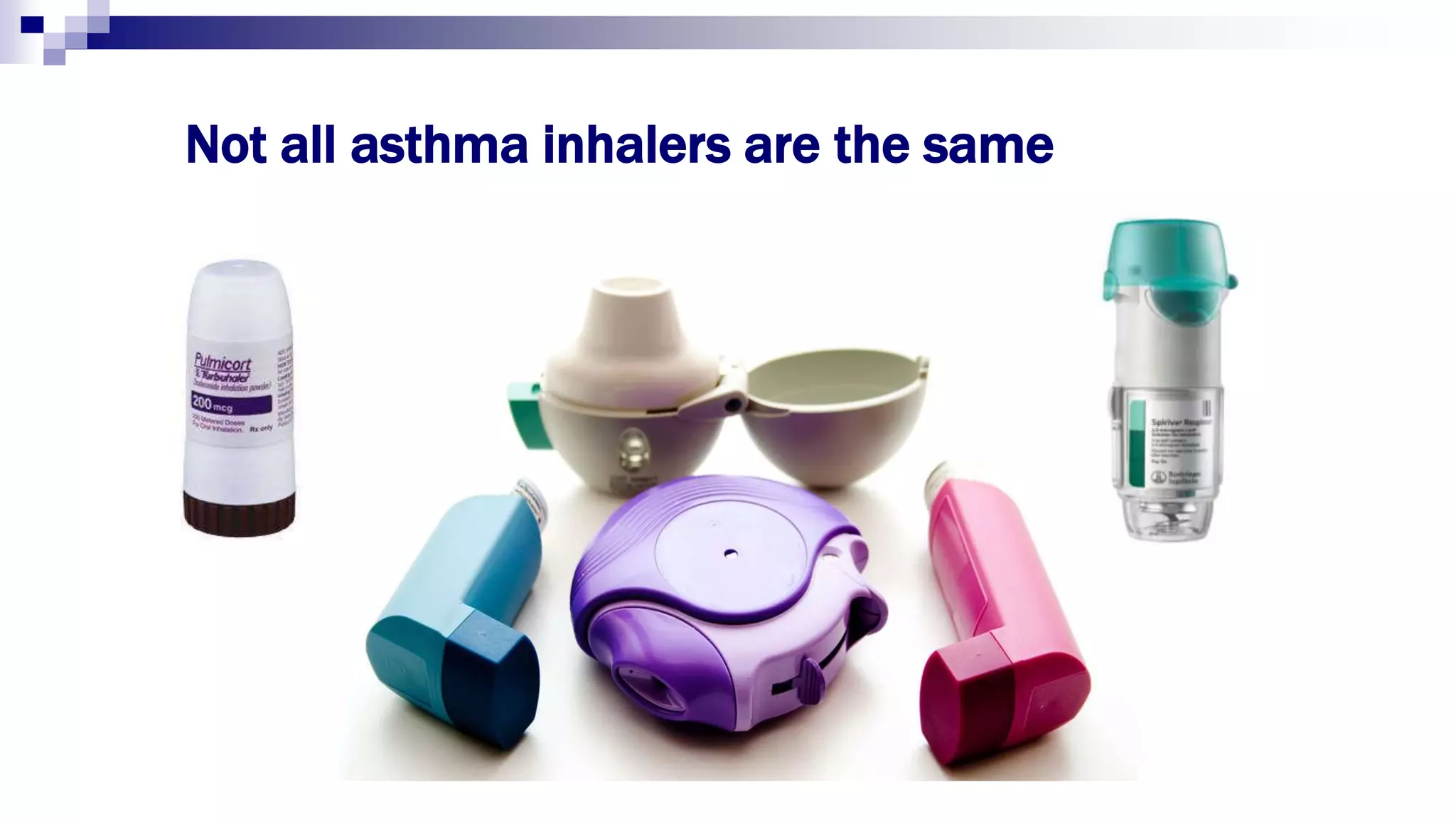
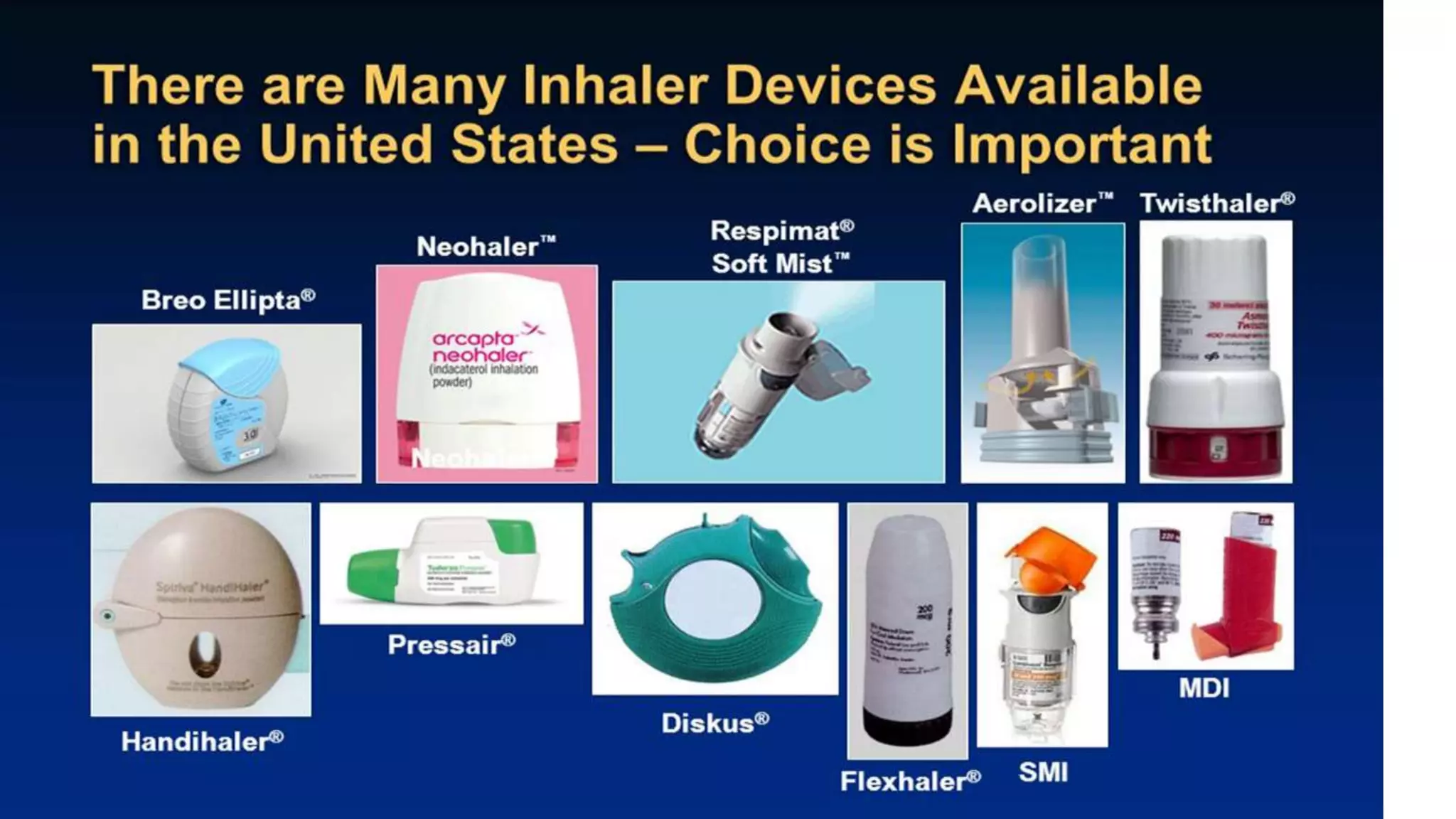
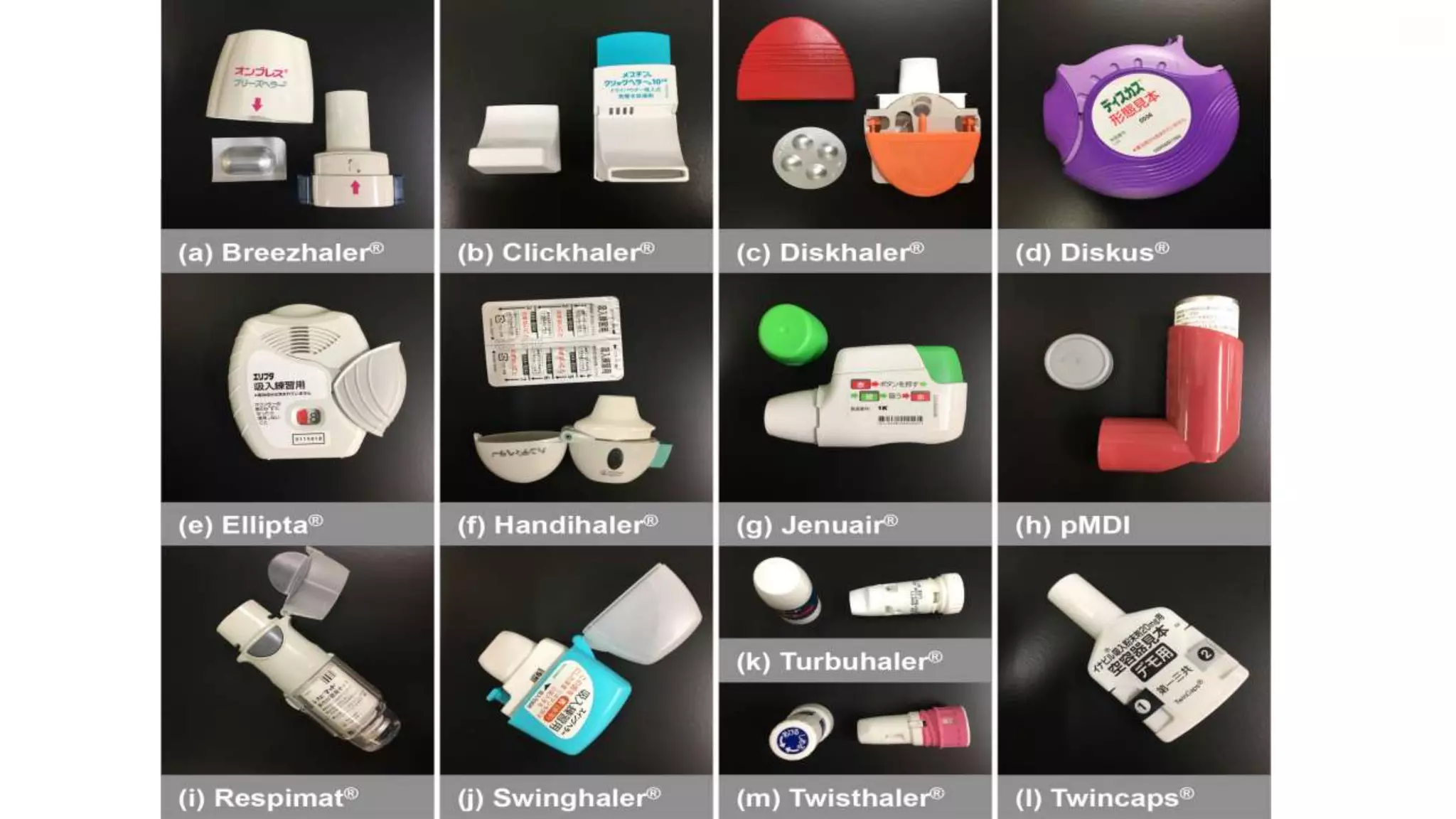
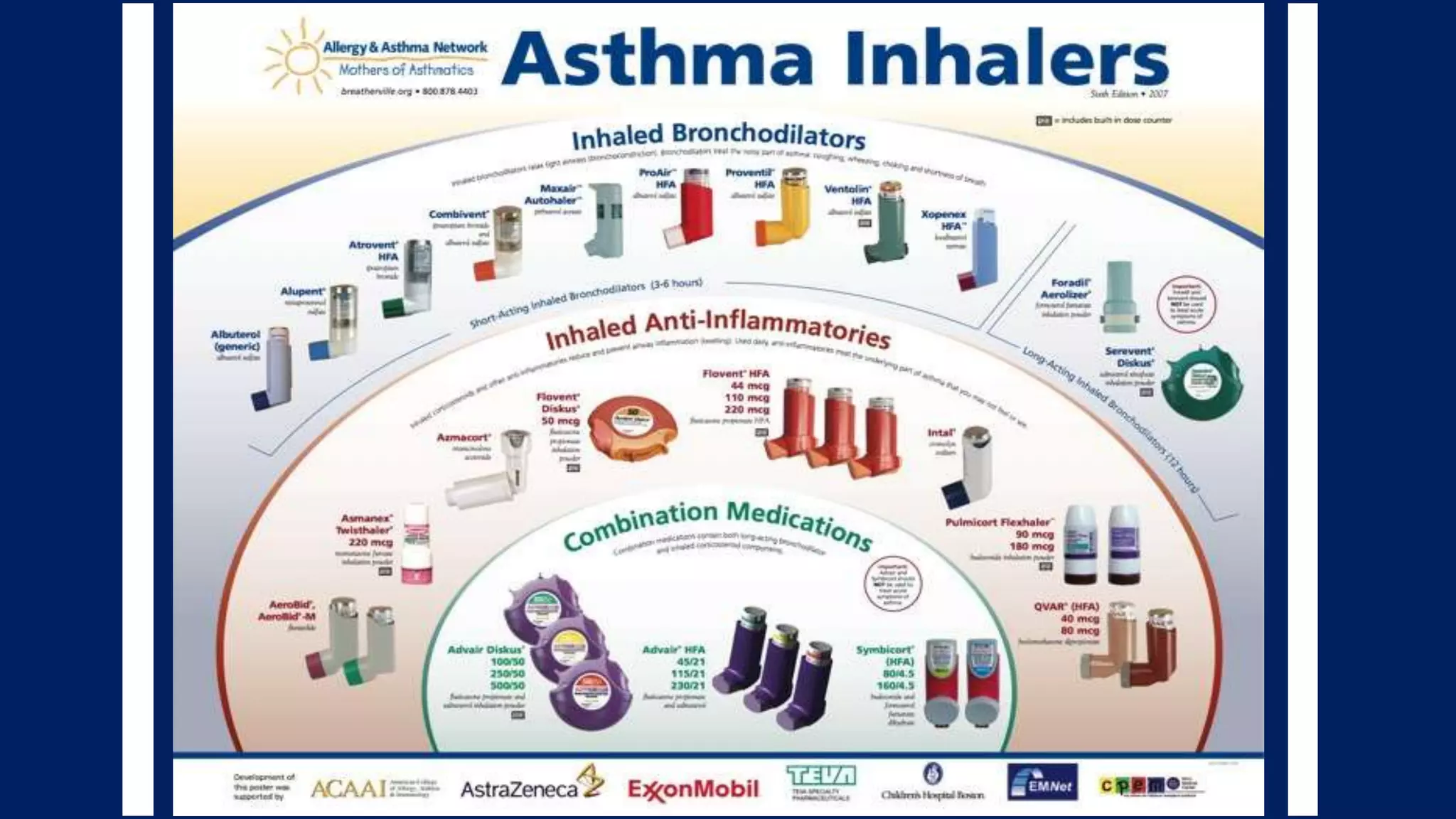
Not all asthma inhalers are the same
10
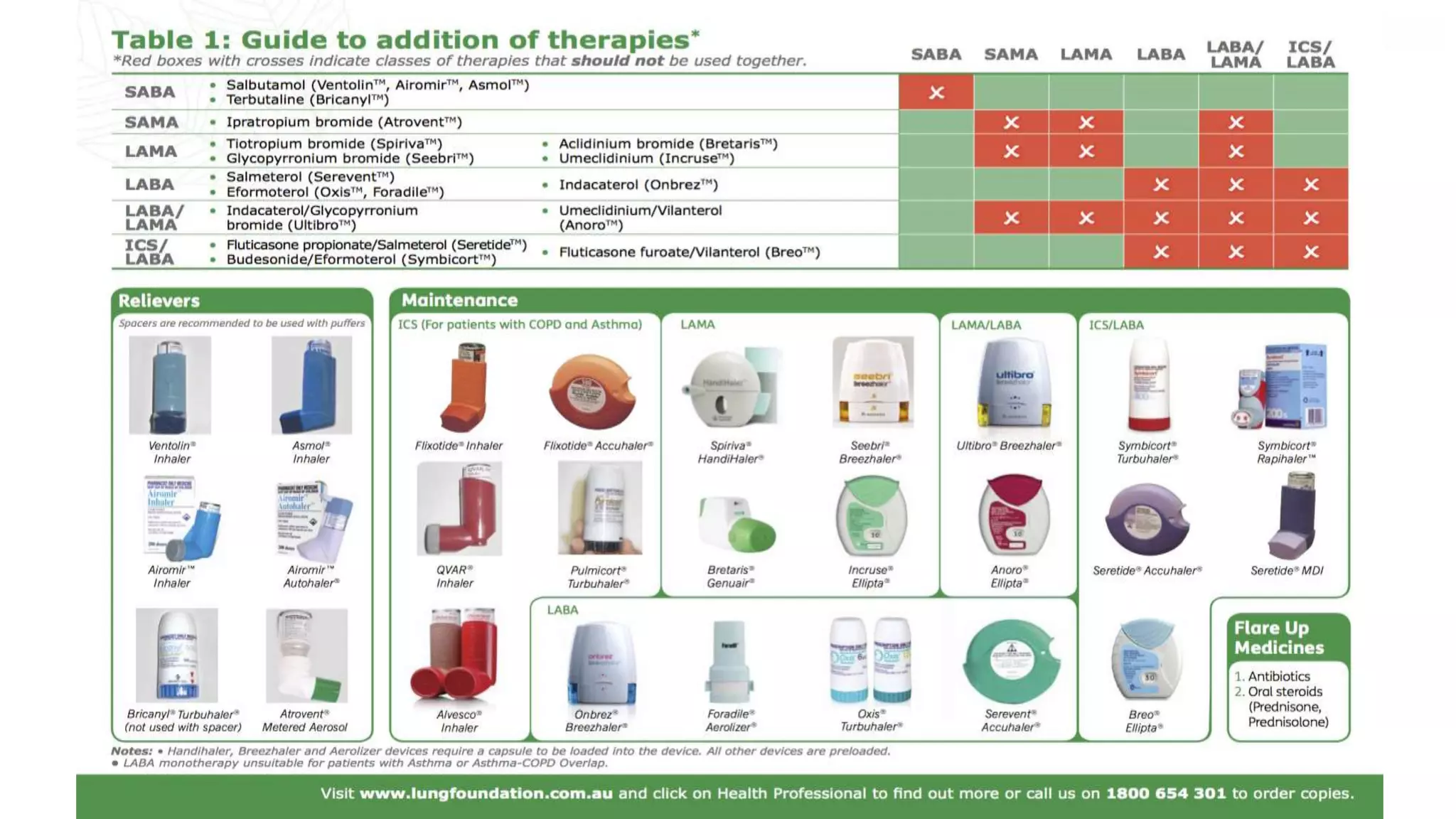
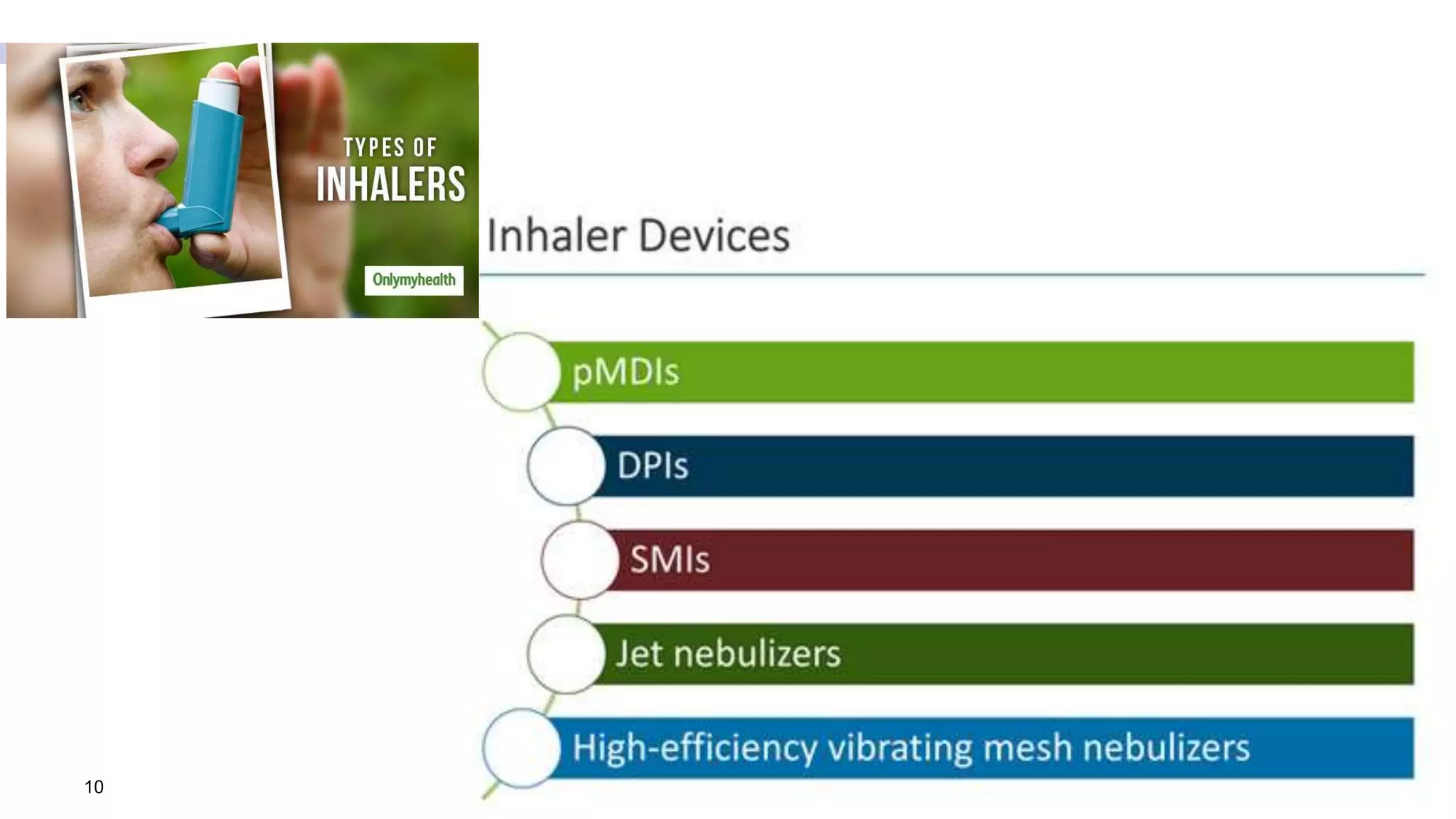
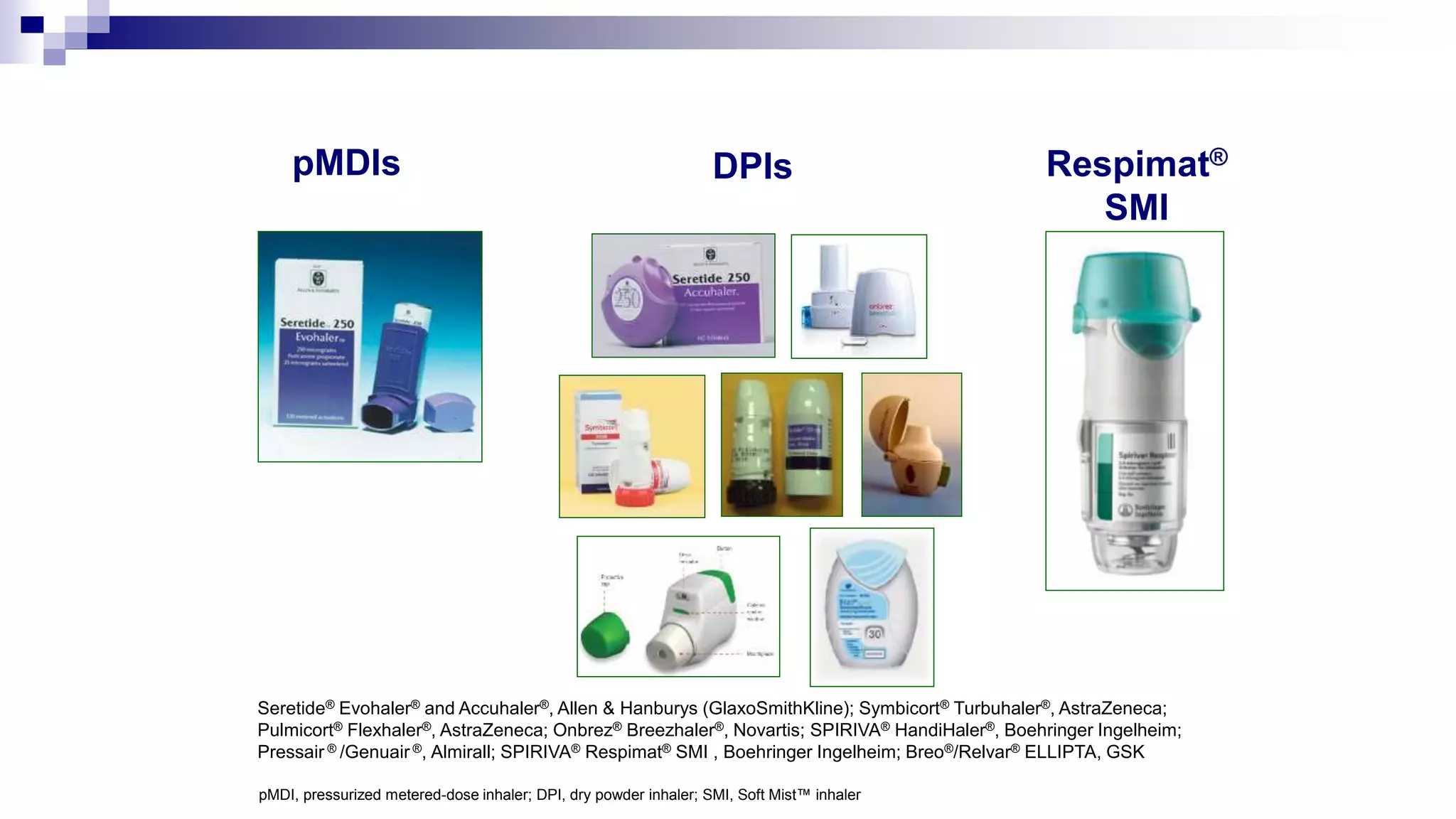
pMDIs DPIs Respimat®
SMI
pMDI, pressurized metered-dose inhaler; DPI, dry powder inhaler; SMI, Soft Mist™ inhaler
Seretide® Evohaler® and Accuhaler®, Allen & Hanburys (GlaxoSmithKline); Symbicort® Turbuhaler®, AstraZeneca;
Pulmicort® Flexhaler®, AstraZeneca; Onbrez® Breezhaler®, Novartis; SPIRIVA® HandiHaler®, Boehringer Ingelheim;
Pressair ® /Genuair ®, Almirall; SPIRIVA® Respimat® SMI , Boehringer Ingelheim; Breo®/Relvar® ELLIPTA, GSK
14
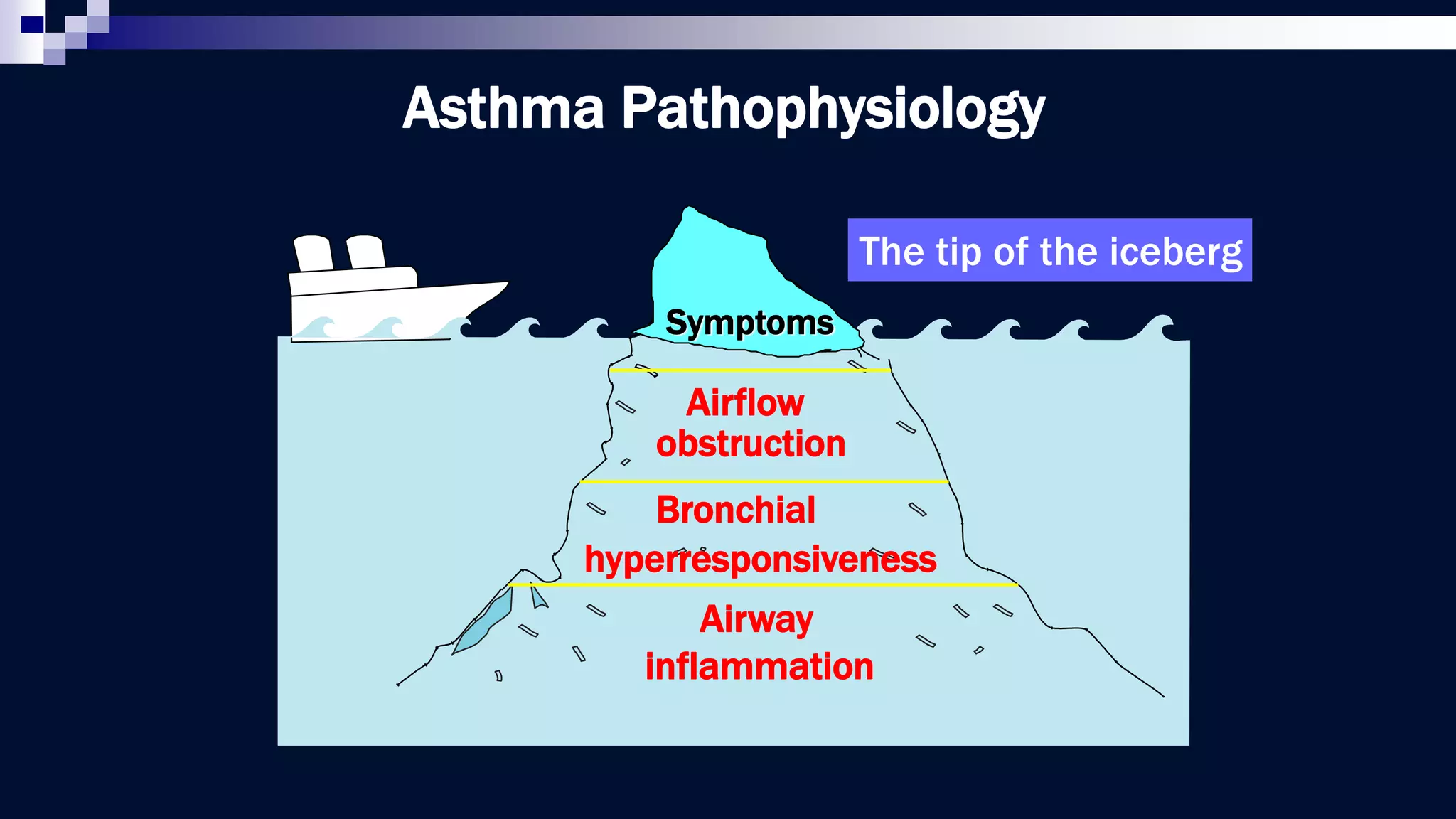
Airway
inflammation
Airflow
obstruction
Bronchial
hyperresponsiveness
Symptoms
Asthma Pathophysiology
The tip of the iceberg
17
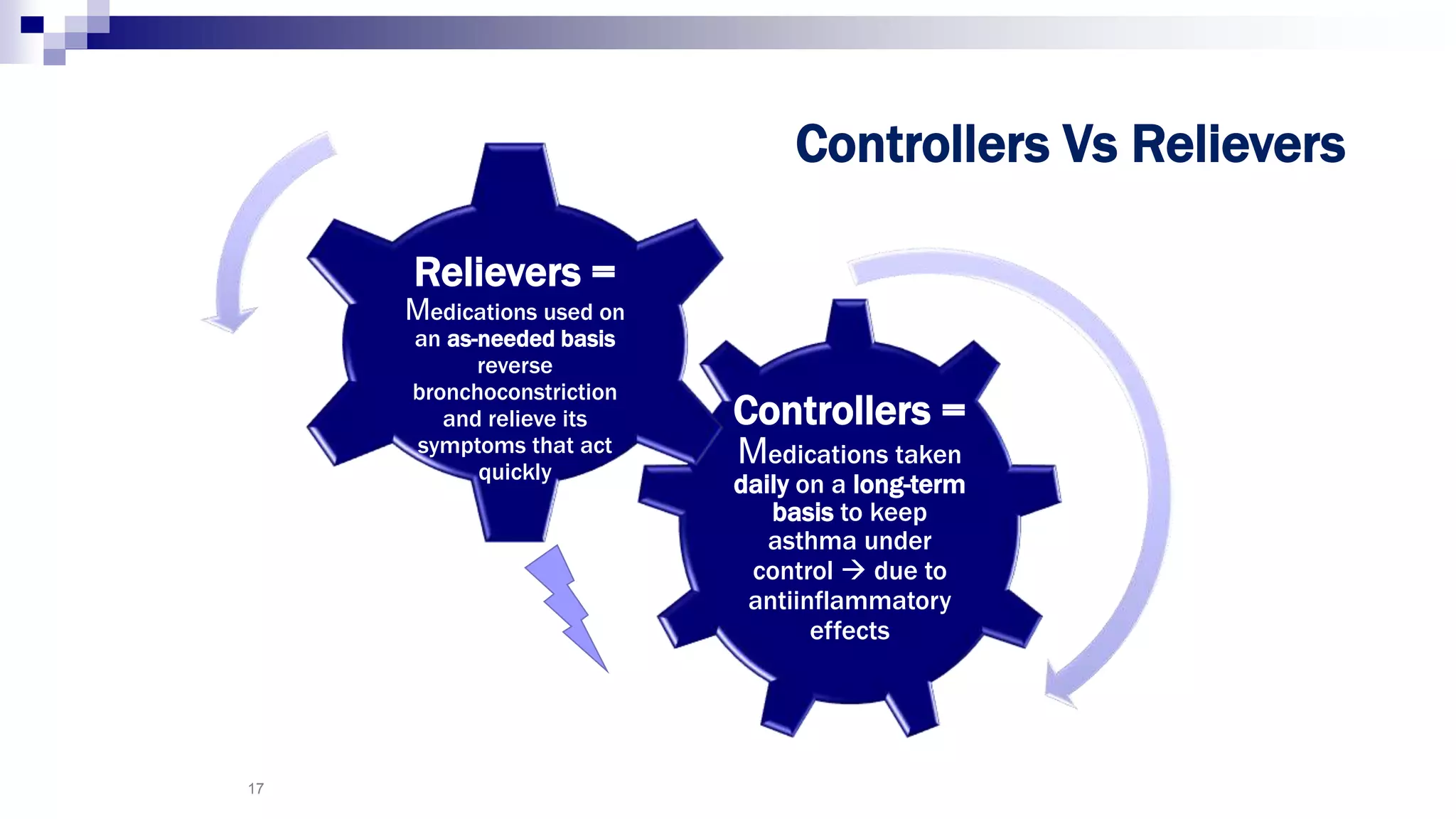
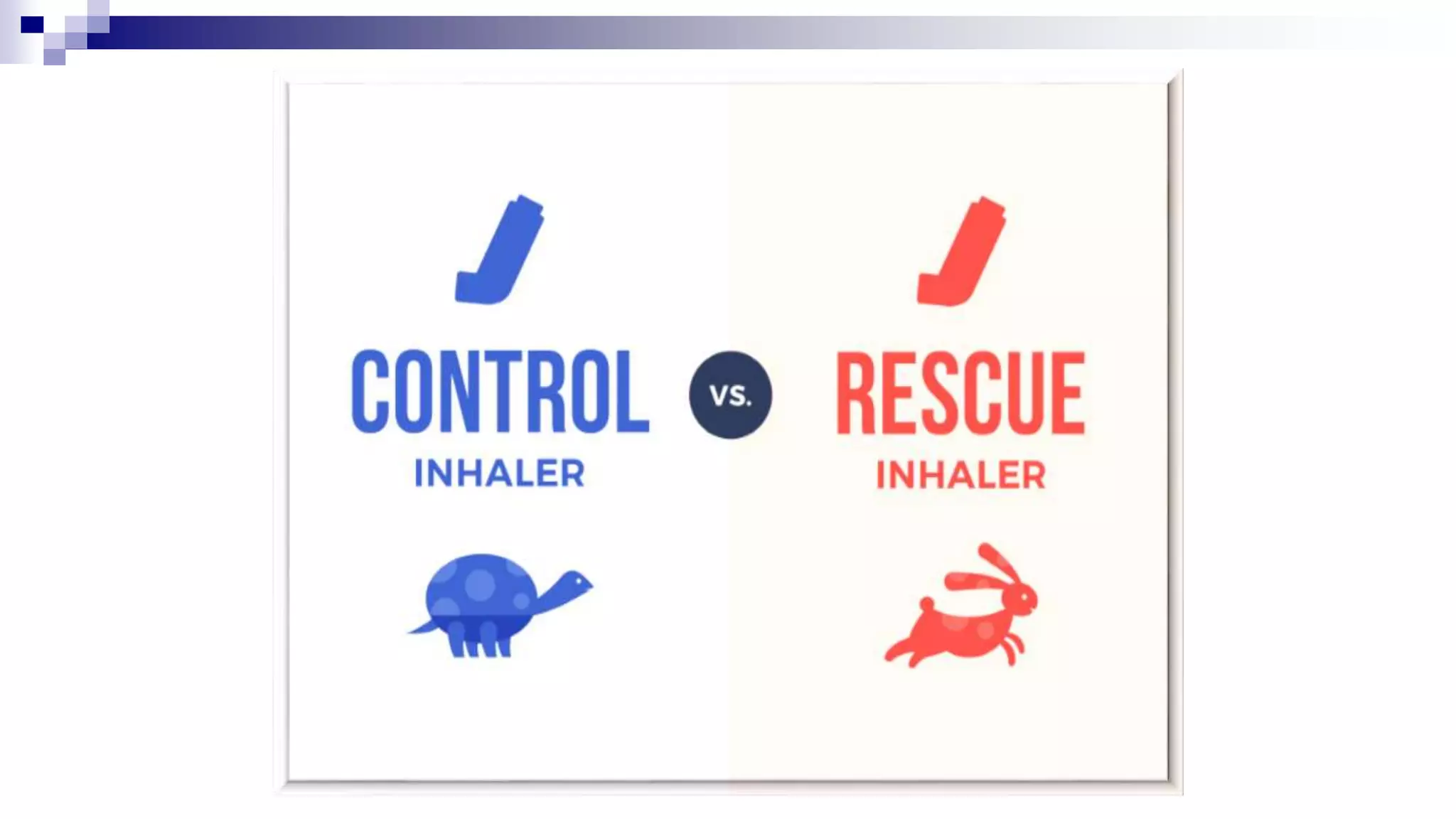
Controllers =
Medications taken
daily on a long-term
basis to keep
asthma under
control  due to
antiinflammatory
effects
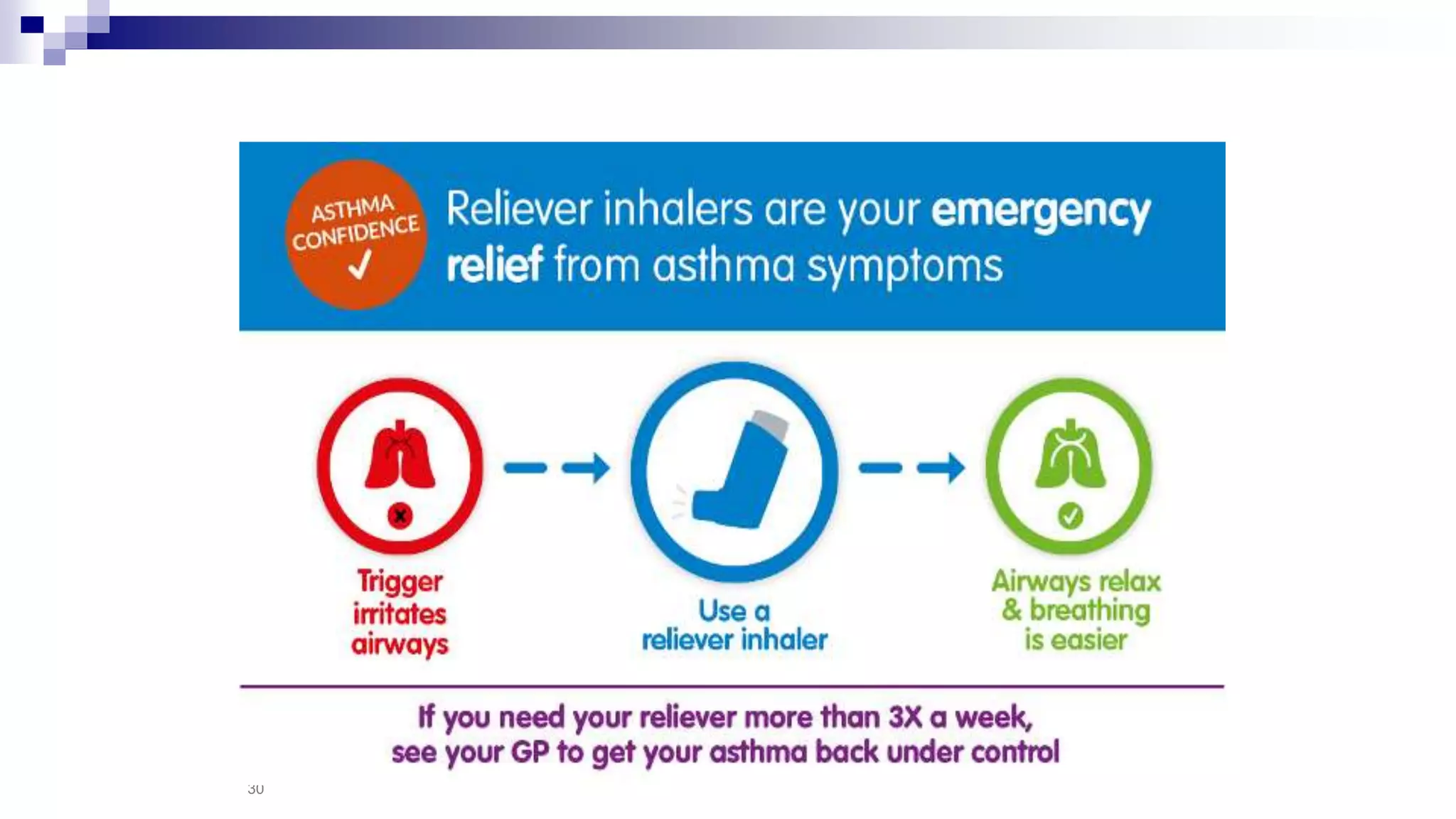
Relievers =
Medications used on
an as-needed basis
reverse
bronchoconstriction
and relieve its
symptoms that act
quickly
Controllers Vs Relievers
20
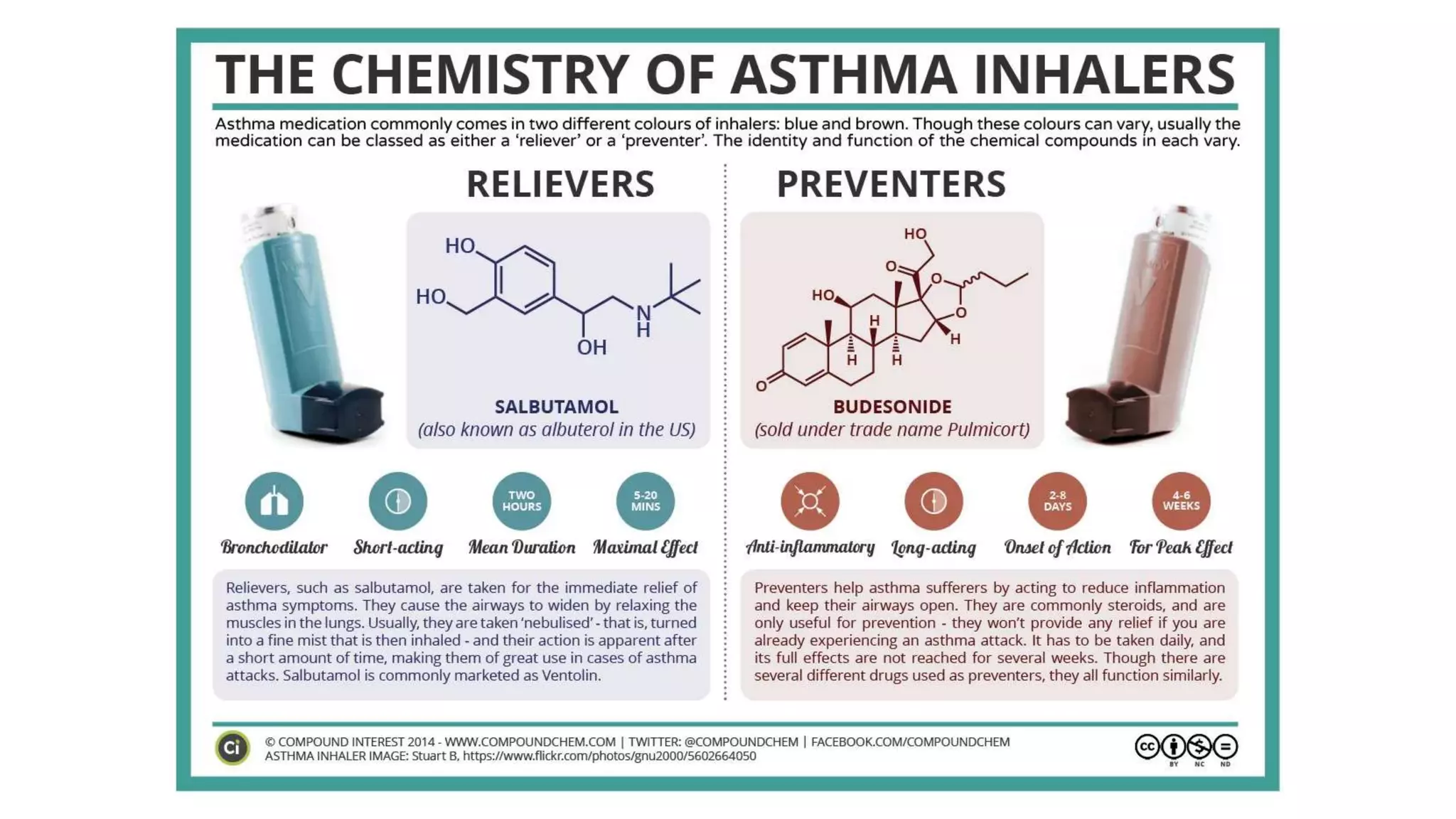
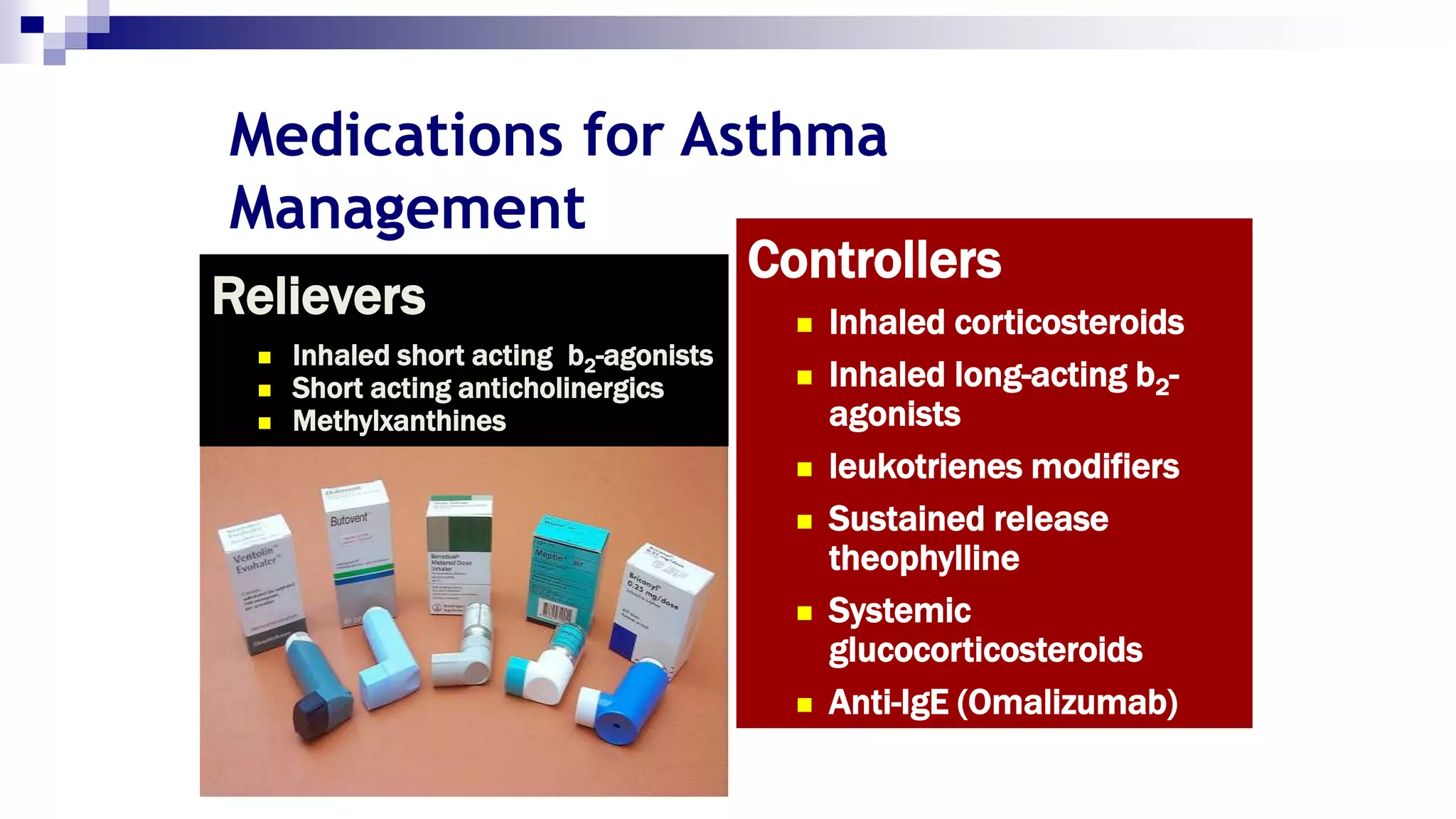
Controllers
 Inhaled corticosteroids
 Inhaled long-acting b2-
agonists
 leukotrienes modifiers
 Sustained release
theophylline
 Systemic
glucocorticosteroids
 Anti-IgE (Omalizumab)
Relievers
 Inhaled short acting b2-agonists
 Short acting anticholinergics
 Methylxanthines
Medications for Asthma
Management
21
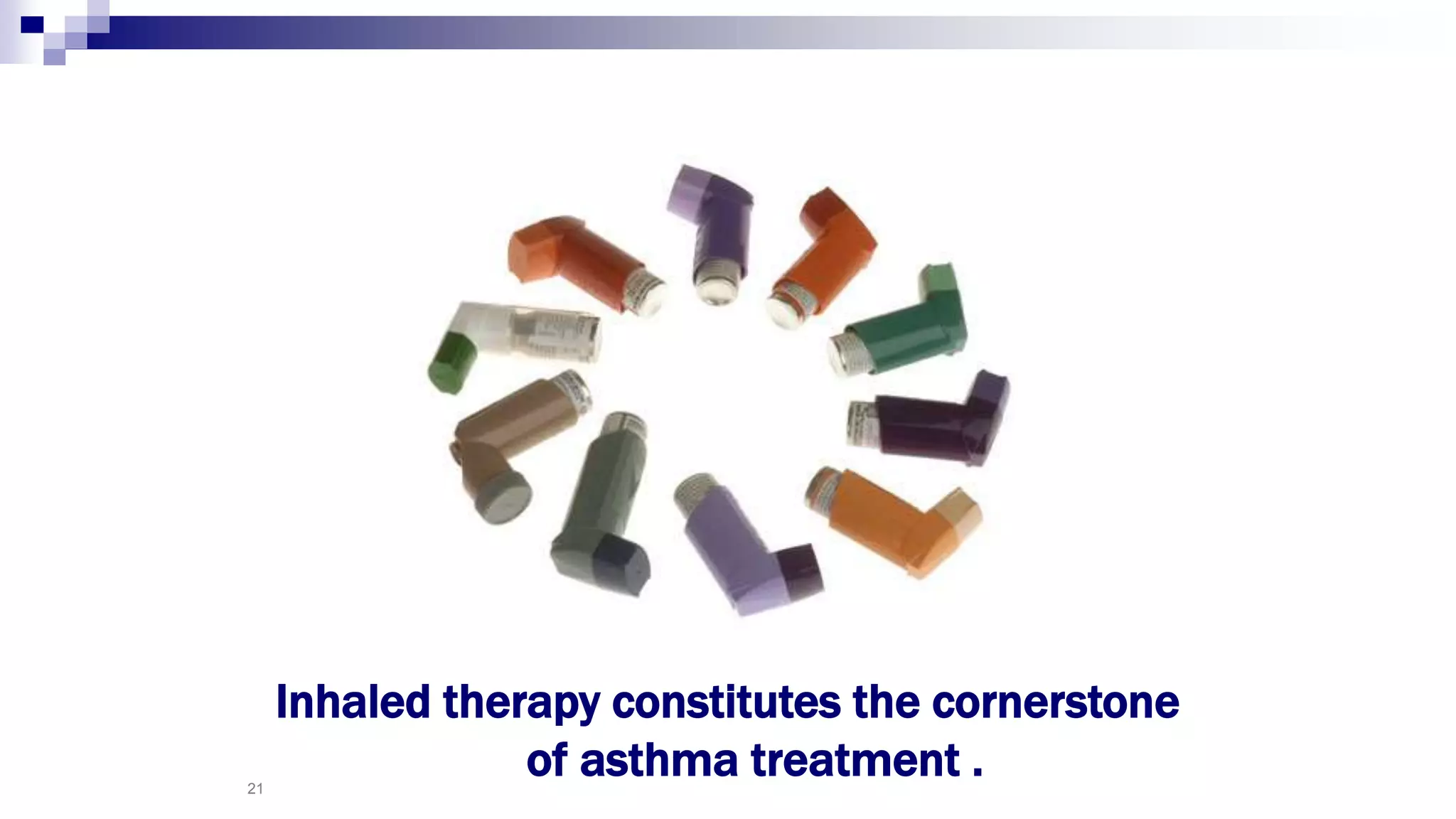
Inhaled therapy constitutes the cornerstone
of asthma treatment .
23
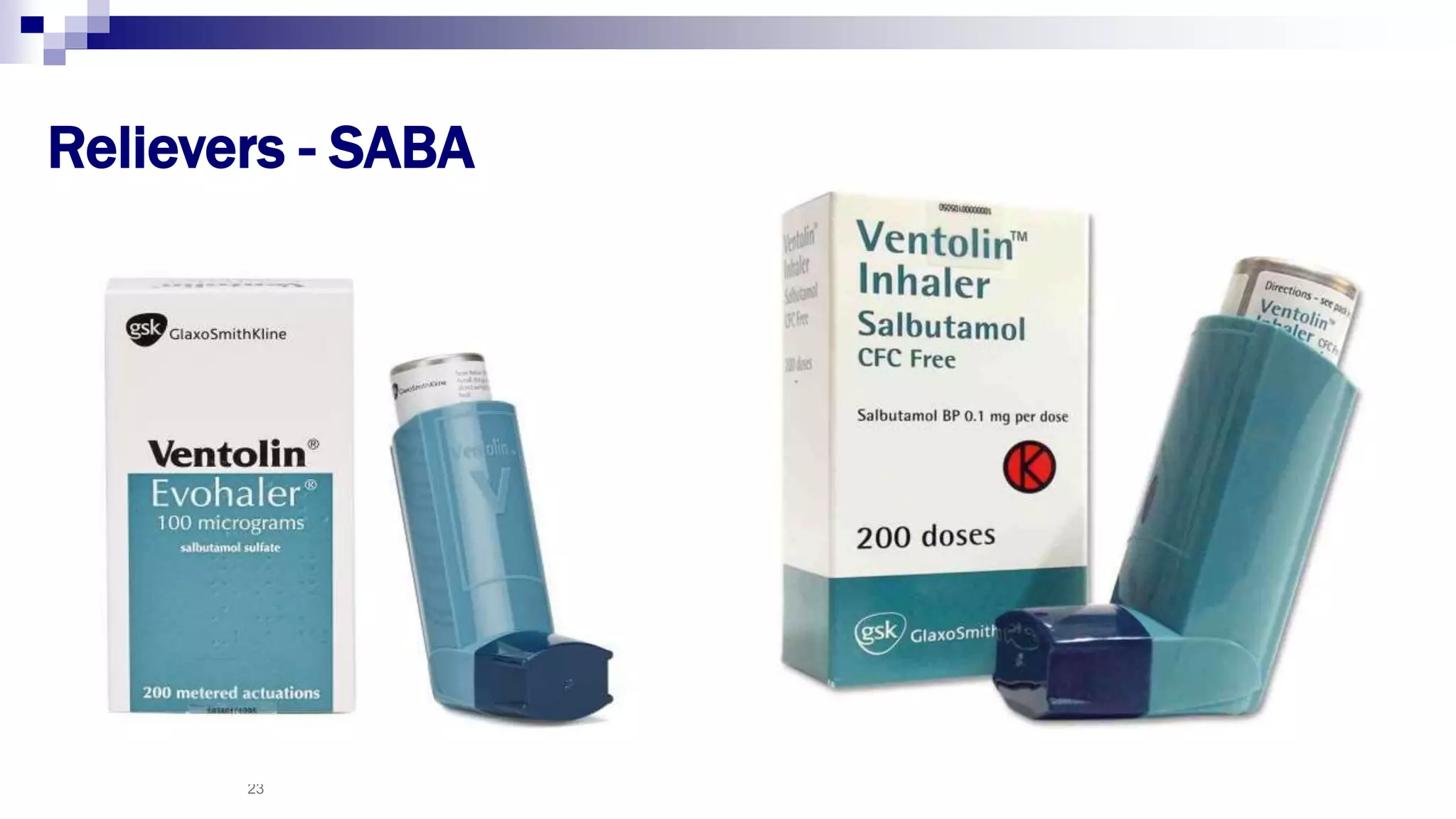
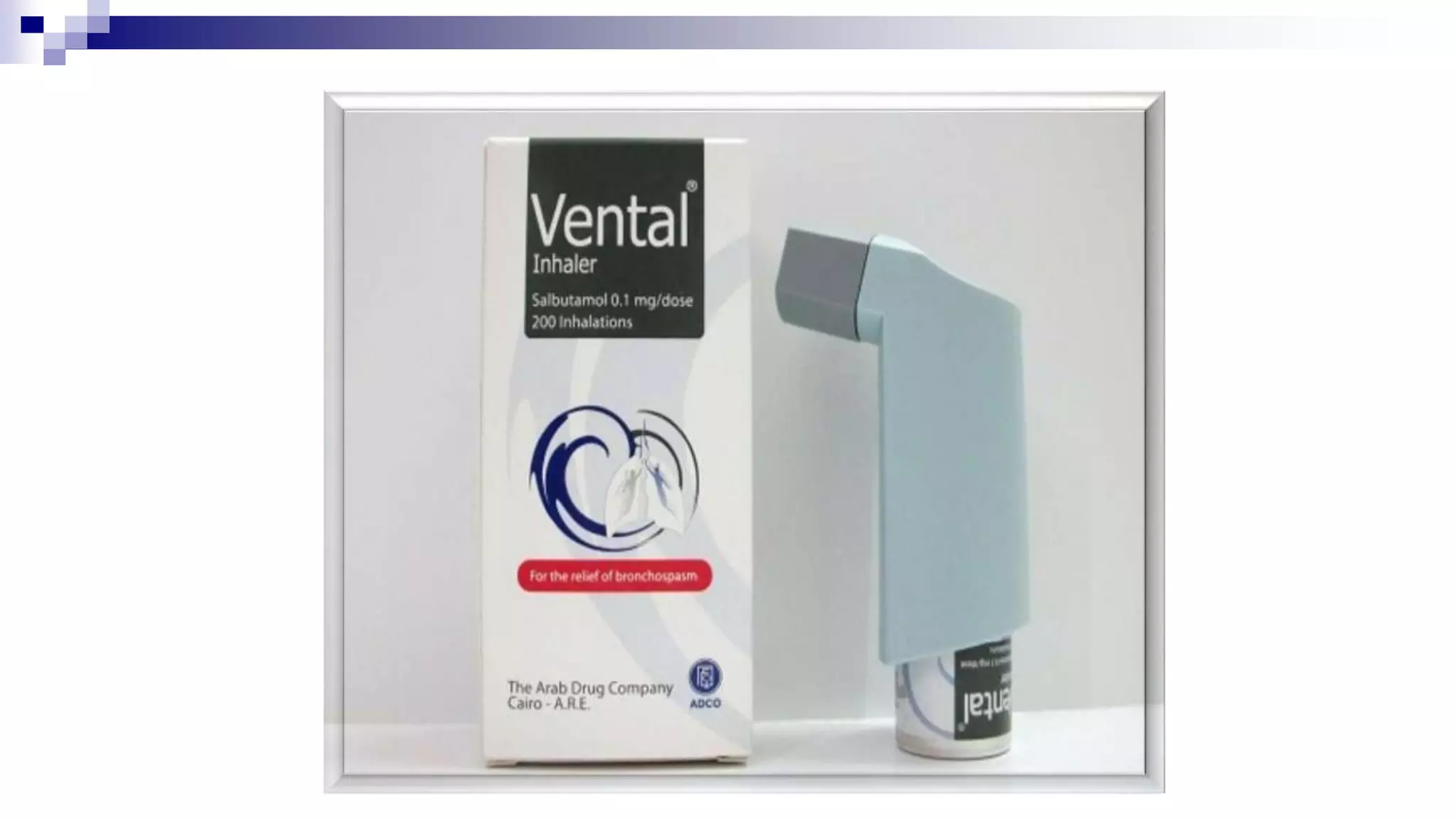
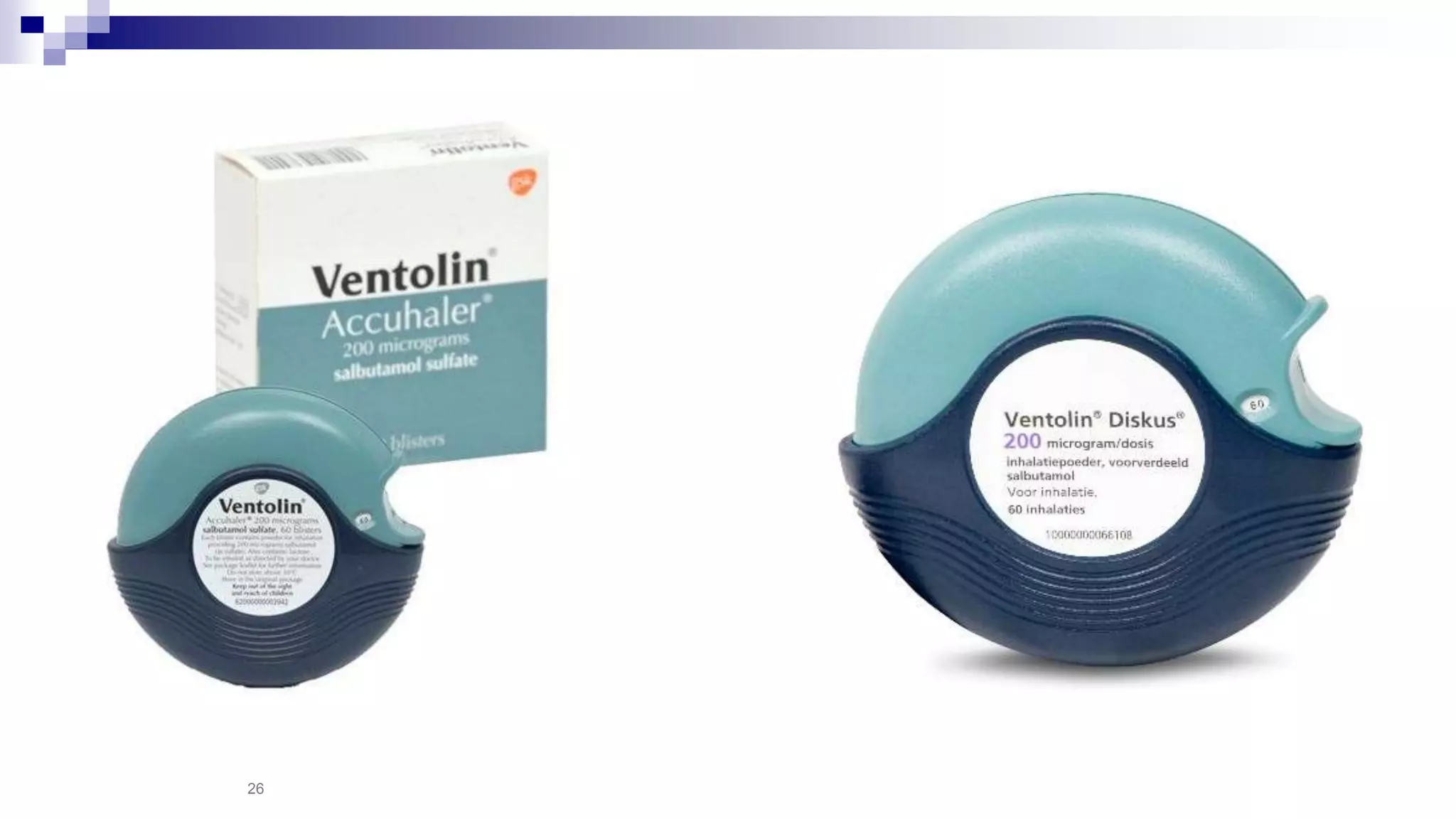
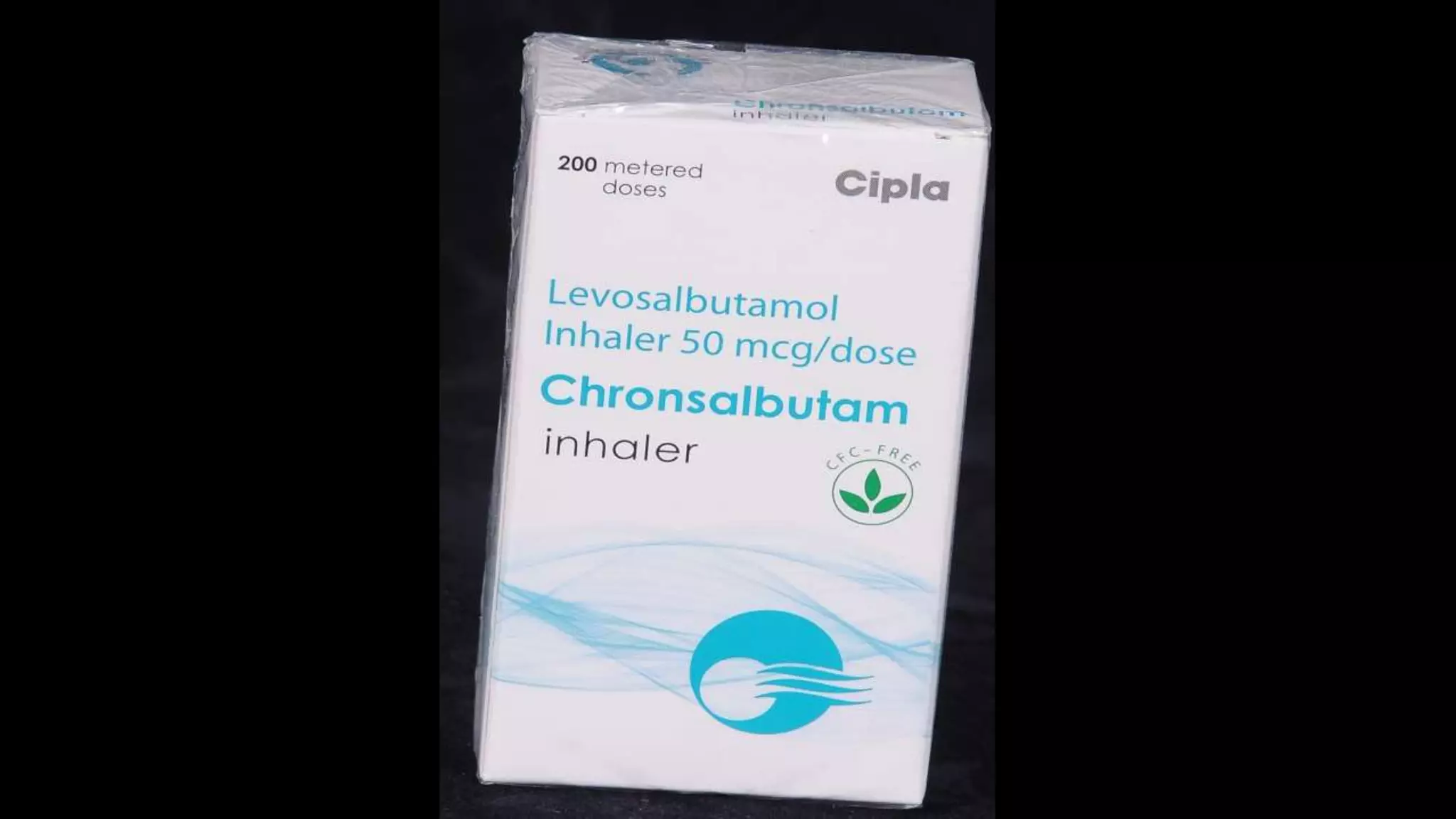
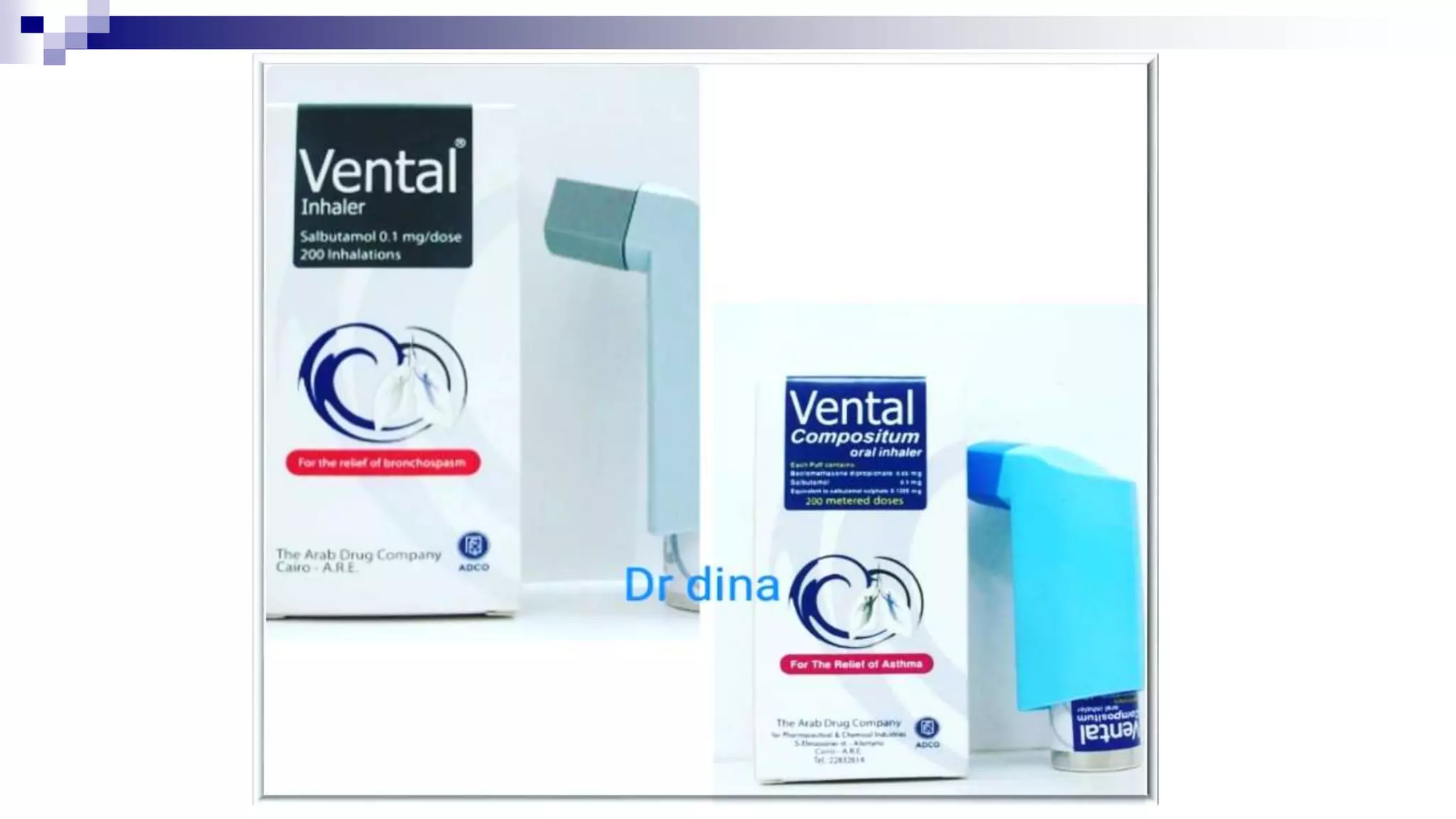
Relievers - SABA
26
30
34
36
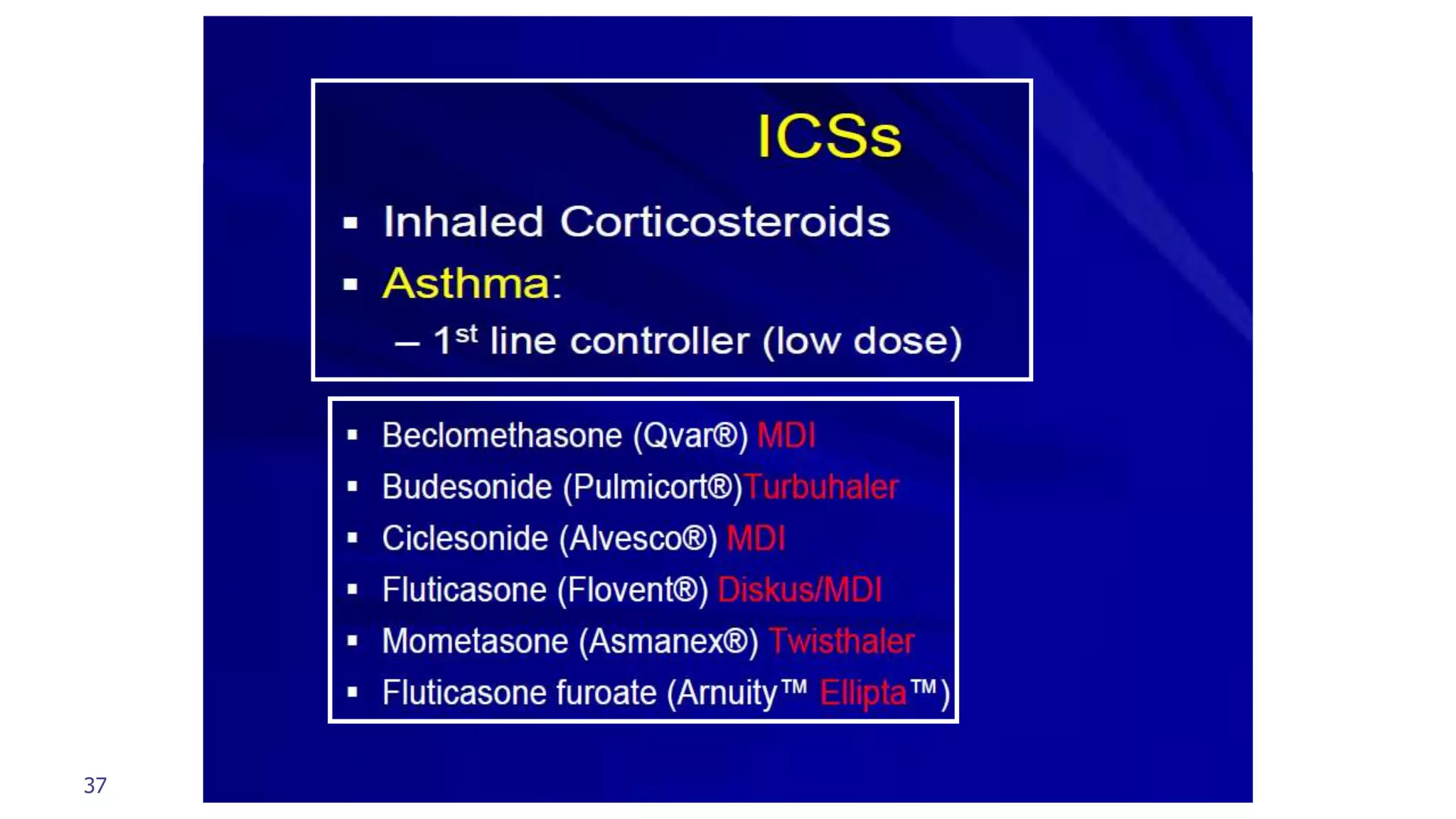
37
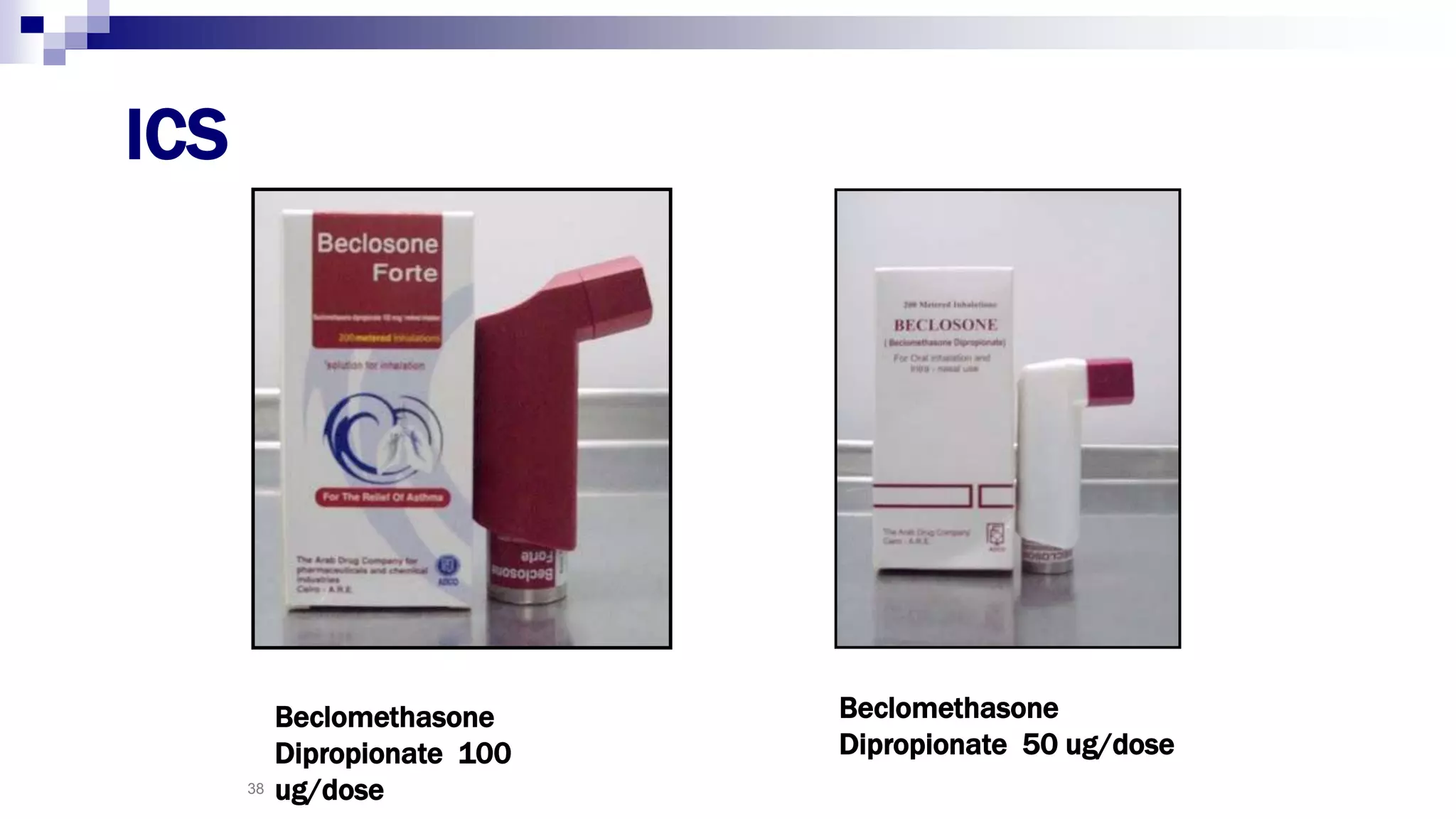
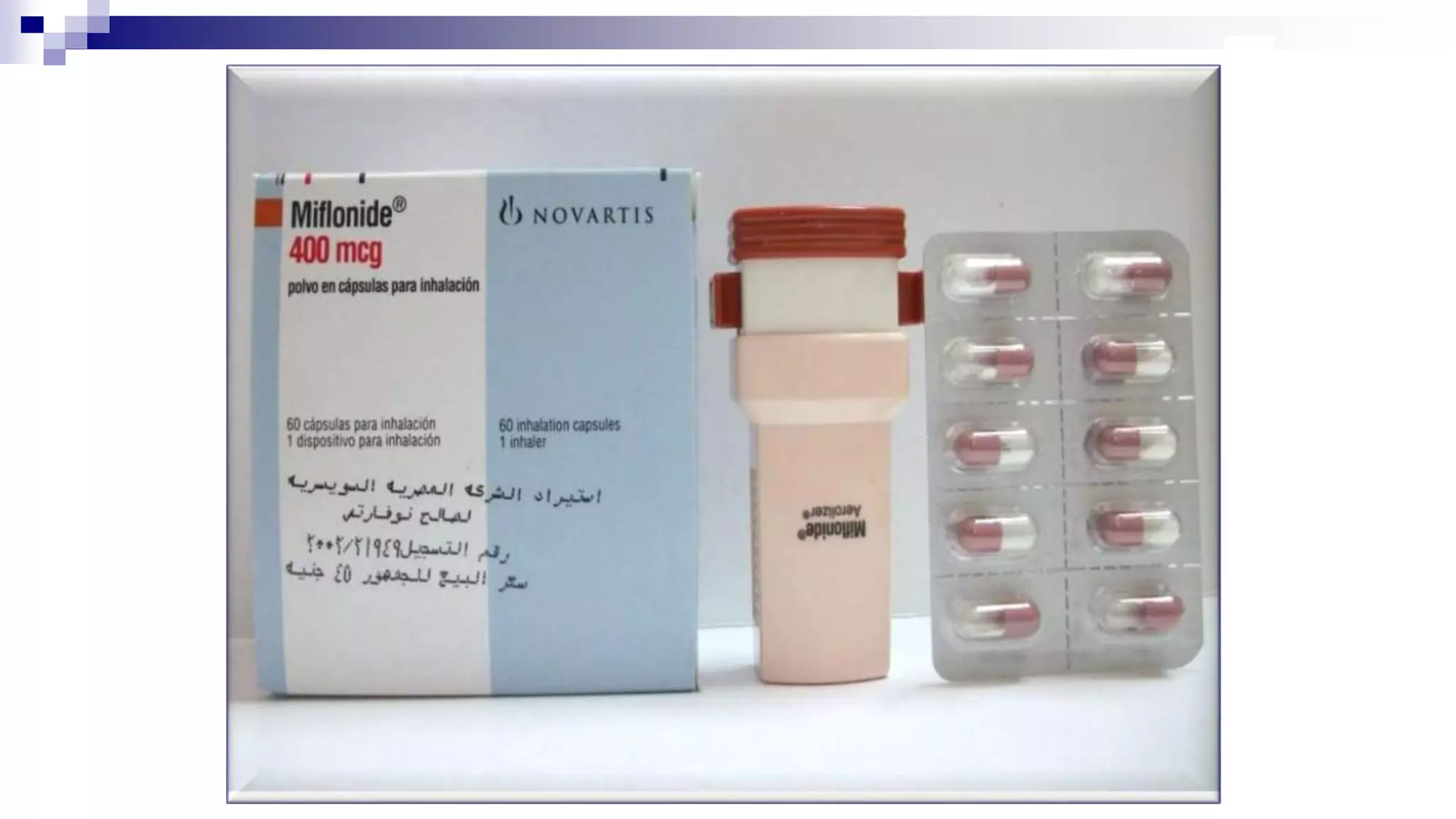
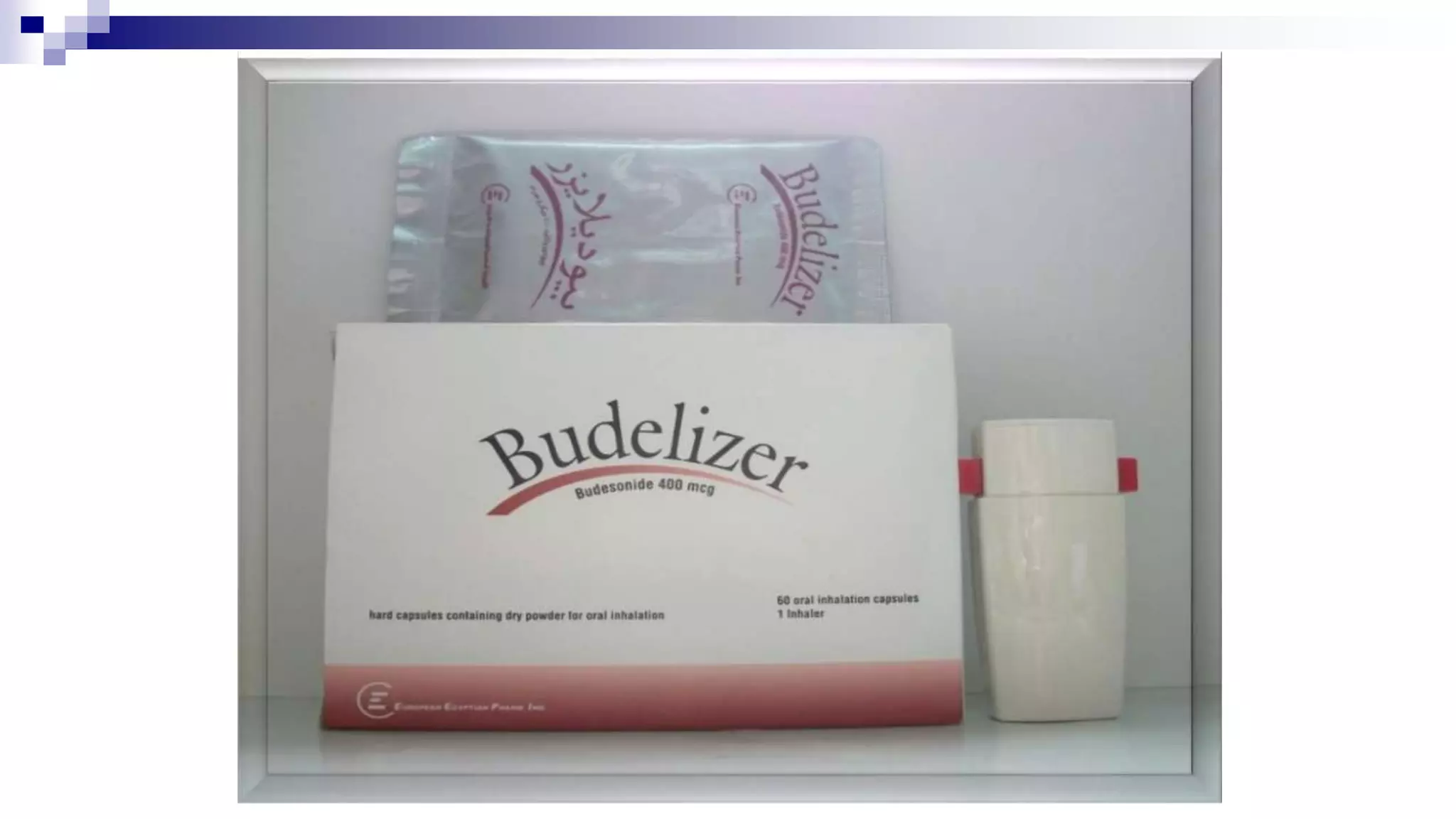
38
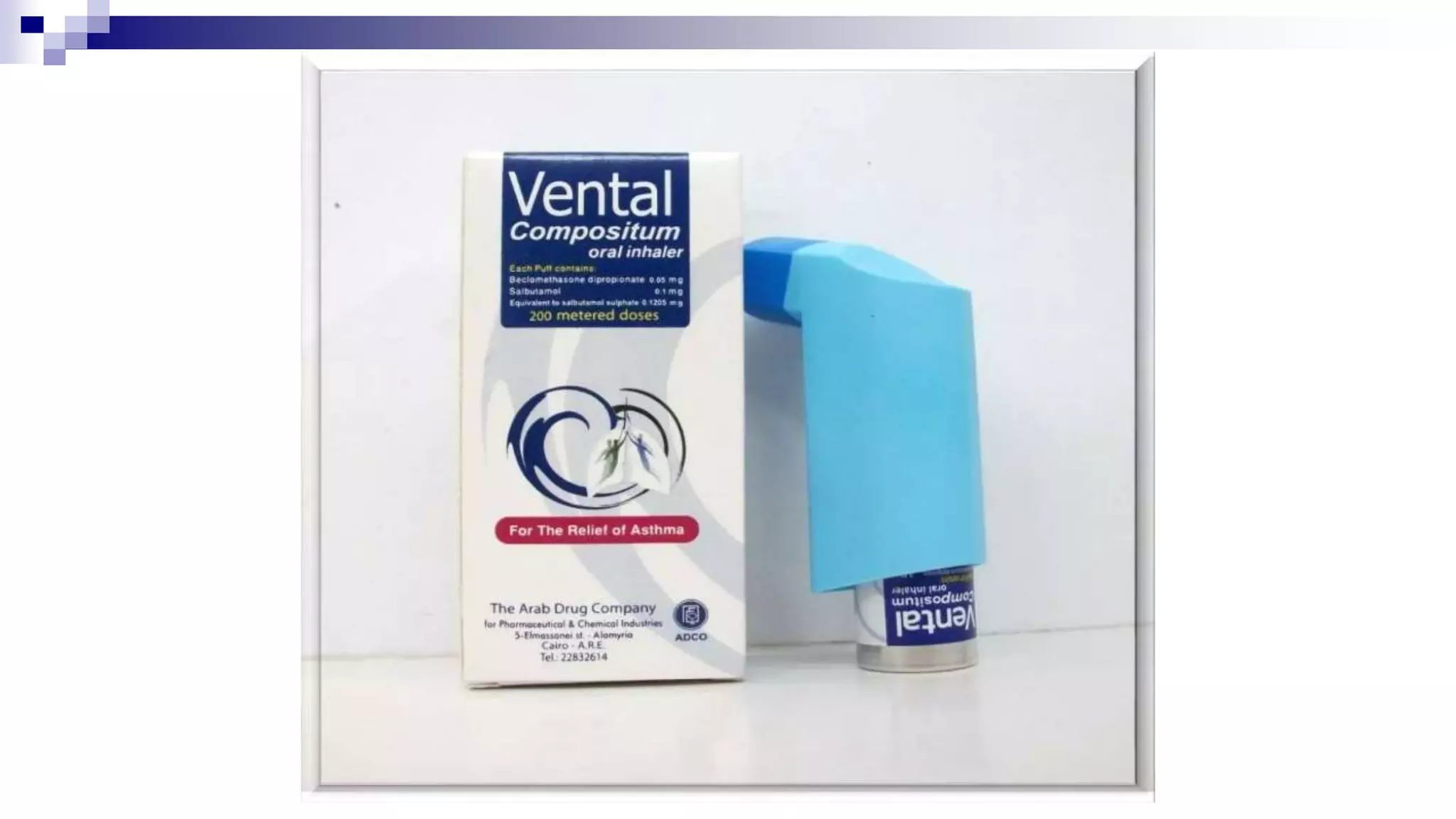
Beclomethasone
Dipropionate 100
ug/dose
Beclomethasone
Dipropionate 50 ug/dose
ICS
39
40
44
45
46
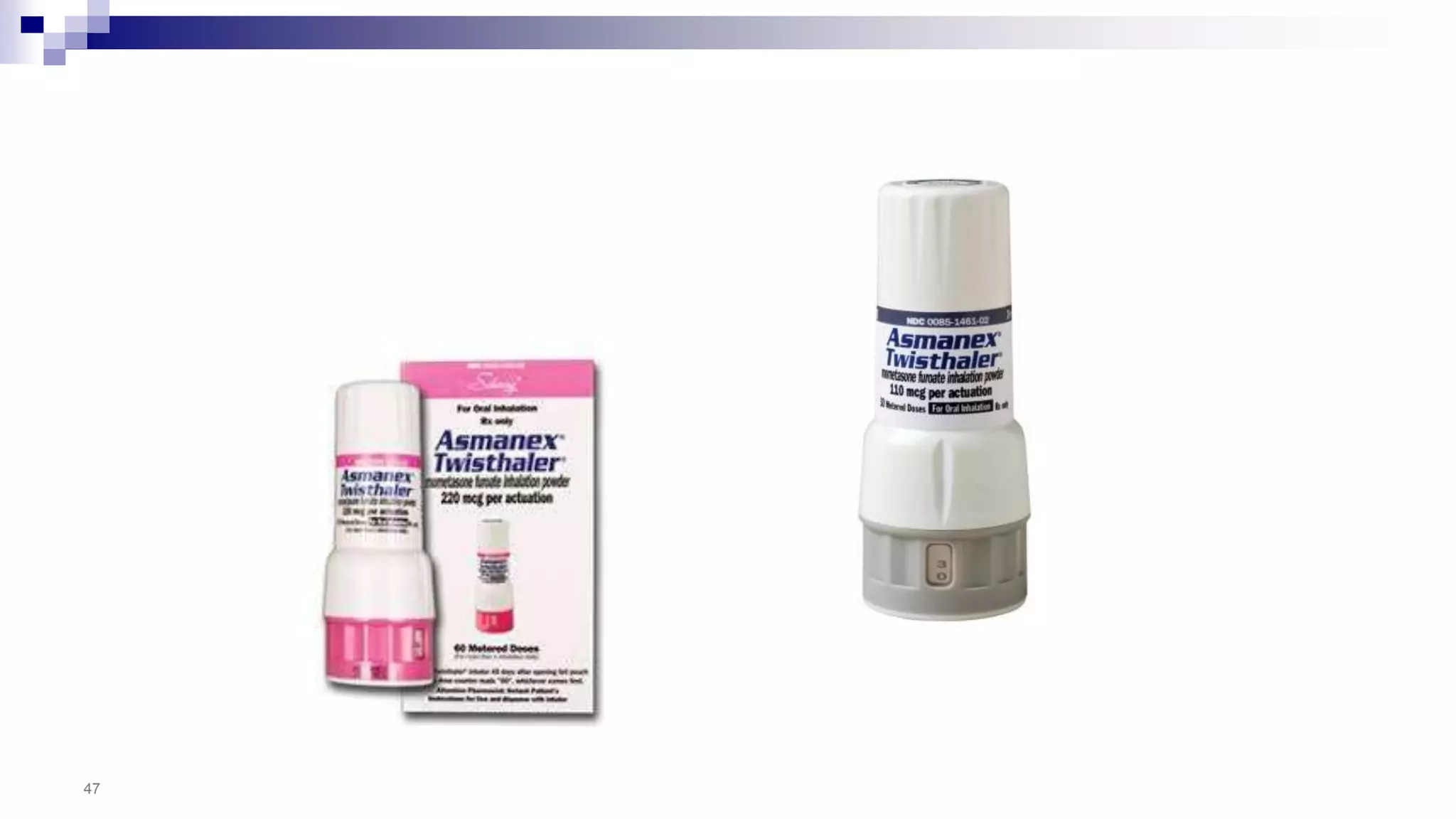
47
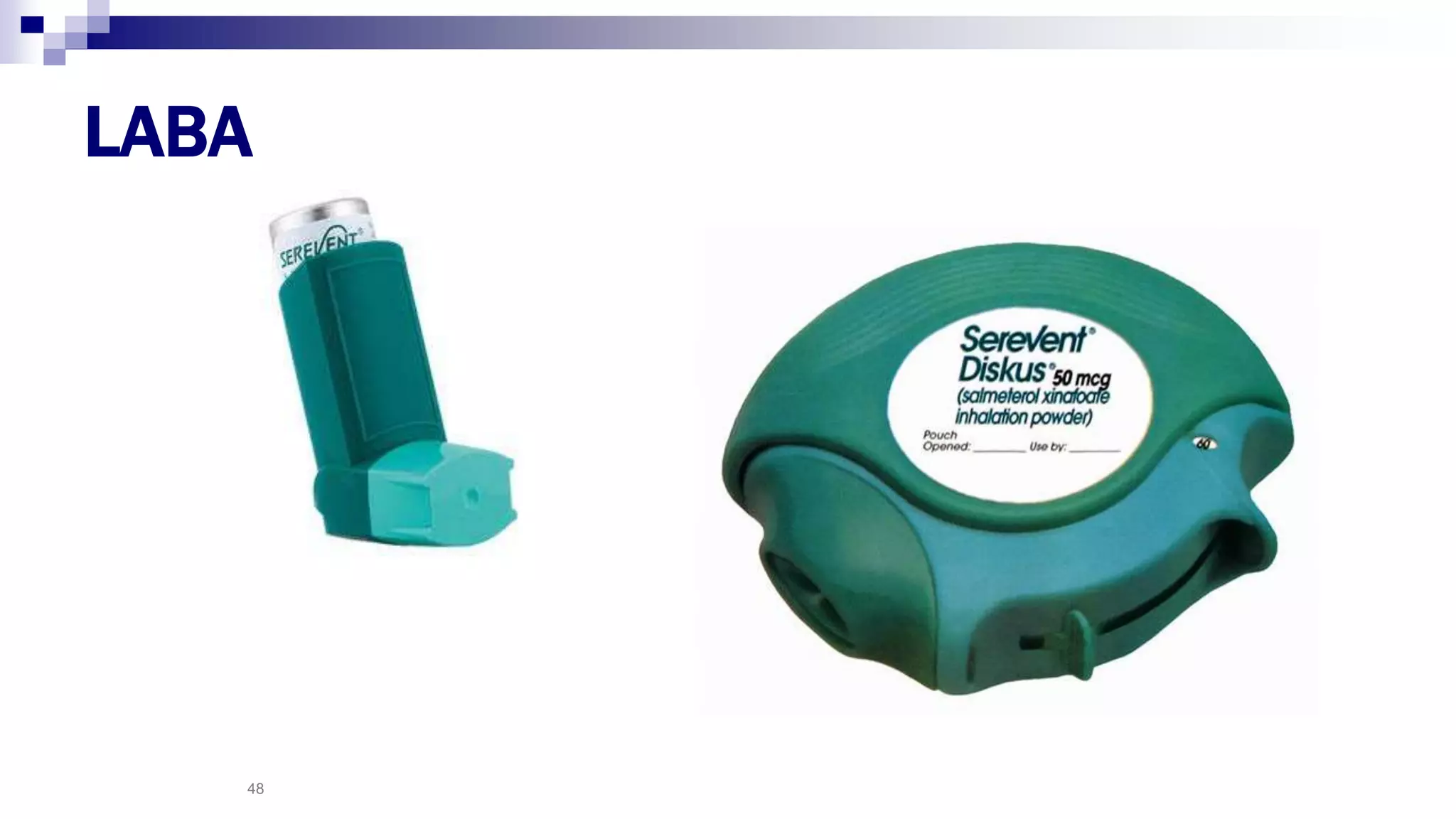
48
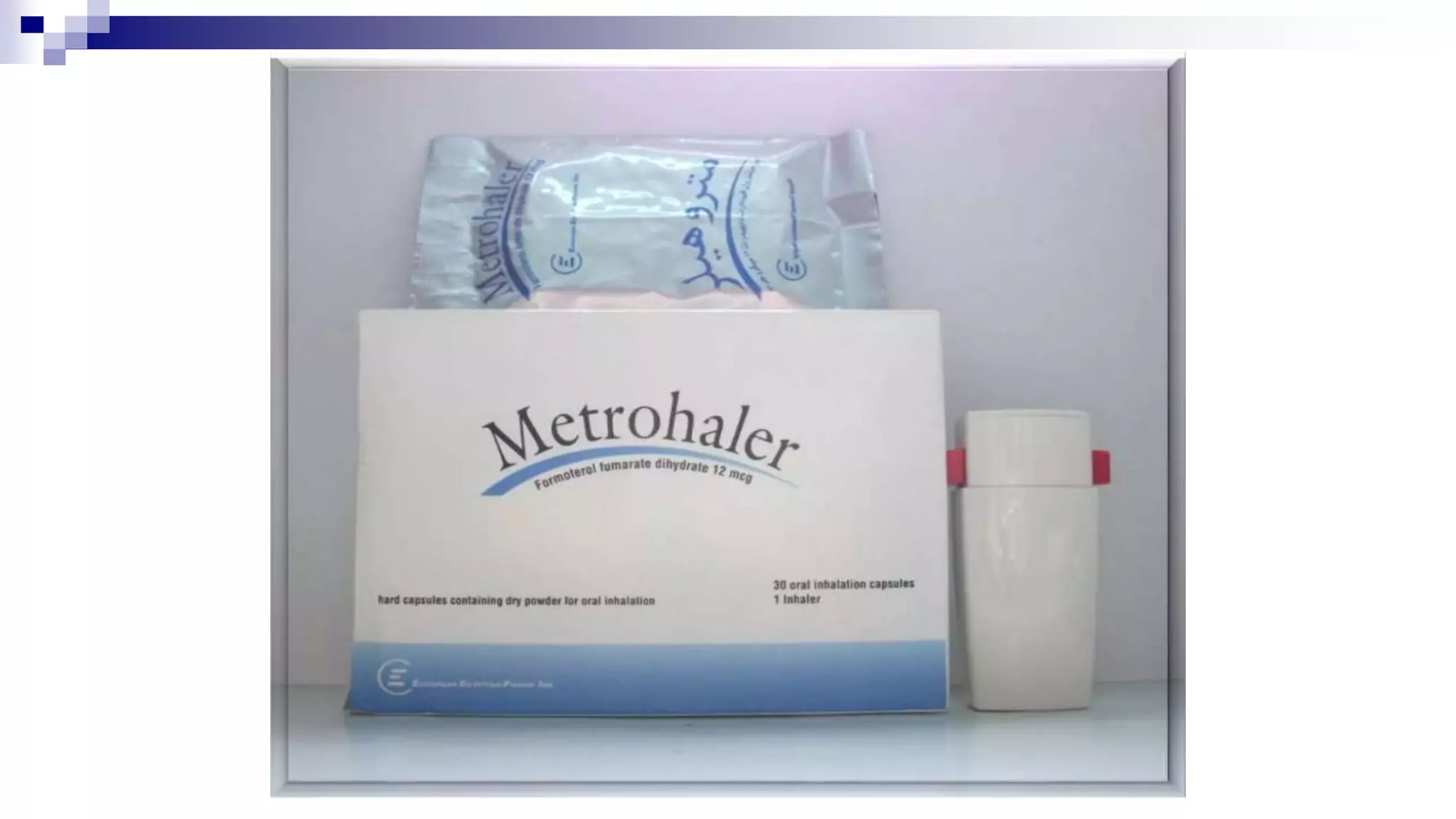
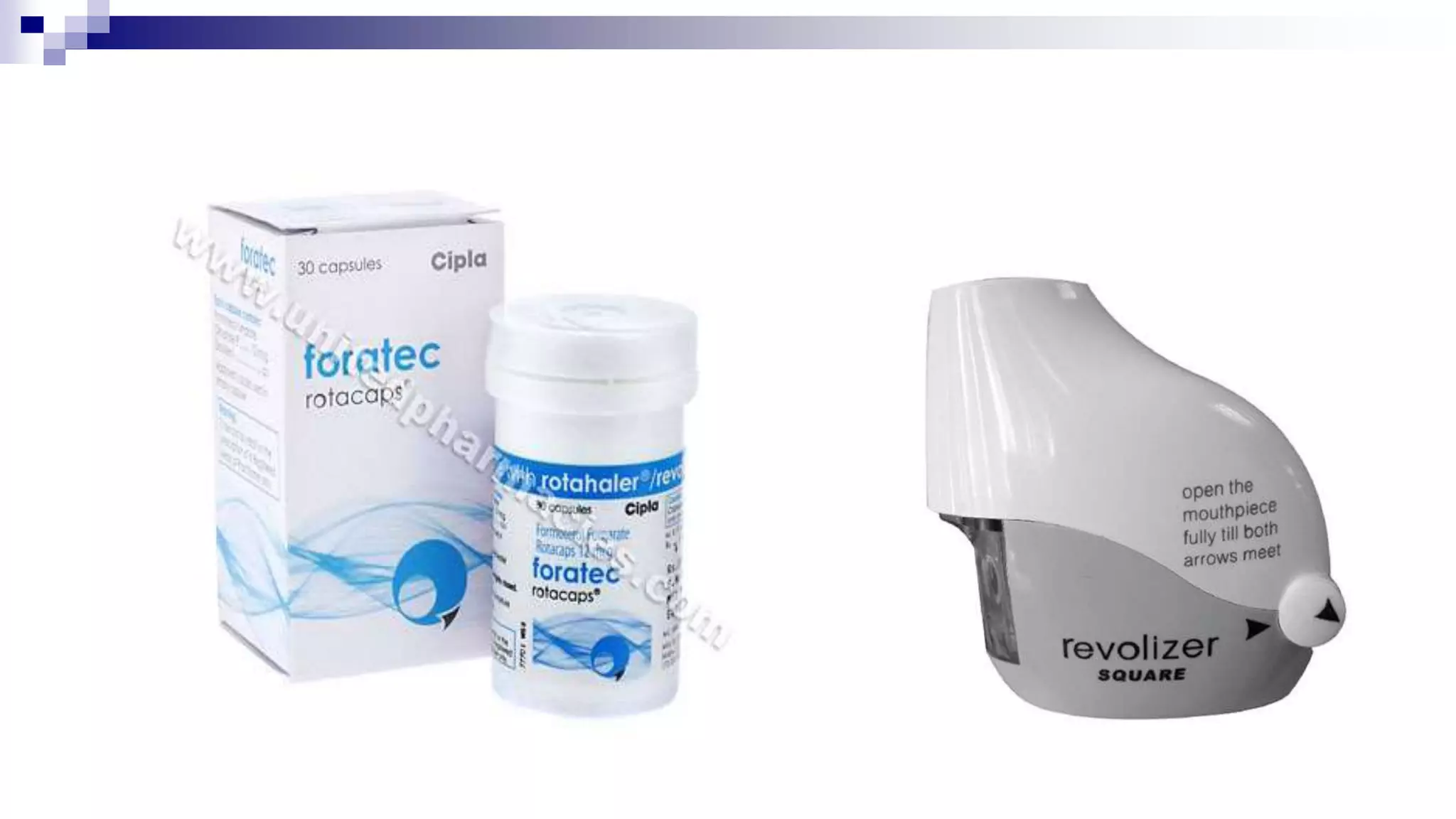
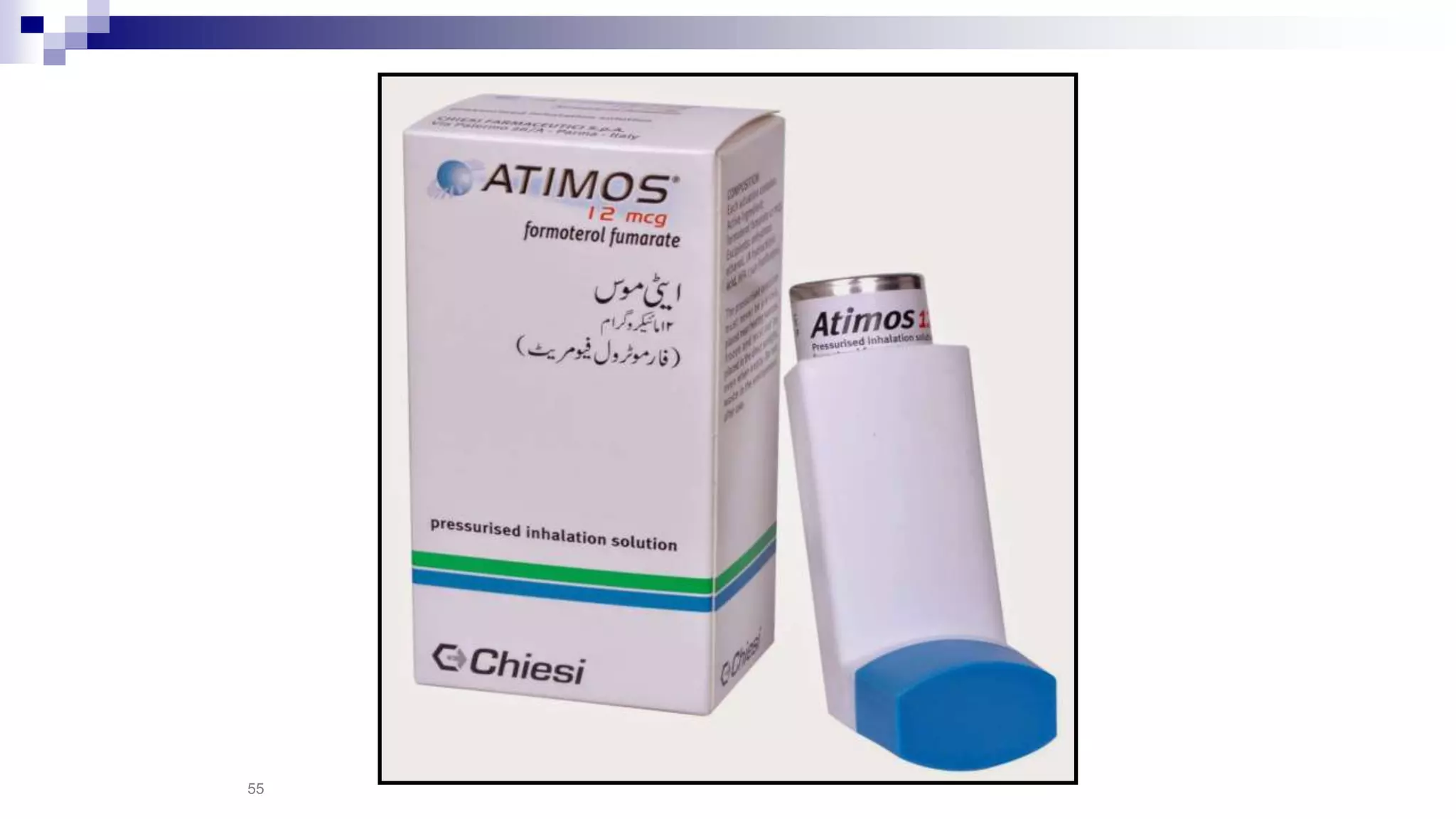
LABA
49
51
52
55
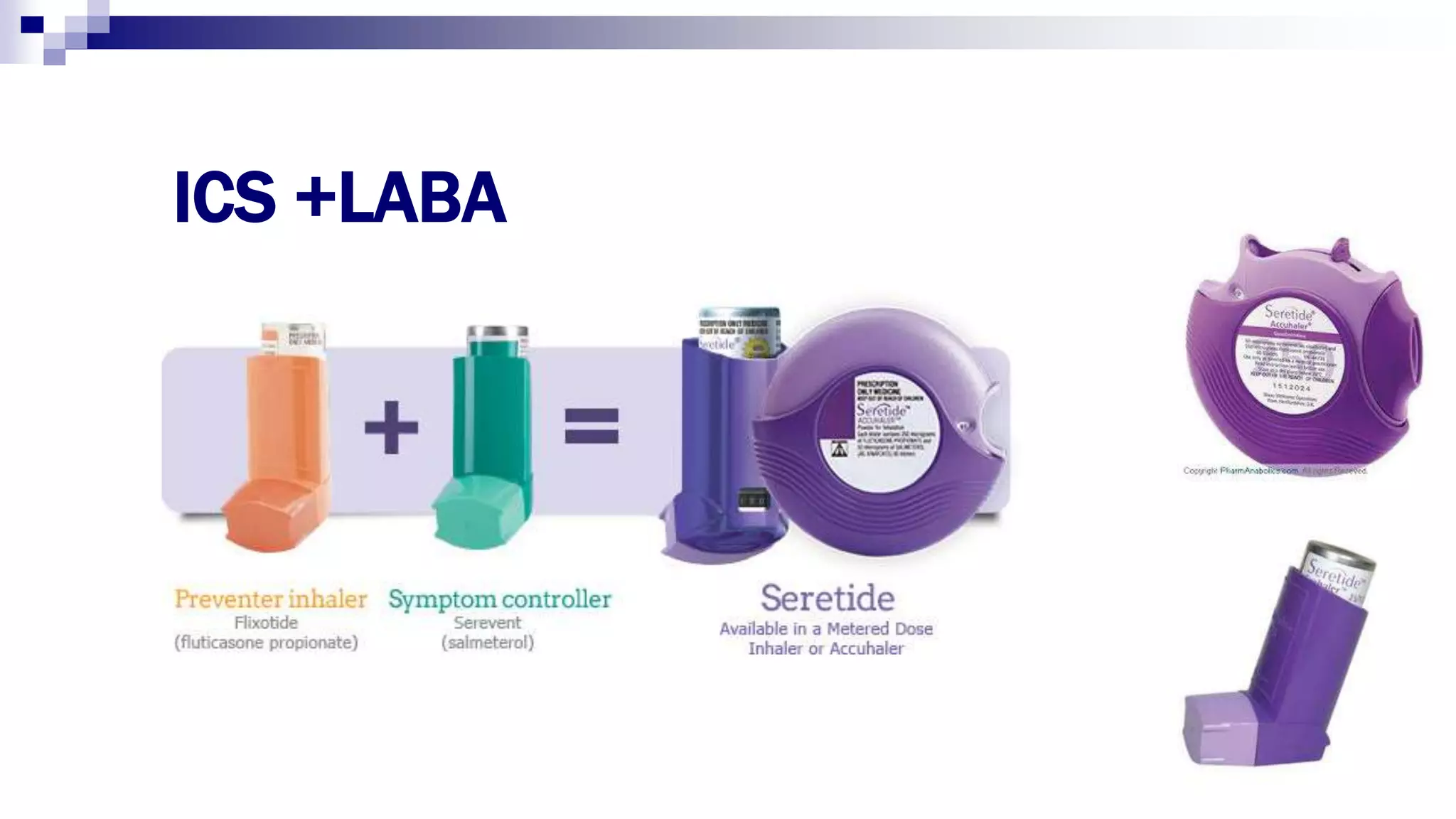
ICS +LABA
57
58
63
65
66
67
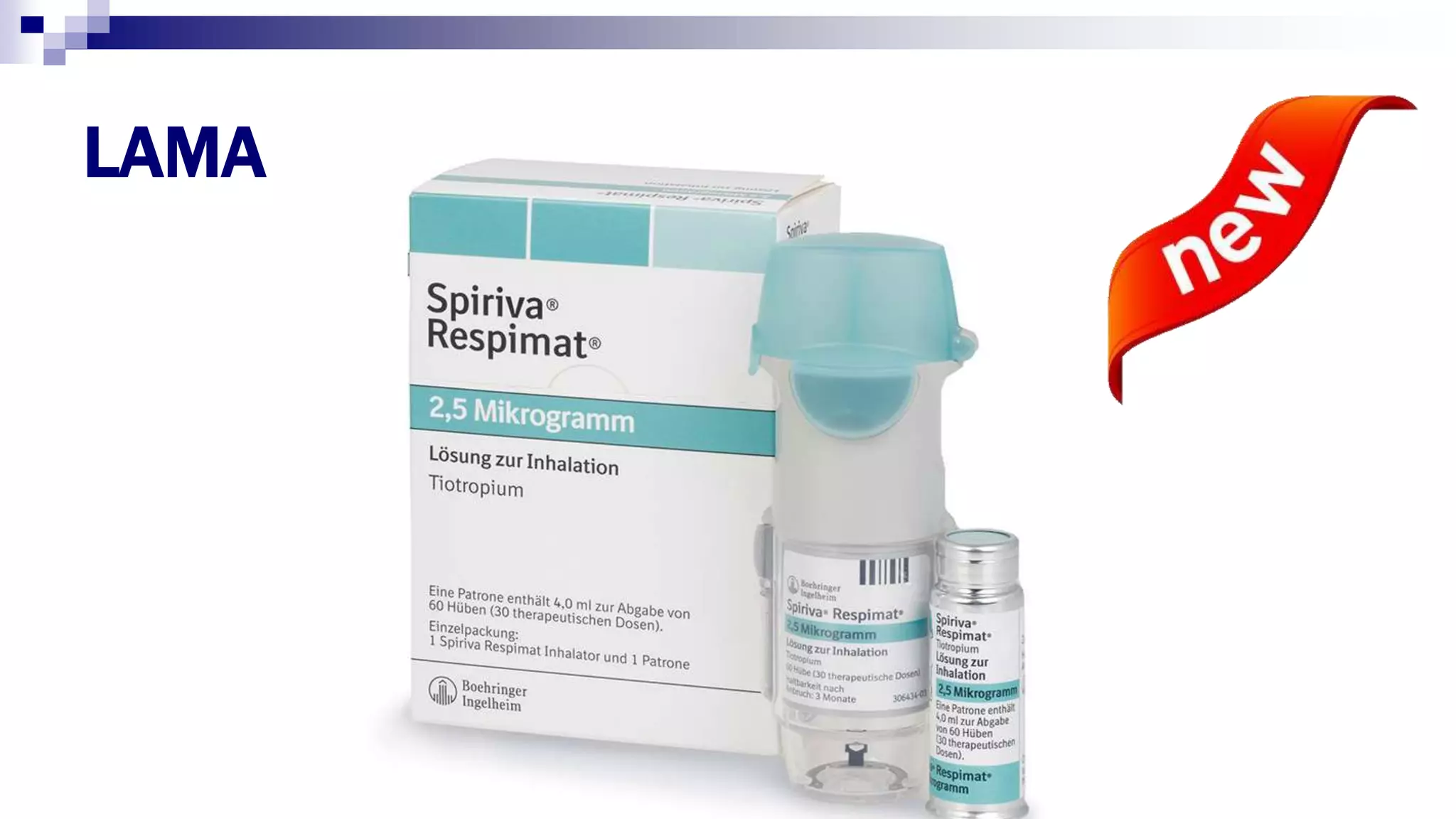
LAMA
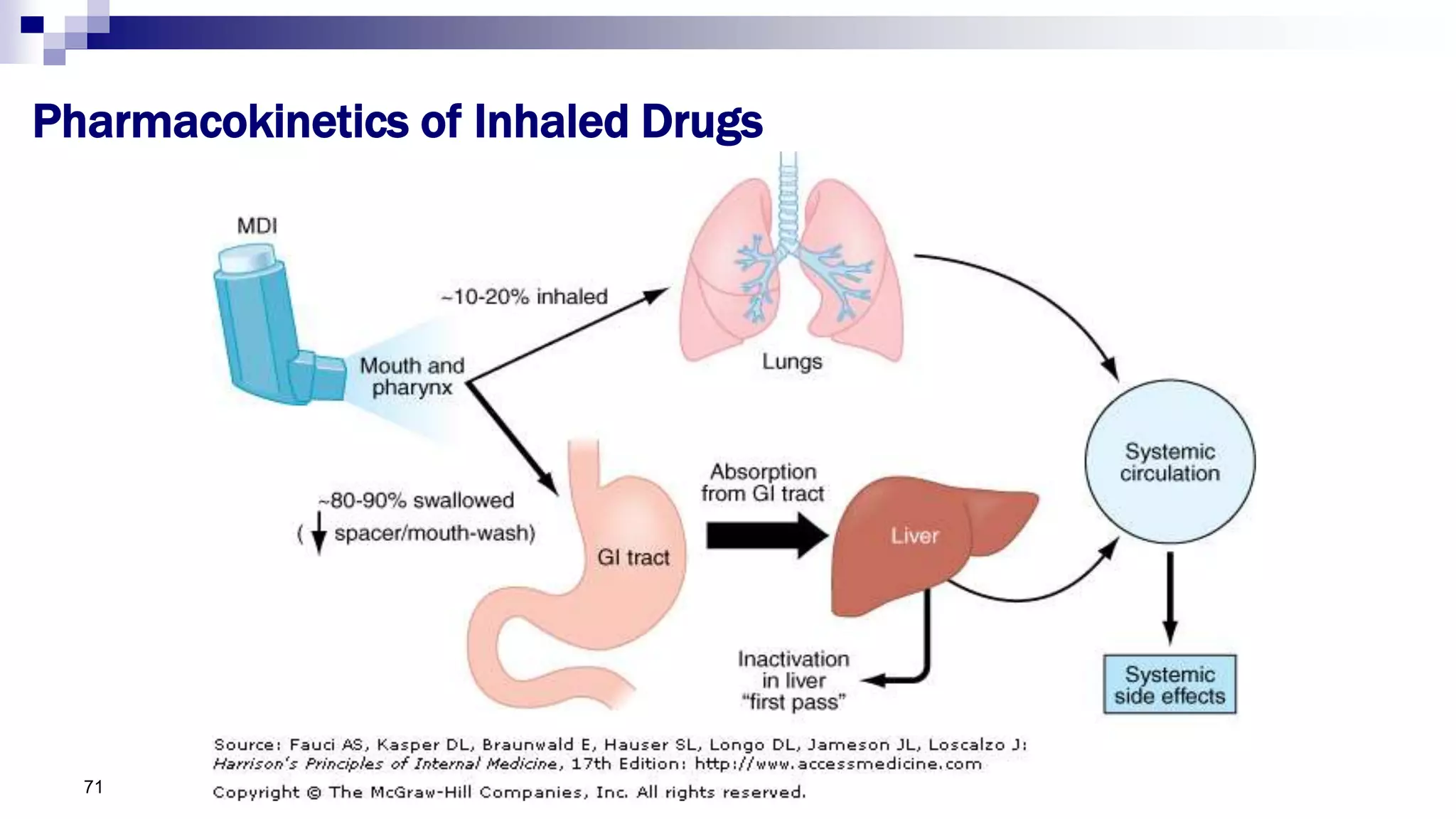
Pharmacokinetics of Inhaled Drugs
71
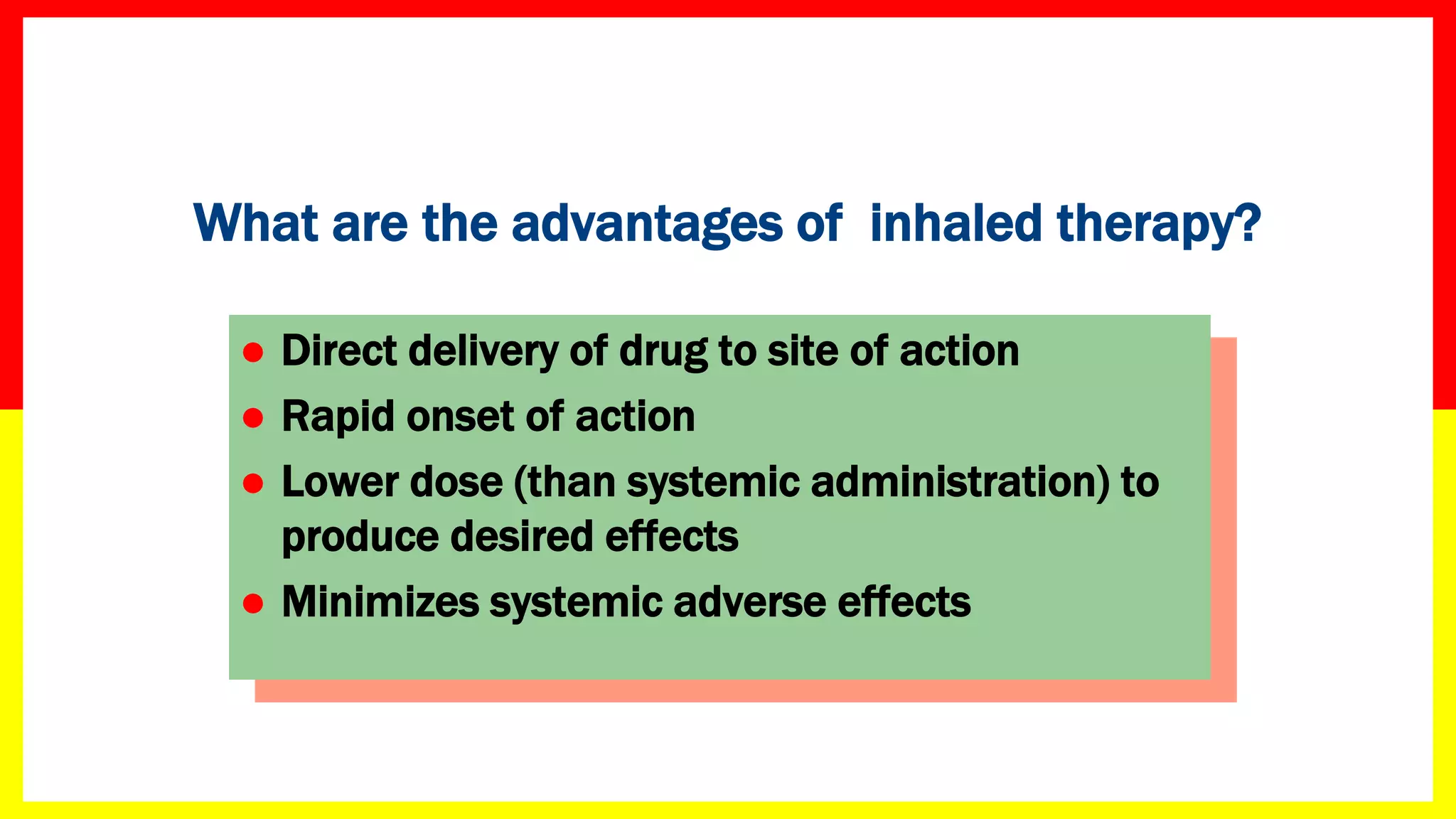
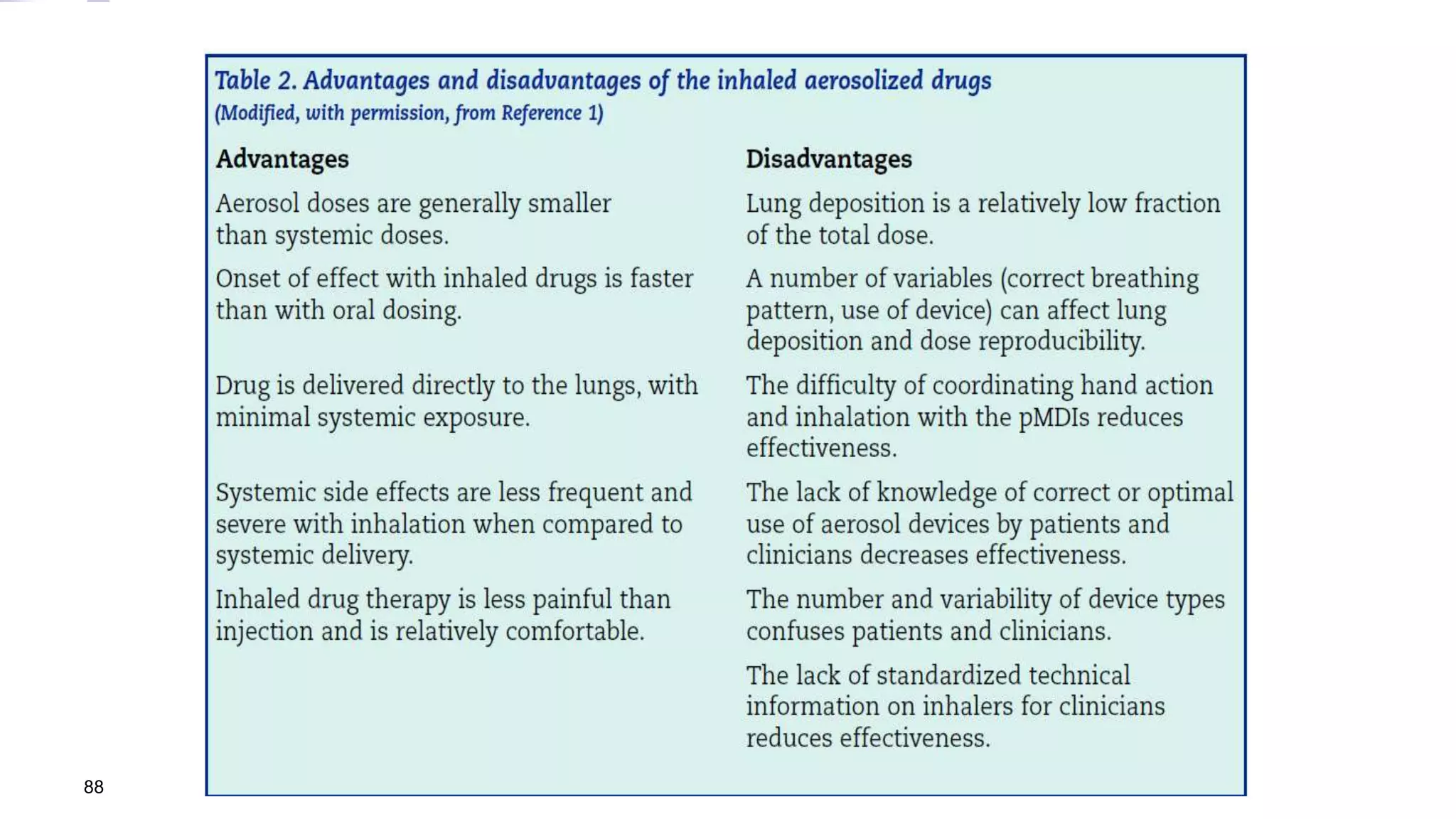
What are the advantages of inhaled therapy?
 Direct delivery of drug to site of action
 Rapid onset of action
 Lower dose (than systemic administration) to
produce desired effects
 Minimizes systemic adverse effects
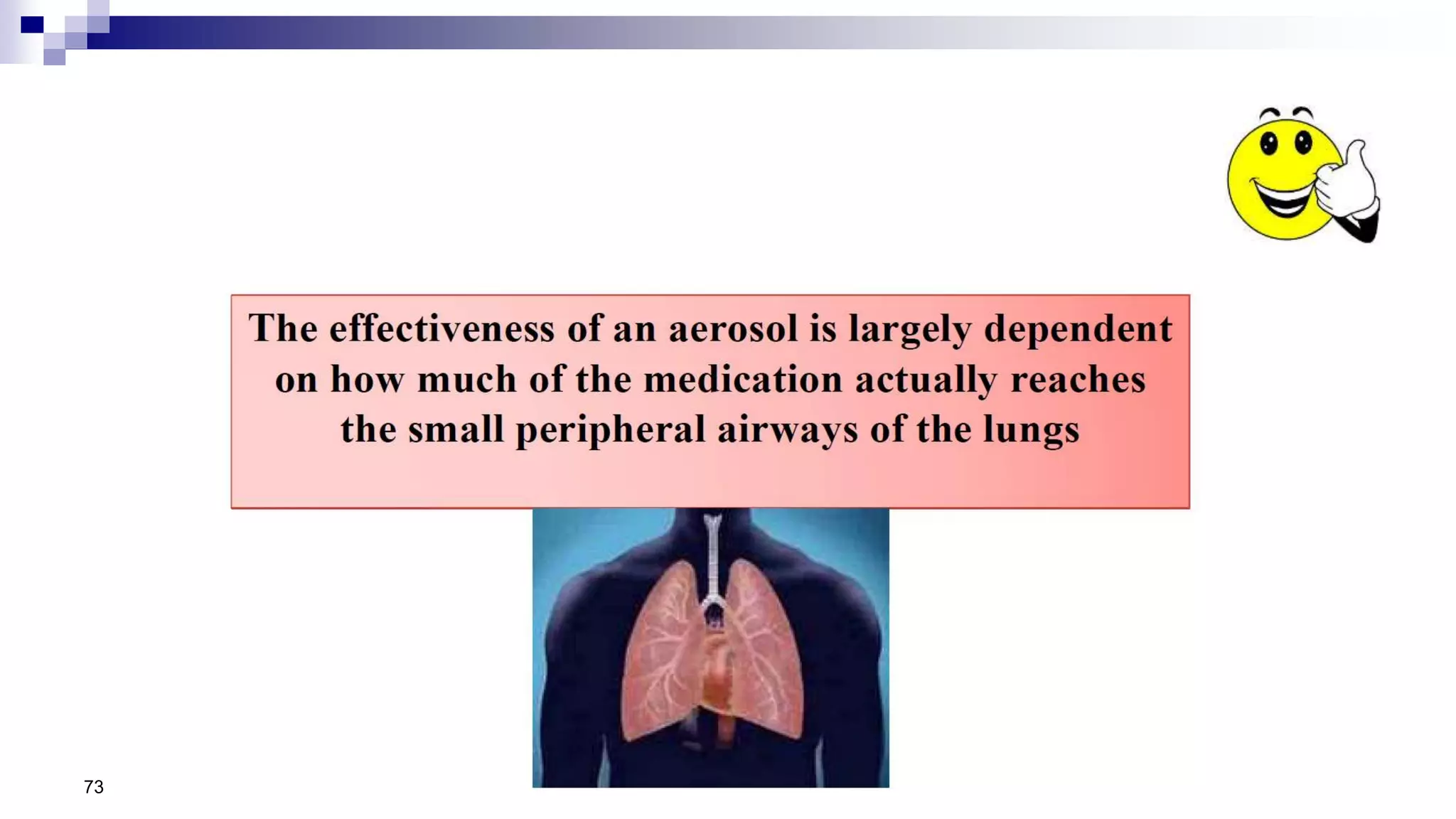
73
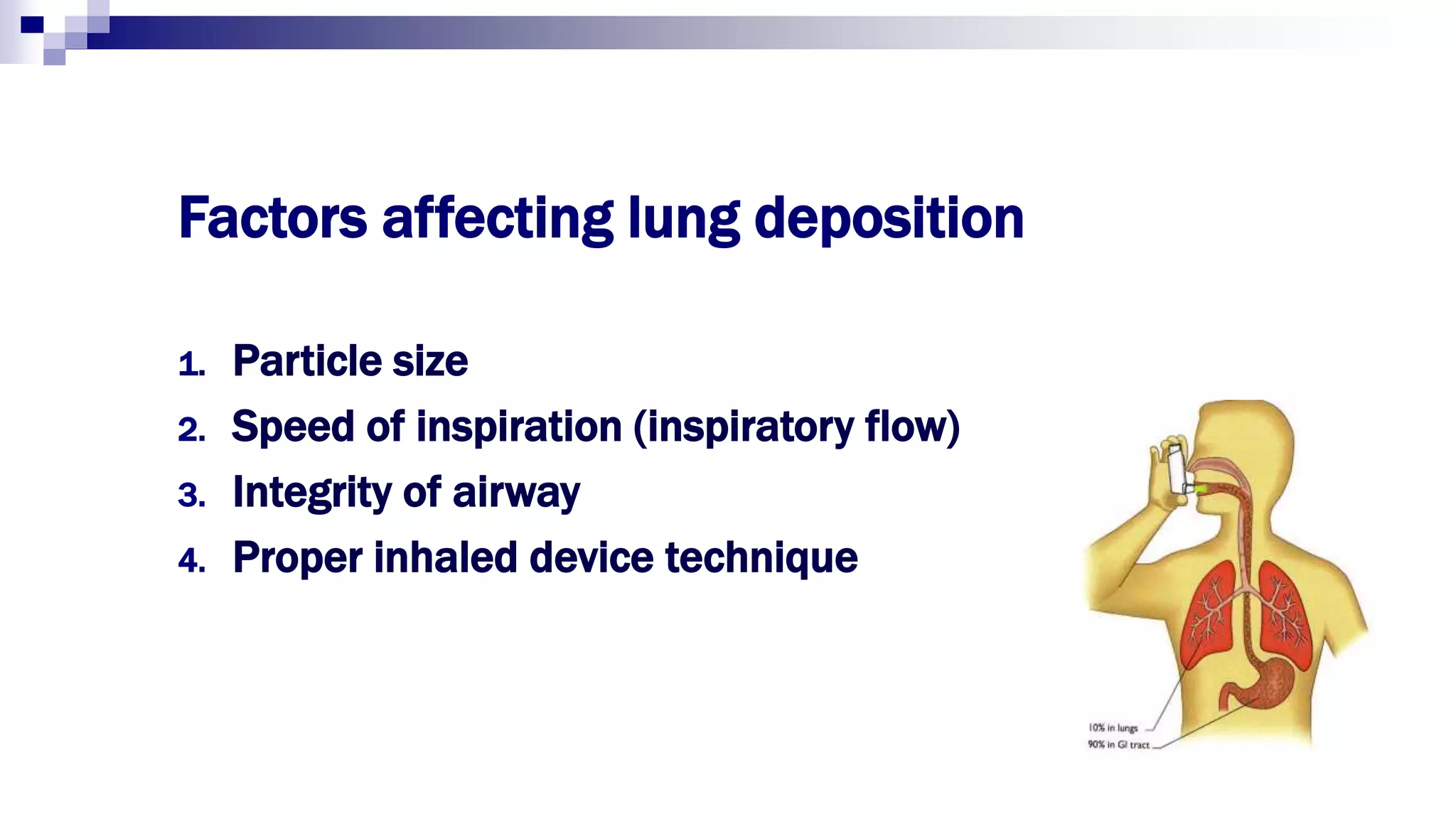
Factors affecting lung deposition
1. Particle size
2. Speed of inspiration (inspiratory flow)
3. Integrity of airway
4. Proper inhaled device technique
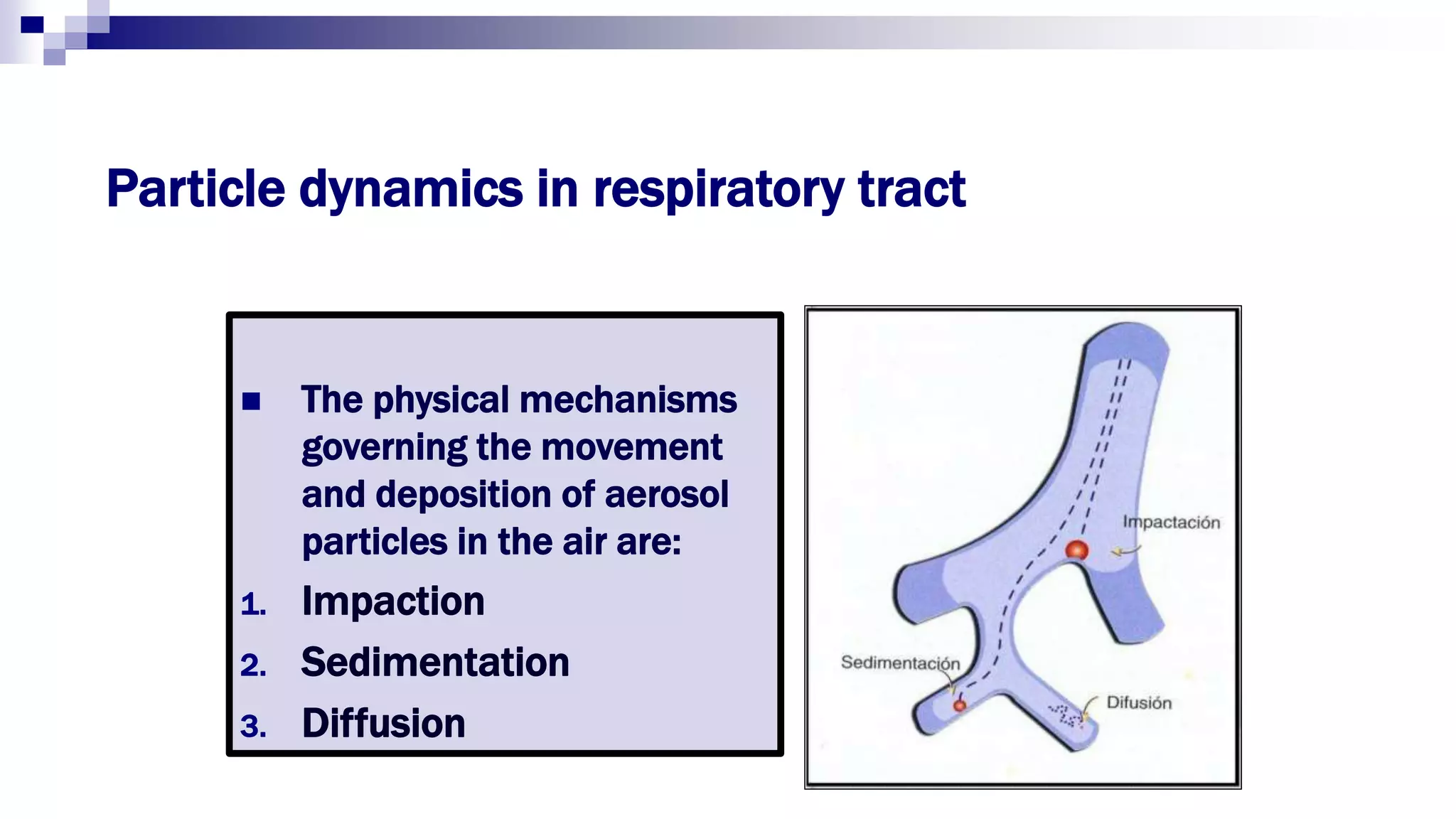
Particle dynamics in respiratory tract
 The physical mechanisms
governing the movement
and deposition of aerosol
particles in the air are:
1. Impaction
2. Sedimentation
3. Diffusion
 Inertial impaction occurs in either the oropharynx or at bifurcations
of main branches of the bronchial tree, particularly in the large
central airways.
 It occurs mainly with large particles or high velocity particles,
where they are unable to follow the airstream when it changes
direction, thus impacting on the airway wall.
76
 Gravitational sedimentation occurs for smaller particles that are able to
follow the airstream and penetrate the more peripheral bronchioles.
 Particles to settle on to the airway surfaces either during the course of slow
steady breathing or during breath-holding.
 Breath-holding is important for smaller particle sizes, owing to the
increased chance of exhalation of the drug, because they can remain
airborne for a considerable time, Breath-holding increases gravitational
sedimentation.
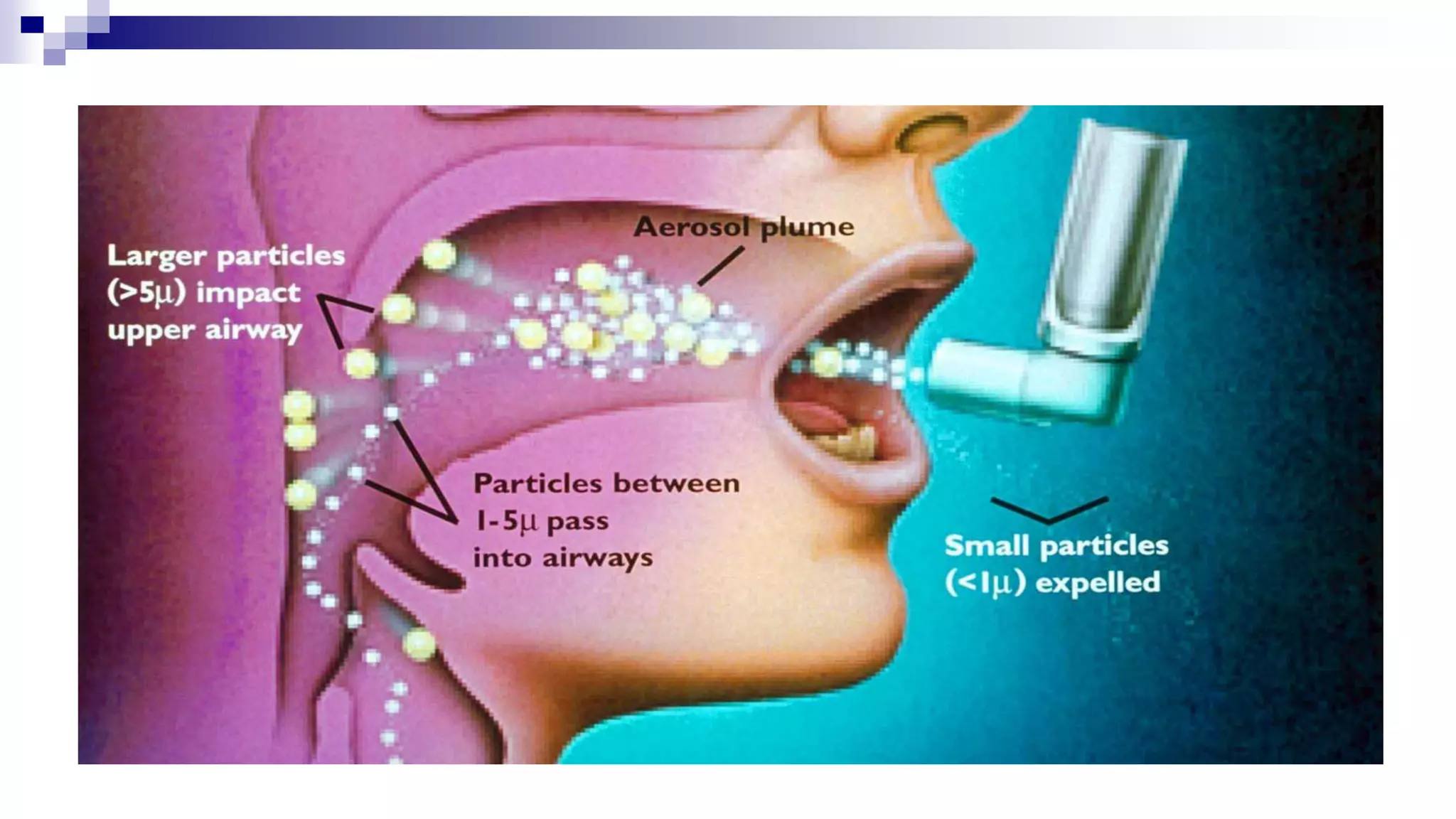
 Particle size is important, those that are too small may be exhaled; those
that are too large experience inertial impaction in the oropharynx and
large conducting airways.
 Increased aerosol particle speed increases the probability of deposition
by impaction in the oropharynx and large conducting airways .
 Slow aerosol particle speed allows more particles to settle on to the
airway surfaces i.e Gravitational sedimentation .
78
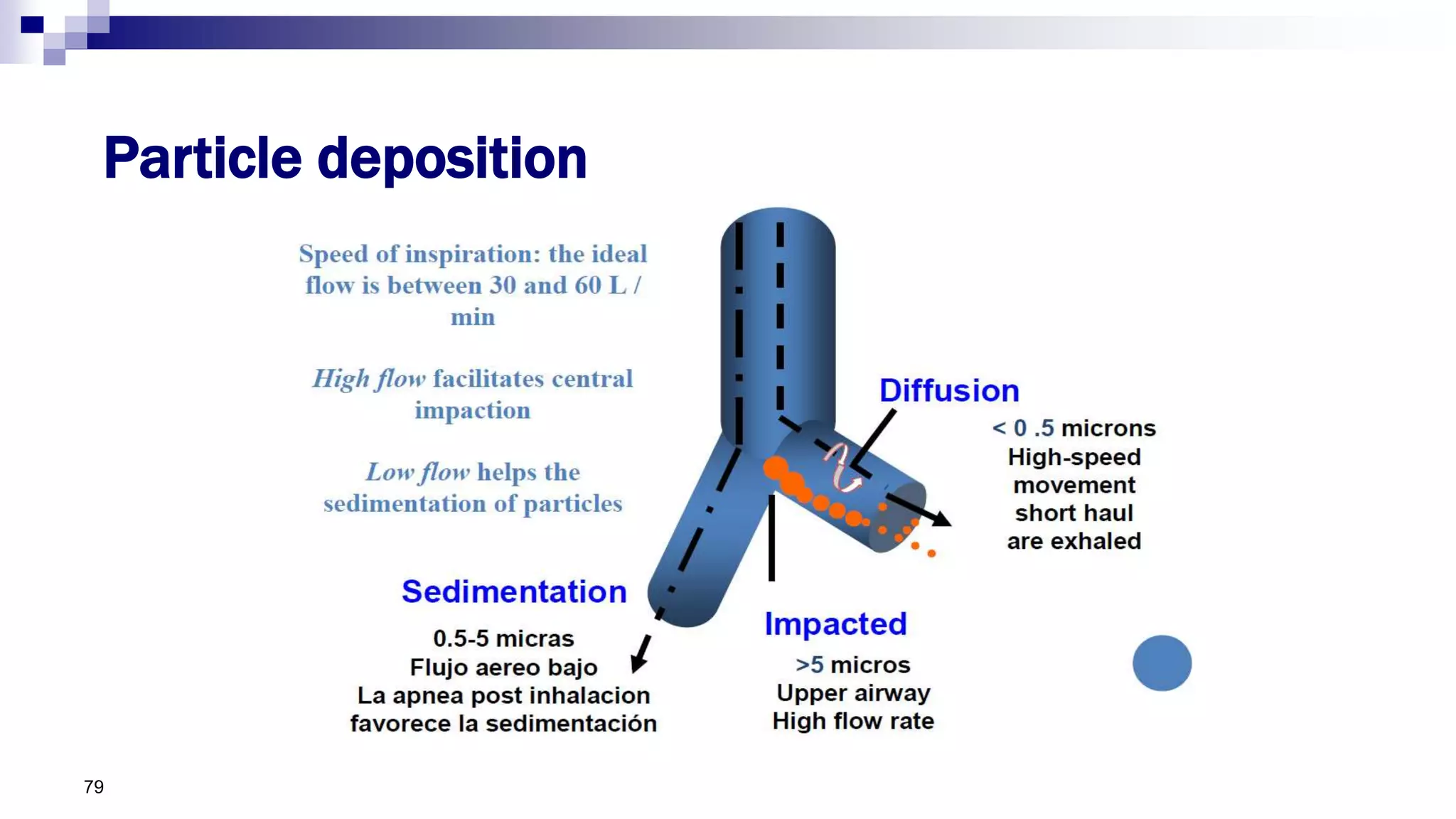
Particle deposition
79
80
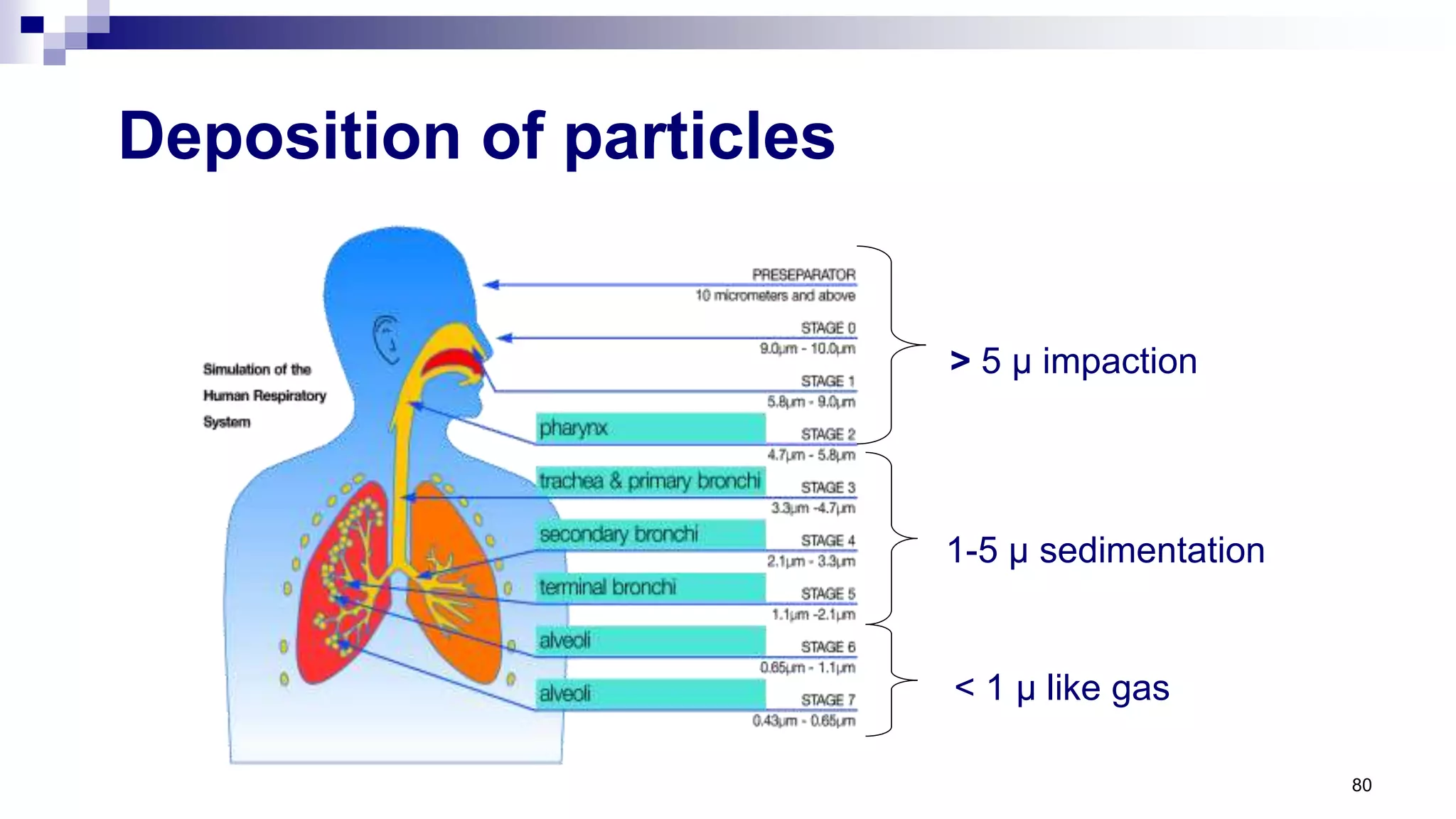
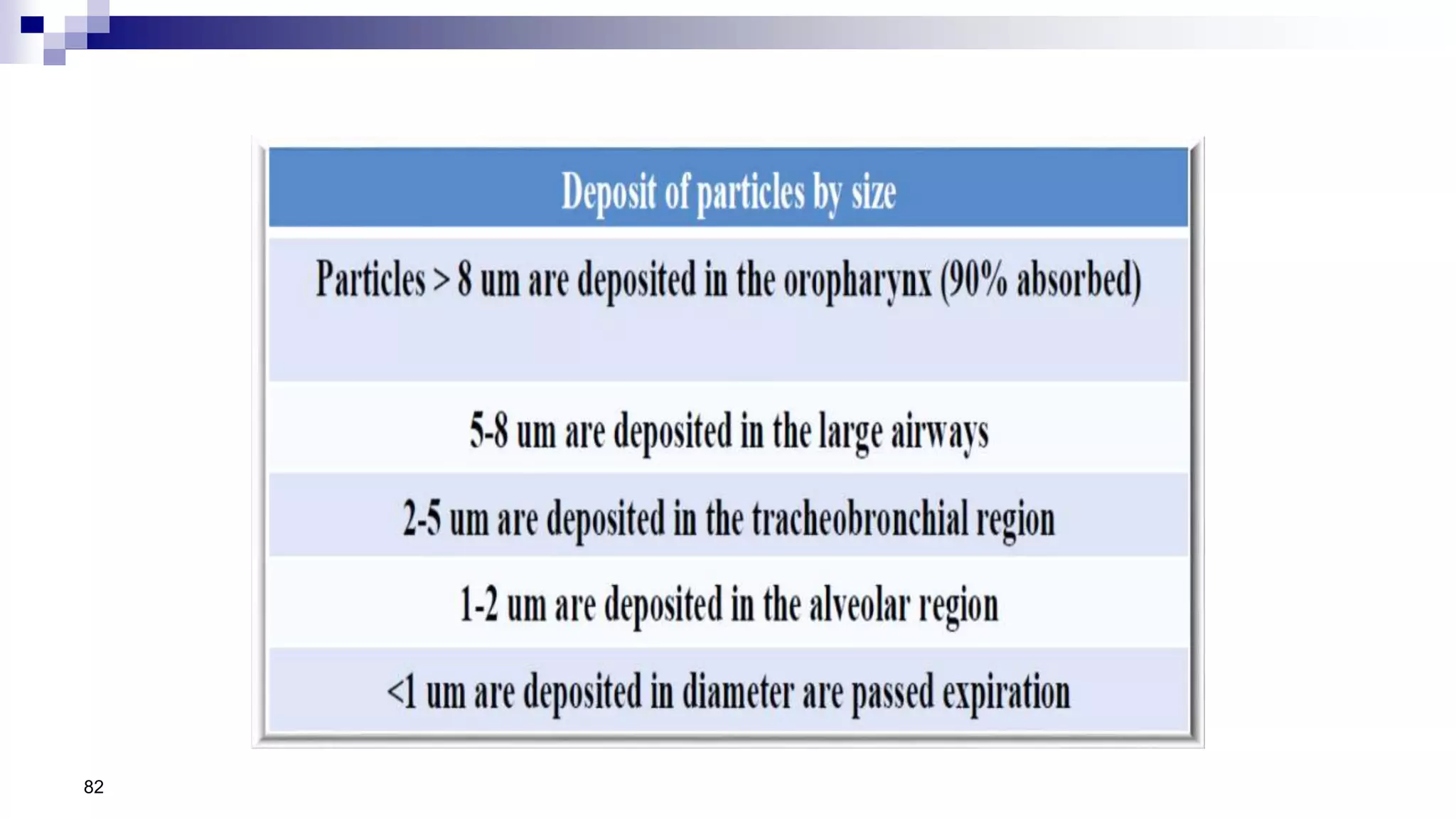
Deposition of particles
> 5 µ impaction
1-5 µ sedimentation
< 1 µ like gas
82
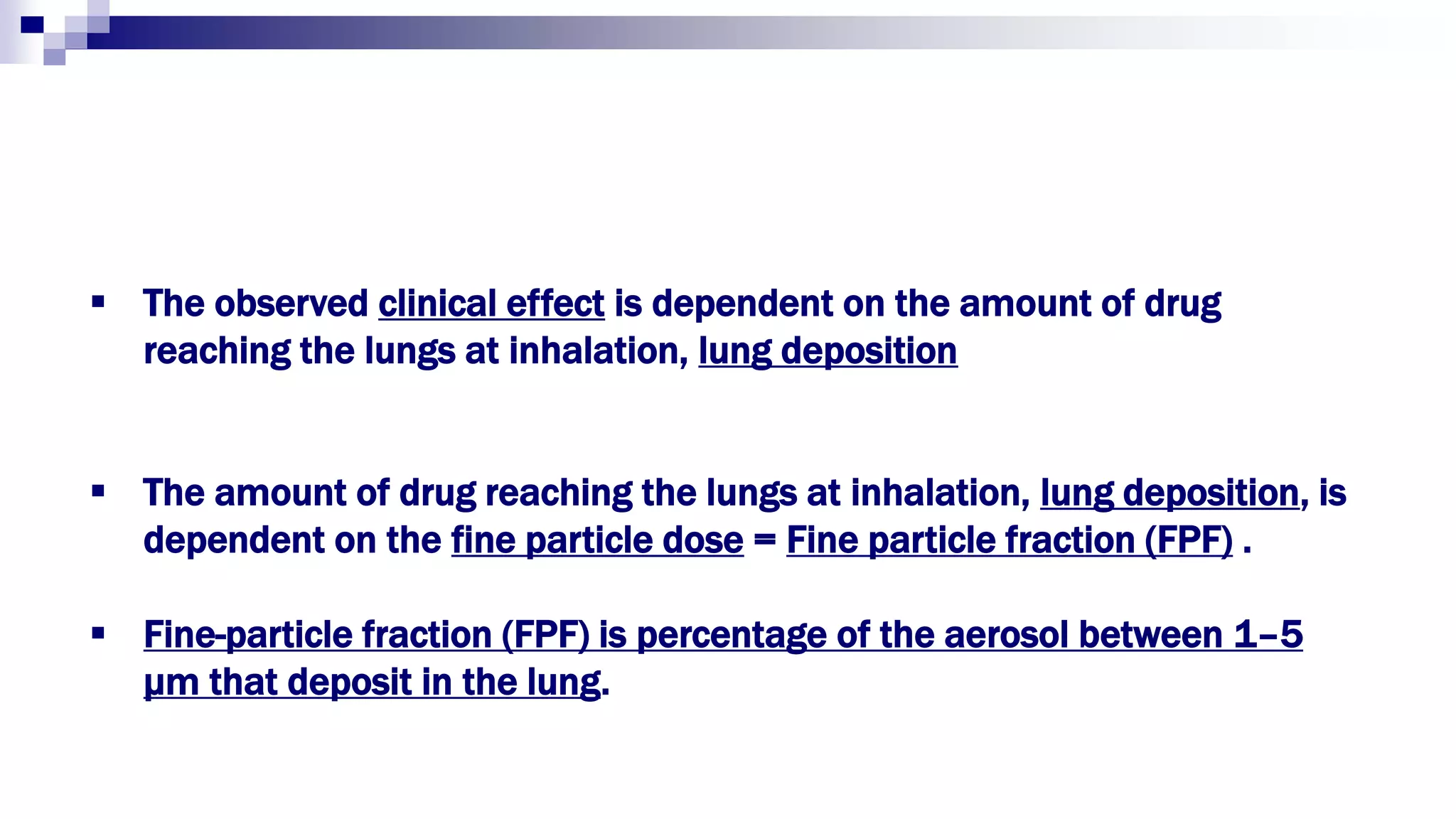
 The observed clinical effect is dependent on the amount of drug
reaching the lungs at inhalation, lung deposition
 The amount of drug reaching the lungs at inhalation, lung deposition, is
dependent on the fine particle dose = Fine particle fraction (FPF) .
 Fine-particle fraction (FPF) is percentage of the aerosol between 1–5
μm that deposit in the lung.
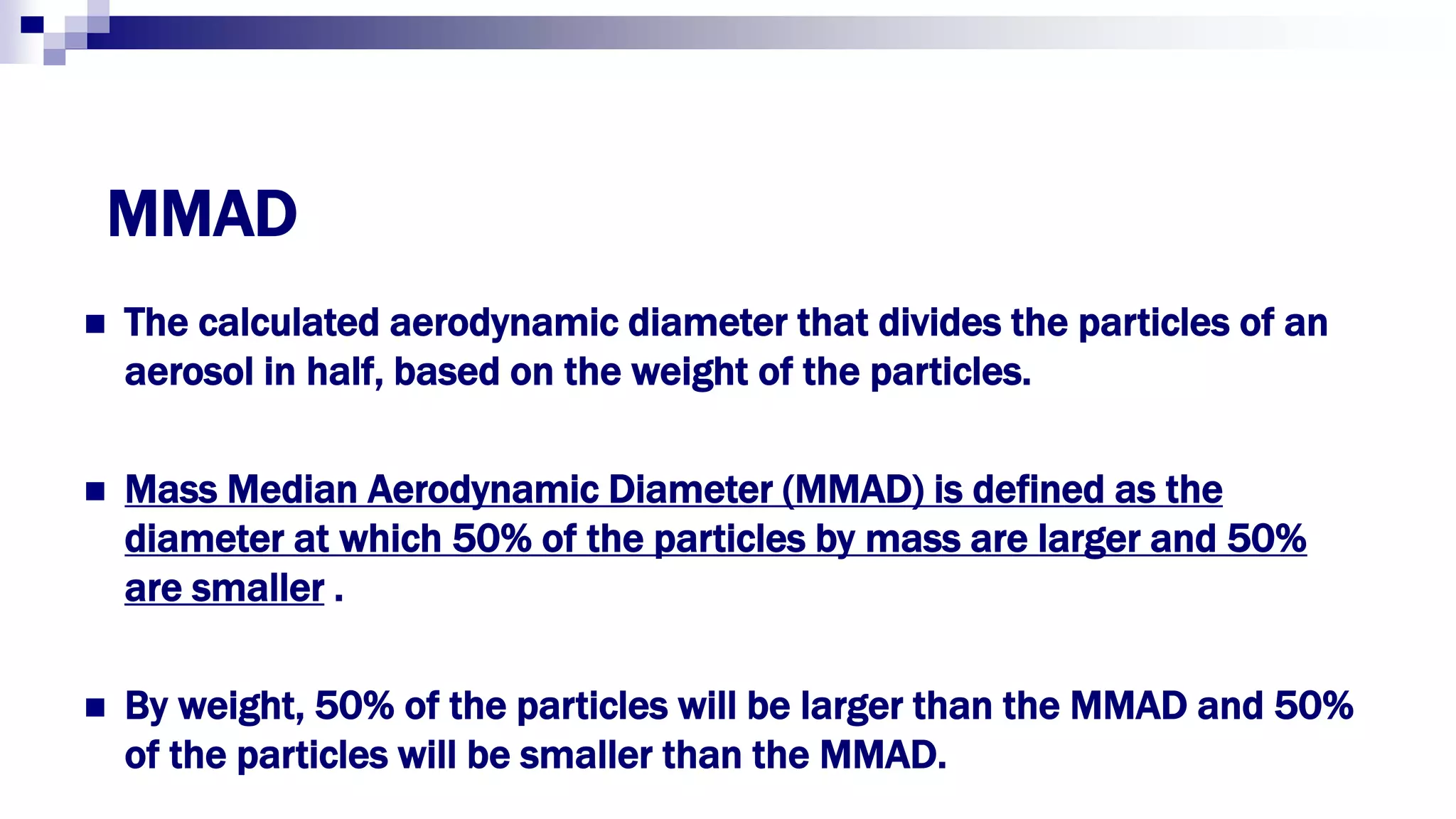
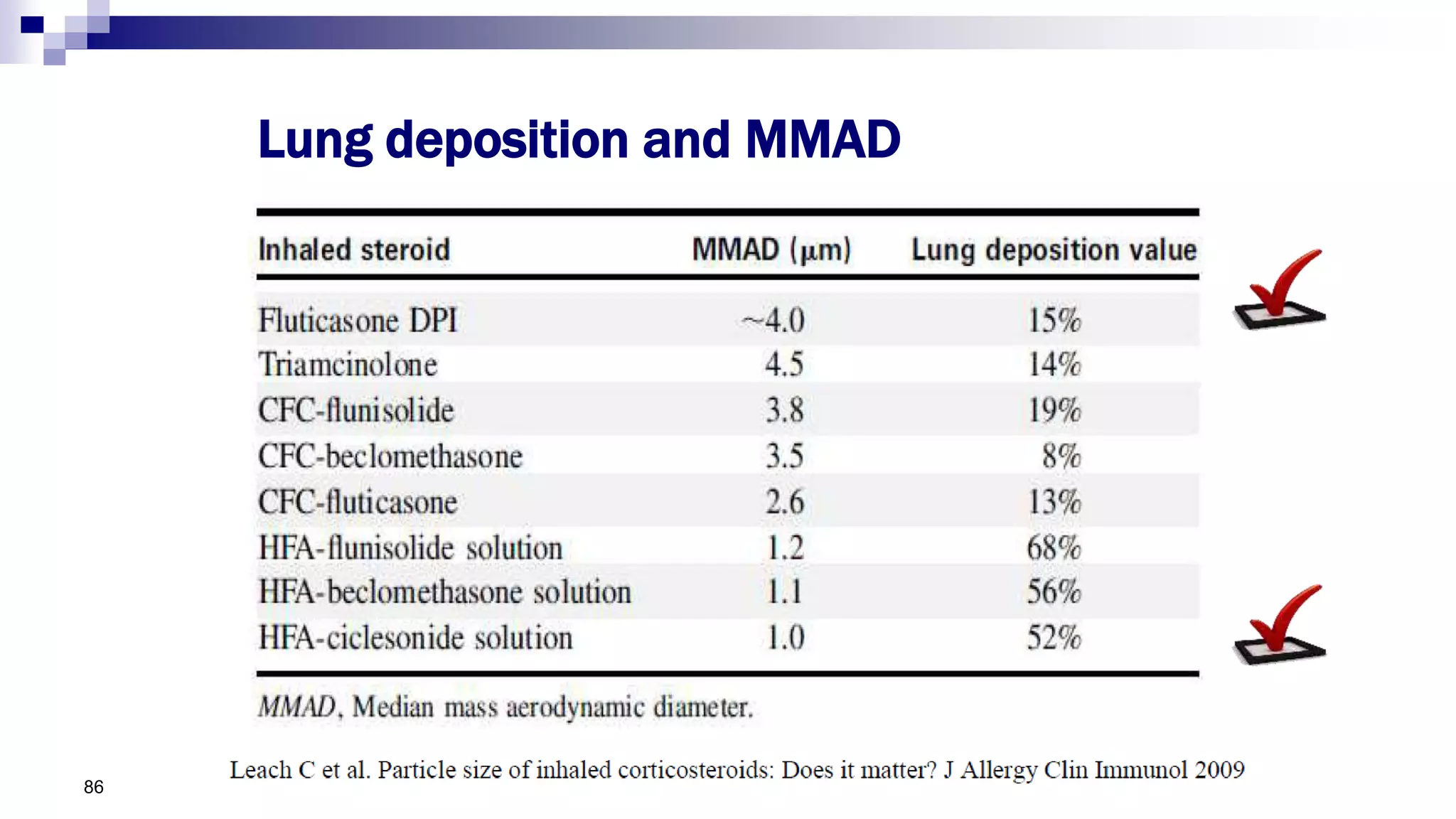
MMAD
 The calculated aerodynamic diameter that divides the particles of an
aerosol in half, based on the weight of the particles.
 Mass Median Aerodynamic Diameter (MMAD) is defined as the
diameter at which 50% of the particles by mass are larger and 50%
are smaller .
 By weight, 50% of the particles will be larger than the MMAD and 50%
of the particles will be smaller than the MMAD.
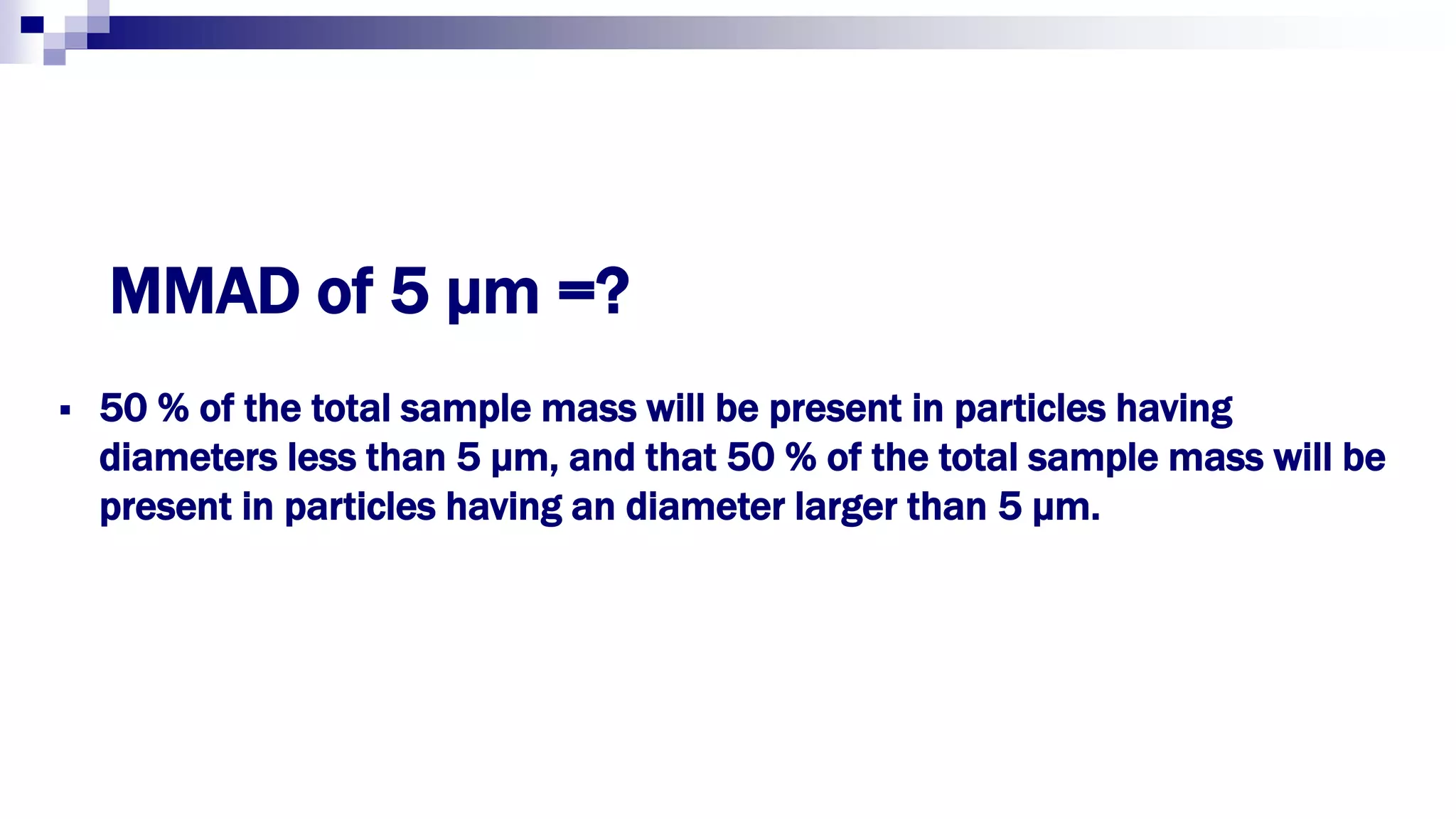
MMAD of 5 μm =?
 50 % of the total sample mass will be present in particles having
diameters less than 5 μm, and that 50 % of the total sample mass will be
present in particles having an diameter larger than 5 μm.
86
Lung deposition and MMAD
88
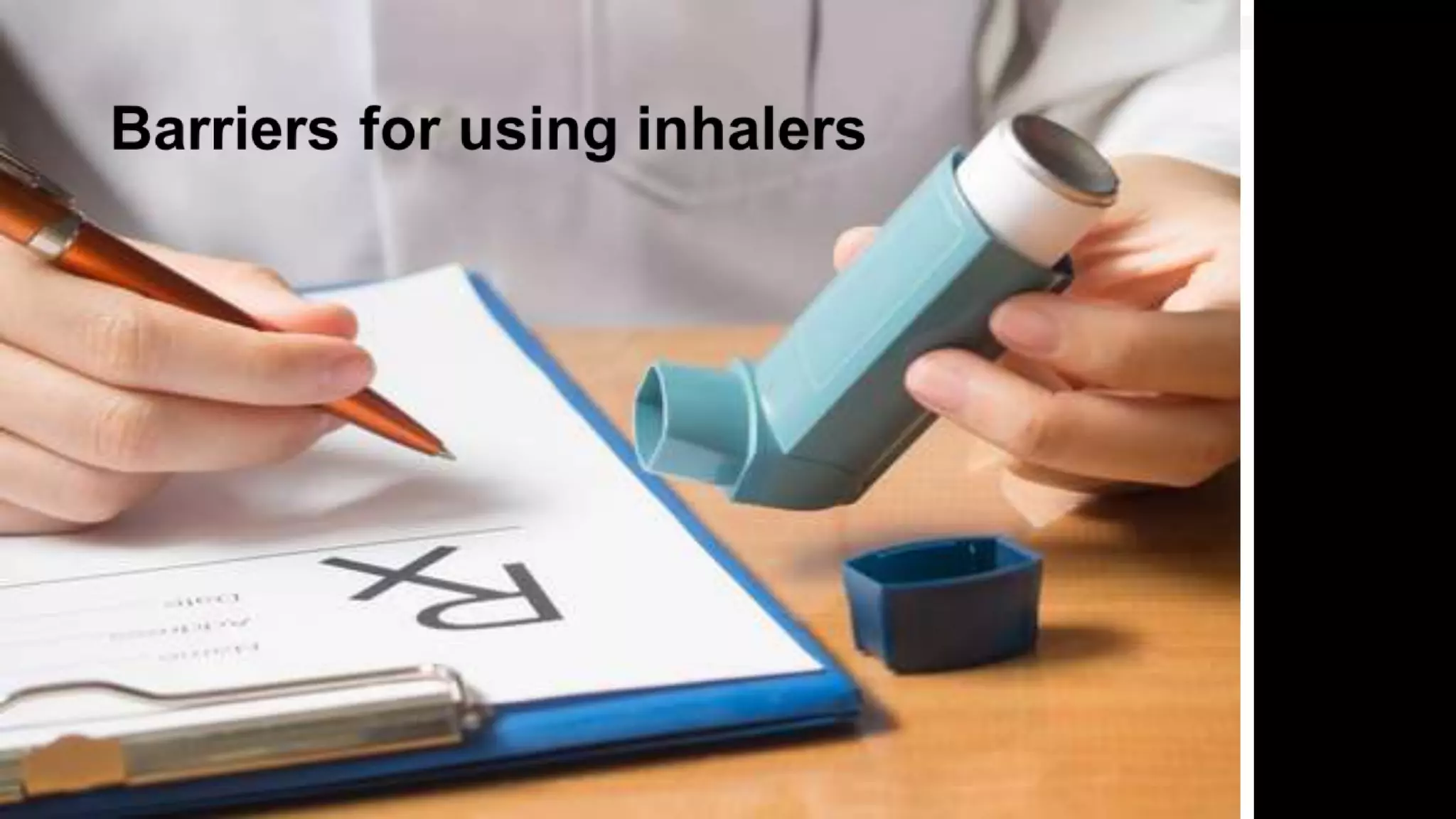
1) Sub optimal communication between HCP & patient
2) Lack of opportunity to discuss fear of side effects
3) Patients under-estimate the severity
4) Over-estimate their level of control
5) Technique
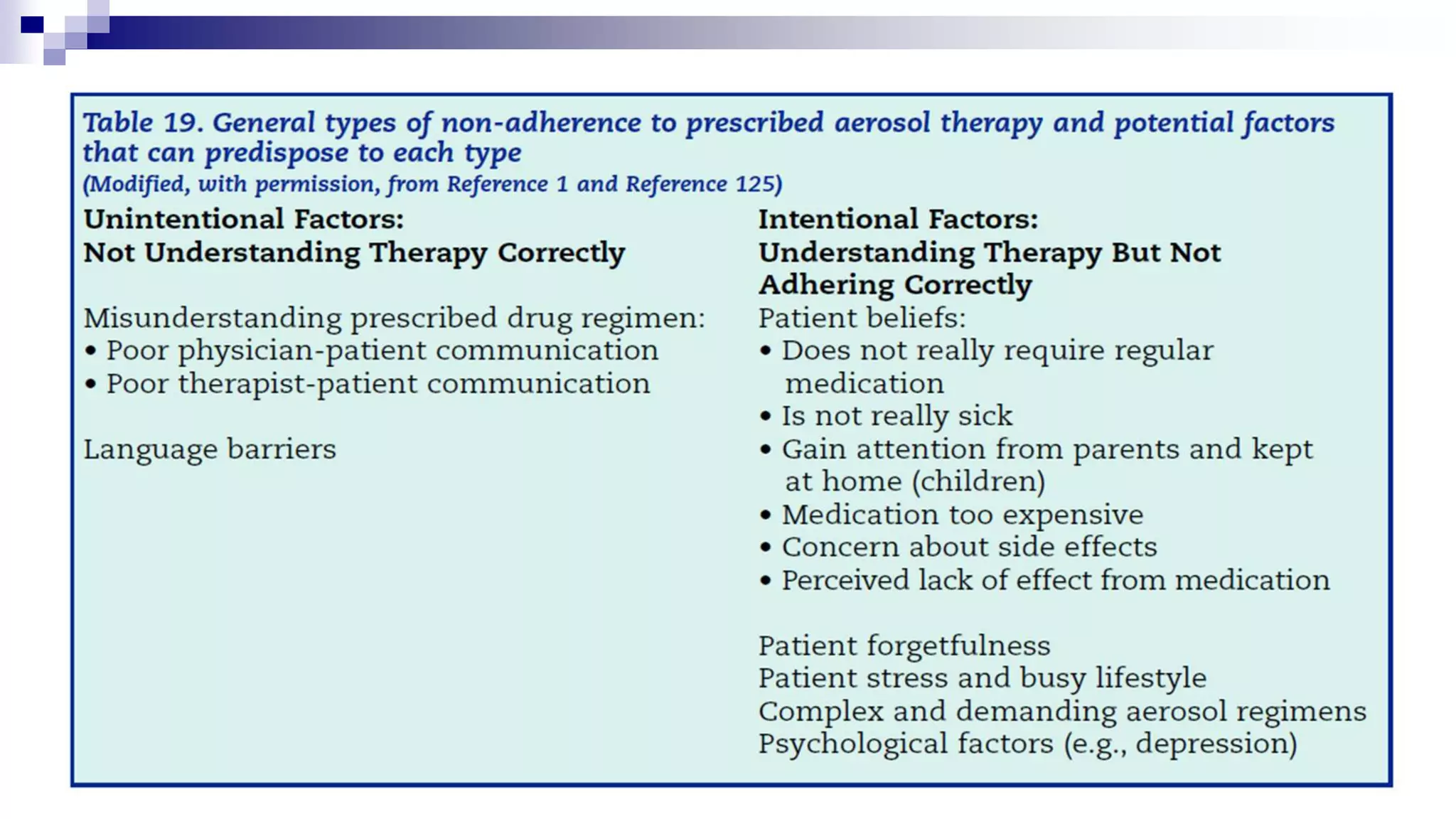
Barriers for using inhalers
94
95
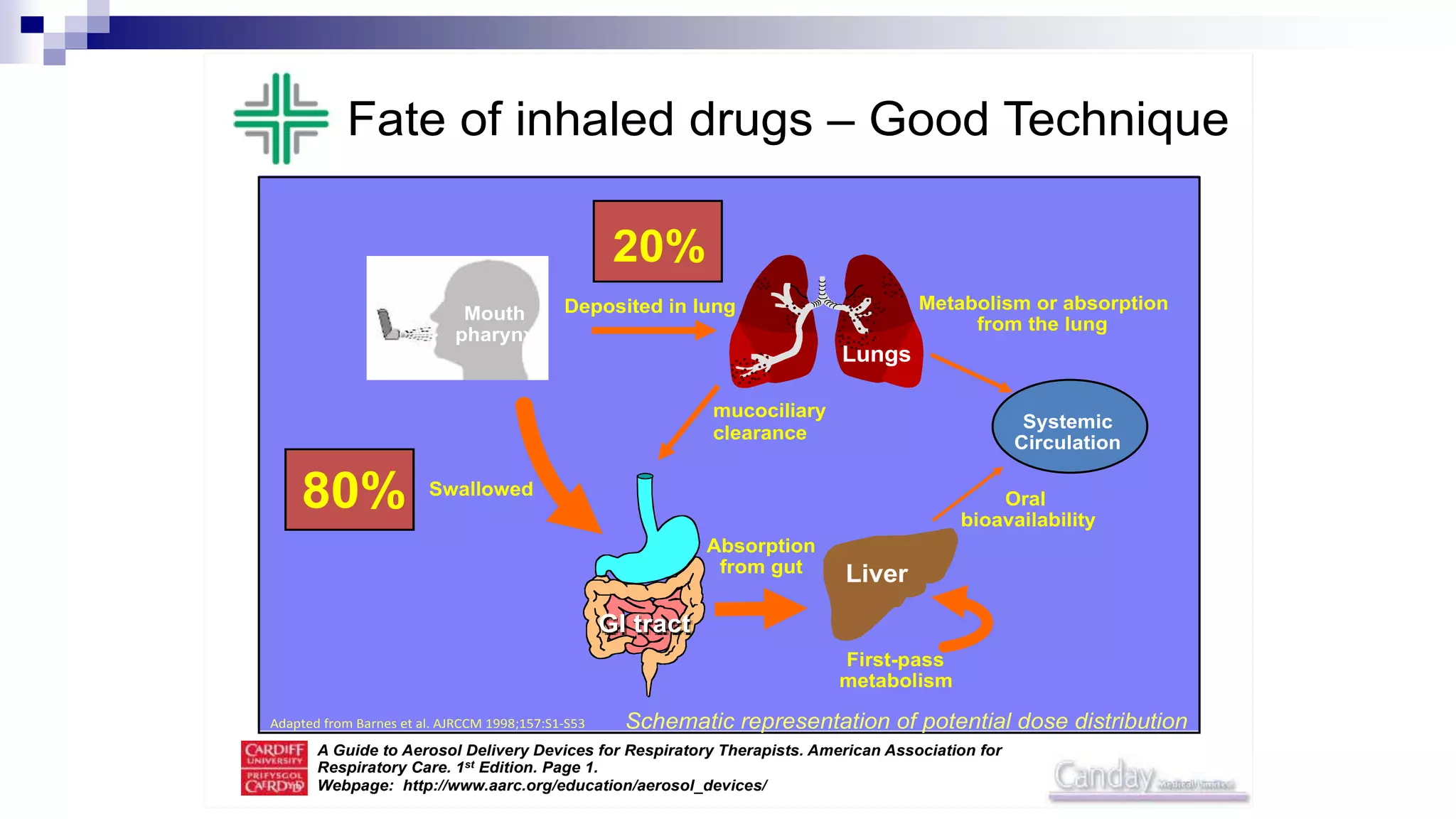
Fate of inhaled drugs – Good Technique
Swallowed
GI tract
Deposited in lung
Lungs
Metabolism or absorption
from the lung
Liver
Oral
bioavailability
Absorption
from gut
First-pass
metabolism
Systemic
Circulation
Mouth
pharynx
mucociliary
clearance
80%
20%
Schematic representation of potential dose distribution
A Guide to Aerosol Delivery Devices for Respiratory Therapists. American Association for
Respiratory Care. 1st Edition. Page 1.
Webpage: http://www.aarc.org/education/aerosol_devices/
Adapted from Barnes et al. AJRCCM 1998;157:S1-S53
96
Fate of inhaled drugs – Good Technique
Swallowed
GI tract
Deposited in lung
Lungs
Metabolism or absorption
from the lung
Liver
Oral
bioavailability
Absorption
from gut
First-pass
metabolism
Systemic
Circulation
Mouth
pharynx
mucociliary
clearance
80%
20%
Schematic representation of potential dose distribution
A Guide to Aerosol Delivery Devices for Respiratory Therapists. American Association for
Respiratory Care. 1st Edition. Page 1.
Webpage: http://www.aarc.org/education/aerosol_devices/
Adapted from Barnes et al. AJRCCM 1998;157:S1-S53
Swallowed
GI tract
Deposited in lung
Lungs
Metabolism or absorption
from the lung
Liver
Oral
bioavailability
Absorption
from gut
First-pass
metabolism
Systemic
Circulation
Mouth
pharynx
mucociliary
clearance
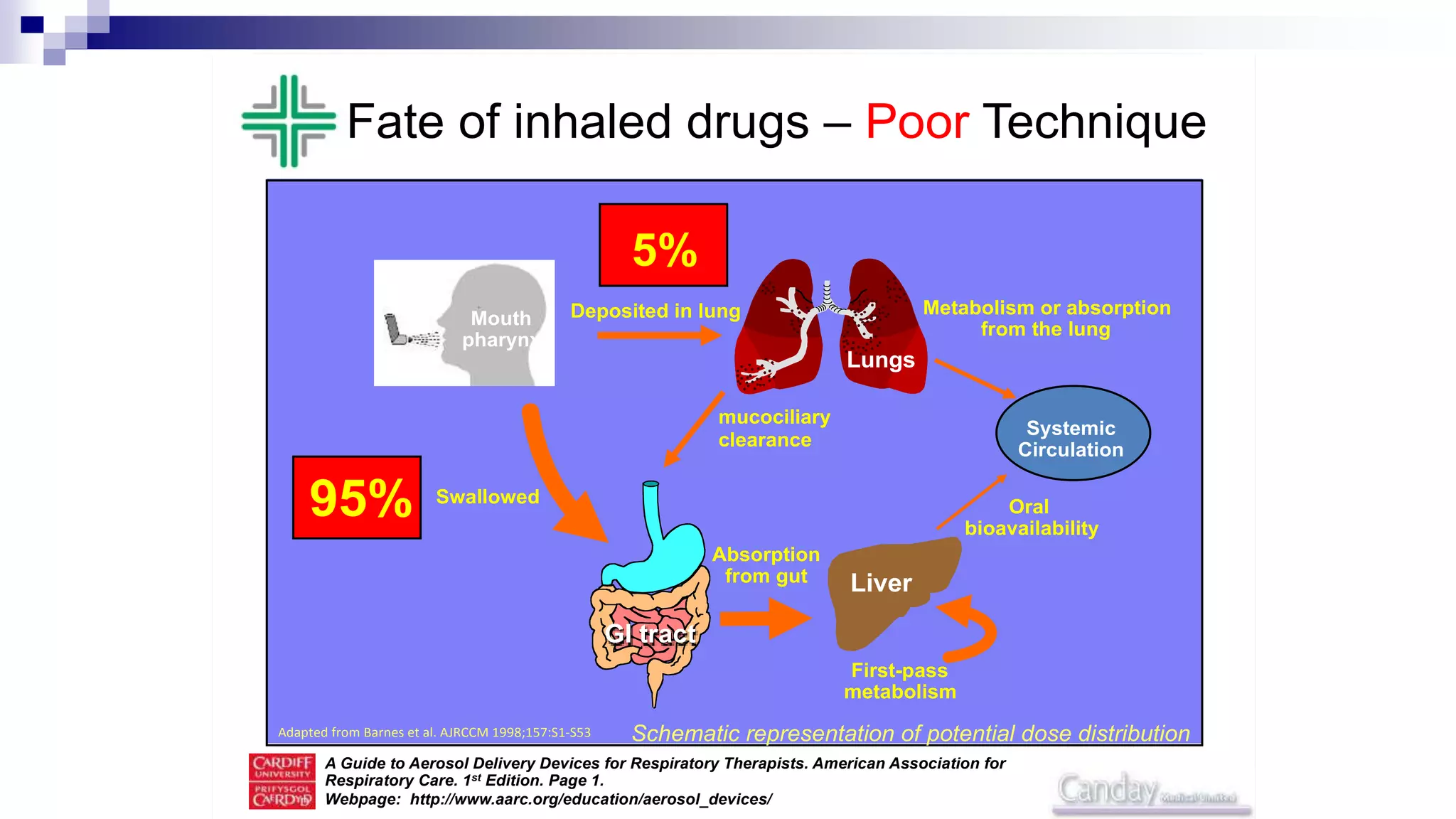
95%
5%
Schematic representation of potential dose distributionAdapted from Barnes et al. AJRCCM 1998;157:S1-S53
A Guide to Aerosol Delivery Devices for Respiratory Therapists. American Association for
Respiratory Care. 1st Edition. Page 1.
Webpage: http://www.aarc.org/education/aerosol_devices/
Fate of inhaled drugs – Poor Technique
97
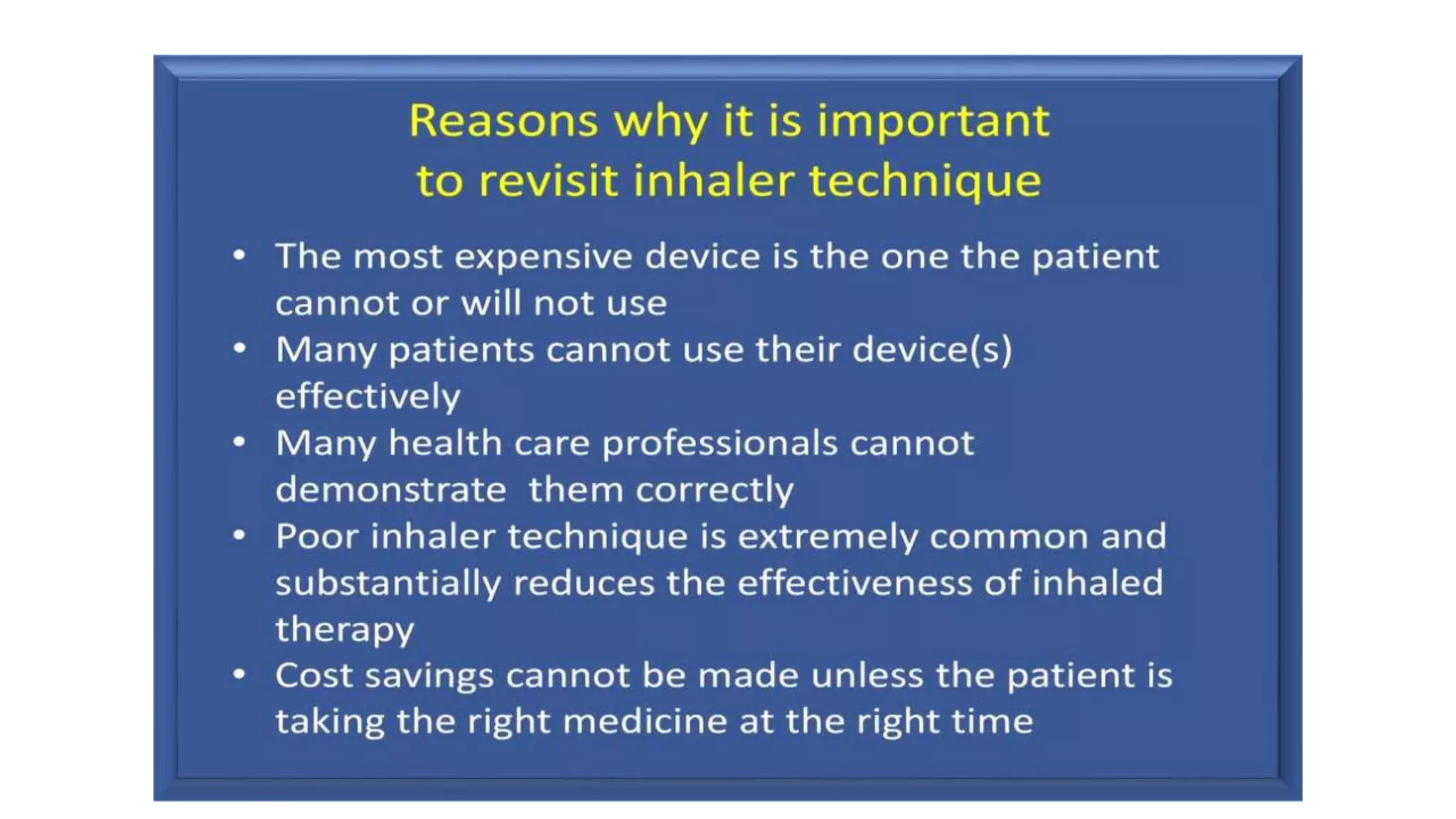
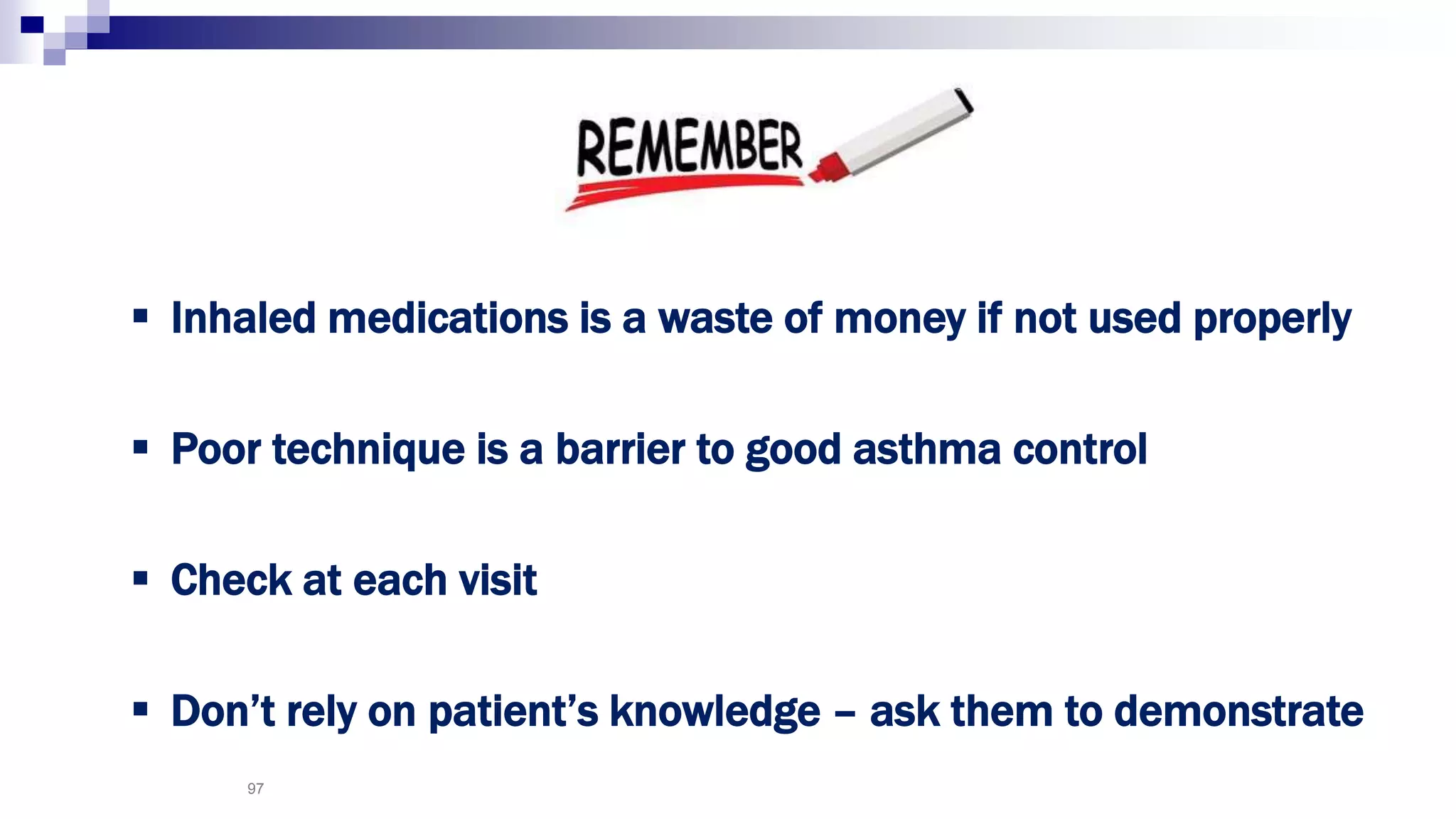
 Inhaled medications is a waste of money if not used properly
 Poor technique is a barrier to good asthma control
 Check at each visit
 Don’t rely on patient’s knowledge – ask them to demonstrate
BTS/SIGN 2011 Recommend
 Prescribe inhalers only after patients have received training
in the use of the device And have demonstrated a
satisfactory technique.
100
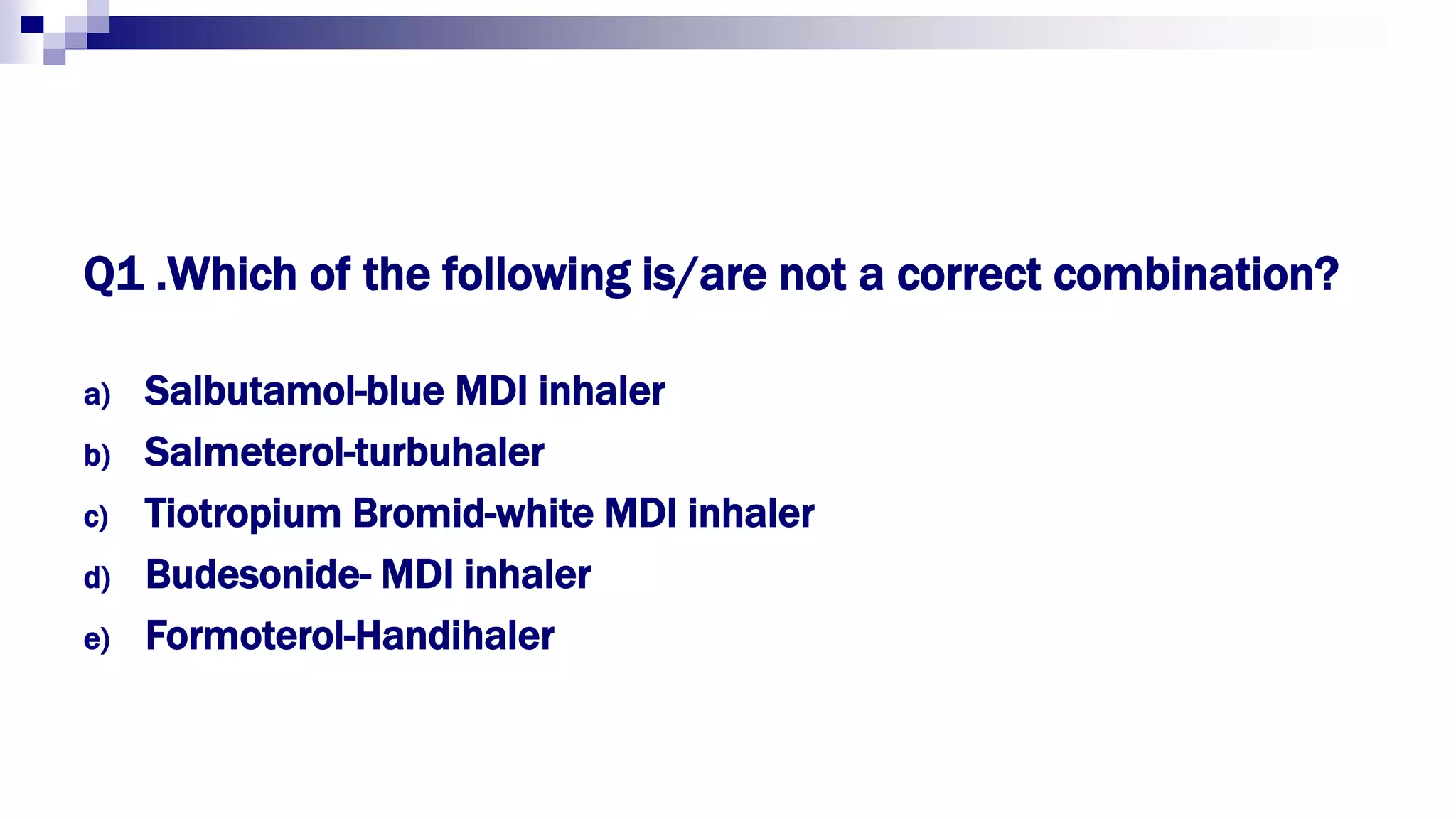
Q1 .Which of the following is/are not a correct combination?
a) Salbutamol-blue MDI inhaler
b) Salmeterol-turbuhaler
c) Tiotropium Bromid-white MDI inhaler
d) Budesonide- MDI inhaler
e) Formoterol-Handihaler
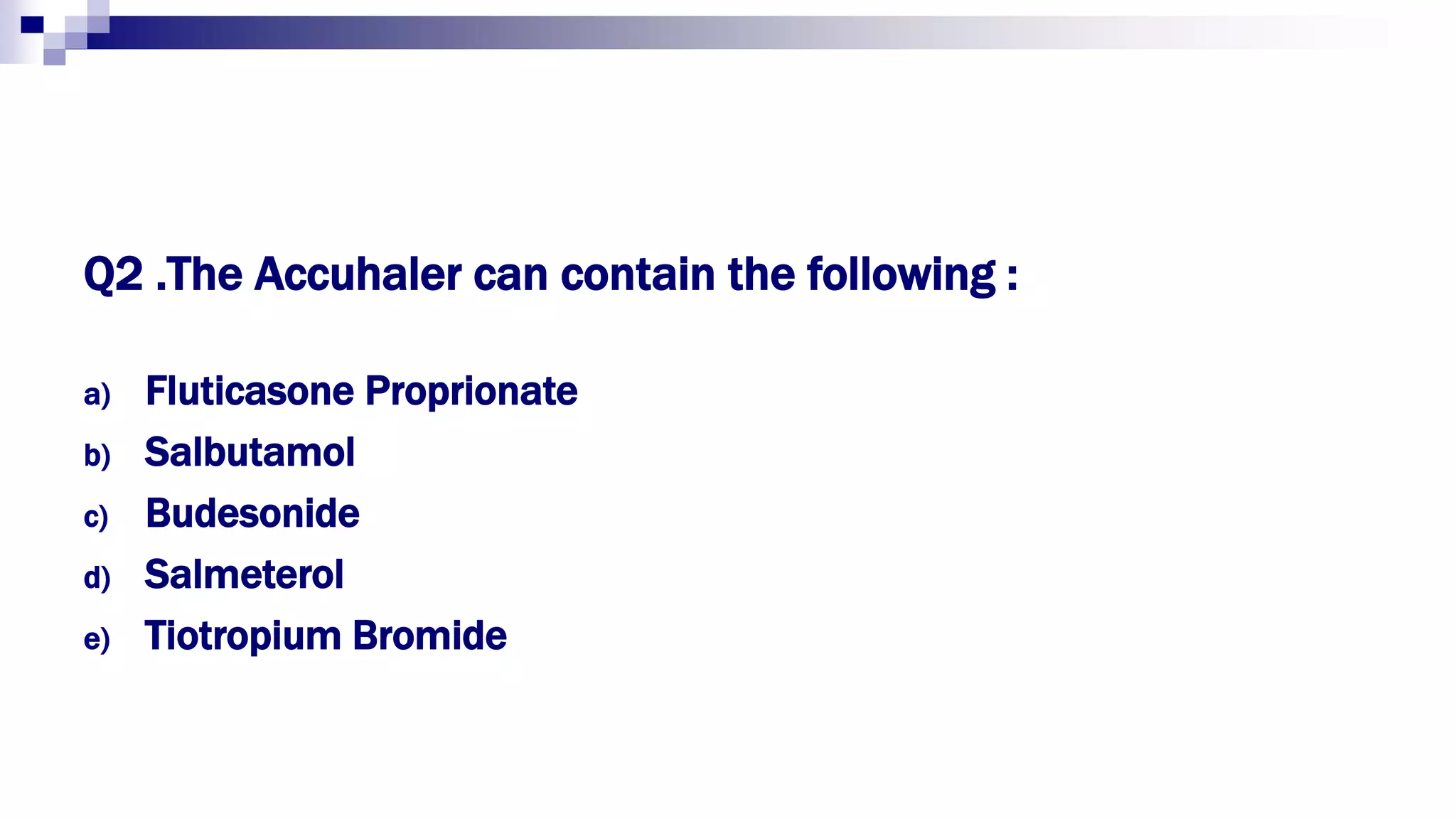
Q2 .The Accuhaler can contain the following :
a) Fluticasone Proprionate
b) Salbutamol
c) Budesonide
d) Salmeterol
e) Tiotropium Bromide
Q3 . Which of these is/are not a correct combination?
a) Blue MDI-short acting beta agonist
b) Purple MDI-anticholinergic
c) Red MDI-inhaled Corticosteroid
d) Handihaler-anticholinergic
e) Aerolizer-Long acting beta agonist
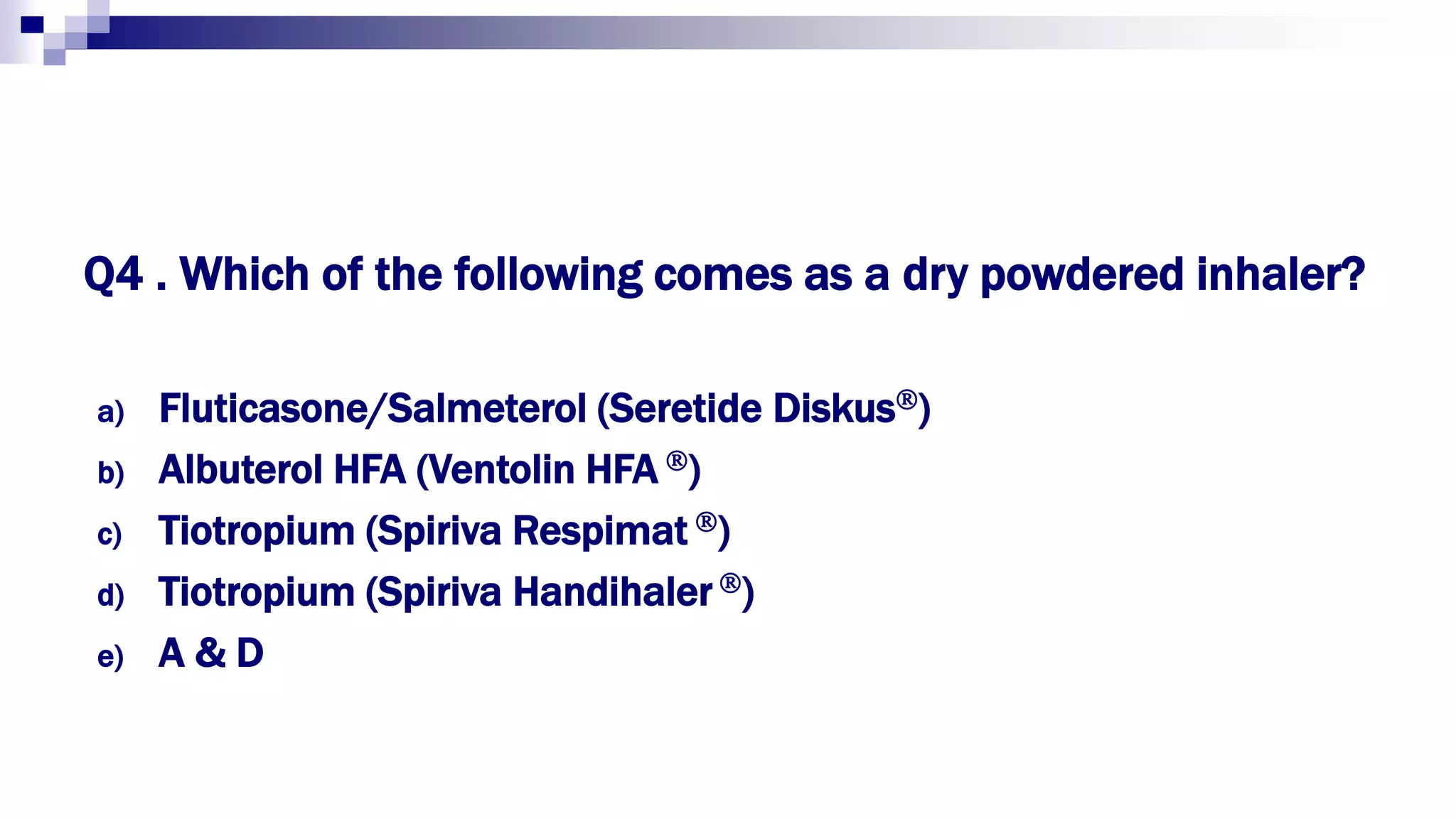
Q4 . Which of the following comes as a dry powdered inhaler?
a) Fluticasone/Salmeterol (Seretide Diskus)
b) Albuterol HFA (Ventolin HFA )
c) Tiotropium (Spiriva Respimat )
d) Tiotropium (Spiriva Handihaler )
e) A & D
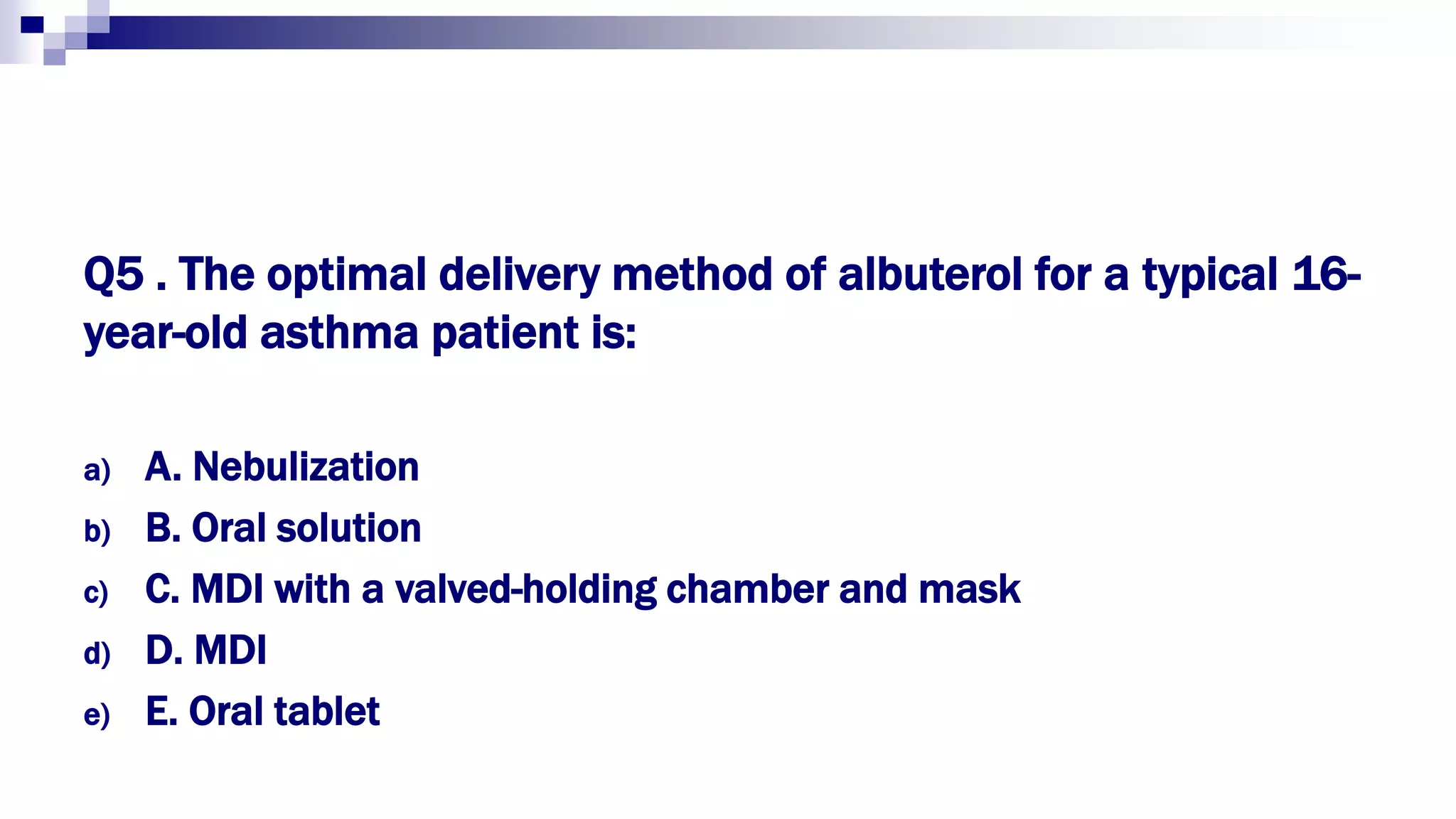
Q5 . The optimal delivery method of albuterol for a typical 16-
year-old asthma patient is:
a) A. Nebulization
b) B. Oral solution
c) C. MDI with a valved-holding chamber and mask
d) D. MDI
e) E. Oral tablet
110
Thank you

Asthma and inhaler usage tips - part 1

  • 1.
  • 3.
  • 4.
  • 8.
    Not all asthmainhalers are the same
  • 10.
  • 11.
    pMDIs DPIs Respimat® SMI pMDI,pressurized metered-dose inhaler; DPI, dry powder inhaler; SMI, Soft Mist™ inhaler Seretide® Evohaler® and Accuhaler®, Allen & Hanburys (GlaxoSmithKline); Symbicort® Turbuhaler®, AstraZeneca; Pulmicort® Flexhaler®, AstraZeneca; Onbrez® Breezhaler®, Novartis; SPIRIVA® HandiHaler®, Boehringer Ingelheim; Pressair ® /Genuair ®, Almirall; SPIRIVA® Respimat® SMI , Boehringer Ingelheim; Breo®/Relvar® ELLIPTA, GSK
  • 14.
  • 15.
  • 17.
    17 Controllers = Medications taken dailyon a long-term basis to keep asthma under control  due to antiinflammatory effects Relievers = Medications used on an as-needed basis reverse bronchoconstriction and relieve its symptoms that act quickly Controllers Vs Relievers
  • 20.
    20 Controllers  Inhaled corticosteroids Inhaled long-acting b2- agonists  leukotrienes modifiers  Sustained release theophylline  Systemic glucocorticosteroids  Anti-IgE (Omalizumab) Relievers  Inhaled short acting b2-agonists  Short acting anticholinergics  Methylxanthines Medications for Asthma Management
  • 21.
    21 Inhaled therapy constitutesthe cornerstone of asthma treatment .
  • 22.
  • 25.
  • 29.
  • 33.
  • 35.
  • 36.
  • 37.
  • 38.
  • 39.
  • 43.
  • 44.
  • 45.
  • 46.
  • 47.
  • 48.
  • 50.
  • 51.
  • 54.
  • 55.
  • 56.
  • 57.
  • 62.
  • 64.
  • 65.
  • 66.
  • 69.
  • 70.
  • 71.
    What are theadvantages of inhaled therapy?  Direct delivery of drug to site of action  Rapid onset of action  Lower dose (than systemic administration) to produce desired effects  Minimizes systemic adverse effects
  • 72.
  • 73.
    Factors affecting lungdeposition 1. Particle size 2. Speed of inspiration (inspiratory flow) 3. Integrity of airway 4. Proper inhaled device technique
  • 74.
    Particle dynamics inrespiratory tract  The physical mechanisms governing the movement and deposition of aerosol particles in the air are: 1. Impaction 2. Sedimentation 3. Diffusion
  • 75.
     Inertial impactionoccurs in either the oropharynx or at bifurcations of main branches of the bronchial tree, particularly in the large central airways.  It occurs mainly with large particles or high velocity particles, where they are unable to follow the airstream when it changes direction, thus impacting on the airway wall. 76
  • 76.
     Gravitational sedimentationoccurs for smaller particles that are able to follow the airstream and penetrate the more peripheral bronchioles.  Particles to settle on to the airway surfaces either during the course of slow steady breathing or during breath-holding.  Breath-holding is important for smaller particle sizes, owing to the increased chance of exhalation of the drug, because they can remain airborne for a considerable time, Breath-holding increases gravitational sedimentation.
  • 77.
     Particle sizeis important, those that are too small may be exhaled; those that are too large experience inertial impaction in the oropharynx and large conducting airways.  Increased aerosol particle speed increases the probability of deposition by impaction in the oropharynx and large conducting airways .  Slow aerosol particle speed allows more particles to settle on to the airway surfaces i.e Gravitational sedimentation . 78
  • 78.
  • 79.
    80 Deposition of particles >5 µ impaction 1-5 µ sedimentation < 1 µ like gas
  • 81.
  • 82.
     The observedclinical effect is dependent on the amount of drug reaching the lungs at inhalation, lung deposition  The amount of drug reaching the lungs at inhalation, lung deposition, is dependent on the fine particle dose = Fine particle fraction (FPF) .  Fine-particle fraction (FPF) is percentage of the aerosol between 1–5 μm that deposit in the lung.
  • 83.
    MMAD  The calculatedaerodynamic diameter that divides the particles of an aerosol in half, based on the weight of the particles.  Mass Median Aerodynamic Diameter (MMAD) is defined as the diameter at which 50% of the particles by mass are larger and 50% are smaller .  By weight, 50% of the particles will be larger than the MMAD and 50% of the particles will be smaller than the MMAD.
  • 84.
    MMAD of 5μm =?  50 % of the total sample mass will be present in particles having diameters less than 5 μm, and that 50 % of the total sample mass will be present in particles having an diameter larger than 5 μm.
  • 85.
  • 87.
  • 89.
    1) Sub optimalcommunication between HCP & patient 2) Lack of opportunity to discuss fear of side effects 3) Patients under-estimate the severity 4) Over-estimate their level of control 5) Technique Barriers for using inhalers
  • 93.
  • 94.
    95 Fate of inhaleddrugs – Good Technique Swallowed GI tract Deposited in lung Lungs Metabolism or absorption from the lung Liver Oral bioavailability Absorption from gut First-pass metabolism Systemic Circulation Mouth pharynx mucociliary clearance 80% 20% Schematic representation of potential dose distribution A Guide to Aerosol Delivery Devices for Respiratory Therapists. American Association for Respiratory Care. 1st Edition. Page 1. Webpage: http://www.aarc.org/education/aerosol_devices/ Adapted from Barnes et al. AJRCCM 1998;157:S1-S53
  • 95.
    96 Fate of inhaleddrugs – Good Technique Swallowed GI tract Deposited in lung Lungs Metabolism or absorption from the lung Liver Oral bioavailability Absorption from gut First-pass metabolism Systemic Circulation Mouth pharynx mucociliary clearance 80% 20% Schematic representation of potential dose distribution A Guide to Aerosol Delivery Devices for Respiratory Therapists. American Association for Respiratory Care. 1st Edition. Page 1. Webpage: http://www.aarc.org/education/aerosol_devices/ Adapted from Barnes et al. AJRCCM 1998;157:S1-S53 Swallowed GI tract Deposited in lung Lungs Metabolism or absorption from the lung Liver Oral bioavailability Absorption from gut First-pass metabolism Systemic Circulation Mouth pharynx mucociliary clearance 95% 5% Schematic representation of potential dose distributionAdapted from Barnes et al. AJRCCM 1998;157:S1-S53 A Guide to Aerosol Delivery Devices for Respiratory Therapists. American Association for Respiratory Care. 1st Edition. Page 1. Webpage: http://www.aarc.org/education/aerosol_devices/ Fate of inhaled drugs – Poor Technique
  • 96.
    97  Inhaled medicationsis a waste of money if not used properly  Poor technique is a barrier to good asthma control  Check at each visit  Don’t rely on patient’s knowledge – ask them to demonstrate
  • 97.
    BTS/SIGN 2011 Recommend Prescribe inhalers only after patients have received training in the use of the device And have demonstrated a satisfactory technique.
  • 99.
  • 103.
    Q1 .Which ofthe following is/are not a correct combination? a) Salbutamol-blue MDI inhaler b) Salmeterol-turbuhaler c) Tiotropium Bromid-white MDI inhaler d) Budesonide- MDI inhaler e) Formoterol-Handihaler
  • 104.
    Q2 .The Accuhalercan contain the following : a) Fluticasone Proprionate b) Salbutamol c) Budesonide d) Salmeterol e) Tiotropium Bromide
  • 105.
    Q3 . Whichof these is/are not a correct combination? a) Blue MDI-short acting beta agonist b) Purple MDI-anticholinergic c) Red MDI-inhaled Corticosteroid d) Handihaler-anticholinergic e) Aerolizer-Long acting beta agonist
  • 106.
    Q4 . Whichof the following comes as a dry powdered inhaler? a) Fluticasone/Salmeterol (Seretide Diskus) b) Albuterol HFA (Ventolin HFA ) c) Tiotropium (Spiriva Respimat ) d) Tiotropium (Spiriva Handihaler ) e) A & D
  • 107.
    Q5 . Theoptimal delivery method of albuterol for a typical 16- year-old asthma patient is: a) A. Nebulization b) B. Oral solution c) C. MDI with a valved-holding chamber and mask d) D. MDI e) E. Oral tablet
  • 109.