






























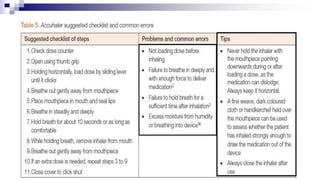
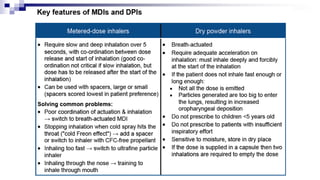




1
By
4
5
Although evidence based treatments are available in most countries,
asthma control remains suboptimal, and asthma-related deaths
continue to be an ongoing concern.
© IPCRG 2007© IPCRG 2007© IPCRG 2007
Achieving asthma control in practice:
understanding the reasons for poor control
Page 9 - © IPCRG 2007Page 9 - © IPCRG 2007Page 9 - © IPCRG 2007
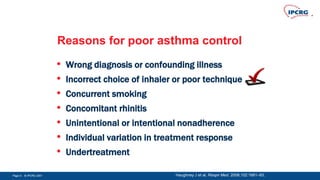
Reasons for poor asthma control
• Wrong diagnosis or confounding illness
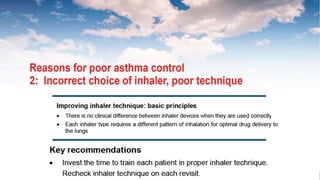
• Incorrect choice of inhaler or poor technique
• Concurrent smoking
• Concomitant rhinitis
• Unintentional or intentional nonadherence
• Individual variation in treatment response
• Undertreatment
Haughney J et al. Respir Med. 2008;102:1681–93.
Page 10 - © IPCRG 2007Page 10 - © IPCRG 2007Page 10 - © IPCRG 2007
Page 11 - © IPCRG 2007Page 11 - © IPCRG 2007Page 11 - © IPCRG 2007
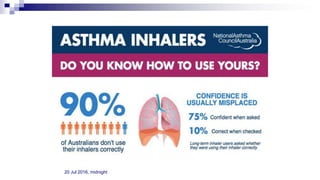
20 Jul 2016, midnight
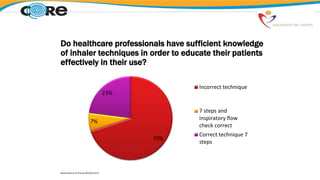
Do healthcare professionals have sufficient knowledge
of inhaler techniques in order to educate their patients
effectively in their use?
70%
7%
23%
Incorrect technique
7 steps and
inspiratory flow
check correct
Correct technique 7
steps
Baverstock et al Thorax 2010;65:A117
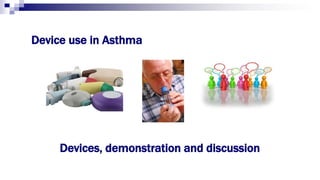
Devices, demonstration and discussion
Device use in Asthma
15
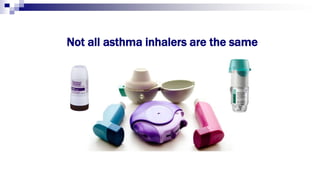
Not all asthma inhalers are the same
Airway
inflammation
Airflow
obstruction
Bronchial
hyperresponsiveness
Symptoms
Asthma Pathophysiology
The tip of the iceberg
19
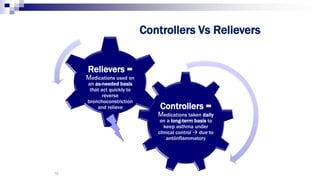
Controllers =
Medications taken daily
on a long-term basis to
keep asthma under
clinical control  due to
antiinflammatory
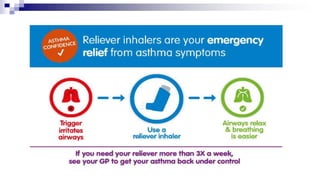
Relievers =
Medications used on
an as-needed basis
that act quickly to
reverse
bronchoconstriction
and relieve
Controllers Vs Relievers
21
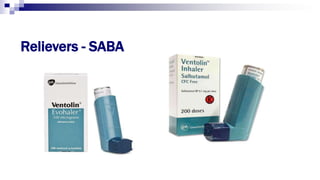
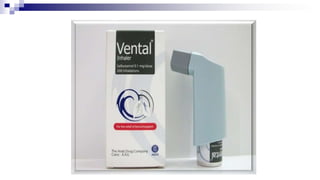
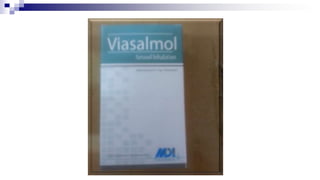
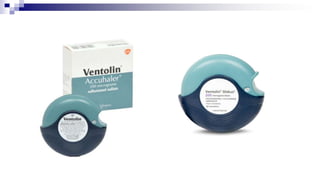
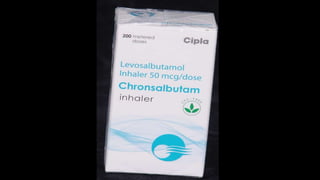
Relievers - SABA
24
26
28
30
31
32
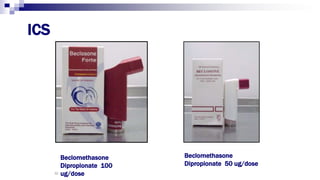
Beclomethasone
Dipropionate 100
ug/dose
Beclomethasone
Dipropionate 50 ug/dose
ICS
33
34
37
38
39
40
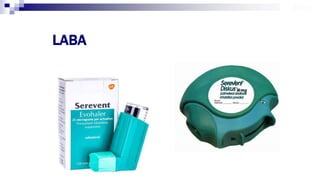
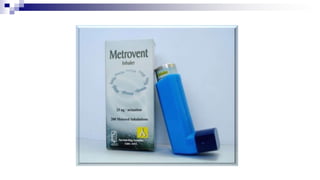
LABA
41
43
44
47
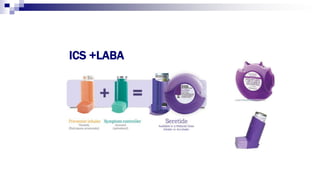
ICS +LABA
49
50
53
54
55
57
LAMA
60
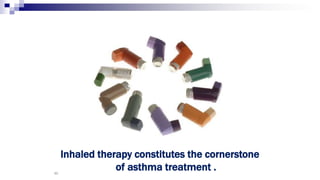
Inhaled therapy constitutes the cornerstone
of asthma treatment .
What are the advantages of inhaled therapy?
 Direct delivery of drug to site of action
 Rapid onset of action
 Lower dose (than systemic administration) to
produce desired effects
 Minimizes systemic adverse effects
62
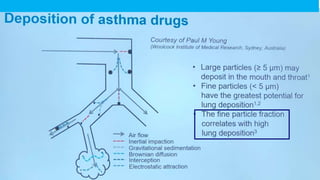
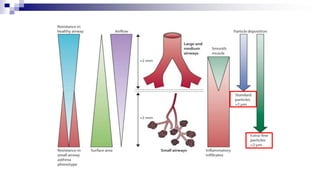
Factors affecting lung deposition
1. Particle size
2. Speed of inspiration (inspiratory flow)
3. Integrity of airway
4. Proper inhaled device technique
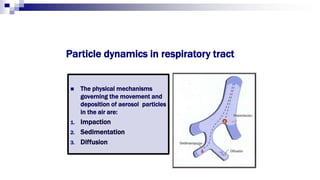
Particle dynamics in respiratory tract
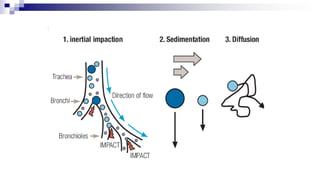
 The physical mechanisms
governing the movement and
deposition of aerosol particles
in the air are:
1. Impaction
2. Sedimentation
3. Diffusion
66
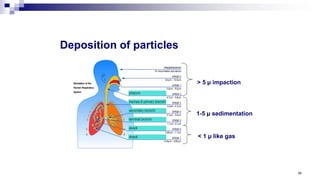
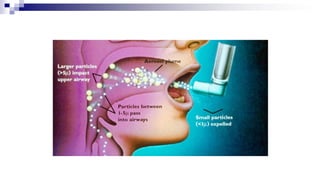
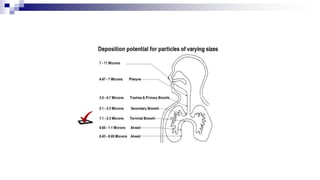
Deposition of particles
> 5 µ impaction
1-5 µ sedimentation
< 1 µ like gas
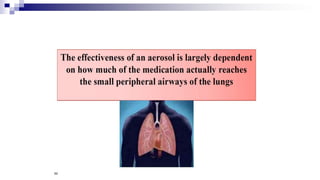
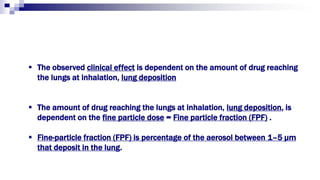
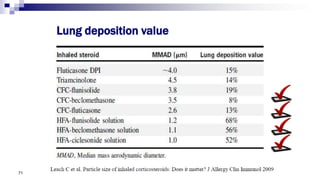
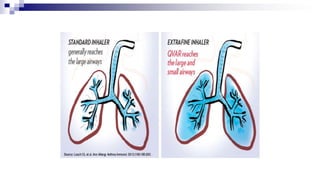
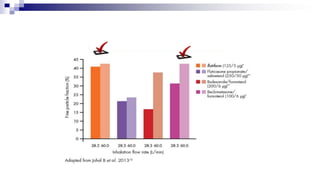
 The observed clinical effect is dependent on the amount of drug reaching
the lungs at inhalation, lung deposition
 The amount of drug reaching the lungs at inhalation, lung deposition, is
dependent on the fine particle dose = Fine particle fraction (FPF) .
 Fine-particle fraction (FPF) is percentage of the aerosol between 1–5 μm
that deposit in the lung.
‒ Fine-particle fraction (FPF) is percentage of the aerosol
between 1–5 μm that deposit in the lung.
71
Lung deposition value
73
75
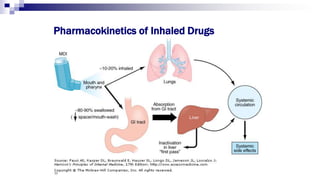
Pharmacokinetics of Inhaled Drugs
77
78
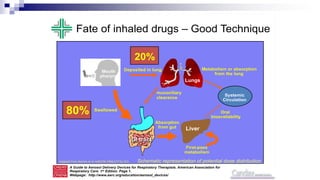
Fate of inhaled drugs – Good Technique
Swallowed
GI tract
Deposited in lung
Lungs
Metabolism or absorption
from the lung
Liver
Oral
bioavailability
Absorption
from gut
First-pass
metabolism
Systemic
Circulation
Mouth
pharynx
mucociliary
clearance
80%
20%
Schematic representation of potential dose distribution
A Guide to Aerosol Delivery Devices for Respiratory Therapists. American Association for
Respiratory Care. 1st Edition. Page 1.
Webpage: http://www.aarc.org/education/aerosol_devices/
Adapted from Barnes et al. AJRCCM 1998;157:S1-S53
79
Fate of inhaled drugs – Good Technique
Swallowed
GI tract
Deposited in lung
Lungs
Metabolism or absorption
from the lung
Liver
Oral
bioavailability
Absorption
from gut
First-pass
metabolism
Systemic
Circulation
Mouth
pharynx
mucociliary
clearance
80%
20%
Schematic representation of potential dose distribution
A Guide to Aerosol Delivery Devices for Respiratory Therapists. American Association for
Respiratory Care. 1st Edition. Page 1.
Webpage: http://www.aarc.org/education/aerosol_devices/
Adapted from Barnes et al. AJRCCM 1998;157:S1-S53
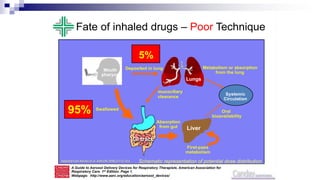
Swallowed
GI tract
Deposited in lung
Lungs
Metabolism or absorption
from the lung
Liver
Oral
bioavailability
Absorption
from gut
First-pass
metabolism
Systemic
Circulation
Mouth
pharynx
mucociliary
clearance
95%
5%
Schematic representation of potential dose distributionAdapted from Barnes et al. AJRCCM 1998;157:S1-S53
A Guide to Aerosol Delivery Devices for Respiratory Therapists. American Association for
Respiratory Care. 1st Edition. Page 1.
Webpage: http://www.aarc.org/education/aerosol_devices/
Fate of inhaled drugs – Poor Technique
80
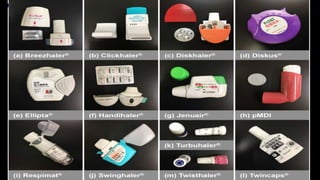
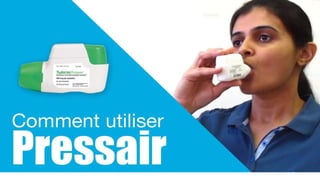
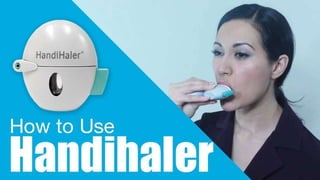
Three main types of inhaler devices are available:
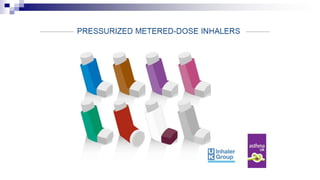
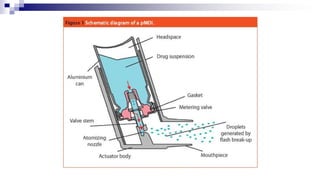
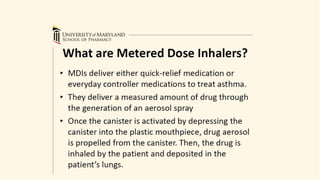
1. The pressurized metered dose inhaler (pMDI)
2. The dry powder inhaler (DPI)
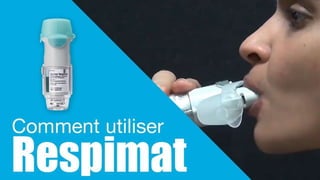
3. The soft mist inhaler (SMI)
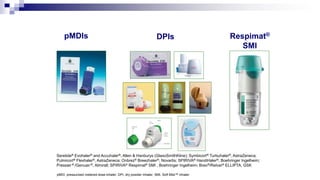
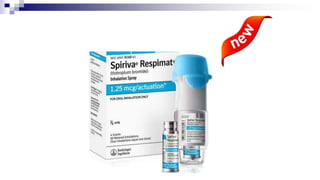
pMDIs DPIs Respimat®
SMI
pMDI, pressurized metered-dose inhaler; DPI, dry powder inhaler; SMI, Soft Mist™ inhaler
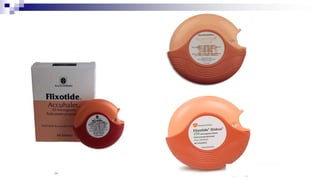
Seretide® Evohaler® and Accuhaler®, Allen & Hanburys (GlaxoSmithKline); Symbicort® Turbuhaler®, AstraZeneca;
Pulmicort® Flexhaler®, AstraZeneca; Onbrez® Breezhaler®, Novartis; SPIRIVA® HandiHaler®, Boehringer Ingelheim;
Pressair ® /Genuair ®, Almirall; SPIRIVA® Respimat® SMI , Boehringer Ingelheim; Breo®/Relvar® ELLIPTA, GSK
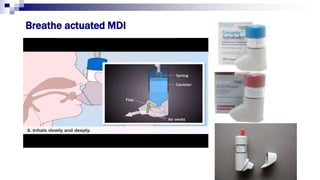
Breathe actuated MDI
88
Children’s Healthcare of Atlanta
100
106
107
108
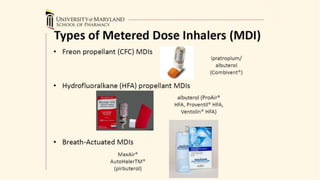
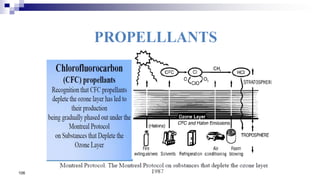
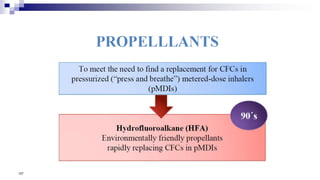
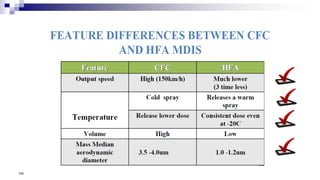
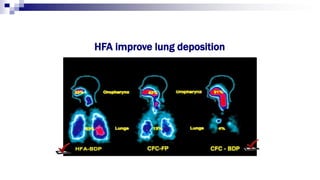
HFA improve lung deposition
111
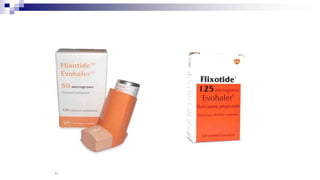
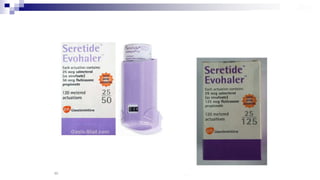
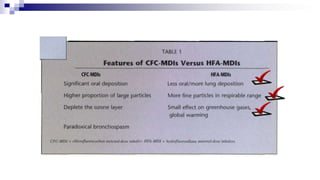
The inhaler is called an "Evohaler" - these are just parts of the brand
name, and reflect the fact that the inhalers contains no CFC propellants.
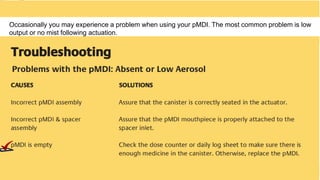
Occasionally you may experience a problem when using your pMDI. The most common problem is low
output or no mist following actuation.
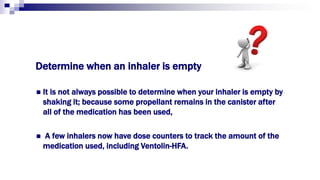
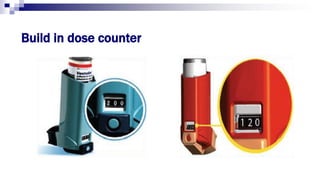
 It is not always possible to determine when your inhaler is empty by
shaking it; because some propellant remains in the canister after
all of the medication has been used,
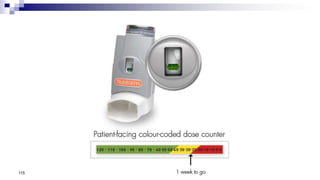
 A few inhalers now have dose counters to track the amount of the
medication used, including Ventolin-HFA.
Determine when an inhaler is empty
Build in dose counter
115
 If you do not have a dose counter, but you use your inhaler on a regular
basis ,another option is to check the package insert to determine the
number of puffs or sprays available in the inhaler.
 You can then divide that number by the average number of puffs you
use each day.
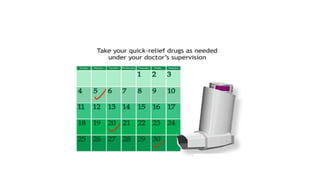
 If you use your rescue inhaler infrequently, write the date you start
using it on the canister in permanent marker and consider refilling
it after three to four months, or sooner if you think it is no longer
effective.
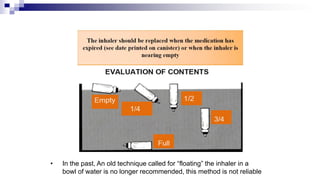
• In the past, An old technique called for “floating” the inhaler in a
bowl of water is no longer recommended, this method is not reliable
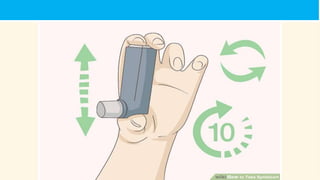
Shaking the Canister:
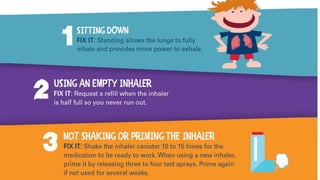
 If your pMDI is left sitting for an extended period of time between uses,
the medication and the propellant can separate. So you will need to
shake the canister before you use the pMDI.
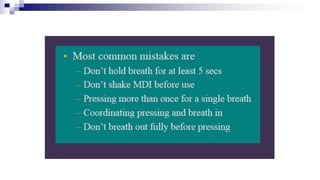
 Not shaking the pMDI canister before use can reduce the delivered
dose of medication by as much as 25%.
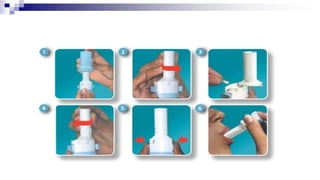
 The patient should also be instructed that on first use, and after several
days or weeks of disuse, the pMDI should be primed.
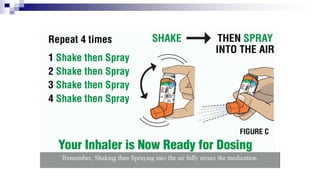
 Priming the pMDI involves discharging two to four doses into the
surrounding air (away from the patient) prior to use.
 Patients should be encouraged to follow the priming instructions described
in the PIL , pMDIs have extra doses - initial priming.
Priming
 Priming is Recommended before their initial use - ensure accurate mixing
of propellant and medication
 Additional priming –
1) if a period of time has elapsed between uses
2) If pMDI is dropped.
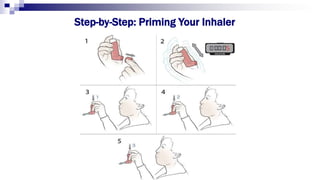
 Simply shake the pMDI, depress the canister, and release 1 or more sprays
into the room.
Step-by-Step: Priming Your Inhaler
Timing of Actuation Intervals:
 When you take your treatment, you should allow for a pause between
each puff from the inhaler.
 It is recommended that you wait approximately 1 minute between
each puff as this may improve the action of the drug.
 The rapid actuation of more than two puffs with the pMDI may reduce
drug delivery because of turbulence and the coalescence of particles.
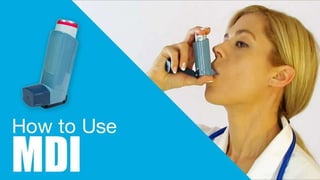
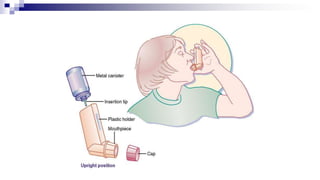
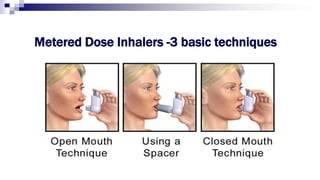
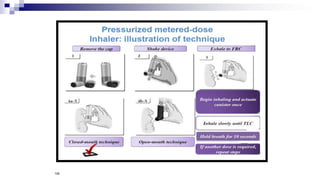
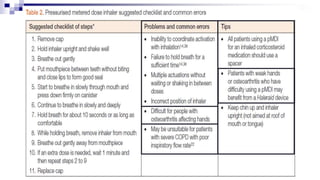
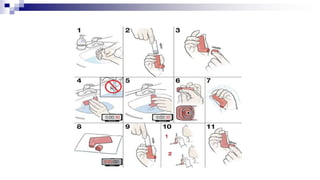
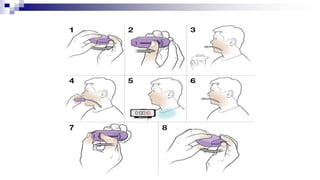
Metered Dose Inhalers -3 basic techniques
128
130
131
132
133
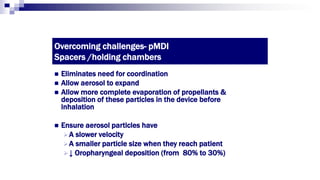
Overcoming challenges- pMDI
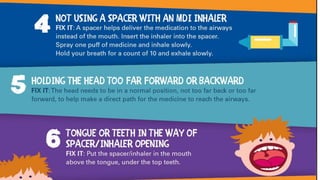
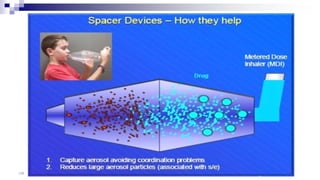
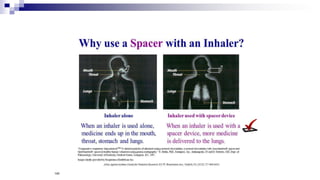
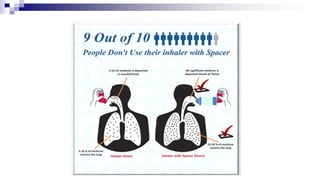
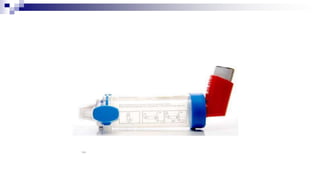
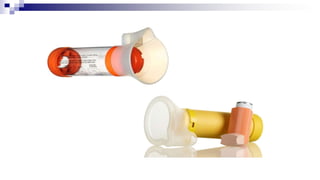
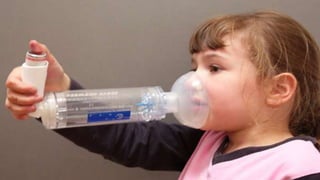
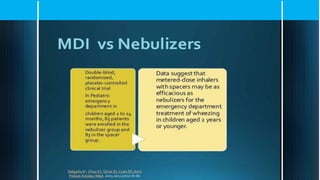
Spacers /holding chambers
 Eliminates need for coordination
 Allow aerosol to expand
 Allow more complete evaporation of propellants &
deposition of these particles in the device before
inhalation
 Ensure aerosol particles have
A slower velocity
A smaller particle size when they reach patient
↓ Oropharyngeal deposition (from 80% to 30%)
138
139
140
 Among patients taking ICS by using a pMDI, failure to maintain
meticulous oral hygiene (rinse, gargle and spit) after each dose will
increase the risk of ‘thrush’ (oropharyngeal candidiasis) and hoarseness,
caused by ICS deposited in the mouth and pharynx.
 For those using a pMDI, the risk of these local side-effects can also be
reduced by using a valved spacer.
143
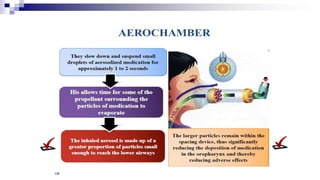
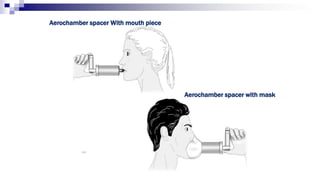
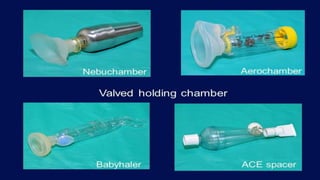
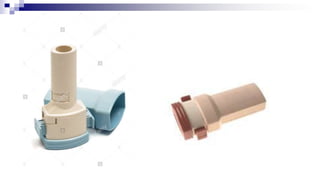
Aerochamber spacer With mouth piece
Aerochamber spacer with mask
144
147
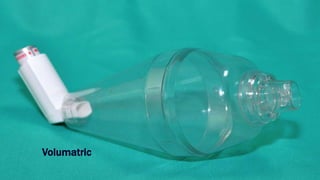
Volumatric
149
 There are many spacers on the market, although little is known
about the benefit of one type versus another. In general, larger-sized
spacers appear to be more effective than smaller ones.
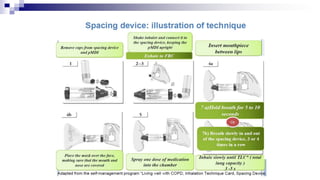
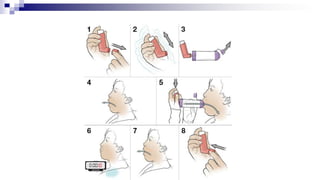
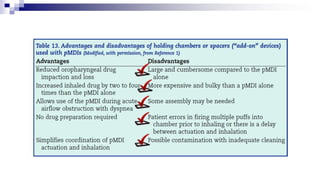
 Proper technique and frequent cleaning are important to ensure
optimal drug delivery.
151
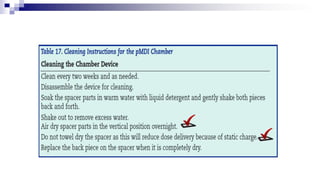
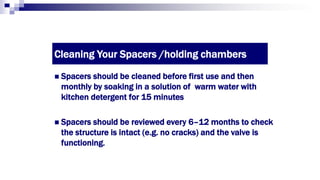
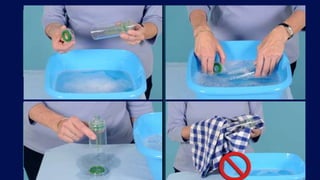
Cleaning Your Spacers /holding chambers
 Spacers should be cleaned before first use and then
monthly by soaking in a solution of warm water with
kitchen detergent for 15 minutes
 Spacers should be reviewed every 6–12 months to check
the structure is intact (e.g. no cracks) and the valve is
functioning.
156
Anti-Static Holding Chamber
Introducing the new PARI Vortex™ Non-
Electrostatic Valved Holding Chamber. It's a
revolutionary breakthrough in holding
chamber technology.
The non-electrostatic charge of the PARI
Vortex ensures that patients receive a more
consistent medication dose treatment after
treatment, day after day.
Important reminders about Spacers
 Only use your spacer with a pressurized metered dose inhaler,
not with a Breath Actuated MDIs or dry-powder inhaler.
 Spray only one puff into a spacer at a time.
 Use your spacer as soon as you've sprayed a puff into it.
 Never let anyone else use your spacer.
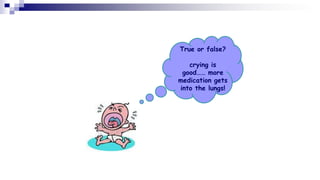
True or false?
crying is
good…… more
medication gets
into the lungs!
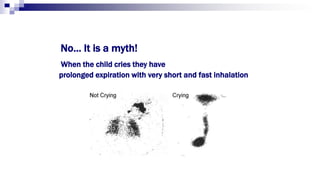
No… It is a myth!
When the child cries they have
prolonged expiration with very short and fast inhalation
Important reminders about Spacers
 Only After using ICS , the throat and mouth should be rinsed thoroughly
(gargle deeply, rinse, and spit out) or in young children using a spacer with
face mask, the face should be washed off with plain water.
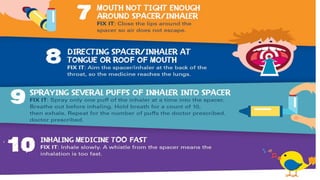
 Multiple doses should be given as separate doses..Never double puff (i.e.
depress canister once, then immediately depress again) because the second
puff contains only propellant; wait at least 30 seconds between puffs to
allow proper medication-propellant mixing.
Important reminders about Spacers
1. To overcome difficulties of patients who are unable to use pMDIs correctly
(ie, because of coordination problems, physical or mental handicaps, etc)
2. To reduce the risk of adverse effects with inhaled respiratory medications
(especially when using high doses of ICS)
3. To decrease or eliminate coughing or arrested inspiration experienced by
some patients when using CFC-driven devices
4. To administer inhaled medication during acute severe asthma
exacerbations as recommended by ATS
164
Use and care of spacers
Inhaler devices. Thorax 2003; 58 (Suppl I):
 Ensure spacer compatible with pMDI used
 Administer drug by repeated single actuations of pMDI
into spacer, each followed by inhalation
 Minimise delay between pMDI actuation and inhalation
 Tidal breathing is as effective as single breaths
 Spacers should be cleaned monthly by washing in
detergent and air drying, with mouthpiece wiped clean of
 pMDI + spacer is preferred delivery method in children
aged 0-5 years
 pMDI + spacer is as effective as other delivery methods
for other age groups
 Choice of inhaler should be based on patient preference
and ability to use
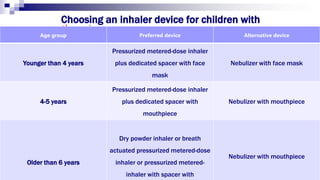
Choosing an inhaler device for children with
asthma *-Age group Preferred device Alternative device
Younger than 4 years
Pressurized metered-dose inhaler
plus dedicated spacer with face
mask
Nebulizer with face mask
4-5 years
Pressurized metered-dose inhaler
plus dedicated spacer with
mouthpiece
Nebulizer with mouthpiece
Older than 6 years
Dry powder inhaler or breath
actuated pressurized metered-dose
inhaler or pressurized metered-
inhaler with spacer with
Nebulizer with mouthpiece
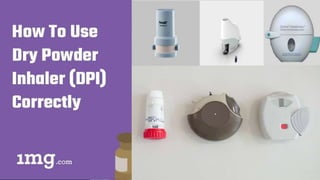
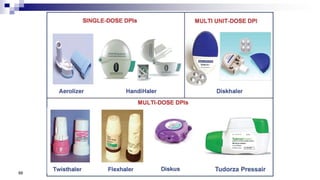
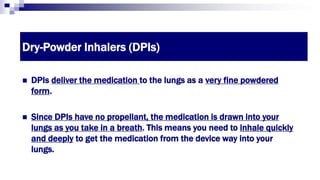
Dry-Powder Inhalers (DPIs)
 DPIs deliver the medication to the lungs as a very fine powdered
form.
 Since DPIs have no propellant, the medication is drawn into your
lungs as you take in a breath. This means you need to inhale quickly
and deeply to get the medication from the device way into your
lungs.
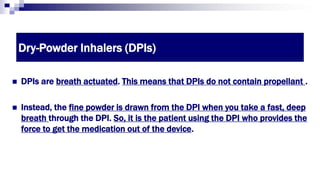
Dry-Powder Inhalers (DPIs)
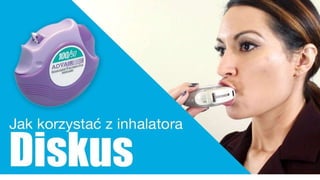
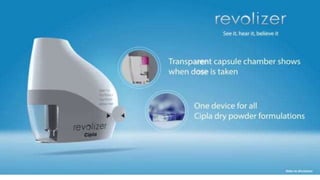
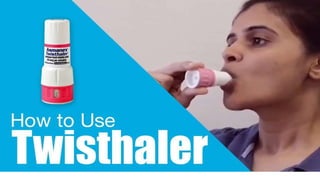
 DPIs are breath actuated. This means that DPIs do not contain propellant .
 Instead, the fine powder is drawn from the DPI when you take a fast, deep
breath through the DPI. So, it is the patient using the DPI who provides the
force to get the medication out of the device.
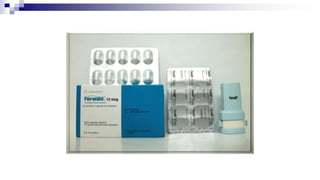
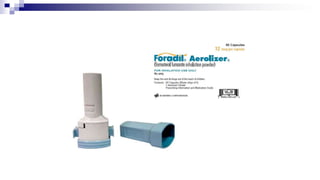
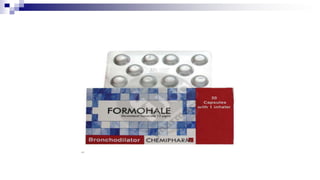
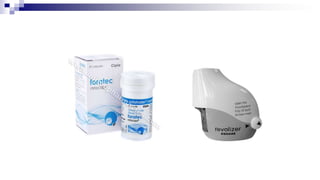
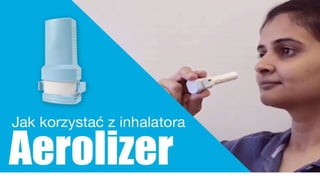
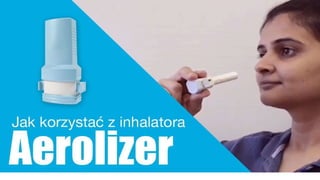
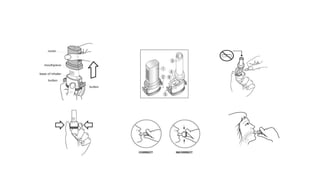
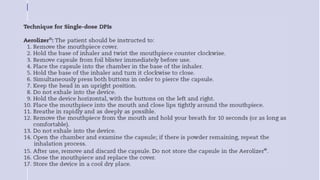
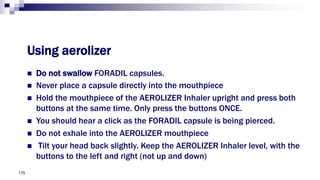
 Do not swallow FORADIL capsules.
 Never place a capsule directly into the mouthpiece
 Hold the mouthpiece of the AEROLIZER Inhaler upright and press both
buttons at the same time. Only press the buttons ONCE.
 You should hear a click as the FORADIL capsule is being pierced.
 Do not exhale into the AEROLIZER mouthpiece
 Tilt your head back slightly. Keep the AEROLIZER Inhaler level, with the
buttons to the left and right (not up and down)
175
Using aerolizer
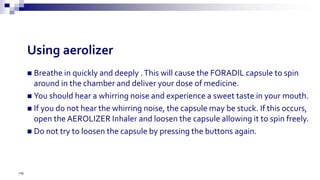
 Breathe in quickly and deeply .This will cause the FORADIL capsule to spin
around in the chamber and deliver your dose of medicine.
 You should hear a whirring noise and experience a sweet taste in your mouth.
 If you do not hear the whirring noise, the capsule may be stuck. If this occurs,
open the AEROLIZER Inhaler and loosen the capsule allowing it to spin freely.
 Do not try to loosen the capsule by pressing the buttons again.
176
Using aerolizer
178
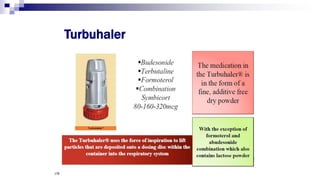
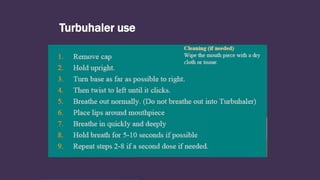
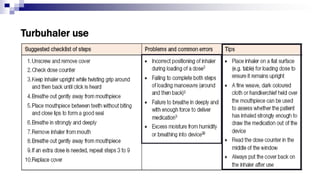
Turbuhaler
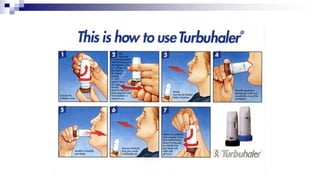
Turbuhaler use
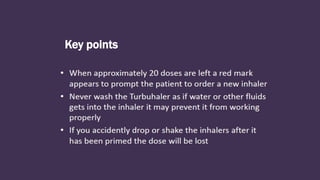
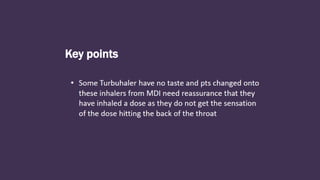
Key points
Key points
Turbuhaler use
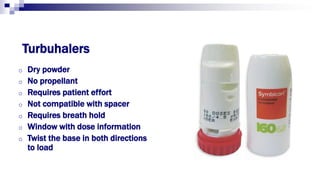
Turbuhalers
o Dry powder
o No propellant
o Requires patient effort
o Not compatible with spacer
o Requires breath hold
o Window with dose information
o Twist the base in both directions
to load
187
189
Turbuhaler use
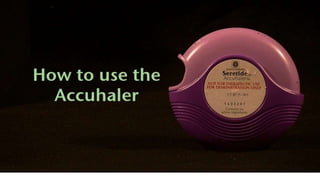
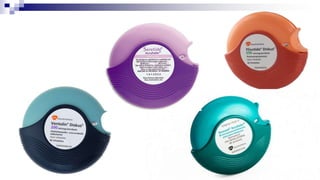
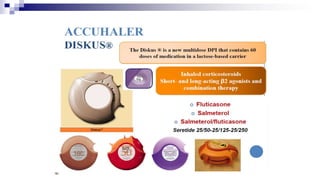
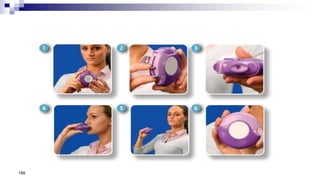
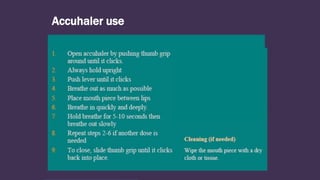
Accuhaler use
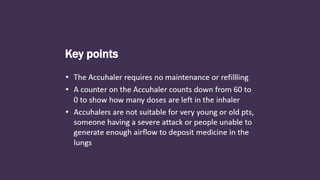
Key points
192
195
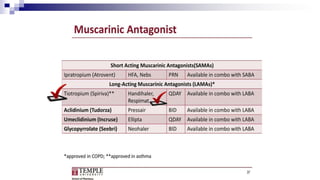
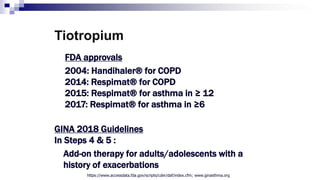
Tiotropium
FDA approvals
2004: Handihaler® for COPD
2014: Respimat® for COPD
2015: Respimat® for asthma in ≥ 12
2017: Respimat® for asthma in ≥6
GINA 2018 Guidelines
In Steps 4 & 5 :
• Add-on therapy for adults/adolescents with a
history of exacerbations
https://www.accessdata.fda.gov/scripts/cder/daf/index.cfm; www.ginasthma.org
FOR INTERNAL USE ONLY. STRICTLY CONFIDENTIAL.
DO NOT COPY, DETAIL OR DISTRIBUTE EXTERNALLY.
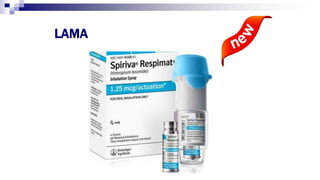
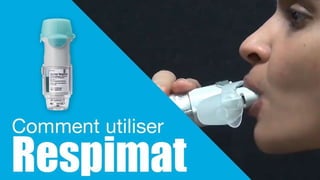
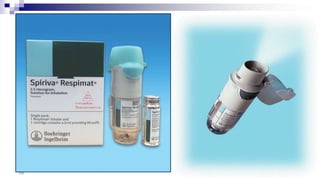
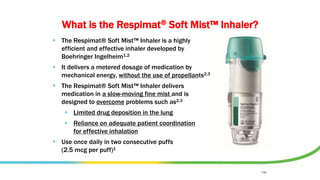
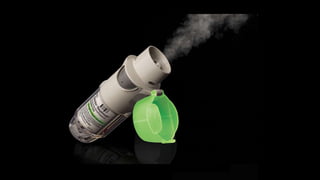
What is the Respimat® Soft Mist™ Inhaler?
 The Respimat® Soft Mist™ Inhaler is a highly
efficient and effective inhaler developed by
Boehringer Ingelheim1,2
 It delivers a metered dosage of medication by
mechanical energy, without the use of propellants2,3
 The Respimat® Soft Mist™ Inhaler delivers
medication in a slow-moving fine mist and is
designed to overcome problems such as2,3
 Limited drug deposition in the lung
 Reliance on adequate patient coordination
for effective inhalation
 Use once daily in two consecutive puffs
(2.5 mcg per puff)1
198
FOR INTERNAL USE ONLY. STRICTLY CONFIDENTIAL.
DO NOT COPY, DETAIL OR DISTRIBUTE EXTERNALLY.
FOR INTERNAL USE ONLY. STRICTLY CONFIDENTIAL.
DO NOT COPY, DETAIL OR DISTRIBUTE EXTERNALLY
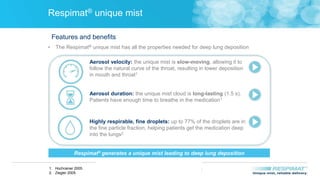
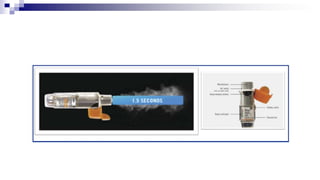
Respimat® unique mist
• The Respimat® unique mist has all the properties needed for deep lung deposition
Aerosol velocity: the unique mist is slow-moving, allowing it to
follow the natural curve of the throat, resulting in lower deposition
in mouth and throat1
Aerosol duration: the unique mist cloud is long-lasting (1.5 s).
Patients have enough time to breathe in the medication1
Highly respirable, fine droplets: up to 77% of the droplets are in
the fine particle fraction, helping patients get the medication deep
into the lungs2
Respimat® generates a unique mist leading to deep lung deposition
Features and benefits
1. Hochrainer 2005.
2. Ziegler 2005.
Children’s Healthcare of Atlanta
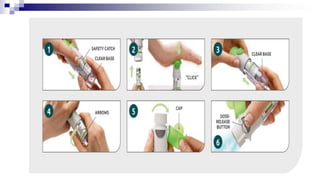
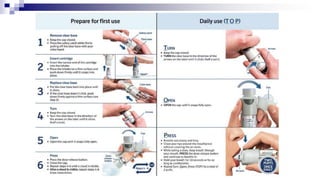
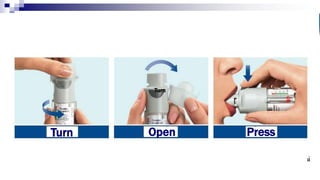
Turn
Turn Open Press
FOR INTERNAL USE ONLY. STRICTLY CONFIDENTIAL.
DO NOT COPY, DETAIL OR DISTRIBUTE EXTERNALLY.
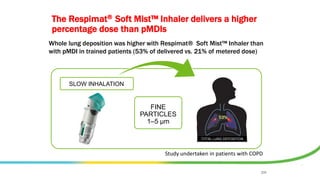
The Respimat® Soft Mist™ Inhaler delivers a higher
percentage dose than pMDIs
SLOW INHALATION
FINE
PARTICLES
1–5 µm
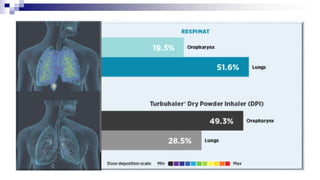
Whole lung deposition was higher with Respimat® Soft Mist™ Inhaler than
with pMDI in trained patients (53% of delivered vs. 21% of metered dose)
205
TOTAL LUNG DEPOSITION
Study undertaken in patients with COPD
207
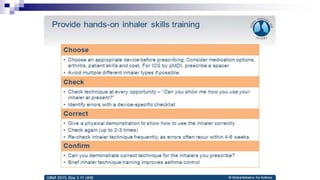
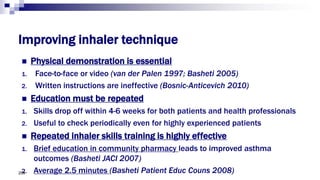
Improving inhaler technique
 Physical demonstration is essential
1. Face-to-face or video (van der Palen 1997; Basheti 2005)
2. Written instructions are ineffective (Bosnic-Anticevich 2010)
 Education must be repeated
1. Skills drop off within 4-6 weeks for both patients and health professionals
2. Useful to check periodically even for highly experienced patients
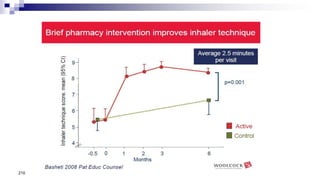
 Repeated inhaler skills training is highly effective
1. Brief education in community pharmacy leads to improved asthma
outcomes (Basheti JACI 2007)
2. Average 2.5 minutes (Basheti Patient Educ Couns 2008)209
210
BTS/SIGN 2011 Recommend
 Prescribe inhalers only after patients have received training in
the use of the device And have demonstrated a satisfactory
technique.
213
 Inhaled medications is a waste of money if not used
properly
 Poor technique is a barrier to good asthma control
 Check at each visit
 Don’t rely on patient’s knowledge – ask them to
215

Asthma Inhaler Techniques In Children

  • 1.
  • 3.
  • 4.
  • 5.
  • 6.
    Although evidence basedtreatments are available in most countries, asthma control remains suboptimal, and asthma-related deaths continue to be an ongoing concern.
  • 8.
    © IPCRG 2007©IPCRG 2007© IPCRG 2007 Achieving asthma control in practice: understanding the reasons for poor control
  • 9.
    Page 9 -© IPCRG 2007Page 9 - © IPCRG 2007Page 9 - © IPCRG 2007 Reasons for poor asthma control • Wrong diagnosis or confounding illness • Incorrect choice of inhaler or poor technique • Concurrent smoking • Concomitant rhinitis • Unintentional or intentional nonadherence • Individual variation in treatment response • Undertreatment Haughney J et al. Respir Med. 2008;102:1681–93.
  • 10.
    Page 10 -© IPCRG 2007Page 10 - © IPCRG 2007Page 10 - © IPCRG 2007
  • 11.
    Page 11 -© IPCRG 2007Page 11 - © IPCRG 2007Page 11 - © IPCRG 2007
  • 12.
    20 Jul 2016,midnight
  • 13.
    Do healthcare professionalshave sufficient knowledge of inhaler techniques in order to educate their patients effectively in their use? 70% 7% 23% Incorrect technique 7 steps and inspiratory flow check correct Correct technique 7 steps Baverstock et al Thorax 2010;65:A117
  • 14.
    Devices, demonstration anddiscussion Device use in Asthma
  • 15.
  • 16.
    Not all asthmainhalers are the same
  • 17.
  • 19.
    19 Controllers = Medications takendaily on a long-term basis to keep asthma under clinical control  due to antiinflammatory Relievers = Medications used on an as-needed basis that act quickly to reverse bronchoconstriction and relieve Controllers Vs Relievers
  • 21.
  • 24.
  • 26.
  • 28.
  • 30.
  • 31.
  • 32.
  • 33.
  • 34.
  • 37.
  • 38.
  • 39.
  • 40.
  • 41.
  • 43.
  • 44.
  • 47.
  • 48.
  • 49.
  • 50.
  • 53.
  • 54.
  • 55.
  • 57.
  • 59.
  • 60.
    60 Inhaled therapy constitutesthe cornerstone of asthma treatment .
  • 61.
    What are theadvantages of inhaled therapy?  Direct delivery of drug to site of action  Rapid onset of action  Lower dose (than systemic administration) to produce desired effects  Minimizes systemic adverse effects
  • 62.
  • 63.
    Factors affecting lungdeposition 1. Particle size 2. Speed of inspiration (inspiratory flow) 3. Integrity of airway 4. Proper inhaled device technique
  • 64.
    Particle dynamics inrespiratory tract  The physical mechanisms governing the movement and deposition of aerosol particles in the air are: 1. Impaction 2. Sedimentation 3. Diffusion
  • 66.
    66 Deposition of particles >5 µ impaction 1-5 µ sedimentation < 1 µ like gas
  • 68.
     The observedclinical effect is dependent on the amount of drug reaching the lungs at inhalation, lung deposition  The amount of drug reaching the lungs at inhalation, lung deposition, is dependent on the fine particle dose = Fine particle fraction (FPF) .  Fine-particle fraction (FPF) is percentage of the aerosol between 1–5 μm that deposit in the lung.
  • 70.
    ‒ Fine-particle fraction(FPF) is percentage of the aerosol between 1–5 μm that deposit in the lung.
  • 71.
  • 73.
  • 75.
  • 77.
  • 78.
    78 Fate of inhaleddrugs – Good Technique Swallowed GI tract Deposited in lung Lungs Metabolism or absorption from the lung Liver Oral bioavailability Absorption from gut First-pass metabolism Systemic Circulation Mouth pharynx mucociliary clearance 80% 20% Schematic representation of potential dose distribution A Guide to Aerosol Delivery Devices for Respiratory Therapists. American Association for Respiratory Care. 1st Edition. Page 1. Webpage: http://www.aarc.org/education/aerosol_devices/ Adapted from Barnes et al. AJRCCM 1998;157:S1-S53
  • 79.
    79 Fate of inhaleddrugs – Good Technique Swallowed GI tract Deposited in lung Lungs Metabolism or absorption from the lung Liver Oral bioavailability Absorption from gut First-pass metabolism Systemic Circulation Mouth pharynx mucociliary clearance 80% 20% Schematic representation of potential dose distribution A Guide to Aerosol Delivery Devices for Respiratory Therapists. American Association for Respiratory Care. 1st Edition. Page 1. Webpage: http://www.aarc.org/education/aerosol_devices/ Adapted from Barnes et al. AJRCCM 1998;157:S1-S53 Swallowed GI tract Deposited in lung Lungs Metabolism or absorption from the lung Liver Oral bioavailability Absorption from gut First-pass metabolism Systemic Circulation Mouth pharynx mucociliary clearance 95% 5% Schematic representation of potential dose distributionAdapted from Barnes et al. AJRCCM 1998;157:S1-S53 A Guide to Aerosol Delivery Devices for Respiratory Therapists. American Association for Respiratory Care. 1st Edition. Page 1. Webpage: http://www.aarc.org/education/aerosol_devices/ Fate of inhaled drugs – Poor Technique
  • 80.
  • 83.
    Three main typesof inhaler devices are available: 1. The pressurized metered dose inhaler (pMDI) 2. The dry powder inhaler (DPI) 3. The soft mist inhaler (SMI)
  • 84.
    pMDIs DPIs Respimat® SMI pMDI,pressurized metered-dose inhaler; DPI, dry powder inhaler; SMI, Soft Mist™ inhaler Seretide® Evohaler® and Accuhaler®, Allen & Hanburys (GlaxoSmithKline); Symbicort® Turbuhaler®, AstraZeneca; Pulmicort® Flexhaler®, AstraZeneca; Onbrez® Breezhaler®, Novartis; SPIRIVA® HandiHaler®, Boehringer Ingelheim; Pressair ® /Genuair ®, Almirall; SPIRIVA® Respimat® SMI , Boehringer Ingelheim; Breo®/Relvar® ELLIPTA, GSK
  • 86.
  • 88.
  • 100.
  • 106.
  • 107.
  • 108.
  • 110.
    HFA improve lungdeposition
  • 111.
    111 The inhaler iscalled an "Evohaler" - these are just parts of the brand name, and reflect the fact that the inhalers contains no CFC propellants.
  • 112.
    Occasionally you mayexperience a problem when using your pMDI. The most common problem is low output or no mist following actuation.
  • 113.
     It isnot always possible to determine when your inhaler is empty by shaking it; because some propellant remains in the canister after all of the medication has been used,  A few inhalers now have dose counters to track the amount of the medication used, including Ventolin-HFA. Determine when an inhaler is empty
  • 114.
  • 115.
  • 116.
     If youdo not have a dose counter, but you use your inhaler on a regular basis ,another option is to check the package insert to determine the number of puffs or sprays available in the inhaler.  You can then divide that number by the average number of puffs you use each day.
  • 117.
     If youuse your rescue inhaler infrequently, write the date you start using it on the canister in permanent marker and consider refilling it after three to four months, or sooner if you think it is no longer effective.
  • 119.
    • In thepast, An old technique called for “floating” the inhaler in a bowl of water is no longer recommended, this method is not reliable
  • 120.
    Shaking the Canister: If your pMDI is left sitting for an extended period of time between uses, the medication and the propellant can separate. So you will need to shake the canister before you use the pMDI.  Not shaking the pMDI canister before use can reduce the delivered dose of medication by as much as 25%.
  • 122.
     The patientshould also be instructed that on first use, and after several days or weeks of disuse, the pMDI should be primed.  Priming the pMDI involves discharging two to four doses into the surrounding air (away from the patient) prior to use.  Patients should be encouraged to follow the priming instructions described in the PIL , pMDIs have extra doses - initial priming. Priming
  • 123.
     Priming isRecommended before their initial use - ensure accurate mixing of propellant and medication  Additional priming – 1) if a period of time has elapsed between uses 2) If pMDI is dropped.  Simply shake the pMDI, depress the canister, and release 1 or more sprays into the room.
  • 124.
  • 126.
    Timing of ActuationIntervals:  When you take your treatment, you should allow for a pause between each puff from the inhaler.  It is recommended that you wait approximately 1 minute between each puff as this may improve the action of the drug.  The rapid actuation of more than two puffs with the pMDI may reduce drug delivery because of turbulence and the coalescence of particles.
  • 127.
    Metered Dose Inhalers-3 basic techniques
  • 128.
  • 130.
  • 131.
  • 132.
  • 133.
  • 136.
    Overcoming challenges- pMDI Spacers/holding chambers  Eliminates need for coordination  Allow aerosol to expand  Allow more complete evaporation of propellants & deposition of these particles in the device before inhalation  Ensure aerosol particles have A slower velocity A smaller particle size when they reach patient ↓ Oropharyngeal deposition (from 80% to 30%)
  • 138.
  • 139.
  • 140.
  • 142.
     Among patientstaking ICS by using a pMDI, failure to maintain meticulous oral hygiene (rinse, gargle and spit) after each dose will increase the risk of ‘thrush’ (oropharyngeal candidiasis) and hoarseness, caused by ICS deposited in the mouth and pharynx.  For those using a pMDI, the risk of these local side-effects can also be reduced by using a valved spacer.
  • 143.
    143 Aerochamber spacer Withmouth piece Aerochamber spacer with mask
  • 144.
  • 147.
  • 148.
  • 149.
  • 150.
     There aremany spacers on the market, although little is known about the benefit of one type versus another. In general, larger-sized spacers appear to be more effective than smaller ones.  Proper technique and frequent cleaning are important to ensure optimal drug delivery.
  • 151.
  • 155.
    Cleaning Your Spacers/holding chambers  Spacers should be cleaned before first use and then monthly by soaking in a solution of warm water with kitchen detergent for 15 minutes  Spacers should be reviewed every 6–12 months to check the structure is intact (e.g. no cracks) and the valve is functioning.
  • 156.
  • 158.
    Anti-Static Holding Chamber Introducingthe new PARI Vortex™ Non- Electrostatic Valved Holding Chamber. It's a revolutionary breakthrough in holding chamber technology. The non-electrostatic charge of the PARI Vortex ensures that patients receive a more consistent medication dose treatment after treatment, day after day.
  • 159.
    Important reminders aboutSpacers  Only use your spacer with a pressurized metered dose inhaler, not with a Breath Actuated MDIs or dry-powder inhaler.  Spray only one puff into a spacer at a time.  Use your spacer as soon as you've sprayed a puff into it.  Never let anyone else use your spacer.
  • 160.
    True or false? cryingis good…… more medication gets into the lungs!
  • 161.
    No… It isa myth! When the child cries they have prolonged expiration with very short and fast inhalation
  • 162.
    Important reminders aboutSpacers  Only After using ICS , the throat and mouth should be rinsed thoroughly (gargle deeply, rinse, and spit out) or in young children using a spacer with face mask, the face should be washed off with plain water.  Multiple doses should be given as separate doses..Never double puff (i.e. depress canister once, then immediately depress again) because the second puff contains only propellant; wait at least 30 seconds between puffs to allow proper medication-propellant mixing.
  • 163.
    Important reminders aboutSpacers 1. To overcome difficulties of patients who are unable to use pMDIs correctly (ie, because of coordination problems, physical or mental handicaps, etc) 2. To reduce the risk of adverse effects with inhaled respiratory medications (especially when using high doses of ICS) 3. To decrease or eliminate coughing or arrested inspiration experienced by some patients when using CFC-driven devices 4. To administer inhaled medication during acute severe asthma exacerbations as recommended by ATS
  • 164.
  • 166.
    Use and careof spacers Inhaler devices. Thorax 2003; 58 (Suppl I):  Ensure spacer compatible with pMDI used  Administer drug by repeated single actuations of pMDI into spacer, each followed by inhalation  Minimise delay between pMDI actuation and inhalation  Tidal breathing is as effective as single breaths  Spacers should be cleaned monthly by washing in detergent and air drying, with mouthpiece wiped clean of  pMDI + spacer is preferred delivery method in children aged 0-5 years  pMDI + spacer is as effective as other delivery methods for other age groups  Choice of inhaler should be based on patient preference and ability to use
  • 167.
    Choosing an inhalerdevice for children with asthma *-Age group Preferred device Alternative device Younger than 4 years Pressurized metered-dose inhaler plus dedicated spacer with face mask Nebulizer with face mask 4-5 years Pressurized metered-dose inhaler plus dedicated spacer with mouthpiece Nebulizer with mouthpiece Older than 6 years Dry powder inhaler or breath actuated pressurized metered-dose inhaler or pressurized metered- inhaler with spacer with Nebulizer with mouthpiece
  • 168.
    Dry-Powder Inhalers (DPIs) DPIs deliver the medication to the lungs as a very fine powdered form.  Since DPIs have no propellant, the medication is drawn into your lungs as you take in a breath. This means you need to inhale quickly and deeply to get the medication from the device way into your lungs.
  • 169.
    Dry-Powder Inhalers (DPIs) DPIs are breath actuated. This means that DPIs do not contain propellant .  Instead, the fine powder is drawn from the DPI when you take a fast, deep breath through the DPI. So, it is the patient using the DPI who provides the force to get the medication out of the device.
  • 175.
     Do notswallow FORADIL capsules.  Never place a capsule directly into the mouthpiece  Hold the mouthpiece of the AEROLIZER Inhaler upright and press both buttons at the same time. Only press the buttons ONCE.  You should hear a click as the FORADIL capsule is being pierced.  Do not exhale into the AEROLIZER mouthpiece  Tilt your head back slightly. Keep the AEROLIZER Inhaler level, with the buttons to the left and right (not up and down) 175 Using aerolizer
  • 176.
     Breathe inquickly and deeply .This will cause the FORADIL capsule to spin around in the chamber and deliver your dose of medicine.  You should hear a whirring noise and experience a sweet taste in your mouth.  If you do not hear the whirring noise, the capsule may be stuck. If this occurs, open the AEROLIZER Inhaler and loosen the capsule allowing it to spin freely.  Do not try to loosen the capsule by pressing the buttons again. 176 Using aerolizer
  • 178.
  • 180.
  • 181.
  • 182.
  • 183.
  • 184.
    Turbuhalers o Dry powder oNo propellant o Requires patient effort o Not compatible with spacer o Requires breath hold o Window with dose information o Twist the base in both directions to load
  • 187.
  • 189.
  • 190.
  • 191.
  • 192.
  • 195.
  • 197.
    Tiotropium FDA approvals 2004: Handihaler®for COPD 2014: Respimat® for COPD 2015: Respimat® for asthma in ≥ 12 2017: Respimat® for asthma in ≥6 GINA 2018 Guidelines In Steps 4 & 5 : • Add-on therapy for adults/adolescents with a history of exacerbations https://www.accessdata.fda.gov/scripts/cder/daf/index.cfm; www.ginasthma.org
  • 198.
    FOR INTERNAL USEONLY. STRICTLY CONFIDENTIAL. DO NOT COPY, DETAIL OR DISTRIBUTE EXTERNALLY. What is the Respimat® Soft Mist™ Inhaler?  The Respimat® Soft Mist™ Inhaler is a highly efficient and effective inhaler developed by Boehringer Ingelheim1,2  It delivers a metered dosage of medication by mechanical energy, without the use of propellants2,3  The Respimat® Soft Mist™ Inhaler delivers medication in a slow-moving fine mist and is designed to overcome problems such as2,3  Limited drug deposition in the lung  Reliance on adequate patient coordination for effective inhalation  Use once daily in two consecutive puffs (2.5 mcg per puff)1 198
  • 199.
    FOR INTERNAL USEONLY. STRICTLY CONFIDENTIAL. DO NOT COPY, DETAIL OR DISTRIBUTE EXTERNALLY. FOR INTERNAL USE ONLY. STRICTLY CONFIDENTIAL. DO NOT COPY, DETAIL OR DISTRIBUTE EXTERNALLY Respimat® unique mist • The Respimat® unique mist has all the properties needed for deep lung deposition Aerosol velocity: the unique mist is slow-moving, allowing it to follow the natural curve of the throat, resulting in lower deposition in mouth and throat1 Aerosol duration: the unique mist cloud is long-lasting (1.5 s). Patients have enough time to breathe in the medication1 Highly respirable, fine droplets: up to 77% of the droplets are in the fine particle fraction, helping patients get the medication deep into the lungs2 Respimat® generates a unique mist leading to deep lung deposition Features and benefits 1. Hochrainer 2005. 2. Ziegler 2005.
  • 200.
  • 204.
  • 205.
    FOR INTERNAL USEONLY. STRICTLY CONFIDENTIAL. DO NOT COPY, DETAIL OR DISTRIBUTE EXTERNALLY. The Respimat® Soft Mist™ Inhaler delivers a higher percentage dose than pMDIs SLOW INHALATION FINE PARTICLES 1–5 µm Whole lung deposition was higher with Respimat® Soft Mist™ Inhaler than with pMDI in trained patients (53% of delivered vs. 21% of metered dose) 205 TOTAL LUNG DEPOSITION Study undertaken in patients with COPD
  • 207.
  • 209.
    Improving inhaler technique Physical demonstration is essential 1. Face-to-face or video (van der Palen 1997; Basheti 2005) 2. Written instructions are ineffective (Bosnic-Anticevich 2010)  Education must be repeated 1. Skills drop off within 4-6 weeks for both patients and health professionals 2. Useful to check periodically even for highly experienced patients  Repeated inhaler skills training is highly effective 1. Brief education in community pharmacy leads to improved asthma outcomes (Basheti JACI 2007) 2. Average 2.5 minutes (Basheti Patient Educ Couns 2008)209
  • 210.
  • 212.
    BTS/SIGN 2011 Recommend Prescribe inhalers only after patients have received training in the use of the device And have demonstrated a satisfactory technique.
  • 213.
    213  Inhaled medicationsis a waste of money if not used properly  Poor technique is a barrier to good asthma control  Check at each visit  Don’t rely on patient’s knowledge – ask them to
  • 215.