: Tuberculosis (TB)is an infectious disease caused by
bacteria that most often affects the lungs.
3.
Other Names:
• Whitedeath
• Great white plague
• Consumption
• Phthisis
• Phthisis pulmonalis
What is TB called in other languages?
• The robber of youth
• The Captain of all these men of Death
• The graveyard cough
• The King’s-Evil
• Yaksma (India)
• Consumptio (Latin)
4.
• A totalof 1.25 million people died from tuberculosis (TB) in 2023
(including 161 000 people with HIV).
• TB has probably returned to being the world’s leading cause of death
from a single infectious agent, following three years in which it was
replaced by coronavirus disease (COVID-19).
• It was also the leading killer of people with HIV and a major cause of
deaths related to antimicrobial resistance.
• In 2023, an estimated 10.8 million people fell ill with TB worldwide,
including 6.0 million men, 3.6 million women and 1.3 million children.
5.
• TB ispresent in all countries and age groups.
• TB is curable and preventable.
• Ending the TB epidemic by 2030 is among the health targets of the
United Nations Sustainable Development Goals (SDGs).
• Every year, 10 million people fall ill with tuberculosis (TB). Despite
being a preventable and curable disease, 1.5 million people die from
TB each year – making it the world’s top infectious killer.
7.
NATURAL HISTORY OFTUBERCULOSIS
AGENT FACTORS:
a. AGENT-
M. tuberculosis is a facultative intracellular parasite (i.e. it is
readily ingested by phagocytes and is resistant to intracellular
killing).
Of importance to man are the human and bovine strains.
Human strain Bovine strain
Vast majority of
cases
Affects mainly cattle
and other animals
Indian tubercle bacillus is said to be less virulent than the European bacillus.
8.
Key species:
• M.tuberculosis
• M. bovis
• M. africanum
• M. microti
• M. canetti
Characteristics:
Thin, rod-shaped bacterium measuring about 0.5 micrometers by 3
micrometers.
It does not form spores
Slow growing
Obligate aerobes [requiring oxygen to survive (apex of the lung)]
Acid fast: (high lipid content)
• Property conferred by mycolic acid
• Do not destain by acid alcohol after being stained with aniline dyes
9.
b. SOURCE OFINFECTION-
Human source Bovine source
Most common source
of infection
Sputum is positive
(new and relapse)
1 case of infectious
pulmonary TB infects
10-15 persons
Tubercle bacilli- some
multiply rapidly and
some slowly
Infected milk
Boiling milk before
consumption
10.
c. COMMUNICABILITY-
i. Patientsare infective as long as they remain untreated.
ii. Effective anti-microbial treatment reduces infectivity by 90% within 48
hrs.
iii. Patients can be regarded as being noninfectious two weeks after the
start of treatment. (Schwartzman K, Menzies D. Tuberculosis: 11.
Nosocomial disease. CMAJ 1999;161(10):1271-7)
11.
HOST FACTORS:
1. AGE-all ages
- sharp rise from childhood to adolescence
- 0-14 yrs: 2% , 15-24yrs: 20%
- Elderly
2. SEX- M>F
3. HEREDITY- Not a heredity disease
4. NUTRITION- Malnutrition
5. IMMUNITY- No inherited immunity.
Acquired as a result of natural infection or BCG vaccination.
12.
SOCIAL FACTORS:
Poorquality of life
Poor housing
Overcrowding
Population explosion
Undernutrition
Smoking
Alcohol abuse
Lack of education
Large families
Early marriages
Lack of awareness of causes of illness
MODE OF TRANSMISSION:
Droplet infection and Droplet nuclei generated by sputum
positive patients with pulmonary TB.
INCUBATION PERIOD:
Time from receipt of infection to development of positive tuberculin test : 3-6 weeks
Development of disease depends on:
• Closeness of contact
• Extent of the disease [IP- weeks, months or years]
• Sputum positivity of the source case
• Host- parasite relationship
15.
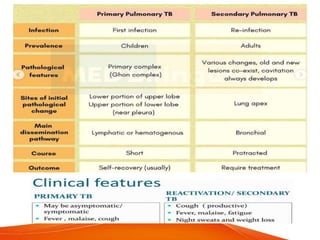
Pathogenesis :
• 1ststep is inhalation of aerosol droplets
• Droplets are deposited in the lungs
• 3 possible outcomes:
– Clearance of bacteria
– Primary active disease
– Latent infection (clinical disease may occur many years later)
Primary active disease:
• Proliferation of bacteria within alveolar macrophages
• Cytokines produced by macrophages attract other phagocytic cells.
• A tubercle (granulomatous structure) forms.
• Tubercle expands into lung parenchyma → Ghon's complex
• Bacteria then can spread to draining lymph nodes → lymphadenopathy
• Ghon's complex + lymphadenopathy/calcification → Ranke complex
• If spread is not controlled by the immune cells, bacteremia with seeding of
other organs may occur → miliary TB
• When bacteria erode into airways (caseating granulomas), the patient
becomes contagious.
• Infection may progress to a chronic stage with episodes of healing and
subsequent scarring of the lesions.
• Spontaneous eradication is rare.
16.
• Latent infection:
•Lifetime risk of reactivation is 5%–10%.
• Immunosuppression is a definite factor in reactivation.
• Risk factors:
– HIV
– Kidney disease
– Diabetes
– Steroids
– Lymphoma
– Advanced age
– Smoking
Diagnosis
1. History
• Travelto endemic areas
• Exposure to individuals with known or suspected active infection
• HIV or other immune deficiencies
• Working in healthcare
• Living in a homeless shelter or correctional institution
2. Physical examination
Findings are often non-specific.
Pulmonary:
Dullness to percussion(effusions)
Crackles on auscultation
Distant hollow breath sounds
Extrapulmonary (depends on organ involvement):
Cervical lymphadenopathy
Hepatomegaly/splenomegaly
Ascites, jaundice
Meningismus, altered mental status
Skin changes (lupus vulgaris)
22.
3. Imaging
Chest X-ray:
•Can be normal in primary TB
• Hilar lymphadenopathy
• Ghon's complex: enlarged hilar lymph nodes+ local shadowing
• Assmann's focus: infraclavicular infiltration
• Pleural effusions
• Reactivation TB:
Simon foci (calcified small scar from primary infection)
Infiltrates in apical segments and upper segments of lower lobes
Cavities with air-fluid levels
Computed tomography (CT) scan:
More sensitive than plain X-ray
Used if chest X-ray is non-specific or alternative diagnosis is considered
24.
4. Laboratory identification
Sputum:
•3 specimens, at least 1 in the early morning
• Acid-fast bacillus(AFB) smear
• Mycobacterial culture [gold standard]
• Nucleic acid amplification (NAA) test
• Blood or urine mycobacterial culture: in HIV or immunocompromised patients
Tuberculin skin test (TST; purified protein derivative (PPD) or Mantoux test):
Intradermal injection of tuberculin antigen
Can detect active or latent infection
Measure induration area in 48–72 hours; positive if:
• > 5 mm in patients with HIV, immunosuppression, or recent contact
with TB
• > 10 mm in patientsfrom high-risk countries, IV drug users, medical
and lab workers
• > 15 mm in patients with no known risk factors for TB
lnterferon-y release assay (IGRA): no distinction between active and inactive TB
25.
Differential Diagnosis:
• Chronicbronchitis ( productive cough for > 3 months in a year for > 2
consecutive years)
• Atypical pneumonia (non-productive, dry cough and extrapulmonary
symptoms such as fatigue, malaise, and headaches)
• Lung mycoses (cough, hemoptysis, dyspnea, fevers, weight loss,
and fatigue)
• Bronchial carcinoma (main airways are affected, Frequently presents with
cough, hemoptysis, and constitutional symptoms. Diagnosis is established
by imaging and biopsy)
• M. avium complex (MAC) infection ( AIDS-defining condition caused by
nontuberculous mycobacteria species which manifests with fever, night
sweats, weight loss, abdominal pain, and diarrhea)
• Granulomatous diseases- sarcoidosis, pneumoconiosis, histoplasmosis
Strategies adopted forCase finding
• Passive case finding
• Intensified case finding
• Active case finding
• Vulnerability mapping
Prevention
• TST screening for individuals at high risk
• Isolation of individuals with active pulmonary infection
• BCG(bacille Calmette-Guérin) vaccine:
A nonvirulent form of M. bovis used as a live vaccine to provide active immunity
against severe forms of TB
Not recommended as a universal vaccine in countries with low TB burden
May be considered for some individuals at high risk of exposure: infants and
adolescents < 16 years of age in a high-incidence country
70%–80% effective against most severe forms of TB (miliary TB,
tuberculous meningitis)
Reduced effect against respiratory TB
No proof of effectiveness in adults > 35
Contraindicated in positive tuberculin reactions, AIDS, or immunosuppression
Vaccine administration will result in a positive TST.
28.
Prognosis
Treatment with anti-mycobacterialdrugs is 85% successful worldwide.
15% mortality rate worldwide.
Complications:
• Pneumothorax
• Bronchial stenosis
• Minor endobronchial disease
• Bronchiectasis
• Lung/ pleural calcification
• COPD
• Cor pulmonale
• Fibrosis/ Emphysema
• Empyema
• Cavitary balls- aspergillomas/ fungus balls- life threatening haemorrhage
• Septic shock- pulmonary TB with HIV co-infection


![Key species:
• M. tuberculosis
• M. bovis
• M. africanum
• M. microti
• M. canetti
Characteristics:
Thin, rod-shaped bacterium measuring about 0.5 micrometers by 3
micrometers.
It does not form spores
Slow growing
Obligate aerobes [requiring oxygen to survive (apex of the lung)]
Acid fast: (high lipid content)
• Property conferred by mycolic acid
• Do not destain by acid alcohol after being stained with aniline dyes](https://image.slidesharecdn.com/tuberculosis-250627094638-97af21df/85/TUBERCULOSIS-power-point-presentation-document-8-320.jpg)


![SOCIAL FACTORS:
Poor quality of life
Poor housing
Overcrowding
Population explosion
Undernutrition
Smoking
Alcohol abuse
Lack of education
Large families
Early marriages
Lack of awareness of causes of illness
MODE OF TRANSMISSION:
Droplet infection and Droplet nuclei generated by sputum
positive patients with pulmonary TB.
INCUBATION PERIOD:
Time from receipt of infection to development of positive tuberculin test : 3-6 weeks
Development of disease depends on:
• Closeness of contact
• Extent of the disease [IP- weeks, months or years]
• Sputum positivity of the source case
• Host- parasite relationship](https://image.slidesharecdn.com/tuberculosis-250627094638-97af21df/85/TUBERCULOSIS-power-point-presentation-document-12-320.jpg)




![4. Laboratory identification
Sputum:
• 3 specimens, at least 1 in the early morning
• Acid-fast bacillus(AFB) smear
• Mycobacterial culture [gold standard]
• Nucleic acid amplification (NAA) test
• Blood or urine mycobacterial culture: in HIV or immunocompromised patients
Tuberculin skin test (TST; purified protein derivative (PPD) or Mantoux test):
Intradermal injection of tuberculin antigen
Can detect active or latent infection
Measure induration area in 48–72 hours; positive if:
• > 5 mm in patients with HIV, immunosuppression, or recent contact
with TB
• > 10 mm in patientsfrom high-risk countries, IV drug users, medical
and lab workers
• > 15 mm in patients with no known risk factors for TB
lnterferon-y release assay (IGRA): no distinction between active and inactive TB](https://image.slidesharecdn.com/tuberculosis-250627094638-97af21df/85/TUBERCULOSIS-power-point-presentation-document-24-320.jpg)


