Downloaded 103 times

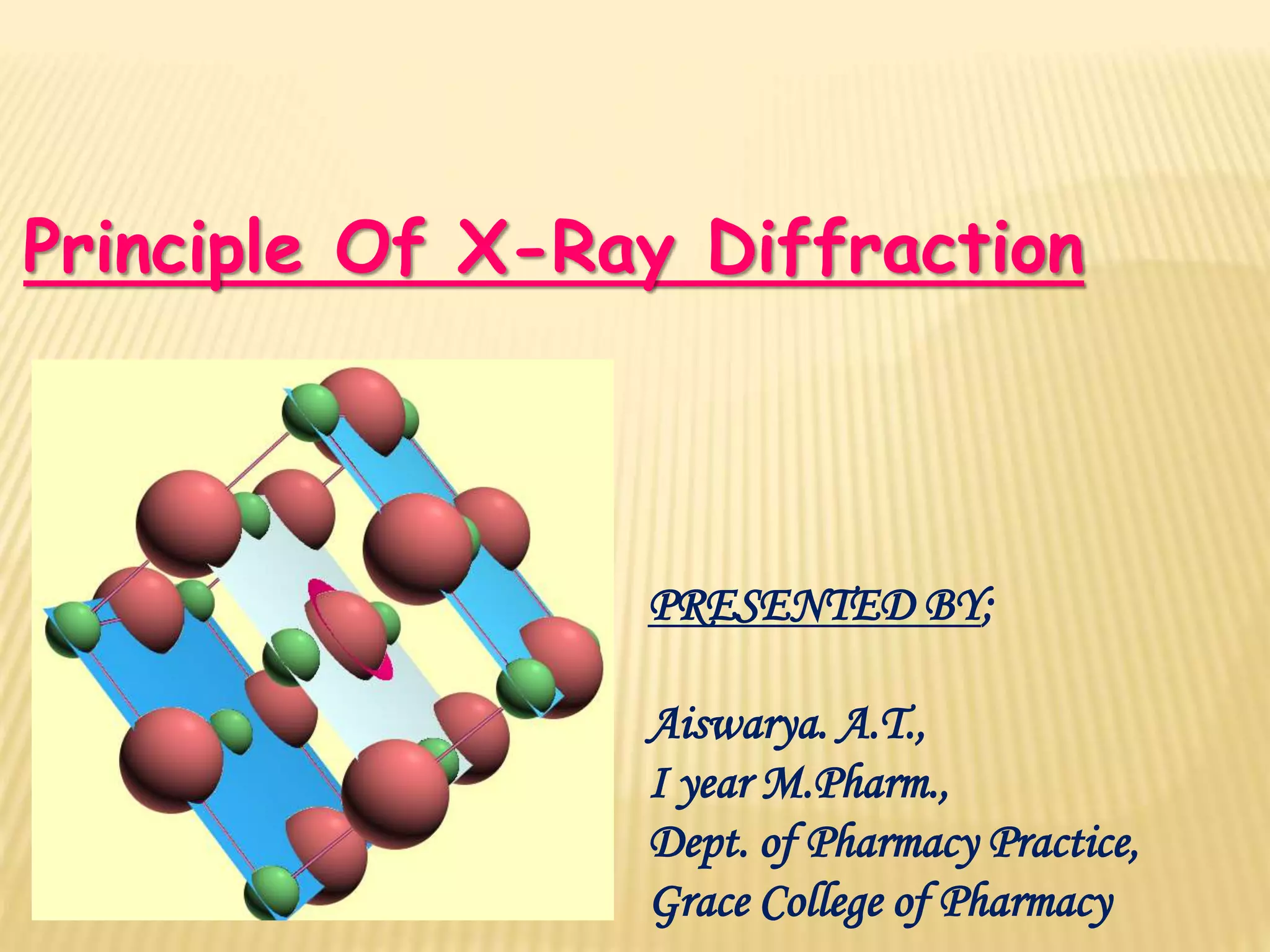
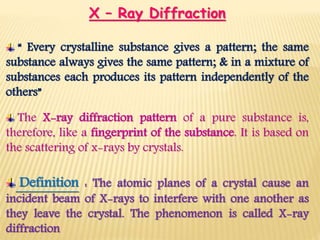
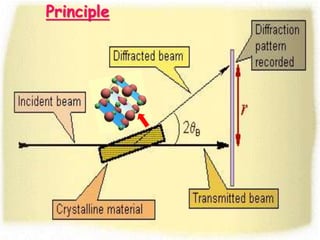
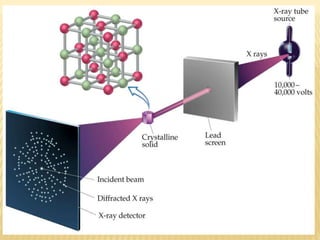
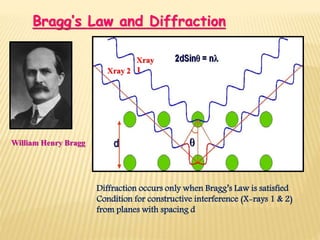
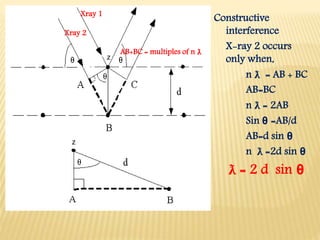
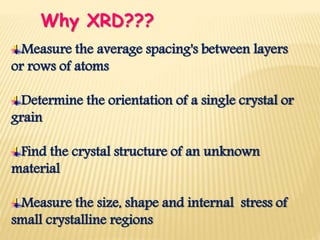


X-ray diffraction patterns provide a unique fingerprint for crystalline substances. When X-rays strike the planes of atoms within a crystal, they cause diffraction according to Bragg's law. Bragg's law states that constructive interference of X-rays occurs when the path length difference between X-rays reflected from successive planes is equal to an integer multiple of the wavelength. This relationship is expressed by the equation nλ = 2d sinθ, where d is the spacing between atomic planes, θ is the incident angle, n is an integer, and λ is the wavelength of electromagnetic radiation. X-ray diffraction analysis can be used to determine properties of crystalline materials such as crystal structure, orientation, and stress.


![FOURIER -TRANSFORM INFRARED SPECTROMETER [FTIR]](https://cdn.slidesharecdn.com/ss_thumbnails/ftir-160604063055-thumbnail.jpg?width=640&height=640&fit=bounds)


![PERI-PROSTHETIC FRACTURE NAIL-PLATE CONSTRUCT [NPC].pptx](https://cdn.slidesharecdn.com/ss_thumbnails/drarunkumardrmohamedashrafperiprostheticfrasturenail-plateconstructnpc-260209164459-7e9d15a1-thumbnail.jpg?width=640&height=640&fit=bounds)


![ONFH[AVN HIP] -TRIPLE REGIME -A NOVAL SURGICAL CONCEPT .pptx](https://cdn.slidesharecdn.com/ss_thumbnails/onfhavnhip2026koaconcalicutdrgokuldevdrmashraf-260210064517-213ec005-thumbnail.jpg?width=640&height=640&fit=bounds)


