PRESENTED BY
Anjali.c
First year m.pharm,
Department of pharmacy practice
Grace college of pharmacy
 Drug use evaluation is an ongoing,
authorized and systematic quality
improvement process, which is designed to:
 Review drug use and or prescribing patterns
 Provide feedback of results to clinicians and
other relevant groups
 Develop criteria and standards
 Promote appropriate drug use
 1. Quantitative DUE
studies
 2. Qualitative DUE
studies
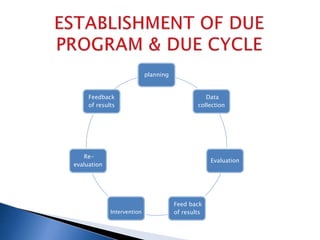
planning
Data
collection
Evaluation
Feed back
of resultsIntervention
Re-
evaluation
Feedback
of results
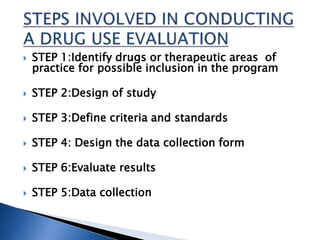
 STEP 1:Identify drugs or therapeutic areas of
practice for possible inclusion in the program
 STEP 2:Design of study
 STEP 3:Define criteria and standards
 STEP 4: Design the data collection form
 STEP 6:Evaluate results
 STEP 5:Data collection
 STEP 6:Evaluate results
 STEP 7:Provide feedback of results
 STEP 8:Develop and implement interventions
 STEP 9:Reevaluate to determine if drug use
has improved
 STEP 10:Reassess and revise the DUE
program
 STEP 11 :Feedback results
Common targets for DUE includes:
 Commonly prescribed drugs
 Drugs associated with potentially significant drug
interactions
 Expensive drugs
 New drugs
 Drugs with narrow therapeutic index
 Drugs that frequently cause serious ADR
 Drugs used in high risk patient
 DUE studies may also be described as
1. prospective,
2. concurrent or retrospective
 ADVANTAGE: The prescribers and others are
unaware of data collection
 DISADVANTAGE: patient do not gain
immediate benefit.
 After the DUE target has been selected ,it is
important to conduct a comprehensive
literature review.
 Criteria
 Standards
 COMMON ASPECTS OF DRUG USE STUDIED IN DUEs
 Patient demographics
 Prescriber details
 Disease severity
 Indication for drug use
 Contraindications
 Side/adverse effects
 Dosing information
 Drug-drug and drug-food
interactions
 Monitoring of drug therapy
 Cost of therapy
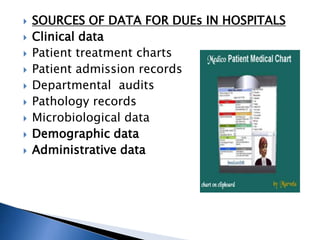
 SOURCES OF DATA FOR DUEs IN HOSPITALS
 Clinical data
 Patient treatment charts
 Patient admission records
 Departmental audits
 Pathology records
 Microbiological data
 Demographic data
 Administrative data
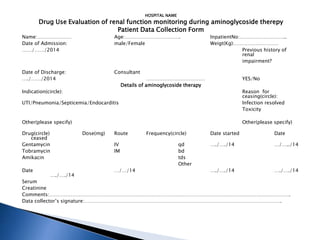
HOSPITAL NAME
Drug Use Evaluation of renal function monitoring during aminoglycoside therepy
Patient Data Collection Form
Name:………………… Age:……………………………. InpatientNo:………………………..
Date of Admission: male/Female Weigt(Kg):………………………
……/……/2014 Previous history of
renal
impairment?
Date of Discharge: Consultant
…./……/2014 ……………………………… YES/No
Details of aminoglycoside therapy
Indication(circle): Reason for
ceasing(circle):
UTI/Pneumonia/Septicemia/Endocarditis Infection resolved
Toxicity
Other(please specify) Other(please specify)
Drug(circle) Dose(mg) Route Frequency(circle) Date started Date
ceased
Gentamycin IV qd …./…./14 …/…../14
Tobramycin IM bd
Amikacin tds
Other
Date …/…/14 …./…./14 …./…./14
…./…./14
Serum
Creatinine
Comments:………………………………………………………………………………………………………………………………….
Data collector’s signature:………………………………………………………………………………………………………….
 Data collectors should be chosen carefully,
and should be familiar with how information
is arranged in the patient’s case notes.
 The data obtained should be collected using
available resources such as spreadsheets
,databases and word processing.
 The reports should be a well –presented and
well –reasoned document ,with no
grammatical or typographical errors
 Educational
 Operational
 The reevaluation is done three to twelve
months after the introduction of the
intervention.
The questions addressed should include:
 Did the program address important aspects
of care?
 Were the criteria developed appropriate?
 Were drug use problems identified?
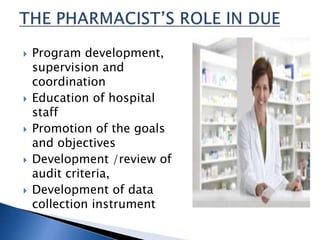
 Program development,
supervision and
coordination
 Education of hospital
staff
 Promotion of the goals
and objectives
 Development /review of
audit criteria,
 Development of data
collection instrument
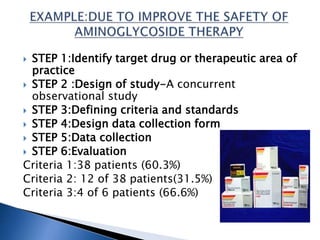
 STEP 1:Identify target drug or therapeutic area of
practice
 STEP 2 :Design of study-A concurrent
observational study
 STEP 3:Defining criteria and standards
 STEP 4:Design data collection form
 STEP 5:Data collection
 STEP 6:Evaluation
Criteria 1:38 patients (60.3%)
Criteria 2: 12 of 38 patients(31.5%)
Criteria 3:4 of 6 patients (66.6%)
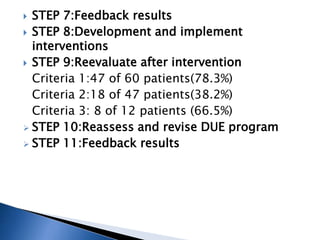
 STEP 7:Feedback results
 STEP 8:Development and implement
interventions
 STEP 9:Reevaluate after intervention
Criteria 1:47 of 60 patients(78.3%)
Criteria 2:18 of 47 patients(38.2%)
Criteria 3: 8 of 12 patients (66.5%)
 STEP 10:Reassess and revise DUE program
 STEP 11:Feedback results
DRUG UTILIZATION EVALUATION

DRUG UTILIZATION EVALUATION

  • 1.
    PRESENTED BY Anjali.c First yearm.pharm, Department of pharmacy practice Grace college of pharmacy
  • 2.
     Drug useevaluation is an ongoing, authorized and systematic quality improvement process, which is designed to:  Review drug use and or prescribing patterns  Provide feedback of results to clinicians and other relevant groups  Develop criteria and standards  Promote appropriate drug use
  • 3.
     1. QuantitativeDUE studies  2. Qualitative DUE studies
  • 4.
  • 5.
     STEP 1:Identifydrugs or therapeutic areas of practice for possible inclusion in the program  STEP 2:Design of study  STEP 3:Define criteria and standards  STEP 4: Design the data collection form  STEP 6:Evaluate results  STEP 5:Data collection
  • 6.
     STEP 6:Evaluateresults  STEP 7:Provide feedback of results  STEP 8:Develop and implement interventions  STEP 9:Reevaluate to determine if drug use has improved  STEP 10:Reassess and revise the DUE program  STEP 11 :Feedback results
  • 7.
    Common targets forDUE includes:  Commonly prescribed drugs  Drugs associated with potentially significant drug interactions  Expensive drugs  New drugs  Drugs with narrow therapeutic index  Drugs that frequently cause serious ADR  Drugs used in high risk patient
  • 8.
     DUE studiesmay also be described as 1. prospective, 2. concurrent or retrospective  ADVANTAGE: The prescribers and others are unaware of data collection  DISADVANTAGE: patient do not gain immediate benefit.
  • 9.
     After theDUE target has been selected ,it is important to conduct a comprehensive literature review.  Criteria  Standards
  • 10.
     COMMON ASPECTSOF DRUG USE STUDIED IN DUEs  Patient demographics  Prescriber details  Disease severity  Indication for drug use  Contraindications  Side/adverse effects  Dosing information  Drug-drug and drug-food interactions  Monitoring of drug therapy  Cost of therapy
  • 11.
     SOURCES OFDATA FOR DUEs IN HOSPITALS  Clinical data  Patient treatment charts  Patient admission records  Departmental audits  Pathology records  Microbiological data  Demographic data  Administrative data
  • 12.
    HOSPITAL NAME Drug UseEvaluation of renal function monitoring during aminoglycoside therepy Patient Data Collection Form Name:………………… Age:……………………………. InpatientNo:……………………….. Date of Admission: male/Female Weigt(Kg):……………………… ……/……/2014 Previous history of renal impairment? Date of Discharge: Consultant …./……/2014 ……………………………… YES/No Details of aminoglycoside therapy Indication(circle): Reason for ceasing(circle): UTI/Pneumonia/Septicemia/Endocarditis Infection resolved Toxicity Other(please specify) Other(please specify) Drug(circle) Dose(mg) Route Frequency(circle) Date started Date ceased Gentamycin IV qd …./…./14 …/…../14 Tobramycin IM bd Amikacin tds Other Date …/…/14 …./…./14 …./…./14 …./…./14 Serum Creatinine Comments:…………………………………………………………………………………………………………………………………. Data collector’s signature:………………………………………………………………………………………………………….
  • 13.
     Data collectorsshould be chosen carefully, and should be familiar with how information is arranged in the patient’s case notes.  The data obtained should be collected using available resources such as spreadsheets ,databases and word processing.
  • 14.
     The reportsshould be a well –presented and well –reasoned document ,with no grammatical or typographical errors  Educational  Operational
  • 15.
     The reevaluationis done three to twelve months after the introduction of the intervention. The questions addressed should include:  Did the program address important aspects of care?  Were the criteria developed appropriate?  Were drug use problems identified?
  • 16.
     Program development, supervisionand coordination  Education of hospital staff  Promotion of the goals and objectives  Development /review of audit criteria,  Development of data collection instrument
  • 17.
     STEP 1:Identifytarget drug or therapeutic area of practice  STEP 2 :Design of study-A concurrent observational study  STEP 3:Defining criteria and standards  STEP 4:Design data collection form  STEP 5:Data collection  STEP 6:Evaluation Criteria 1:38 patients (60.3%) Criteria 2: 12 of 38 patients(31.5%) Criteria 3:4 of 6 patients (66.6%)
  • 18.
     STEP 7:Feedbackresults  STEP 8:Development and implement interventions  STEP 9:Reevaluate after intervention Criteria 1:47 of 60 patients(78.3%) Criteria 2:18 of 47 patients(38.2%) Criteria 3: 8 of 12 patients (66.5%)  STEP 10:Reassess and revise DUE program  STEP 11:Feedback results