Optical Rotatory Dispersion &
Circular Dichorism
CONTENT
 ORD
 PRINCIPLE
 FUNDAMENTAL OF ORD
 CD
 COTTON EFFECT
 ORD CURVES
 APPLICATION
 DIFFERENCE B/W ORD & CD
 CONCLUSION
ORD
• ORD is technique related to the optical activity
• Rate of change of specific rotation with change in wave length
• Optical rotation caused by compound changed with wavelength of
light was first denoted by Biot in 1817
FUNDAMENTAL OF ORD
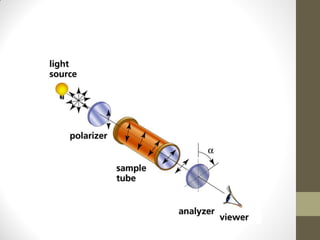
• Plane polarized light
• Optical activity
• Specific rotation
• Circular birefringence
• Optical rotation
• Elliphicity
Plane polarized light
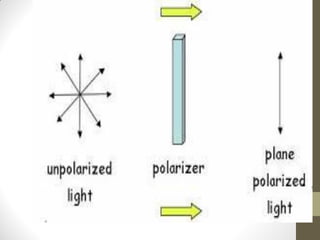
• Light from ordinary lamp consists of waves vibrating in many
different planes
• It is passed through Polaroid lens it is found to be vibrate in
one plane is said to be plane polarized light
OPTICAL ACTIVITY
• The compounds which are having the ability to rotate the
plane of polarized light are called optical active compound
• This property of compounds is called optical activity
• Measured by Polarimeter
• Dextrorotatory
• Levorotatory
SPECIFIC ROTATION
• The specific rotation ([α]) is an intensive property of
a chemical compound, defined as the change in orientation of
the plane of linearly polarized light as this light passes through
a sample with a path length of 1 decimeter and a sample
concentration of 1 gram per 1 millilitre
• It is denoted by [α]
CIRCULAR BIREFRINGENCE
• Birefringence is the optical property of a material having
a refractive index that depends on the polarization and
propagation direction of light
• α= (nL-nR)π/ α
CIRCULAR DICHORISM
Some material posses special properties of absorption of the light
circularly light to different extent than the right circulary
polarized light
Chiral or asymmetric compounds produce CD spectrum
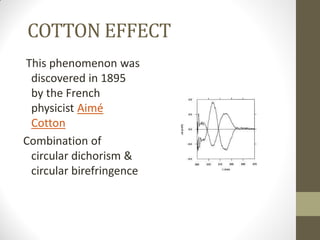
COTTON EFFECT
This phenomenon was
discovered in 1895
by the French
physicist Aimé
Cotton
Combination of
circular dichorism &
circular birefringence
ORD CURVES
• Plain curves
• Anomalous curves
• single cotton effect curves
• multiple cotton effect curve
PLAIN CURVES
• Normal smooth curves
• Do not cross the zero rotation line
• e.g.:- alcohols hydrocarbons
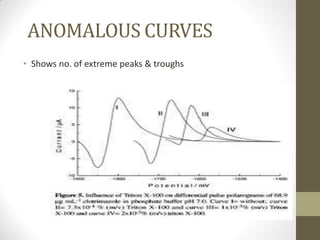
ANOMALOUS CURVES
• Shows no. of extreme peaks & troughs
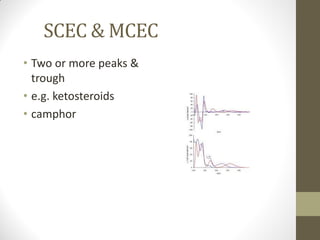
SCEC & MCEC
• Two or more peaks &
trough
• e.g. ketosteroids
• camphor
APPLICATION
• CD/ORD of protein
• Qualitative analysis of molecules
• Enzyme co-factor evaluation
• CD/ORD of proteins
• CD as finger printing
• CD/ORD of nucleic acids
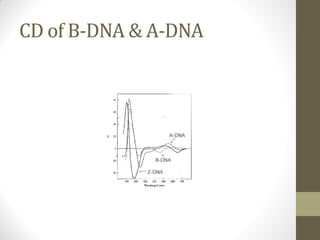
• CD of B-DNA is different as compared to A-DNA
• Evidence for base stacking
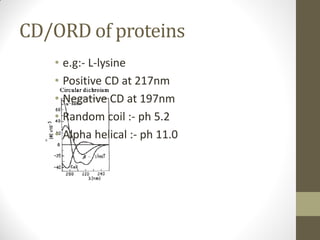
CD/ORD of proteins
• e.g:- L-lysine
• Positive CD at 217nm
• Negative CD at 197nm
• Random coil :- ph 5.2
• Alpha helical :- ph 11.0
QUALITATIVE ANALYSIS
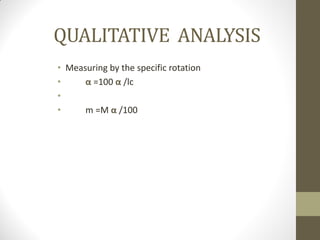
• Measuring by the specific rotation
• α =100 α /lc
•
• m =M α /100
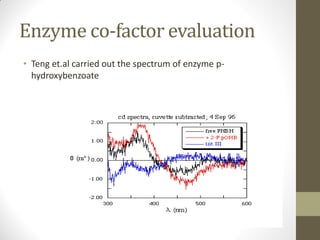
Enzyme co-factor evaluation
• Teng et.al carried out the spectrum of enzyme p-
hydroxybenzoate
CD as finger printing
• It acts as finger printing technique for trace amount of
carbohydrate meterial
• E.g. dermatan sulphate
• heparitin sulphate
• E.g :- pectin in the presence of citric acid& sucrose
CD of B-DNA & A-DNA
BASE STACKING
• ORD spectrum of Polycytidylic acid shows at 292nm is
35,160deg/M/cm
• HELICITY DETERMINED BY
• Formaldehyde
• Ethylene glycol
DIFFERENCE B/W ORD & CD
ORD CD
PLANE POLARIZED LIGHT
DISPERSIVE PHENOMENA
PLANE POLARIZED IS USED & IS NOT
CONVERTED TO ELLIPTICAL LUGHT
GRAPHS ARE OBTAINED BY SPECIFIC
ROTATION V/S WAVELENGTH
CIRCULARLY POLARIZED LUGHT
ABSORPTIVE PHENOMENA
CIRCULAR POLARIZED LIGHT IS USED
& IS CONVERTED TO ELLIPICITY
GRAPHS ARE OBTAINED MOLAR
ELLIPICITY V/S WAVE LENGTH
INSTRUMENTATION OF ORD
• Light source
• Monochromator
• Polarizer
• Analyzer
• Sample tube
• photomultiplier
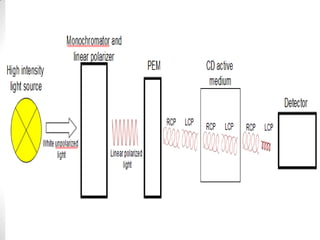
INSTRUMENTATION OF CD
• Light source
• Polarizer
• Sample tube
• Photomultiplier
• Recorder
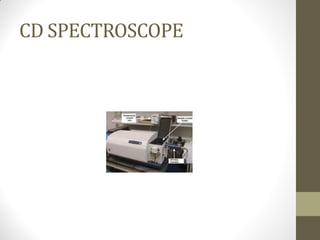
CD SPECTROSCOPE
CD/ORD
 Simple and quick experiments
 No extensive preparation
 Relatively low concentrations/amounts of sample
 Microsecond time resolution
 Any size of macromolecule
 Better resolution
 Better sensitivity
 Easier to assign
REFERENCE
 WWW. Science direct.com
 WWW.notes .com
 Principles & techniques by Avinash Upadhyay
 WWW.scribd.com
 THANK YOU

OPTICAL ROTATORY DISPERSION & CIRCULAR DICHORISM(ORD CD)

  • 1.
    Optical Rotatory Dispersion& Circular Dichorism
  • 2.
    CONTENT  ORD  PRINCIPLE FUNDAMENTAL OF ORD  CD  COTTON EFFECT  ORD CURVES  APPLICATION  DIFFERENCE B/W ORD & CD  CONCLUSION
  • 3.
    ORD • ORD istechnique related to the optical activity • Rate of change of specific rotation with change in wave length • Optical rotation caused by compound changed with wavelength of light was first denoted by Biot in 1817
  • 4.
    FUNDAMENTAL OF ORD •Plane polarized light • Optical activity • Specific rotation • Circular birefringence • Optical rotation • Elliphicity
  • 5.
    Plane polarized light •Light from ordinary lamp consists of waves vibrating in many different planes • It is passed through Polaroid lens it is found to be vibrate in one plane is said to be plane polarized light
  • 7.
    OPTICAL ACTIVITY • Thecompounds which are having the ability to rotate the plane of polarized light are called optical active compound • This property of compounds is called optical activity • Measured by Polarimeter • Dextrorotatory • Levorotatory
  • 9.
    SPECIFIC ROTATION • Thespecific rotation ([α]) is an intensive property of a chemical compound, defined as the change in orientation of the plane of linearly polarized light as this light passes through a sample with a path length of 1 decimeter and a sample concentration of 1 gram per 1 millilitre • It is denoted by [α]
  • 10.
    CIRCULAR BIREFRINGENCE • Birefringenceis the optical property of a material having a refractive index that depends on the polarization and propagation direction of light • α= (nL-nR)π/ α
  • 11.
    CIRCULAR DICHORISM Some materialposses special properties of absorption of the light circularly light to different extent than the right circulary polarized light Chiral or asymmetric compounds produce CD spectrum
  • 12.
    COTTON EFFECT This phenomenonwas discovered in 1895 by the French physicist Aimé Cotton Combination of circular dichorism & circular birefringence
  • 13.
    ORD CURVES • Plaincurves • Anomalous curves • single cotton effect curves • multiple cotton effect curve
  • 14.
    PLAIN CURVES • Normalsmooth curves • Do not cross the zero rotation line • e.g.:- alcohols hydrocarbons
  • 15.
    ANOMALOUS CURVES • Showsno. of extreme peaks & troughs
  • 16.
    SCEC & MCEC •Two or more peaks & trough • e.g. ketosteroids • camphor
  • 17.
    APPLICATION • CD/ORD ofprotein • Qualitative analysis of molecules • Enzyme co-factor evaluation • CD/ORD of proteins • CD as finger printing • CD/ORD of nucleic acids • CD of B-DNA is different as compared to A-DNA • Evidence for base stacking
  • 18.
    CD/ORD of proteins •e.g:- L-lysine • Positive CD at 217nm • Negative CD at 197nm • Random coil :- ph 5.2 • Alpha helical :- ph 11.0
  • 19.
    QUALITATIVE ANALYSIS • Measuringby the specific rotation • α =100 α /lc • • m =M α /100
  • 20.
    Enzyme co-factor evaluation •Teng et.al carried out the spectrum of enzyme p- hydroxybenzoate
  • 21.
    CD as fingerprinting • It acts as finger printing technique for trace amount of carbohydrate meterial • E.g. dermatan sulphate • heparitin sulphate • E.g :- pectin in the presence of citric acid& sucrose
  • 22.
    CD of B-DNA& A-DNA
  • 23.
    BASE STACKING • ORDspectrum of Polycytidylic acid shows at 292nm is 35,160deg/M/cm • HELICITY DETERMINED BY • Formaldehyde • Ethylene glycol
  • 24.
    DIFFERENCE B/W ORD& CD ORD CD PLANE POLARIZED LIGHT DISPERSIVE PHENOMENA PLANE POLARIZED IS USED & IS NOT CONVERTED TO ELLIPTICAL LUGHT GRAPHS ARE OBTAINED BY SPECIFIC ROTATION V/S WAVELENGTH CIRCULARLY POLARIZED LUGHT ABSORPTIVE PHENOMENA CIRCULAR POLARIZED LIGHT IS USED & IS CONVERTED TO ELLIPICITY GRAPHS ARE OBTAINED MOLAR ELLIPICITY V/S WAVE LENGTH
  • 25.
    INSTRUMENTATION OF ORD •Light source • Monochromator • Polarizer • Analyzer • Sample tube • photomultiplier
  • 26.
    INSTRUMENTATION OF CD •Light source • Polarizer • Sample tube • Photomultiplier • Recorder
  • 27.
  • 29.
    CD/ORD  Simple andquick experiments  No extensive preparation  Relatively low concentrations/amounts of sample  Microsecond time resolution  Any size of macromolecule  Better resolution  Better sensitivity  Easier to assign
  • 30.
    REFERENCE  WWW. Sciencedirect.com  WWW.notes .com  Principles & techniques by Avinash Upadhyay  WWW.scribd.com
  • 31.