1
x-ray diffraction
By
KAUSHAL KUMAR SAHU
Assistant Professor (Ad Hoc)
Department of Biotechnology
Govt. Digvijay Autonomous P. G. College
Raj-Nandgaon ( C. G. )
SYNOPSIS
Introduction
Definition
History
Principle
Instrumentation
Methods
Applications
Advantages
Limitation
Conclusion
References
2
INTRODUCTION
X-ray diffraction (XRD) is one of the most important non-destructive
tools to analyze all kinds of matter—ranging from fluids, to powders and
crystals. From research to production and engineering, XRD is an
indispensable method for materials characterization and quality control.
X-ray diffraction techniques are used for the identification of crystalline
phases of various materials and the quantitative phase analysis subsequent
to the identification.
X-ray diffraction techniques are superior in elucidating the three-
dimensional atomic structure of crystalline solids.
3
DEFINITION
The atomic plans of a crystal cause an incident beam of x-rays to
interfere with one another as they leave the crystal.
The phenomenon is called x-ray diffraction.
4
HISTORY
X-ray were discovered in 1895 by the German physicist Wilhelm Conrad Rontgen
and were so named because their nature was unknown at the time.
He was awarded the Nobel Prize for physics in 1901.
1912: Max Theordor Felix von Laue (1879-1960) (U of Munich) thought that X-ray
has a wavelength similar to interatomic distances in crystals and the crystal should act
like a 3D diffraction grating.
Along with Walter Friedrich (research assistant) and Paul Knipping (PhD grad
student), he did the first diffraction experiment on CuSO4 crystal – Nobel Prize in
Physics.
5
PRINCIPLE
X-ray diffraction is based on constructive interference of
monochromatic x-rays and a crystalline sample.
These x-rays are generated by a cathode ray tube, filtered to
produce monochromatic radiation, collimated to concentrate and
directed towards the sample.
The interaction of incident rays with the sample produces
constructive interference when conditions satisfy Bragg’s law.
6
BRAGG’S LAW
In physics, Bragg's law, or Wulff–Bragg's condition, a special case of Laue diffraction, gives the
angles for coherent and incoherent scattering from a crystal lattice.
When X-rays are incident on an atom, they make the electronic cloud move as does
any electromagnetic wave. The movement of these charges re-radiates waves with the
same frequency, blurred slightly due to a variety of effects; this phenomenon is known As Rayleigh
scattering (or elastic scattering).
These re-emitted wave fields interfere with each other either constructively or destructively
(overlapping waves either add up together to produce stronger peaks or are subtracted from each
other to some degree), producing a diffraction pattern on a detector or film.
The resulting wave interference pattern is the basis of diffraction analysis. This analysis is
called Bragg diffraction.
7
BRAGG’S EQUATION
nΛ = 2d sinΘ
where,
Λ = the wavelength of the x-ray
d = the spacing of the crystal layers
(path difference)
θ = the incident angle (the angle
between incident ray and the scatter
plane)
n = an integer
8
production of x- rays
collimator
Monochromator
Filter
Crystal monochromator
Detectors
Photographic methods
Counter methods
INSTRUMENTATION
9
PRODUCTION OF X- RAYS
10
COLLIMATOR
11
MONOCHROMATORS
In order to do monochromatization 2 methods are available:-
Filter
Crystal monochromator
Flat crystal monochromator
Curved crystal monochromator
12
The x-ray intensities can be measured and recorded either by
Photographic methods
Counter methods
 Geiger – Muller tube counter
 Proportional counters
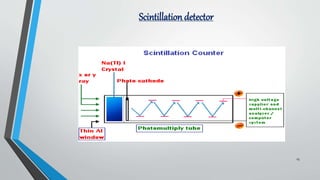
 Scintillation detector
 Solid state semiconductor detector
 Semi-conductor detectors
DETECTORS
13
Geiger – Muller tube counter
14
Scintillation detector
15
Semi –conductor detectors
16
17
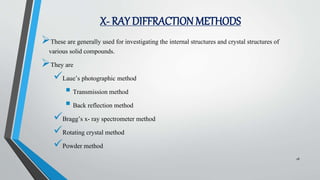
X- RAY DIFFRACTION METHODS
These are generally used for investigating the internal structures and crystal structures of
various solid compounds.
They are
Laue’s photographic method
 Transmission method
 Back reflection method
Bragg’s x- ray spectrometer method
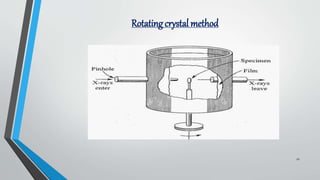
Rotating crystal method
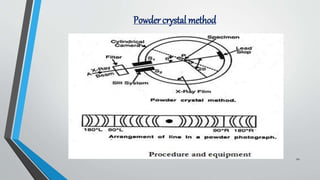
Powder method
18
Transmission Laue method
19
Bragg’s x-ray spectrometer method
20
Rotating crystal method
21
Powder crystal method
22
APPLICATION
Structure of crystal
Polymer characterization
State of anneal in metals
Particle size determination
23
ADVANTAGE
It is a powerful and rapid technique.
Less sample required.
Unknown determination.
24
LIMITATION
XRD also has size limitations.
It is much more accurate for measuring large crystalline
structures rather than small ones.
25
CONCLUSION
For materials including metals, minerals, plastics,
pharmaceuticals and semiconductors XRD apparatus provide
highly accurate tools for non-destructive analysis.
The diffraction systems are also supported by an extensive
range of application software.
26
REFERENCES
http://serc.carleton.edu>techniques
https://www.omicsonline.org.>open
http://www.rigaku.com>techniques
27

X ray diffraction by kk sahu

  • 1.
    1 x-ray diffraction By KAUSHAL KUMARSAHU Assistant Professor (Ad Hoc) Department of Biotechnology Govt. Digvijay Autonomous P. G. College Raj-Nandgaon ( C. G. )
  • 2.
  • 3.
    INTRODUCTION X-ray diffraction (XRD)is one of the most important non-destructive tools to analyze all kinds of matter—ranging from fluids, to powders and crystals. From research to production and engineering, XRD is an indispensable method for materials characterization and quality control. X-ray diffraction techniques are used for the identification of crystalline phases of various materials and the quantitative phase analysis subsequent to the identification. X-ray diffraction techniques are superior in elucidating the three- dimensional atomic structure of crystalline solids. 3
  • 4.
    DEFINITION The atomic plansof a crystal cause an incident beam of x-rays to interfere with one another as they leave the crystal. The phenomenon is called x-ray diffraction. 4
  • 5.
    HISTORY X-ray were discoveredin 1895 by the German physicist Wilhelm Conrad Rontgen and were so named because their nature was unknown at the time. He was awarded the Nobel Prize for physics in 1901. 1912: Max Theordor Felix von Laue (1879-1960) (U of Munich) thought that X-ray has a wavelength similar to interatomic distances in crystals and the crystal should act like a 3D diffraction grating. Along with Walter Friedrich (research assistant) and Paul Knipping (PhD grad student), he did the first diffraction experiment on CuSO4 crystal – Nobel Prize in Physics. 5
  • 6.
    PRINCIPLE X-ray diffraction isbased on constructive interference of monochromatic x-rays and a crystalline sample. These x-rays are generated by a cathode ray tube, filtered to produce monochromatic radiation, collimated to concentrate and directed towards the sample. The interaction of incident rays with the sample produces constructive interference when conditions satisfy Bragg’s law. 6
  • 7.
    BRAGG’S LAW In physics,Bragg's law, or Wulff–Bragg's condition, a special case of Laue diffraction, gives the angles for coherent and incoherent scattering from a crystal lattice. When X-rays are incident on an atom, they make the electronic cloud move as does any electromagnetic wave. The movement of these charges re-radiates waves with the same frequency, blurred slightly due to a variety of effects; this phenomenon is known As Rayleigh scattering (or elastic scattering). These re-emitted wave fields interfere with each other either constructively or destructively (overlapping waves either add up together to produce stronger peaks or are subtracted from each other to some degree), producing a diffraction pattern on a detector or film. The resulting wave interference pattern is the basis of diffraction analysis. This analysis is called Bragg diffraction. 7
  • 8.
    BRAGG’S EQUATION nΛ =2d sinΘ where, Λ = the wavelength of the x-ray d = the spacing of the crystal layers (path difference) θ = the incident angle (the angle between incident ray and the scatter plane) n = an integer 8
  • 9.
    production of x-rays collimator Monochromator Filter Crystal monochromator Detectors Photographic methods Counter methods INSTRUMENTATION 9
  • 10.
  • 11.
  • 12.
    MONOCHROMATORS In order todo monochromatization 2 methods are available:- Filter Crystal monochromator Flat crystal monochromator Curved crystal monochromator 12
  • 13.
    The x-ray intensitiescan be measured and recorded either by Photographic methods Counter methods  Geiger – Muller tube counter  Proportional counters  Scintillation detector  Solid state semiconductor detector  Semi-conductor detectors DETECTORS 13
  • 14.
    Geiger – Mullertube counter 14
  • 15.
  • 16.
  • 17.
  • 18.
    X- RAY DIFFRACTIONMETHODS These are generally used for investigating the internal structures and crystal structures of various solid compounds. They are Laue’s photographic method  Transmission method  Back reflection method Bragg’s x- ray spectrometer method Rotating crystal method Powder method 18
  • 19.
  • 20.
  • 21.
  • 22.
  • 23.
    APPLICATION Structure of crystal Polymercharacterization State of anneal in metals Particle size determination 23
  • 24.
    ADVANTAGE It is apowerful and rapid technique. Less sample required. Unknown determination. 24
  • 25.
    LIMITATION XRD also hassize limitations. It is much more accurate for measuring large crystalline structures rather than small ones. 25
  • 26.
    CONCLUSION For materials includingmetals, minerals, plastics, pharmaceuticals and semiconductors XRD apparatus provide highly accurate tools for non-destructive analysis. The diffraction systems are also supported by an extensive range of application software. 26
  • 27.