1
2
3
4
5
Recycling of Iron from Alumina’s
tailing
Make Toxic Red Mud environment
friendly
To make the Tailing Profitable
6
7
WHAT IS RED MUD ?
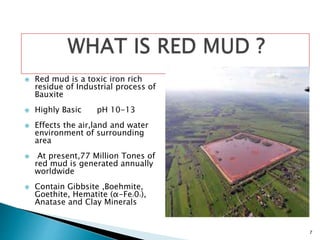
 Red mud is a toxic iron rich
residue of Industrial process of
Bauxite
 Highly Basic pH 10-13
 Effects the air,land and water
environment of surrounding
area
 At present,77 Million Tones of
red mud is generated annually
worldwide
 Contain Gibbsite ,Boehmite,
Goethite, Hematite (α-Fe203),
Anatase and Clay Minerals
8
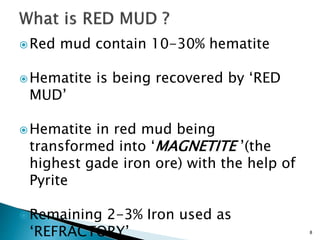
Red mud contain 10-30% hematite
Hematite is being recovered by ‘RED
MUD’
Hematite in red mud being
transformed into ‘MAGNETITE ’(the
highest gade iron ore) with the help of
Pyrite
Remaining 2-3% Iron used as
‘REFRACTORY’
9
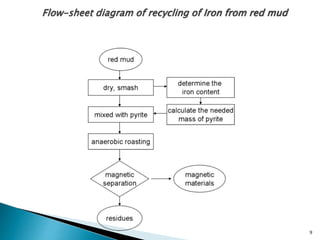
Flow-sheet diagram of recycling of Iron from red mud
10
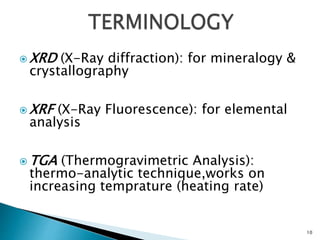
 XRD (X-Ray diffraction): for mineralogy &
crystallography
 XRF (X-Ray Fluorescence): for elemental
analysis
 TGA (Thermogravimetric Analysis):
thermo-analytic technique,works on
increasing temprature (heating rate)
TERMINOLOGY
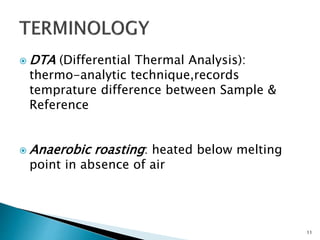
 DTA (Differential Thermal Analysis):
thermo-analytic technique,records
temprature difference between Sample &
Reference
 Anaerobic roasting: heated below melting
point in absence of air
11
12
13
 Red mud samples dried at 110 ◦ C for 4 h
before testing
 30 g of red mud contain the mole ratio of FeS2
to Fe2 O3 was 1:4 or 1:8 roasted at 600 ◦ C for
30 min under N2 atmosphere.
 The thermogravimetric analysis (TG) and
differential thermal analysis (DTA) of the
samples were performed on a thermal
analyzer
14
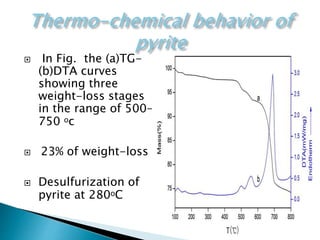
 In Fig. the (a)TG-
(b)DTA curves
showing three
weight-loss stages
in the range of 500–
750 ᵒc
 23% of weight-loss
 Desulfurization of
pyrite at 280ᵒC
15
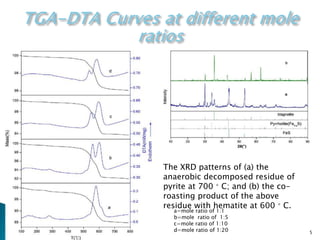
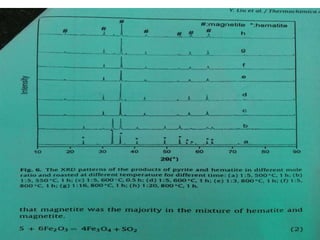
The XRD patterns of (a) the
anaerobic decomposed residue of
pyrite at 700 ◦ C; and (b) the co-
roasting product of the above
residue with hematite at 600 ◦ C.
a=mole ratio of 1:1
b=mole ratio of 1:5
c=mole ratio of 1:10
d=mole ratio of 1:20
16
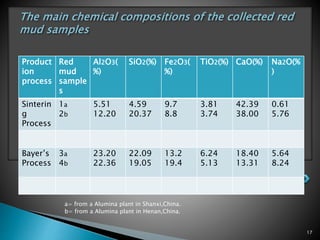
a= from a Alumina plant in Shanxi,China.
b= from a Alumina plant in Henan,China.
17
Product
ion
process
Red
mud
sample
s
Al2O3(
%)
SiO2(%) Fe2O3(
%)
TiO2(%) CaO(%) Na2O(%
)
Sinterin
g
Process
1a
2b
5.51
12.20
4.59
20.37
9.7
8.8
3.81
3.74
42.39
38.00
0.61
5.76
Bayer’s
Process
3a
4b
23.20
22.36
22.09
19.05
13.2
19.4
6.24
5.13
18.40
13.31
5.64
8.24
18
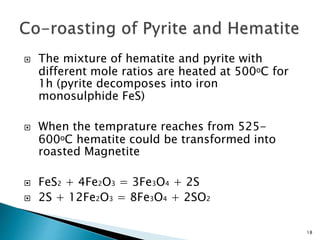
 The mixture of hematite and pyrite with
different mole ratios are heated at 500ᵒC for
1h (pyrite decomposes into iron
monosulphide FeS)
 When the temprature reaches from 525-
600ᵒC hematite could be transformed into
roasted Magnetite
 FeS2 + 4Fe2O3 = 3Fe3O4 + 2S
 2S + 12Fe2O3 = 8Fe3O4 + 2SO2
19
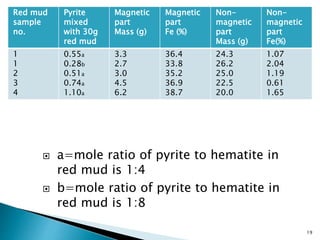
 a=mole ratio of pyrite to hematite in
red mud is 1:4
 b=mole ratio of pyrite to hematite in
red mud is 1:8
Red mud
sample
no.
Pyrite
mixed
with 30g
red mud
Magnetic
part
Mass (g)
Magnetic
part
Fe (%)
Non-
magnetic
part
Mass (g)
Non-
magnetic
part
Fe(%)
1
1
2
3
4
0.55a
0.28b
0.51a
0.74a
1.10a
3.3
2.7
3.0
4.5
6.2
36.4
33.8
35.2
36.9
38.7
24.3
26.2
25.0
22.5
20.0
1.07
2.04
1.19
0.61
1.65
20
21
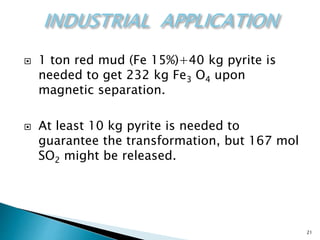
 1 ton red mud (Fe 15%)+40 kg pyrite is
needed to get 232 kg Fe3 O4 upon
magnetic separation.
 At least 10 kg pyrite is needed to
guarantee the transformation, but 167 mol
SO2 might be released.
22
23
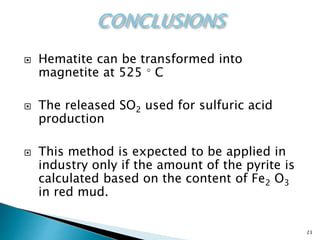
 Hematite can be transformed into
magnetite at 525 ◦ C
 The released SO2 used for sulfuric acid
production
 This method is expected to be applied in
industry only if the amount of the pyrite is
calculated based on the content of Fe2 O3
in red mud.
24

MINERAL PROCESSING (2)

  • 1.
  • 2.
  • 3.
  • 4.
  • 5.
    5 Recycling of Ironfrom Alumina’s tailing Make Toxic Red Mud environment friendly To make the Tailing Profitable
  • 6.
  • 7.
    7 WHAT IS REDMUD ?  Red mud is a toxic iron rich residue of Industrial process of Bauxite  Highly Basic pH 10-13  Effects the air,land and water environment of surrounding area  At present,77 Million Tones of red mud is generated annually worldwide  Contain Gibbsite ,Boehmite, Goethite, Hematite (α-Fe203), Anatase and Clay Minerals
  • 8.
    8 Red mud contain10-30% hematite Hematite is being recovered by ‘RED MUD’ Hematite in red mud being transformed into ‘MAGNETITE ’(the highest gade iron ore) with the help of Pyrite Remaining 2-3% Iron used as ‘REFRACTORY’
  • 9.
    9 Flow-sheet diagram ofrecycling of Iron from red mud
  • 10.
    10  XRD (X-Raydiffraction): for mineralogy & crystallography  XRF (X-Ray Fluorescence): for elemental analysis  TGA (Thermogravimetric Analysis): thermo-analytic technique,works on increasing temprature (heating rate) TERMINOLOGY
  • 11.
     DTA (DifferentialThermal Analysis): thermo-analytic technique,records temprature difference between Sample & Reference  Anaerobic roasting: heated below melting point in absence of air 11
  • 12.
  • 13.
    13  Red mudsamples dried at 110 ◦ C for 4 h before testing  30 g of red mud contain the mole ratio of FeS2 to Fe2 O3 was 1:4 or 1:8 roasted at 600 ◦ C for 30 min under N2 atmosphere.  The thermogravimetric analysis (TG) and differential thermal analysis (DTA) of the samples were performed on a thermal analyzer
  • 14.
    14  In Fig.the (a)TG- (b)DTA curves showing three weight-loss stages in the range of 500– 750 ᵒc  23% of weight-loss  Desulfurization of pyrite at 280ᵒC
  • 15.
    15 The XRD patternsof (a) the anaerobic decomposed residue of pyrite at 700 ◦ C; and (b) the co- roasting product of the above residue with hematite at 600 ◦ C. a=mole ratio of 1:1 b=mole ratio of 1:5 c=mole ratio of 1:10 d=mole ratio of 1:20
  • 16.
  • 17.
    a= from aAlumina plant in Shanxi,China. b= from a Alumina plant in Henan,China. 17 Product ion process Red mud sample s Al2O3( %) SiO2(%) Fe2O3( %) TiO2(%) CaO(%) Na2O(% ) Sinterin g Process 1a 2b 5.51 12.20 4.59 20.37 9.7 8.8 3.81 3.74 42.39 38.00 0.61 5.76 Bayer’s Process 3a 4b 23.20 22.36 22.09 19.05 13.2 19.4 6.24 5.13 18.40 13.31 5.64 8.24
  • 18.
    18  The mixtureof hematite and pyrite with different mole ratios are heated at 500ᵒC for 1h (pyrite decomposes into iron monosulphide FeS)  When the temprature reaches from 525- 600ᵒC hematite could be transformed into roasted Magnetite  FeS2 + 4Fe2O3 = 3Fe3O4 + 2S  2S + 12Fe2O3 = 8Fe3O4 + 2SO2
  • 19.
    19  a=mole ratioof pyrite to hematite in red mud is 1:4  b=mole ratio of pyrite to hematite in red mud is 1:8 Red mud sample no. Pyrite mixed with 30g red mud Magnetic part Mass (g) Magnetic part Fe (%) Non- magnetic part Mass (g) Non- magnetic part Fe(%) 1 1 2 3 4 0.55a 0.28b 0.51a 0.74a 1.10a 3.3 2.7 3.0 4.5 6.2 36.4 33.8 35.2 36.9 38.7 24.3 26.2 25.0 22.5 20.0 1.07 2.04 1.19 0.61 1.65
  • 20.
  • 21.
    21  1 tonred mud (Fe 15%)+40 kg pyrite is needed to get 232 kg Fe3 O4 upon magnetic separation.  At least 10 kg pyrite is needed to guarantee the transformation, but 167 mol SO2 might be released.
  • 22.
  • 23.
    23  Hematite canbe transformed into magnetite at 525 ◦ C  The released SO2 used for sulfuric acid production  This method is expected to be applied in industry only if the amount of the pyrite is calculated based on the content of Fe2 O3 in red mud.
  • 24.

Editor's Notes

  • #15 (a)TGA curve (b)DTA curve