S.RAM PRAKASH
18UT38
 Characterization refers to study of materials
features such as its composition, structure,
and various properties like physical,
electrical, magnetic, etc.
 Important characterization of nanoparticles -
Nanoparticle properties vary significantly with
size and shape. - Accurate measurement of
nanoparticles size and shape is, therefore,
critical to its applications.
Microscopy
1- Scanning Electronic Microscopy SEM
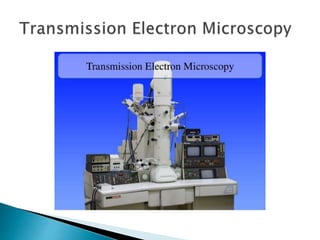
2- Transmission Electron Microscopy TEM
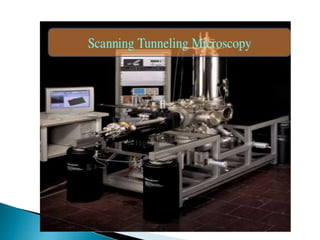
3- Scanning Tunneling Microscopy STM
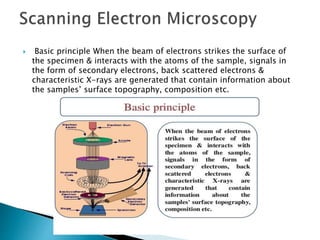
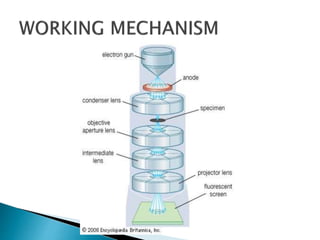
 Basic principle When the beam of electrons strikes the surface of
the specimen & interacts with the atoms of the sample, signals in
the form of secondary electrons, back scattered electrons &
characteristic X-rays are generated that contain information about
the samples’ surface topography, composition etc.
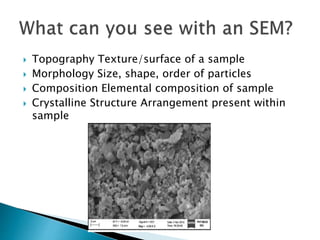
 Topography Texture/surface of a sample
 Morphology Size, shape, order of particles
 Composition Elemental composition of sample
 Crystalline Structure Arrangement present within
sample
 Operation modes. There are 3 modes
 -Primary: High resolution (1-5 nm);
 secondary electron imaging -Secondary:
 Characteristic X-rays; identification of elemental composition
of sample by EDX technique-Tertiary:
 Back-scattered electronic images; clues to the elemental
composition of sample
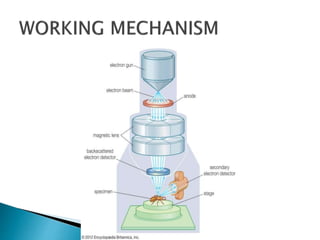
 In a typical SEM, the beam passes through pairs of scanning
coils or pairs of deflector plates in the electron column to the
final lens, which deflect the beam horizontally & vertically.
The image displayed is therefore a distribution map of the
intensity of the signal being emitted from the scanned area of
the specimen.
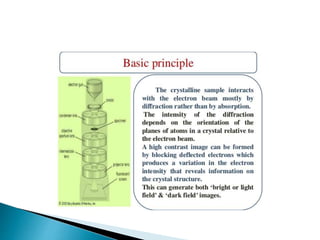
 Morphology
 Shape, size, order of particles in sample -
Crystalline Structure
 Arrangement of atoms in the sample
 Defects in crystalline structure -Composition
 Elemental composition of the sample.
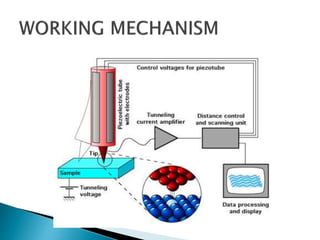
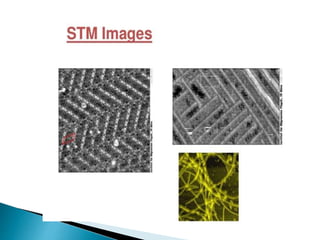
 It is based on the concept of quantum tunneling.
When a conducting tip is brought very near to a
metallic or semi-conducting surface, a bias
between the two can allow electrons to tunnel
through the vacuum between them. Variations in
tunneling current as the probe passes over the
surface are translated into an image.
 They normally generate image by holding the
current between the tip of the electrode & the
specimen at some constant value by using a
piezoelectric crystal to adjust the distance
between the tip & the specimen surface.
Characterization of nanoparticles

Characterization of nanoparticles

  • 1.
  • 2.
     Characterization refersto study of materials features such as its composition, structure, and various properties like physical, electrical, magnetic, etc.  Important characterization of nanoparticles - Nanoparticle properties vary significantly with size and shape. - Accurate measurement of nanoparticles size and shape is, therefore, critical to its applications.
  • 3.
    Microscopy 1- Scanning ElectronicMicroscopy SEM 2- Transmission Electron Microscopy TEM 3- Scanning Tunneling Microscopy STM
  • 4.
     Basic principleWhen the beam of electrons strikes the surface of the specimen & interacts with the atoms of the sample, signals in the form of secondary electrons, back scattered electrons & characteristic X-rays are generated that contain information about the samples’ surface topography, composition etc.
  • 6.
     Topography Texture/surfaceof a sample  Morphology Size, shape, order of particles  Composition Elemental composition of sample  Crystalline Structure Arrangement present within sample
  • 7.
     Operation modes.There are 3 modes  -Primary: High resolution (1-5 nm);  secondary electron imaging -Secondary:  Characteristic X-rays; identification of elemental composition of sample by EDX technique-Tertiary:  Back-scattered electronic images; clues to the elemental composition of sample  In a typical SEM, the beam passes through pairs of scanning coils or pairs of deflector plates in the electron column to the final lens, which deflect the beam horizontally & vertically. The image displayed is therefore a distribution map of the intensity of the signal being emitted from the scanned area of the specimen.
  • 9.
     Morphology  Shape,size, order of particles in sample - Crystalline Structure  Arrangement of atoms in the sample  Defects in crystalline structure -Composition  Elemental composition of the sample.
  • 13.
     It isbased on the concept of quantum tunneling. When a conducting tip is brought very near to a metallic or semi-conducting surface, a bias between the two can allow electrons to tunnel through the vacuum between them. Variations in tunneling current as the probe passes over the surface are translated into an image.  They normally generate image by holding the current between the tip of the electrode & the specimen at some constant value by using a piezoelectric crystal to adjust the distance between the tip & the specimen surface.