TEJASVI NAVADHITAMASTU
“Let our (the teacher and the taught) learning be radiant”
Let our efforts at learning be luminous and filled with joy, and endowed with the force of purpose
Paper V: Instrumentation and Analytical Techniques
Dr. Prabhakar Singh. D.Phil. Biochemistry
Department of Biochemistry, VBSPU, Jaunpur
X-Ray Diffraction
X-Ray Diffraction
X Ray: An electromagnetic wave of high energy and very short wavelength
(between ultraviolet light and gamma rays), which is able to pass
through many materials opaque to light.
Energy : 100 eV to 100keV
Wavelength : 0.01 to 10 nanometer
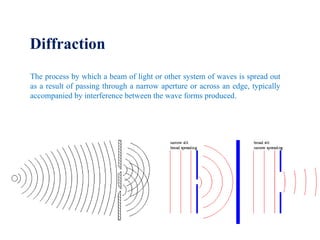
Diffraction
The process by which a beam of light or other system of waves is spread out
as a result of passing through a narrow aperture or across an edge, typically
accompanied by interference between the wave forms produced.
X Ray Diffraction
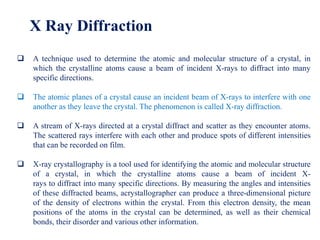
 A technique used to determine the atomic and molecular structure of a crystal, in
which the crystalline atoms cause a beam of incident X-rays to diffract into many
specific directions.
 The atomic planes of a crystal cause an incident beam of X-rays to interfere with one
another as they leave the crystal. The phenomenon is called X-ray diffraction.
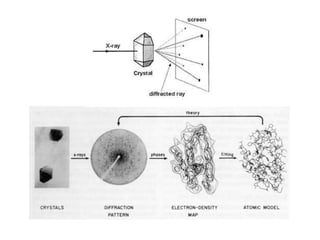
 A stream of X-rays directed at a crystal diffract and scatter as they encounter atoms.
The scattered rays interfere with each other and produce spots of different intensities
that can be recorded on film.
 X-ray crystallography is a tool used for identifying the atomic and molecular structure
of a crystal, in which the crystalline atoms cause a beam of incident X-
rays to diffract into many specific directions. By measuring the angles and intensities
of these diffracted beams, acrystallographer can produce a three-dimensional picture
of the density of electrons within the crystal. From this electron density, the mean
positions of the atoms in the crystal can be determined, as well as their chemical
bonds, their disorder and various other information.
Principles
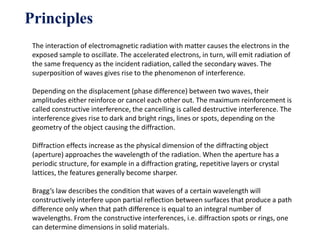
The interaction of electromagnetic radiation with matter causes the electrons in the
exposed sample to oscillate. The accelerated electrons, in turn, will emit radiation of
the same frequency as the incident radiation, called the secondary waves. The
superposition of waves gives rise to the phenomenon of interference.
Depending on the displacement (phase difference) between two waves, their
amplitudes either reinforce or cancel each other out. The maximum reinforcement is
called constructive interference, the cancelling is called destructive interference. The
interference gives rise to dark and bright rings, lines or spots, depending on the
geometry of the object causing the diffraction.
Diffraction effects increase as the physical dimension of the diffracting object
(aperture) approaches the wavelength of the radiation. When the aperture has a
periodic structure, for example in a diffraction grating, repetitive layers or crystal
lattices, the features generally become sharper.
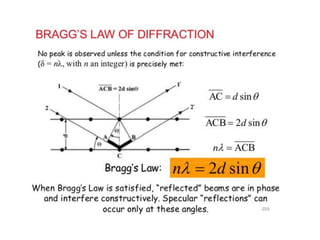
Bragg’s law describes the condition that waves of a certain wavelength will
constructively interfere upon partial reflection between surfaces that produce a path
difference only when that path difference is equal to an integral number of
wavelengths. From the constructive interferences, i.e. diffraction spots or rings, one
can determine dimensions in solid materials.
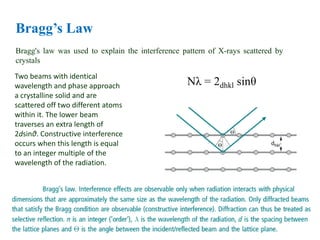
Two beams with identical
wavelength and phase approach
a crystalline solid and are
scattered off two different atoms
within it. The lower beam
traverses an extra length of
2dsinθ. Constructive interference
occurs when this length is equal
to an integer multiple of the
wavelength of the radiation.
Bragg’s Law
Bragg's law was used to explain the interference pattern of X-rays scattered by
crystals
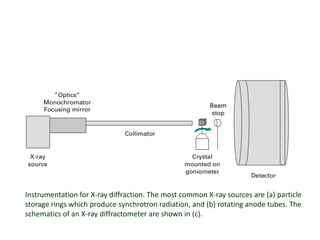
Instrumentation for X-ray diffraction. The most common X-ray sources are (a) particle
storage rings which produce synchrotron radiation, and (b) rotating anode tubes. The
schematics of an X-ray diffractometer are shown in (c).
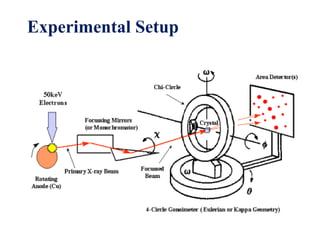
Experimental Setup
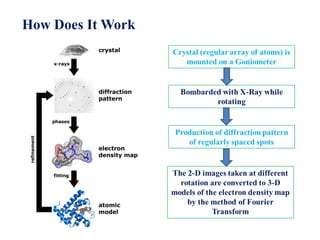
How Does It Work
Prabhakar singh  ii sem-paper v-x ray diffraction

Prabhakar singh ii sem-paper v-x ray diffraction

  • 1.
    TEJASVI NAVADHITAMASTU “Let our(the teacher and the taught) learning be radiant” Let our efforts at learning be luminous and filled with joy, and endowed with the force of purpose Paper V: Instrumentation and Analytical Techniques Dr. Prabhakar Singh. D.Phil. Biochemistry Department of Biochemistry, VBSPU, Jaunpur X-Ray Diffraction
  • 2.
    X-Ray Diffraction X Ray:An electromagnetic wave of high energy and very short wavelength (between ultraviolet light and gamma rays), which is able to pass through many materials opaque to light. Energy : 100 eV to 100keV Wavelength : 0.01 to 10 nanometer
  • 3.
    Diffraction The process bywhich a beam of light or other system of waves is spread out as a result of passing through a narrow aperture or across an edge, typically accompanied by interference between the wave forms produced.
  • 4.
    X Ray Diffraction A technique used to determine the atomic and molecular structure of a crystal, in which the crystalline atoms cause a beam of incident X-rays to diffract into many specific directions.  The atomic planes of a crystal cause an incident beam of X-rays to interfere with one another as they leave the crystal. The phenomenon is called X-ray diffraction.  A stream of X-rays directed at a crystal diffract and scatter as they encounter atoms. The scattered rays interfere with each other and produce spots of different intensities that can be recorded on film.  X-ray crystallography is a tool used for identifying the atomic and molecular structure of a crystal, in which the crystalline atoms cause a beam of incident X- rays to diffract into many specific directions. By measuring the angles and intensities of these diffracted beams, acrystallographer can produce a three-dimensional picture of the density of electrons within the crystal. From this electron density, the mean positions of the atoms in the crystal can be determined, as well as their chemical bonds, their disorder and various other information.
  • 5.
    Principles The interaction ofelectromagnetic radiation with matter causes the electrons in the exposed sample to oscillate. The accelerated electrons, in turn, will emit radiation of the same frequency as the incident radiation, called the secondary waves. The superposition of waves gives rise to the phenomenon of interference. Depending on the displacement (phase difference) between two waves, their amplitudes either reinforce or cancel each other out. The maximum reinforcement is called constructive interference, the cancelling is called destructive interference. The interference gives rise to dark and bright rings, lines or spots, depending on the geometry of the object causing the diffraction. Diffraction effects increase as the physical dimension of the diffracting object (aperture) approaches the wavelength of the radiation. When the aperture has a periodic structure, for example in a diffraction grating, repetitive layers or crystal lattices, the features generally become sharper. Bragg’s law describes the condition that waves of a certain wavelength will constructively interfere upon partial reflection between surfaces that produce a path difference only when that path difference is equal to an integral number of wavelengths. From the constructive interferences, i.e. diffraction spots or rings, one can determine dimensions in solid materials.
  • 6.
    Two beams withidentical wavelength and phase approach a crystalline solid and are scattered off two different atoms within it. The lower beam traverses an extra length of 2dsinθ. Constructive interference occurs when this length is equal to an integer multiple of the wavelength of the radiation. Bragg’s Law Bragg's law was used to explain the interference pattern of X-rays scattered by crystals
  • 8.
    Instrumentation for X-raydiffraction. The most common X-ray sources are (a) particle storage rings which produce synchrotron radiation, and (b) rotating anode tubes. The schematics of an X-ray diffractometer are shown in (c).
  • 9.
  • 10.