X-ray diffraction (XRD)
Dr. M. Sonia Angeline
ASSISTANT PROFESSOR
Kristu Jayanti College
INTRODUCTION
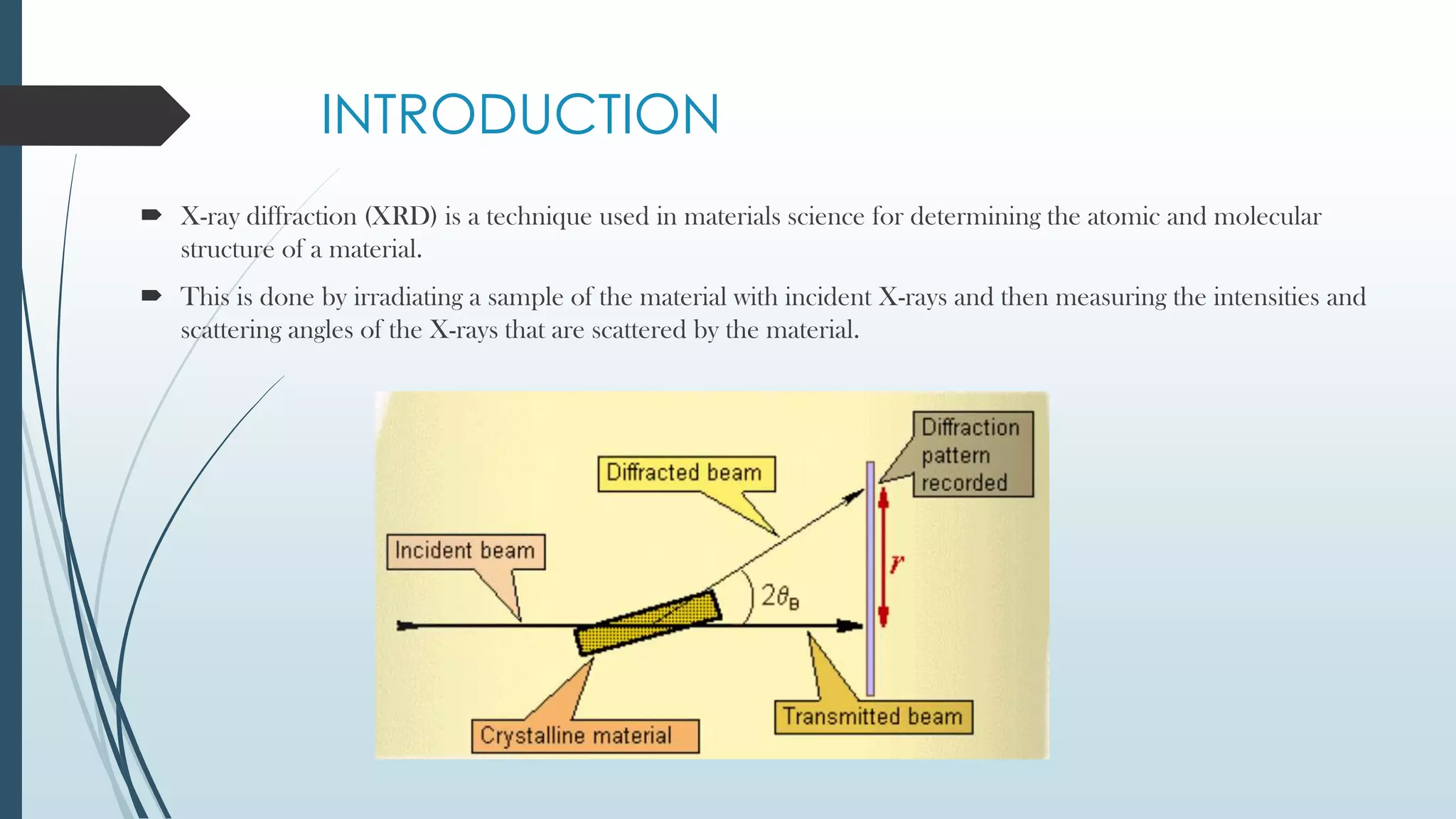
 X-ray diffraction (XRD) is a technique used in materials science for determining the atomic and molecular
structure of a material.
 This is done by irradiating a sample of the material with incident X-rays and then measuring the intensities and
scattering angles of the X-rays that are scattered by the material.
INTRODUCTION
 A primary use of XRD analysis is the identification of materials based on their diffraction pattern.
 As well as phase identification, XRD also yields information on how the actual structure deviates
from the ideal one, owing to internal stresses and defects.
 X-ray diffraction, a phenomenon in which the atoms of a crystal, by virtue of their uniform
spacing, cause an interference pattern of the waves present in an incident beam of X rays.
 The atomic planes of the crystal act on the X rays in exactly the same manner as does a uniformly
ruled grating on a beam of light.
 X-ray diffraction (XRD) relies on the dual wave/particle nature of X-rays to obtain information
about the structure of crystalline materials.
 A primary use of the technique is the identification and characterization of compounds based on
their diffraction pattern.
PRINCIPLE
 Max von Laue, in 1912, discovered that crystalline substances act as three-dimensional diffraction
gratings for X-ray wavelengths similar to the spacing of planes in a crystal lattice.
 X-ray diffraction is now a common technique for the study of crystal structures and atomic spacing.
 X-ray diffraction is based on constructive interference of monochromatic X-rays and a crystalline
sample.
 These X-rays are generated by a cathode ray tube, filtered to produce monochromatic radiation,
collimated to concentrate, and directed toward the sample.
 The interaction of the incident rays with the sample produces constructive interference (and a
diffracted ray) when conditions satisfy Bragg's Law (nλ=2d sin θ).
 This law relates the wavelength of electromagnetic radiation to the diffraction angle and the lattice
spacing in a crystalline sample.
PRINCIPLE
 These diffracted X-rays are then detected, processed and counted.
 By scanning the sample through a range of 2θangles, all possible diffraction
directions of the lattice should be attained due to the random orientation of the
powdered material.
 All diffraction methods are based on generation of X-rays in an X-ray tube.
 These X-rays are directed at the sample, and the diffracted rays are collected.
A key component of all diffraction is the angle between the incident and
diffracted rays.
PRINCIPLE
 The dominant effect that occurs when an incident beam of monochromatic X-rays interacts with a target material is
scattering of those X-rays from atoms within the target material.
 In materials with regular structure (i.e. crystalline), the scattered X-rays undergo constructive and destructive
interference.
 This is the process of diffraction. The diffraction of X-rays by crystals is described by Bragg’s Law, n(lambda) = 2d
sin(theta).
 The directions of possible diffractions depend on the size and shape of the unit cell of the material.
 The intensities of the diffracted waves depend on the kind and arrangement of atoms in the crystal structure.
 However, most materials are not single crystals, but are composed of many tiny crystallites in all possible orientations
called a polycrystalline aggregate or powder.
 When a powder with randomly oriented crystallites is placed in an X-ray beam, the beam will see all possible
interatomic planes. If the experimental angle is systematically changed, all possible diffraction peaks from the powder
will be detected.
Why XRD?
 Measure the average spacings between layers or rows of atoms
 Determine the orientation of a single crystal or grain
 Find the crystal structure of an unknown material
 Measure the size, shape and internal stress of small crystalline regions
INSTRUMENTATION
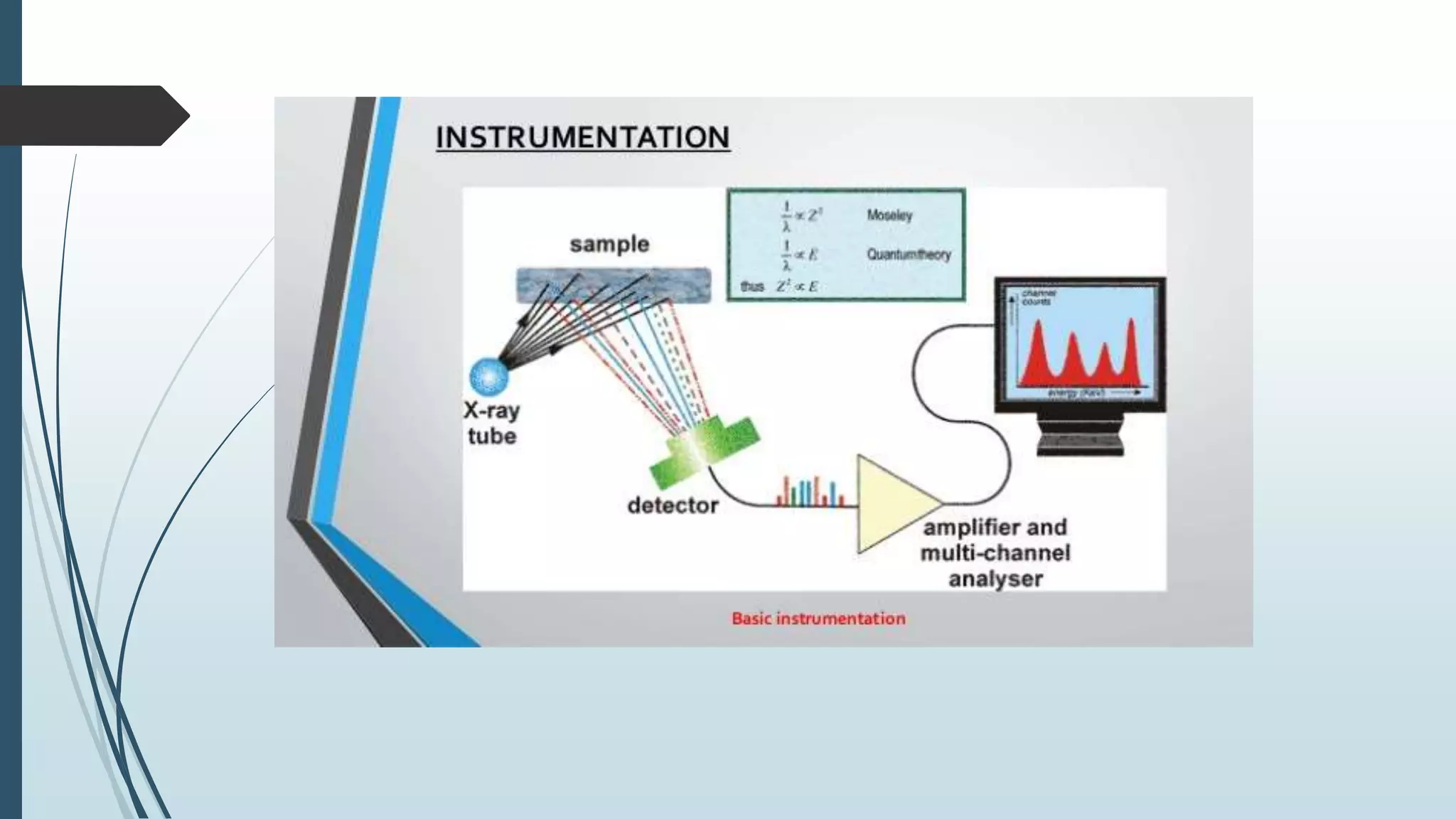
 X-ray diffractometers consist of three basic elements: an X-ray tube, a sample holder, and an X-ray detector.
 X-rays are generated in a cathode ray tube by heating a filament to produce electrons, accelerating the electrons
toward a target by applying a voltage, and bombarding the target material with electrons.
 When electrons have sufficient energy to dislodge inner shell electrons of the target material, characteristic X-ray
spectra are produced.
 Filtering, by foils or crystal monochrometers, is required to produce monochromatic X-rays needed for diffraction.
 These X-rays are collimated and directed onto the sample.
 As the sample and detector are rotated, the intensity of the reflected X-rays is recorded.
 When the geometry of the incident X-rays impinging the sample satisfies the Bragg Equation, constructive
interference occurs and a peak in intensity occurs.
 A detector records and processes this X-ray signal and converts the signal to a count rate which is then output to a
device such as a printer or computer monitor.
How Does it Work?
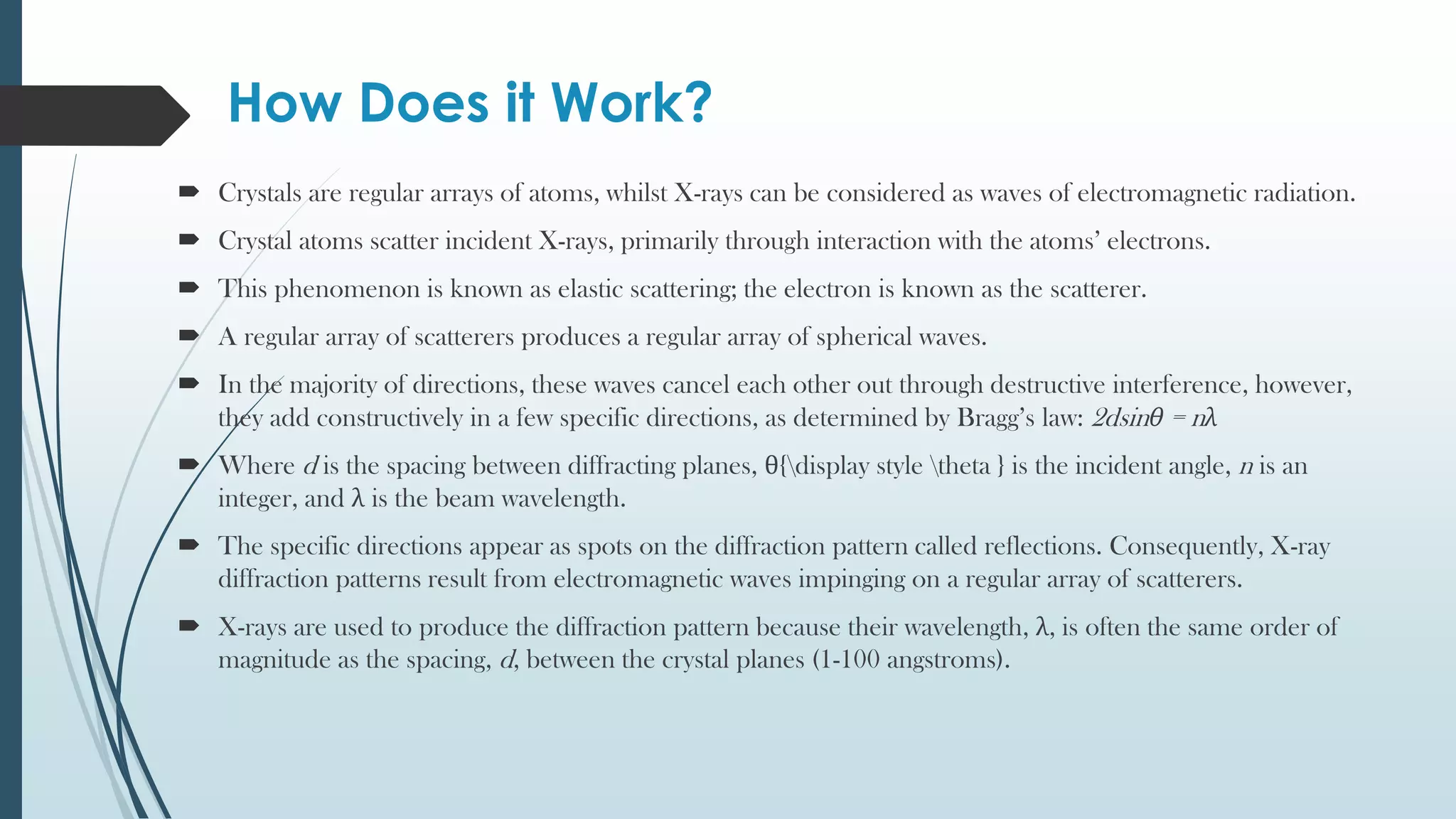
 Crystals are regular arrays of atoms, whilst X-rays can be considered as waves of electromagnetic radiation.
 Crystal atoms scatter incident X-rays, primarily through interaction with the atoms’ electrons.
 This phenomenon is known as elastic scattering; the electron is known as the scatterer.
 A regular array of scatterers produces a regular array of spherical waves.
 In the majority of directions, these waves cancel each other out through destructive interference, however,
they add constructively in a few specific directions, as determined by Bragg’s law: 2dsinθ = nλ
 Where d is the spacing between diffracting planes, θ{display style theta } is the incident angle, n is an
integer, and λ is the beam wavelength.
 The specific directions appear as spots on the diffraction pattern called reflections. Consequently, X-ray
diffraction patterns result from electromagnetic waves impinging on a regular array of scatterers.
 X-rays are used to produce the diffraction pattern because their wavelength, λ, is often the same order of
magnitude as the spacing, d, between the crystal planes (1-100 angstroms).
APPLICATIONS
 Determination of unknown solids is critical to studies in geology, environmental science, material science, engineering and
biology.Other applications include:
 characterization of crystalline materials
 identification of fine-grained minerals such as clays and mixed layer clays that are difficult to determine optically
 determination of unit cell dimensions
 measurement of sample purity
 With specialized techniques, XRD can be used to:determine crystal structures using Rietveld refinement
 determine of modal amounts of minerals (quantitative analysis)
 characterize thin films samples by:
 determining lattice mismatch between film and substrate and to inferring stress and strain
 determining dislocation density and quality of the film by rocking curve measurements
 measuring superlattices in multilayered epitaxial structures
 determining the thickness, roughness and density of the film using glancing incidence X-ray reflectivity measurements
XRD Benefits and Applications
 XRD is a non-destructive technique used to [2]:
 Identify crystalline phases and orientation
 Determine structural properties:
- Lattice parameters
- Strain
- Grain size
- Epitaxy- type of crystal growth or material deposition in which new crystalline layers
- Phase composition
- Preferred orientation
 Measure thickness of thin films and multi-layers
 Determine atomic arrangement
Crystallography
INTRODUCTION
 A crystal consists of a periodic arrangement of the unit cell into a lattice.
 The unit cell can contain a single atom or atoms in a fixed arrangement.
 Crystals consist of planes of atoms that are spaced a distance d apart, but can be resolved into many atomic
planes, each with a different d spacing.
 a,b and c (length) and α, β and γ angles between a,b and c are lattice constants or parameters which can be
determined by XRD.
 Crystallography is the science that examines crystals, which can be found everywhere in nature—from salt to
snowflakes to gemstones.
 Crystallographers use the properties and inner structures of crystals to determine the arrangement of atoms
and generate knowledge that is used by chemists, physicists, biologists, and others.
WORKING
 X-ray crystallography (XRC) is the experimental science determining the atomic and molecular structure of a crystal, in
which the crystalline structure causes a beam of incident X-rays to diffract into many specific directions.
 By measuring the angles and intensities of these diffracted beams, a crystallographer can produce a three-dimensional
picture of the density of electrons within the crystal.
 From this electron density, the mean positions of the atoms in the crystal can be determined, as well as their chemical
bonds, their crystallographic disorder, and various other information.
 X-ray crystallography is still the primary method for characterizing the atomic structure of new materials and in
discerning materials that appear similar by other experiments.
 X-ray crystal structures can also account for unusual electronic or elastic properties of a material, shed light on chemical
interactions and processes, or serve as the basis for designing pharmaceuticals against diseases.
 In a single-crystal X-ray diffraction measurement, a crystal is mounted on a goniometer. The goniometer is used to
position the crystal at selected orientations.
 The crystal is illuminated with a finely focused monochromatic beam of X-rays, producing a diffraction pattern of
regularly spaced spots known as reflections.
 The two-dimensional images taken at different orientations are converted into a three-dimensional model of the
density of electrons within the crystal using the mathematical method of Fourier transforms, combined with
chemical data known for the sample.
 Poor resolution (fuzziness) or even errors may result if the crystals are too small, or not uniform enough in their
internal makeup.
 Crystallographers use X-ray, neutron, and electron diffraction techniques to identify and characterize solid
materials.
 They commonly bring in information from other analytical techniques, including X-ray fluorescence, spectroscopic
techniques, microscopic imaging, and computer modeling and visualization to construct detailed models of the
atomic arrangements in solids.
APPLICATIONS
 The pharmaceutical and biochemical fields rely extensively on crystallographic studies.
 Proteins and other biological materials (including viruses) may be crystallized to aid in studying their
structures and composition.
 Many important pharmaceuticals are administered in crystalline form, and detailed descriptions of
their crystal structures provide evidence to verify claims in patents.
 This provides valuable information on a material's chemical makeup, polymorphic form, defects or
disorder, and electronic properties.
 It also sheds light on how solids perform under temperature, pressure, and stress conditions.
https://www.youtube.com/watch?v=QHMzFUo0NL8

X ray diffraction

  • 1.
    X-ray diffraction (XRD) Dr.M. Sonia Angeline ASSISTANT PROFESSOR Kristu Jayanti College
  • 2.
    INTRODUCTION  X-ray diffraction(XRD) is a technique used in materials science for determining the atomic and molecular structure of a material.  This is done by irradiating a sample of the material with incident X-rays and then measuring the intensities and scattering angles of the X-rays that are scattered by the material.
  • 3.
    INTRODUCTION  A primaryuse of XRD analysis is the identification of materials based on their diffraction pattern.  As well as phase identification, XRD also yields information on how the actual structure deviates from the ideal one, owing to internal stresses and defects.  X-ray diffraction, a phenomenon in which the atoms of a crystal, by virtue of their uniform spacing, cause an interference pattern of the waves present in an incident beam of X rays.  The atomic planes of the crystal act on the X rays in exactly the same manner as does a uniformly ruled grating on a beam of light.  X-ray diffraction (XRD) relies on the dual wave/particle nature of X-rays to obtain information about the structure of crystalline materials.  A primary use of the technique is the identification and characterization of compounds based on their diffraction pattern.
  • 4.
    PRINCIPLE  Max vonLaue, in 1912, discovered that crystalline substances act as three-dimensional diffraction gratings for X-ray wavelengths similar to the spacing of planes in a crystal lattice.  X-ray diffraction is now a common technique for the study of crystal structures and atomic spacing.  X-ray diffraction is based on constructive interference of monochromatic X-rays and a crystalline sample.  These X-rays are generated by a cathode ray tube, filtered to produce monochromatic radiation, collimated to concentrate, and directed toward the sample.  The interaction of the incident rays with the sample produces constructive interference (and a diffracted ray) when conditions satisfy Bragg's Law (nλ=2d sin θ).  This law relates the wavelength of electromagnetic radiation to the diffraction angle and the lattice spacing in a crystalline sample.
  • 5.
    PRINCIPLE  These diffractedX-rays are then detected, processed and counted.  By scanning the sample through a range of 2θangles, all possible diffraction directions of the lattice should be attained due to the random orientation of the powdered material.  All diffraction methods are based on generation of X-rays in an X-ray tube.  These X-rays are directed at the sample, and the diffracted rays are collected. A key component of all diffraction is the angle between the incident and diffracted rays.
  • 6.
    PRINCIPLE  The dominanteffect that occurs when an incident beam of monochromatic X-rays interacts with a target material is scattering of those X-rays from atoms within the target material.  In materials with regular structure (i.e. crystalline), the scattered X-rays undergo constructive and destructive interference.  This is the process of diffraction. The diffraction of X-rays by crystals is described by Bragg’s Law, n(lambda) = 2d sin(theta).  The directions of possible diffractions depend on the size and shape of the unit cell of the material.  The intensities of the diffracted waves depend on the kind and arrangement of atoms in the crystal structure.  However, most materials are not single crystals, but are composed of many tiny crystallites in all possible orientations called a polycrystalline aggregate or powder.  When a powder with randomly oriented crystallites is placed in an X-ray beam, the beam will see all possible interatomic planes. If the experimental angle is systematically changed, all possible diffraction peaks from the powder will be detected.
  • 7.
    Why XRD?  Measurethe average spacings between layers or rows of atoms  Determine the orientation of a single crystal or grain  Find the crystal structure of an unknown material  Measure the size, shape and internal stress of small crystalline regions
  • 8.
    INSTRUMENTATION  X-ray diffractometersconsist of three basic elements: an X-ray tube, a sample holder, and an X-ray detector.  X-rays are generated in a cathode ray tube by heating a filament to produce electrons, accelerating the electrons toward a target by applying a voltage, and bombarding the target material with electrons.  When electrons have sufficient energy to dislodge inner shell electrons of the target material, characteristic X-ray spectra are produced.  Filtering, by foils or crystal monochrometers, is required to produce monochromatic X-rays needed for diffraction.  These X-rays are collimated and directed onto the sample.  As the sample and detector are rotated, the intensity of the reflected X-rays is recorded.  When the geometry of the incident X-rays impinging the sample satisfies the Bragg Equation, constructive interference occurs and a peak in intensity occurs.  A detector records and processes this X-ray signal and converts the signal to a count rate which is then output to a device such as a printer or computer monitor.
  • 10.
    How Does itWork?  Crystals are regular arrays of atoms, whilst X-rays can be considered as waves of electromagnetic radiation.  Crystal atoms scatter incident X-rays, primarily through interaction with the atoms’ electrons.  This phenomenon is known as elastic scattering; the electron is known as the scatterer.  A regular array of scatterers produces a regular array of spherical waves.  In the majority of directions, these waves cancel each other out through destructive interference, however, they add constructively in a few specific directions, as determined by Bragg’s law: 2dsinθ = nλ  Where d is the spacing between diffracting planes, θ{display style theta } is the incident angle, n is an integer, and λ is the beam wavelength.  The specific directions appear as spots on the diffraction pattern called reflections. Consequently, X-ray diffraction patterns result from electromagnetic waves impinging on a regular array of scatterers.  X-rays are used to produce the diffraction pattern because their wavelength, λ, is often the same order of magnitude as the spacing, d, between the crystal planes (1-100 angstroms).
  • 11.
    APPLICATIONS  Determination ofunknown solids is critical to studies in geology, environmental science, material science, engineering and biology.Other applications include:  characterization of crystalline materials  identification of fine-grained minerals such as clays and mixed layer clays that are difficult to determine optically  determination of unit cell dimensions  measurement of sample purity  With specialized techniques, XRD can be used to:determine crystal structures using Rietveld refinement  determine of modal amounts of minerals (quantitative analysis)  characterize thin films samples by:  determining lattice mismatch between film and substrate and to inferring stress and strain  determining dislocation density and quality of the film by rocking curve measurements  measuring superlattices in multilayered epitaxial structures  determining the thickness, roughness and density of the film using glancing incidence X-ray reflectivity measurements
  • 12.
    XRD Benefits andApplications  XRD is a non-destructive technique used to [2]:  Identify crystalline phases and orientation  Determine structural properties: - Lattice parameters - Strain - Grain size - Epitaxy- type of crystal growth or material deposition in which new crystalline layers - Phase composition - Preferred orientation  Measure thickness of thin films and multi-layers  Determine atomic arrangement
  • 13.
  • 14.
    INTRODUCTION  A crystalconsists of a periodic arrangement of the unit cell into a lattice.  The unit cell can contain a single atom or atoms in a fixed arrangement.  Crystals consist of planes of atoms that are spaced a distance d apart, but can be resolved into many atomic planes, each with a different d spacing.  a,b and c (length) and α, β and γ angles between a,b and c are lattice constants or parameters which can be determined by XRD.  Crystallography is the science that examines crystals, which can be found everywhere in nature—from salt to snowflakes to gemstones.  Crystallographers use the properties and inner structures of crystals to determine the arrangement of atoms and generate knowledge that is used by chemists, physicists, biologists, and others.
  • 15.
    WORKING  X-ray crystallography(XRC) is the experimental science determining the atomic and molecular structure of a crystal, in which the crystalline structure causes a beam of incident X-rays to diffract into many specific directions.  By measuring the angles and intensities of these diffracted beams, a crystallographer can produce a three-dimensional picture of the density of electrons within the crystal.  From this electron density, the mean positions of the atoms in the crystal can be determined, as well as their chemical bonds, their crystallographic disorder, and various other information.  X-ray crystallography is still the primary method for characterizing the atomic structure of new materials and in discerning materials that appear similar by other experiments.  X-ray crystal structures can also account for unusual electronic or elastic properties of a material, shed light on chemical interactions and processes, or serve as the basis for designing pharmaceuticals against diseases.  In a single-crystal X-ray diffraction measurement, a crystal is mounted on a goniometer. The goniometer is used to position the crystal at selected orientations.
  • 16.
     The crystalis illuminated with a finely focused monochromatic beam of X-rays, producing a diffraction pattern of regularly spaced spots known as reflections.  The two-dimensional images taken at different orientations are converted into a three-dimensional model of the density of electrons within the crystal using the mathematical method of Fourier transforms, combined with chemical data known for the sample.  Poor resolution (fuzziness) or even errors may result if the crystals are too small, or not uniform enough in their internal makeup.  Crystallographers use X-ray, neutron, and electron diffraction techniques to identify and characterize solid materials.  They commonly bring in information from other analytical techniques, including X-ray fluorescence, spectroscopic techniques, microscopic imaging, and computer modeling and visualization to construct detailed models of the atomic arrangements in solids.
  • 17.
    APPLICATIONS  The pharmaceuticaland biochemical fields rely extensively on crystallographic studies.  Proteins and other biological materials (including viruses) may be crystallized to aid in studying their structures and composition.  Many important pharmaceuticals are administered in crystalline form, and detailed descriptions of their crystal structures provide evidence to verify claims in patents.  This provides valuable information on a material's chemical makeup, polymorphic form, defects or disorder, and electronic properties.  It also sheds light on how solids perform under temperature, pressure, and stress conditions. https://www.youtube.com/watch?v=QHMzFUo0NL8