Relaxation in NMR Rebecca Marsh
This presentation can also be found at  www.reachforthesky.com A more complete text by James Keeler (from which some of these  images were taken) can be found online at  http://www-keeler.ch.cam.ac.uk/lectures
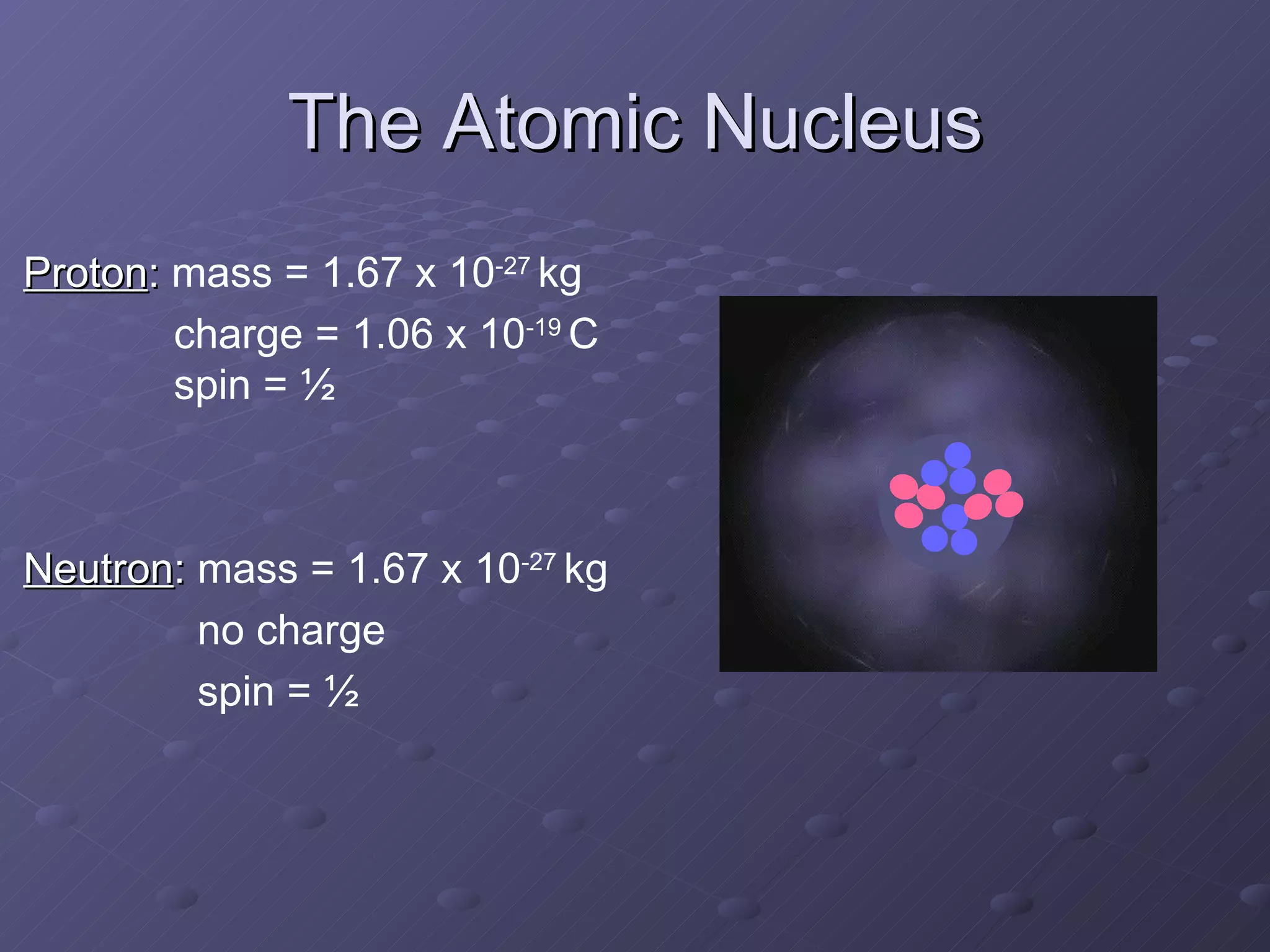
The Atomic Nucleus Proton :  mass = 1.67 x 10 -27  kg   charge = 1.06 x 10 -19  C      spin = ½ Neutron :  mass = 1.67 x 10 -27  kg   no charge     spin = ½
The Atomic Nucleus Proton :  mass = 1.67 x 10 -27  kg   charge = 1.06 x 10 -19  C       spin = +½   made up of 3 quarks  (2 up, 1 down) Neutron :  mass = 1.67 x 10 -27  kg   no charge     spin = ½   made up of 3 quarks  (1 up, 2 down) Q D Q U Q U proton
What  is  Spin?? classical mechanics :  spin  is the rotation of a body about its own center of mass quantum mechanics :  spin  refers not to rotation but to the  presence  of angular momentum. For particles that cannot be broken down into smaller subunits  spin  is an inherent physical characteristic, just like mass or charge.
Nuclear Spin An unpaired neutron or proton will have non-zero spin. Therefore, there is an angular momentum,  m  (aka the magnetic quantum number)   m  approximately represents the direction of the angular momentum vector. m  ranges from –  l  to +  l , in integer steps, where  l  is the azimuthal quantum number. m : spin angular momentum h : Planck’s constant γ : gyromagnetic ratio
Magnetic Resonance
Magnetic Resonance transition energy
Magnetic Resonance α β transition energy
Relaxation Relaxation describes how a spin returns to equilibrium. * There is no transverse magnetization * There is no phase coherence * The distribution of spins follows the Boltzmann Distribution:
Relaxation Two types of relaxation Longitudinal relaxation: along the axis of the external magnetic field Transverse relaxation: perpendicular to the external magnetic field
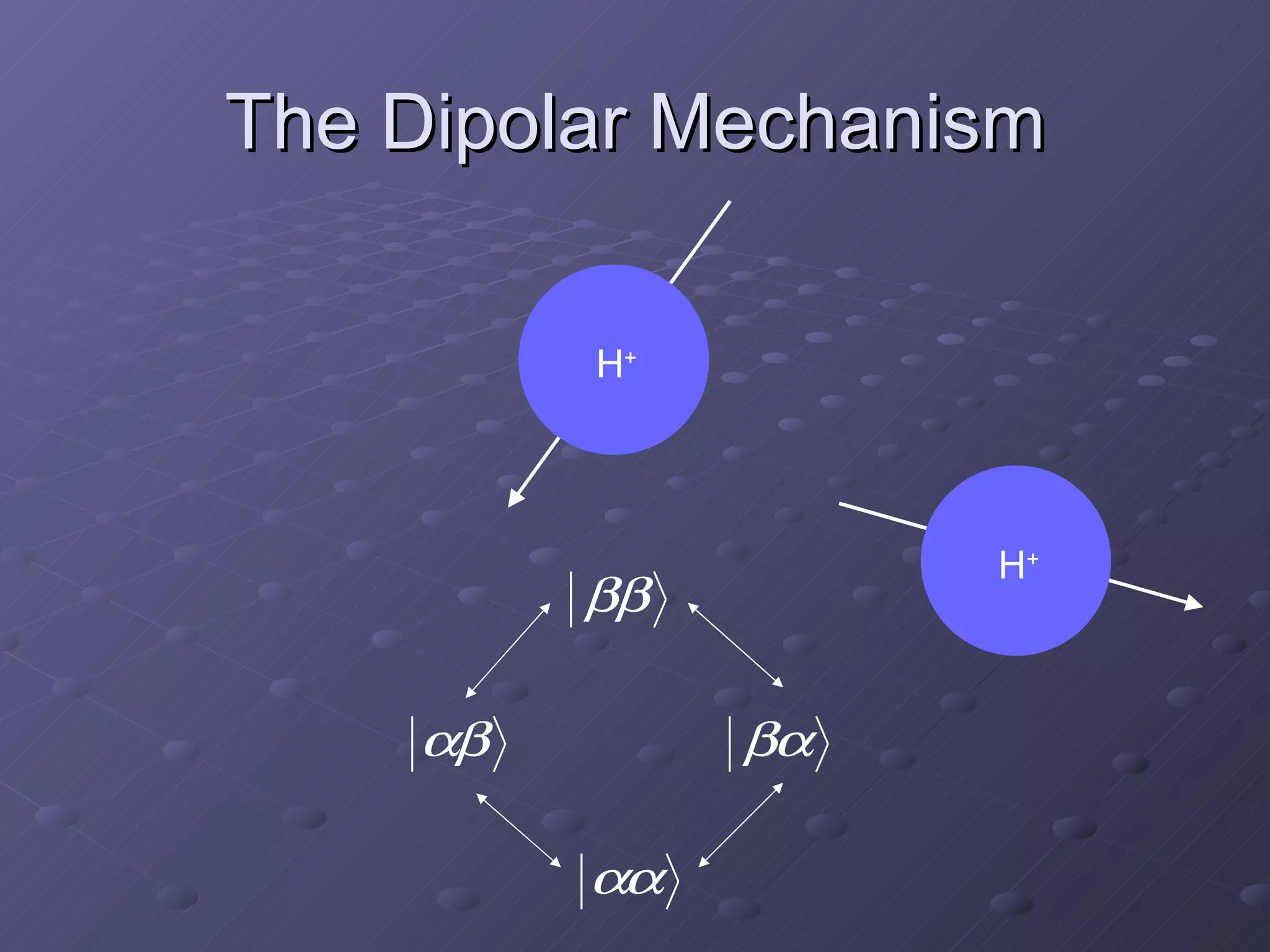
What Causes Relaxation? Magnetic fields are generated within the sample, from  1) spins interacting with other spins 2) spins interacting with the surrounding environment
Transverse ( spin-lattice )   Relaxation
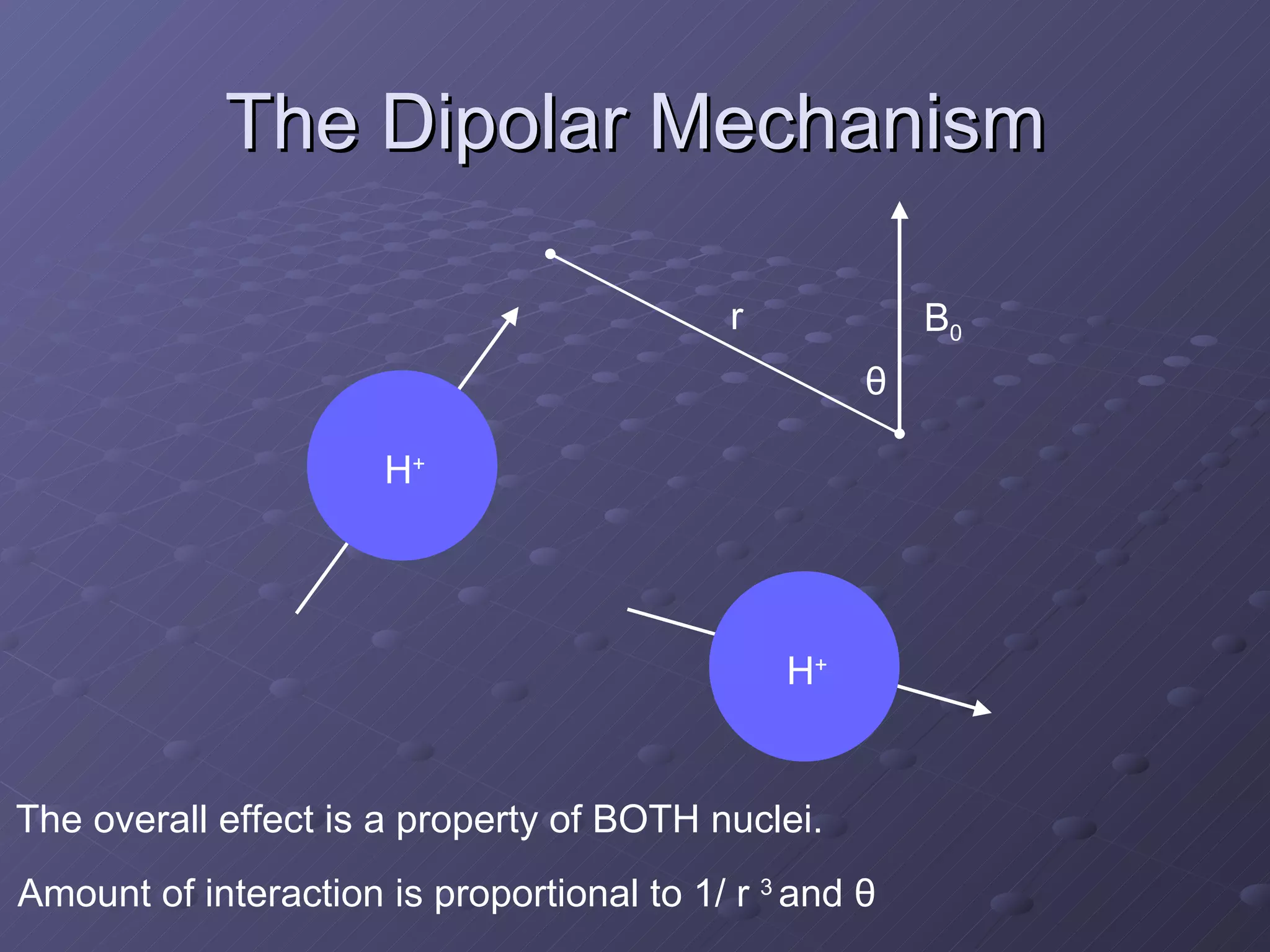
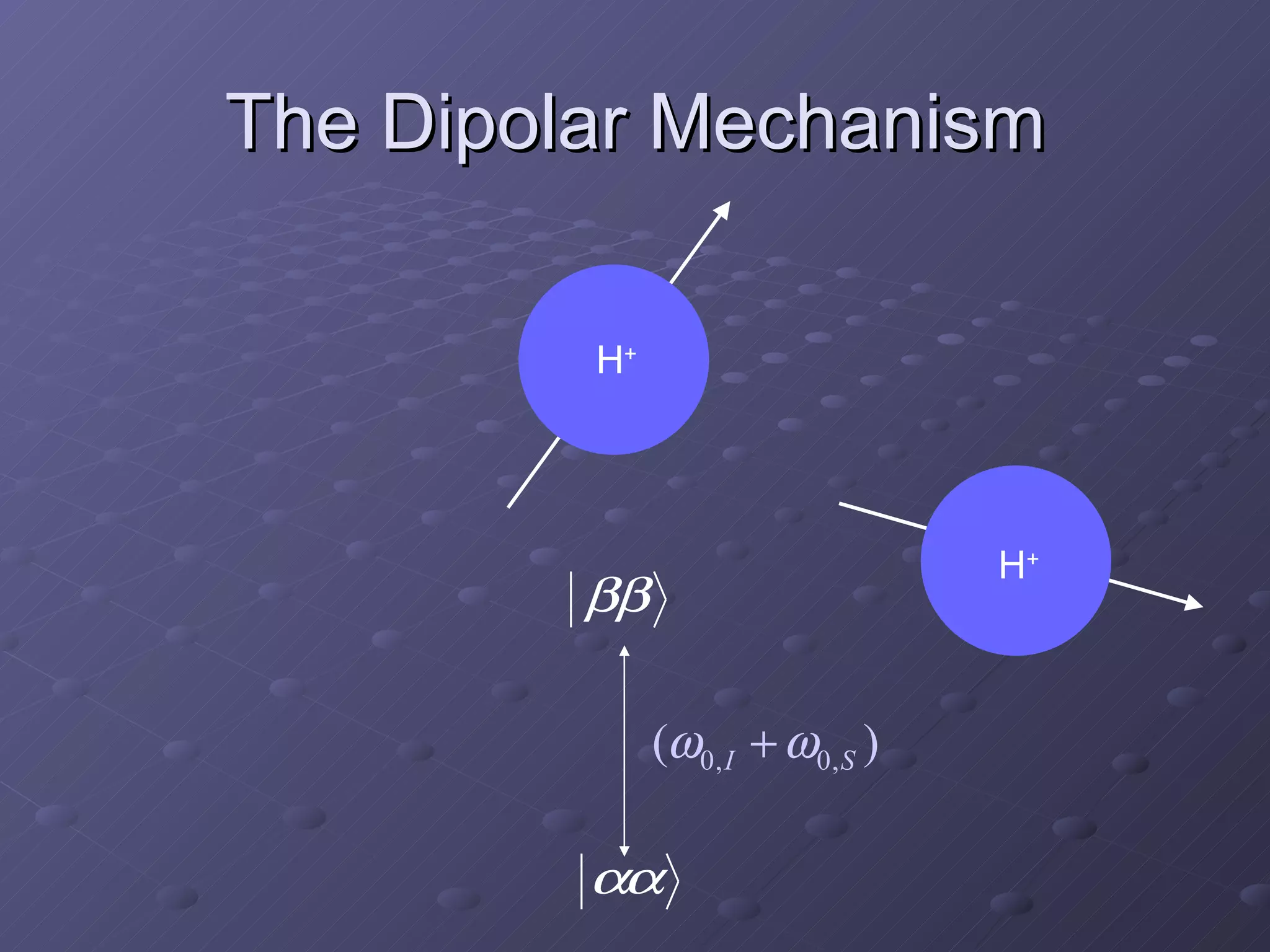
The Dipolar Mechanism H + The overall effect is a property of BOTH nuclei. H + r Amount of interaction is proportional to 1/ r  3  and  θ B 0 θ
The Dipolar Mechanism H + H +
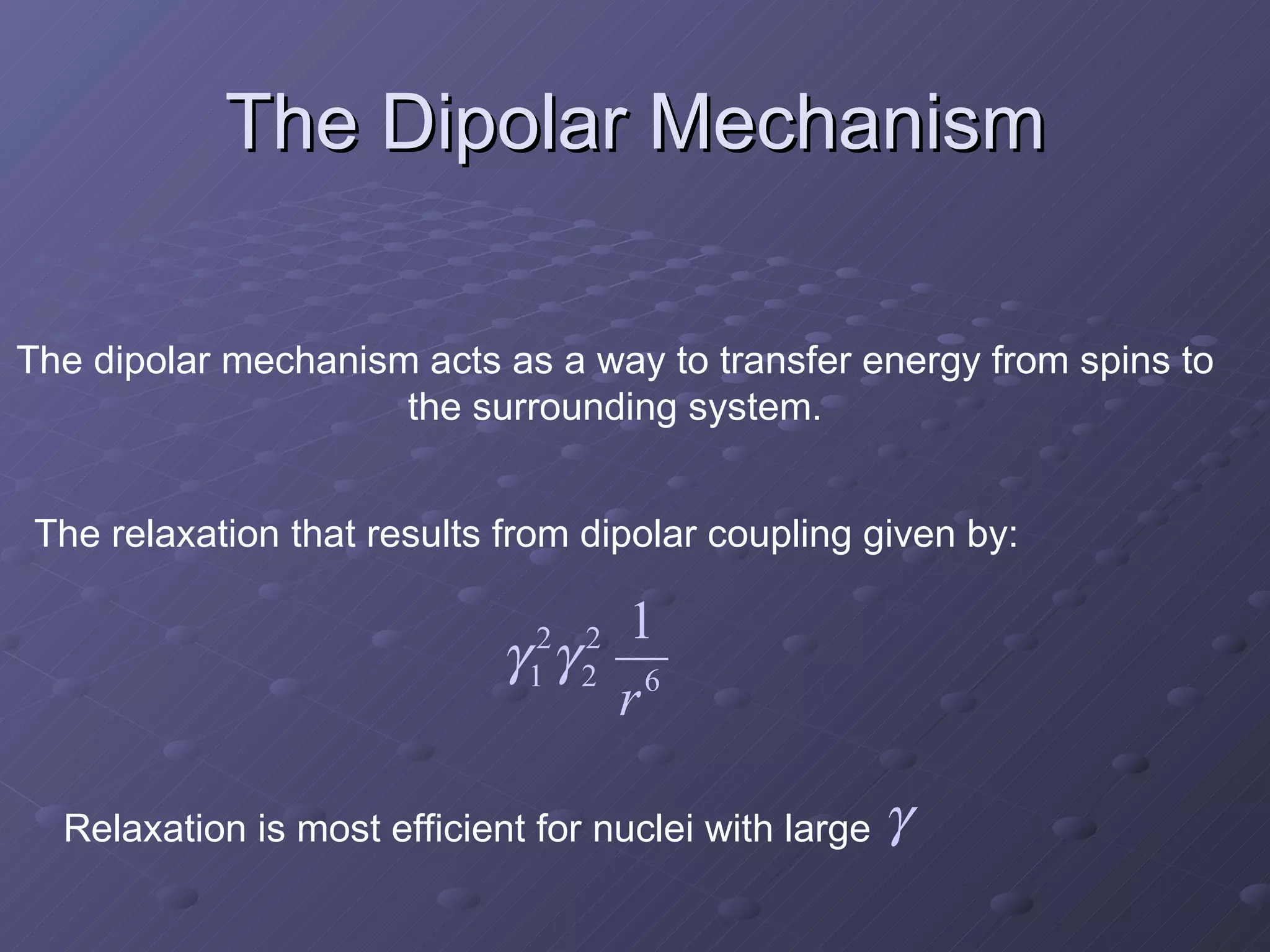
The Dipolar Mechanism The dipolar mechanism acts as a way to transfer energy from spins to the surrounding system. The relaxation that results from dipolar coupling given by: Relaxation is most efficient for nuclei with large
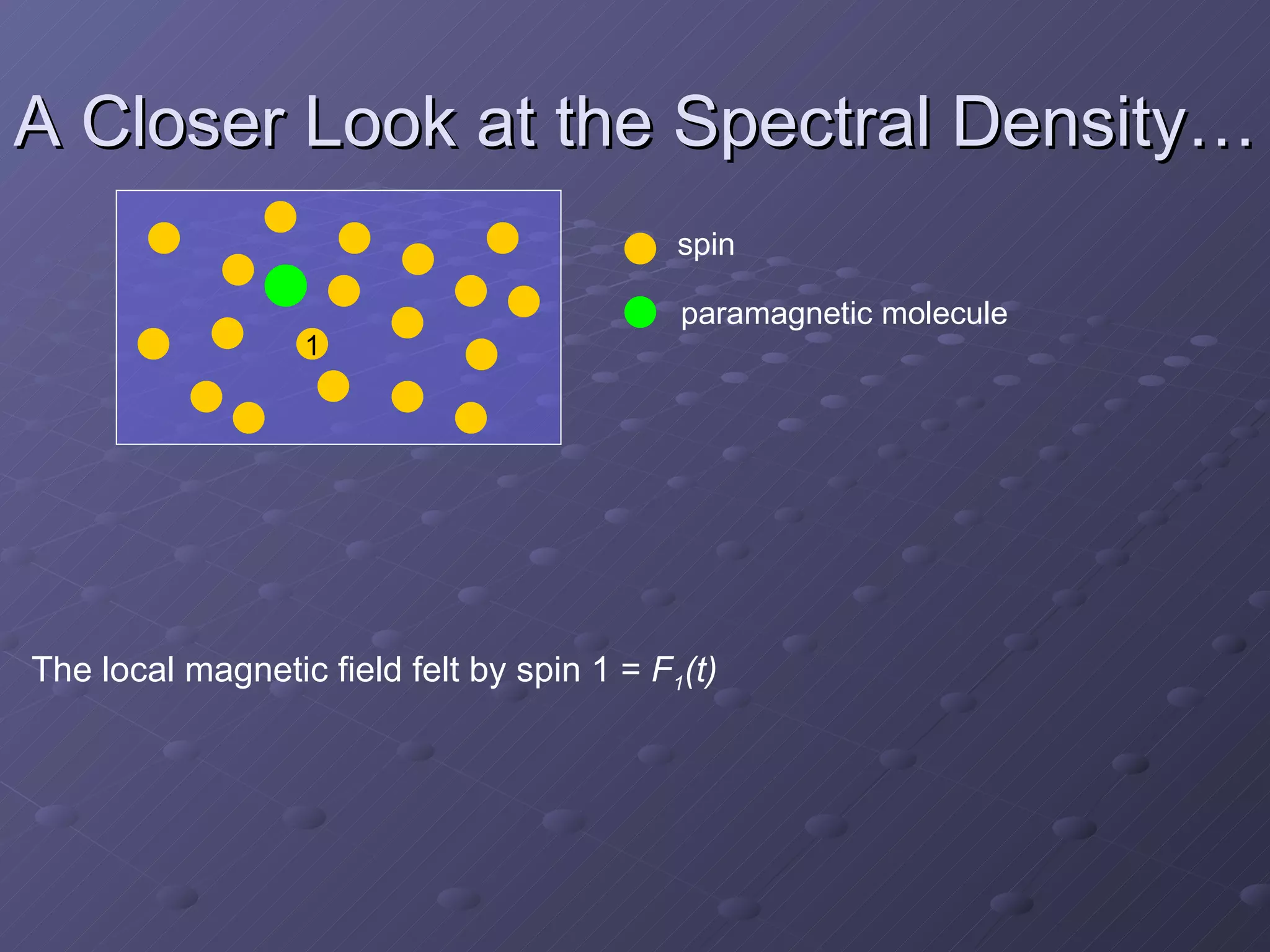
A Closer Look at the Spectral Density… spin paramagnetic molecule
A Closer Look at the Spectral Density… spin paramagnetic molecule The local magnetic field felt by spin 1 =  F 1 (t) 1
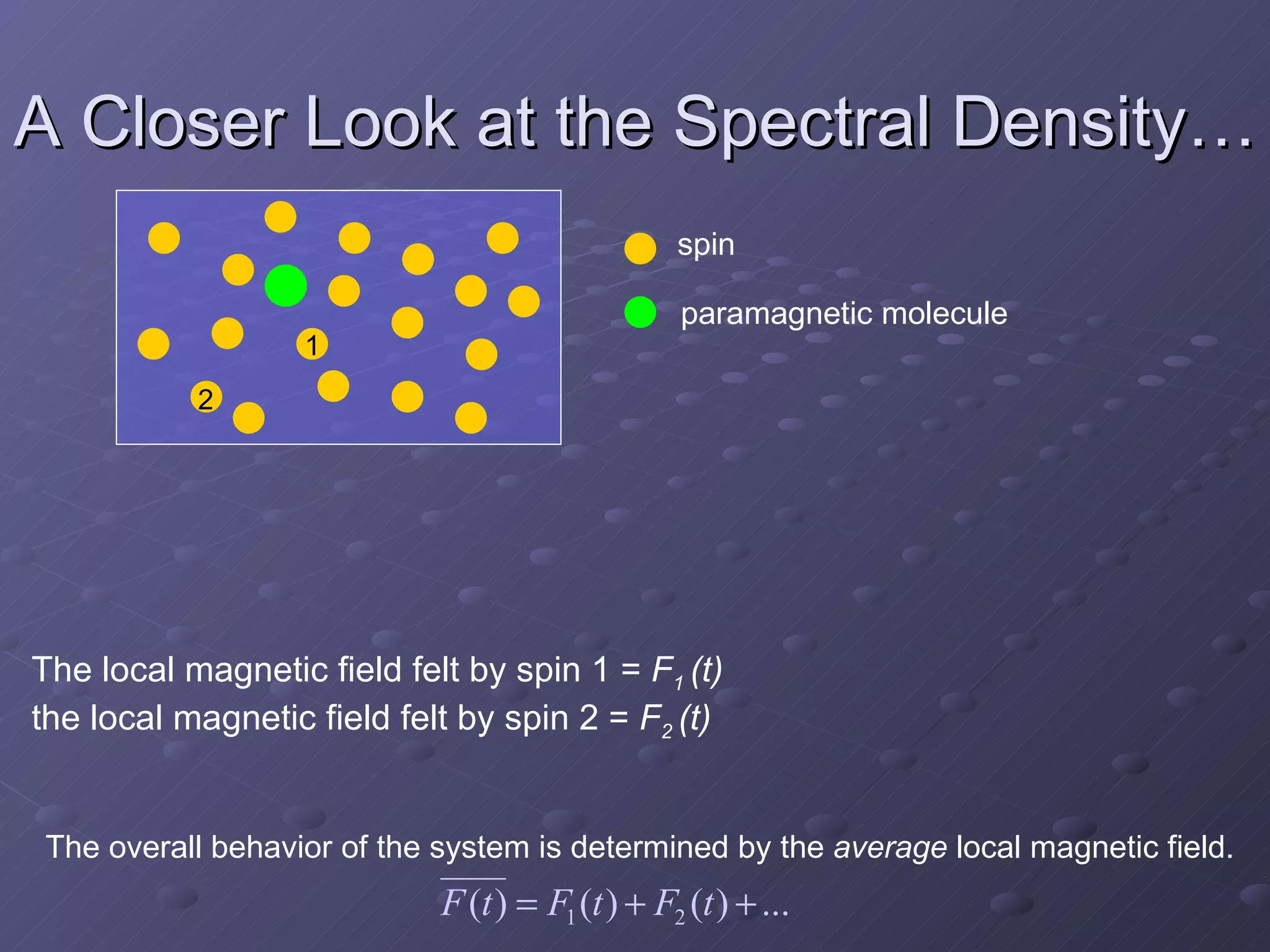
A Closer Look at the Spectral Density… spin paramagnetic molecule 1 2 The local magnetic field felt by spin 1 =  F 1  (t) the local magnetic field felt by spin 2 =  F 2  (t) The overall behavior of the system is determined by the  average  local magnetic field.
A Closer Look at the Spectral Density… spin paramagnetic molecule 1 2 The local magnetic field felt by spin 1 =  F 1  (t) The local magnetic field at time  t+ τ   , the magnetic field felt by spin 1 =  F 1 (t +  τ )
A Closer Look at the Spectral Density… spin paramagnetic molecule 1 2 If  is very small, then  and  As  gets longer, the spin will have diffused a larger distance, and  may be positive or negative.  In the limit of very large  ,  approaches zero.
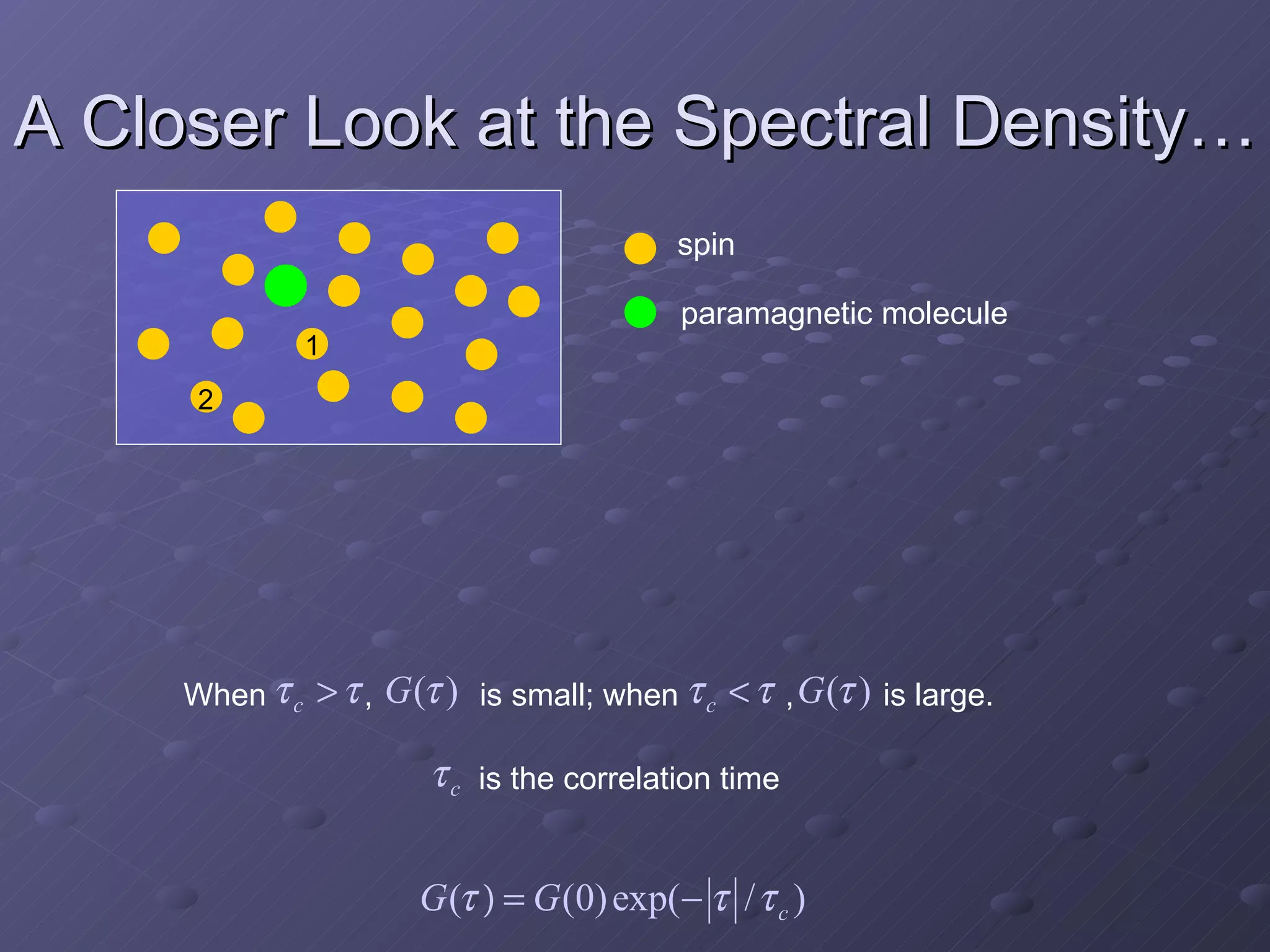
A Closer Look at the Spectral Density… spin paramagnetic molecule 1 2 is the correlation time When  ,  is small; when  ,  is large.
A Closer Look at the Spectral Density… indicates the amount of motion present at different frequencies.
A Closer Look at the Spectral Density… large small At a given frequency  , the spectral density is highest when
Relaxation… In order to cause a single spin to relax, the local spectral density must be equal to the Larmor frequency,  At a given frequency  , the spectral density is highest when
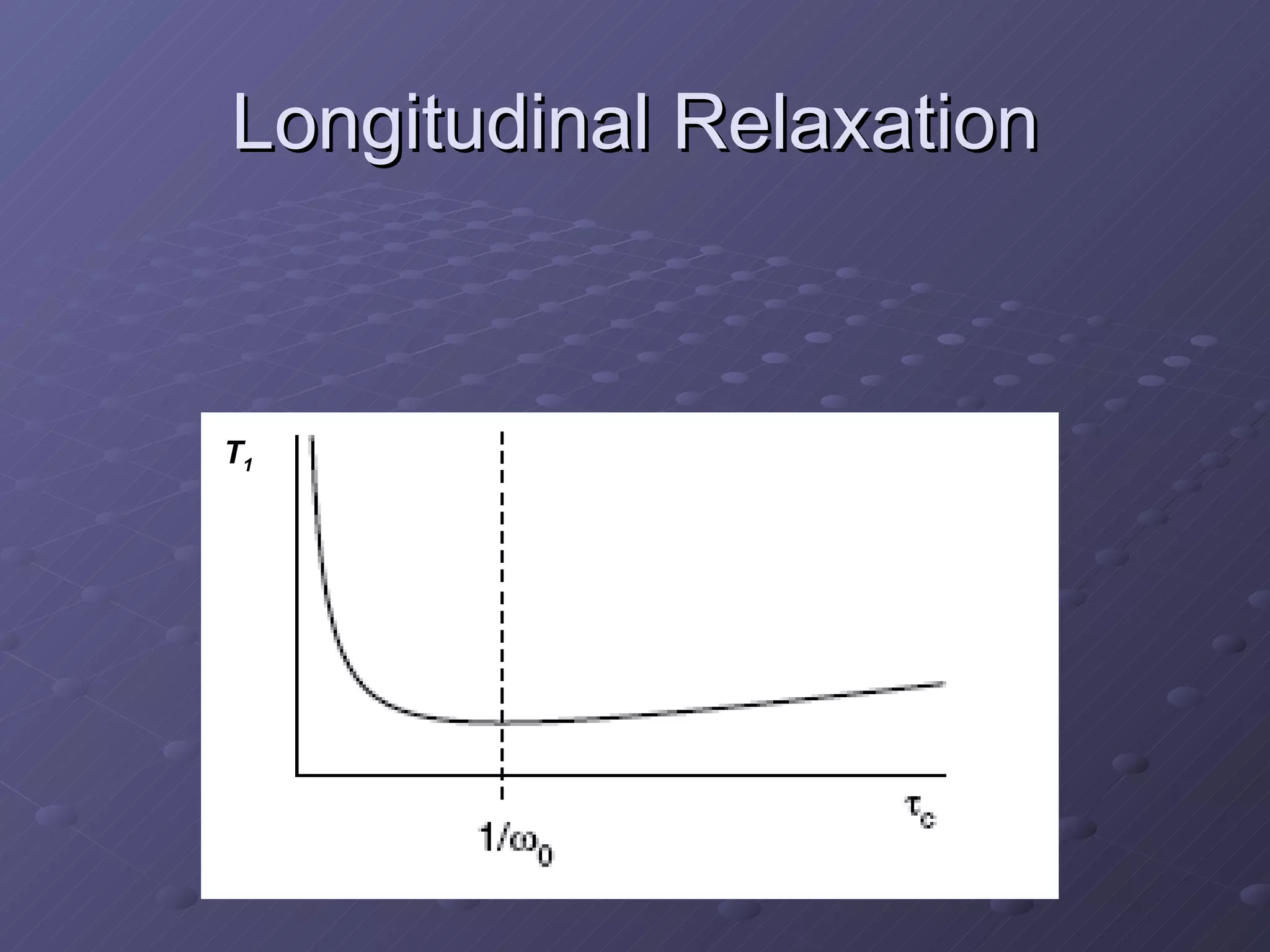
Relaxation… In order to cause a single spin to relax, the local spectral density must be equal to the Larmor frequency,  At a given frequency  , the spectral density is highest when  T 1
Longitudinal Relaxation T 1
Why does T 1  vary by tissue? From www.revisemri.com T 1  of fat ~ 250ms ; T 1  of CSF ~ 2000ms “ free” water:   pure water, rapidly moving     tumbling frequency >  “ structured” water :  bound to macromolecules     tumbling frequency ~  “ bound” water: motion restricted by a double bond     tumbling frequency <
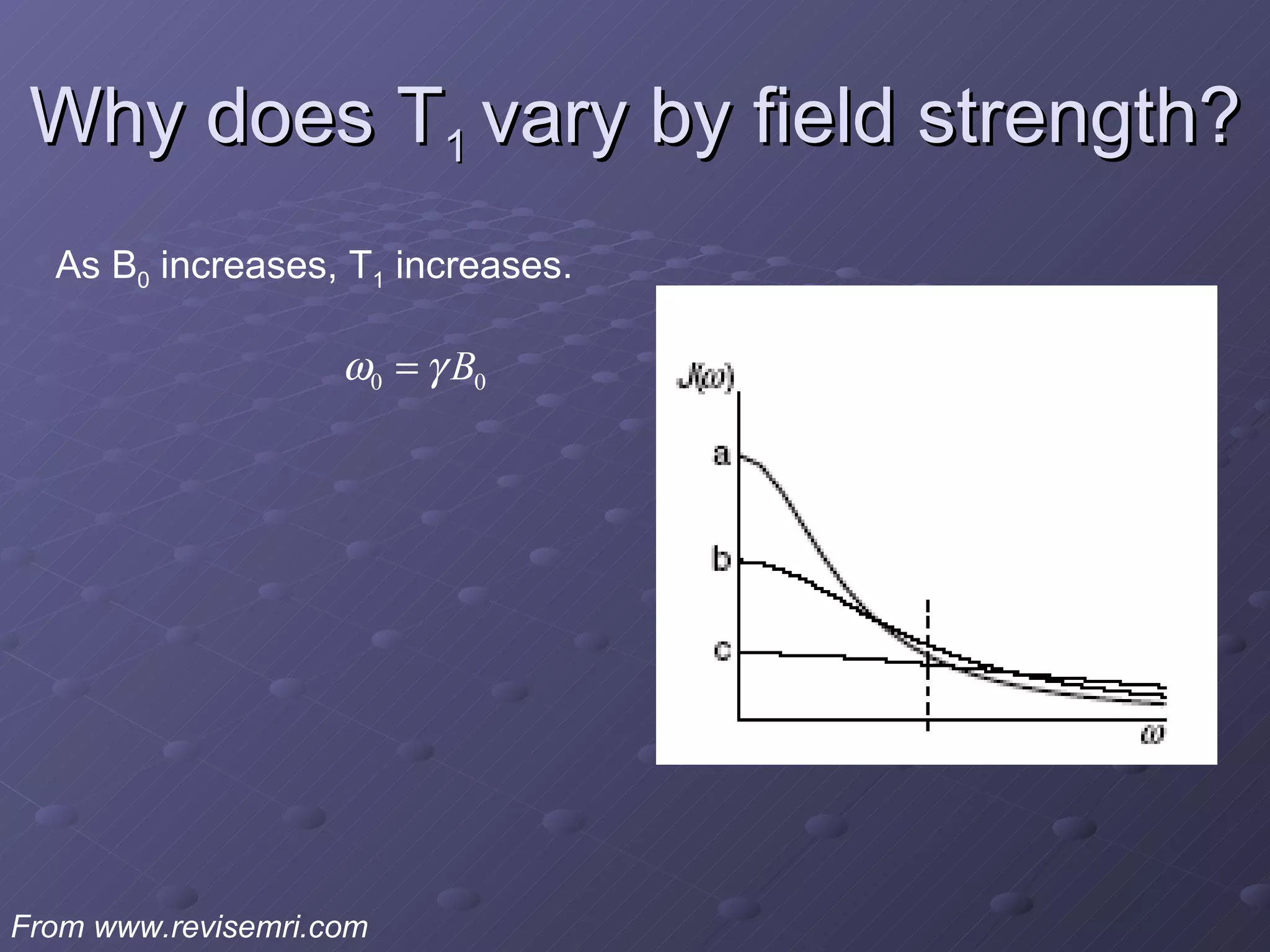
Why does T 1  vary by field strength? From www.revisemri.com As B 0  increases, T 1  increases.
Why do contrast agents affect T 1  ? From www.revisemri.com Increasing the amount of oscillations at the Larmor frequency increases relaxation. Gd  3+  has 7 unpaired electrons, each of which interacts with the external magnetic field.
Transverse ( spin-spin ) Relaxation random phase phase coherence MR pulse relaxation disappearing phase coherence
Transverse Relaxation disappearing phase coherence Transverse relaxation can be caused by anything that destroys the  phase coherence: 1) Local oscillating fields (from transitions between energy states) (This also causes longitudinal relaxation!) 2) Differences in local magnetic fields (not oscillations) which cause them to precess at different Larmor frequencies
Transverse Relaxation 2) Differences in local magnetic fields (not oscillations) which cause them to precess at different Larmor frequencies
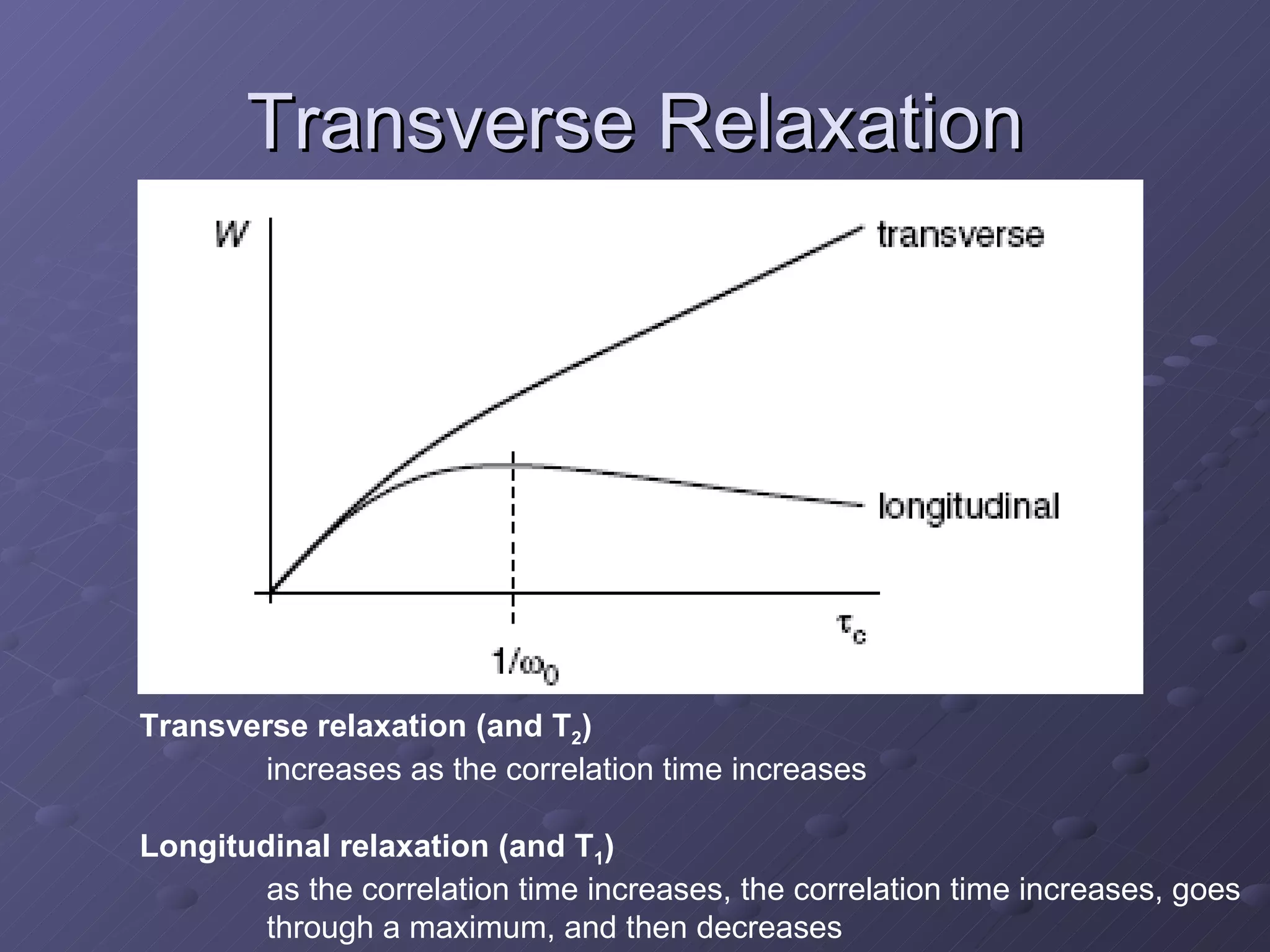
Transverse Relaxation Transverse relaxation (and T 2 ) increases as the correlation time increases Longitudinal relaxation (and T 1 ) as the correlation time increases, the correlation time increases, goes through a maximum, and then decreases
Questions? (please be nice…)
Quantum Mechanical Notations There are 4 sets of Quantum Numbers.  These describe the energies of electrons in the atom. principal quantum number azimuthal quantum number magnetic quantum number denotes the energy levels available in a subshell spin quantum number

Relaxation in NMR

  • 1.
    Relaxation in NMRRebecca Marsh
  • 2.
    This presentation canalso be found at www.reachforthesky.com A more complete text by James Keeler (from which some of these images were taken) can be found online at http://www-keeler.ch.cam.ac.uk/lectures
  • 3.
    The Atomic NucleusProton : mass = 1.67 x 10 -27 kg charge = 1.06 x 10 -19 C spin = ½ Neutron : mass = 1.67 x 10 -27 kg no charge spin = ½
  • 4.
    The Atomic NucleusProton : mass = 1.67 x 10 -27 kg charge = 1.06 x 10 -19 C spin = +½ made up of 3 quarks (2 up, 1 down) Neutron : mass = 1.67 x 10 -27 kg no charge spin = ½ made up of 3 quarks (1 up, 2 down) Q D Q U Q U proton
  • 5.
    What is Spin?? classical mechanics : spin is the rotation of a body about its own center of mass quantum mechanics : spin refers not to rotation but to the presence of angular momentum. For particles that cannot be broken down into smaller subunits spin is an inherent physical characteristic, just like mass or charge.
  • 6.
    Nuclear Spin Anunpaired neutron or proton will have non-zero spin. Therefore, there is an angular momentum, m (aka the magnetic quantum number) m approximately represents the direction of the angular momentum vector. m ranges from – l to + l , in integer steps, where l is the azimuthal quantum number. m : spin angular momentum h : Planck’s constant γ : gyromagnetic ratio
  • 7.
  • 8.
  • 9.
    Magnetic Resonance αβ transition energy
  • 10.
    Relaxation Relaxation describeshow a spin returns to equilibrium. * There is no transverse magnetization * There is no phase coherence * The distribution of spins follows the Boltzmann Distribution:
  • 11.
    Relaxation Two typesof relaxation Longitudinal relaxation: along the axis of the external magnetic field Transverse relaxation: perpendicular to the external magnetic field
  • 12.
    What Causes Relaxation?Magnetic fields are generated within the sample, from 1) spins interacting with other spins 2) spins interacting with the surrounding environment
  • 13.
  • 14.
    The Dipolar MechanismH + The overall effect is a property of BOTH nuclei. H + r Amount of interaction is proportional to 1/ r 3 and θ B 0 θ
  • 15.
  • 16.
  • 17.
  • 18.
  • 19.
    The Dipolar MechanismThe dipolar mechanism acts as a way to transfer energy from spins to the surrounding system. The relaxation that results from dipolar coupling given by: Relaxation is most efficient for nuclei with large
  • 20.
    A Closer Lookat the Spectral Density… spin paramagnetic molecule
  • 21.
    A Closer Lookat the Spectral Density… spin paramagnetic molecule The local magnetic field felt by spin 1 = F 1 (t) 1
  • 22.
    A Closer Lookat the Spectral Density… spin paramagnetic molecule 1 2 The local magnetic field felt by spin 1 = F 1 (t) the local magnetic field felt by spin 2 = F 2 (t) The overall behavior of the system is determined by the average local magnetic field.
  • 23.
    A Closer Lookat the Spectral Density… spin paramagnetic molecule 1 2 The local magnetic field felt by spin 1 = F 1 (t) The local magnetic field at time t+ τ , the magnetic field felt by spin 1 = F 1 (t + τ )
  • 24.
    A Closer Lookat the Spectral Density… spin paramagnetic molecule 1 2 If is very small, then and As gets longer, the spin will have diffused a larger distance, and may be positive or negative. In the limit of very large , approaches zero.
  • 25.
    A Closer Lookat the Spectral Density… spin paramagnetic molecule 1 2 is the correlation time When , is small; when , is large.
  • 26.
    A Closer Lookat the Spectral Density… indicates the amount of motion present at different frequencies.
  • 27.
    A Closer Lookat the Spectral Density… indicates the amount of motion present at different frequencies.
  • 28.
    A Closer Lookat the Spectral Density… large small At a given frequency , the spectral density is highest when
  • 29.
    Relaxation… In orderto cause a single spin to relax, the local spectral density must be equal to the Larmor frequency, At a given frequency , the spectral density is highest when
  • 30.
    Relaxation… In orderto cause a single spin to relax, the local spectral density must be equal to the Larmor frequency, At a given frequency , the spectral density is highest when T 1
  • 31.
  • 32.
    Why does T1 vary by tissue? From www.revisemri.com T 1 of fat ~ 250ms ; T 1 of CSF ~ 2000ms “ free” water: pure water, rapidly moving  tumbling frequency > “ structured” water : bound to macromolecules  tumbling frequency ~ “ bound” water: motion restricted by a double bond  tumbling frequency <
  • 33.
    Why does T1 vary by field strength? From www.revisemri.com As B 0 increases, T 1 increases.
  • 34.
    Why do contrastagents affect T 1 ? From www.revisemri.com Increasing the amount of oscillations at the Larmor frequency increases relaxation. Gd 3+ has 7 unpaired electrons, each of which interacts with the external magnetic field.
  • 35.
    Transverse ( spin-spin) Relaxation random phase phase coherence MR pulse relaxation disappearing phase coherence
  • 36.
    Transverse Relaxation disappearingphase coherence Transverse relaxation can be caused by anything that destroys the phase coherence: 1) Local oscillating fields (from transitions between energy states) (This also causes longitudinal relaxation!) 2) Differences in local magnetic fields (not oscillations) which cause them to precess at different Larmor frequencies
  • 37.
    Transverse Relaxation 2)Differences in local magnetic fields (not oscillations) which cause them to precess at different Larmor frequencies
  • 38.
    Transverse Relaxation Transverserelaxation (and T 2 ) increases as the correlation time increases Longitudinal relaxation (and T 1 ) as the correlation time increases, the correlation time increases, goes through a maximum, and then decreases
  • 39.
  • 40.
    Quantum Mechanical NotationsThere are 4 sets of Quantum Numbers. These describe the energies of electrons in the atom. principal quantum number azimuthal quantum number magnetic quantum number denotes the energy levels available in a subshell spin quantum number